Showing posts with label Taiwan history. Show all posts

Monday, November 14, 2016

Map of all the historical sites in Taiwan that have been burned down

What's this a map of? Historical sites in Taiwan that have burned down. The fire icon represents a fire, the laughing ghost total destruction, the ghost facing you, arson (the Wiki site it is based on is here).

The latest in mysterious fires to historical sites in Taiwan occurred last week when a 1920s era Japanese government building in Taichung burned. LTN documents.

In 2013, after yet another mysterious fire, this time at a historical site at NTU, the Taipei Times observed:
Despite a denial from NTU secretary-general Chang Pei-jen (張培仁), the blaze, reported at 12:24am, has raised some eyebrows amid rumors that developers have been eyeing the plot for a development project.

While police, who have not ruled out arson, investigate the cause of the fire, relevant government agencies should take a more active role to better preserve and care for the nation’s many old buildings and landmarks that are rich in Taiwanese culture and history.

The public has good reason to be worried, considering the slew of news reports that suggest cultural and historical sites are being pushed aside to make way for development.

Last month, New Taipei City’s (新北市) Yingge District (鶯歌) — known as the birthplace of the nation’s pottery and ceramics industry — saw a 90-year-old oval-shaped kiln and its smokestack knocked down by a construction company, which owns the site, as well as another square-shaped kiln and its brick-built chimney that had stood for more than 50 years. The area, once dotted with more than 300 high-rise kiln smokestacks, is now left with fewer than a score of them.

Reports of similar demolitions of buildings and houses with historical value have also shocked and saddened many local residents, historians and cultural preservationists, as in the case of demolitions of Japanese colonial era kilns carried out by the Miaoli County Government for urban development projects and in Taichung, where a 114-year-old house was torn down by excavators in the middle of the night.

Sporadic cases of historical houses consumed by fire have also occurred, the causes of which remain unsolved to this day.
These fires appear to be linked to developers, who either want to force the site to go up for sale, or to force occupants out. This paper notes:
According to the statistics of fire occurrence, 52 fire events happened in Taiwan’s cultural heritages and historical buildings from the 1970s to 2014. Among them, the highest proportion of fire causes is arson (33%) and the second largest is electrical fire (27%), as shown in Figure 1.
Another source puts the arson count at 41%. Recall that it is not difficult for a skilled arsonist to make a fire seem like an electrical fire. Not all arson cases are developer-related, some are simply madmen or personal. In a few cases it is not the fire that destroys the buildings, but the firemen -- many older wooden structures can't take the force of water from fire hoses. Such fires not only destroy the historical sites, but in Taipei's cramped residential areas, they often take nearby buildings as well. Indeed, the tiny winding lanes surrounding them make it nearly impossible to save smaller historic sites in case of fire.

One such case was the Aug 4, 2005 arson attack on a temple site in Taipei, the Xi Ben Yuan. After the site burned down for the first time in 1975 (also thought to be arson), it was occupied by squatters and the usual collection of shops and vendors, quickly becoming a living community. The Taipei city government offered the site for sale but no one wanted it, then they rezoned it under "urban renewal" laws and tried again, to no avail. Finally they decided to treat it as a park and plaza and began removing the squatters. During this process, it was discovered that parts of the old temple had survived, and preservationists moved in. The site quickly became the topic of urban legends -- it had been an execution ground in 2-28 rumored some, and in another, it was the home of a Japanese treasure stash. Neither was true, but a mining company applied for a permit to excavate the site.

It was eventually designated a historical site. As scholars and preservationists worked to reconstruct the site, on Aug 4, 2005, it was struck by arson. The fire burned the lecture hall. At that point, it was -- probably not coincidentally -- mooted that the historical site designation be removed. Fortunately, the lecture hall had a solid brick structure and could be rebuilt. Incredibly, when the building burnt in 1975, someone had carried off the old bell from the bell tower to preserve it, and 30 years later, it was returned.

Many of these fires never make the news....
_______________________
Don't miss the comments below! And check out my blog and its sidebars for events, links to previous posts and picture posts, and scores of links to other Taiwan blogs and forums!

Friday, January 08, 2016

Bu Dai Xi: Origins?

Politics_68
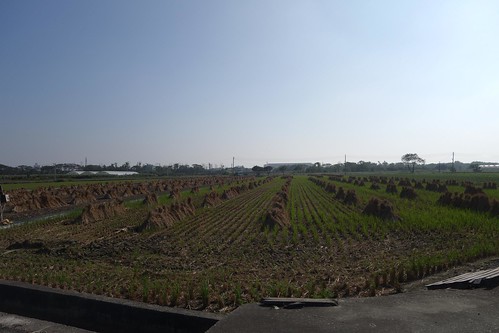
Haystacks in Chiayi

From "Puppets and Cultural Identity in Taiwan", Jean-Luc Penso, pp 169-178. In Objects, Heritage, and Cultural Identity, edited by Muyard, Frank, Chou Liang-kai, and Dreyer, Serge. Taiwan Historica, 2009:
The first use of puppets was for divinatory purposes but their use became more secular over the centuries. Puppets played an essential role in the creation of the most respected and secular Chinese opera, since the art of puppets actually initiated opera. Many facts corroborate this argument. For example, the actors' gestures and particularly, the way they walk are not natural, but copy a puppet's movements. Another example is to be found in the way actors call puppeteers "Master", while a puppeteer would not have to show this form of respect to an actor.

According to Jacques Pampaneau, a specialist in Chinese theater, the glove puppets called "po-te-hi" in Taiwanese or "budaixi" (布岱戲) in Mandarin are believed to have come from India by the maritime route (Pimpaneau 1977). The name for glove puppets in Sanskrit is "pu ta li", close to "po-te-hi" and "budaixi", but once again, nothing is certain regarding this possible influence.
_______________________
Don't miss the comments below! And check out my blog and its sidebars for events, links to previous posts and picture posts, and scores of links to other Taiwan blogs and forums!
Sunday, October 11, 2015

Then and Now: Zhongshan Green Bridge

National historic monuments of Taiwan sent around this view of Japanese-era Taichung across the bridge on what is now Zhongshan Road, the 新盛橋.

Today the buildings are gone, but the bridge, designated a historical monument in 2004, is still there, now known as the 中山綠橋 (location). According to Wiki, the bridge was built in 1908 to commemorate the completion of the north-south rail line. You can still see the ball atop the concrete railing on the bridge.
_______________________
Don't miss the comments below! And check out my blog and its sidebars for events, links to previous posts and picture posts, and scores of links to other Taiwan blogs and forums!

Sunday, June 21, 2015

Then and Now: Shuishe Village at Sun Moon Lake

National Historic Monuments of Taiwan on Facebook sent around a pic of Shuishe village from Sun Moon Lake in the late 1920s or 1930s, it looks like. Shuishe is on the north side of the lake and is now occupied by big hotels, including the Lalu Sun Moon Lake, and a pier. Today it looks like this, from Streetview:
The hills are still visible on the right side, but of course the village is gone.

Interestingly, a friend pointed out to me, the Japanese English versions all refer to the aboriginal villages as "savage" villages in English, but the Japanese language uses the term used today in Chinese, buluo, which does not appear to have that connotation. Part of the Japanese project for Taiwan was emphasizing their own "civilizing" mission by heightening the difference between the Japanese and aborigines and reducing the status of the aborigines; this was particularly true of representations to outsiders.
_______________________
Don't miss the comments below! And check out my blog and its sidebars for events, links to previous posts and picture posts, and scores of links to other Taiwan blogs and forums!

Thursday, March 12, 2015

1945 US maps of Japanese airfields in Taiwan

These were sent around Facebook. Originally posted by John Gong.
_______________________
Don't miss the comments below! And check out my blog and its sidebars for events, links to previous posts and picture posts, and scores of links to other Taiwan blogs and forums!

Sunday, March 08, 2015

Blast from the Past: Byoritsu oil refinery, Miaoli, 26 May, 1945

Wiki says:
Scope and content: Spectacular crash at Byoritsu oil refinery, Formosa, was photographed by a B-25 of the 5th Air Force's 345th Bomb Group on 26 May 1945. Just as it released its string of parafrags B-25 NO. 192 was hit by flak from a camouflaged battery and trails smoke. A gaping hole is visible on the piolot's side.

General notes: The aircraft visible is the North American B-25J-10-NC Mitchell (s/n 43-36192) "Jaunty Jo". Crew : 2/Lt Robert J. Knauf Pilot, 2/Lt Martin H. Mulner Jr. Co-Pilot, 1/Lt Lloyd E. Bodell Navigator, Cpl Harold O. Montville Eng/Gunner, Sgt Tennyson C. Harrell Radio/Gunner.
Taiwan Airpower Blog has the background and story, along with more photos of the crash, and then and now photos.
_______________________
Don't miss the comments below! And check out my blog and its sidebars for events, links to previous posts and picture posts, and scores of links to other Taiwan blogs and forums!

Tuesday, December 23, 2014

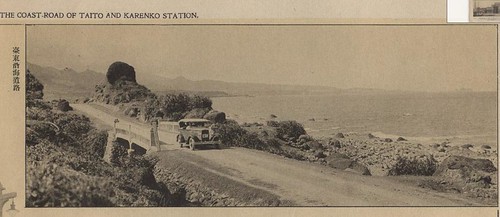
Then and Now: the old Japanese Coast Road

taitocoast
I was trawling around the East Asia Image Collection again today, the Taiwan Photographic Monthly, and found this image of the old Japanese coast road. I stopped for a moment, thinking... I've seen this spot.

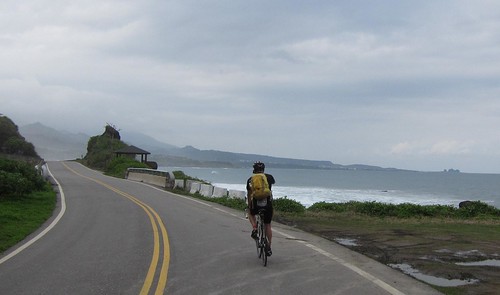
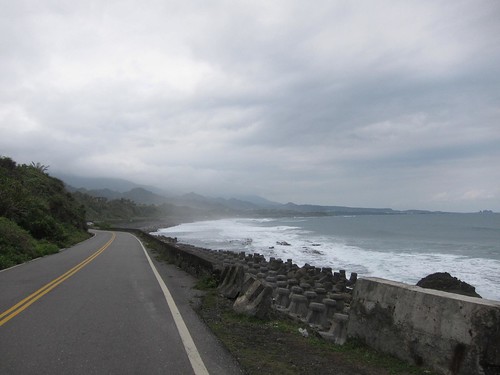
Sure enough, back in March of this year I came down for a weekend of riding on the rift valley and the coast and got a shot of my man Drew Kerslake riding the old Japanese coast road. The old Japanese coast road is now the Baonon bike path on the coast in Chenggong township (it is designated the Dong 19). It's a slightly different angle, and the rock has fallen/been bashed into a smaller piece, but it's the same spot (Google maps Streetview).

This will give you some idea of what the first Japanese drivers on this road must have seen.
_______________________
Don't miss the comments below! And check out my blog and its sidebars for events, links to previous posts and picture posts, and scores of links to other Taiwan blogs and forums!

Sunday, December 21, 2014

Then and Now: Anping and Yangmingshan


The top image of Sekkan Fortress (Anping Fort) I got from the East Asian Image Collection at Lafayette, in their collection of Taiwan Photographic Monthly imagery. The shot of the ruined fortress in the upper right inset is taken from the land side. In the main image, shot from the harbor, you can see that the fort has been restored, with the small white building still there and housing the small museum, but without the silly observation tower. The modern harbor is below, same angle but much farther away. The area behind the fortress is now developed, of course, and a major tourism disaster.

A reader sent me these two shots, the top from 1931, the bottom from 2012, of a building on Yangmingshan. Which building?
_______________________
Don't miss the comments below! And check out my blog and its sidebars for events, links to previous posts and picture posts, and scores of links to other Taiwan blogs and forums!

Saturday, December 20, 2014

More Chu joy: Chu's Ancestral House Renovated by Taoyuan Culture Bureau

My friend Iris shoots a mountain road.

Business as usual: Solidarity.tw translates/writes on how the Taoyuan County culture bureau hurriedly signed $NT 30 million in contracts to renovate incoming KMT Chairman Eric Chu's ancestral home as a cultural/historic site, before the DPP could get in and stop the silliness. What a coincidence! It was declared to be a historic when Chu was the County Chief. Chu is a reformer? This is business as usual, in which high-ranking KMTers treat the government and the nation as a combination ATM and game preserve. From the piece:
Councilor Huang Ching-hsi pointed out that not only was the villa was named a historic site when Chu was county magistrate; it is the estate of Chu’s grandmother’s family. If the government “has too much money,” it could instead renovate county-owned historic buildings, like the Japanese-style police dormitories, Huang suggested.

The cultural bureau’s rush to finish refurbishment tendering procedures before the county is promoted to a special municipality is inappropriate and aimed at making everyone feel that “the rice has already been cooked” [what’s done is done], Huang said. “Not only is the bureau slapping the buttocks of Eric Chu’s horse; it’s making Chu look unethical.”
Too right. Not only does it make Chu look bad -- and Chu should have stopped it -- but it also shows the way the KMT has distorted Taiwan history by making it, not a history of things that happened in Taiwan, but a history of things that the Han did in Taiwan. This anti-Japanese approach to history is also slowly erasing Japan in Taiwan. All over Taiwan Japanese-era buildings rot, with no one to preserve their tales. Sad.
____________________
Daily Links:
_______________________
Don't miss the comments below! And check out my blog and its sidebars for events, links to previous posts and picture posts, and scores of links to other Taiwan blogs and forums!

Friday, December 19, 2014

Blast from the Past: 1971 letter in Chicago Sun-Times

From a longtime reader and net-friend, who wrote it in 1971. Closing sentence..."We have the responsibility to inform ourselves of the political realities inside Formosa and not to be blinded by those who would have us believe that Formosa is an economic paradise while justifying the political hell which reigns there."
_______________________
Don't miss the comments below! And check out my blog and its sidebars for events, links to previous posts and picture posts, and scores of links to other Taiwan blogs and forums!

Sunday, November 09, 2014

Blast from the Past: Taroko 1914

The Puli Image collection on Facebook sent around this picture taken in July of 1914 by Japanese troops operating in Taroko. Explanation below:

《大正3年(1914)太魯閣討伐記念繪明信片-
 九中隊將校與ムクシイバワ社(摩古伊波社)的首棚合影  
大正3年(1914)7月,太魯閣討伐軍隊萩野守備隊所屬的第九中隊,進佔太魯閣族ムクシイバワ社(摩古伊波社,約今花蓮縣銅門附近),與該社的首棚珍貴合影。 「首棚架」是太魯閣部落族人依據gaya「出草」後,置放敵首之處,一般置放於部落之前方不遠處,除警告進入部落範圍外,同時寄予被馘首之靈保護部落之意。
更多太魯閣戰役百年影像,11月8日起在埔里圖書館展出
_______________________
Don't miss the comments below! And check out my blog and its sidebars for events, links to previous posts and picture posts, and scores of links to other Taiwan blogs and forums!
Thursday, January 30, 2014

William Lai goes all presidential

Rice seedlings and an assembly line for packing them for shipment to planters.

And the Chen Shui-bian mantle shifts to Tainan Mayor William Lai (Taipei Times):
Greater Tainan Mayor William Lai (賴清德) said yesterday that his municipality refused to adopt revised high-school curriculum outlines established by the Ministry of Education, adding that all municipal high schools would keep the current outlines.
The new history guidelines appear to be largely pro-China propaganda. Lai is burnishing his local credentials and his pro-Taiwan credentials, but this is a move that will enable him to appear as a standard bearer of the Taiwan identity.... should he feel at all Presidential....
_______________________
Don't miss the comments below! And check out my blog and its sidebars for events, links to previous posts and picture posts, and scores of links to other Taiwan blogs and forums!
Tuesday, August 13, 2013

Blast from the Past: Cinema enters Taiwan

A rain squall seen from Shiti Port on the east coast of Taiwan.

From here (it downloads a .doc file):
In August and September of 1899, an unnamed businessperson brought an Edison projection system from the US and showed a documentary short on the Spanish-American War. Encouraged by these new historical findings, film historian Ye Long-Yan dug deeper into the colonial archives and was greeted by an even greater surprise. In August 1896, less than a year after the “invention” of cinema, a time coinciding with Japan’s acquisition of Taiwan, a Japanese merchant brought with him to Taipei some ten Edison short films. That was the very first exhibition of Kinetoscope in Asia, three months before the same technology arrived in Kobe, Japan.
The kinetoscope, an early movie system in which customers watched films individually, is introduced on Wiki. How cinema was used by the Japanese later is discussed here.
_______________________
Don't miss the comments below! And check out my blog and its sidebars for events, links to previous posts and picture posts, and scores of links to other Taiwan blogs and forums!
Saturday, July 13, 2013

Taoyuan Pond Ride

A while back I wrote a post about the Ponds of Taoyuan which I've always liked and which inspired me to contemplate riding around and photographing the ponds. You should read that post as a backgrounder to this ride. With that post in mind, this Thursday I took the HSR up to Taoyuan to get some pics of these historical sites. For a camera, I took only my trusty Powershot S95. Click on READ MORE below in order to, well, read more.

Wednesday, June 12, 2013

Taipei Times Editorial Page on history: say what?

A vendor waits for customers

Lately the strange rightward shift in certain editorials of the Taipei Times has sent any number of people scurrying to their keyboards to ask me WTF is going on with those editorials. This week's piece  was hard to classify....
The effort continues and only last week, Taiwan supporters were excitedly clamoring over the release of a declassified CIA document from 1949 which said that from a legal standpoint, Taiwan could not be considered to have been part of the ROC. All that is fine, but in the end, no amount of legal documents, historical findings, maps, obscure quotes or other materials will convince Beijing to abandon its longstanding claim that Taiwan is a renegade province of China that needs to be “reunited,” by force if necessary.
Does the Taipei Times really imagine that anyone who studies these matters thinks if they wave a document that Beijing will suddenly change its mind? Probably there is a nutcase or two who thinks that, but no one sober does. Who is the Taipei Times talking about here?

Actually, no one was excitedly clamoring, for I was on the discussion list where the document appeared in its wanderings around the web, that appearance being the one that triggered the article in the Taipei Times about the report "CIA report shows Taiwan concerns". Erudite list members quickly pointed out that the document was released in 1993. Hence, no clamor. Just a document of historical interest. This did not stop the Taipei Times from making the same point again in the next paragraph.
Beijing’s recent behavior with regard to its territorial claims in the South China Sea, or the even sillier contention made more than once during the past weeks in the Chinese Communist Party-controlled media that Okinawa, Japan, might also be part of Chinese territory, should be enough to drive home the reality that historical facts and international law will not influence Chinese thought.
So I'll make the the same point again: no one seriously believes Beijing will pay attention to international law. But the editorial goes on to repeat the same point a couple of more times, in case you missed it the first two times...
....Relying on prayers and entertaining fantasies about a Eureka document that will succeed in deflating Beijing’s claims where everything else has failed serves no purpose other than delaying an outcome that should not be inevitable.

....However, Taiwan should not kid itself — old maps and declassified missives are a waste of time, no matter how valid the cases they make.

....Czechs, Slovaks, Poles, Russians, the French and others would have been foolish to sit and wait for the Nazis as they advanced across Europe armed only with legal documents and maps.
Yes, we should have a consensus on resisting China. But part of constructing that consensus is building a shared identity. And that identity has to have a past that presents a strong and true alternative to Beijing's false claims. That past must be plausibly legitimate. That's one of the key uses of history, and of documents like this.

Further, knowledge of the past is extremely useful in summoning help for the present and future..... One can imagine how the TT's position would play in reality:
Taiwan independencista: You should support Taiwan independence!
American Shiao Ming: Why? The Chinese say Taiwan has been part of China for centuries.
Taiwan independencista: Never mind that! We are looking to the future! We don't believe we are part of China!
American Shiao Ming: Why not? Aren't you Chinese? Weren't you given back to China in 1945!
Taiwan independencista: I don't know! Who cares!? Why is this history important?! What I think now is more important!
American Shiao Ming: Ok, sure. Whatever.
The flaw in the Taipei Times' position is simple: China legitimates its position via appeals to history (among its many approaches) and it is necessary to know that history in order to respond to those claims. Moreover, since history legitimates, proper use of it can help others who might want to rally to Taiwan's side to support us. We are not just talking to Beijing here, but to the whole world, including uncaring and uncommitted Taiwanese at home. By legitimating our position through law and history, we define ourselves as different from the expansionists in Beijing who ignore law and history. Key!

The Taipei Times should take notice that it is common for people who delve deeply into the history of Taiwan to have very little support for annexing it to China, and for the political parties that advocate annexation. Instead of accusing people of searching for a magic bullet, perhaps the editorialist should make a better attempt to understand the uses, functions, and effects of historical knowledge.

One of the great victories of the KMT in shaping the Taiwan consciousness was getting the Taiwanese to care so little for their own history. Let's not ape that trend.

UPDATE: J Michael responds here.
________________
Daily Links
_______________________
Don't miss the comments below! And check out my blog and its sidebars for events, links to previous posts and picture posts, and scores of links to other Taiwan blogs and forums!

Sunday, May 19, 2013

Sanity Break: Photos of Taiwan from before the Boom


For those of you wanting a sanity break from the Phils/Taiwan stupidity, BusinessInsider.com has a great collection of photos taken in 1980.

_______________________
Don't miss the comments below! And check out my blog and its sidebars for events, links to previous posts and picture posts, and scores of links to other Taiwan blogs and forums!
Tuesday, May 14, 2013

Formosan Button Man

Military Intelligence: What US troops will see when Taiwan is taken: "The Big Button Man!!" from the _Lubbock Morning Avalanche_ (Lubbock, Texas) 27 April 1945 Page 4. via Paul Barclay and the East Asia Image Collection at Lafayette. Needless to say, no such tradition existed.

_______________________
Don't miss the comments below! And check out my blog and its sidebars for events, links to previous posts and picture posts, and scores of links to other Taiwan blogs and forums!

Wednesday, April 24, 2013

Formosa: The Fleeting Prussian Possibility in the 19th century.

Shuimen town, Pingtung, morning.

From The Prussian Expedition in the Far East (1860-1862), Bernd Martin (link):
The French Baron Gros even encouraged the Prussian envoy to annex the island of Formosa as a Prussian colony. The French seemed very keen on having the Prussians as their allies in colonial adventures in Southeast Asia. While French troops were to invade the kingdom of Cambodia the Germans should occupy Formosa and thus hinder both the British and the Chinese from interfering with France's colonial acquisitions. The idea of Formosa as a German colony under Prussian administration remained a visionary goal until the Japanese took over the island in 1895.

......

Meanwhile, with the Prussian government's growing pride in the results of the expedition, the discussion was opened again for a permanent foothold, such as the Western powers had, in East Asia. A royal order from Berlin pointed at the Solomon Islands and Formosa (Taiwan) as the most suitable places for a German colony for the settlement of convicts and emigrants from Prussia. However, Count Eulenburg could not feel easy with the idea of Prussia becoming an equal colonial partner of the British or French. He warned his government that any colonial acquisition in East Asia might result in a diplomatic estrangement between Prussia and the Western powers· and would certainly endanger the recently concluded treaties with China and Japan. In order to stress his arguments Eulenburg reported that the island of Formosa was in no way suitable for any kind of western colonization due to its intolerably hot and humid climate. Notwithstanding the protest of Prince Adalbert, Admiral-in-Chief of the Prussian Navy, who strongly favoured a military invasion of Formosa, the mission was ordered home by the civilian government.
_______________________
Don't miss the comments below! And check out my blog and its sidebars for events, links to previous posts and picture posts, and scores of links to other Taiwan blogs and forums!
Saturday, April 20, 2013

“Evading Suspicion and Shirking Responsibility”: The Politics of Official Discord in Qing Taiwan, 1725-1726

Don't come any closer!

The Sungkyun Journal of East Asian Studies hosted an interesting journal article on the complexities of 18th century Qing Administration in Taiwan.....
That is, when Chanjibu impeached Magistrate Zhou Zhongxuan 周鐘瑄 for illegally accepting seven hundred taels of silver from a defendant in a criminal case. Ordinarily, this “crime” would hardly even have aroused the attention of the prefect, much less that of the emperor, particularly when the sum involved was so small. Nevertheless, the case would embroil bureaucracies in Taiwan, Fujian, and beyond, make and break several careers, cause the governor-general—and one of Yongzheng’s most trusted administrators—to lose the emperor’s favor, be handed over for resolution to a new governor, and ultimately require the appointment of two imperial commissioners before its denouement. Clearly, the case was after all not just about squabbling or corrupt officials in Taiwan, or even necessarily the bureaucratic administration there.
Some great little tidbits, like this one:
According to Chanjibu, Jing had also brought a classmate’s nephew to Taiwan for the express purpose of assuming false residence (maoji 冒籍) in Zhanghua 彰化 County in order to take advantage of its generous quota in the civil service examination.
The footnote to this comment is not to be missed. I recall reading in one of the 19th century articles about Taiwan passing mention of people moving to Taiwan to take advantage of better opportunities to pass the imperial exams.

Enjoy!
_______________________
Don't miss the comments below! And check out my blog and its sidebars for events, links to previous posts and picture posts, and scores of links to other Taiwan blogs and forums!

Wednesday, March 20, 2013

Blast from the Past: Videos from '40s and '50s

Whenever I take my dog for a walk in the fields in the morning, I bring my macro lens.

This is less than a minute of elementary education in Taiwan from 1947.

This two and half minute video looks like someone's travel video of Taiwan from the 1950s, lots of old sights here.

Check the sidebar of Youtube, there's even more stuff there.
_______________________
Don't miss the comments below! And check out my blog and its sidebars for events, links to previous posts and picture posts, and scores of links to other Taiwan blogs and forums! Delenda est, baby.