Showing posts with label aborigines. Show all posts

Monday, September 11, 2017

William Lai sworn in

A tiny shrine in Tainan.

Straits Times reports on the dawn of a "pragmatic" era in Taiwan with the William Lai cabinet:
At the ceremony, the 57-year-old Mr Lai said his main task is to grow the economy, rather than to build political momentum before the island's next election, the South China Morning Post in Hong Kong reported.

He also said his main responsibility is to build Taiwan, "expand the economy and look after the people", adding that his Cabinet would press on with reforms in areas ranging from the energy industry to labour, pensions and tax, while "eliminating obstacles for investment", Reuters reported.
As a keen observer pointed out in a Facebook discussion, growing the economy is necessary to build momentum before the election. Lai's appointment is squarely aimed at the election.

Note what Lai did not discuss: wages, living standards, housing. Lai is an oily center-right construction-industrial state machine politician emitting reassuring signals to that System, not a "strongman" as Lawrence Chung said in SCMP the other day. IMHO we will not see any of the necessary changes to the system, just "reforms" that will result in further concentrations of wealth. He might actually hurt DPP chances in the 2018 election with such "reforms".

(aside: "strongman" isn't in Chung's piece by accident. It's a KMT propaganda attack on him from 2015.)

Lai's elevation to the premiership is a signal that he has arrived and is being groomed as a possible presidential candidate. As I wrote the other day...
.....This gives Lai a chance to get national name recognition and give him central government experience. It also gives him a chance to show his face in the north.

Note that this gets him out of Tainan in a way that prevents it from looking like he is ignoring Tainan to run for the New Taipei City mayorship -- it would be a bit awkward if he were campaigning in Yungho or Chungho while still technically the mayor of Tainan. It seems obvious to me that eventually Lai will be begged to run, in fine Taiwan style, for New Taipei City mayor in the 2018 election. And in fine Taiwan style, he will reluctantly accept.
I will be very surprised if Lai is still premier once the 2018 elections are over with. I still expect him to run for New Taipei City mayor. Although some publications are arguing that Lai will challenge Tsai for the 2020 presidential nomination, I think that if he was really going to do that, she would not have made him premier -- why raise a rival up? Rather, this is a signal that she is confident he won't challenge her in 2020. This means, though, he will be presidential in 2024 assuming all goes well. He will be ~65 then, the right age for a Taiwan president.

According to news reports the new cabinet is pretty much the same as the old. I expect several posts to change over the next few months as ministers leave for whatever reason: personal, to run for office, etc.

This is not only seasoning for Lai, giving him central government experience. It is also a test of Lai as a DPP party politician. Lai is a New Tide faction member. Recall that so far, the DPP Presidential candidate has also been the party chair. If Lai can successfully balance the factions and regional tensions in his handling of central government appointments, he will go far in demonstrating that he is viable as a party Chair (and Presidential candidate). If the new administration turns out to be New Tide dominated, that will hurt his support within the party for the presidency in 2024.

Lai is a signal of a good thing: he is another of the emerging new generation of leaders in the DPP, emerging leaders that the KMT simply doesn't have. Cheng Wen-Tsan in Taoyuan is also looking like a solid prospect for the future. Moreover, with the lock on Tainan and Kaohsiung, the DPP has places to smoothly cultivate new leaders. The KMT has only Nantou and Miaoli, two small, mountainous, and broke counties. Note that I have not mentioned Lin Chia-lung in Taichung. All I have to say about him is *sigh*

Lai is also a signal of another good thing: the internalization of democracy and democratic politics as part of the new Taiwan identity. The island was spared a terrible political crisis in figuring out what the Taiwan identity means with the emergence of the second generation pro-Taiwan identity (as opposed to first generation in which being pro-independence meant being anti-KMT) as a global event across the under-40 generation in Taiwan. This saved the DPP from the crisis of defining what Taiwan means: the young did it for them. In an alternate universe, the appointment of Lai might have triggered a round of debilitating debates over what Lai meant for the new identity. The lack of any debate is a positive sign.

Lai also signals that the generational shift in the DPP is now finished: the activist generation has handed the party off to the politicians. The revolution is complete, and it has not eaten too many of its children. You can tell that transition is now over because nobody discussed the Lai appointment in that context. Meanwhile the KMT has not undergone a parallel transition from mainlander elite control to Taiwanization and with the appointment of Wu Den-yih as Chairman, is in fact actively resisting it...

Much of this is covered in the ICRT show on Friday with Keith Menconi, Gavin Phipps as host, and myself. The podcast is great, we had a lot of lighthearted fun. Keith Menconi is wonderful and I will miss him very much. Hope everything goes well for you in the US, Keith!

On a personal note, a month after surgery I finally got on the bike for a ride in the hills. Feels good. More pictures inbound!
________________
Daily Links:
_______________________
Don't miss the comments below! And check out my blog and its sidebars for events, links to previous posts and picture posts, and scores of links to other Taiwan blogs and forums!

Monday, April 03, 2017

Namaxia Redux

Above awesome cyclist Mark Roche takes a break on the epic first day of riding out to Namaxia.

A gray day, but great friends to go to Namaxia with. Unfortunately I planned a route that was too taxing for me, and so had to take it easy on day 2. But a good time was had by almost all... click READ MORE for pics and commentary...

Saturday, March 25, 2017

Taiwan News Latest: Taiwan, the once and future Austronesian Ocean State

Boats on Lanyu

I was inspired by the discovery of what might be the skeletons of African slaves in the Spanish cemetery in Keelung. Relecting on Taiwan's diverse ethnic roots, I noted in my latest Taiwan News piece:
I often reflect on these facts when I read some reporter describing the people of Taiwan as “ethnic Chinese” or when people refer to themselves as having "Taiwanese blood." These ideas are vapid political constructs whose intent is overtly nationalistic: to claim a people is “ethnic Chinese” is to veer dangerously close to arguing that Beijing should be annexing them. Or when people write about Taiwan’s “deep historical links to China”, actually less than four centuries old, but ignore Taiwan’s thousands of years of historical links to Austronesian peoples and trade and emigration networks that spanned half the globe, from Madagascar to New Zealand and Hawaii.
These rich historical connections can be used by Tsai and the DPP to posit another kind of rhetoric of identity for Taiwan, one rooted in its Austronesian roots, that can link it to the nations that are the focus of its southbound policy.

Previous Taiwan News commentaries are gathered on this page.
_______________________
Don't miss the comments below! And check out my blog and its sidebars for events, links to previous posts and picture posts, and scores of links to other Taiwan blogs and forums!
Saturday, February 04, 2017

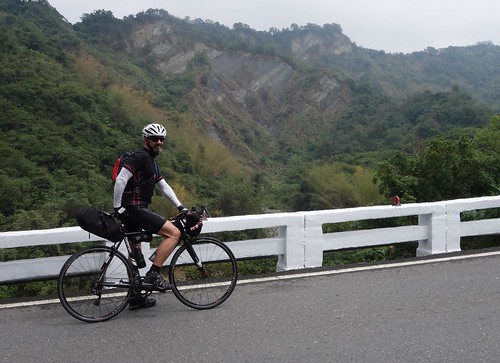
Missing Megaliths...

EastCoast081
At one of the megalith sites outside Dulan.

From a 1967 work...
On the lower slopes of the mountains behind the hamlet of Chung Yung, known also as Katsawan, behind the town of Ch'ang Pin, a megalithic site was investigated by Sung in 1963. No megaliths remained in their original position at that time; all have been rolled down the hill from their original plateau site to the village below and incorporated in walls and house foundations. Shouldered stones are the most abundant. An important feature of the site is the presence of large round stones, usually basalt, of doughnut shape with a hole in the center. They are reminiscent of the stone money of the island of Yap in Micronesia, but are somewhat smaller in scale. The only other site with stones of this shape thus far encountered is T'ai Yuan. Coarse, orange, gritty pottery is common, and a few sherds of cord-marked pottery were also found. A small coarse, orange effigy of a dog or pig was found by Sung, and a similar specimen was illustrated by Kanaseki and Kokubu from Peinan (Kanaseki and Kokubu 1957: 55). One wonders whether or not these animal effigies have any relationship to the famous ones from Lanyu.
One wonders how many of Taiwan's standing stones have become foundations, walls, tables... gravel.
_______________________
Don't miss the comments below! And check out my blog and its sidebars for events, links to previous posts and picture posts, and scores of links to other Taiwan blogs and forums!
Tuesday, October 04, 2016

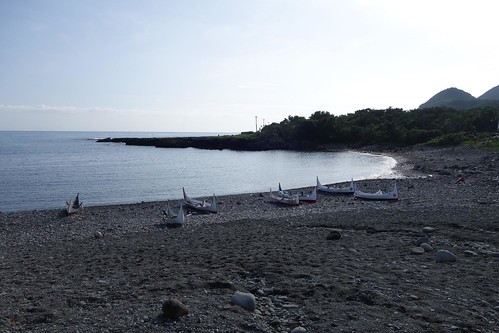
Vanuatu peopled from Taiwan and Philippines

If you weren't outdoors this weekend, you missed out.

This news is making the rounds:
Back in 1985, archaeologist Peter Bellwood of the Australian National University in Canberra proposed that the Lapita had roots in farming cultures in East Asia. Based on dating of Lapita sites, he proposed that they moved rapidly from mainland China to Taiwan and the Philippines, then out across the open ocean from Vanuatu to Samoa, covering 24,300 kilometers in about 300 years. This “express train” picture fit with linguists’ models, in which Austronesian languages spread from East Asia into Oceania and were distinct from Papuan languages in Melanesia.

But other researchers argued that the DNA of living Polynesians showed evidence that their Lapita ancestors had lingered in Melanesia, mixing with the locals and slowly spreading eastward. This so-called “slow boat” model had prevailed in recent years.

In the new study, an international team extracted ancient DNA from the skeletons of four ancient women from the islands of Vanuatu and Tonga, dated to 2300 to 3100 years ago, including three directly associated with the Lapita culture. The team sequenced the DNA at up to 231,000 positions across the genomes of each skeleton and compared the sequences to those of nearly 800 present-day people from 83 populations in East Asia and Oceania.

The four women were from a distinct population that had no evidence of mixing with the ancestors of people living in Papua New Guinea today, as the team reports in Nature this week. Instead, the women shared all their ancestry with the indigenous Atayal people in Taiwan and the Kankanaey people in the Philippines. “The Lapita have no evidence for Papuan ancestry,” says co-author Pontus Skoglund, a postdoc in David Reich’s lab at Harvard Medical School in Boston. That suggests that their ancestors rode the fast train, sweeping all the way to Oceania without mixing with Melanesians on the way.
Dr. Frank Muyard, who has long been studying the history of the Austronesian peoples and their migrations, observed in a discussion online (posted with permission):

++++++++++

This is indeed huge, and a game-changing research for both fields of Southeast Asian/Pacific prehistory and Austronesian studies.

Many of the past 30 years assumptions and theories will have to be revised and revisited. It shows that ancient DNA studies are necessary to confirm/infirm research of populations origins, and that inference into the past based only on current genetic analysis can be easily flawed.

But the original Nature article is very light on info about the Taiwan populations studied. We are only told about a closest link to Atayal, and then, in another part of the article, of links to Amis, but we don't have the DNA analysis details. I would also like to see additional research on more Taiwan Indigenous groups data, since recent archaeological researches show that Taiwan peopling history is itself getting more complex than often assumed.

The distance showed between Lapita aDNA and current Dai (Tai-Kadai) DNA would also in theory dismiss the hypotheses of direct migration from South China to the Philippines, which have been opposed to the Out-of-Taiwan theory of Austronesian dispersal, although here also we would need aDNA from South China to confirm that.

[and in response to a later query]

This is indeed a confirmation of the Express train hypothesis supported by Bellwood, Blust and Diamond.

But the Bellwood-Blust theory has been challenged in many places for years and was not fully supported yet by genetic studies (same for the precise origins in Asian mainland for proto-Austronesian migration to Taiwan which are still much debated).

Now it is. The "game changing" is thus about the lack of mixing with the "Papuan" populations in the Bismark Archipelago (the Triple I hypothesis, Roger Green) and therefore non-hybrid nature of the Lapita culture and first colonization of Remote Oceania (up east to Tonga/Samoa).

The closest genetic link with the Kankanaey in N-W Philippines, rather than other places in the archipelago (this also will have to be confirmed by other studies) is also interesting both for the Taiwan-Philippines and the Philippines-Lapita relations.

The direct ancestor of Lapita distinct ceramics is still eluding research and now that it appears not being due to cultural hybridity in the Bismarck Arc. will certainly spur more investigation.

Expect more aDNA research in the whole region to try and back up various theories.

We also need to understand better the Atayal-Amis similarities/differences, and the repeatedly attested close links between Amis and Polynesians - both in genetics and culture. In any case, the ancestors of the Lapita people lived in Taiwan/Philippines 4000 years ago, and cannot be directly associated with present groups, much evolution/change happened since in Taiwan and in post-Lapita Polynesia.

And that would involve understanding better the late Neolithic/Metal Age interactions between Taiwan and the Philippines. Hopefully we will have more studies on that soon.
_______________________
Don't miss the comments below! And check out my blog and its sidebars for events, links to previous posts and picture posts, and scores of links to other Taiwan blogs and forums!
Sunday, August 21, 2016

Son and Sun in Lanyu

ZebLanyu_DSC02701
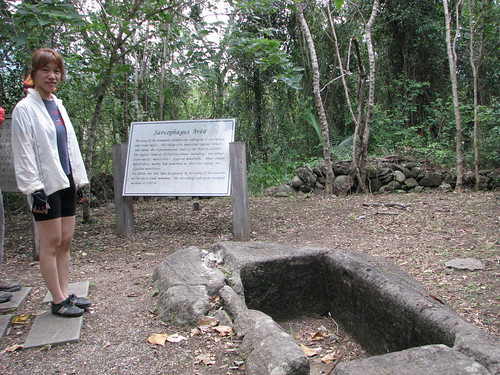
This was her only smile during what was obviously a difficult trip for her. But she and the sea and Lanyu were all beautiful...

Another August, another trip out to Lanyu. My son, my man Drew of Taiwan in Cycles, and my bother in spirit Domenic Alonge headed out to experience the beauty of Lanyu (slogan: "A free goat with every pic!"). Pics below the READ MORE line if you can stand more of my favorite island...

Wednesday, August 10, 2016

Wed Short Shorts: Please stop, Kerry Brown

Taiwan: you're never far from this

Interesting news for the KMT today. First, the political warfare military instructors are going to be phased out of educational institutions across the nation by 2020. In the old days they were responsible for following and reporting on the political views of students, and also for school discipline and punishment. Students viewed them with terror. Generally they were pro-KMT and enforced party ideologies and historical theology. Remnants of that attitude remain, as this video from Feb shows. But on the whole they have changed with democratization. Getting rid of the KMT's political presence in the government is one thing; rooting out its institutional presence is another, and more difficult. It will be another generation before that is gone...

Bigger news for the KMT is that the local factions are signalling they want evolution, if not revolution: they want local chapter heads to be elected by local chapters, not appointed by the Party center. This is a direct threat to the mainlander elites who really run things, since they've been accustomed to managing the patronage networks from above... from the KMT news organ:
According to Yao Chiang-lin (姚江臨), a member of KMT’s Central Standing Committee, former President Ma Ying-jeou (馬英九), who was concurrently KMT chairman, had included direct election of local chapter directors as one of his party chairmanship election campaign planks. However, he did not fulfill his promise, nor did the following chairpersons, Wu Po-hsiung (吳伯雄), Eric Chu (朱立倫), and Hung Hsiu-chu.
As everyone has noted since the 1970s, if the KMT wants to survive, it will have to Taiwanize. This would be an important first step. Hung, backed by the mainlander old soldiers, is temporizing. Readers may recall back in February then Chairman Eric Chu appointed a bunch of retreads and old men to the Party Chapter Chair positions, signaling that there would be no "reform" on his watch.

A friend of mine put it:
More noise..... I wonder if this will be like the time the party majorly reformed following its big election losses in 2000, 2004, 2014....
Turning to the outside world...

Like far too many China scholars who seem unable to approach Taiwan except through a China frame, UK scholar and uber-commentator Kerry Brown expends billions of pixels trying to subsume Taiwan into China, and thus, utterly failing to understand Taiwan. His latest so-does-not-get-it effort in the Diplomat is how Tsai’s Apology Strengthens Taiwan’s Place at Front of Chinese Modernity...
This issue is a huge one. Han Chinese treatment of smaller ethnic communities in modern Chinese history has been one of the darkest and most taboo issues. Mongolians in the Inner Mongolian region during the Cultural Revolution, starting in 1966, endured terrible treatment, with official figures released a decade later admitting that over 20,000 had died. Chinese Muslims were forced to eat pork, and Tibetan monasteries were closed down, with many destroyed. Up to today, similar patterns of exclusion and poverty exist in China’s 55 recognized ethnic minority groups. Attempts to hold the government to account on these issues run the risk of being painted as politically motivated, separatist attacks. The idea of Beijing issuing an apology along the lines that Tsai has for its ethnic communities and the treatment they have received in the last decades, let alone centuries, is currently unimaginable.

Tsai’s apology will no doubt not be widely reported across the Strait. But it does stand as a major historic movement with relevance for all Chinese, not just those in Taiwan. It shows how a Han Chinese-dominated community can start to look at its behavior and record in relations between ethnic groups over the decades and admit to some hard truths. In this, Tsai has possibly been inspired by the actions of leaders like Kevin Rudd in Australia. Rudd’s groundbreaking decision when elected prime minister in 2008 to issue a formal apology to the country’s aborigines was a courageous act, and ranks as perhaps his most important achievement in power.
The framework for understanding Tsai's action is not "Chinese modernity". It can never be "Chinese modernity" because modernity in China is a Han-chauvinist, colonialist, and imperialist modernity, a modernity imposed on China by Han elites, a modernity stamping out local differences and local cultures and languages as fast as possible and replacing them with Han language, history, and values, because China is an empire that is attempting to cover itself with the hard candy shell of a state. Thus, the use of "ethnic groups" in the media and academia to describe Tibetans or Uighurs is a good example of China's soft power at work -- its deployment as a descriptor obscures the imperial nature of Chinese rule. China is an empire, its variegated peoples are occupied peoples, not "ethnic groups" as if they somehow were serendipitously found to be living in China (gosh, how did that happen?) and were not the subjects of imperial conquest.

When the PLA comes over, the destruction of Taiwan's culture and political independence will be just another example of Chinese colonialist modernity at work. Just as it was the first time the KMT imposed Chinese modernity on Taiwan in 1945...

Tsai's apology was not "Chinese" but Taiwanese. Her actions, as I noted in the long post below, are not a further development of "Chinese modernity" but the offering of an inclusive Taiwanese democratic alternative that is based on resistance to Han-centered Chinese modernity. Her apology was made possible by a Taiwan-centered modernity with Taiwan independence at its core, and itself is an act furthering independence.

Even Brown himself recognizes that no Han in China could apologize to those "ethnic groups". Hmmm, wonder why...

Note to KBrown: the people in Taiwan are Taiwanese, not Chinese. I am pretty sure you don't regard Kevin Rudd's apology as a beacon to British people everywhere. Tsai's apology to Taiwan's aborigines is similarly not a beacon to Chinese people everywhere. If Chinese people choose to be inspired by it, that would be awesome, but I don't hold out much hope...
_____________
Daily Links:
_______________________
Don't miss the comments below! And check out my blog and its sidebars for events, links to previous posts and picture posts, and scores of links to other Taiwan blogs and forums!
Thursday, August 04, 2016

Understanding Tsai's Apology to Aborigines as a Pro-independence move

A vegetable seller breaks for a chat at a local temple.

One of the sharpest observers of Taiwan and its aborigines I know articulated a key issue with Tsai's apology in a comment on the post below this one about the apology:
The real key issue is that Tsai's apology shifts the official view of Taiwan from the primordialist standpoint of Chinese sovereignty as outlined in the two Chinese nationalist programs (ROC and PRC, to one of coloniality, and therein robbing the ROC and PRC of their territorial claims, which seek sovereignty in the integration of a Han racial nation. Tsai has effectively moved the goalposts and repositioned Taiwan outside of the Chinese nationalist paradigm.
KMT Chairman Hung, who understood this intuitively, attacked the apology:
Hung questioned whether or not Tsai was making use of aboriginal perspective of history to eliminate Han Chinese People’s perspective of history, or even engaging in desinicization to create a new perspective of history. “It is inevitable that people will question the DPP’s real motives,” added Hung.
Remember, in the KMT political lexicon, desinicization is a code term for removing markers of KMT colonialism in Taiwan -- which is exactly what Tsai was doing.

In the discourse of Chinese expansionism, which seeks to expand China out to the old Qing borders, the Qing (and other governments of China) were not imperialists or colonialists, but were Chinese and their lands China. Hence, the current wave of expansion is "rectification of the borders" and the variegated peoples in China are Chinese.

That means that in the Chinese expansionist view, Taiwan can never be a colonial holding, but is China, and colonialism cannot occur there, just as Tibet and Mongolia and Xinjiang can never be the objects of Han/Chinese imperialism, and the peoples of China are not peoples subjugated and assimilated by the dominant Han majority via the familiar processes of ethnic chauvinism and colonial expansion, but non-Han minorities who just happen to live in China (and whaddya know, how'd they get there?).

Tsai's apology drove a truck through this formula by acknowledging that the Han project in Taiwan is a colonial project. If it is a colonial project, then Taiwan is not a part of China, but a colony separate and different from it, where Han people do not belong, but have entered from the outside. Tsai implicitly recognized some kind of aboriginal claim to Taiwan. She also identified the aborigines as specific and diverse groups some of which she named, against China's presentation of all aboriginal groups as a single minority "mountain people", a minority that just happens to live in China (and whaddya know, how'd they get there? Because they weren't colonized or anything). Further, by presenting the apology as a form of transitional justice, she also aligned it with the movement for transitional justice in Taiwan against KMT colonial power, and with the Taiwan identity that is slowly obliterating the "ethnic" differences long exploited by the KMT. A shrewd political move.

The apology also recognizes that there can be no transitional justice without transitional justice for the aborigines. Otherwise transitional justice would be little more than a negotiation between privileged Han groups...

MEDIA: A sharp new PHD alerted me to the fact that AP caught some of this as well:
Tsai was elected by a landslide in January elections that have thrown a shadow over the island's relations with China, which claims Taiwan as a part of its territory from ancient times. Her view of Taiwan as a colonial society clashes with Beijing's claim that the island has always been an inherent part of China, which must eventually be reunited with the mainland, by force if necessary.
Kudos to whoever wrote that.

UPDATED: The Granite Studio takes note.
_____________
Daily Links:
_______________________
Don't miss the comments below! And check out my blog and its sidebars for events, links to previous posts and picture posts, and scores of links to other Taiwan blogs and forums!

Friday, May 27, 2016

Taroko people vs Asia Cement: the long twilight struggle

The amazing beauty of Taroko.

FocusTaiwan on the massive Asia Cement plant disaster outside Taroko Gorge...
Economics officials said Thursday that the Asia Cement Co.'s mining project inside the Taroko National Park can be terminated next year as new Environment Minister Lee Ying-yuan (李應元) hopes, but the company's operations in the 417 hectares outside the park cannot be suspended without new legislation banning such activities.

....

His new "vision" immediately alarmed the Hualien County government, which said the livelihoods of more than 1,000 families would be affected if the minister's new policy was carried through.

Kuomintang Legislator Hsu Chen-wei (徐榛蔚), wife of Hualien County Magistrate Fu Kun-chi, said Lee should have listened to local people and should give them some time to adapt before announcing his new policy.
If you're thinking that the cement company is in bed with the pan-Blue local government...

History from the piece above....
The Ministry of Economic Affairs (MOEA) said Asia Cement obtained a license to develop a total of 442.7 hectares in Hualien in 1973. Some 25 hectares of the licensed mining district were zoned in the Taroko National Park when the park was established in 1986, but it did not affect Asia Cement's right to keep developing the land.

In 1994, Asia Cement requested government permission to continue using the mining district inside the park, a request that was granted the next year.
The News Lens also picked up on this story, but also left out an important component of the issue. When the KMT legislator mentioned "local people" she meant the jobs dependent on the plant, not the livelihoods it wiped out. Those "local people"... who could they be? They've gone completely missing from the FocusTaiwan, News Lens, and Taipei Times report, which present the case in conventional environment vs big business terms. Let's restore their existence...
In 1974, the Siou-lin District administrative office, the Hua-lien County (花蓮縣) government, and the Asia Cement Company held several meetings for residents regarding Asia Cement's desire to develop a production site in Siou-lin District. However, as the Council’s judgment clearly points out, “The meeting only highlighted the benefits of the establishment of an Asia Cement factory during these “informational meetings,” never clearly stating to attendees that they would need to desist all cultivation and use of Truku Reserved Lands.” Furthermore, the Truku people's full understanding of the meetings' proceedings cannot be taken for granted when these meetings were conducted solely within the context of the laws and language of the Republic of China, which were alien and unfamiliar to the Truku people.

Subsequently, the Siou-lin District administrative office proceeded to transfer the lease for large sections of Reserved Lands to the Asia Cement Company, soon afterward revoking the cultivation rights registrations for 146 hectares of land. Fortunately, because of errors in documentation, a few of these revocations were not completed and a few were able to retain their cultivation rights. Two of these comparatively lucky rights holders eventually became litigants in the aforementioned case. After the lease agreement between the Siou-lin District administrative office and Asia Cement was formed, the original Truku rights-holders were forced off their land. Many of the original cultivation rights’ registrants have since passed away, and the remaining few who are parties to this case are now quite elderly.

During the course of protracted litigation, the Siou-lin District administrative office and the Asia Cement Company have repeatedly produced a written document which they claim is an agreement to abandon cultivation rights to which the seals and signatures of the Truku cultivation rights-holders have been affixed as proof of the aboriginal people's voluntarily renouncing cultivation rights and receipt of compensatory payment. However, the two aboriginal plaintiffs in this case do not recall signing any such document, and the handwriting used on all the signatures appending the agreement is curiously identical.
Read the whole thing, it's a common story of what really goes on in these cases when indigenes face large government-backed resource extraction companies. The historical background is given in this piece here by the awesome Scott Simon:
In 1968, the KMT government began legal registration of Aboriginal land in Taiwan as Aboriginal Reserve Land. Although indigenous people had lived on Taiwan for 6,000 years before the first Chinese settlers arrived, Aboriginal families received only cultivation rights under the new legal system. Usage rights on the land, moreover, were granted only on the condition that crops be planted for 10 years. The stipulation effectively forced assimilation on Aboriginal people, as it made them abandon their traditional mix of hunting, gathering, and slash-and-burn agriculture. It required that they instead adopt Chinese customs of settled agriculture, presumably for the growth of cash crops. The law stipulated that land could not be sold or rented to Chinese people--it either had to be cultivated or ceded to the government as state property.

Although Aboriginal Reserve Land was supposedly reserved for indigenous people, legal loopholes actually gave the Taiwanese government as well as Han Chinese individuals and corporations access to indigenous land. The government often "rented" indigenous land to outside commercial interests if indigenous people did not cultivate the land and sign "rental" agreements for the property in question. And indigenous people themselves often rented land to each other or outside Han Chinese. Han Chinese entrepreneurs were thus able to acquire space for villas, hotels, and factories on reserve land. The legacy of these problems remains. Indigenous people have no full legal ownership rights over the land, which means that they have no right to take out loans against it, a restriction that has prevented them from developing their own lands.

The policy of Aboriginal Reserve Land thus gave corporations adequate legal loopholes through which to seize Aboriginal land during a window of opportunity from 1968 to 1978. In 1973, the Taiwanese conglomerate Asia Cement applied to rent land from the Hsiulin Township Office and held its first consultative meeting with Taroko people. Township officials encouraged Taroko people to rent the land, saying it would give them employment opportunities, prevent out-migration of young people, and bring development to the community. The original landowners received compensation for displaced crops--a mere fraction of the land’s real estate value--and the promise that the land would be returned to them after 20 years.
In sum, Asia Cement did not have to compensate the aboriginal people for the value of the land (since the government "owned" it), just for the (far smaller sum of the) value of the crops it could have grown. Theft, backed by martial law, so protest was impossible. The article notes that few jobs were given to local aborigines out of the cornucopia promised, all grotty low paying work, which eventually was given to migrant workers, displacing even those few aborigines who got work at the cement company. It also tells the story of how the case was revived, with depressingly predictable responses....
One lucky day for the Taroko people, township officials left a hearing in anger, leaving behind a stack of documents. As Igung Shiban looked through them, she found that they were filled with irregularities. Some were missing dates or official seals. Most suspicious of all, the signatures of many former owners who had supposedly given up their property rights were all written in the same handwriting. In nearly a year of research, she pulled the agreements, one by one, from the township office files and showed them to the signatories to confirm whether or not they had actually signed them. It turned out that most of the signatures on the agreements to relinquish land rights were forgeries.

Asia Cement resorted to intimidation to stop her research--Shiban and her husband were physically attacked twice, and her husband was burned on the leg—but they didn’t give up. Fortunately, local environmental activists and National Legislator Bayan Dalur, an indigenous representative given a seat through the opposition Democratic Progressive Party (DPP), helped them pursue the case by providing access to government documents.
This old report, preserved on the useful Taiwan First Nations website, describes:
"There will definitely be bloodshed next time. We'll kill you one by one," promised Chou Wei-kuen, a company spokesman, after the group stormed the gates.
Activist Igung Shiban started an organization and took its case to the United Aborigines Working Program of the UN (here) where it didn't make much progress because you-know-who across the Strait suppressed it because it was Taiwanese. Packed with useful, fascinating details, Igung Shiban wrote in her 1997 report to the UN...
This dilemma of the Taroko people is the dilemma of all the indigenous people of Taiwan: Shimen Dam in Taoyuan County drowned the villages of the Taiyal. The military air base built into the mountain near Hwalien airport displaced the villages there. The Machia Dam in Taitung County forced the Lukai people out of their homes. The forced expropriation of indigenous reserved land by the government's Retired Servicemen's Association, Forestry Department, and National Parks Service, have each contributed their part to the loss the indigenous land and extinction of indigenous culture. If the campaign for return of land from Asia Cement were to succeed, it would be a crucial turning point. So we must persist in this campaign. This is not just our struggle; it is part of the hope for indigenous people throughout the world.
_____________
Daily Links:
_______________________
Don't miss the comments below! And check out my blog and its sidebars for events, links to previous posts and picture posts, and scores of links to other Taiwan blogs and forums!
Thursday, April 28, 2016

Hall of Barbarous Tribes

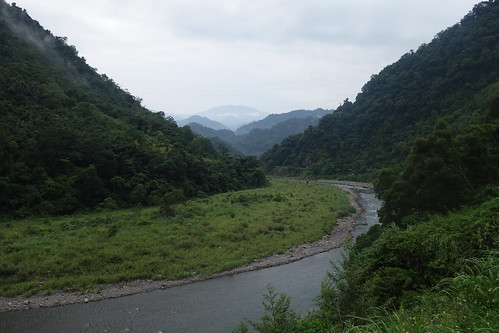
This is from the 1916 Taiwan Exhibition in Taipei, Japan (source). Serendipitous hits while searching: Japan Focus has an excellent review of the experiences of aboriginal tour groups in Japan during the colonial era. The amazing Paul Barclay's PHD thesis on ethnographic mapping of Taiwan under Japan is available online. Some good pics and excellent discussion of development and art in the Japanese era in Modernity in Agony. Below is a shot of the midway from that exhibition.
_______________________
Don't miss the comments below! And check out my blog and its sidebars for events, links to previous posts and picture posts, and scores of links to other Taiwan blogs and forums!
Wednesday, April 06, 2016

Scott Simon: Dogs and their humans in the world of Gaya

Japanese era photo of Saisiyat hunters and their hunting dogs

As a lifelong dog lover, I was absolutely delighted, and then deeply moved, to read this article by anthropologist Scott Simon in American Anthropologist: Real People, Real Dogs, and Pigs for the Ancestors: The Moral Universe of "Domestication" in Indigenous Taiwan (Nov 2015) (link).

This paper discusses the relationship between the Truku, dogs and pigs, and how state power in the form of colonial regimes and colonial modernity has impacted those relationships and the relationships between these three types of sapient beings and Gaya, the "sacred ancestral law". It's not just deeply insightful, it's moving and beautiful. Just a couple of paragraphs:
Like Amazonian hunter-gatherers (Kohn 2007), Seejiq describe dogs as sentient and intentional beings with whom humans can communicate. They know the names of dogs, identify their companion humans, and relate stories about their hunting exploits. They observe that dogs exhibit individual preferences in selecting friends or mates. Gaya demands hunters to be modest about their own abilities, yet they brag about the abilities of their dogs. When people eat outside, perhaps around a fire on winter evenings (Figure 4), they allow dogs to approach and eat with them. This relationship has not changed much since the Japanese colonial period, when ethnographers expressed surprise about sharing tables and even bowls with dogs. Kim (1980:189), three decades later, likewise considered sharing a table with dogs to be among the “unpleasant experiences” of fieldwork. Yet excess sentimentality attached to dogs is not appreciated. Contrary to Yi-Fu Tuan’s definition of pets that includes bringing them into the house (Mullin 2007:293), the norm is to keep dogs outside. It is considered cruel to tie up dogs, even if many people still feel the need to do so.

.......

The Seejiq affirm sovereignty when they say that their Gaya is efficacious, even better than state law, in managing multispecies relations. In one story, a police officer stopped an elderly Seejiq hunter, confiscated the serow (a mountain goat) he had caught, and took it home to eat. A few days later, the brakes on his brand-new motorcycle failed and he careened off a cliff to his death, an unlikely accident that people explained by saying Seejiq ancestors had punished him. Indigenous people everywhere seem to delight in revealing differences in the way they relate to animals as compared to the dominant groups. These conversations are prompted by conflicts over both material and abstract issues, such as hunting regulations and sovereignty, but also by relatively mundane conflicts, such as garbage collectors poisoning dogs. When indigenous people talk with anthropologists about cultivating trust with prey animals or affirm ontological difference in their relationships to animals, they assert moral superiority over colonial and postcolonial power. For peoples whose life projects are endangered by outside forces, calling attention to different ways of relating to animals is a means of positioning themselves as sovereign peoples.
Track down a copy of this paper. Well worth reading for the lovely prose, the beautiful stories it tells, and the deep insights it offers. The final paragraph hits like a sledgehammer.
_______________________
Don't miss the comments below! And check out my blog and its sidebars for events, links to previous posts and picture posts, and scores of links to other Taiwan blogs and forums!
Monday, February 29, 2016

Kingdom of Women


Reuters: China's women struggle for power
One fifth of Chinese NPC parliamentarians are female, higher than the 17 percent of the U.S. Congress who are women. But China's parliament comes under the firm thumb of the Communist Party, where real power lies.

All nine members of the Party's top ruling body, the Politburo Standing Committee, who marked the 100th anniversary of International Women's Day on Sunday, are men.
At Ketagalan media: Gwen Wang on Taiwan's legislature:
On gender balance, the percentage of women in the Legislature has increased to 38 per cent (43 seats), from 34 per cent (38 seats) in the previous Legislature. The outcome of the legislative race is described by Dr. Nathan Batto as “a victory for diversity”, with Taiwan now ranking 10th in the world in the proportion of women in its national legislature. The steady increase in Taiwanese women’s representation in the parliament shows that women are gradually gaining power in Taiwan’s political institutions.
Me, a couple of weeks ago...
The KMT Chairmanship struggle is still a two woman race between Hung Hsiu-chu, the reactionary mainlander former presidential candidate, and Huang Min-hui, a Taiwanese faction politician from a family with long service to the KMT. Remarkable to think that if Chen Chu succeeds Tsai Ing-wen to the Chairmanship of the DPP, the president and heads of both major political parties will be female come May. This demonstrates not merely female power but continuity of female power, since the previous party heads will have both been female.
From Emma Jinhua Teng, An Island of Women: The discourse of gender in Qing travel writing about Taiwan, 2010.
Seventeeth- and eighteenth-century Chinese travellers to the island colony of Taiwan almost invariably remarked that indigenous custom gave precedence to the female sex. 'The savages value woman and undervalue man' became a commonplace of Qing ethnographic writing about the indigenous peoples of the island, known as fan (savages) to the Chinese. As an inversion of the Confucian patriarchal maxim 'value man and undervalue woman', this pithy expression indexed the alterity of Taiwan to the Chinese who colonized the island in 1683. Encountering a land with female tribal heads, uxorilocal-residence marriage, and matrilineal inheritance, Chinese travellers perhaps thought that they had stumbled upon the mythical Kingdom of Women -- the Chinese equivalent of Amazon. As in the Kingdom of Women, it seemed, here women took the lead, and men followed. The anomalous gender roles of the indigenous peoples thus became one of the most popular topics in Qing travel writing about Taiwan...
But people say that the influence of Taiwan aborigines on the local Han is insignificant.

ADDED: And of course, pre-1945 Taiwan was 25% Hakka, with different attitudes toward the role and status of women then the Hoklo.
_______________________
Don't miss the comments below! And check out my blog and its sidebars for events, links to previous posts and picture posts, and scores of links to other Taiwan blogs and forums!

Tuesday, December 08, 2015

The aboriginal struggle continues

Glorious day out there today on the bike....

In the Qing Dynasty the aborigines were divided into two groups, the "cooked" who had been assimilated to Han culture to some degree, and the "raw", who remained free of Qing rule. This marvelous piece entitled The Tribe That Disappeared from Songshan Airport on a woman's discovery of her Ketagalan roots, reproduces a poem about the way the assimilated aborigines were abused and subjected to theft of land.
There was a poem during Qing rule called An Ode to the Cooked Tribes:

The Raw Tribes are feared as tigers, but the Cooked Tribes are treated like the dirt; trembling before the fierce and trampling the weak, just because the people lack the wisdom of ages.

A cooked tribesman obeys the law and works the field, but the day comes when a Chinese sets his sights on the tribesman’s land; he takes away the fields and the tribesman starves, regretting becoming “cooked.”

The tribesman hears of an official in the city and treks to the palace and kowtows before him in appeal; but his words are as the chirping of quails, and the official cannot understand at all.

His sad tales not finished, the official loses patience; the official orders the tribesman be beaten. The tribesman listens to the verdict with head lowered: “Stupid savage! Do as I say, give your fields to the Chinese man, who is your brother in every way!”

What a shame! The raw tribesmen are forced to kill, and the cooked tribesmen are bullied. Would our Chinese officials listen to these voices?
Also, an aboriginal hunter harvesting animals in the mountains was given a harsh three year sentence...
Two years ago, a Bunun called Wang Guang-lu from Hairui Township in Taitung County was hunting Formosan serow (a kind of goat) and Reeve's muntjac (one of the three rare species of deer in Taiwan) with a shotgun because his 92-year-old mother wanted to eat fresh game.

Wang was caught by the police and sentenced to three years and six months in jail. Chen Cai-yi, a lawyer from Legal Aid Foundation, considered the verdict unacceptable because, "the ruling of this case was even more serious than that of a murder case.”

China Times reports, Wang says normal pork is too greasy and makes his mother nauseous and dizzy. This is why he went hunting in the mountains with a shotgun. He didn’t expect the sentence to be this serious.

The court sentenced Wang to three years and six months in jail, saying he violated the Controlling Guns, Ammunition and Knives Act and Wildlife Conservation Act. The Supreme Court also fined him NT$ 70,000 (approximately US$ 2,138). The case was rendered last month.
Richard Foster, hiker extraordinaire, pointed out on my Facebook that the Serow is actually a bovine, not a kind of goat, and Taiwan's only native bovine. Foster noted:
FYI The best place to see the serow, muntjac, flying squirrels, other mammals, Swinhoe/Micado pheasants is at dusk or later near the Forestry Bureau office at km50 on the Dasyueshan road. Also drive down the road after dark with flashlights looking for eyeshine. Feel free to stop at any of the 3 police stations on the road and thank them for protecting the forest.
_______________________
Don't miss the comments below! And check out my blog and its sidebars for events, links to previous posts and picture posts, and scores of links to other Taiwan blogs and forums!

Thursday, May 28, 2015

Ginger: a root of Taitung's destruction

FentonGuguan_54
No days like this one this weekend, the weather service is saying...

The returns are high, the risks are low, and the damage is immense.  FocusTaiwan:
For farmers to harvest old ginger root on a 1 jia (2.3-acre) plot in the mountains, they only have to spend around NT$1.2 million (US$39,328) to prepare the soil and grow and harvest the crop, but can earn NT$6 million in return, said Hu Wu-jen (胡武仁), secretary of the Yanping Township Office.

"The risks are low and the profits are good. Of course ginger farmers are running up the mountains," said Hu, who used to be a ginger farmer himself.

He said most farmers planting ginger in the mountains rent the land for a year from indigenous people, who may not have the NT$300,000 needed to prepare a 2.3-acre plot.

So the indigenous people rent their land to ginger farmers and when they get their land back after a year, it has already been prepared for cultivation and use, said Hu, calling it a "win-win" situation for the indigenous people and ginger farmers.

The ginger farmers look for new pastures after a year because the old ginger root they grow "is picky when it comes to the soil" and needs virgin soil for the best results, said a farmer surnamed Chang.
Under the current laws, according to the article, aborigines can cultivate a plot of land. That is, if the government has allocated it for that purpose (or as pasture). Local aborigines cannot transfer or rent that land to others, unless they are relatives. Note that the control and definition of who owns what belongs to the government, which is run by outsiders. The aboriginals have lost control of their land to the Han. Even when it is "theirs"...

Ginger cultivation has other issues associated with it. Not mentioned in the article is pesticides. This PHD thesis observes:
One applies fertilizer, organic fertilizers, and agro-medicine (nongyao), which harm your body, when growing ginger…many people [use these agrochemicals]…[The gingers] used to grow quite easily and in relatively larger sizes, but now they only grow to be 10 cm long (roughly 4 inches)… These gingers get sick (shengbing) and people keep spraying pesticide…
The thesis also notes that after ginger is planted, the land is not arable for many years. Another issue associated with ginger is landslides.
When asked about how a landslide took place, an experienced Bunun farmer in his early 60s offered his opinion on the design of a ginger farm, “What one should do [after plowing a large area of land] is to dig a trench along the bottom edge of the ginger farm and pile rocks along it to build a base [to make up for the loss of vegetation]” (March 31, 2010). This local narrative redirected the perception of landslide risk to how land is farmed rather than simply blaming highland agriculture as the overarching factor for causing landslides (Sheng, 1966).

....

In Vakangan, one can spot the cultivation of ginger sitting on hills along and above residential houses. While some individuals in the community fear or talk about these plantations as landslides waiting to happen, especially given the region’s proneness to hurricanes, it is also a plantation that offers job opportunities for many local people. Nonetheless, when looking closely into the cycle that drives the plantation, one finds that the risk of landslide is not so simple and straightforward.
This conflict between aboriginals and Han over land plays out in many ways. Another article from the same day tells the story of the area of Dingyanwan and its Han farmers. It was declared a forest reservation area and some farming was allowed. But then the government decided to plant trees and stop the farming. Then. in 1963...
A total of 13 farmers in Dingyanwan were sent to prison for 13 days for obstructing the execution of public duties before being released after paying fines, but the conflict between the farmers and the government has continued to simmer for 50 years.

In 1976, local farmers filed a petition to maintain their farming operations on the land, but a joint investigation concluded that the fields should still be used for afforestation, and farmers were asked by the Forestry Bureau to remove their crops.

The farmers stalled and ignored the request, and in 2001, the Forestry Bureau turned tough and accused over 70 farmers in Dingyanwan of occupying state-owned lands. Prosecutors decided, however, not to prosecute the case.

The bureau then filed civil actions against the farmers to recall the land on the charge of estrepement -- referring to destructive waste of the land committed by a tenant.

When the farmers found that they had no access to proof favorable to their claims, they lost their cases and were ordered to return the lands they worked within a designated period of time.
In 2012 the local legislator "negotiated" with the forestry bureau for the farmers, who were then allowed to plant fruit trees. As the article notes, there was a neglected group...

The problem was that the deal left out a major stakeholder in the area, indigenous Puyumas who consider the land to be their jurisdiction and see the farmers as nothing more than illegal squatters.
Puyuma representatives said in a meeting with the local government on Oct. 28, 2014 that if Dingyanwan's status as a protected forest area is removed, the land should be returned to the Puyuma people because they have been living and hunting there, according to a document from the Taiwan Provincial Consultative Council.

The tribe's representatives asked the local government to handle the issue cautiously by holding more negotiations with them and taking into account both economic development and the Puyumas historical connection with the land.
Taitung's forests are "twice promised land", a prize for the most politically savvy and well-connected. Now with big developers muscling in to pick up chunks for their Chinese tourist business, Taitung is going to take another hit. Of course the piece ends on a note of sympathy for... the poor abused Han.
All of which has left the farmers in an uneasy limbo.
...by "farmers" they don't mean aborigines.

_______________________
Don't miss the comments below! And check out my blog and its sidebars for events, links to previous posts and picture posts, and scores of links to other Taiwan blogs and forums!

Thursday, March 05, 2015

Way Cool: Last Japanese Soldier Hideout in WWII was Amis

House in Laochijia.

This is very cool -- had to share it with you. From Wiki:
Private Teruo Nakamura (中村 輝夫 Nakamura Teruo?, October 8, 1919 − June 15, 1979) was a Taiwan-born soldier of the Imperial Japanese Army from the indigenous Amis tribe, who fought for Japan in World War II and did not surrender until 1974. He is the last known Japanese hold-out to surrender after the end of hostilities in 1945. His name in his native Amis language was Attun Palalin.[1] The Taiwanese press referred to him as Lee Guang-Hui (李光輝), a name of which he learned only after his repatriation in 1975.

........

Nakamura's repatriation and his perception in the Japanese public at the time differed considerably from that of earlier holdouts, such as Hiroo Onoda, who had been discovered only a few months earlier. One reason for this was the question of his nationality. Born on Taiwan, Nakamura was ethnically Amis and legally stateless; questions of nationality were of considerable importance in the Japanese public at the time, and while the Japanese embassy in Jakarta offered to repatriate him, there were also diplomatic questions over how to treat him in case he wanted to go back to Taiwan.[2] At the time of his capture, he spoke neither Japanese nor Chinese. Secondly, while Onoda had been an officer, Nakamura's rank as a private from a Japanese colony did not excite the public imagination and was likely to raise questions about the role of Japanese colonialism during the war instead. Another sensitive issue was the question of back pay of his soldier's pension. As a private of a colonial unit, Nakamura was not entitled to pensions after a 1953 change in the law on pensions, and thus received only a minimal sum of ¥68,000 (US $227.59 at the time, now US $1,100 in 2015).[1] This raised a considerable outcry in the press, motivating the government to donate over $100,000, similar to what had been offered to Onoda, which in turn generated questions by earlier Taiwanese holdouts and led to considerable public discussion of the differences in treatment of Japanese and Taiwanese holdouts by the government.

_______________________
Don't miss the comments below! And check out my blog and its sidebars for events, links to previous posts and picture posts, and scores of links to other Taiwan blogs and forums!

Friday, November 21, 2014

Then and Now

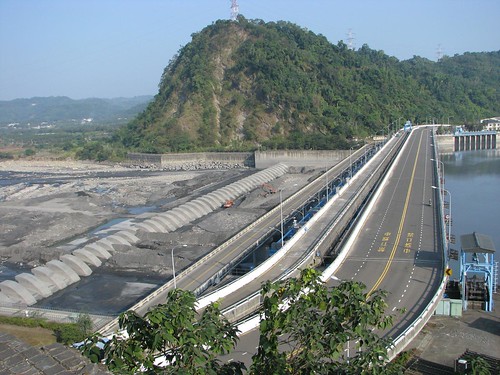
Paul Barclay, who runs the East Asia Image Collection at Lafayette College is traveling in Taiwan at the moment. If you get the chance, go listen to him talk, he's wonderful. A friend traveling with him in central Taiwan posted this Japanese era pic captioned A Bamboo Bridge in Savage District  (original link). This picture was taken facing more or less east along the river.

LuguLoop90
Just for fun, I dug up a modern image I took of it on a ride several years ago. It is now the location of the Jiji Weir (my pic faces north). The old Japanese era road follows what is now the 152 on the north bank of the river, parallel to but above the 16, along the train to Jiji and Shuili, I believe. Corrections welcome.

Jonathan Burke, a friend on Facebook, posted this pic. He wrote:
Eighty years of history in two photos; the first was taken in 1935, the second was taken in 2014. The photos show a house belonging to the Paiwan people (one of Taiwan's indigenous tribes); the shot was taken in the era of Japanese occupation and the house was preserved as a historical site. After decades of neglect it has been renovated. Both photos feature the same person; first as a boy in 1935, then as a 92 year old man in the second photo.
Way cool.
_______________________
Don't miss the comments below! And check out my blog and its sidebars for events, links to previous posts and picture posts, and scores of links to other Taiwan blogs and forums!
Thursday, October 16, 2014

Stereotype Quest: how many stereotypes can you spot?

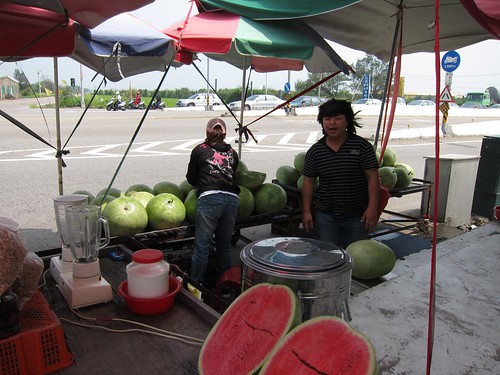
Watermelon and watermelon juice sellers... man I miss watermelon.

Taipei Times reports:
The video clip was said to portray Aboriginal women as ‘exotic objects of lust, and neglected to mention the artists it was promoting
Here's the link, filmed by aboriginal director. See how many of the millions of ethnic stereotypes crammed in here you can spot. Click read more for a quick list I compiled:

Monday, June 09, 2014

Truku aboriginals shut down Mugumuyu over excessive tourism, police vow to prosecute

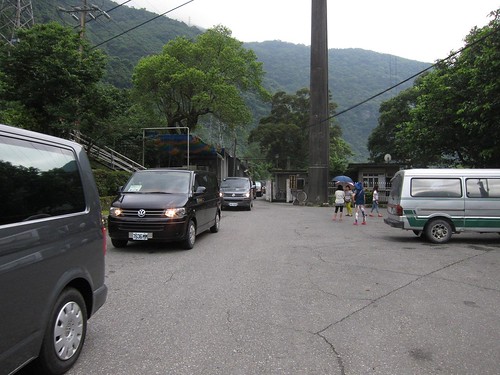
Vans pouring out of Mugumuyu.

UPDATE: Don't miss the comments below.

Mugumuyu is a stunning and rich river gorge southwest of Hualien city, just west of Liyu Lake. Last month I biked into Mugumuyu to enjoy its beauty, but got rained out. Nevertheless, I noted the number of small buses and vans flowing in and out, an appalling number of visitors, when supposedly the number was controlled. So I was dismayed, but unsurprised, to hear that the local aboriginal community had finally taken matters into its own hands and shut the road into their community down, to block the endless flow of vans in and out. TT observes:
Prior to blocking the road, the residents performed a ritual at a monument erected in remembrance of 39 villagers who were buried by mudslides triggered by Typhoon Ofelia in 1990 by firing gunshots into the air and sending up smoke signals, declaring to their ancestral spirits their determination to defend their traditional territory.

“It’s not that we do not welcome visitors, but since our village has been opened to outside visitors in 2006, there have been on average more than 100 minibuses bringing in about 3,000 visitors per day on holidays,” village council chairman Masaw said.

“The large number of vehicles has polluted the air, creates traffic jams on the roads and makes it difficult for us to go to work in the fields,” he added.

Rakaw Didi, a spokesman for the village, which is administratively known as Tongmen Village (銅門), said that to maintain the village’s ecology and quality of life, the village council passed resolutions at the end of last month to close off the village for a year and to ask future visitors to enter into the village on foot, not in cars.
Now the local news is reporting that the police plan to prosecute the aborigines. Of course.
_______________________
Don't miss the comments below! And check out my blog and its sidebars for events, links to previous posts and picture posts, and scores of links to other Taiwan blogs and forums!
Monday, May 12, 2014

Colonizers are Modernizers

An anthropologist acquaintance points out:
Double standards of animal abuse for indigenous peoples and majority peoples. When the Bunun indigenous people have a pig catching contest, the state forbids it, labeling it as animal abuse. When the Han Taiwanese fatten up pigs beyond belief for temple sacrifices, they call it culture and promote it.
_______________________
Don't miss the comments below! And check out my blog and its sidebars for events, links to previous posts and picture posts, and scores of links to other Taiwan blogs and forums!
Tuesday, April 22, 2014

Riding the Tawu/Longxi Industry Road

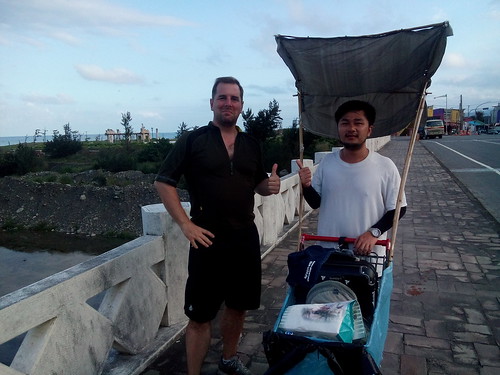
The evening we stayed in Tawu we ran into this amazing man, TX Wong, from Hong Kong. Tex was walking around Taiwan, a 30 day tour, 30-40 kms a day. He was two weeks in and expected to take another two weeks. This was his second trip. I am hoping to interview him in early May about his experiences.

Busy as heck this week, and then took three days off to go cycling. So that explains the lack of posts...

A lovely weekend on the east coast as my friend Michael Cannon and I headed out to explore the Tawu-Longxi industry road. Two days of fun in the sun, with plenty of beer, great scenery, and even a trio of pole dancing babes. Click on READ MORE to read more...