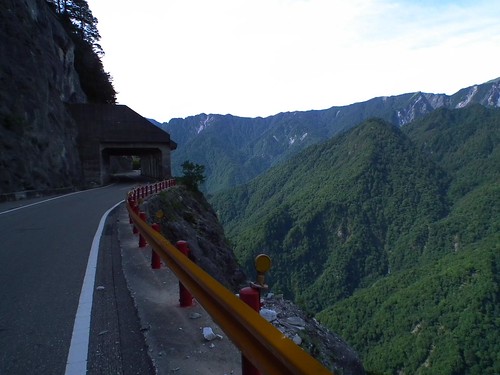
FocusTaiwan on the massive Asia Cement plant disaster outside Taroko Gorge...
Economics officials said Thursday that the Asia Cement Co.'s mining project inside the Taroko National Park can be terminated next year as new Environment Minister Lee Ying-yuan (李應元) hopes, but the company's operations in the 417 hectares outside the park cannot be suspended without new legislation banning such activities.If you're thinking that the cement company is in bed with the pan-Blue local government...
....
His new "vision" immediately alarmed the Hualien County government, which said the livelihoods of more than 1,000 families would be affected if the minister's new policy was carried through.
Kuomintang Legislator Hsu Chen-wei (徐榛蔚), wife of Hualien County Magistrate Fu Kun-chi, said Lee should have listened to local people and should give them some time to adapt before announcing his new policy.
History from the piece above....
The Ministry of Economic Affairs (MOEA) said Asia Cement obtained a license to develop a total of 442.7 hectares in Hualien in 1973. Some 25 hectares of the licensed mining district were zoned in the Taroko National Park when the park was established in 1986, but it did not affect Asia Cement's right to keep developing the land.The News Lens also picked up on this story, but also left out an important component of the issue. When the KMT legislator mentioned "local people" she meant the jobs dependent on the plant, not the livelihoods it wiped out. Those "local people"... who could they be? They've gone completely missing from the FocusTaiwan, News Lens, and Taipei Times report, which present the case in conventional environment vs big business terms. Let's restore their existence...
In 1994, Asia Cement requested government permission to continue using the mining district inside the park, a request that was granted the next year.
In 1974, the Siou-lin District administrative office, the Hua-lien County (花蓮縣) government, and the Asia Cement Company held several meetings for residents regarding Asia Cement's desire to develop a production site in Siou-lin District. However, as the Council’s judgment clearly points out, “The meeting only highlighted the benefits of the establishment of an Asia Cement factory during these “informational meetings,” never clearly stating to attendees that they would need to desist all cultivation and use of Truku Reserved Lands.” Furthermore, the Truku people's full understanding of the meetings' proceedings cannot be taken for granted when these meetings were conducted solely within the context of the laws and language of the Republic of China, which were alien and unfamiliar to the Truku people.Read the whole thing, it's a common story of what really goes on in these cases when indigenes face large government-backed resource extraction companies. The historical background is given in this piece here by the awesome Scott Simon:
Subsequently, the Siou-lin District administrative office proceeded to transfer the lease for large sections of Reserved Lands to the Asia Cement Company, soon afterward revoking the cultivation rights registrations for 146 hectares of land. Fortunately, because of errors in documentation, a few of these revocations were not completed and a few were able to retain their cultivation rights. Two of these comparatively lucky rights holders eventually became litigants in the aforementioned case. After the lease agreement between the Siou-lin District administrative office and Asia Cement was formed, the original Truku rights-holders were forced off their land. Many of the original cultivation rights’ registrants have since passed away, and the remaining few who are parties to this case are now quite elderly.
During the course of protracted litigation, the Siou-lin District administrative office and the Asia Cement Company have repeatedly produced a written document which they claim is an agreement to abandon cultivation rights to which the seals and signatures of the Truku cultivation rights-holders have been affixed as proof of the aboriginal people's voluntarily renouncing cultivation rights and receipt of compensatory payment. However, the two aboriginal plaintiffs in this case do not recall signing any such document, and the handwriting used on all the signatures appending the agreement is curiously identical.
In 1968, the KMT government began legal registration of Aboriginal land in Taiwan as Aboriginal Reserve Land. Although indigenous people had lived on Taiwan for 6,000 years before the first Chinese settlers arrived, Aboriginal families received only cultivation rights under the new legal system. Usage rights on the land, moreover, were granted only on the condition that crops be planted for 10 years. The stipulation effectively forced assimilation on Aboriginal people, as it made them abandon their traditional mix of hunting, gathering, and slash-and-burn agriculture. It required that they instead adopt Chinese customs of settled agriculture, presumably for the growth of cash crops. The law stipulated that land could not be sold or rented to Chinese people--it either had to be cultivated or ceded to the government as state property.In sum, Asia Cement did not have to compensate the aboriginal people for the value of the land (since the government "owned" it), just for the (far smaller sum of the) value of the crops it could have grown. Theft, backed by martial law, so protest was impossible. The article notes that few jobs were given to local aborigines out of the cornucopia promised, all grotty low paying work, which eventually was given to migrant workers, displacing even those few aborigines who got work at the cement company. It also tells the story of how the case was revived, with depressingly predictable responses....
Although Aboriginal Reserve Land was supposedly reserved for indigenous people, legal loopholes actually gave the Taiwanese government as well as Han Chinese individuals and corporations access to indigenous land. The government often "rented" indigenous land to outside commercial interests if indigenous people did not cultivate the land and sign "rental" agreements for the property in question. And indigenous people themselves often rented land to each other or outside Han Chinese. Han Chinese entrepreneurs were thus able to acquire space for villas, hotels, and factories on reserve land. The legacy of these problems remains. Indigenous people have no full legal ownership rights over the land, which means that they have no right to take out loans against it, a restriction that has prevented them from developing their own lands.
The policy of Aboriginal Reserve Land thus gave corporations adequate legal loopholes through which to seize Aboriginal land during a window of opportunity from 1968 to 1978. In 1973, the Taiwanese conglomerate Asia Cement applied to rent land from the Hsiulin Township Office and held its first consultative meeting with Taroko people. Township officials encouraged Taroko people to rent the land, saying it would give them employment opportunities, prevent out-migration of young people, and bring development to the community. The original landowners received compensation for displaced crops--a mere fraction of the land’s real estate value--and the promise that the land would be returned to them after 20 years.
One lucky day for the Taroko people, township officials left a hearing in anger, leaving behind a stack of documents. As Igung Shiban looked through them, she found that they were filled with irregularities. Some were missing dates or official seals. Most suspicious of all, the signatures of many former owners who had supposedly given up their property rights were all written in the same handwriting. In nearly a year of research, she pulled the agreements, one by one, from the township office files and showed them to the signatories to confirm whether or not they had actually signed them. It turned out that most of the signatures on the agreements to relinquish land rights were forgeries.This old report, preserved on the useful Taiwan First Nations website, describes:
Asia Cement resorted to intimidation to stop her research--Shiban and her husband were physically attacked twice, and her husband was burned on the leg—but they didn’t give up. Fortunately, local environmental activists and National Legislator Bayan Dalur, an indigenous representative given a seat through the opposition Democratic Progressive Party (DPP), helped them pursue the case by providing access to government documents.
"There will definitely be bloodshed next time. We'll kill you one by one," promised Chou Wei-kuen, a company spokesman, after the group stormed the gates.Activist Igung Shiban started an organization and took its case to the United Aborigines Working Program of the UN (here) where it didn't make much progress because you-know-who across the Strait suppressed it because it was Taiwanese. Packed with useful, fascinating details, Igung Shiban wrote in her 1997 report to the UN...
This dilemma of the Taroko people is the dilemma of all the indigenous people of Taiwan: Shimen Dam in Taoyuan County drowned the villages of the Taiyal. The military air base built into the mountain near Hwalien airport displaced the villages there. The Machia Dam in Taitung County forced the Lukai people out of their homes. The forced expropriation of indigenous reserved land by the government's Retired Servicemen's Association, Forestry Department, and National Parks Service, have each contributed their part to the loss the indigenous land and extinction of indigenous culture. If the campaign for return of land from Asia Cement were to succeed, it would be a crucial turning point. So we must persist in this campaign. This is not just our struggle; it is part of the hope for indigenous people throughout the world._____________
Daily Links:
- Awesome: Dynamic maps of the Taiwan Strait and its relations throughout history
- Tsai faces world's worst property market
- Latest issue of NCCU's Strategic Vision is out
- Legislature struggles over assets bill
- Ibises = problem
[Taiwan] Don't miss the comments below! And check out my blog and its sidebars for events, links to previous posts and picture posts, and scores of links to other Taiwan blogs and forums!


