Showing posts with label KMT. Show all posts

Sunday, May 21, 2017

Former Veep Wu Den-yih elected KMT Chairman

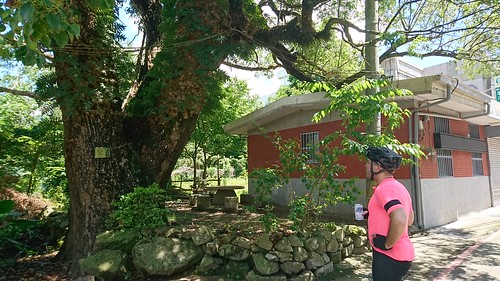
Dom ponders a gorgeous old Camphor tree in the village of Shuangchi near Dongshih.

Wu Den-yih wins KMT Chair election.
Former vice president Wu Den-yih (吳敦義) yesterday became the new Chinese Nationalist Party (KMT) chairman after securing more than 140,000 votes of the 272,682 cast in the election.
Hau did not make an announcement and pledged support for the KMT's effort get NPP head Huang Guo-chang recalled. Huang is in a seat that the KMT could win in a by-election.

Wu immediately stated that if elected President in 2020 he would abide by the 1992 Consensus. Beijing sent him warm fuzzies and congrats for his election. Let's not forget, he is Ma's man. Solidarity, who had a great run down of the results, observed:
Wu was the most experienced, pragmatic, and politically skilled of this race’s candidates. He has significant political experience in northern, central, and southern Taiwan alike. Although association with the Ma administration has tainted his name, unlike Hung he does seem to live in the real world and be better able to communicate with ordinary people. He and his wife have anticipated a future presidential run for some time. He is well-equipped to manage the party’s relationships with Taiwanese local factions, which have been threatened by the DPP’s newfound political power. Given these qualities, plus the organizational skills he exhibited in this race, the green camp should steel itself for robust challenges in 2018 and 2020 rather than complacently leaning on its demographic dividend.
Wu has said that his wife and himself were told by a fortune teller that he would be President and she First Lady. Wu was born in 1948, in Nantou County. Next year he will be 70, and 72 in 2020. At this moment, my bet is that Wu is already envisioning a 2020 run, as his remarks on the 1992 Consensus suggest.

Wu has been elected in the south -- mayor of Kaohsiung in the 1990s. He will steer a more pragmatic course for the KMT than Hung's bitter-end ideology, but it will be difficult for him to overcome the Party's numerous problems. Much will be shown by the KMT's performance in 2018.

Wu's reiteration of the 1992 Consensus under which each side has its own interpretation -- the latter codicil has never been accepted by Beijing even though the international media routinely claim that it is -- is not merely a gesture aimed at Xi Jin-ping. Recall that Hung Hsiu-chu, the rightist and ideological purist, has championed a different view. Wu is signaling to his own people that he is going to follow the "centrist" position of Ma. Recall also that the 1992 Consensus has only minority support in Taiwan...

ADDED: News just out, Hung advisor says he will never accept Taiwanization of KMT. Wu's election is going to reinvigorate the struggle between Taiwan/mainlander groups within the KMT.

MEDIA: No, Reuters, the KMT and the CCP have not always recognized Taiwan as part of "one China." *sigh*
_____________
Daily Links
_______________________
Don't miss the comments below! And check out my blog and its sidebars for events, links to previous posts and picture posts, and scores of links to other Taiwan blogs and forums!
Wednesday, April 19, 2017

KMT Chairmanship Election: Candidates register

Spring went by quickly....

There is no lack of comedy in this election as the six candidates submitted their forms and signatures. Five of the six had over 100K signatures, with Wu Den-yih submitting over 200,000. However...
However, the total number of signatures submitted exceeded the 478,000 party members eligible to endorse aspiring candidates as of Tuesday. One hopeful ascribed this to possible duplicate endorsements or artificial inflation of the number of signatures collected.
Can you imagine electoral fraud in a KMT-involved election?

The Straits Times had a more serious review. Of Wu Den-yih, it observes:
Compared with his ex-boss, the Harvard-educated former Taiwan president Ma Ying-jeou, Mr Wu also has more of the common touch - he announced his bid for the party's top post with a campaign song that he penned, called "No Turning Back".

"I hope that the song will make it easier to remember what I stand for," said Mr Wu, who has won Mr Ma's endorsement to be KMT chief.
Wu, according to a couple of experts I know, was one of the factors hold down a KMT revolt against Ma during his disastrous second term. He is a smart insider politician. Unfortunately for Wu he is a Taiwanese, not a mainlander, and thus not acceptable to the Old Soldiers, who want a mainlander like themselves.

The interesting thing is whether the other two candidates, Hau and Hung, will split the Old Soldier vote and hand the Chairmanship to Wu. If that is the case, then expect Wu to run in 2020. If the Old Soldiers vote as a bloc, then they will anoint either Hau or Hung, and probably the latter. Hung will also have been Chair for the assets committee fight and the pension fight, taking uncompromising pro-KMT positions, which will endear her to the Old Soldiers whose votes will be decisive.

Hau was already warning voters and the party to be on the lookout for bribes, as if he were setting up a complaint to file in the future when he loses, to try and get the election annulled and ... held again? Thrown to the Central Standing Committee?

A Hung victory will pose a very interesting dilemma for the KMT. Who will be the candidate in 2020? The Chair has usually been the candidate, but Hung will never win the election. Will they force her to accept Wu or Hau? What will the price be?

Recall that 2018 is the local elections. Hung won't be much good for that, but Wu will.
_______________________
Daily Links:
_______________________
Don't miss the comments below! And check out my blog and its sidebars for events, links to previous posts and picture posts, and scores of links to other Taiwan blogs and forums!

Wednesday, March 15, 2017

Me on Bill Sharp's show

The very kind Bill Sharp was kind enough to give me a few minutes on his show to talk about the KMT.
_______________________
Don't miss the comments below! And check out my blog and its sidebars for events, links to previous posts and picture posts, and scores of links to other Taiwan blogs and forums!
Saturday, March 11, 2017

Taiwan News Latest: DPP on Drugs, don't worry, be happy

Net fishing on Lanyu

“They wanted to have a good time, but they were like children playing in the street; they could see one after another of them being killed--run over, maimed, destroyed--but they continued to play anyhow.”

Taiwan's anti-drug regime has a dual nature: it is absolutely brutal, yet has a strong rehabilitative element. I look at it in my latest piece for Taiwan News...
Although it is not often remarked on, side by side with the loud regime of strict punishment to restore society’s moral order by scapegoating an outcast is a quiet regime of rehabilitation, forced rehab in the case of repeat offenders. It is important to note that the DPP Administration did not advocate disturbing any of this. Although DPP politicians have from time to time joined the call to punish drug use more severely, by and large the DPP has avoided the KMT’s harsher approaches.
The "War on Drugs" was announced in 1993 by then-premier Lien Chan. Drugs suck twice over: first they destroy you, then the government steps in and destroys you again. Lien's order destroyed the lives of many people only harming themselves. Fortunately, as I note in the piece above, in 1994 the government also moved to impose a rehabilitation regime. This means that in Taiwan drug users have the twin status of patients and criminals.

According to one of the papers I read in preparation for this, the reason for the KMT administration's decision to make war on victims was simple: the US was also promoting its own costly and destructive War on Drugs, and the KMT wanted to curry favor with the US. It also saw participation in international "anti-drug" efforts as a way to align itself with the international community and raise the ROC's profile, in the KMT's never ending religious quest to become a recognized state.
_______________________
Don't miss the comments below! And check out my blog and its sidebars for events, links to previous posts and picture posts, and scores of links to other Taiwan blogs and forums!
Sunday, March 05, 2017

Latest Taiwan news piece: Did Chiang plan for 2-28 to happen?

Downhill on gravel: not fun

Interesting news: a Chinese official said that China needs to have more contact with Taiwan's elected officials. Apparently some in China are coming to the conclusion that its policy of ignoring the DPP is hurting its ability to influence Taiwan...

Taiwan Sentinel hosted a good piece on Ma's discussion with Jerome Cohen, which basically consisted of Ma spouting nonsense about history and Cohen nodding indulgently and letting the former president say whatever he wanted, unchallenged. Cohen was asked by the local China people to address Ma as "Mr Ma" and not president, etc. Ma's twisting of history is the normal KMT practice...

...speaking of KMT history twisting, I am exploring the idea that Chiang Kai Shek probably planned for 2-28 to occur. I looked at it in a previous post. But I developed the idea further in my most recent Taiwan News column:
The KMT had abundant information on Japanese Taiwan, including lists of prominent leaders and their political positions, the Home Rule movement, and extensive information on the island's political and industrial infrastructure. In Formosa Betrayed George Kerr avers that "In addition to these reports on subversion potential, and on specific communications and industrial objectives, we also received from Chungking a long report on Formosan-Chinese leaders, and on Formosans who were exiles in China."

Moreover, Taiwanese in KMT China were closely watched by the KMT, especially after the war began in 1937. Arbitrary arrest and detention of Taiwanese in China was common, and many, even those working for the KMT, concealed their Taiwanese origins. In Fujian the local government set up internment camps for Taiwanese and hundreds were arrested, interned, and had their property confiscated.
The highest echelons of the KMT handed down the KMT's Japan-war policy of identifying Taiwanese as Japanese empire subjects like Koreans and Okinawans. It's hard to imagine how decision-makers in KMT could be aware of Taiwanese and could possess lists of who and what was important in Taiwan, including the Home Rule movement, and yet not know what would happen when it oppressed Taiwan.

The KMT was well aware of the home rule movement in Taiwan. These contacts began quite early, right after the KMT was formed. Years ago a Taipei Times editorial on the perennial topic of KMT historical revisionism observed:
It is also worth noting that when Lin Hsien-tang (林獻堂), the father of the Formosan home-rule movement, met Tai Chi-tao (戴季陶), a close associate of Sun Yat-sen, in Tokyo in 1913, Tai told him that the KMT was too busy in China to provide any assistance in Taiwan and that if the Taiwanese wanted to remedy the harshness of Japanese colonial rule they should look to Japanese liberals for help.
...that was in 1913. In fact Lin had also talked to prominent Chinese intellectual Liang Qiqiao, who had fled to Japan and remained there until 1912, and Liang had told him the same thing.

But let's not forget, during the entire Japanese period Taiwan was a political issue in Japan's domestic politics, and the KMT could hardly have failed to be aware of this. For example, in the early 1920s one of the domestic political parties was a champion of the Home Rule movement. Moreover, Taiwanese student organizations formed in major cities in China after 1922, hoping to garner KMT support by advocating a Han-based nationalism. This movement opposed the Taiwanese home rule movement, but still saw Taiwan as a nation separate from China, and incorporated strains of Leninist and Communist thinking.

The KMT would also have been aware of Japanese repression and Taiwanese resistance, of the revolts the island had suffered. They would have known that Taiwan was revolt-prone...

There is no question: the Chiang and his KMT would have had minute, extensive knowledge of the Taiwan's politics...

Of interest: Ma was criticized this week by deep Blue KMT ideologue Alex Tsai for saying that Chiang should be held accountable for 2-28. LOL.
_______________________
Don't miss the comments below! And check out my blog and its sidebars for events, links to previous posts and picture posts, and scores of links to other Taiwan blogs and forums!
Friday, February 24, 2017

KMT notes + Links

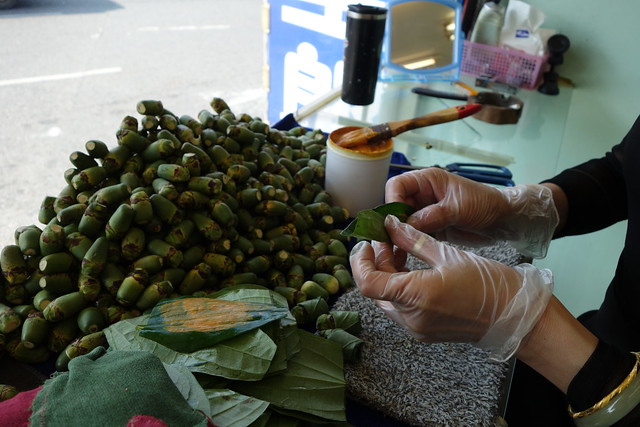
Wrapping betel nuts...

The KMT still knows how to play the old faction game, as the DPP lost in the most recent round of farmer's association elections...
All cities and counties have a pan-blue leadership, except Taipei and Taitung County, where there is no clear political affiliation, and Chiayi County, where the DPP is in control, according to reports.

The DPP’s effort to extend its influence failed completely in Yunlin County, the nation’s most significant agricultural county.

The DPP aimed to seek more than half of the seats in five of the county’s 20 farmers’ associations in a bid to lessen the control of the Chang family, but the DPP failed to obtain a majority in any of the associations, whereas all the candidates endorsed by the Chang family won.
The farmers associations are significant sources of political power, votes, and patronage fundings.

Meanwhile, the infighting in the KMT continued.

Have the powers that be in the KMT decided to put up Pan Wei-kang as a candidate in the Chairmanship election? Sharp observer Aaron Wytze noted that she is popular with the Old Soldiers and KMT women's groups, meaning that she is a threat to siphon off votes from current Chairman Hung Hsiu-chu's base. Pan was supposed to announce her candidacy today but I haven't seen any news on it.

Meanwhile Hau Long-bin, another KMT Chair candidate and former Taipei mayor, suggested running former premier Jiang Yi-hua (Apple in Chinese). I hope so. Jiang and Hau appear to be favorites of Ma, which will not make them appeal to the population at large, especially the under 40 group.

Just for kicks, former Ma Ying-jeou presidential adviser and former head of the Personnel Administration Bureau and current head of the KMT’s Evaluation and Discipline Committee Chen Keng-chin (陳庚金), called on public servants to “goof around as much as possible and milk their jobs for all they are worth” to “drag down the government.” Absolutely despicable.

Comic relief: Wu Den-yih, also premier under Ma Ying-jeou and another chairmanship candidate, said that the KMT was unable to cultivate talent because of Ma's integrity.
Wu said former President and ex-party leader Ma Ying-jeou's integrity and fears he would accused of favoritism saw him unwilling to promote close aides and associates to higher positions.
As Michal Thim pointed out in an analysis of this problem, Ma had the habit of appointing mainlander academics to positions in his cabinet, instead of appointing politicians out of the party. This meant that when they were done serving, they returned to academia. Thus, the KMT did not benefit from their experience, and few KMT politicians received practice in administrating large government bodies. The DPP truly is better at cultivating politicians.
_______________
Daily Links:
_______________________
Don't miss the comments below! And check out my blog and its sidebars for events, links to previous posts and picture posts, and scores of links to other Taiwan blogs and forums!
Thursday, February 09, 2017

Not The Onion: Beijing to commemorate 2-28

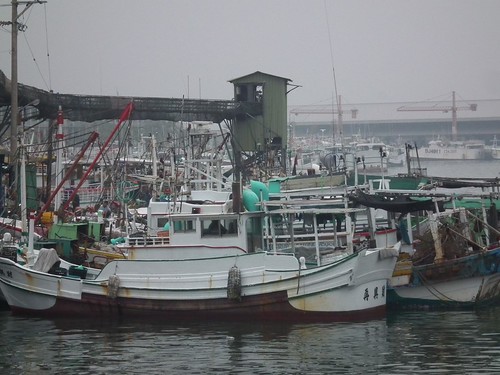
Fishing boats in Donggang

J Michael Cole has the news at Taiwan Sentinel:

Taiwan Affairs Office Spokesman An Fengshan told a regular press conference on Wednesday that China will hold a series of events to commemorate the 70th anniversary of the 228 Massacre in Taiwan.
That will be later this month... a previous conference was held on the 65th anniversary.
In his speech, Ji Bin said the 228 uprising was a “patriotic, democratic and autonomous movement of the Taiwan compatriots against the dictatorship of the KMT authorities at that time,” and “part of the struggle of the Chinese people for liberation and a glorious patriotism of Taiwan compatriots.”
Most observers in Taiwan are interpreting this in light of the Taiwan-China relationship. Many said, as Cole observed, that it represents direct appeals to the people of Taiwan, since the CPP has likely realized that the KMT can no longer deliver the island. Of course, as always, it attempts to subsume the island's independent history into the faux historical narrative of the CCP.

But I expect there is more than that. The CCP's biggest audience isn't Taiwan, but its own people. Remember that if China attacks Taiwan, the PRC is going to suffer economic, physical, and social harm. The people of China have to be psychologically and morally prepared for such privations. More than simply incorporating Taiwan history into fake CCP history, commemorating 2-28 shows the people of China that Beijing is striving in every way possible to bring Taiwan into the fold peacefully, so that it can present a "more in sorrow than anger" war to its own people, so it can say "every avenue has been exhausted, see?" Too many people think about Chinese government pronouncements about Taiwan as if they were solely foreign policy moves, in light of US and Taiwan policy. But Xi's Taiwan announcements are domestic political theatre as well....

This is even more urgent for Beijing because young Chinese are changing, as everyone I know who interacts with them is reporting. A recent poll said it was "surprising" to find that they are less nationalistic. This should not be surprising. Chinese youth are traveling more than ever before, both abroad and in their own country and its occupied territories. They are better educated, and many have been abroad for extended periods. Such experiences change people, and while making them love their nation more, make them more thoughtful about their national identity.

The reason it is "surprising" that Chinese youth are less nationalistic is because so much writing on China sources inflammatory quotes from the Chinese net, while making zero attempt to determine whether they are 50-centers planted on the net for the very purpose of managing this image of China abroad.

Speaking of managing the presentation...

...China is allegedly mulling changes to the Anti-Secession Law. Since the CCP can attack Taiwan any time it likes, for any reason it wants, the idea that this is a "law" is clearly something aimed at the international media (as well as a sort of reply to the Taiwan Relations Act). One change mulled is to make it part of the "law" explicitly that China will attack if Taiwan does not accept Beijing's One China principle. This change will probably never happen, because of the way it reduces the options Beijing has in dealing with Taiwan. Rather, a number of experts pointed out that Beijing is probably running a whisper campaign designed to put pressure on President Tsai Ing-wen.

Beijing is very good at this sort of media management. It was first reported in the Yomiuri Shimbun and will probably make the international media, especially the more pro-Beijing outlets. ZOMG TENZ!!But once again, it behooves me to point out what China is not doing: arresting Taiwanese businessmen, kicking Taiwanese out of China, cutting off exports from Taiwan, or any of hundreds of others moves it could make. Or any other move that might have costs for China. Talk is cheap, after all, and whispers even cheaper...
__________________
Daily Links:
_______________________
Don't miss the comments below! And check out my blog and its sidebars for events, links to previous posts and picture posts, and scores of links to other Taiwan blogs and forums!
Monday, February 06, 2017

Politics round-up

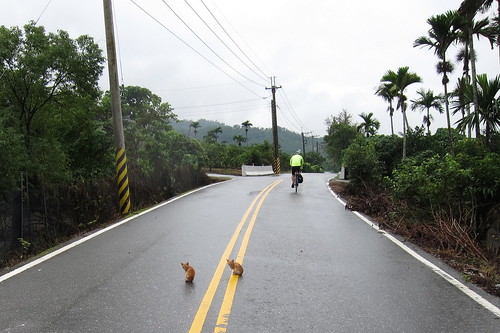
Little lost kitties.


Reverberating into local politics: Taiwan businesses in China are getting out as the China economy continues to slide. This will undercut the KMT argument, constantly made, that Taiwan needs to tie itself economically to China in order to survive. As each year passes, it is more and more clear that the golden age was under the Chen Administration, and the Ma Administration deeply impaired Taiwan's ability to engage China on Taiwan's terms.
"After the Lunar New Year holiday, we will likely see a large-scale shutdown of small to mid-sized businesses in China, including those run by Taiwanese people," said the Association of Taiwan Investment Enterprises on the Mainland (ATIEM), a corporate community made up of Taiwanese businesspeople in China.

The association said a wave of departures started around four years ago, adding that the current wave was different from before — in the past, while Taiwanese businesses would shut down factories in China, many kept their assets in the mainland as they maintained an optimistic outlook on the Chinese economy.

"They used to either keep their mainland savings in banks or invest in real estate, businesses ventures or the stock market. But what is different about the current wave of departures is that not only have the factories and assets left, people have stopped feeling any sort of sentimental attachment to the place altogether," an anonymous committee member of the association told local media.
Those Taiwanese businessmen remaining in China will be either too invested to leave, or true expats unwilling to return to the homeland, slowly becoming ever more out of touch with their homeland. Like all expats they have developed a set of elaborate rationalizations for their living outside of their homeland, which are often mistaken for meaningful political commentary.

Meanwhile the KMT continues to stumble. This week the news came out that the forms for new party membership application hilariously contains only places in China to be filled in as birthplace...
However, the party’s Web site for online membership application does not include most Taiwanese counties and cities as an option for the applicant’s place of birth.

Although it lists 59 locations for applicants to choose as their place of birth, no Taiwanese administrative division is included other than Taipei and Kaohsiung.
They probably bought it from a Chinese company. UPDATE: Nope. It was deliberately designed that way to comply with the Republic of China territorial boundaries.

KMT Chairmanship hopeful Steve Chan observed that the KMT might disappear if its internal splits continue. Report in English.

The big news this week was Tsai's cabinet reshuffle. As a commenter predicted here last year when this disappointing cabinet was picked, Tsai is moving out the technocrats, among whom are KMTers (Taipei Times report quotes observers noting that too many KMTers remain) and replacing them with politicians who can effectively run the ministries and campaign for the DPP. It's February, remember, and campaigning for the 2018 elections, which will be held in Jan Nov of 2018, will begin at the end of the year. I expect more cabinet members to be replaced. Tsai also reportedly plans a new cross-strait policy in time for the elections.

Also hilariously, Hau Long-bin, the KMT heavyweight, criticized the cabinet changes, accusing the DPP of nepotism since the new Minister of Labor is President Tsai's cousin, saying: “Nepotism is not good under any circumstances.”

Hau, readers will recall, is the son of KMT reactionary General and Premier Hau Pei-tsun, and owes his high position entirely to the fact that his father is a powerful KMT figure.

This habit of constantly replacing cabinet ministers is bad for Taiwan. Needs to stop... and Tsai's obliviousness to simple issues, such as appointing a family member to high posts in her administration, as well as appointing few women to positions in her cabinet, also needs to stop.
__________________
Daily Links:
  • Longtan Butokoden: photo and essay from Josh Ellis
  • Taiwan sees record high tourists in 2016. As expected. Excellent news for Taiwan. Nobody will even notice the loss of Chinese tourists, and as word gets around, tourists from more lucrative countries that aren't threatening to murder Taiwanese and take their island will come. And before you tell me something about soft power or people to people contacts or other nonsense, the Chinese group tourists were simply making China even more despised. The individual tourists are far more respectful and likable.
  • Thursday = COLD FRONT
  • Cambodia is rapidly turning into a protectorate of China (along with Laos). The PM this week banned the ROC national flag in deference to Beijing, but asked for Taiwanese investment to continue.
  • Joe Hung, the reactionary KMT commentator, with another round of comical spew in China Post. A good look into what the Deep Blues actually think.
  • NOT FAKE NEWS: Comically, after years of regurgitating Chinese propaganda about Taiwan in reports studded with errors and misunderstandings, BBC is producing a site dedicated to fighting fake news. Hint: look in the mirror, BBC. 
  • INTERNSHIP:  Winkler Partners, law firm in Taipei, great place to work full of great people. Apply for our paid international law student internship before 15 February and join us in Taipei, Taiwan! http://bit.ly/1NWwsdd
_______________________
Don't miss the comments below! And check out my blog and its sidebars for events, links to previous posts and picture posts, and scores of links to other Taiwan blogs and forums!
Saturday, January 14, 2017

Taiwan News #8: So much KMT.... =UPDATE WITH MORE AWESOMENESS=

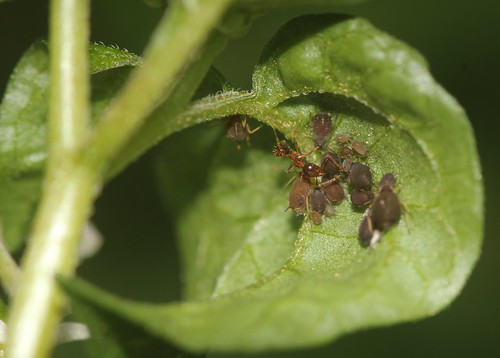
Ants tending aphids. They've curved several leaves around, and parked the aphids inside.

My latest piece in Taiwan News is on the KMT Chairmanship election and its latest developments.
The KMT Chairmanship election heated up with both former Taipei Mayor Hau Long-bin and former Vice President Wu Den-yih challenging current KMT Chair Hung Hsiu-chu for her seat in the May 20 election. This trio was immediately parodied by Taiwan netizens as Hau-Wu-Chu (好無助), a homonym for "hopeless." Wu, a practiced politician, delivered an Oscar-worthy press conference, a Noh play of traditional references to Sun Yat-sen, calls for "power under unity" for the KMT, and a mask of tears for the memory of President Chiang Ching-kuo, who has the same kind of sainthood for the KMT that Ronald Reagan does for the US Republican party. Clearly the ability to summon tears at will is a must for would-be politicians in Taiwan.
Should be "so hopeless" not "hopeless".

None of these politicians has much of a following outside the KMT. Indeed, this week Hau observed that Wu is one of the least popular politicians among the population at large, and said that if elected Chairman, he would make Terry Gou (Wiki), the head of Foxconn, the 2020 KMT presidential candidate. Gou is a (1) big businessman whose (2) primary business is in China, and (3) who will be 70 in 2020. I am sure that 1, 2, and 3 will make him very attractive to younger and working/middle class Taiwanese, and to younger members of the KMT.

But from the KMT point of view Gou would have one priceless quality: he could afford to pay for his own election campaign. The KMT might not be able to...

Steve Chan, who resigned his KMT Vice Chairman position last week, announced his candidacy. Some of you might recall that Hung Hsiu-chu was in SE Asia a while back trawling local Chinese communities for support -- this week she is in the US doing the same.

At least we did get an entertaining alternative candidate for the KMT Chair in the person of Han Kuo-yu... UPDATE: but for sheer awesomeness this song for Wu Den-yih announcing his candidacy cannot be beat.

In the DPP other individuals are declaring their interest in candidacies. Kuan Bi-ling, the DPP politico, said she'd be interested in running for K-town mayor. The tussle over New Taipei City, currently the nation's largest, looks to be quite interesting, especially if current Tainan mayor William Lai shows an interest in running, which he should do if he wants to become President. He would likely beat all comers. But for 2020 and beyond, many of us are thinking current Taoyuan mayor (can you even think of his name?) ____ will be a powerful dark horse presidential candidate. He's popular and appears to be doing a good job in Taoyuan. Current Taichung mayor Lin Jia-long is also said to harbor presidential ambitions.

The DPP's discussion of who gets what merely emphasizes how its geographic advantages are so powerful -- the DPP has a lock on the south and can develop new candidates with wide population bases, whereas of the KMT-held areas Miaoli, Nantou, Hualien, and Taitung lack the money and population to vault a politician to national prominence, except for corruption allegations. Whoever wins the DPP nomination in K-town and the election will automatically come into consideration as a possible presidential candidate, and certainly for higher national posts such as Premier.

Also apropro: Timothy Rich: Can the KMT rebuild itself?
_______________________
Don't miss the comments below! And check out my blog and its sidebars for events, links to previous posts and picture posts, and scores of links to other Taiwan blogs and forums!
Thursday, January 12, 2017

KMTers still distancing themselves from the KMT

Newly opened office of a KMT politician in Fengyuan. But... where is the familiar KMT logo?

Yup. Buried at the bottom of the sign. And of course the big characters at the top above "Forward Together" say "Taiwan". Next to the KMT logo is his title "Legislator" and name. But nothing on the sign except the blue color and the tiny non-standard KMT logo signal his party affiliation.
_______________________
Don't miss the comments below! And check out my blog and its sidebars for events, links to previous posts and picture posts, and scores of links to other Taiwan blogs and forums!

Saturday, December 31, 2016

Taiwan News #6 and more on the KMT!

Anime drawing of KMT Chairman Hung Hsiu-chu posted to her Facebook page. It says "Chu-chu" (a cute diminutive form of her name) will not lead the KMT to "New Partyization". We have to let the members of the New Party and the People's First Party will come back to the KMT, it says.

My latest for Taiwan News...
Supporting Yang was Sufin Siliko (Liao Kuo-tung,廖國棟), the KMT's legislative caucus whip, an Amis aborigine, who called on Hung to step down for being a chairperson who "brazenly violates the party's internal rules." Liao warned that if the party did not follow its rules, there would be a civil war within the KMT.
This week the news of the KMT's internal struggle has come out in the open. That piece I wrote on Wednesday night. It details the pushback and eventual compromise over Hung's moving the election date and her attempt to flood the party vote with the Old Soldiers who support her. Hau Long-bin, the former mayor of Taipei, and Wu Den-yi, the former vice-president, leagued against her. Consider Sufin Siliko's criticisms, enumerated in a piece in TT warning that the KMT could split if Hung wins again:
  • Sufin said no party member, including KMT Vice Chairman Hau Lung-bing (郝龍斌) and former vice president Wu Den-yih (吳敦義), ...dares to openly challenge the veterans’ branch.
  • senior party members and businesspeople have come to him expressing concerns that the KMT might create a new party
  • the party shouldn't move to the right, but "...the 100-year-old KMT needs to stand in the center in order to be the ruling party again,” he said.
  • “We the caucus want to get out of the quagmire [of ill-gotten party assets] as soon as possible, and uphold that the party assets except those required for personnel expenditure have been dealt with,” he said.
  • “The caucus wishes to maintain the [so-called] 1992 consensus, which says ‘one China, different interpretations,’ while the headquarters wants ‘one China, same interpretation,’” he said.
The latter three are things that many of us on the outside, and many more moderate types within the KMT, all realize must be done if the KMT is to survive...

Liao was also calling for younger leadership, according to the KMT news organ... and trying to get Wu Den-yih to run for head of the party....
When asked by media, Liao stated that many KMT legislators, including himself, had urged Wu Den-yih to run for the KMT chairmanship, but Wu was not forthcoming with a response.

Liao stated, “More and more people within the KMT caucus have expressed the hope that the KMT could choose a young leader. Johnny Chiang is a popular candidate. A young leader will give the KMT a new image and bring more opportunities. However, the question is how to convince elders within the party that it is important for them to pass the baton to the younger generation.”
.
The current struggle will likely result in a leader from the older generation...

Hung is far to the right of center even in her own party. This week she spoke to university students and was the hero of the Chinese exchange students... and called for political negotiations...
“The reality is [Beijing] believes its sovereignty claim covers Taiwan, and Taiwan vice versa, so the sovereignty claims of the two sides actually overlap,” she said, calling for mutual recognition of governance and a step forward toward political negotiations rather than restricting cross-strait talks to economy-related matters.
This is an extreme position, not supported in Taiwan's society at large, and not supported in her own party. Apparently she learned nothing from her presidential run.

Will the KMT split? Probably not. The obvious split is between the rightist mainlanders and the moderate mainlanders + Taiwanese. The former unofficial leader of the Taiwanese KMT legislators, longtime legislator Wang Jin-pyng, is basically powerless. He will not lead a Taiwanese revolt. Wu Den-yih, probably the highest ranking Taiwanese, is a servant of the mainlander elites and will never revolt. Who else would lead a split? A putsch against Hung is far more likely, but as long as she keeps the Old Soldiers in her pocket, she's powerful.
_______________________
Don't miss the comments below! And check out my blog and its sidebars for events, links to previous posts and picture posts, and scores of links to other Taiwan blogs and forums!

Monday, December 26, 2016

Cosplay Nazis. Yeah, sure. It's not only that. =UPDATED=

Thanks, China. You're even occupying our air.

UPDATE: Kerim Friedman has some very useful commentary on this incident. Also, re the MC's comments on the Wushe cosplay incident below, a Keen Observer pointed out to me that it might have simply been shouted out in the heat of the moment. I haven't commented more because I don't feel I have a clear understanding of why Nazi kitsch is so popular here.
*****

Everyone is now aware of the totally tasteless and stupid cosplay event in which students from a high school in Hsinchu dressed up as Nazis (report in Chinese). The Jewish Center in Taiwan has issued a statement on it.

The internet is full of sudden expertise in the matter of power fetishes, costume displays, Nazism, ethics, and so on. Old incidents are being brought back to light. I am not going to rehash that here, it's been beaten to death. But my man Drew Kerslake alerted me that this is not the first time the school has been involved in a crypto-fascist cosplay. Ltn reports that on that same day of school celebration another year....:
.....還有另一個班級cosplay霧社事件,司儀還喊出「打倒日本鬼子,光復我中華民族」。
...had another cosplay, of the Wushe Incident, whose Master of Ceremonies shouted "Fight the Japanese Devils, Restore our Chinese people!"
光復, the name of the school, is the KMT code term for the "restoration" of Taiwan, so the mention of it would immediately suggest that to the listeners, and would align and subsume the aboriginal revolt against the Japanese colonial people with the ROC and its imperial expansion. Note how the speaker even turns the aborigines into "Chinese".

There's a problem here.
_______________________
Don't miss the comments below! And check out my blog and its sidebars for events, links to previous posts and picture posts, and scores of links to other Taiwan blogs and forums!

Saturday, December 24, 2016

Taiwan News Number 5: KMT Chair election

A woman feeds stray dogs.

This week my piece was on the KMT's Chairmanship election, which has been moved up from Aug to May of 2107.
Potential rivals are few, and all are wounded. The "princelings," the children of KMT elites, lack appeal. Eric Chu, the current Mayor of New Taipei City, the one municipality still controlled by the KMT, performed poorly in the Presidential election and worse, is half-Taiwanese and thus suspect to many staunch mainlander voters. Hau Long-bin, the son of reactionary old KMT heavyweight Hau Pei-tsun and the former mayor of Taipei, lost an easy legislative election in 2016 in Keelung, long a KMT stronghold. Other names frequently mentioned include princeling Sean Lien, the son of heavyweight Lien Chan, who lacks appeal outside the deep Blues, and former Vice President Wu Den-yi, whose power base is in sparsely populated Nantou and who is Taiwanese. Except for Wu, who is a formidable politician with deep links throughout the party, none are likely to pose a great challenge to Hung.
I consider Wu more of a threat, in the sense that Huang Min-hui was a threat, because he is Taiwanese and can appeal to that large and dissatisfied wing. I have heard it was Wu who helped keep the KMT in line in the second Administration of Ma, when grumbling was widespread. Hau is also revered by the Old Soldiers since he is the son of the reactionary politician and general Hau Pei-tsun. But that loss in Keelung really hurt him.

After I wrote this and sent it in, Hau came out against the recent moves to change the position of the Old Soldiers in the party, indicating he is probably courting their votes. Perhaps he will run in May. If the Old Soldier votes, which determine the outcome, are split, then someone like Wu may have a chance. But in the end I still expect Hung will win. Hau may be a princeling, but the Old Soldiers can see that Hung is one of them. Moreover, Hung is an authoritarian ideologue and more KMT than the KMT, while Hau had to govern in the real world and lacks those qualities... UPDATE: Hau and Wu are leagued against Hung.

KMT-sympathetic news orgs were reporting that Ma was considering a run too. Still no new blood...

2020? Whoever becomes Chairman is automatically the next presidential candidate. I doubt the KMT will become wise enough to separate the two; the DPP certainly hasn't. Want to know who the next KMT candidates will be? Watch who makes pilgrimages to China to receive the blessing of the CCP...
_______________________
Don't miss the comments below! And check out my blog and its sidebars for events, links to previous posts and picture posts, and scores of links to other Taiwan blogs and forums!
Thursday, November 03, 2016

Xi-Hung Meeting = Big Nada

Preparing for a neighborhood event...

Brian Hioe at New Bloom summed it up...
THE FACT THAT Hung Hsiu-Chu’s meeting with Xi Jinping in Beijing has largely been a non-event in Taiwan probably attests to its futility. Given that Hung is already known for outlandishly extreme pro-unification views, Hung’s meeting with Xi probably does not really surprise the Taiwanese public, in the way that Eric Chu’s or Ma Ying-Jeou’s meetings with Xi Jinping in 2015 provoked stronger reactions. Hence the lack of any real public response. But does the Hung-Xi meeting indicate anything new?
Brian and I had a good laugh about the Xi-Hung meeting over drinks last night. The only people who really cared about the meeting were the international media.Beijing well understands how this ritual of the Beneficent Emperor presiding over a visit from an eager vassal looks to the media, which loves a good TAIWAN IS TENZ! story. Bloomberg's hilarious headline was China’s Xi, Taiwan opposition leader voice concern over tensions. Voice concern over tensions... they themselves caused, as a friend pointed out on Twitter.

Prior to the meeting J Michael Cole had wondered aloud over at CPI what agreements Hung might make with Xi. But Xi, meeting in his capacity as Party Chairman rather than Emperor of China, was never going to make any agreements with the isolated head of a fading, split party whose members he undoubtedly plans to use and then have shot when China comes over.

The issue highlighted what many of us have said for a while now, some for over a decade now, that China has no Taiwan strategy (Cole wrote on that this week as well). It is simply following the well-worn grooves of its reflexive actions of the part, supplying ceremonies to satisfy its domestic audience. AP reported that...
Chinese President Xi Jinping met with Taiwan's opposition leader Tuesday, underscoring Beijing's message to the island's independence-leaning administration that it won't have access to the mainland's highest levels of power if it doesn't accept that Taiwan is part of China.
...but it could just as well written that Xi has no access to Taiwan's highest levels of power. Xi's refusal to deal with Tsai has not painted Tsai into a corner. Instead, it has forced the CCP to court a political party whose influence is fading, limiting the CCP's ability to affect Taiwan politics. Since it won't deal with DPP politicians it can't court, influence, or subvert them. It can't makes its case to pan-Green voters. As if to underscore that, the CCP even banned reporters from pro-Green papers from covering the meeting. This strategy could hardly be more self-defeating.

Fortunately the CCP is too ideologically blind to realize that. Indeed, the KMT once again reminded voters what its values are, which won't help it at the polls -- each kow-tow to the CCP reinforces the KMT's irrelevance for Taiwanese voters. As Brian H pointed out in his piece, even Ma Ying-jeou, whose China policy was one of the chief causes of the KMT's catastrophic 2014 and 2016 election losses, realizes this.

The pro-KMT China Post reported that the chief difference between Hung's trip was that the KMT itself is split....
Lawmakers banded together and called for assurances, revealing a divide between party headquarters and the KMT rank and file. The legislators called on Hung to be sensitive to the KMT's current image problem, pleading for her to make "certain statements" at "appropriate settings."

The internal strife was clear in reports that Hung and former President Ma Ying-jeou clashed over viewpoints on the "1992 Consensus."

Ma reportedly attempted to drive home the importance of its "different interpretations of one China" clause, while Hung showed a reluctance to be boxed in.

The ensuing public spats between Central Policy Committee Director Alex Tsai and the aides of former President Ma offered few reassurances that consensus within KMT existed before Hung left for China.

It was under these two sources of pressure that Hung promised a no-frills encounter with Chinese leader Xi Jinping. A perfunctory checklist would indicate that Hung did what was advised and has managed to stay out of trouble. Barring last-minute contingencies, her trip has not derailed the KMT in any dramatic fashion.
Behind closed doors, certain media reported Xi said Taiwan independence would destroy the CCP. Thanks for supplying another incentive for Taiwan independence.

The Cross-Strait Peace Agreement that Hung keeps touting is hugely vague on the details. It will never work -- if peace is institutionalized across the Strait Taiwan will move further towards independence -- only the CCP threat to murder Taiwanese keeps the island from declaring independence. Beijing understands this, which is why Xi was cold to the idea. Institutionalized peace institutionalizes Taiwan as a de facto independent state.

Surely the KMT must realize this. The Party is not pursuing it on behalf of Taiwan, but on behalf of the ROC, a virtual state which must, whether China comes over or Taiwan becomes independent, be swallowed up by history. Institutionalized peace institutionalizes the continued existence of the ROC and the KMT's umbilical connection to it -- it institutionalizes the possibility of a continued future for the KMT.
_______________
Daily Links:
_______________________
Don't miss the comments below! And check out my blog and its sidebars for events, links to previous posts and picture posts, and scores of links to other Taiwan blogs and forums!
Thursday, September 15, 2016

How dumb is China?

Entering Fengyuan Station.

UDN, the rabidly pro-KMT paper, reports on the story of KMT mayors being invited to a forum in China.
新竹、苗栗、南投、花蓮、金門等國民黨和無黨籍縣市正副首長共8人,16日將應中國國台辦之邀,赴中國參訪,研擬爭取陸客來台到「有九二共識」的縣市觀光旅遊。代表新北市赴陸的副市長葉惠青接到記者詢問,態度十分低調,強調此行主要是看到了民間產業的需求,為民間服務,「每一個市場都要爭取」。
KMT and "independent" Mayors of Hsinchu, Miaoli, Nantou, Hualien, Kinmen, and two other places, a total of eight people are heading off to China. These represent, according to the article, the "1992 Consensus areas". LOL.

No DPP mayors are invited.

Here's a double stupidity. First, China makes it impossible to separate the KMT from China, so it can't Taiwanize. Indeed, China might be sophisticated enough to realize that is a possibility, and so it continues to sink hooks into the KMT to make sure it can't put distance between the two. But I kinda doubt China is that sharp. So now every voter in Taiwan is reminded of who the KMT is sleeping with.

I've noted this before: once again, by being inflexible, China has given up an opportunity to subvert DPP mayors and to talk to DPP constituents, and to look diplomatic and reasonable.

And then there's the KMT. If you were a smart politician in a contested region, you might consider not going, to put some distance between you and the CCP. Eric Chu, as head of New Taipei City, is an invitee, and New Taipei City will be hotly contested in 2018 (now less than 1.5 years away). What will he do? I'd beg off, if I were him.

Meanwhile, in Japan, the new Democratic party head is a half-Taiwanese who is very aware of her links to Taiwan. This is good for Taiwan.
_______________________
Don't miss the comments below! And check out my blog and its sidebars for events, links to previous posts and picture posts, and scores of links to other Taiwan blogs and forums!
Friday, September 02, 2016

Still your father's KMT

Above is a poster from the Facebook of KMT Chairman Hung Hsiu-chu. She's flooded her Facebook with similar images. This one shows her as an anime character, and she's asking in Chinese: "Young people, let me ask! Why do you hate the KMT?"

The answer, of course, lies within the KMT itself. The TT reported on the continued retrograde motion of the KMT under the guidance of Chairman Hung:
Some Chinese Nationalist Party (KMT) members yesterday voiced dissent after KMT Chairwoman Hung Hsiu-chu (洪秀柱) on Tuesday said that the party leadership has drafted amendments to the party’s policy platform, which is to be discussed at the party’s national congress on Sunday, to align its efforts to strengthen the so-called “1992 consensus” and explore the potential for a “peace agreement” with Beijing.
The KMT's top down leadership style on display -- once again, no reform in sight under Hung:
“Major policy proposals should be bottom-up discussions. I do not understand why the party leadership is rushing this,” KMT Legislator Lai Shih-bao (賴士葆) told the United Daily News. “At the very least, the party’s rank-and-file members should have been consulted, and the KMT Central Standing Committee should have voted on the issue before it was submitted to the national congress.”
Remember this from 2005 if you are tempted to imagine the KMT will reform:
Members of Super KMT II, which takes its name from SKII, a kind of cosmetic which claims to help maintain an appearance of youthfulness, vowed to become key reformers in the quest to bring young people back to the KMT. Jul 8, 2005
No young people? Complaints about that for more than a decade now, though apparently the KMT has the superior infrastructure. Brian Hioe noted the other day:
However, the KMT still maintains a sizable and active youth section. Interestingly enough, despite the fact that the DPP absorbed many young people drawn from post-Sunflower civil society for the Tsai campaign, the DPP has never been able to build a comparable youth section to either the KMT or TSU.

And it is that in the KMT’s moment of crisis, young people within the KMT are calling for internal party reform in order to rescue the party—with some surprisingly sympathetic responses from post-Sunflower youth activists. The Grassroots Alliance (草協聯盟) and leading figure Hsu Hsiao-Chin (徐巧芯) have been much discussed in Taiwanese civil society as of late.
Hoie sharply notes that KMT young are much-discussed and sympathized with by outsiders, who recognize that they have grown up in what I call the Church of the KMT -- in its ideological bubble."This may be another sign that Taiwan’s current young may have moved beyond ethnic identity politics in the post-Sunflower political paradigm," he notes. But he goes on...
And it is that members of the Grassroots Alliance has been targeted most often not by their peers on the other side of the political aisle, but by older members of the KMT. The Grassroots Alliance and its key figures have been attacked from the beginning through claims that members have been brainwashed by the DPP or are “light green.” One imagines that, given the absolute loyalty of young members of the Grassroots Alliance to the party as a matter of personal identity, it is not exactly pleasant for members of the Grassroots Alliance to come under attack by the party when their calls for reform seem rather earnest in nature and done with the best interests of the KMT in mind. If this is the way the KMT treats their young, perhaps we can see why efforts at reform have been stymied, and why the KMT has such difficulty grooming young leaders and advancing them to positions in which they could take power as the next generation of the party—meaning possible extinction as a party when there is nobody left to carry on the party torch.
Indeed, in the TT article at the beginning of this piece quotes KMT Chair Hung criticizing the young:
Hung criticized Tsai’s comments about Taiwan’s “naturally independence-leaning” younger generations, saying: “It is an artificial pro-independence sentiment ... [that was] manipulated by politicians who made young people forget about the Republic of China’s history and cross-strait ties to “cut the umbilical cord” between Taiwan and China.”
When you are viewing things through the lens of ideology, opposition is always explained in terms of conspiracy...

And then there is this...
"Meetings held by the KMT Central Standing Committee consist of one person laying down the law. There's no democracy at all in the party," Yang said. March 24, 2000
Nothing has changed. The party rank and file are just cannon fodder, the real decisions are made by elites.

Moreover, the policies that Hung is advocating, especially the "peace agreement" which is a non-starter with little support outside the KMT, are old. The idea of "peace agreement" was originally proposed by then-independent and former KMT heavyweight James Soong as he ran for president in the 2000 election.... (TT, March, 2000)
"While the political dispute cannot be settled at once, I would like to use cultural and economic approaches to promote a friendly atmosphere, in the hopes of pushing through a 30- to 50-year peace accord under the auspices of international witnesses," he said.
These "peace agreements" are never concretely spelled out because the KMT likely sees them as a way to annex Taiwan to China and to neutralize Taiwan in China's favor in the ongoing hegemonic struggle between the US, Japan, and China. It's hilarious to hear Hung talking about them fifteen years of non-start later, and even more hilarious to read in the media that Tsai does not have a coherent foreign policy given the KMT's current utter lack of a concrete foreign policy (for which the party is never criticized in the foreign media).

Hung did signal that the KMT will engage in independent diplomacy with China, which will likely make Beijing laugh...

Michael Danielson had a piece in the TT today assessing the KMT's first 100 days in opposition. Observing that "the KMT lost China and now it is going to lose Taiwan", Danielson reminds us:
Finally, the KMT continues to promote the “1992 consensus” as the savior of the nation’s economy and its relationship with China. Beijing’s reaction to Tsai has been relatively modest. Retrospectively, the KMT’s obsession with the “1992 consensus” has not given Taiwan more real international space, but rather contributed to the KMT’s downfall through the Sunflower movement and Taiwanese’s negative reaction to an economic integration with China, which they fear would lead to more social inequality.
Since integration with China has driven Taiwan's social inequality, it is not surprising that the public objects to more.

Danielson correctly observes that Beijing did little for Taiwan's international space. The two, social movements and international space, are connected -- J Michael Cole cogently argued last year that China, seeing that Ma was hamstrung by the Sunflowers and domestically weak, had decided to punish Ma by implementing the new flight routes that came dangerously close to Taiwan's. People have already forgotten that the free trade agreements with other nations promised by President Ma if Taiwan signed ECFA never materialized because Beijing blocked them, as the Ma Administration complained.

The truth is that "progress" in cross-strait relations often lauded by commentators either never really existed or else actively harmed Taiwan's interests.
_______________________
Don't miss the comments below! And check out my blog and its sidebars for events, links to previous posts and picture posts, and scores of links to other Taiwan blogs and forums!
Tuesday, August 23, 2016

Two Hit Pieces on the Tsai Administration

We were heartbroken to lose our beautiful lab/retriever mix to kidney failure a couple of months ago. Then yesterday I was in the street in front of our house parking my scooter when this dog, a neighbor's, ran over to say hello. He is super friendly, and of course I greeted him. I remarked to our neighbor on how gorgeous he was and joked that I wished he were mine. My neighbor laughed and said I could have him, because he was her daughter's and neither mom nor daughter wanted him. Next thing I knew, we'd adopted him. So wonderful!

First, the good news. AP has made a quantum leap in quality in The Formula:
China claims Taiwan is its own territory, to be brought under its control by force if necessary. Tsai's election upended Beijing's strategy of using economic inducements to convince Taiwanese that political unification is not only inevitable but also in their best interests.

Tsai's Democratic Progressive Party holds a strong legislative majority and favors Taiwan's formal independence from China, although she has taken no steps toward that goal.

Despite that, her refusal to endorse the concept of a single Chinese nation prompted Beijing to suspend the liaison contacts days after her inauguration, in an attempt to ratchet up pressure on her.

Although China says Taiwan has been part of its territory since ancient times, the two sides have only been unified for four of the past 120 years, splitting most recently amid the Chinese civil war in 1949. Taiwan does not acknowledge Beijing's claim of authority over it, while surveys show an overwhelming majority of Taiwanese favor maintaining their current state of de-facto independence.
Depending on what you mean by "unified" AP is wrong to say for those four years Taiwan was "unified" -- the ROC occupied it on behalf of the wartime Allies and it was not (and is not) part of China. But note the care that AP takes to present the Taiwan side in this, and also to correctly define the 1992 Consensus (not even mentioned!!!) as what it is: the demand that Tsai say Taiwan is part of China. This is a thing lovely to see. Mega kudos and beers on me, if I ever meet this writer.

Aside: My observant friend pointed out to me another fascinating aspect of Tsai's apology to the aborigines: her apology re-orients all groups on the state as a neutral arbitrator with all citizens having a state-based citizenship, rather than the KMT vision of a ethnic-colonial state with a Han ruling elite redefining and then playing off local ethnic groups against each other to maintain power (a classic imperial ruling mode). Creating a neutral and Taiwan-centered State is a key yet little noted aspect of the post colonial transition Tsai must manage.

Sadly, the last week saw two hit pieces on the Tsai Administration, President Tsai Ing-wen ‘losing control’ of Taiwan’s pro-independence camp from Lawrence Chung in SCMP, whose pro-China/KMT political stance is obvious, the other from Ralph Jennings in the LA Times, Taiwan's ties with China slip as new president fumbles for a formula. Both hit pieces open with headlines that emphasize the President is losing control and directionless.

The Chung piece, despite its political views (even quoting those unnamed analysts) was actually more balanced: it gave views from the Green camp in last two paragraphs (placed where they could be most easily cut by the editor, but still...). The Jennings piece contains little of such balance and worse, is studded with erroneous claims and KMT propaganda attacks. Let's look at that headline:
Taiwan's ties with China slip as new president fumbles for a formula  
The direction of the attack is obvious from the beginning...

Onward:
It demanded stronger safety measures for its travelers on the island. Chinese state media warned that tourists might stop going to Taiwan. 
Note the sequence in Jennings’ piece: China reacts to the crash, innocent victim style.  Reality: China is being opportunistic, using "safety" as pretext for already-planned tourism cut (Jennings notes that planned cut elsewhere). Unlike previous crashes with clear causes, this one was murky and perhaps a murder-suicide. All that context was just removed, because it complicates the simple-minded anti-Tsai narrative that Tsai disrupts relations.
But since Taiwan’s new president, Tsai Ing-wen, took office in May, China has grown surlier and no one is sure how much further it will go. And the abrasiveness cuts both ways: Despite the pledge to help families in the tour bus disaster, Tsai is considerably less conciliatory to China than her predecessor.
Kudos for the first sentence -- so rare in the international media to see agency forthrightly assigned to China. But then comes the false equivalence between aggressor and victim: “abrasiveness cuts both ways”. Apparently resisting annexation is “abrasive”.  And of course the global media double standard: Baltic Republics resisting Russian expansion? Plucky heroic democracies. Tibet and Xinjiang? How sad. Taiwan resisting Chinese expansion? Abrasive!

Please concretely identify an "abrasive" comment from Tsai Ing-wen on China since becoming President.

Also Ma was not "conciliatory". His party was actively allied with the CCP in annexing Taiwan to China. But none of that ever appears in the western media. Jennings even quotes the MAC:
“We need to know people’s views and keep listening to other people’s voices,” said Chiu Chui-cheng, spokesman for Taiwan’s China policymaking body, the Mainland Affairs Council. “With so much flexibility and goodwill, we think China should show support and understanding.”
Very conciliatory language. But apparently it's "abrasive".

Jennings...
“President Tsai is still trying to find a solution,” said Liu Yi-jiun, public affairs professor at Fo Guang University in Taiwan. “She’s entering … the tunnel and she’s still far away from the end. ... She needs to say something not to discourage the Chinese leaders.”
Liu Yi-jiun’s web page at the university is here. In fact if you search the name, the vast majority of hits are from… Ralph Jennings’ articles.  Despite the large number of observant, heavyweight journalists, academics, commentators, and political players in the capital, Jennings draws quotes monotonously from an academic at a second-tier university in the hills outside Taipei.

Apparently it never occurs to these commentators or writers that Tsai might know what she was doing and it is they who are clueless. But then "Tsai is smarter than us" wouldn't make good copy...
Beijing wants Tsai’s administration to enter a dialogue in which each side casts itself as part of a single entity known as China, though subject to different interpretations — a bit like China’s “one country, two systems” approach to Hong Kong. 
This is just a plain error: Beijing has NEVER accepted the “two interpretations” codicil. That that claim is KMT propaganda. Beijing does not want Tsai to "enter into a dialogue". It wants Tsai to say that Taiwan is part of China.

Progress: in several of the last few articles I have seen, the bogus term 1992 Consensus has entirely disappeared. Apparently even editors in newsrooms far away have realized it is bullshit and are now searching for formulas to represent it.

Jennings continues:
Complicating matters are the China-related mishaps, including the bus fire, that have mounted quickly under Tsai’s watch.
That and the errant missile are the only China-related mishaps. The others named below it either have nada to do with China, or were caused by China. Such problems occur at the same rate as during other presidencies (remember the falling crane, the train derailment on Alishan, the Suhua Highway Bus Crash, or the 2015 Transasia airplane crash? All killed Chinese tourists), but if that were said, Jennings' "mounted quickly" narrative would disappear. In fact tourism is dangerous and Chinese (and all other!) tourists are regularly involved in deadly incidents of all kind all over the world, but why provide context? Too rational, that...

Jennings:
In July, Beijing’s top Taiwan policy advisor predicted a “severe” effect on relations after the island’s navy misfired a supersonic antiship missile. 
This scene will be familiar to readers: western media forwards Chinese propaganda with neither further investigation nor caveats. Note that no “severe” effect on relations has occurred since -- it is nearly September. Jennings does not bother to mention that, of course. Stenography like this is how the media creates the appearance of tensions: since no one will bother to report that nothing happened, readers abroad will naturally assume that something serious has subsequently occurred.

Never mind that if something "severe" occurs, it will not because of some errant missile, but because China was simple waiting for some incident it could blame for its change of policy.

Jennings:
This month, Kenya deported five  Taiwanese citizens to China, drawing a “strong protest” from the Foreign Ministry in Taipei.  Beijing persuaded Kenya to hand over the Taiwanese, who will probably be charged with fraud, on the premise that they all belong under one flag, that of China.
No other news article makes the claim that Beijing wanted the men because they were “Chinese”. AFAIK Beijing has never asked for the men for that reason. Instead, the Chinese asked for the fraud suspects over a year ago in Jan of 2015 on the (internationally valid) grounds that the crimes had been committed against Chinese, Beijing’s consistent position throughout and with deportations elsewhere. This claim of Jennings’ appears to be a very serious error. Happy to correct if  anyone can supply documentation.
But the absence of talks since Tsai’s inauguration has meant the freezing of any new economic deals.
Talks are not “absent”. They were cut off by Beijing. You can be sure that if Taipei had cut off relations, the international media would be having kittens. But Beijing’s actions are always made to vanish via passive framing. Let’s rewrite that so it is clear...
“But Beijing’s decision to cut off official communication since Tsai’s inauguration has meant the freezing of any new economic deals.”
Jennings continues:
China hoped Tsai would offer an extension of the upbeat relations of the previous eight years, when Beijing-friendly President Ma Ying-jeou agreed to see the two sides as part of one China. That allowed the governments to build trust and sign 23 deals related to trade, transit and investment.
This is just rank nonsense. Ma did not “agree” to see Taiwan as part of China, as if that had ever been in doubt, he has always believed that. Rather, the “trust” occurred because both sides wanted to use economic deals to put Taiwan in China’s orbit, because both espouse the same brand of Han Chinese nationalistic expansionism. At least Jennings observes that Ma was seen as too close to China.

Jennings:
Taiwan should make “concrete efforts for the resumption of cross-strait communication,” China’s State Council Taiwan Affairs Office spokesman, Ma Xiaoguang, said this month, according to the official New China News Agency.
Again, stenographer for Chinese propaganda, reported without analytical comment.  Above it does note that China cut off semi-official communications – but that caveat should be here.

Jennings:
Tsai’s government has discussed no specific proposals to improve ties with China, saying it needs a clearer idea of Taiwanese public opinion before making any moves. But it’s now reviewing existing regulations on Taiwan-China interaction with a view toward improving them, a government official said.
This is what Tsai has always said: the Administration’s policies will be rooted in the people’s desires and the Constitution. Tsai’s characteristic move is to let her opponents talk. She is following that strategy.

Thus, Jennings inverts reality: Tsai knows what she is doing and has a legal basis for her policy, it is Beijing that is confused and uncertain about how to handle a pro-Taiwan government in power in Taipei.  But none of that will be presented in a western media piece, and Beijing’s bombastic quotes will be reproduced without analytical comment by the writer.

Even more urgently: the claim that “Tsai should clarify her China policy” is not a neutral political observation by analysts. It was, throughout the presidential election campaign, a constant refrain of the KMT’s candidates that the DPP should clarify its China policy. No sensitivity is shown to that in this article. Instead, this charge is presented as if it has no history as a KMT propaganda attack (ex: April 2015, May 2015, Dec 2015 review in the Diplomat).

Indeed, the attacks in this piece from Jennings are simply an expanded version of KMT Chairman Hung Hsiu-chu's attacks on Tsai:
Hung said she has misgivings about the incoming DPP government’s ability to handle cross-strait problems, adding that the relationship would return to the same state as eight years ago, with economic exchanges dwindling, the number of Chinese tourists dropping, military matters becoming more tense and the diplomatic truce ending."
Withal, this LA Times article is little more than a KMT political attack on the Tsai Administration. It is absolutely shameful.

Sucks. Think I'll go hug my dog now.

UPDATE: I removed a section. My deepest apologies to Denny Roy.
_______________
Daily Links:
_______________________
Don't miss the comments below! And check out my blog and its sidebars for events, links to previous posts and picture posts, and scores of links to other Taiwan blogs and forums!