Showing posts with label Taoyuan. Show all posts

Sunday, May 29, 2016

Asian Silicon Valley = DPP Collision with Student Movement

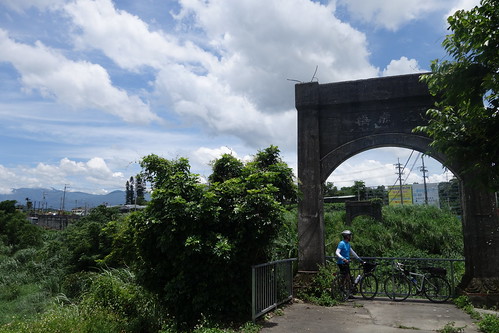
Lovely but hot weather this weekend. Here a friend poses by the wreck of an old suspension bridge near Dongshih.

Well well. Last year, shortly after getting into office, the new Taoyuan mayor saw the construction-industrial state light, and did a 180 on the Taoyuan Aerotropolis project (which he had opposed as a candidate, causing the government to begin expropriating the land before the review was complete), a ridiculous construction-industrial state giveaway. I wrote at the time:
The Aerotropolis is the largest land expropriation in the democratic era. Cheng's turnaround, if it lasts, is likely due to central government pressure. The aerotropolis is a freeport that is a giveaway to land speculators and land developers, and with its suspension of many labor laws, is likely intended as a portal to let Chinese labor into Taiwan.

Stopping that aerotropolis is a key to the DPP's remaining a serious party in Taiwan. It can't just pretend to be the party of social justice and economic development for ordinary people. It actually has to be one. If Cheng flips on this, it will cost the DPP Taoyuan in 2018 and hurt its chances in the Presidential election.
J Michael Cole's wonderful rant in 2013 is well worth revisiting (also my post on his). As originally envisioned (the draft bill is here) the project was going to let Chinese infrastructure firms bid on it, which would have been a disaster, one of the many pro-China decisions that cost the KMT in 2014 and 2016. The project would also have been governed by the free trade zone rules proposed by the KMT, which would turn the zone administrators into dictators administering miniature Uzbekistans. Indeed, there was some speculation that casino gambling would be permitted within the Aerotropolis as a free trade zone unrestricted by the rules applied to the rest of Taiwan.

The DPP has apparently learned little, for the new government has chosen the Aerotropolis as the site for its Asian Silicon Valley...
Premier Lin Chuan (林全) yesterday vowed to reduce land expropriation and enhance communication with the public as the government pushes forward with the Taoyuan Aerotropolis project, which is to be a key component of a larger “Asian Silicon Valley” project that President Tsai Ing-wen (蔡英文) proposed during her campaign [MT: 2015 article].

...

“Politically speaking, [the government] should reduce unnecessary land expropriation to avoid delays in the project’s progress due to protests by local residents,” Lin said in response to media queries for comments on the stalled project.

“The government should also do its best to communicate with the public. I believe that [Taoyuan Mayor] Cheng Wen-tsang (鄭文燦) would help negotiate and he should not only follow the rules and regulations, but also pay attention to things that have been overlooked.”

....

“Taipei and Hsinchu are the right and left hands of Taoyuan, with Taipei being an international metropolis and Hsinchu being an important research and development hub for the IT industry,” Lin said. “We have chosen Taoyuan as the base for the Asian Silicon Valley project to revive the economy in northern Taiwan.”
The Asian Silicon Valley is the island's industrial site for its internet-of-things operations, which everyone expects will be the Next Big Thing. China Post compares it to Ma's China-centric economic plans here, but in many ways it is just another in a long long long line of projects that are supposed to internationalize Taiwan's economy by linking airports and high-tech manufacturing and getting outsider firms to relocate here. Remember the chimerical APROC plan?

"To revive the economy in northern Taiwan". ROFL. The economy in northern Taiwan is just fine, thanks. It's the center and south that desperately need investment; occupancy rates in the southern science parks are below average. The real purpose of such announcements is to get local construction-industrial state patronage networks to re-orient on the DPP because it is now doling out construction dollars, expropriating land and handing it to developers, and keeping housing prices in Taoyuan up. Whatever happened to the DPP's commitment to spreading development from the north to other regions?

Note the presence of the strange phrase "unnecessary land expropriation". How can such a thing exist? Was land not in the project being expropriated? Isn't all expropriation "necessary expropriation"? Or what? "Unnecessary land expropriation" = {null}. Couple that with the "better communication" promise and you have full-blown Ma Ying-jeou Administration jive talkin' at its finest. This is the technocratic administration "communicating" and everyone should shut up and listen. Because the government's plans are never wrong, the problem can only be insufficient communication.

Now, recall that the land expropriations triggered protests before (student roughed up)

Recall that the student movement has promised to hold the DPP to account.

This seems, at some point, tailor-made for a collision between the students/Sunflowers and the DPP administration.
_____________
Daily Links:


_______________________
Don't miss the comments below! And check out my blog and its sidebars for events, links to previous posts and picture posts, and scores of links to other Taiwan blogs and forums!

Sunday, June 08, 2014

Student Activist Roughed up at Chinese Culture University

Two men rough up a student activist calling for suspension of the Taoyuan Aerotropolis project and public hearings on the project. Note end of video when kid is flung against the wall and then dragged by his hair. Are these men university staff?
_______________________
Don't miss the comments below! And check out my blog and its sidebars for events, links to previous posts and picture posts, and scores of links to other Taiwan blogs and forums!

Tuesday, June 03, 2014

Farglory Bribery Scandal engulfs Taoyuan county.

A roach checks out possible danger.

Taoyuan County Commissioner John Wu was out there apologizing to the taxpayers for (yet another) land development scandal involving KMT politicians....
Yeh Shih-wen (葉世文) was dismissed from his position as deputy Taoyuan county commissioner on Friday last week, after prosecutors raided his office and residence earlier that day as part of an investigation into corruption allegations.

Yeh allegedly accepted bribes from Farglory Land Development Co (遠雄建設) chairman Chao Teng-hsiung (趙藤雄) in connection with a land development project in the county.
The mess is far reaching...
Leaders of the county government’s Urban and Rural Development Bureau, Department of Land, and Public Works Department were relieved of their positions and the director and secretary-general of the Office of Ethics were reassigned to other departments due to their dereliction of duty, he added.
Taoyuan County is booming as the communities near Taipei are rapidly becoming bedroom communities for Taipei's workers, who can no longer afford to live in the capital. The Taipei metro system is being extended out to the county. Development is everywhere, and so is money. Farglory paid a bribe of over $500K US for the privilege of constructing a housing development, according to the confession of its Chairman the other day.

Yeh was formerly the head of the Construction Planning Agency (see this 2010 Taiwan Review piece), which means that dozens of land development cases involving him and Farglory will be probed. Allegations of bribery in connection to another Farglory land development case during his tenure have already been made. John Wu, meanwhile, was blindsided by the case and may take a hit in the upcoming elections, though he currently enjoys a big lead over the DPP candidate.

The shocking thing about the case is not the bribery, which appears routine, but the fact that the Chairman of Farglory was denied bail yesterday. The usual procedure is for the court to grant bail, which the accused white collar criminal with good political connections then uses to flee to abroad, usually China (see Chen Yu-hao, etc). But in this case, the court shut him down. This has led to private speculation that there's a political angle going on behind the scenes, though I know of no evidence to support that claim.

But let's not forget the human cost of all this bribery and corruption...
Amber Shyu (徐玉紅), a resident of the Linkou project site who has been resisting forced eviction for nearly a decade, said she hopes investigators will work independently to dig out unlawful conduct involved in the project, so that the people can live happily and peacefully in their homes.
Hidden behind the euphemism "urban renewal" is a wasteland of corruption and destruction of ordinary people's lives and property.
_________________
Daily Links:
_______________________
Don't miss the comments below! And check out my blog and its sidebars for events, links to previous posts and picture posts, and scores of links to other Taiwan blogs and forums!

Saturday, July 13, 2013

Taoyuan Pond Ride

A while back I wrote a post about the Ponds of Taoyuan which I've always liked and which inspired me to contemplate riding around and photographing the ponds. You should read that post as a backgrounder to this ride. With that post in mind, this Thursday I took the HSR up to Taoyuan to get some pics of these historical sites. For a camera, I took only my trusty Powershot S95. Click on READ MORE below in order to, well, read more.

Wednesday, November 28, 2012

Taoyuan vs the Aborigines

The gorgeous 159A between Shijhuo and Chiayi.

Meant to get this up yesterday, but sooooo busy... An interesting situation sheds light on one of the reasons for the upgrades to municipalities that several counties have undergone in the last few years (TT):
“At the moment, Fusing Township (復興) in Taoyuan County is designated an Aboriginal township with a mayor and a council elected by all residents, and based on the law, the post of mayor can only be filled by an Aborigine,” Yabu Eyo, a representative from a Fusing-based Atayal Aborigines self-help organization, told a news conference at the Legislative Yuan yesterday morning.

“When Taoyuan County becomes a special municipality, Fusing Township would become merely a district, with the head of the district being appointed by the mayor — and we would lose our council as well,” he said. “We are worried that the appointed district chief may not understand Atayal culture, customs and traditions.”
As I noted two years ago....
TheNorth-South income disparity is an important driver of the island's political life; but now emerging is a growing clash between the municipalities and the counties. For years, Taipei and Kaohsiung commanded a huge chunk of government money, with Taipei getting the majority of that. To counter Taipei's massive advantages, Taipei County, Kaohsiung and its county, Taichung and its county, and Tainan and its county have decided to upgrade to municipality status in order to collect a bigger share of the government budget. Recall that in the ROC system a municipality is the equivalent of a province whereas the counties remain merely local administrations. The result is a worsening of urban-rural budget issues.
This clash over resources, which manifests itself in the two key faultlines of counties vs. municipalities and north vs south, has fallout for other political issues. To wit:
The new upgrades will result in new development and new land speculation, which will in turn bring in new monies into the pockets of officialdom. It will also result in a vast expansion of government payrolls, since a municipality has the right to employ thousands more people in the local government -- meaning new opportunities for political patronage that will help cement the grip of the party in power on the local governments. The expansion also allows for new appointees to committees and boards.
ADDED: Apple below observes:
There is another way of looking at the upgrade/merger of counties and cities to special municipalities. It could be considered part of a process of relocating the ROC to Taiwan. The effective abolition of the Taiwan provincial government has necessitated an ongoing reorganisation of the ROC government system. As provinces no longer have any role in the government, the government is creating special municipalities to fill their place.
_______________
Daily Links, yesterday's version:
_______________________
Don't miss the comments below! And check out my blog and its sidebars for events, links to previous posts and picture posts, and scores of links to other Taiwan blogs and forums! Delenda est, baby.

Monday, July 04, 2011

The Glorious Northern Cross

School's out. Time for a ride over the Northern Cross Island Highway (Map). I hadn't been on this route since 2009, and had been itching to ride it. The second day of this ride, from Baling to I-lan, is one of my favorite routes on the island.

Friday, December 24, 2010

The Ponds of Taoyuan

Ponds of the Taoyuan Tableland
The Taoyuan Tableland and its ponds. The international airport is in the upper right corner.

I was hunting around for a place to bike tomorrow, looking for an old Qing dynasty canal in our fair city of Taichung, when I stumbled across this page on "Taiwan's Beautiful Canals and Ditches." Put off by its odious oily oozing Chinese-centrism, I left a note there to remind them that the aborigines had constructed waterworks long before the Han conquistadors and settlers showed up. However, as I did so, my roving eye fixed on something on that page I had seen dozens of times, but had never noticed before: the ponds of Taoyuan.

Most people reading this have flown in and out of Taoyuan international and looked down to see the sparkling faery landscape of ponds that spill across the Taoyuan tableland. The page on old waterworks in Taiwan describes what you are seeing:

Those shining mirrors are the county's agricultural irrigation ponds. The Longtan pond was the first, built in 1748. The region's irrigation system has developed gradually, pond-by-pond, over the past 261 years. Each pond stands as a historical record of how local families brought the land under cultivation, and at one time, there were more than 10,000 such ponds in Taoyuan. However, urban expansion has led to the destruction of many of these ponds -- one recent survey shows that there are only 693 left -- with each one filled with dirt marking the end of the history of certain families, as well as the loss of habitat for water birds.

According to the survey, each pond can provide territory for an average of seven water birds. With an estimated 7,000 hectares of pond lost over the years, this represents the loss of habitat for nearly 50,000 birds.

The article goes on to say that the ponds are particularly vulnerable to destruction by Taiwan's developmentalist sociopathology. Irrigation regulations require that a given pond have only one owner. Hence, negotiations for ponds are easy since construction companies do not have to deal with more than one owner.

Another web page describes how they were constructed:
The ponds were usually built in the lower areas. Builders dig both the red soil and pebble layers, then encircle the area with banks. The red soil is highly adhesive. When mixed with pebbles and pressed tightly, a waterproof bank can be made. Banks encircle the ponds in the low areas. Before the Shih-men Reservoir was constructed, ponds were the major source of irrigation water.

According to statistics, there were as many as ten thousand ponds on the Taoyuan plain before the great drought in 1913. At that time, Taoyuan Hsien was known as the "thousand lakes hsien". All ponds were connected; and thus an irrigation system was created.
The ponds were also supplanted by other waterwork construction in the twentieth century. After the Taoyuan Main canal was completed during the Japanese period and the Shihmen Reservoir came online a couple of decades later under the KMT, the new infrastructure became major sources of irrigation water for the area. The ponds were also integrated into central government systems during the twentieth century. Nevertheless, a little over 50% of the area's irrigation water continued to come from the pond and weir system. The Taoyuan Irrigation Association mandates that the ponds must be 80% full at all times, as a backup irrigation system in case of drought.

The ponds made complex agriculture possible in the relatively waterless Taoyuan Tableland, supporting not only rice cultivation, but also domestic waterfowl, fish, and valuable water plants. They also provided home to wild birds and rare plants:
A big mound of earth sits next to a factory in Three Lakes Village, brought in to fill in nearby ponds. Yen points to the mound and comments, "There used to be ponds here about two meters deep." Of the three or four ponds nearby, one has been filled in, one has been converted for recreational fishing, and one has been drained. A few aquatic plants can still be found in the boggy area left behind after the one pond was drained. "There used to be frogsmouth all over the place," laments Yen, "but even that is disappearing fast." Insectivorous sundew plants once grew in the rice paddies right next to the factory, but are no longer to be found (here).
Sadly, the ponds are rapidly disappearing, in many areas remembered only by placenames like Dragonlake, Three Lakes Village, or Big Lake. The focus on saving wetlands in Taiwan has primarily been on areas next to rivers or the ocean, the ponds of Taoyuan, of deep argicultural, environmental, and cultural interest, have somehow slipped off the radar. So next time you fly out of Taoyuan Airport, look down. There'll be fewer ponds when you get back.
_______________________
Don't miss the comments below! And check out my blog and its sidebars for events, links to previous posts and picture posts, and scores of links to other Taiwan blogs and forums! Delenda est, baby.

Monday, August 24, 2009

Northern Cross Redux

Fishing boats in the early morning in I-lan waters.

This weekend I went back for another trip across the Northern Cross Island Highway (Riding the Northern Cross in June, Google maps with the route map from the Yongning Metro here).

Beginning the ride outside of Sanxia in Taipei County.

The climb begins. The first day is actually the hardest, opening with a long climb followed by a 9% grade out of Fuxing. After that climbing is steady but the grade is not difficult.

Clear skies, flowing water, green mountains. It doesn't get any better than this.

We cross the river on the lower suspension bridge.

Got some nice pics of the lovely red bridge.

After lunch, we puffed up the road next to chasms on one side and rock faces on the other.

Jeff (left) and Michael take a break from climbing.

Logged out area.

My son Zeb snaps a pic as Chris looks on.

Endless vistas....eying such sights, Chris opined that he'd never think of "Taoyuan County" in the same way.

This amazing rock face, layer upon layer of rock rising hundreds of meters above the river, brought everyone to the side of the road to take a picture.

Chris and Michael admire the view.

Small communities everywhere, yet we wondered how they could survive floods and slides.

A dam destroyed by flooding a while ago.

Chris poses jauntily on the suspension bridge going into Baling, where we stopped for the night at the CYC Hostel.

The suspension bridge offered lovely views of the lilac car bridge right next to it.

The rivers race, but the race for gravel always wins.

Entering Baling at 600 meters of altitude.

In the morning we arose to find this moth waiting for us.

My son takes his bike out of the hostel, which not only offers cheap sleeps, but also washers/dryers, and lets you store the bikes inside.

The second day requires an opening climb of 680 meters in ten kilometers, but offers amazing views of cliffs, chasms, and rivers.

Lots of roadkill, including bats and this strange mole/rat. We also found a viper run over by a car. It was moving, but only because ants were dragging it.

Lala Shan, the famous resort, is above the bridge where we stopped for breakfast.

The view from breakfast.

In the bright sunlight and clean air, all sorts of sounds wafted over to us, from hymns at the local Church, to the sound of someone's water boiling.

Here's where we had to cross the landslide last time.

An awesomely gorgeous day.

The little orange dot across the chasm on the road there is my son.

Plenty of bugs, as always.

....and a spider or two.

Descending into I-lan, lovely views of the plains below.

The Lanyang River and beyond it, I-lan town.

Monday morning we raced back up the coast to Keelung.

At 8 we arrived at the old tunnel cutting off the peninsula south of Fulong. A favorite of rental bikers, it is crowded on weekends. We waited for the tunnel to open at 8:30 (actually 8:45). The old Japanese train tunnel, 2 kms long, is an enjoyable break from the sun on the way up to coast.

As always, fisherman are out early.

We then took the bike path out of Fulong, crossing yet another suspension bridge, this one under repair.

The bike path.

Fog still lingered as we drove north.

And the stunningly clear day made it another unforgettable ride. Definitely coming back on this route next month -- and hope to see you there!
_______________________
Don't miss the comments below! And check out my blog and its sidebars for events, links to previous posts and picture posts, and scores of links to other Taiwan blogs and forums!

Friday, February 16, 2007

Taoyuan Streets


Running red lights in Taoyuan.

Yesterday I had the singular experience of being the formal witness to a friend's divorce up in Taoyuan. The divorce was amicable and was processed with the usual efficiency of local clerkdom -- meaning that everything has to be just perfect, but once it is, things proceed smoothly.


Taiwan, land of pigeon castles


The household registration office....


.....has a drive-thru window. How do they get the cars through the door?


At one point we had to get a document notarized by the court.


We celebrated by going to hang out with friends at the local KTV.


Debating music choices at a tiny local KTV. There are thousands of these in towns across Taiwan. They all use the same song system, and have the same 25 English songs, most of them bad.


Back to Taichung....