Stressed? Tired? I recommend a healthy dose of 136 out of Taiping to Puli and Sun Moon Lake. Take scooter, $100 bill for gas to Sun Moon Lake, $100 for gas to return, $100 for lunch, and $25 for a bottle of soda. Drive for 45 minutes on 136. Result: Relaxation and enjoyment. Side Effects: wishing you could do it again, broken back from potholes on 14 and 21 between Puli and Yuchih. (click on any pic to view it at Flickr in its large size).
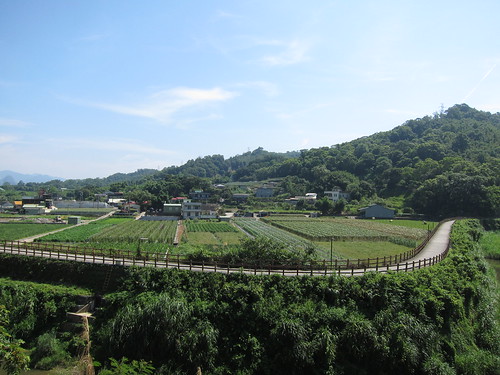
136 shoots south out of Taiping and connects Taichung to 14 and Puli. It is about 28 kilometers long, but rises steeply through a series of switchbacks over the ridges outside of Taichung city. The terrain is mountainous, with small streams and farms here and there, and mountainsides carpeted with betel nut trees. The pavement is new and perfectly smooth.
The drive began with me entering the prosaic factory and warehouse town of Taiping. Here the local government is repairing the bridge that broke two years ago in a flood -- the local government too is broke, like most local governments in Taiwan.
Taiping.
As you leave Taiping, you start climbing through a series of small communities before you hit the mountains.
The views upgrade dramatically as you head in.
I made a small panorama of this spot.
Forests of betel nut trees cover many of the slopes.
Jagged peaks intersperse with small farms.
And small streams by your side the whole way.
This point is more or less the highest point on the road. The views are stunning, and the county put in an overlook that has since collapsed. On Saturday afternoons a couple of vendors set up next to the road here.
Naturally I panned this spot.
I would have taken more shots of the road, but I was too busy enjoying the day with its bright sunlight and cool air.
All good things come to an end, and so 136, quiet and empty, crashes into 14, a road beaten into porridge by endless lines of gravel trucks and tourists.
Naturally, I made a pan of the spot.
14 crowded with vehicles heading into the mountains.
The government, on the theory that you can never have too much concrete splattered across the countryside like color in a Jackson Pollack painting, is putting in an expressway.
Sun Moon Lake. I saturated the colors on many shots, but that ruined most of the mountain shots.
The CYC Youth Activity center. Note that the sign does not tell you that it is the China Youth Corps, one of the indoctrination arms of the former Leninist ruling party. Although today it is technically separate from the KMT,
the two continue to work hand in glove.
Han Shih Yin Di. The Han Shih Campground at Sun Moon Lake across from the CYC Youth Activty Center. I've camped here
on other occasions, so I won't repeat those observations here. I have a large website devoted to
Sun Moon Lake. Here a group of students from Chinyi University in Taiping listen to what they are supposed to be doing in order to have fun. Because clearly, young people do not know how to have fun and must be told how to. Have fun guys, it's compulsory!
My students. The ostensible goal of my trip was to spend a couple of hours with my first year students, who were on a class trip. The trip was overseen by the second year students. Although I am not a first year advisor, I have almost all of them in my econ class, and I also teach them writing.
Me among the students. The second year students, in black, ran the show.
Here the second years take a break.
Vicki strikes a pose.
Orange.
The students are formed into groups, and then they are supposed to develop a chant that asserts that their group is the number 1 group. Here one group struts their stuff.
Two second year students watch.
Other campers.
David, outgoing, good looking, intelligent, makes a perfect emcee.
Queenie (pink) and Joyce.
Rainbow.
Mavis looks on. Where do they get these names?
One of the paramount cultural traits of the Chinese cultures is
tuan jie, the idea that the group must come together tightly as a group. Taiwanese culture is collectivist, and the individual has no space or rights that she can assert against the group. Nor is the group defined by those who come together, what constitutes
the group is defined by those in power -- groups in Taiwanese culture are fundamentally authoritarian in nature. When you are placed in a group, you must come together with that group -- which means following the lead of those who lead. Or else.
For Americans from an individualist society where groups are fluid, and membership and level of participation are
choices, the experience of Chinese-style groups is agony. For Taiwanese, American behavior is both inexplicable and threatening, often glossed as
selfishness and
arrogance. Each side has a totally different view of how humans and groups in their society should relate to each other.
In Taiwanese universities student life revolves around the Class. In the vocational universities, the intake is divided into groups of 50 or so students, usually on some random basis like odd-even student numbers. For example, our intake is 100, producing two Classes, designated A and B. For the rest of their university career, the kids in A class will take courses only with A class. What courses they take and in which order will be determined by the university, which assigns classes and teachers. There is no way that a B Class student could choose to take a writing class with a teacher designated to teach A students. Moreover, by organizing the students into classes and designating what teachers and courses they take, the university prevents mixing between students from different years, impairing the development of vertical relationships between the students of different years.
The authoritarian nature of this system, with its emphasis on cutting the bridges that people might build to each other, should be obvious. In the martial law days student leaders were recruited in each class to spy on their fellow students. Society might be democratic now, but the university system retains the structures of authoritarianism, and thus, still experiences their effects. This system will be defended and taken for granted even by teachers with extensive experience abroad -- one of the defining moments of an academic career in Taiwan is when you realize that all those Taiwanese with western educations brought back only their degree from overseas. All else was checked at Customs.
Hence, on the class trip, all the students play. All the students
must play. There is no idea that the whole class could go, and those who wanted to play could play, and those who wanted to cook, could cook, and those who wanted to hike, could hike, and those who wanted to sit around and shoot the breeze, could. All
must play, and all
must enjoy. Or else you must be arrogant, anti-social, and selfish. Thus, for students of an independent mind, class trips are a boring torture of mindless, shallow games. My wife, who was educated as a young girl in American schools overseas, and then brought back to Taiwan at 16 to be tortured by local school system, still has nightmares about the transition, thirty years later.
This raises another issue: the
apparent immaturity of the students, oft remarked on by westerners. In authority-centered structures, from fundamentalist Christianity and Mormonism to Fascism and Communism, victims/participants are expected to display happiness -- "Be Grateful that We're Fucking On You" is the attitude of Authority in all such systems. In response, and in defense, members often display an immaturity akin to childishness. When students display happiness playing games like these, which in our society is something only 12 year olds do, what exactly is going on?
The second years set up stations containing different games all over the area. Here a group of students attempts to hit a coin with another coin, hoping to turn it over.
A group of students poses with the Asian Sign of Picture Taking.
The boardwalk to the nearby town.
In De Hwa village, the tourists were out and about purchasing the totally unique souvenirs.
A gorgeous day to shoot Sun Moon Lake.
I stopped by this roast pork seller, who was advertizing "boar" meat. Dressed in aboriginal clothing, he assured me that the sauce was one of his own invention. After tasting it, I observed to myself that his invention had included a healthy dose of bottled satay sauce. But it was delicious. As I ate, we chatted, and he told me he was actually from Taipei, and just comes down on the weekend to sell roast meat to tourists.
A cruise boat with the gigantic Wenwu Temple in the background.
I like this spot so much....
...I made a small pan of it. The stitching program did an excellent job as the seams are practically invisible.
After a couple of hours at play in the fields of the horde, I drove back home. This area was so representative...
...I had to pan it.
About 500m down the road from the sign that says TAIPING 19 TAICHUNG 23 is this sign that says Taiping city begins here. The city limits appear to stretch more than a dozen kilometers into the mountains.
The road goes ever on.
[Taiwan]