Showing posts with label Japanese period. Show all posts

Wednesday, November 22, 2017

Book Review: Outcasts of Empire: Japan's Rule on Taiwan's "Savage Border," 1874-1945

Outcasts of Empire: Japan's Rule on Taiwan's "Savage Border," 1874-1945
Paul D. Barclay (Author)
Asia Pacific Modern
Philip E. Lilienthal Imprint in Asian Studies
University of California Press, 2018


In Outcasts of Empire: Japan's Rule on Taiwan's "Savage Border," 1874-1945, Paul Barclay tells this story, beginning with the Wushe Rebellion in 1930 led by Mona Ludao...:
The invasive and exploitative policies that provoked Mona and his confederates also eroded precolonial forms of social organization, authority, and ritual life among Taiwan’s indigenes. As it severed bonds between indigenes and their lands, in addition to prohibiting or reforming folkways it deemed injurious to its civilizing mission, the government-general nonetheless laid the groundwork for the emergence of Taiwan Indigenous Peoples as a conscious and agentive historical formation. By arresting the diffusion of Chinese language and customs into Taiwan’s interior, restricting geographic mobility across the so-called “Savage Border,” dividing the colony into normally and specially administered zones, and sanctioning a battery of projects in top-down ethnogenesis, the government-general inscribed a nearly indelible “Indigenous Territory” on the political map of Taiwan over the five decades of its existence.
...and tells it in narrative that is at once highly readable, deeply informed, illuminating, and sensitive to the humanity of every historical figure who appears in it. You can imagine my happiness in this age of unaffordable scholarly books that the book is available for free download. My deepest thanks to Dr. Barclay for not only writing this excellent book, but also for letting it be freely available.

Barclay's tale begins with the drama of the Wushe uprising, using it as a wedge to pry open the relations between the Japanese colonial state, run "on the cheap" as he frequently points out, and the original peoples of the island. Every aspect of their existence presented a quandary for Japan. Taiwan was that nation's first colony in a world of colonies and colonizers, and there was no reserve of experienced administrators and explorers that Japan could draw on. The nature of the aborigines themselves was elusive and the incoming Japanese state had only the most rudimentary body of knowledge about them to draw on. Moreover, the high mountain areas were inaccessible and unknown.

For the Han settlers on the plains Japanese rule was simpler. The initial period of Japanese rule was marked by rebellion after rebellion, ending with the crushing of the Tapani Revolt in 1915. This revolt complicated relations with the aborigines, since it drew off colonial resources urgently needed to extend Japanese rule into the highlands.

After that period of revolt in which the population was ruled via state brutality and terror, the settler population was ruled via what Barclay, drawing on existing theory, labels the "disciplinary state". The settlers could gradually be educated and disciplined into internalizing state-sanctioned behavioral norms and producing a surplus that could both fund the colonial government and provide some return on the massive investments of the Japanese state for the new colony.

However, this approach could never work for the peoples residing in the highlands of Taiwan. The colonial government simply lacked the resources to enforce disciplinary rule in the highlands of Taiwan. Thus, in Taiwan, as in so many other areas, the incoming colonial power created two areas: one where its disciplines could be enforced and the population gradually assimilated at least some of the expected norms, the other a special administrative district where peoples were exempt from the power of the disciplinary state and instead interacted with it in other ways. Those latter areas are what we call indigenous areas today. In Taiwan "the indigenous areas", like so many other aspects of Taiwanese life from the use of Penglai rice to Taiwanese deep sea tuna fishing practices, are constructions of the Japanese colonial state.

The story thus begins with the Japanese state's attempt to communicate, study, and trade with the peoples of the area. At first, because it was weak and underfunded, and its knowledge of aboriginal communities was poor, it had low-ranking colonial officials and soldiers marry aboriginal women and act as brokers between the state and its perceived subject peoples, and it conducted trade through intermediaries. These arrangements gave aboriginal leaders leverage, which the state found odious and obstructionist. Unlike the Japanese, the aborigines were experienced in handling imperial rule, and Barclay repeatedly notes how the frontier was a fluid place filled with hybrids: aboriginal leaders who lived in Chinese houses and acquired Han wives, Han who moved easily between the two worlds and spoke the languages of both, and flows of gifts and resources in both directions.

Eventually the state acquired enough power to dispense with such makeshifts and came to rule more directly. The broker-buffer and the power of aborigines to impose at least some limited terms on the colonial state's desire for profits and resources were a cost the state became unwilling to tolerate in its capitalist quest for the resources of Taiwan's mountains. In telling this history, Barclay never loses sight of that simple fact: the purpose of Taiwan, like every colony, was to make money for the "mother" country.

Every aspect of this book, from its copious illustrations, maps, and photos, to its insistence on  proper representation in labeling aborigines with their aboriginal names along with the other names they were known by, to its deep empirical and theoretical understandings of colonial processes and racial hierarchies, is an absolute delight. A Japan scholar, Barclay always has one comparative eye on developments in Japan -- the colonial processes to assimilate and suppress Taiwan were mirrored by similar processes in Korea, and by the Japanese state's ongoing program to create a state and a language at home out of its own unruly and variegated peoples. These programs frequently intersected, for example, when the State moved to ensure its low ranking soldiers and privates, often drawn from marginal and under-educated populations at home, instructed the aborigines in the "right" Japanese language forms.

Barclay points out that a key factor in the creation and preservation of an "indigenous" area in Taiwan was the deep appreciation of aboriginal artistic powers in Japan. This provided motivation for the state to research, construct, and produce aboriginal identities, and preserve a separate territorial and cultural space for them. Today aborigines in Taiwan are dependent on these Japanese representations and constructions of aboriginal lifeways in "recovering" their past practices and traditions.

Barclay's book is timely as well as informative. In the ceaseless struggle over local identities Taiwan's aboriginal peoples, today as yesterday, remain useful for demonstrating that Taiwan is different from Some Other Place. That they are so useful for such goals was both a purpose, and a legacy, of the Japanese colonial state in Taiwan.
_______________________
Don't miss the comments below! And check out my blog and its sidebars for events, links to previous posts and picture posts, and scores of links to other Taiwan blogs and forums!

Wednesday, September 06, 2017

Oh Hell Yeah! New Book: From Province to Republic to Colony

I received this gloriously wonderful book in the mail last week (Books Tw). This post is not a review of the book because none is necessary: this book is fantastic. It covers the life and activities of James W. Davidson, the reporter who traveled with the Japanese invasion force in 1895 and wrote The Island of Formosa Past and Present, one of the foundational books of the literature on Taiwan. He also served as a US consul in Taiwan and elsewhere.

From Province to Republic to Colony contains, well, everything. It's a combination of scrapbook and scholarly commentary on the life of Davidson: newspaper clippings, letters to and from Davidson, lists in his own hand, photos of the period, period illustrations, writings of Davidson's and so on. Commentary is presented in Chinese and English. Go below for some random photos of the interior this amazing volume. Alas, all my cameras are broken, so photos not as good as they might be. But if you are at all interested in the history of Taiwan, you want this book.

Monday, March 13, 2017

Final comments on whether Chiang set up 2-28


In Formosa Betrayed, George Kerr’s foundational work on the 2-28 massacre, he describes the provision of intelligence on Taiwan to the US government by the Republic of China (ROC) government in Chungking during WWII, saying:
"In addition to these reports on subversion potential, and on specific communications and industrial objectives, we also received from Chungking a long report on Formosan-Chinese leaders, and on Formosans who were exiles in China."(p14)
The report had been prepared by an exiled Formosan whom Kerr identifies as a notorious schemer, but this brief remark is a window into a world generally neglected in historical writing on 2-28. After opening that window, we can ask: did Chiang Kai-shek and the KMT set up the massacre so they could murder the local leadership, which otherwise might oppose KMT rule?

The problem of historiography
Formosa Betrayed opens with a discussion of US policy toward Formosa during the war, then presents the background of Chen Yi, who would become governor of Formosa in 1945, and then briefly covers the expectations of Formosan leaders in 1945. Kerr then moves on to the arrival of the US and ROC leaders in Taiwan, and from there to a narrative of the development of the revolt.

Similarly, in A Tragic Beginning: The Taiwan Uprising of February 28, 1947, another commonly cited work on 2-28, Ramon Myers and Lai Zehan, after setting the stage in the first chapter, move on to a detailed discussion of the people of Taiwan under Japanese rule, followed by a chapter describing the establishment of KMT rule in Taiwan.

This pattern of presenting the Taiwan experience of Japanese rule, followed by the beginning of KMT rule on the island, is true of almost all presentations of 2-28’s history, long or short. Even the Wiki page on the event offers a Background that briefly describes the experiences of Taiwan and its people under Japanese rule, followed by a somewhat longer explication of KMT rule. It then presents the revolt.

There’s a key element missing: this discourse emphasizes the continuity of the Taiwanese experience with Japanese Formosa while ignoring the continuity of KMT experience with Japanese Formosa.

Instead, the KMT in Taiwan in 1945 is always presented as if it had simply parachuted in from China with little or no prior knowledge of Taiwan. Chen Yi’s trip to Taiwan and background is often mentioned, but the KMT’s extensive knowledge of Taiwan and Taiwanese in the prewar era typically draws no attention. Kerr, for example, writes:
“Chiang's personal power within China derived from his consummate skill in playing off one powerful Party or Army faction against another and his family alliance with the leading industrialists and financiers. In mid-year 1945, the so-called Political Science Group was the faction momentarily in the ascendant at Chungking. When a temporary committee was established to plan for the "Provisional Government of Taiwan Province," a member of this group became the Chairman.

This was Chiang's friend General Chen Yi.”(p47)
Kerr provides detailed information on the relationship between Chen Yi, the Soong family, and Chiang Kai-shek, yet tells us nothing about this committee or of the KMT’s knowledge of Formosa. What was its understanding of Formosa? What were its information sources?

Instead of presenting a chapter on the extensive and detailed knowledge the KMT had of Taiwanese and their politics on Formosa, most writers simply give Chen Yi’s background in Fujian and his trip to Taiwan. This unconsciously signals the reader that no other knowledge exists or is necessary. Thus, Chen Yi’s Taiwan-related background comes to stand in for the KMT’s background on Taiwan.

This neglect of the KMT’s connections to Formosans and its knowledge of their political positions functions as an apologetic for Chiang and the KMT in its own right. If the reader never learns of prior deep KMT knowledge of Taiwan, the reader will never make the connection to possibility that Chiang planned it all. Indeed, that possibility is disallowed by the discourse.

It also underpins further apologetic positions, such as the oft-heard “Chen Yi misled Chiang” or “Chiang was too distracted by events in China” and so forth. Such comments only make sense if the analytical context is that the KMT and Chiang were completely ignorant of Formosa prior to the KMT's arrival there in 1945, and Chen Yi was the Party's sole major connection to Taiwan. But that is totally untrue.

As we have seen in my two other posts (here and here), the KMT had deep knowledge of Taiwan’s politics and its major leaders. But there’s another issue with Chen Yi I’d like to highlight.

2-28 was a reprise. When Chen Yi was governor of Fukien province, he imprisoned and killed students protesting for stronger anti-Japanese members, along with members of the People’s Political Councils. According to Kerr, Chen Yi brought in the big state monopolies and Japanese businesses, and drove thousands of small traders into bankruptcy.
“In the period of Chen Yi's governorship the Province of Fukien was systematically looted. Hot-headed students demonstrated, rioting broke out again and again, and Chen Yi reacted without mercy. The brutality with which students were tortured and killed in Fukien set something of a record even for China”(p55).
The province was “systematically looted” according to Kerr. Sound familiar?

When Chen Yi was posted to Taiwan, there were protests from both Chinese and from expatriate Formosans living in China. Indeed, it was Formosans who were familiar with Chen Yi’s record from Fujian who were among his biggest critics after he took over Taiwan. These vociferous criticisms and predictions were of course known to the KMT and to Chiang.

Did Chiang set up 2-28? Either Chiang understood the consequences of Chen Yi’s appointment and meant for something like the revolts in Fujian to happen so that a generation of Formosan leadership could be wiped out, or he was completely indifferent to the fate of Taiwan, or he was stupid beyond belief.

Yet remember, when you pick, that whatever his innumerable faults, one strength Chiang had was strong political skills...

UPDATE:
Great comment

Anonymous Anonymous said...
Actually quite some research has been done on the preparation committee you mention (especially by Taiwanese historians and published in Chinese). [mt: yeah, so its influence on the construction of the discourse on KMT entry into Taiwan is limited]. Among other things, the committee did not have any Taiwanese members when it was founded in April 1944. CKS insisted on putting some Taiwanese on only after the first few months, but even then their influence remained restricted. The whole thing was more for show and to appease the few voices within the KMT, who argued for Taiwan's incorporation into China, most of whom were banshan.

The committee eventually did publish a report and made all kinds of suggestions about the future rule of Taiwan, it even mentioned the possibility of some kind of self-rule. Of course, all those suggestions remained non-binding in the end and the government opted for what was in fact a military occupation. One of the main reasons being that the KMT didn't even know if the Taiwanese, in particular the soldiers, were actually going to welcome them (remember that Taiwanese in general were still despised by the KMT high echelons during the war and seen as collaborators and/or slaves of the Japanese [sound familiar?]).

I think it's also important to remember the larger historical context here, namely that the KMT had never considered "getting back" Taiwan before the Cairo Conference in late 1943, when the allies winning the war had already become an increasingly realistic scenario. However, they were surely not prepared for the rather sudden end of the Pacific War. This is easily forgotten, but by August 1945 there was just no internal consensus among KMTers of how to rule Taiwan after the war, which was another reason CKS opted for the military occupation. The military occupation had nothing to do whatsoever with what the committee had been working on.

Nothing of this exculpates CKS of course, quite to the contrary. He might have not really been able to anticipate the situation in Taiwan, but as you said, he did know Chen Yi and he gave him all the powers to do as he wanted.
_______________________
Don't miss the comments below! And check out my blog and its sidebars for events, links to previous posts and picture posts, and scores of links to other Taiwan blogs and forums!

Tuesday, August 02, 2016

Way Cool: Cache of Japanese Military Maps of Asia

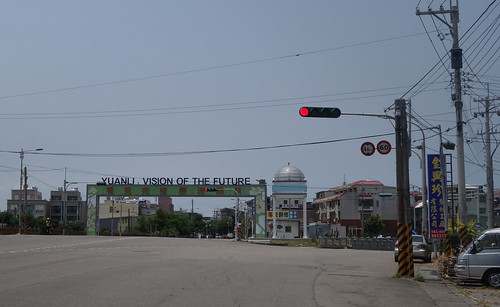
Yup: Yuanli's town slogan is "A vision of the future."

A friend passed this around Facebook: a trove of Japanese military maps made prior to WWII with incredible detail and information. A teaser...
These maps were captured in the waning days of World War II as the U.S. Army took control of Japan. American soldiers confiscated thousands of secret Japanese military maps and the plates used to print them, then shipped them to the United States for safekeeping.

..........

Not surprisingly, the Japanese surveyors weren’t always welcomed in other countries. In 1895, angry locals in Korea killed several assistants on a Japanese survey team, Kobayashi writes. (Japan annexed Korea in 1910 and held it until the end of World War II.) Two decades later, Japan sent secret survey teams into China. These men disguised themselves as traveling merchants and made their maps equipped only with a compass and by counting their steps to mark distance.

In the age-old tradition of cartographic copying, the Japanese often built on maps they’d captured from their foes, adding their own notes and details on top of the original. Cyrillic script is visible in the Japanese map above of Vladivostok, Russia, for example. Naturally, their enemies did the same thing. The formerly classified U.S. Army map of Okinawa below, printed in 1945, is based on a captured Japanese map.
Stanford is currently putting the maps online. There is a topical index here and many maps of Taiwan -- here is one collection, the red not yet digitized, the green are accessible. Here is a Keelung map, and here is a Taichung map at 1:50,000. Click somewhere inside the viewing frame to see the map, it sometimes doesn't appear unless you click in that frame. Sometimes you have to grab and move the map around in the viewer to actually see it, they digitized a lot of unnecessary area around the map, so the first thing you see sometimes is a lot of useless gray area (on some maps click on the upper right corner of the map box for full screen and move the image around til you see the map). The maps are fully zoomable. Way cool.
_______________________
Don't miss the comments below! And check out my blog and its sidebars for events, links to previous posts and picture posts, and scores of links to other Taiwan blogs and forums!
Friday, April 29, 2016

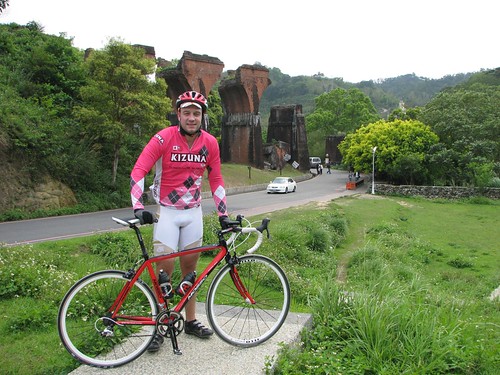
藤坪溪Bridge: Then and Now

This famous bridge was completed in 1907 and carried trains across a valley in Miaoli until destroyed in the great 1935 earthquake.


Today it is the famous Longteng Broken Bridge, a tourist trap on one of the area's many pretty roads. Don't miss the ride there if you're biking in Miaoli.
_______________________
Don't miss the comments below! And check out my blog and its sidebars for events, links to previous posts and picture posts, and scores of links to other Taiwan blogs and forums!
Thursday, April 28, 2016

Hall of Barbarous Tribes

This is from the 1916 Taiwan Exhibition in Taipei, Japan (source). Serendipitous hits while searching: Japan Focus has an excellent review of the experiences of aboriginal tour groups in Japan during the colonial era. The amazing Paul Barclay's PHD thesis on ethnographic mapping of Taiwan under Japan is available online. Some good pics and excellent discussion of development and art in the Japanese era in Modernity in Agony. Below is a shot of the midway from that exhibition.
_______________________
Don't miss the comments below! And check out my blog and its sidebars for events, links to previous posts and picture posts, and scores of links to other Taiwan blogs and forums!

Monday, November 30, 2015

Blast From The Past: Taiwanese are Hardworking

A Japanese era pusher railroad.

From Robert Frank's Guadalcanal, a superb history of the Battle of Guadalcanal, discussing Japanese army deployments to the island (p, 253)...
The 17th Army petitioned Imperial Headquarters for reinforcements, including another infantry division, a tank regiment, and many artillery, supply, and communication units.1

1Incorporated in this list were several thousand laborers to porter supplies on Guadalcanal. The 17th Army specified it wanted only Taiwanese for this role, because, notes the Defense Agency history volume, it was a Japanese belief that the Taiwanese had the "strongest backs" among the subject peoples in the Greater East Asia Co-Prosperity Sphere.
_______________________
Don't miss the comments below! And check out my blog and its sidebars for events, links to previous posts and picture posts, and scores of links to other Taiwan blogs and forums!
Sunday, November 01, 2015

Evangelizing Formosa, 1938

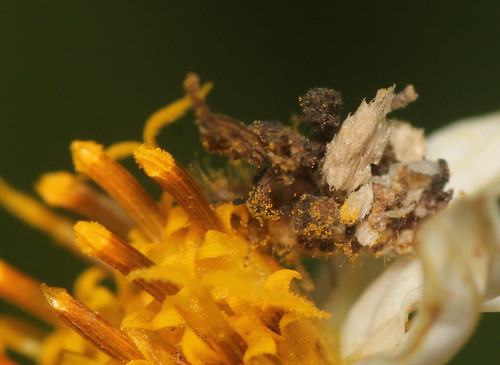
A shot of a lacewing larva, which conceals itself by affixing debris to its body.

From the Japan Christian Yearbook for 1938. Interesting for many reasons, from the remark that Hakka is a dialect of Cantonese to the problems missionaries faced in communicating, to the veiled allusions to political issues -- their congregations and meetings were watched by security police, they were forbidden to engage in street preaching, and in certain kinds of gatherings. Many of these missionaries came over from Japan and spoke Japanese and later, learned Hoklo/Taiwanese.

++++++++++++

Chapter XXIV
EVANGELISM IN FORMOSA
Hugh MacMillan


A missionary in Formosa, visiting a country congregation, was taken by the , minister of the church in that locality for a walk and to call on some of the Christian homes. Before they had gone far they met a farmer, whom after he had curiously eyed the foreigner, they engaged in conversation. "Have you ever heard the gospel?" the minister asked soon after the opening greetings, with apparent evangelistic fervour. "Oh, yes," answered the farmer with much assurance. "Well, to-night at seven-thirty this foreign missionary is going to speak in the church at Market street; come along and you ll hear him preach the gospel in our own language." The farmer grunted the usual assent and passed on his way.

Sunday, October 11, 2015

Then and Now: Zhongshan Green Bridge

National historic monuments of Taiwan sent around this view of Japanese-era Taichung across the bridge on what is now Zhongshan Road, the 新盛橋.

Today the buildings are gone, but the bridge, designated a historical monument in 2004, is still there, now known as the 中山綠橋 (location). According to Wiki, the bridge was built in 1908 to commemorate the completion of the north-south rail line. You can still see the ball atop the concrete railing on the bridge.
_______________________
Don't miss the comments below! And check out my blog and its sidebars for events, links to previous posts and picture posts, and scores of links to other Taiwan blogs and forums!

Monday, August 31, 2015

History and the Economist *sigh* Banyan can't get anything right

LanyuDanno_2015_359
Another trip to Lanyu last week, which is why I've not been blogging....

Banyan at The Economist wrote on former President Lee Teng-hui's epic trolling of the KMT the last couple of weeks... let's take a look....
A 92-YEAR-OLD politician may be inured to insults, however outrageous his alleged transgression. Even so Lee Teng-hui, Taiwan’s president from 1988 to 2000, may have been taken aback by the hostility to comments he made to a Japanese magazine this month. [A total misreading -- Lee was trolling and well aware of how the KMT would react: in a way that put them outside Taiwan's mainstream.] He criticised efforts by Taiwan’s present government to mark the 70th anniversary this year of Japan’s second-world-war surrender as meant to “harass Japan and curry favour with China”. Taiwan, he argued [Lee "argues" but Lee was not arguing, he was stating historical fact], had been part of Japan: its young men had fought not against the Japanese empire, but for it (the “motherland”, he called it). Ma Ying-jeou, the current president, led a chorus of outrage in Taiwan. [Note the pro-KMT construction: Ma did not lead a chorus of outrage in Taiwan -- he led a chorus of outrage from the KMT] In China the press heaped scorn on his “absurd remarks”. The angry derision was perhaps all the more intense because, historically, Mr Lee had a point.[Note that no one from the pro-Taiwan side or a historian is permitted to speak on this issue, excepting Lee. Note also how cleverly the article fails to concretely state that the historical fact tens of thousands of Taiwanese loyally and willingly served the Japanese war effort. Instead, Banyan merely says Lee "had a point" as if there was something arguable about Lee's statements. What was that point again? Say it, Banyan.]

Although China insists Taiwan has always been an “inalienable” part of China, it has not been governed from the mainland since 1895, when it was ceded to Japan.[
That is almost correct, technically, since from 1945-1949 Taiwan was administrated by the KMT under the Allied occupation of what was still Japanese sovereign territory until 1952. It's astonishing to read this in the Economist, let alone in a piece by Banyan. Kudos!] When Taiwan returned to China in 1945,[Taiwan was never "returned to China." This is shameful.] it became the last redoubt of the Nationalist or Kuomintang party, the KMT, as it lost mainland China in its civil war with the Chinese Communist Party. Mr Lee was later the KMT’s leader. But after he left the presidency, the party expelled him for his support of Taiwan’s formal independence from China.[Note the misleading "from China" which implies incorrectly that Taiwan is part of China. Independence supporters want independence, period.] Since then the KMT has tended to regard him as an embarrassment—like a gaga elderly relation given to relieving himself in public [What a vile and unnecessary comment.]. Mr Lee’s fondness for Japan is well-known. His elder brother is among those honoured at Yasukuni, a controversial shrine in Tokyo for Japan’s war dead, including some convicted of war crimes. Mr Lee’s views, however, though baldly expressed, are not uncommon in Taiwan. Nor, across Asia, is Mr Lee so unusual in his ambivalent feelings about Japan’s colonial past.
As everyone knows, Taiwanese love Japan, and many in Lee's generation still identify as Japanese in some way, speaking and reading Japanese amongst themselves. Several old men I know can still sing the Japanese national anthem and explain what the words mean. Lee correctly noted that while a few locals headed over to China to oppose Japan (though many more immigrated here during the interwar period, and many who headed to China were looking for work opportunities in the Empire or in China), tens of thousands of Taiwanese troops served in the Imperial Japanese Army as soldiers, laborers, prison guards, or in other capacities. For example, there was a corps of Taiwanese "military farmers" sent to central China to engage in farming in devastated areas under Japanese control, while others were sent as instructors to south China. Still other Taiwanese served as semi-skilled workers in government. For males, the pay was several times what they could make in Taiwan. The enslaving of women for sex began in Taiwan in 1938, and some Taiwanese girls were conscripted as nurses. The draw was so great that labor shortages began occurring in Taiwan after 1941 (for more, see this book).

The erasure of these veterans -- their absence from public discourse, their lack of public notice on the ubiquitous and vile "Martyrs' Shrines" and other memorials, is deliberate, of course, part of the KMT's overall goal of erasing Japan from Taiwan's historical memory. The KMT wishes Japan exists only as a caricature of evil, the "wretched colony" of current presidential candidate Hung Hsiu-chu's fantasies, and like any colonizer, to substitute its own identities for existing identities.

Another key function of this public denial of their existence was that there was no formal recognized body of Taiwanese veterans with a distinct identity who might take political action against the Chinese colonizers in the formative period of KMT rule. Recall that in the 1947 uprising Tang Shouren of the Tsou people led 100 former Japanese soldiers in an assault on Chiayi, which participants reported, decades later in recounting this incident for oral histories, was apparently part of a larger vision of uniting with local Han to drive out the incoming Chinese. During the 1947 Han people across Taiwan put on Japanese clothing and uniforms and sang Japanese songs -- to this day this Japanese identity is often asserted against the faux Chinese identity of the KMT. The KMT feared Taiwanese uprisings and expended much effort in the early 1950s to eliminate weapons caches, especially in the mountains, where the aborigines made superb soldiers, and where some had even been trained as pilots. It was still executing 1947 leaders well into the 1950s -- Tang Shouren was finally arrested and murdered in 1954.
_______________________
Don't miss the comments below! And check out my blog and its sidebars for events, links to previous posts and picture posts, and scores of links to other Taiwan blogs and forums!

Sunday, August 23, 2015

Kongo and Taiwan

The battlecruiser Kongo in her WWI configuration, as she would have appeared in 1923. Some of my South African readers might recognize the port.

I've been a battleship nut since I was a kid, and as an adult, a Pacific War buff. Yamato may have been the mightiest of Japan's battleships, but to my mind there's no question that the greatest of them was the battleship Kongo (金剛). Kongo participated in perhaps the most effective Japanese battleship action of the war, the night bombardment of Henderson Field on Guadalcanal on Oct 13, 1942. Kongo also sank the legendary Samuel B. Roberts in the desperate Battle off Samar in Oct of 1944 and put the hurt on US carriers in that battle. And Kongo also had a long association with Taiwan.

Kongo was originally built in the UK as a battlecruiser, ordered by the Japanese navy. In 1923 Hirohito, then Crown Prince and Regent since the Emperor was incapacitated, decided to tour Taiwan. In April of 1923 he embarked aboard Kongo from Yokusaka and arrived in Keelung on April 16, 1923. The Takao Club, a fantastic website, has a detailed essay on his journey in Taiwan, with numerous photos. After a week, Hirohito boarded Kongo again, from Takao (Kaohsiung) to make an inspection tour of the naval base at Makung in Penghu. Hirohito left Keelung on the 26th and returned aboard Kongo on the 26th.

In 1929 and again in 1935 Kongo received an extensive upgrade (image), and was reclassified as a fast battleship. In 1927 Kongo stopped at Makung. In 1933 she visited Taiwan and Penghu, and again in 1938 on her way to and from operations in China, stopped at Keelung and Makung.

Makung (Mako in Japanese),was upgraded to Guard District status in November of 1941. When the war began, three minesweeper divisions, three patrol vessels, three D1A aircraft, and the cargo ship Kure Maru No. 5 were based there. The port was decommissioned in 1943 and the military district moved to Takao (Kaohsiung), though it was used as a port and attacked by US planes in 1944 and '45.

On Dec 2, 1941, Kongo was at Makung in Penghu when her fleet commander received the fateful order "Niitakayama nobore (Climb Mt. Niitaka) 1208" which notified the fleet that hostilities against the US would begin on Dec 8. Mt Niitaka is of course Yushan, then the highest peak in the Japanese Empire. Kongo then moved off to the South China Sea to support the offensive against the British Empire.

In January of 1942 Kongo stopped by Makung again on her way from Camranh Bay in Vietnam to Palau to support the Japanese offensive against the United States. In 1942 she participated in the terrible fighting in the Solomons, but though she sortied several times in 1943, she did no fighting.

After the catastrophic defeat at Leyte Gulf in October of 1944, Kongo returned to Brunei. In November of 1944 she was at port in Brunei after a pointless sortie around Pratas Island (now Dongsha and controlled by the ROC). After being attacked in port by US aircraft, Kongo, undamaged, left Brunei for Kure on November 16 in the company of several other ships, including the battleship Nagato.

On the night of November 20th the division of ships entered the Formosa Strait, and for some reason, ceased zig-zagging, a regular practice of ships in formation in waters where submarines may be encountered. In the wee hours of November 21 the convoy was sighted by the US submarine Sealion. At 2:56 am Sealion fired a spread of six torpedoes, two of which apparently hit Kongo. Her boiler rooms flooded, but she was still able to make 16 knots. The flooding, however, gradually became uncontrollable. At 4:50 the group was split into two formations, with Kongo sent to Keelung along with two destroyers. The ship continued to fill with water. Within 20 minutes she had a 45 degree list and at 5:18 she lost all power. The order was given to abandon ship. Sadly, at 5:24 the ammunition in the forward 14 inch gun magazine detonated, destroying the ship and killing nearly everyone on board. Over 1200 lives were lost, and only 237 men were rescued.

Today Kongo rests in 115 meters of water just 100 kms northeast of Keelung, the port to which she once ferried a Crown Prince.

ADDED: The Sealion's attack on Kongo was actually recorded, one of a tiny handful of audio recordings of attacks by submarines during WWII.
_______________________
Don't miss the comments below! And check out my blog and its sidebars for events, links to previous posts and picture posts, and scores of links to other Taiwan blogs and forums!

Friday, August 14, 2015

Japan-era Airplane ID chart

Issued in Taiwan by Japan during the war, an airplane ID chart.
_______________________
Don't miss the comments below! And check out my blog and its sidebars for events, links to previous posts and picture posts, and scores of links to other Taiwan blogs and forums!
Friday, August 07, 2015

Taiwan and Cocaine in the Japanese era

eedafgh.jpg
Fill er up.

There's a blurb in George Kerr's immortal Formosa Betrayed where he discusses the tons of coca leaf that vanished when the KMT took over Taiwan in 1945. That little remark is a clue to vast network of coca growing and processing that helped fund the Japanese colony in Taiwan, but was also part of a larger worldwide explosion of coca growing in the colonies of imperial powers of Europe as well. Consider:
The rapid rise of the Dutch to prominence in the world coca and cocaine trades took interested parties by surprise, especially the Peruvians, who until 1900 felt they enjoyed a natural birthright to the world coca market. In 1904 the Dutch island of Java (now part of Indonesia) exported only 26 tons of coca leaf; this figure soared to 800 tons in 1912 and 1,700 tons in 1920, glutting the world the world market. The Dutch built an especially productive and integrated industrial cocaine regime, but it was dismantled by decree almost as quickly as it arose.(p332)
The British also took an interest in coca production in India, but German chemists produced the cheapest cocaine out of Peru, driving most other nations out of the business at the turn of the century, and making the nation the world center of coca leaf and cocaine production. Even the Japanese bought land in Peru, and a thriving expat community helped run the cocaine business in that country.

According to the Gootenberg book cited above, Japan's interest in cocaine grew out of the State's involvement in the production of drugs. A Japanese chemist who had worked for Parke-Davis during heyday of its production of cocaine (as an anesthetic) returned to Japan and brought his expertise in cocaine manufacture with him. By the 1910s Japan's big sugar interests in Formosa had begun to invest in coca production. By the 1930s Japan was one of the largest makers and sellers of cocaine in Asia. Gootenberg observes that you can view Japan's production of cocaine as part of the larger Japanese policy of economic self-sufficiency and state-capital marriage (recall that Japan didn't define some drugs as legal and others as illegal like the US; it had no "drug problem"), or you can see it as something increasingly sinister and illicit. The latter view predominated in the US and among nations interested in stamping out the trade after 1930.

Gootenberg writes in another paper:
By 1920, Japan itself produced more than 4,000 lbs. of cocaine, which then doubled to 8,000 by 1922 (see TABLE 4). Official figures for the 1930s shrunk to just under 2,000 lbs., if considered by some historians and contemporary League officials as doctored for international consumption. (This is a hard charge to prove, though Karch has tried by putative estimates of coca-alkaloid capacity.) Exports across Asia officially dropped to negligible levels, though complaints registered about Japanese firms and reporting, as well as cases of deliberate smuggling (such as the “Fujitsuru” and “Taiwan Governor” brand vials in India). Other specialists have noted growing diplomatic cooperation between Japan and international drug officials, at least until the invasions of Manchuria and China, when opiates became a major issue. The firms making cocaine and morphine were among Japan’s largest: Hoshi, Sankyo, Koto and Shiongo Pharmaceuticals, and enjoyed growing links to major trading trusts (such as Mitsui and Mitsubishi) and to interlocking governmental, colonial and military officials. In 1934, we know that Taiwan’s [Chiayi] district kept 694 acres under intensive coca cultivation (by Taiwan Shoyaku and Hoshi); earlier plots on Iowa Jima and Okinawa fall off the record. About 300,000 pounds of Formosan leaf were harvested annually in the late 1930s.
In yet another work, Gootenberg says that by the late 1920s Taiwan was producing 3 tons of cocaine per year (Columbia produced 350 tons in 2010 according to the UN), a figure he questions in one of his books (below). The major producers were Sankyo and Hoshi Pharmaceuticals, which combined had 684 acres under cultivation in Chiayi.  Jennings' book on Japan's opium policies in Korea says in a footnote...
By the mid-1920s, Hoshi's Taiwan plantation was producing an average of 40-50,000 pounds of dried coca leaves per year, while his Peru operation average 20-25,000 pounds a year. The raw coca was shipped to Japan for processing, and most of the cocaine probably wound up in the illicit traffic in China.
Hoshi was thick with the Opium Monopoly in Taiwan and knew Goto Shinpei. In Taiwan he bought semi-refined morphine from the Opium Monopoly, shipped it back to Japan, and processed it into heroin, perfectly legal in those days. Having vanquished the opium laws, Hoshi then branched into cocaine. Gootenberg says that Formosan coca leaf had three great advantages: the Foreign Office handed out permits for it like candy, it was much cheaper to ship it to Asia than Peruvian cocaine, and it had more alkaloids than Peruvian leaf (in fact yielded twice as much cocaine as Andean coca). Gootenberg writes:
Once the refined cocaine was produced in Tokyo, Japanese law made disposing of the cocaine an easy matter. Smugglers did not even bother to repackage the standard 700-gram packages they bought from wholesalers. As a result, the brand names of the Japanese manufacturers such as Hoshi Pharmacueticals, Dai Nippon, and Sankyo Pharmaceuticals, were as well known in Calcutta as they were in Tokyo, even though medicinal cocaine exports to India were nil. 
Hoshi would also be involved in attempting to set up cinchona production for quinine in Taiwan's mountains, cultivating the first cinchona trees in 1922 and producing the first quinine in 1934 (link).

For a period in the late 1920s and early 1930s, according to Gootenberg, the Taiwan military government took over production of cocaine at one of the local firms, supplying its own label for the packaging which said "Taiwan Governor General, Central Factory." That label eventually supplanted the other leading Japanese label in India, and the British Governor-General there complained loudly about it. The Imperial Military was deeply involved in the drug trade, as papers unearthed by the US Occupation showed, escorting tramp steamers laden with opium and apparently, carrying cocaine from Taiwan to China after the war began.

Gootenberg also presents some simple calculations based on South American and Javanese examples that the Japanese were vastly underreporting their cocaine production in Taiwan, which he contends should have been nearly 7 tons annually. The Japanese "cooked their books" as the US Occupation showed; during the 1920s Japan was importing a million pounds of coca leaf from Java alone, and Japanese also operated coca plantations on Iwo Jima and Okinawa. In fact after the 1920s Japan's problem was disposing of all this production, since cocaine became little used in medicine.

The war ended this "autonomous" Japanese sphere of cocaine production; the fact that Japan's production was beyond western ability to control was likely the real driver of US complaints about Japan's cocaine trade. The British also feared competition with opium from cocaine, while the US, the moral crusader on drug use, coincidentally had no colonies which produced cocaine.

Coca plants will grow most anywhere; it is something of a historical accident that today South America and not Taiwan or Java is the world center of the trade, a result of the US victory in WWII and Japan's destruction of the coca plantations in Java. Imagine the alternate universe where I am posting pictures of coca plants on farms in Chiayi during my rides there...
_______________________
Don't miss the comments below! And check out my blog and its sidebars for events, links to previous posts and picture posts, and scores of links to other Taiwan blogs and forums!

Sunday, June 21, 2015

Then and Now: Shuishe Village at Sun Moon Lake

National Historic Monuments of Taiwan on Facebook sent around a pic of Shuishe village from Sun Moon Lake in the late 1920s or 1930s, it looks like. Shuishe is on the north side of the lake and is now occupied by big hotels, including the Lalu Sun Moon Lake, and a pier. Today it looks like this, from Streetview:
The hills are still visible on the right side, but of course the village is gone.

Interestingly, a friend pointed out to me, the Japanese English versions all refer to the aboriginal villages as "savage" villages in English, but the Japanese language uses the term used today in Chinese, buluo, which does not appear to have that connotation. Part of the Japanese project for Taiwan was emphasizing their own "civilizing" mission by heightening the difference between the Japanese and aborigines and reducing the status of the aborigines; this was particularly true of representations to outsiders.
_______________________
Don't miss the comments below! And check out my blog and its sidebars for events, links to previous posts and picture posts, and scores of links to other Taiwan blogs and forums!

Friday, April 03, 2015

Then and Now: Mt Banping

The image above, from the East Asia Image Collection, shows Banpingshan in what is now Kaohsiung (map link), in the Japanese era. Wiki says:
During the Qing Dynasty rule of Taiwan, the mountain was the site of the most important limestone quarry in Taiwan. After the quarry was closed in 1997, the mountain was turned into a nature park. Vegetation is used for its slope protection and the old cement plant's grit removal pond was transformed into Banping Lake Wetland Park in the neighboring Zuoying District.
I got to searching for some images and stories about the limestone quarry, and I found this thesis about fengshui and Banpingshan which was filled with pics. In the abstract the thesis says that "Because of the specific geology, the geomantic records describe Banping Mountain as a dangerous mountain implying ill omens." The two images above, according to the text, show the mountain as it appeared between 1895 and 1950. The angle is nearly the same as in the image at the top. The mountain was originally over 200 meters high, but extensive limestone quarrying over two centuries removed the top layer of the mountain, reducing its height to 200 meters by 1895 and then again to its current 180 meters. The graphic below is from that thesis, the topmost line is the original Qing height, the middle line is the Japanese era height, and the green line is the extant mountain.

In 1917 the Japanese built a concrete firm below the quarry, which eventually was transferred to the incoming KMT after the war. Three concrete firms eventually ended up there. The text of the thesis does not say, but this image above I think shows the concrete and limestone in the post-1950 period.

Another shot of the concrete company and the quarry, taken in 1961, according to the text.

Here is Banping Mountain today, from Wiki. This speech notes that in 2004 the Kaohsiung city government decided to whack away the southern tip of the mountain to put in a road. The Kaohsiung metro tunneled right through the center of it. Today it is a nature park and wetland district with walkways and good views over the city.
_______________________
Don't miss the comments below! And check out my blog and its sidebars for events, links to previous posts and picture posts, and scores of links to other Taiwan blogs and forums!
Sunday, March 29, 2015

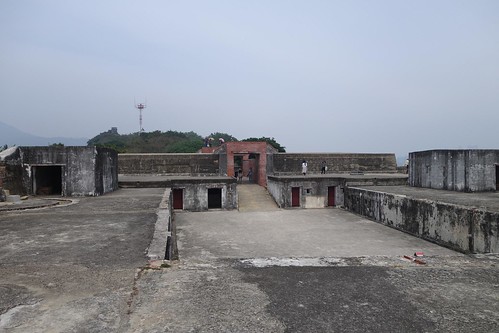
Cihou Fort, Kaohsiung

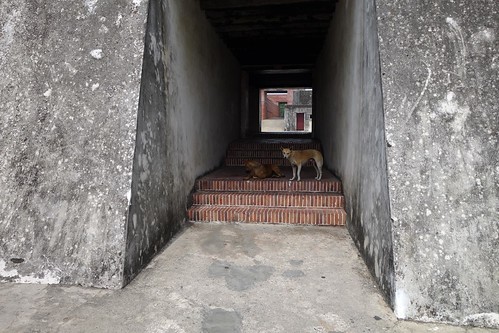
KTown_Mar15_144
Dogs get out of the sun at the fort's entrance.

Yesterday gave the legs a test with a day spent walking around Kaohsiung. Lovely weather and great company made it a perfect day.

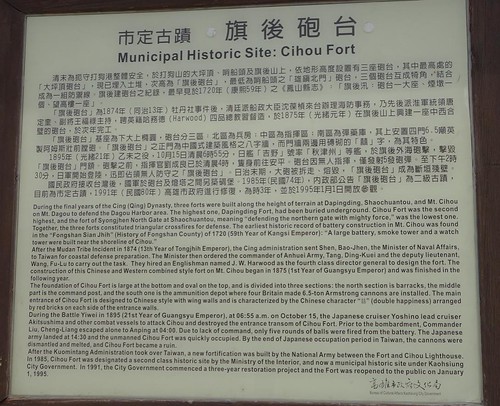
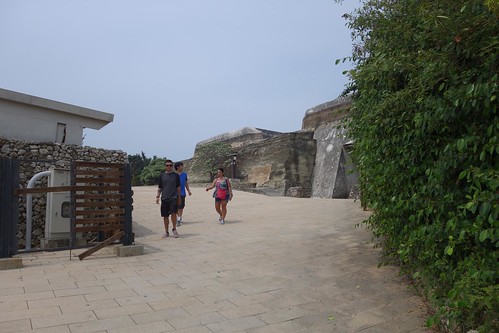
One of our stops was Cihou Fort, the Qing Dynasty gun battery located outside Kaohsiung harbor (map link). The fort is easy to get to: just take the metro to Shiziwan, then walk to the ferry, take the ferry across the harbor (5 mins, $15 nt), then walk half a kilometer or so to the fort entrance. Entrance is free.

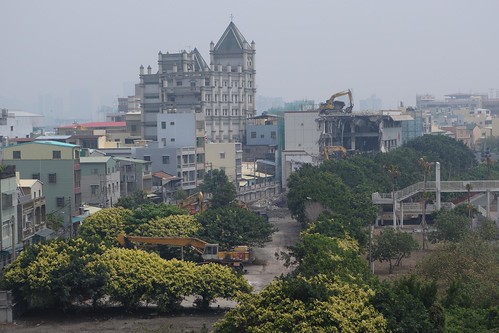
KTown_Mar15_144
The walk up offers some good views over the city, including one of a hospital being torn down. Note where the power shovel is parked...

Wiki notes:
First fortifications were built in 1720 (during Kangxi's reign and Qing rule). After Japanese expedition in 1874 Chinese authorities constructed a modern fort, which in 1880 had new Armstrong's guns installed. It played no part in the Sino-French War; the fighting in Taiwan took place around Keelung and during blockade French ships did not approach the port.

Taiwan was ceded to Japan according to the Treaty of Shimonoseki in the aftermath of the first Sino-Japanese war. The local troops, however, fought on. On 12 October 1895, escadre commanded by admiral Arichi Shinanojo (cruisers Yoshino, Naniwa, Akitsushima, Yaeyama, Saien (ex Chinese Jiyuan, captured in Weihaiwei) and corvette Hiei) arrived at Kaohsiung and prompted the foreigners to evacuate, as they would conduct the attack on the next day. The foreigners boarded gunboat HMS Tweed and two tugs and withdrew (only to return once the fight was over). At 7 am, 13 October, Japanese ships "opened fire on the Takow [Kaohsiung] forts at a range of about 6,000 yards. For the first half hour, the forts responded, but after this their guns were silent...The forts fired twenty four rounds, the best shot being from the 8-inch B.L. Armstrong guns in Apes' Hill fort, which struck the water about 500 yards from the Naniwa Kan."The Japanese troops seized the forts in early afternoon, suffering no casualties (4 Chinese soldiers were killed).
The Chinese text says the fort's commander ran away when the Japanese appeared. The gun crews, incompetent though they were, bravely soldiered on, firing a few rounds. Wiki adds that the fort, designed by a British engineer, consists of three parts:
...fortified barracks, around rectangular square, with close-defence parapet on the roof. Of the two gates, one leads to the battery, the other used to be a main southern gate. It bore a Chinese inscription, which could be translated as "Mighty blow to the South" – the characters for "mighty blow" were shot away by a shell from Yoshino. The rest, still visible, serve as ironic remainder of history.
Much of the fort still remains, since it was still used in the KMT period. It was restored in the early 1990s by the Kaohsiung city government.

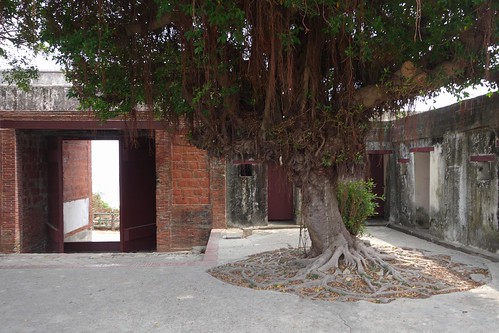
The gate.

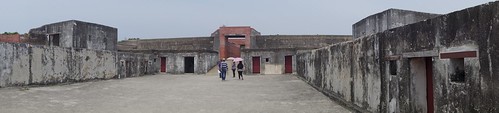
A pan of the interior.

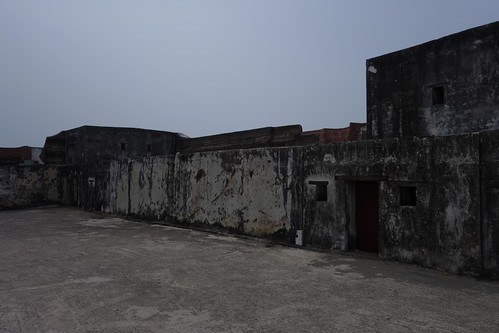
The barracks and other rooms, all locked.

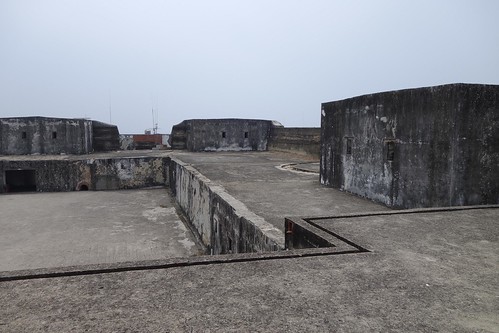
The parapet where the four 7" guns were mounted.

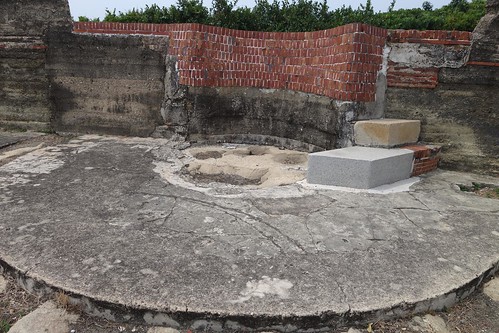
Gun site.

Good views over the nearby sea.

Half the fort.

Rear gate.

Well worth a visit on a day trip out here, Cihou Fort remains an evocative historical site of Taiwan as a nexus of colonial interest from Imperial Japan, the Manchu Empire, and the European powers.
_______________________
Don't miss the comments below! And check out my blog and its sidebars for events, links to previous posts and picture posts, and scores of links to other Taiwan blogs and forums!

Thursday, March 12, 2015

1945 US maps of Japanese airfields in Taiwan

These were sent around Facebook. Originally posted by John Gong.
_______________________
Don't miss the comments below! And check out my blog and its sidebars for events, links to previous posts and picture posts, and scores of links to other Taiwan blogs and forums!

Sunday, March 08, 2015

Blast from the Past: Byoritsu oil refinery, Miaoli, 26 May, 1945

Wiki says:
Scope and content: Spectacular crash at Byoritsu oil refinery, Formosa, was photographed by a B-25 of the 5th Air Force's 345th Bomb Group on 26 May 1945. Just as it released its string of parafrags B-25 NO. 192 was hit by flak from a camouflaged battery and trails smoke. A gaping hole is visible on the piolot's side.

General notes: The aircraft visible is the North American B-25J-10-NC Mitchell (s/n 43-36192) "Jaunty Jo". Crew : 2/Lt Robert J. Knauf Pilot, 2/Lt Martin H. Mulner Jr. Co-Pilot, 1/Lt Lloyd E. Bodell Navigator, Cpl Harold O. Montville Eng/Gunner, Sgt Tennyson C. Harrell Radio/Gunner.
Taiwan Airpower Blog has the background and story, along with more photos of the crash, and then and now photos.
_______________________
Don't miss the comments below! And check out my blog and its sidebars for events, links to previous posts and picture posts, and scores of links to other Taiwan blogs and forums!
Monday, February 16, 2015

Then and Now: Imourod on Lanyu

Was trawling the East Asia Image Forum for Lanyu pics when I came across this picture of the people of Lanyu launching boats, from the first half of the 1930s. Got to wondering what beach this was. Did I have this view?

Yep, sure did. It's the beach that now hosts the village of Imourod, Hongtou (red head) in Chinese. I've placed them next to each other for comparison.
The angle is the same but my pic was taken from farther away. Erosion and vegetation have blurred the shapes....
_______________________
Don't miss the comments below! And check out my blog and its sidebars for events, links to previous posts and picture posts, and scores of links to other Taiwan blogs and forums!

Tuesday, December 23, 2014

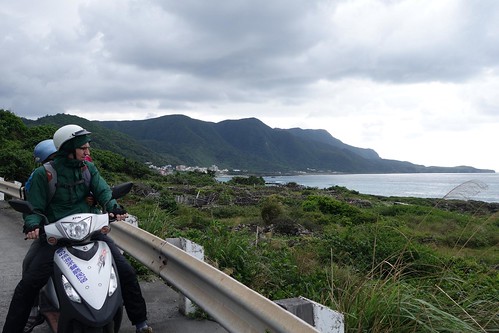
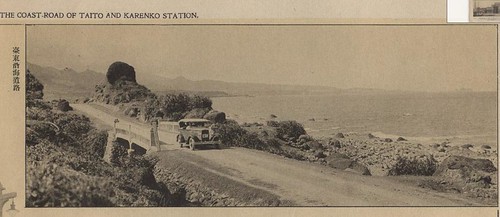
Then and Now: the old Japanese Coast Road

taitocoast
I was trawling around the East Asia Image Collection again today, the Taiwan Photographic Monthly, and found this image of the old Japanese coast road. I stopped for a moment, thinking... I've seen this spot.

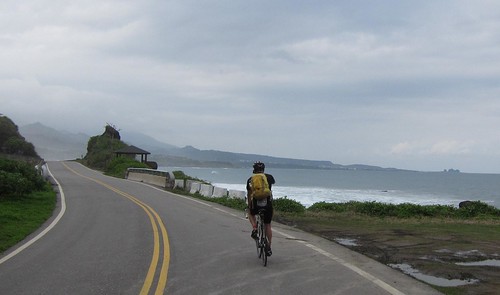
Sure enough, back in March of this year I came down for a weekend of riding on the rift valley and the coast and got a shot of my man Drew Kerslake riding the old Japanese coast road. The old Japanese coast road is now the Baonon bike path on the coast in Chenggong township (it is designated the Dong 19). It's a slightly different angle, and the rock has fallen/been bashed into a smaller piece, but it's the same spot (Google maps Streetview).

This will give you some idea of what the first Japanese drivers on this road must have seen.
_______________________
Don't miss the comments below! And check out my blog and its sidebars for events, links to previous posts and picture posts, and scores of links to other Taiwan blogs and forums!