Showing posts with label political economy. Show all posts

Monday, August 18, 2014

A Cole-Sullivan TwoFer + links

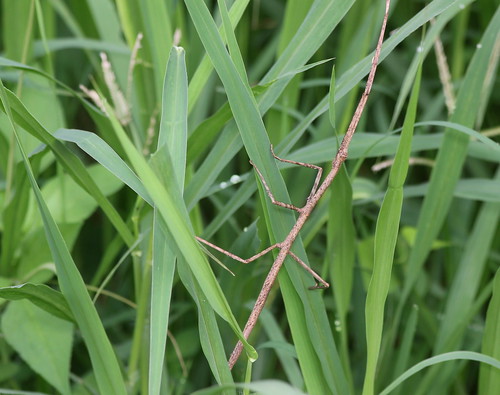
Out walking the dog, found this beautiful walking stick.

Taiwan expert Jon Sullivan with an excellent piece on the DPP, Taiwan identity, social class issues, and politics at The National Interest. He scribes:
Notwithstanding underlying trends in public opinion, a spate of recent academic publications suggests that this may indeed be happening. They suggest that a new economic cleavage based on class has not just mitigated national identity, but has replaced it. Because of the unusual equality of growth during Taiwan’s “economic miracle,” combined with the dominance of national identity during the democratization process, class has not been particularly salient in Taiwan. But since the global financial crisis, exacerbated by ECFA, Taiwan has seen the emergence of inequalities that it hasn’t witnessed in generations. The reality for many Taiwanese is stagnant or declining wages, unaffordable houses, unemployment, poor social mobility and feelings of relative deprivation and economic insecurity. Reflecting on these developments, Tsinghua University scholar Zheng Zhenqing says that “under the influence of the global financial crisis, a new axis of class politics has emerged.” Wu Yushan at Taiwan’s Academia Sinica agrees that “class politics based on wealth gap has become new driving force of party politics [. . .] the dominant social cleavage [has shifted] away from identity towards distribution.” Qi Dongtao at the National University of Singapore similarly argues that class divisions and class awareness have increased dramatically since ECFA. When the global financial crisis decimated Taiwanese exports, President Ma and the KMT promoted growth by opening up to the Chinese economy via the vehicle of ECFA.
This is a really excellent piece. But there's a connection missing. The Taiwanese identity is still driving politics, and the emerging class politics we see in Taiwan is just the other side of the Taiwanese identity coin: it was always driven in part by economic injustice. Taiwanese have always resented how the mainlander-run political order extracted the surpluses they generated and handed them out among the mainlander population, most of whom were left out of the economic miracle since they lacked the kind of sophisticated production and financial skills and resources that the Taiwanese possessed. This economic cleavage produced two privileged classes: mainlander bureaucrats and soldiers who lived on the surplus produced by the Taiwanese, and the extremely wealthy capitalist class which had intimate connections to the top of the KMT and exploited those connections to make money off upstream industrial development (like plastics), finance, and land development. The Taiwanese identity is in large part a response to the colonial processes that underlie KMT control of Taiwan's economic flows.

Thus, the economic justice issue is a Taiwan identity issue, one bleeds into the other. The driver of both is of course China. Taiwan expert Ketty Chen observed this in her extensive and excellent piece on the SOAS conference this summer:
Lastly, the SOAS conference also brought to the forefront an issue that cannot be ignored – the influence of China, as the China factor was one of the reasons for the student occupation of the Legislative Yuan and the Sunflower Movement. Moreover, the movement against media monopoly, the demolition of Mainlander communities in Taipei, land expropriation in Miaoli County and elsewhere in Taiwan, all in the name of progress, development and investment, all bear the influence of China.
Sullivan knows this, of course; few understand Taiwan politics better than he does. That is probably why he confidently expects the Taiwan identity to become a huge driver of politics in the future -- especially as the current young generation matures (talking about my generational issues). But he could hardly talk about economic justice in the relatively conservative National Interest.

Meanwhile over at Sullivan's wonderful China Policy Institute blog, J Michael Cole has a piece arguing that it is Time to Bring the Orphan In From the Cold:
Although Washington might operate under the assumption that limiting the DPP’s room to maneuver—or killing its chances of being re-elected—is to the U.S.’ advantage, such a strategy is terribly short sighted. Independence, the “status quo,” and anything short of “one China,” is a trump card not only for the DPP, but also for the many KMT voters who would never agree to seeing their country absorbed by authoritarian China. Pan-blue voters might not be as vocal as their “green” counterparts on the subject, but that notion is very clear in their minds (less than 10 percent of blue voters support unification). The last thing Washington wants to do, therefore, is to deny those voters that safe zone. In fact, knowing what we know about the composition of the Sunflower Movement, it is clear that any move by the U.S. to constrain the choices of the Taiwanese (e.g., freezing the DPP’s independence clause) would only fuel anti-American sentiment on the island, which certainly isn’t to Washington’s advantage. The more the U.S. forces Taiwanese in a direction that they don’t want to go, the greater the risks of instability on the island. Repeats of the Sunflower occupation, which will certainly occur if the government makes any concessions on Taiwan’s sovereignty, can only further weaken Taiwanese society and invite Chinese intervention (on this aspect, recent developments in Crimea should dispel any notion that authoritarian governments such as those in Moscow or Beijing will be deterred by fears of retaliation or sanctions when acting within what they regard as their immediate neighborhood). Washington officials should realize that a strong, confident, and united Taiwan, one that doesn’t feel isolated or forced to make choices it would rather not make is in the U.S.’ interest.
Cole is largely right, but I would go further to contend that letting the KMT run Taiwan is against US interests, because the KMT is a pro-China party and because it will be less likely to cooperate with the US when China finally moves on the Senkakus or something big in the South China Sea. This is evident in how the Ma Administration constantly moves to irritate Washington (here and here, but especially here and here), to contravene its policies and stir up trouble with Japan. Anyone seriously think a DPP president will call in the Japanese ambassador to upbraid him about the Senkakus?

The other point that I constantly make is that the everywhere else around the periphery of China, the US is taking steps in concert with local governments to resist Chinese expansionism. But with Taiwan the US is encouraging Chinese expansionism. How's that again? Does the US really want to give up 23 million people, an army and an air force, and a forward position with a fellow democracy, and then fight a war with China over the uninhabited Senkakus or Spratlys? The truth is that Taiwan is an asset that US thinkers can't seem to imagine how to use.

Sad, that.
__________________
Daily Links:
_______________________
Don't miss the comments below! And check out my blog and its sidebars for events, links to previous posts and picture posts, and scores of links to other Taiwan blogs and forums!

Sunday, May 11, 2014

Talking about my... generational issues

Towering.

Why don't you all fade away
And don't try to dig what we all say
I'm not trying to cause a big sensation
I'm just talkin' 'bout my generation

Popped over to Thinking Taiwan.com, where you should really be going, and read a lot today. One point that is made in various forms by many commentators there, and everywhere else, is that this generation of kids is different: it's the first to grow up under democracy.

Well, that's true, yet this generation is different in another way too: it is the first to face economic prospects worse than those of its parents. This generation is suffering under years of worsening income inequality (Gini coefficient), stagnant incomes, and slowing growth:

Year Growth Rate
Gini 


1990

6.87

0.308

1991

7.88

0.312

1992

7.56

0.315

1993

6.73

0.318

1994

7.59

0.317

1995

6.38

0.317

1996

5.54

0.320

1997

5.48

0.324

1998

3.47

0.325

1999

5.97

0.326

2000

5.80

0.350

2001

-1.65

0.345

2002

5.26

0.343

2003

3.67

0.338

2004

6.19

0.340

2005

4.70

0.339

2006

5.44

0.340

2007

5.98

0.341

2008

0.73

0.345

2009

-1.81

0.342

2010

10.76

0.342

2011

4.19

0.308

2012

1.48

0.312

2013

2.1


Source: DGBAS

Cruelly, this generation's growing environmental awareness confronts an environment increasingly traumatized by the construction-industrial state, while many of its best management and engineering prospects must look for work in China.

To put this in historical perspective, between 1895 and 1938, Taiwanese knew solid economic growth driven by Japanese subsidies for rice and sugar production which paid above-world-market prices for those items. For a brief period around 1936-37, per capita incomes in Taiwan may have exceeded per capita incomes in Japan proper. Thus the great-grandparents of this generation knew a land whose wealth and stability steadily grew.

The war intervened and trade with Japan collapsed after 1943 with the US sub blockade. When the war ended, Japanese were largely repatriated, and the island was catastrophically looted by the KMT. Incomes plummeted and with the advent of a million or so extra mouths to feed in 1949, per capita incomes probably did not recover until the mid-1960s (Mendel discusses this in the classic The Politics of Formosan Nationalism). The KMT, probably deliberately, marks the beginning of its records in 1950, which shows steady growth (experienced by the locals, until about 1965, as recovery) throughout the 50s to the 80s, with a few blips. Hence, until 1990, two generations came and went under steady GDP growth and constantly increasing economic prospects.

But the second of those two generations is still around, and it views things rather differently than the young. In its late 40s to early 60s, it is the true Strawberry generation, consolidating its gains, keeping its head down, not taking risks, deploring the action-oriented youth, and not taking to the streets to protect the future of its children. When their children took to the streets, they faced resistance from above: their parents cajoled, threatened, and forbade them from taking such action, according to many students I spoke to. When Hon Hai Chairman Terry Gou denigrated democracy the other day, saying that it didn't put food on the table, he was speaking as one in that older generation and many must have quietly agreed. Their experience is that democracy has brought slumping economic prospects and rising prices. What good can it be?

But there's another generational change quietly taking place: when Ma Ying-jeou finally steps down from the Presidency, he will likely be the last mainlander president born in China. The current generation of mainlander candidates for presidency were all born in Taiwan, the place where their faux mainlander identity was created, a true-born Taiwan identity even though it regards the island as an inferior place of exile. Their children, now in their 20s and 30s, are either emigrating, mostly to the US (like Ma Ying-jeou's daughters), or quietly adopting the rapidly evolving Taiwanese identity, which has both democracy and the island itself at its core. This generational change is happening within the KMT even as the DPP is finally handing off the torch to the generation that came of age after the democracy activism of the 70s and 80s.

While people note that the young are quite different than the old, in fact all the actors are in a place where no generation has ever been. What new Taiwan will they create? Stick around and see... because things are going to get real interesting...
_________________
Daily Links:
_______________________
Don't miss the comments below! And check out my blog and its sidebars for events, links to previous posts and picture posts, and scores of links to other Taiwan blogs and forums!
Friday, May 09, 2014

Student protests spark economy as Honhai Chairman pans democracy, says it won't put food on the table

A temple in Pingtung.

Terry Gou made headlines this week, denigrating democracy.....
Hon Hai Technology Group chairman Terry Gou (郭台銘) said yesterday that “democracy makes no pottage” and that social movements were only a waste of social resources that did the nation’s GDP growth no good.
That's it, in a nutshell. J Michael ripped him excellently here, pointing out that Gou's real audience is might well be Beijing. Gou wants to import equipment from Huawei, the Chinese maker which is widely suspected of tight cooperation with Chinese security services and threatened to not pay his taxes if he couldn't import it. But it was Huang Tien-lin who deflated him most persuasively in today's Taipei Times, pointing out that blocking the trade pact gave the economy a boost....
Long before the protests against the cross-strait service trade agreement began on March 18, I had said that if the agreement were blocked, Taiwan’s economy would do better than forecast. Today we are faced with the facts. The student movement saved the nation just before the doors to hell were closed behind us and public confidence has increased. In March, during the student protests, exports reached US$27.76 billion, the third-highest month in history. Last month, economic indicators remained “green,” signaling steady growth, and foreign stock investors overbought for 26 days, with net purchases reaching NT$137.5 billion (US$4.6 billion).

These amounted to market approval of the political turmoil that went on for more than a month. Furthermore, the stock market index increased by 172 points during the student protests, or 1.98 percent, making it among the strongest markets in Asia.
This is part of a larger argument that Huang makes, which contends that keeping our distance from China enhances our economic growth. I think this argument is partly wrong -- from the end of the Lee Administration to the end of the Chen Administration was the Golden Age of Taiwan investment in China, when Taiwan exported stuff made in Taiwan and processed it there. We enjoyed reasonable growth, especially in the last couple of booming years of the Chen Administration. Huang links that to Chen's attempt to slow the drift into the China abyss:
The third was then-president Chen Shui-bian’s (陳水扁) announcement putting an end to the “active opening” policy on New Year’s Day 2006 and applying the breaks to further deregulation of cross-strait trade. The result was that the economy took a turn for the better, and 2006 and 2007 provided the best economic performance during Chen’s eight-year presidency, with the stock market almost breaking through the 10,000-point mark, reaching 9,859 points.
Should add that economic growth is expected, at the moment, to be better than last year. Cross-strait integration is slowly strangling Taiwan's economy. The government has become quite effective at deploying neo-liberal discourse to conceal its relocation of Taiwan into China's orbit. For example...
Both the Trans-Pacific Partnership (TPP) and the Regional Comprehensive Economic Partnership (RCEP) are important to Taiwan and will play a crucial role in the country's economic development, Cho said in his opening remarks at an international forum on the service industry.

The output of Taiwan's service industry could fall by US$1.9 billion if the country fails to join the TPP, but could increase by US$8.58 billion if it becomes part of the economic bloc, he said.

Although services account for 70 percent of Taiwan's gross domestic product, they make up only 1 percent of the global market, Cho said. "There is plenty of room for Taiwan to develop," he added.

Taiwan should open up its services market more, which could help upgrade its industries, increase output and create jobs, Cho said.
The last is actually correct. The catch is, you have to open up to a market that is better than you at doing these things and competes on quality, so you can learn from it, not from one that is less skilled than you are and competing on cost. China can't upgrade Taiwan's service industries; the effect will be the opposite. Indeed, we are already seeing that in manufacturing.

Respecting this neoliberal discourse, the students did not disavow the neoliberal economic religion itself, but rather emphasized that they were for a good trade pact, but the services pact isn't one. This was a clever move and even better, the international media reported it correctly.

Meanwhile, as if to prove that we don't need the services pact, two Taiwanese banks announced further overseas expansion this week.
Cathay Financial Holding Co. said it has obtained approval from the Central Bank of Myanmar to set up a representative office for Cathay United Bank in Yangon, which the parent company expects will open during the third quarter this year.
Yangon, in Myanmar. Lots of people predicting Myanmar will be The Next Asian Tiger. Taiwanese firms already trickling in, but other Asian states remain far ahead in investment there, with China in the lead. With new investment markets like Myanmar opening up, distancing Taiwan from China and slowing the pace of integration is a possibility that should be a policy... but not under the current Administration.
________________
Daily Links:
  • Taiwan hospitals suffer from nursing shortages. Hospitals and nurses are another example of the way female labor is exploited to maintain the profitability of local institutions.
  • The canals of Changhua County
  • US might tap into Taiwan early warning radar.
  • Head of national security bureau Tsai De-sheng resigns. Many observers are interpreting this as Ma's right hand King Pu-tsun sweeping out those who will not play ball -- Tsai was one who did not sing the praises of China.
  • Pro-KMT paper says students lack independence of thought and objectivity. Because you are only independent and objective if you do what the KMT tells you to do.
  • KMT under threat: Changhua County Chief KMT primary is contested by the losers (FocusTw reports winner). This is splitting the party in Changhua. In Nantou there are two serious pan-Blue candidates, helping the DPP. In both counties the KMT faces corruption scandals. Yeehah. The Changhua KMT and DPP likely nominees are both current legislators so the election of either will trigger a by-election, as will a couple of other races. With a tight race in Taichung, central Taichung politics will be fun this year.
  • High Comedy: the Taiwan rep office in Australia responds to Taiwan scholar Mark Harrison's piece on the Sunflowers. "Therefore, the story of Taiwan shouldn’t be simply or unfairly interpreted as the Taiwanese struggle against authoritarianism and for democracy, but the planned and consistent movement to prosperity and its unique, multi-opinion and vibrant democracy." and other fantasies. Every sentence in it is a gem, and so revealing of a certain mindset of authoritarian control. Note how the official presents the KMT's view of the past -- obviously thinking that KMT = ROC. The Party-State mentality is alive and well in the KMT and its minions, who communicate in declarations and commands, unable to persuade or lead. In a democracy, government officials who are not direct appointees should remain nuetral....
  • ADDED: Nuke plants may have to shut down early. Seems there is no place to store the waste. The gov't must have known this was coming....
_______________________
Don't miss the comments below! And check out my blog and its sidebars for events, links to previous posts and picture posts, and scores of links to other Taiwan blogs and forums!
Sunday, January 26, 2014

Taiwan Offshoring

FTV_Jan_2014_133
No time for blogging for a couple more days...

Commonwealth strikes again with two great pieces on offshoring Taiwan's wealth here and here.

Oh, and J Michael Cole on the truck driver who crashed into the presidential office
_______________________
Don't miss the comments below! And check out my blog and its sidebars for events, links to previous posts and picture posts, and scores of links to other Taiwan blogs and forums!

Thursday, November 07, 2013

Central Bank Opposes Financial Free Trade in FTZ

keehike_big064.JPG
Strongpoint overlooking Keelung.

The Ma government keeps looking for an end around Taiwan's conservative financial regulations, which have protected the island fairly well from the stupidity and criminality that goes on elsewhere. Financial integration is a key goal of putting the island into China's orbit. President Ma himself noted in his Double Ten Day speech last month that he hoped the "free economic zones", 1960s style development zones, would include financial services, effecting getting them out from under Central Bank and other regulation. He said...
In addition, the free economic pilot zones (FEPZs) have already entered the launch phase. The Executive Yuan has relaxed 12 regulations to dramatically streamline customs procedures applying to pilot zone firms when they outsource processing operations, so that new operating models based on smart logistics can be gradually established in these zones. The Shanghai Free Trade Zone officially opened recently, giving us yet another competitor. Therefore, we must step up efforts to open up our market. The Executive Yuan is actively deliberating on whether to allow other industrial activities in the FEPZs, such as the financial sector’s wealth and asset management services. This is the right direction. We should expand the scope of liberalization for both domestic and international financial and economic activities.
Not so fast, however, says the Central Bank. I seldom source from WantWant since it is so pro-China, but in this case I'll make an exception. This WantWant piece's fuming at the Central Bank shows how closely Ma's policies align with those of China.
The central bank said that if the Taiwan dollar were to be traded in the free trade zone, then Taiwan would have opened its gates wide to the world, which it is not prepared to allow.

But the dilemma also lies in the fact that Taiwan has long isolated itself from the world's financial markets and has become a desert for foreign capital. If the government is currently planning a free trade zone that is no different than the system currently in place, the project is doomed to failure.

The central bank has cited the effects of the 1997 Asian financial crisis and the Lehman Brothers crisis in 2008 as reasons to lock the Taiwan dollar at home.

No doubt the memories of those financial disasters remain in Hong Kong and Singapore, but those two territories still consider it worthwhile to open their doors, judging the benefits to outweigh the potential risks.

Taiwan is urged to reconsider its policies regarding the international financial market and to take other countries in a similar position as examples. While other Asian financial heavyweights such as Hong Kong and Singapore compete to establish themselves as renminbi offshore financial centers, Taiwan talks the talk but remains petrified of taking the plunge.
It is hard to see how a system where all the financial transactions but those taking place in a certain zone are heavily regulated can ever function effectively. You can imagine that it would be laundering transactions from all over the world. Further, local banks would simply move transactions into the zone via paperwork to escape regulation. It would also make a nifty conduit by which PRC state banks could gut Taiwanese money policy simply by moving large sums in and out. The Central Bank's opposition is the correct move.

______________
Daily Links:

_______________________
Don't miss the comments below! And check out my blog and its sidebars for events, links to previous posts and picture posts, and scores of links to other Taiwan blogs and forums!

Thursday, September 26, 2013

The 1% Government

Taiwan is getting pummeled by several long-term trends  -- the financial liberalization of the late 1980s that brought in big global financial players, to Taiwan's detriment; the shift of factories and investment to China; and governance by the KMT. The trend is clear, as Commercial Times observed in another hard hitting editorial:
According to government statistics, the disposable annual income of people aged below 30 averaged only NT$366,000 (US$12,388) in 2012, lower than NT$380,000 in 1999.

In 2012, the starting monthly salaries for bachelor's degree holders averaged NT$26,000, down from NT$28,000 in 1999. The average starting salary of master's degree holders was NT$31,000, up only slightly from 13 years ago, when the average salary was NT$30,000.

There is an obvious trend in which wealth is concentrated in the hands of the older generations.

In 2010, 75 percent of residential properties in Taiwan were owned by people aged 45 or older, with homeowners younger than 35 accounting for only 8 percent. Many of these young homeowners are believed to have obtained financial support from their parents. In other words, the situation for young people is even worse than it appears.
This wealth gap between generations, as this Commercial Times points out, is cushioning the blow this brutal economy is giving the young. Meanwhile the KMT continues to serve the big money -- still no real stock tax, no change in the land tax (here), and now the premier wants to chain the minimum wage to the consumer price index (CPI), essentially freezing it at the current low level for the next few years:
Premier Jiang Yi-huah (江宜樺) yesterday decided that beginning next year, the minimum wage will be contingent on growth in the consumer price index (CPI), a policy drawing severe criticism from labor groups.

With a threshold of a cumulative CPI growth of 3 percent or higher needed before the minimum wage will be reviewed, “it is highly likely that the basic wage levels will remain stagnant in the remaining three years of President Ma Ying-jeou (馬英九) tenure,” Taiwan Labor Front secretary-general Son Yu-lian (孫友聯) said.
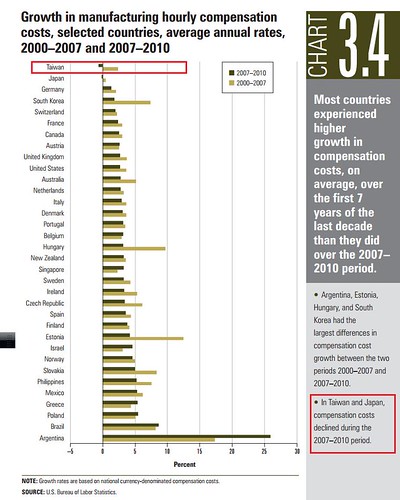
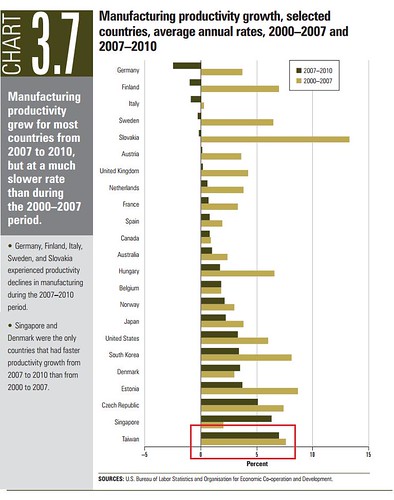
This means that the government can hold wages down without appearing to, simply by lowballing the CPI. Theoretically, wages will always remain the same relative to prices, which means that laborers will never be able to capture a larger share of the pie, at least while the Ma government is in office. Since 2007 and especially since the Ma Administration came to power, wages have regressed while productivity has boomed. Taiwan's gap between CPI changes and wage changes was the highest in the world in 2010. The Ma government wants to freeze this historically anomalous situation and treat it as the norm. The struggle for control of Taiwan between the pro-China and pro-Taiwan sides really masks the brutal and ongoing defeat of Taiwanese workers economically; it enables both parties to enlist workers on their side via their tribal social identities while screwing them out of their rightful livelihood.
_______________________
Don't miss the comments below! And check out my blog and its sidebars for events, links to previous posts and picture posts, and scores of links to other Taiwan blogs and forums!

Tuesday, August 13, 2013

Economic Round Up: Beijing to strip Taiwan banks?

So hot on the east coast this weekend, everyone is taking a dip.

With President Ma away on a foreign trip, FocusTaiwan provides some of the most recent numbers on Taiwan's economic situation....
Taiwan's exports usually post strong growth in July, but that was not the case this year. A rare monthly decline in exports was recorded in July and the annual export growth rate for the month was also lower than expected.

Even though exports rose 1.6 percent year-on-year, the growth rate fell far short of expectations, said Liang Kuo-yuan, director of Polaris Research Institute.

....

Taiwan recorded a rare 0.9 percent annual decline in exports to China and Hong Kong in July, according to customs statistics.

Another factor that affected exports in July was the 7.7 percent drop in the export of information and communication technology (ITC) products, Liang said.
According to the articles FocusTaiwan collected, Taiwan's July exports fell 4.4 percent from June but increased 1.6 percent year-on-year. In June exports had annualized growth of over 8%. A huge chunk of growth was due to mineral exports, which grew 20%, with the steepest decline in capital goods. Another signal of bad times to come: imports from the US and Japan both shrank over 15%. Since those two countries are Taiwan's most important sources of production technology and raw materials, shrinking imports should mean that producers are planning to produce less.

The Taipei Times published an excellent editorial on the economy the other day. It noted:
Taiwan’s economy lost steam again last month after exports shrank 4.4 percent month-on-month to US$35.3 billion, data released on Wednesday by the Ministry of Finance showed. That brought the nation’s exports up just 2.3 percent during the first seven months to US$175.74 billion from a year ago.

....

Taiwan’s exports to six emerging countries, including Malaysia and five other ASEAN members, showed robust growth as reflected by an annual growth of 7.3 percent in exports to US$33.45 billion in the seven-month period ending on July 31.

That makes ASEAN countries Taiwan’s second-biggest export destination, surpassing the US, Europe and Japan.

In fact, ASEAN seized the No. 2 position in 2007, when exports to those countries grew at an annual rate of 16.7 percent, outpacing China’s 12.6 percent expansion based on the statistics compiled by the Ministry of Finance.
Facts like these show the retrograde nature of Ma's go-China policy in its full light: it actually refocused Taiwan away from cultivating growing markets abroad to a stronger focus on the China market. You could hardly ask for a better strategy for Taiwan if you were an economic planner in Beijing looking at a Taiwan that was competing with your exports to the ASEAN area. I'm sure it is just a coincidence.

The services pact with China was totally ripped by Huang Tien-lin, President of First Commercial Bank, in the Taipei Times....
Why do I say this is the beginning of a disaster? You need only look at how enthusiastically the financial services industry has flocked to China. Confucius said: “Going too far is as bad as not going far enough” (過猶不及). This is a sentiment deemed fundamental to economists and yet, even now, there are many financial holding companies preparing to increase their investments in China and plough billions into local banks, mergers and acquisitions, and stocks and securities, and opening overseas branches in Fujian Province.

Initial estimates suggest that Taiwanese banks have either already transferred, or are preparing to transfer, not less than NT$160 billion in core capital to China. This is another example of integration with China that will surely see the further marginalization of Taiwan, just as the exodus of Taiwanese manufacturing to China did in the past.

Closely related to this is the deregulation of Chinese yuan deposits in February that, in the short four-month period to the end of June, has seen the accumulation of more than NT$360 billion worth of Chinese yuan in domestic and offshore accounts. This figure is increasing at the rate of NT$50 billion per month, giving a projected annual increase of NT$600 billion, a rate and amount equivalent to half Taiwan’s average annual increase in national M2 deposits — NT$1.2 trillion — in the decade from 2001 to 2011.

What is the purpose of accumulating all these yuan deposits? Naturally, they are to be used for providing financial services in China. This increase in credit financing in China means squeezing the amount of credit available to be extended in Taiwan.
Credit is a key driver of economic growth, the lubricant of a healthy economy. As Huang notes, the money flows not only will reduce investment on this side of the Strait, but also threaten Taiwan politically and socially by increasing the exposure of local banks to China's increasingly slowing economy. This "financial integration" has long been an important goal of China precisely because its political effects are so powerful. Unlike the US, Taiwan cannot simply print an enormous pile of money and save its banks. Debts owed to Taiwan banks give China additional leverage over Taiwan -- both directly: "Submit! Or we won't pay up!" -- and indirectly, since bank officials are likely to pressure the government to further align itself with Beijing in order to protect themselves from the consequences of the coming overexposure. Not that they aren't already.

Consider also: Taiwan's truly wealthy keep their wealth parked overseas or in land; savings in local banks are likely to be held by middle class and upper middle class individuals. It is they who will suffer if and when Taiwan's overexposed banks are punished by huge losses in China.

The move to China by the banks comes at a time when private domestic investment is moribund. The Economic Daily News observed:
According to the Directorate General of Budget, Accounting and Statistics, the increase in consumption was driven by rises in stock transactions and mutual fund fees. This demonstrates that the consumption increase had nothing to do with real consumption.

The rise in net exports, meanwhile, was the result of slower growth in imports, due to slower demand for equipment. Consequently, capital formation contracted 3.03 percent in the second quarter, cutting 0.52 percentage points off overall economic growth.

More worrying still, over the past five years, there have been four years in which private-sector investment recorded negative growth, despite various efforts made by the government to promote investment.
Recall also that Taiwan is not attracting much foreign direct investment; FDI was negative in 2011, positive for 2012 (source). With economic expansion slowing in Japan, and the US and Europe afflicted with austerity madness, it seems Taiwan will continue to suffer from the stupid, self-destructive policies of European and American elites.

Finally, enjoy a well written blog post on the nature of the debates over China, its credit issues, and its growth model from Michael Pettis.
______________
Daily Links:
_______________________
Don't miss the comments below! And check out my blog and its sidebars for events, links to previous posts and picture posts, and scores of links to other Taiwan blogs and forums!

Sunday, July 07, 2013

The Destruction of the Huaguang Community

The Taipei Times has written an excellent two-part series on the destruction of the Huaguang community in Taipei to make way for a ritzy upscale development...

Part 1 Refugees Squatting on a Gold Mine

Part 2 This Land is Whose Land?

"For decades, the 12-hectare Huaguang Community (華光社區), which is located in the heart of Taipei, was home to the poor, the elderly and the disadvantaged — until, that is, it became prime real estate. The area will soon be flattened to make way for a glitzy, upmarket neighborhood inspired by Tokyo’s Roppongi district. The process of forced evictions by the central government began a few years ago, and there was no relocation plan for the residents. To facilitate evictions, the Ministry of Justice (MOJ), which owns the land, filed lawsuits against residents for “illegally” occupying state properties, resulting in fines to residents that range from a few hundred thousand New Taiwan dollars to several million. Most inhabitants have been forced to leave. Others have died while fighting for their right to stay."
The savagery of the government's drive to get the people off the land by defining them them as illegal residents and then slapping them with fines and lawsuits and garnishing of salaries is shocking. These are old people in their sixties, seventies, and eighties, who have been squatting here for decades, many born and raised in the community. Since everyone says that the development will make big bucks, the obvious thing to do is arrange a generous compensation plan and resettle the people in shiny new houses.

Ordinary lower-class mainlanders like these people and their forebearers were in many ways excluded from the Taiwan Miracle. The Taiwanese themselves, limited in their ability to obtain government and military jobs along with important civil occupations in the 1950s and 1960s, turned to manufacturing and developed Taiwan's brilliant miracle economy. Mainlander/KMT elites and their cronies skimmed that wealth in a variety of ways to fund the developmentalist state, party and state-owned corporations, and enrich themselves. But working class and poor mainlanders often lacked the skills, education, capital, and family connections to better their lives. They got by on state rations -- given rice confiscated or taxed away from Taiwanese farmers -- and settled down in squatter communities like Huaguang and other communities now vanished from Taipei. Now the KMT government, in that marvelous bit of alchemy by which public lands are transmuted into private gold, is screwing them.
“I was taught to love my country, but I didn’t know the country I loved was like this,” Cheng Wei-hui says. “It gives money to big corporations and condemns us people to death.”
Yes, that's right. This Flickr search (English) and this one (Chinese) will bring up some nice pictures of the community.
_______________________
Don't miss the comments below! And check out my blog and its sidebars for events, links to previous posts and picture posts, and scores of links to other Taiwan blogs and forums!

Wednesday, May 29, 2013

Good-bye capital gains tax, we hardly knew ya

One of the many things this mess with the Phils has enabled the government to divert public attention from the drive to eliminate the capital gains tax. As a tax on the wealthy which kicked in when the stock market crossed 8,500, it was odious to the KMT, the island's party of the 1%. In the latest "economic stimulus" package of the government, it will be killed....
One of the measures involved the legislature passing an amendment to the Income Tax Act (所得稅法) before the current session ends on Friday to drop the 8,500-point threshold that automatically triggers the capital gains tax for individual investors, Jiang said.

The Chinese Nationalist Party (KMT) has proposed removing the requirement that the TAIEX surpass 8,500 points for the tax to be imposed and replace it with a tax on investors who sell NT$1 billion (US$33.3 million) worth of shares during one calendar year.

The premier said that abolishing the threshold would turn the economy around because it would be like “lifting the cover off a pot” to let the “suffocated” economy breathe.
Alas, removing the capital gains tax will simply result in more capital being hoarded and then shipped out of the country instead of being reinvested here and driving economic growth in Taiwan. It will only make the rich richer, and Taiwan being so expensive, the poor cannot even console themselves with babies.

UDN rightly complained:
Despite the many steps taken, however, nothing has seemed to work. The latest package focuses on expanding consumer spending, boosting domestic investment, encouraging innovation and new business start-ups, and revising the capital gains tax on stock sales. The content is not at all inspiring because it did not go beyond the existing policy framework.

Moreover, the government is planning to invest a mere NT$3.24 billion over five years in the new package. How can we expect it to rescue Taiwan's weak economy?
Figure it out. In US dollars, $3.24 billion is a little over US$100 million, or $20 million annually for the "stimulus". Peanuts.

According to the TT article, the DGBAS lowered its estimate of growth for the year to 2.4%. Recall that industrial output fell for the third straight month in April, as Bloomberg noted in its roundup of economic indicators.
____________________
Daily Links:
_______________________
Don't miss the comments below! And check out my blog and its sidebars for events, links to previous posts and picture posts, and scores of links to other Taiwan blogs and forums!

Wednesday, May 15, 2013

Ma Polls Down

At Tianzhong Station.

It seems almost superfluous to say so, but the President is deeply unpopular. FocusTaiwan says....
President Ma Ying-jeou's approval rating has fallen to 21 percent from 23 percent a year ago, according to a United Daily News poll conducted as Ma nears the end of the first year of his second term in office. He was sworn in on May 20, 2012.

Disapproval of Ma's performance rose from 66 percent to 70 percent during the same period, the poll results showed.

Although the government continues to trumpet the economy as its top priority, its efforts have been found lacking, with 76.4 percent of respondents saying they were not satisfied with the current economic situation in Taiwan.
UDN is rabidly pro-KMT. Taiwan Thinktank had similar but slightly lower numbers out the other day. Both pan-Blue and pan-Green polling organizations are getting similar numbers. According to the UDN poll Ma's strong suit is foreign policy and his weakness is the economy.

Mustn't read much into this. Next year's local elections will be contested on local issues with some influence from Ma's low numbers. Ma and the KMT will again have the strong support of the monied classes since no serious progress has been made on Taiwan's wealth gap, income inequality, or tax unfairness. But slumping domestic numbers go a long way to explain why Ma has come on "tough" against the Philippines in incident of the dead fisherman.

_________________
Daily Links:
_______________________
Don't miss the comments below! And check out my blog and its sidebars for events, links to previous posts and picture posts, and scores of links to other Taiwan blogs and forums!

Saturday, March 16, 2013

Stanton's Speech at World Taiwanese Congress, Complete

Dusk over Taichung.

The Taipei Times ran an article today on former AIT head William Stanton's speech at the World Taiwanese Congress in Taipei: Taiwan increasingly leaning towards China.
Taiwan is actually increasingly leaning toward China, he said, and the “status quo,” as perceived by Taiwanese, was “problematic” and “an illusion,” given that China is growing ever stronger and Taiwan is increasingly dependent on China economically.

Taiwanese cannot unilaterally decide the development of cross-strait ties, Stanton said at the annual meeting of the World Taiwanese Congress in Taipei, adding that how much patience China shows toward maintaining the “status quo” remains a question if bilateral relations do not proceed the way China sees fit.
Stanton was kind enough to permit several of us to post it on the web. Below the READ MORE link is the speech in its entirety. Great job, sir.

Saturday, December 22, 2012

WSJ: Taiwan firms returning quietly SHHHHH....

Nightview at a downtown park in Taichung

WSJ: Taiwan firms returning jobs quietly from China:
With wages rising across China and growing labor unrest threatening operations at mainland factories, Taiwan sees an opportunity to try to convince its “salmon to swim back home,” as local media have put it. Officials at Taiwan’s Industrial Development Bureau, which announced Catcher’s and Largan’s factory plans, said they didn’t know of any companies willing to discuss their participation in the program.

Hui-Ying Chen, deputy director of the IDB’s industrial policy division, said Taiwanese companies returning to invest often want to stay low-key, possibly to avoid accidentally offending clients or the local governments they work with. She said that since many of these companies continue to run factories in China, they likely want to avoid saying anything that might come off as negative toward the business environment there. Moreover, Taiwanese upstream suppliers tend to hold a strong belief that any publicity is bad publicity.

“When they call for information, they will leave their telephone number, but often they won’t even tell us what industry they are in,” she said. “Although they want to invest in Taiwan, many don’t want their names announced.”
Local news reports put the number of firms considering at as many as 131.

As I've blogged on several times, one of the sweeteners is that firms that invest a certain amount in a "return" from China can hire more foreign laborers, a number which is already at a record figure. This tends to incentivize the worst kind of investments -- labor-intensive, low value added, heavily dependent on subsidized water and electricity (and effectively, labor), for their profit. The incentives also include zero tariffs on equipment imports, low-interest loans, and tech assistance. ....

Another good sign is the potential return of the smaller firms that were Taiwan's bread and butter. Plastics News observes that Taiwan's plastics firms are considering returning from China....
Two years ago, when Taiwan’s government started urging businesses to consider it, some executives didn’t take the suggestions seriously, said David Chang, vice general manager of Taiwanese press maker Multiplas Enginery Co. Ltd.

“At the time people considered it a joke,” Chang said. “Now people don’t think it’s a joke because of the wage increases [in mainland China].”

The head of the Taiwan Plastics Industry Association, which represents about 700 processing and moldmaking companies, predicted some work could come back, although he cautioned discussions are in their early stages.
Hsieh Sheng-Hai, secretary general of the Taipei-based group, said processors are closely studying it and want to see how key customers, including Taiwan’s large contract electronics manufacturers like Foxconn, handle the increased challenges of operating on the mainland.

He noted that even if work leaves the mainland, it may not come back to Taiwan – it could go to Indonesia, Vietnam or elsewhere in Southeast Asia. But it’s also true that Taiwanese companies see more problems operating in the mainland and are looking for solutions, industry officials said.

“They feel moving back to Taiwan would be much easier to do their business,” Hsieh said.

Some global plastics machinery companies at Taipei Plas, held Sept. 21 to Sept. 25, said they had seen significantly more sales of equipment to companies in Taiwan, and said “reshoring” from mainland China was a big driver.
Naomi Rovnick also reported on this for The Atlantic a few months back, also instancing the plastics industry. She pointed out that other factors are driving the shift of Taiwanese manufacturers out of China....
Sway Su, another attendee and a researcher for Taiwan's Plastics Industry Development Center, a trade association, echoes that view. "Manufacturing wages in some wealthier cities in mainland China are the same as in Taiwan now. So Taiwanese manufacturers want to move their production to Indonesia, Vietnam, Cambodia or Thailand and are looking at how to make that work." The minimum wage in Vietnam's capital, Hanoi, is 2 million dong ($95) a month. By contrast, in China's cheapest province for manufacturing, Jiangxi, in the nation's poor interior, monthly wages are around $137.

....

But there are other reasons to look farther afield. China began phasing out tax breaks for foreign investors back in 2008 and they are mostly gone. Vietnam, meanwhile, now offers a range of sweeteners. Wang, of JoyFly Technology, says he has just returned from a research trip to Vietnam, where he found that factory land in the south could be leased for 30% less than in China's Pearl River Delta, the export hub close to Hong Kong. "Of course, Vietnam's roads are nowhere near as good as China's and there are often power cuts," he admits.

A lack of credit is driving manufacturers out, or even bust. The Beijing government has been urging state-owned lenders to curb loan growth for some time. Misjudged infrastructure projects that Chinese provincial governments championed as part of Beijing's massive economic stimulus program of 2009-10 may contribute to a huge pile-up of bad loans, economists say, though the extent of the problem remains a matter for debate.

As a result, getting loans from Chinese banks has been a problem for many months, says Gerry Wang (no relation to George), general manager of a Taiwanese owned machinery manufacturing company named FCS based in Ningbo. Liguang's Adam Yin says that banks in Ningbo are lending to successful factories at annual interest rates of 7% to 8%, and claims that in early 2010, rates were more like 6% to 7%.
When the trickle becomes a stream, it will be time to sit up and notice. But most of the firms pulling out of China will be heading for elsewhere -- Mexico, Brazil, Indonesia, the last of which has been in the news lately as a potential investment site.
______________________
Daily Links:
_______________________
Don't miss the comments below! And check out my blog and its sidebars for events, links to previous posts and picture posts, and scores of links to other Taiwan blogs and forums! Delenda est, baby.

Wednesday, December 19, 2012

Taiwan Firms in China to 2008... big numbers

Stats of the Day, from the abstract to The Estimation of Aggregate Statistics for Taiwan-Invested Enterprises in China: 1988-2008

"Between 1988 and 2008, Taiwan-Invested enterprises (TIEs) contributed enormously to the economic development of China. However, the official statistics do not reflect the actual status of TIEs in China. Through literature compilation, statistical analysis and use of appropriate formula for estimation, the aggregate statistics of TIEs in China at the end of 2008 were estimated at: USD166.5billion Taiwanese direct investment in China; USD116.6 billion fixed asset investment of TIEs in China; USD1,965.3 billion cumulative international trade of TIEs in China; and 14.34 million people employed by TIEs in China."

From this journal.
_______________________
Don't miss the comments below! And check out my blog and its sidebars for events, links to previous posts and picture posts, and scores of links to other Taiwan blogs and forums! Delenda est, baby.

Thursday, October 11, 2012

Looking Backward: Free Economic Zones in Taiwan

Anyone remember the promises? 6-6-3? The Golden Decade? All that good stuff? Yeah, they foundered somewhere off the Diaoyutai. President Ma's ROC National Day Address offered a kind of apology for ignoring the economy in the form of still more promises...
In his National Day address titled “Forging Ahead Together with Composure in the Face of Adversity,” Ma sought to tackle economic issues and said his administration would focus its efforts on boosting the development of service industries, raising salaries and eliminating investment barriers to create more job opportunities.

“To bolster of national security and Taiwan’s interests, we will relax regulations on foreign investments to create a friendlier and more convenient investment environment. In the future, liberalization will become the norm and barriers the exception,” Ma said at a National Day ceremony in front of the Presidential Office.

Ma said relaxing regulations on foreign investment would create a better investment environment and more jobs, and he promised that the government would strike a balance between labor rights and foreign investment.
Why the need to strike a balance between labor rights and foreign investment? It seems an unsubtle hint that the government is going to make another half-hearted attempt to bring in Chinese workers via some kind of increased foreign labor plan, something that keeps being proposed by KMTers (over the last two decades) and opposed by everyone else, including many in the KMT. The government has already relaxed the rules on foreign labor to allow another 80,000 workers on top of the record-high 440,000 foreign workers already present in Taiwan. The new rules say that any business that relocates from China to Taiwan will be able to recruit additional foreign labor. Moreover, overseas firms that establish an enterprise in Taiwan will be able to recruit 5-10% of their labor force from overseas. Wonder how that would work with Chinese firms? Would they be able to bring in labor from China?

In any case there already is a loophole through which Chinese labor is entering Taiwan in a trickle -- a business can open an associated school and hand out "scholarships" and "internships", then bring in Chinese "students" (read: workers) via that route. I've heard this is already happening. Would like more confirmation.....

The Ma Administration also plans to erect "Free Economic Demonstration Zones" around Taiwan. The first one is slated for K-town, already under development. WantWant ChinaTimes has some simply penetrating commentary:
Taiwan's Council for Economic Planning and Development announced recently that a draft plan for showcase free economic zones will be presented in November before its scheduled introduction next year, aimed at attracting investment to boost exports.

The free economic zones, which are part of President Ma Ying-jeou's policies formulated to achieve his Golden Decade vision, are based on the traditional model that ensures rapid economic development through free trade.
The Ma Administration's policies are the policies of the 1960s: low-cost labor and economic development zones.

The FEDZ plan, according to another WantWant piece, offers foreign investors terms more favorable than the WTO mandates, while offering China "only" what the WTO mandates.

A Taipei times commentary observed that in many cases, FTAs forbid labor payment discrimination systems. This means that the FEDZ policy may hamper Taiwan's ability to sign FTAs -- another broken Ma promise, recall -- as outgoing labor minister Jennifer Wang observed as she went out the door. Both that commentary and the WantWant commentary make exactly the same point: if low-wage labor in Taiwan grows, it will only bring in dirty, labor-intensive industries....from the TT commentary:
If a policy of decoupling the wages paid to foreign workers from those paid to native workers is to have the desired effect of increasing job opportunities for Taiwanese workers, it will have to be a nationwide policy, not one limited to certain special zones. Furthermore, if special zones were to promote differential wages for foreign migrant workers as an attraction, it is very likely that most of the investors it would attract would be labor-intensive manufacturers, and that is not in keeping with the original purpose for which special zones were set up.
The whole purpose of the original export zones was to get foreign makers to invest, bring in expertise, and upgrade the skills of Taiwan workers. The wave of science parks help foster growth in tech industries. Now it's 1960 again....

...worse, we all know what those industries will want: free land in the zone, subsidized labor (foreign workers at low cost), subsidized water, and subsidized electricity. The profits of such firms will come, essentially from the pockets of taxpayers in the form of government subsidies.
__________________
Daily Links:
_______________________
Don't miss the comments below! And check out my blog and its sidebars for events, links to previous posts and picture posts, and scores of links to other Taiwan blogs and forums! Delenda est, baby.