Showing posts with label regional integration. Show all posts

Friday, May 09, 2014

Student protests spark economy as Honhai Chairman pans democracy, says it won't put food on the table

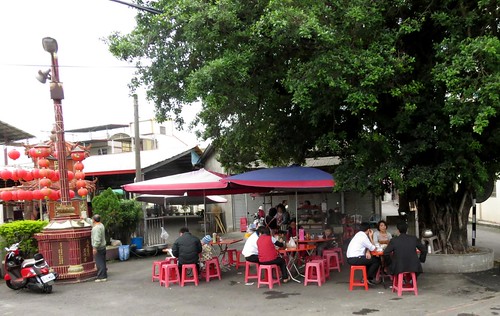
A temple in Pingtung.

Terry Gou made headlines this week, denigrating democracy.....
Hon Hai Technology Group chairman Terry Gou (郭台銘) said yesterday that “democracy makes no pottage” and that social movements were only a waste of social resources that did the nation’s GDP growth no good.
That's it, in a nutshell. J Michael ripped him excellently here, pointing out that Gou's real audience is might well be Beijing. Gou wants to import equipment from Huawei, the Chinese maker which is widely suspected of tight cooperation with Chinese security services and threatened to not pay his taxes if he couldn't import it. But it was Huang Tien-lin who deflated him most persuasively in today's Taipei Times, pointing out that blocking the trade pact gave the economy a boost....
Long before the protests against the cross-strait service trade agreement began on March 18, I had said that if the agreement were blocked, Taiwan’s economy would do better than forecast. Today we are faced with the facts. The student movement saved the nation just before the doors to hell were closed behind us and public confidence has increased. In March, during the student protests, exports reached US$27.76 billion, the third-highest month in history. Last month, economic indicators remained “green,” signaling steady growth, and foreign stock investors overbought for 26 days, with net purchases reaching NT$137.5 billion (US$4.6 billion).

These amounted to market approval of the political turmoil that went on for more than a month. Furthermore, the stock market index increased by 172 points during the student protests, or 1.98 percent, making it among the strongest markets in Asia.
This is part of a larger argument that Huang makes, which contends that keeping our distance from China enhances our economic growth. I think this argument is partly wrong -- from the end of the Lee Administration to the end of the Chen Administration was the Golden Age of Taiwan investment in China, when Taiwan exported stuff made in Taiwan and processed it there. We enjoyed reasonable growth, especially in the last couple of booming years of the Chen Administration. Huang links that to Chen's attempt to slow the drift into the China abyss:
The third was then-president Chen Shui-bian’s (陳水扁) announcement putting an end to the “active opening” policy on New Year’s Day 2006 and applying the breaks to further deregulation of cross-strait trade. The result was that the economy took a turn for the better, and 2006 and 2007 provided the best economic performance during Chen’s eight-year presidency, with the stock market almost breaking through the 10,000-point mark, reaching 9,859 points.
Should add that economic growth is expected, at the moment, to be better than last year. Cross-strait integration is slowly strangling Taiwan's economy. The government has become quite effective at deploying neo-liberal discourse to conceal its relocation of Taiwan into China's orbit. For example...
Both the Trans-Pacific Partnership (TPP) and the Regional Comprehensive Economic Partnership (RCEP) are important to Taiwan and will play a crucial role in the country's economic development, Cho said in his opening remarks at an international forum on the service industry.

The output of Taiwan's service industry could fall by US$1.9 billion if the country fails to join the TPP, but could increase by US$8.58 billion if it becomes part of the economic bloc, he said.

Although services account for 70 percent of Taiwan's gross domestic product, they make up only 1 percent of the global market, Cho said. "There is plenty of room for Taiwan to develop," he added.

Taiwan should open up its services market more, which could help upgrade its industries, increase output and create jobs, Cho said.
The last is actually correct. The catch is, you have to open up to a market that is better than you at doing these things and competes on quality, so you can learn from it, not from one that is less skilled than you are and competing on cost. China can't upgrade Taiwan's service industries; the effect will be the opposite. Indeed, we are already seeing that in manufacturing.

Respecting this neoliberal discourse, the students did not disavow the neoliberal economic religion itself, but rather emphasized that they were for a good trade pact, but the services pact isn't one. This was a clever move and even better, the international media reported it correctly.

Meanwhile, as if to prove that we don't need the services pact, two Taiwanese banks announced further overseas expansion this week.
Cathay Financial Holding Co. said it has obtained approval from the Central Bank of Myanmar to set up a representative office for Cathay United Bank in Yangon, which the parent company expects will open during the third quarter this year.
Yangon, in Myanmar. Lots of people predicting Myanmar will be The Next Asian Tiger. Taiwanese firms already trickling in, but other Asian states remain far ahead in investment there, with China in the lead. With new investment markets like Myanmar opening up, distancing Taiwan from China and slowing the pace of integration is a possibility that should be a policy... but not under the current Administration.
________________
Daily Links:
  • Taiwan hospitals suffer from nursing shortages. Hospitals and nurses are another example of the way female labor is exploited to maintain the profitability of local institutions.
  • The canals of Changhua County
  • US might tap into Taiwan early warning radar.
  • Head of national security bureau Tsai De-sheng resigns. Many observers are interpreting this as Ma's right hand King Pu-tsun sweeping out those who will not play ball -- Tsai was one who did not sing the praises of China.
  • Pro-KMT paper says students lack independence of thought and objectivity. Because you are only independent and objective if you do what the KMT tells you to do.
  • KMT under threat: Changhua County Chief KMT primary is contested by the losers (FocusTw reports winner). This is splitting the party in Changhua. In Nantou there are two serious pan-Blue candidates, helping the DPP. In both counties the KMT faces corruption scandals. Yeehah. The Changhua KMT and DPP likely nominees are both current legislators so the election of either will trigger a by-election, as will a couple of other races. With a tight race in Taichung, central Taichung politics will be fun this year.
  • High Comedy: the Taiwan rep office in Australia responds to Taiwan scholar Mark Harrison's piece on the Sunflowers. "Therefore, the story of Taiwan shouldn’t be simply or unfairly interpreted as the Taiwanese struggle against authoritarianism and for democracy, but the planned and consistent movement to prosperity and its unique, multi-opinion and vibrant democracy." and other fantasies. Every sentence in it is a gem, and so revealing of a certain mindset of authoritarian control. Note how the official presents the KMT's view of the past -- obviously thinking that KMT = ROC. The Party-State mentality is alive and well in the KMT and its minions, who communicate in declarations and commands, unable to persuade or lead. In a democracy, government officials who are not direct appointees should remain nuetral....
  • ADDED: Nuke plants may have to shut down early. Seems there is no place to store the waste. The gov't must have known this was coming....
_______________________
Don't miss the comments below! And check out my blog and its sidebars for events, links to previous posts and picture posts, and scores of links to other Taiwan blogs and forums!

Thursday, April 16, 2009

Taichung Mayor: Supersize Me

Taichung Mayor Jason Hu, fresh from pushing for Taichung to swallow its neighboring communities and become a municipality, has called for a Taiwan and south China to form a mega-region, says SCMP (no URL, sorry):
Hong Kong, Guangdong, Fujian and Taiwan should form a "mega-region" to boost competitiveness, the mayor of the Taiwanese city of Taichung proposed yesterday.

Jason Hu Chih-chiang raised the idea at a meeting with Secretary for Constitutional and Mainland Affairs Stephen Lam Sui-lung, who gave a positive response.

Mr Hu, who arrived in the city on Monday to attend today's Hong Kong Taiwan Inter-City Forum, said he envisioned the economic hub resembling the Boston-New York-Washington megalopolis.

After a one-hour closed-door meeting with Mr Lam, Mr Hu said: "It is a breakthrough because we have not only thought about co-operation between Hong Kong and Taiwan. We're thinking about, in a much greater scale, including Canton [Guangdong] and Fujian. I think nobody had ever thought of that."

While Hong Kong had close economic ties with neighbouring Guangdong, Mr Hu noted that collaboration between Taiwan and its closest mainland province, Fujian, were similarly growing. "When we two [Hong Kong and Taiwan] co-operate more, the four can become a mega-region."

He suggested mutual preferential treatment, including landing visas for tourists and business travellers in the region. The integrated economic force would give the region "incomparable competitiveness in the world", the mayor said.

He played down suggestions that Hong Kong would lose its role after Beijing's implementation of the three direct links - air, sea transport and postal services - adding that Taiwan businesses would still need Hong Kong's financial services to help expand their markets.
Unfortunately, as was reported today, Beijing has flatly rejected a proposal to increase cross-strait flights to 300 a week, saying that Hong Kong has taken a big hit from the loss of fliers on what was once the busiest air route in the world. Hong Kong officials are also being urged to put more effort into developing relations with Taiwan, now that the CCP and the KMT are mending fences (also from SCMP):
At a meeting with visiting KMT vice-chairman Eric Chu Li-luan, who is also head of Taoyuan county, on April 1, Chief Executive Donald Tsang Yam-kuen said he hoped to visit Taiwan before his term ended in 2012. Mr Tsang spoke as Secretary for Home Affairs Tsang Tak-sing was concluding a landmark visit to Taiwan - in his capacity as leader of a joint Hong Kong and Macau delegation of Buddhist associations.

Reflecting on the dramatic changes, Ms Lu said it was merely a return to normalcy. "It's indeed abnormal for the Hong Kong government to [have been] so unconcerned about what has happened in Taiwan, as if it doesn't exist," she said.

"Taiwanese society has expressed enormous interest in gaining more of an understanding about Hong Kong. In comparison, Hong Kong has not made a lot of effort to promote itself in Taiwan."
...and further.....
Taiwan issues fall under the Constitutional and Mainland Affairs Bureau, headed by Stephen Lam Sui-lung. The bureau has been criticised for not focusing enough on Hong Kong-Taiwan relations.

Timothy Wong Ka-ying, an associate director of Chinese University's Hong Kong Institute of Asia-Pacific Studies, said the meagre budget (just a few million dollars) set aside for Hong Kong-Taiwan exchanges this year was "unbelievable". "Still, I don't think Legco will oppose an increase in funding for Taiwan issues. It's first of all a question of far-sighted vision. Then it is political will," he said.

Dr Wong said Hong Kong lost a big opportunity by not forging ties with Taiwan during the long period of uneasy relations. "Taiwan has increasingly shifted its focus onto the mainland. Now that they have direct channels of dialogue, their interest in Hong Kong has waned. It appears that Taiwanese society now sees clearly that their future lies with the mainland. That line of thinking has transcended party politics.

"If this is the case, the pace of change across the strait will be astoundingly fast. Faced with the fundamental change ... Hong Kong does not have a sense of crisis.

"We ought to act quickly on issues like the relaxation of visa restrictions on Taiwanese people visiting Hong Kong, the setting up of various representative offices and hosting events like the Hong Kong Festival in Taiwan," Dr Wong said.

Johnny Lau Yui-siu, a veteran China expert, also said Hong Kong had lagged far behind during the fast-paced changes across the strait. "I'm very disappointed. We wasted over 10 years [after the handover] in playing a role in mainland-Taiwan relations," he said.
The perceptive friend who sent me this said that another small place fearing marginalization by China is -- Hong Kong. The most recent wave of angst there was sparked by plans to transform Shanghai into a massive shipping center by 2020. Calls to move closer to Taiwan are part of that larger issue. Just as in Taiwan, calls for greater integration with China in Hong Kong are driven both by fears of economic marginalization and the Cargo Cult economic claims -- if we just integrate with China, we'll all be rich! No, $200 billion of Taiwan investment isn't enough! Must. Have. More!

My friend also flipped me a piece by SCMP's Tom Holland, which noted of Shanghai:

Shanghai is far from being a hotbed of enterprise. Ever since Jiang Zemin and Zhu Rongji took over the city's government in the late 1980s, Shanghai's economic policy has been aimed overwhelmingly at promoting state sector and foreign investment.

For years, the government funded massive investment programmes by requisitioning and auctioning land, paying minimal compensation, and ploughing the proceeds into state-owned industries. Meanwhile, every effort was made to attract investments from foreign manufacturers of high technology by offering generous tax breaks and other incentives.

In some ways, the policy was a roaring success. Between 2000 and 2004, the city's heavy industry grew at a 25 per cent annual rate, and today Shanghai is China's leading producer of cars, power generating equipment, personal computers and many important chemicals.

But the city paid a heavy price. Discriminated against by tax and other regulations, denied access to land and tied up in red tape, local private entrepreneurs got squeezed out. According to Massachusetts Institute of Technology professor Huang Yasheng, the local private sector's share of Shanghai's fixed asset investments fell from a high of 10 per cent in the mid-1980s to a negligible amount this decade (see the first chart).

As a result, private income growth was suppressed. Although today Shanghai's per capita gross domestic product is around five times the national average, disposable household income is only about 1.8 times the mean (see the second chart).

The concentration of so much wealth in the hands of the state and foreign-invested businesses has acted as a further disincentive to private enterprise. Today, according to Mr Huang, Shanghai not only has relatively fewer private companies than almost any other province in China, but they are smaller too.

The only thing we have to fear is fear itself....

_______________________
Don't miss the comments below! And check out my blog and its sidebars for events, links to previous posts and picture posts, and scores of links to other Taiwan blogs and forums!