Showing posts with label inflation. Show all posts

Thursday, September 26, 2013

The 1% Government

Taiwan is getting pummeled by several long-term trends  -- the financial liberalization of the late 1980s that brought in big global financial players, to Taiwan's detriment; the shift of factories and investment to China; and governance by the KMT. The trend is clear, as Commercial Times observed in another hard hitting editorial:
According to government statistics, the disposable annual income of people aged below 30 averaged only NT$366,000 (US$12,388) in 2012, lower than NT$380,000 in 1999.

In 2012, the starting monthly salaries for bachelor's degree holders averaged NT$26,000, down from NT$28,000 in 1999. The average starting salary of master's degree holders was NT$31,000, up only slightly from 13 years ago, when the average salary was NT$30,000.

There is an obvious trend in which wealth is concentrated in the hands of the older generations.

In 2010, 75 percent of residential properties in Taiwan were owned by people aged 45 or older, with homeowners younger than 35 accounting for only 8 percent. Many of these young homeowners are believed to have obtained financial support from their parents. In other words, the situation for young people is even worse than it appears.
This wealth gap between generations, as this Commercial Times points out, is cushioning the blow this brutal economy is giving the young. Meanwhile the KMT continues to serve the big money -- still no real stock tax, no change in the land tax (here), and now the premier wants to chain the minimum wage to the consumer price index (CPI), essentially freezing it at the current low level for the next few years:
Premier Jiang Yi-huah (江宜樺) yesterday decided that beginning next year, the minimum wage will be contingent on growth in the consumer price index (CPI), a policy drawing severe criticism from labor groups.

With a threshold of a cumulative CPI growth of 3 percent or higher needed before the minimum wage will be reviewed, “it is highly likely that the basic wage levels will remain stagnant in the remaining three years of President Ma Ying-jeou (馬英九) tenure,” Taiwan Labor Front secretary-general Son Yu-lian (孫友聯) said.
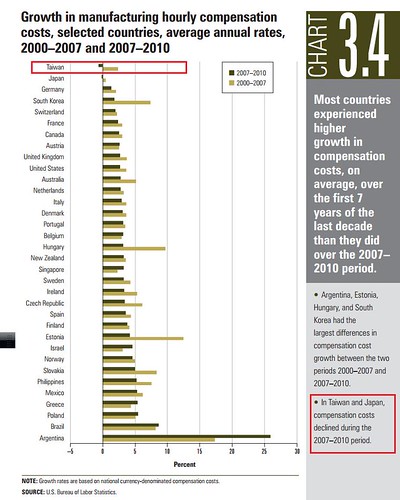
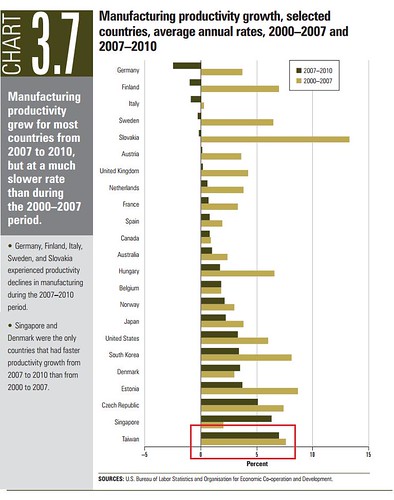
This means that the government can hold wages down without appearing to, simply by lowballing the CPI. Theoretically, wages will always remain the same relative to prices, which means that laborers will never be able to capture a larger share of the pie, at least while the Ma government is in office. Since 2007 and especially since the Ma Administration came to power, wages have regressed while productivity has boomed. Taiwan's gap between CPI changes and wage changes was the highest in the world in 2010. The Ma government wants to freeze this historically anomalous situation and treat it as the norm. The struggle for control of Taiwan between the pro-China and pro-Taiwan sides really masks the brutal and ongoing defeat of Taiwanese workers economically; it enables both parties to enlist workers on their side via their tribal social identities while screwing them out of their rightful livelihood.
_______________________
Don't miss the comments below! And check out my blog and its sidebars for events, links to previous posts and picture posts, and scores of links to other Taiwan blogs and forums!

Tuesday, September 25, 2012

Inflation over time


A graphic from Apple Daily, Sept 24, reminds us why the Ma Administration is thrusting Taiwan into the Senkakus mess: because the gov't needs a good distraction. Inflation ticks along at a steady pace, normal but painful in a nation with stagnating salaries. The list shows the price changes in goods since 1998, including rent -- a 30 ping apt has risen from $15K to $22K a month, not one of the bigger rises. Ordinary people are being forced out to the Taipei burbs.... or farther. Masking the effects of price rises is the Taiwanese habit of living at home until marriage, meaning that many people are being subsidized by the wealth their parents accumulated a couple of decades ago in the waning days of the go-go era.

Not all of this is under government control, and it is notable that water and electricity remain cheap -- water is the same price it was 13 years ago. Where the government can intervene to keep prices low, it has -- yet low water and electricity costs keep Taiwan investing in heavily subsidized water and electricity hungry industry, instead of clean industries of the future.

Youth unemployment is rising, as the overall unemployment rate reached 4.4%, according to the government's figures. Monthly employee overall compensation actually fell marginally. The NT is on the rise, hurting exports too.....

ADDED: The Cabinet refused a raise to the minimum wage too...
_______________________
Don't miss the comments below! And check out my blog and its sidebars for events, links to previous posts and picture posts, and scores of links to other Taiwan blogs and forums! Delenda est, baby.

Thursday, September 06, 2012

Inflation Jumps to 3.42%; welcome to the new food world

Penghu_2_12
Singers in Chiayi city. 

The government's latest calculations...
The consumer price index (CPI) rose 3.42 percent last month from a year ago, following a 2.46 percent increase in July. It marked the highest level since August 2008, when the index expanded 4.68 percent, the DGBAS said in its monthly report.

DGBAS section chief Wang Shu-chuan (王淑娟) attributed the higher-than-expected rise in consumer prices last month to the surge in vegetable and fruit prices triggered by the two typhoons — Saola and Tembin — and torrential rains.

Vegetable prices increased 57.93 percent last month from a year earlier, the highest since October 2007, while fruit prices rose 20.14 percent, the report said.
Wow. Analysts also said that rising global fuel costs are an issue. Note that the rising grain prices due to the drought in the US have yet to affect prices here, but they will probably start impacting small bakeries at some point. The Japan Times scribes:
The FAO's price index increased 23 percent for corn, 19 percent for wheat and 12 percent for sugar in July from the previous month. The futures prices at the Chicago Merchandise Exchange have soared about 40 percent for corn and wheat, and about 30 percent for soybeans in the past two months.
Other factors are complicating demand -- rising grain prices and lack of grain have driven up meat prices, which were also being pushed up by long-term rising demand in developing nations as their incomes rise. And of course, America's insane biofuels policy, which consumes 40% of our corn crop, also drives up food prices. The Taipei Times ran a good overview commentary on the worsening global food issue a few days back.

Since gov't inflation reports are heavily influenced in a downward direction by political factors, just add whatever fudge factor you think is appropriate to arrive at the real figure. Veggies are so expensive I got into the foul habit of curbing my consumption of them. I expect that in the next few years, there is going to be a huge expansion of home and rooftop gardening in Taiwan as it begins to sink into the urban service working classes that high food costs are here to stay. Buy land ASAP, folks....

Taiwan's overall food security situation is grim. Many articles tell tales similar to this one:
According to Peng, rising energy cost and the unaffordable price of petroleum for cross-ocean shipping will be part of the cause that will kill global food trade. Research done by Oxford University reveals that this is likely to happen in 13 years. The report says that world production of petroleum will meet only half of world’s need in 2023. Or if the prediction of World Energy Outlook– which foresees the price of each barrel of petroleum will rise to USD 200 in 2030–comes true, then the cost of shipping will get too high to continue cross-ocean food trade. Food exporting countries will also cut their production because it will be too expensive.

Actually something like this already happened in 2008 when the petroleum price rose to 120 USD per barrel. At that time Taiwan suspended importing sweet corn from the U.S and gave special permission to import it from China. The follow-up question is: Can China be the alternative when China’s food self-sufficiency rate is only 95% and dropping?
The petroleum price predictions here are likely nonsense -- the world has plenty of oil as shale and slate oil sources remain largely untapped, far more than peak oil theorists originally realized -- but the 2008 issues remain. As China's food demand increases, emergency food imports to Taiwan will become more difficult. The US is likely to become a far less reliable supplier given that drought will only worsen there over time as humans continue to relentlessly heat the planet. What policies does Taiwan have in place to promote long-term food security?
_______________________
Don't miss the comments below! And check out my blog and its sidebars for events, links to previous posts and picture posts, and scores of links to other Taiwan blogs and forums! Delenda est, baby.

Tuesday, April 10, 2012

Electricity, gas, water price spikes: politics as usual

Reuters reports:
Taiwan's economic ministry said on Monday that said Taipower has applied to raise electricity prices by mid-May in response to a surge in global crude prices this year.

State-owned Taipower has proposed raising electricity prices for industrial use by 20-30 percent and residential tariffs by up to 10 percent and commercial rates by more than 20 percent, the ministry said.
Taiwan Today offers additional information:
The latest statistics released by the U.S. Department of Energy reveal that Taiwan’s electricity rates for households and industrial users are the second and fourth lowest in the world.
The subsidy regime encourages the development of businesses like naptha cracking whose profitability derives largely from massive subsidies to electricity and water. One wonders whether the Ma Administration let the proposed naptha cracker in Changhua die because it realized that the project was going to be uneconomical once higher water and electricity prices were factored in, and the protests of environmentalists provided a convenient excuse.

The DPP is criticizing the government for hiking prices and for keeping them low before the election, and for not reviewing the CPC's pay policies. What they really should be doing is criticizing the government for its narrow-minded, unimaginative policies -- not providing monies and policy initiatives for weatherization and solarization, not promoting building codes to green Taiwan's infrastructure, not promoting cycling to work, not installing utility-scale wind, and similar. The DPP's criticisms lack vision.... for years Taiwanese have lived in a bubble created by subsidized water and electricity prices. Rude awakening time -- the DPP really ought to be thanking Ma for doing what Chen lacked the courage to do during his second administration.
_______________________
Daily Links:
_______________________
Don't miss the comments below! And check out my blog and its sidebars for events, links to previous posts and picture posts, and scores of links to other Taiwan blogs and forums! Delenda est, baby.

Monday, April 21, 2008

Inflated Expectations

Taiwan and China are back together exploring for oil in the Taiwan Straits, according to recent news reports. And United Daily News (UDN), a paper tightly linked to the KMT, reported that Hu of China had invited President-elect Ma to China for talks. The Olympics is going to make a great backdrop to the visit that Ma promised he wouldn't be making...though KMT officials themselves dismissed such talk. Direct flights aren't expected until next year. Whatever the inflated expectations of some, reality is expected to move more slowly...

...but not prices. Sticker shock: went to our usual volume retailer the other day, only to find that the bag of wheat flour we used to buy for $38 is now $53. Gasoline is outrageous -- we take scooters everywhere now. Imported stuff is skyrocketing -- brie I used to enjoy at $99 is now $189, cheap smoked processed cheese from Germany rose from $125 to $165 at the local supermarket. The Central bank said inflation was near 4% in both Feb and March of this year...

One solution to the problem of inflation is to let the NT dollar gain in value. For most of the ROC's brief existence on Taiwan the NT dollar has been more or less pegged to the US dollar. Indeed, last week Goldman Sachs predicted the NT would continue to rise:

The New Taiwan dollar may advance to an 11-year high in six months as the central bank allows further gains to stem inflation, Goldman Sachs Group Inc said, raising its forecast for the currency.

The NT dollar may strengthen 6.3 percent to NT$28.5, the world’s biggest securities firm said, revising its earlier forecast of NT$30.50. The currency has advanced 6.4 percent in the past three months, the best among 10 most-active currencies in Asia outside Japan.

“The central bank will likely utilize currency appreciation as another policy tool in combating imported inflation,” Goldman’s research team led by London-based Jim O’Neill wrote in a monthly global report received by Bloomberg today. “The interest-rate differential vis-a-vis the US dollar has become more favorable.”

Letting NT rise would be a quick way to increase the purchasing power of Taiwanese and enable locals to feel they have more money in their pockets. It would make imported goods cheaper. The negative side, of course, is that it makes Taiwan goods more expensive in world markets, forcing exporters to slash costs or move. It also has another pernicious effect, noted last week in a long commentary in the Taipei Times:

Even more serious is that when the nation’s currency appreciates against the US dollar, government and private assets denominated in US dollars suffer from exchange loss with their decrease in value.

Inflation may well become the number 1 challenge for the incoming Ma administration, since the current government has announced that price freezes on gas and electricity will be lifted on May 20, the day Ma is sworn in.