Showing posts with label annexation. Show all posts

Thursday, February 09, 2017

Not The Onion: Beijing to commemorate 2-28

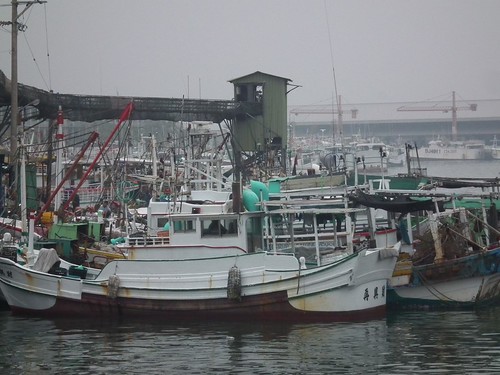
Fishing boats in Donggang

J Michael Cole has the news at Taiwan Sentinel:

Taiwan Affairs Office Spokesman An Fengshan told a regular press conference on Wednesday that China will hold a series of events to commemorate the 70th anniversary of the 228 Massacre in Taiwan.
That will be later this month... a previous conference was held on the 65th anniversary.
In his speech, Ji Bin said the 228 uprising was a “patriotic, democratic and autonomous movement of the Taiwan compatriots against the dictatorship of the KMT authorities at that time,” and “part of the struggle of the Chinese people for liberation and a glorious patriotism of Taiwan compatriots.”
Most observers in Taiwan are interpreting this in light of the Taiwan-China relationship. Many said, as Cole observed, that it represents direct appeals to the people of Taiwan, since the CPP has likely realized that the KMT can no longer deliver the island. Of course, as always, it attempts to subsume the island's independent history into the faux historical narrative of the CCP.

But I expect there is more than that. The CCP's biggest audience isn't Taiwan, but its own people. Remember that if China attacks Taiwan, the PRC is going to suffer economic, physical, and social harm. The people of China have to be psychologically and morally prepared for such privations. More than simply incorporating Taiwan history into fake CCP history, commemorating 2-28 shows the people of China that Beijing is striving in every way possible to bring Taiwan into the fold peacefully, so that it can present a "more in sorrow than anger" war to its own people, so it can say "every avenue has been exhausted, see?" Too many people think about Chinese government pronouncements about Taiwan as if they were solely foreign policy moves, in light of US and Taiwan policy. But Xi's Taiwan announcements are domestic political theatre as well....

This is even more urgent for Beijing because young Chinese are changing, as everyone I know who interacts with them is reporting. A recent poll said it was "surprising" to find that they are less nationalistic. This should not be surprising. Chinese youth are traveling more than ever before, both abroad and in their own country and its occupied territories. They are better educated, and many have been abroad for extended periods. Such experiences change people, and while making them love their nation more, make them more thoughtful about their national identity.

The reason it is "surprising" that Chinese youth are less nationalistic is because so much writing on China sources inflammatory quotes from the Chinese net, while making zero attempt to determine whether they are 50-centers planted on the net for the very purpose of managing this image of China abroad.

Speaking of managing the presentation...

...China is allegedly mulling changes to the Anti-Secession Law. Since the CCP can attack Taiwan any time it likes, for any reason it wants, the idea that this is a "law" is clearly something aimed at the international media (as well as a sort of reply to the Taiwan Relations Act). One change mulled is to make it part of the "law" explicitly that China will attack if Taiwan does not accept Beijing's One China principle. This change will probably never happen, because of the way it reduces the options Beijing has in dealing with Taiwan. Rather, a number of experts pointed out that Beijing is probably running a whisper campaign designed to put pressure on President Tsai Ing-wen.

Beijing is very good at this sort of media management. It was first reported in the Yomiuri Shimbun and will probably make the international media, especially the more pro-Beijing outlets. ZOMG TENZ!!But once again, it behooves me to point out what China is not doing: arresting Taiwanese businessmen, kicking Taiwanese out of China, cutting off exports from Taiwan, or any of hundreds of others moves it could make. Or any other move that might have costs for China. Talk is cheap, after all, and whispers even cheaper...
__________________
Daily Links:
_______________________
Don't miss the comments below! And check out my blog and its sidebars for events, links to previous posts and picture posts, and scores of links to other Taiwan blogs and forums!
Tuesday, March 03, 2015

Annual Review of Capitulationist Raccoon Boost

A been in my yard loaded with morning glory pollen.

Every once in a while I review the awesome figures generated by the arrival of the Annexationist Herbivores at the Taipei Zoo. Last year I scribed:
Heh. It was four years ago this month that the Annexation Lardbombs exploded at the Taipei Zoo. They were delivered on Dec 23, 2008, and went on display a month later, to a brief flurry of absolute madness. Profoundly political and not the least bit a demonstration of goodwill, they were handled as a "domestic transfer" under CITES, one of the many quiet ways that the Ma government has capitulated to Beijing, as my round-up post above notes. They were named "Reunification" in Chinese. The Zoo's annual budget for them was over a million US$, and it wasted $10 million US on the enclosure for them, according to AP.
It's now been over five years. Meanwhile, let's once again review those promises from the heady days of late 2008.
Zoo officials expect the two giant pandas to attract more than 6 million visitors in the first year, saying they will issue numbered slips to visitors at the panda hall to prevent them from waiting in long lines.(TT)
Here's the data, through 2013. I can't find the 2014 visitor data on the zoo website in any language -- the 2013 data didn't come out until Dec of 2014 in English. Obviously, the visitor level is roughly what it was prior to the panda arrival, which means that these lolling lardbombs have done nada for overall zoo attendance. Indeed, attendance actually fell from 2009 levels over the next three years, bouncing back only in 2013. The Zoo is nowhere near the levels it was in the early 2000s, despite the tourism boosts. Just too much competition for the leisure dollar, I expect. But where are the 6 million visitors for the pandas? Somewhere back in the 1990s, perhaps...

UPDATE: Someone found the numbers for me. Looks like we got a 2014 kick for the baby lardbomb. Still nowhere near 6 million.

1999   4981102
2000   5794384
2001   5473487
2002   4147406
2003   2836936
2004   3054593
2005   3106296
2006   3460300
2007   3370091
2008   3284443
2009   3673564
2010   2808110
2011   2710720
2012   2722042
2013   3222668
2014   4,222,083
_______________________
Don't miss the comments below! And check out my blog and its sidebars for events, links to previous posts and picture posts, and scores of links to other Taiwan blogs and forums!

Tuesday, October 14, 2014

Hong Kong's Effect on Taiwan is major media moment

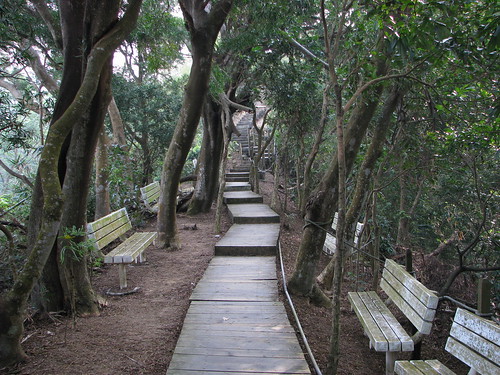
A hiking trail

Cindy Sui of the BBC sent around a piece today on the effect of the Hong Kong protests on Taiwan's desire to annex itself to China. It's mostly good, and its the first major media piece I've seen that refers to the ghostly deadlines of 2021 and 2049 for annexation of Taiwan that some in the Chinese media have talked about.

As several of us have been remarking recently, one ironic effect of the Hong Kong protests is that everyone is now noticing Taiwan. Yay! Normally the international media hedges when it talks about Taiwan's rejection of annexation speaking of "some people" dislike that, or referring to "skepticism" or "wariness". But perhaps we're going to see more forthright acknowledgement in the major media that Taiwan doesn't want to become part of China. One can only hope.

Ben Goren has a long discussion of the BBC piece here, with many criticisms, which I won't repeat. Ben observes:
Then there’s this beauty:

Thousands of Chinese tourists flood into Taiwan daily, boosting the island’s economy.
I don’t have a problem with the object of this sentence, only the entire predicate. Perhaps Cindy Sui can point to some hard statistical evidence that Chinese tourists are actually boosting Taiwan’s economy and if so, which sectors / areas in particular. If she can’t then really all she’s doing here is repeating Government propaganda.
The problem is an interesting one because there are many ways to think about how to measure the economic effect of Chinese tourists and it would not be easy for anyone to produce a definitive account. This paper argues for a net US dollar gain of nearly $50 million a month from Chinese tourism after allowing for the "crowding out" effect of reducing US and Japanese tourist arrivals, partly because it appears to increase tourism from Hong Kong, but the data are too old and limited to be useful (2009 data). I'd be curious to see a more recent in-depth model. I suppose nearly $600 million annually is technically "boosting" the economy. This 2014 paper views Chinese tourism from another POV -- its economic effect on the environment:
When forecasting the estimated growth of Chinese visitors in Taiwan to 2016, an additional 0.8% increase in economic output is expected at the expense of a 2.7% increase in CO2 emissions and a 3.0% increase in water use.
Another paper from 2013...
It is concluded that by 2011, the economic spillover effects for the retail sector and accommodations services sector were US$773.49 million and US$438.43 million, respectively. The total spillover effects of US$7617 million accounted for 0.183% of Taiwan's GDP
I don't think there is any question we're getting a "boost" from Chinese tourism, if only because the word "boost" has no real meaning, though none of the models attempt to measure the costs, except the one that looks at the environment. I also don't think there's any question that it is not a boost we want: Chinese tourism produces nothing that raises long-term living standards in Taiwan. This pointless flow of revenues (profits go largely to a few Hong Kong tourism firms) might even be tolerable, if it were not part of a strategy to annex Taiwan to China.

Sui writes, referring to the Sunflower Protesters (her reporting on them was excellent, example) and their demand for a bill to provide oversight of cross-strait agreements:
They might just succeed. The activists enjoyed nearly 50% public support for their demands for greater scrutiny of government deals with China, according to a government survey, partly because - unlike Hong Kong - they did not disrupt traffic.
Actually, "nearly 50% support" seems wrong. Rather, it was strong majority support. For example, Ben writes on a pro-KMT TVBS poll that has 65% supporting passage of a bill to oversee agreements with China, including a plurality against the trade pact. Another TVBS poll showed over 60% wanted the services pact withdrawn, numbers similar to those in this Businessweek poll. That the government has not attempted to ram the bill through again clearly indicates its deep unpopularity, both with the public at large and within the KMT. The students had broad public support because the service pact was a crapshit agreement that was bad for Taiwan and rejected by the public. If only someone in the media would clearly say that....

PS: if you're interested in the meaty contents of the oversight bill, the always-excellent Frozen Garlic has a great post on it.
PPS: In fairness, a government poll found the public supported the services pact, by 1%, 41-40. Those results surely required real artistry to achieve.
PPPS: What's the boost from the services pact? I looked at it here. You'll need a microscope to see it.
________________
Daily Links:
  • New ROC stamps honor endangered species. Test your ROC understanding: which stamp has higher value, Formosan Black Bear or Giant Black and White Annexation Lardbombs? Go here, select MINT STAMP and 2014 in the drop down menus.
  • Taiwan Review on the new national park in the Penghu
  • Ma tells K-town residents they should take the MRT and other tales from Ben at Letters from Taiwan. There have been lifelong authoritarian rulers who were less tone-deaf than Ma Ying-jeou. 
  • Huffington Post notes Sunflower influence on Hong Kong protests. This is amazing.... even though they get a UDN guy.
  • Chinese espionage now rampant in Taiwan
  • Ma vows to clean up food industry in Taiwan. Yawn. Let's revisit the past. Government vows to improve tracking after plasticizer scare (2011). I'm not going to bother searching for more.
  • WHOA: I was wondering when something suggestive like this would appear. The oil scandal for Ting Hsin/WeiChuan has caused the Ministry of Finance to put the brakes on Ting Hsin conglomerate's takeover of the management of Taipei 101. And there is the purchase of the cable news station. One wonders what toes Ting Hsin was going to step on. Lucky for those being stepped on the oil scandal broke, eh?
_______________________
Don't miss the comments below! And check out my blog and its sidebars for events, links to previous posts and picture posts, and scores of links to other Taiwan blogs and forums!

Sunday, July 13, 2014

The Diplomat: Julian Ku argues PRC Murder of Taiwanese is Legal, US defense of Taiwan is not

The wreckage of Ku's arguments.

No one seems to know from what deliberations this declaration [Cairo] issued, it was apparently drafted, at the moment, by Harry Hopkins, after consultation only with the President and the Chinese visitors. Of all the acts of American statesman- ship in this unhappy chapter, the issuance of this declaration, which is so rarely criticized, seems to me to have been the most unfortunate in its consequences. The other direct results of this phase of American statesmanship have either been erased by subsequent events or seem to have produced, at least, no wholly calamitous after effects to date; but this thoughtless tossing to China of a heavily inhabited and strategically important island which had not belonged to it in recent decades, and particularly the taking of this step before we had any idea of what the future China was going to be like, and without any consultation of the wishes of the inhabitants of the island, produced a situation which today represents a major embarrassment to United States policy, and constitutes one of the great danger spots of the postwar world. G Kennan, Russia and the West under Lenin and Stalin (cited in Chen and Reisman below).

Today brought Julian Ku's airy, inept piece on Why Japan Would Violate International Law If It Militarily Intervened to Defend Taiwan which appeared at The Diplomat and his blog. Because the only other post I had seen from Ku was an equally uninformed, pro-PRC piece on the Chinese ADIZ over the Senkaku Islands, like many I initially assumed Ku was some kind of bog-standard PRC shill, for which I apologize. I changed my mind after I read a number of his other posts. Onward, but sadly, not upward.

Ku scribes in a key paragraph of his case:
I think this could be right as a matter of Japanese constitutional law if an invasion of Taiwan could be plausibly construed as a threat to Japan, but there is a strange international law flaw to this argument. Under black-letter international law, Japan cannot use military force in Taiwan absent China’s consent, even if the Taiwan government requests its assistance. Why? Because the UN Charter’s Article 51 only authorizes an act of “collective self-defense if an armed attack occurs against a Member of the United Nations.” Taiwan is not a member of the United Nations, and to make matters worse from Taiwan’s perspective, Japan recognizes the government in Beijing as the rightful government of China, and Japan further recognizes that Taiwan is part of China.
There's a lot here to unpack. J Michael Cole was first with a rapid response over at Thinking Taiwan. He identifies the major error of Ku's in this passage: he doesn't know what Japanese policy is...
If we look closely, Tokyo’s position regarding Taiwan isn’t that Japan recognizes, as Wu claims, that Taiwan is part of China. Rather, it understands and respects this contention by Beijing, much like many governments worldwide, in constructs of superb diplomatic vagueness, “take note of” or “acknowledge” the PRC’s contention
Japanese policy is thus exactly the same as US policy: the status of Taiwan remains undetermined. Ku got that completely wrong. Cole then turns to a discussion of the Cairo and Potsdam Declarations:
Furthermore, Article 8 of the Potdsam Proclamation (raised in point 3 of the communiqué) clearly states that the terms of the Cairo Declaration (signed on November 27, 1943) shall be carried out, meaning that “All territories Japan has stolen from China, including Manchuria, Taiwan, and the Pescadores, shall be restored to the Republic of China.” Restored to the Republic of China (ROC), not the PRC, which at the time of the communiqué, issued July 26, 1945, and the Declaration simply did not exist (it wouldn’t until 1949). It is therefore easy to see why Ku’s argument that China would be using force against secessionists within its own territory if it attacked Taiwan (akin to Ukraine, he writes) defies logic, as Taiwan cannot secede from a body of which it never was part — in this case, the PRC. 
Of course, Cairo has no legal weight. As I noted ages ago, President Truman defined US policy on Cairo in 1950, twice. First, announcing intervention in Korea -- haha, wait til we get below on Korea:
[June] ....Accordingly I have ordered the 7th Fleet to prevent any attack on Formosa. As a corollary of this action I am calling upon the Chinese Government on Formosa to cease all air and sea operations against the mainland. The 7th Fleet will see that this is done. The determination of the future status of Formosa must await the restoration of security in the Pacific, a peace settlement with Japan, or consideration by the United Nations.
On Dec 27, 1950, Truman articulated the formal US position, which has never varied from that moment.
The Cairo Declaration of 1943 stated the purpose to restore "Manchuria, Formosa and the Pescadores to the Republic of China." That Declaration, like other wartime declarations such as those of Yalta and Potsdam, was in the opinion of the United States Government subject to any final peace settlement where all relevant factors should be considered. The United States cannot accept the view, apparently put forward by the Soviet government, that the views of other Allies not represented at Cairo must be wholly ignored. Also, the United States believes that declarations such as that issued at Cairo must necessarily be considered in the light of the United Nations Charter, the obligations of which prevail over any other international agreement.
This is the position of the UK as well. Cairo doesn't mean anything, it was just noise some nations made in wartime and any realization would have to await the end of the war and the subsequent treaty arrangements. It can't overthrow international law or the UN Charter, which requires that populations whose territories are being transferred get a vote on the transfer. It even required that in 1943 when Cairo was drafted. It certainly requires that now. China can't simply invade because to do so is a violation of the Charter (more below) and many decades of international law and practice.

I can't resist pointing out that Article 6 of the Joint Communique that Ku and Cole refer to says that both parties must refrain from force or the threat of force against each other. LOL.

I also can't resist pointing out that the language of Cairo refers to an impossible fantasy: Taiwan could not be "restored" to the ROC or PRC since neither owned it in 1895. Nor was it "stolen." Cairo's statements are Chinese propaganda. But that's a minor nitpick...

Ku then goes on to argue that it would be perfectly legal if the PRC murdered Taiwanese wholesale and annexed their territory:
If Taiwan keeps the status quo and does not declare independence, and China still invades, the U.S. has signaled that it would come to Taiwan’s defense. But that would be one state (China) using force within its own territory to put down secessionists (a la Ukraine) and almost certainly legal.
Taiwan's status, as defined by the San Francisco Peace Treaty, is undetermined. Period. It is a territory awaiting final determination of its status. Period. No internationally recognized treaty gives Taiwan to China (see Chen and Reisman for a full discussion of the innumerable problems with the Chinese claim). Hence the Taiwanese are not secessionists. Since Ku raised the UN issue, as a decolonized territory -- it was a Japanese colony, remember? -- what does the UN say about such territories? There's a declaration adopted in 1960... every article in it says any Chinese attack on Taiwan would be illegal, but the first will suffice:
1. The subjection of peoples to alien subjugation, domination and exploitation constitutes a denial of fundamental human rights, is contrary to the Charter of the United Nations and is an impediment to the promotion of world peace and co-operation.
Note also that Article 73 of the Charter obligates UN members to assist territories in attaining self-government. Just a taste:
to develop self-government, to take due account of the political aspirations of the peoples, and to assist them in the progressive development of their free political institutions, according to the particular circumstances of each territory and its peoples and their varying stages of advancement;
Invading and annexing Taiwan is hardly assisting it in getting self-government, which is what China in either its ROC (v1.0) or PRC (v2.0) is obligated to do under the UN Charter. Well, I suppose we will get our very own Beijing-approved satrap, like Hong Kong.

In fact, if you read the UN Charter itself, you will find that disturbances of the peace are a fundamental anathema to the UN. Start with Article 2, (3) and (4). Nowhere does the Charter say that the use of force is permissible against non-UN member states, as many commented. You don't get a mulligan if the state in question is not a UN member (the UN condemned the Indonesia attack on East Timor, for example and demanded Jakarta stop). An attack on an unincorporated territory is an breach of the peace whether the state in question is a UN member state or not; indeed the UN charter requires that states put every effort into peaceful solutions, which of course China has not done (the KMT-CCP negotiation represents talks between two versions of the same Chinese expansionism, much as Taiwanese land developers will have their employees purchase tiny plots of land or homes in an area they want to develop and join the homeowners association in negotiating with the company, so that such "negotiations" happen between the company and its agents. Basically the annexation of Taiwan is just a familiar Chinese construction company land grab, blown up to galactic scale).

In fact, as an acquaintance pointed out, the UN intervened in Korea in 1950 -- well, the US intervened and pulled the UN in as cover -- and neither Korea nor the PRC (which attacked the UN forces) were in the UN. What the Korean war shows is that the UN can legalize anything it can be cajoled or tricked into supporting. What it also shows is that even between non-UN states, war is a serious breach of the international regime and dealing with it is not illegal. In fact, it can be made legal by the magic wand of the UN. Hence Ku's whole argument is a non-starter from the beginning; whether such intervention is illegal will have to await the decision of the international community (but given China's clout in the UN....). Laudably, Ku says at the end it would be a good idea whether or not it is legal. Kind of him, eh?

Finally, I would like to point out how personal this kind of writing is. I had an exchange on Twitter with someone who just didn't get why this piece angered so many people. I'm not parachuting into Taiwan for a year with a MOFA fellowship (on my tax dollars!) like Ku is. I actually live here, and I actually have a son heading for the Army soon, as well as literally thousands of people I know and love here on this island filled with 23 million innocents, the vast majority of whom don't want to be annexed to China. The discussion of whether the PRC has the legal right to murder my children and annex their island is not a parlor game for those of us who live on this island. Pieces like Ku's are irresponsible at best, vile at worst, since not only are they likely to be cited by the PRC and its mouthpieces everywhere, but they are occurring at a time when the PRC is beginning to see what it can do with lawfare.

Please don't feed that monster.

UPDATED: Ku has reply hereStill ineptly and erroneously claims US and Japan think Taiwan is part of China. From CRS report below: "The United States has its own “one China” policy (vs. the PRC’s “one China” principle) and position on Taiwan’s status. Not recognizing the PRC’s claim over Taiwan nor Taiwan as a sovereign state, U.S. policy has considered Taiwan’s status as unsettled." Ku is wrong in every particular.
__________________
Daily Links:
_______________________
Don't miss the comments below! And check out my blog and its sidebars for events, links to previous posts and picture posts, and scores of links to other Taiwan blogs and forums!
Friday, April 25, 2014

Matsu, Goddess of Annexation

DSC_0137
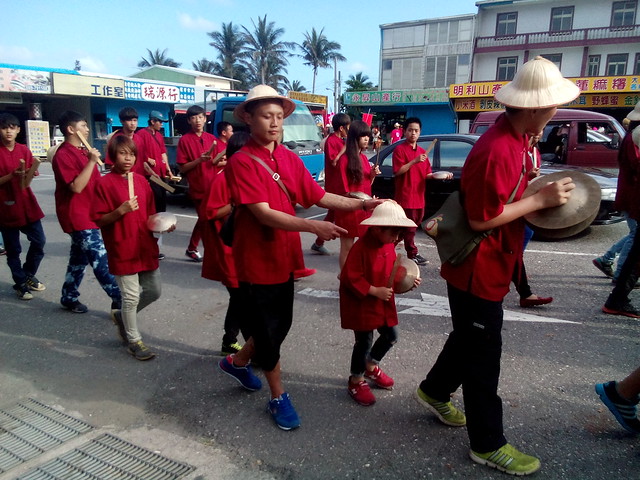
A religious procession in Tawu, Taitung.

Taichung city's tourist bureau is out to build the world's largest statue of Matsu, a sea goddess much reverenced in Taiwan and China. Taipei Times says:
Among the NT$1.2 billion (US$39.8 million) to be spent building the proposed Daan Matsu cultural park in Greater Taichung, around NT$600 million of the funds will go toward constructing a nearly 70m tall statue of Matsu, including the foundation and a path of reverence for the sea goddess. Greater Taichung’s Tourism and Travel Bureau Director General Chang Da-chun says, “This will definitely be the tallest Matsu statue in Southeast Asia.” There are already many official and private tour groups from China making queries, Chang says, adding that he is confident that, along with Jenn Lann Temple in Dajia, “It will create a huge tourist attraction.”
The Taichung city government has long complained that those busloads of Chinese tourist dollars leave Taichung port and head directly to Sun Moon Lake in Nantou without dropping a cent in the city. Determined to change that, the city government proposed a few years ago to build a penguin exhibit in the city, to which tourist flows would be diverted, presumably because everyone knows you go to Taiwan to see the native penguins. That idea was greeted with general derision, but this one is more interesting.

Interesting because Matsu worship has long been an important vector of pro-China, pro-annexation propaganda and activities on both sides of the Strait. Remember when the emerald Matsu statue landed at Taichung harbor, there to be received by Taichung Mayor Jason Hu and the head of the Jenn Lann Temple in Dajia, pro-annexation politician/businessman/but not gangster, no siree Yen Ching-piao? Several years ago BBC noted this connection between Matsu and China's drive to annex Taiwan, in the context of visits by Chinese religious representatives to the famous Matsu procession:
But for China, sending its temple representatives here to join in the celebrations is not without its political motivations.

The Chinese government has placed great emphasis on reviving Mazu in China – seeing it as an important way to underscore its insistence that Taiwanese people and culture came from China – and that Taiwan is a part of China.

Beijing hopes to reunify with the island one day and has not renounced the use of force to do so.

"They’re doing this to show both sides believe in Mazu and have a similar heritage," said Tsai Ming-hsien, a volunteer Mazu celebrations organiser who has had many dealings with Chinese temple officials.
In 2009 Yen Ching-piao's right hand man Cheng Ming-kun, whose formal position is deputy Chair of the Jenn Lann Matsu Temple in Dajia, the center of Taiwan's Matsu worship, was in China discussing with Beijing how to use Matsu to help China annex Taiwan. In May of 2009 a boat carrying Cheng Ming-kun and a load of Mazu pilgrims was the first passenger ferry to cross the strait. Of course Ma Ying-jeou appointed Yen Ching-piao, who says he is not a gangster at all but merely a misunderstood businessman, his "local spokesman" for ECFA.

It may seem like a silly religious stunt, but building a giant Matsu statue in Taichung where it will face China across the Strait, is a stunt with serious pro-annexation political overtones.
_______________________
Don't miss the comments below! And check out my blog and its sidebars for events, links to previous posts and picture posts, and scores of links to other Taiwan blogs and forums!
Tuesday, March 04, 2014

Mearsheimer, Taiwan, and the future

EastCoastMar201472
The rift valley, morning.
Frozone: One more shot from his death ray, and I'm an epitaph. Somehow, I manage to find cover, and what does Baron von Ruthless do?
Mr. Incredible: (laughing) He starts monologuing?

Frozone: He starts monologuing! He goes into this prepared speech about how feeble I am, compared to him! How inevitable my defeat is! How the World! Will soon! Be his!

Mr. Incredible: Yammerin'!

Frozone: Yammering! I mean, the guy has me on a platter and he won't shut up!
Mearsheimer's Say Good-bye to Taiwan, which raised hackles among many of us who watch this island, collected a pile of responses, including one from TECRO(and also Ben Goren's)(also don't miss The Foreigner on Ukraine and China)(and Nat Bellocchi's)(and James Holmes). Zachary Keck over at The Diplomat observed of Mearsheimer:
Thirdly, I think Mearsheimer understates the degree to which other countries besides the U.S. might come to Taiwan’s aid. Foremost among these is Japan, which is already considering a Taiwan Relations Act of its own. This is a crucial difference between the situation the U.S. faced in seeking regional hegemony in the Western Hemisphere and one that China faces in the Asia-Pacific. Namely, Beijing is surrounded by powerful neighbors, all of whom are adamantly opposed to a return to Chinese regional hegemony. I don’t believe these countries will be weaker collectively than China for some time to come, if ever.
Keck advances the idea of an armed insurgency among the Taiwanese if China occupies Taiwan, an idea I find dubious. But more importantly, he says that Mearsheimer's piece is "thought-provoking and provocative." Actually, once you get past the veneer of realist theory at the beginning, it is the old inevitability thesis, which I've been hearing from ruddy-faced, thoroughly plotzed foreigners in Taipei bars now for twenty years, combined with a melange of PRC talking points and some real truths about Taiwan and East Asia -- not that "inevitability" isn't also a PRC talking point. Though well-written, Mearsheimer's piece is actually rather blandly abstract and not particularly insightful, as if there were no longer any possibility of saying anything new in the Taiwan context. Well, after the messes of Charles Glaser and Bruce Gilley, one can hardly expect too much, especially from the unreality of the realist school.

Some small points....

Mearsheimer writes:
It is also worth noting that the United States does not recognize Taiwan as a sovereign country, and according to President Obama, Washington “fully supports a one-China policy.”
Either way this is disturbing -- either Mearsheimer does not know that Washington's One China policy does not include Taiwan, or he withholds that fact from the reader.

Mearsheimer also uses the term "unification." The widespread use of this term to describe the annexation of Taiwan is a good example of the way PRC talking points have been incorporated into everyday use among US foreign policy commentators, one of Beijing's subtler and stronger forms of soft power. He repeats Beijing's "feelings" -- note that the use of Chinese propaganda to represent Beijing's point of view is also normalized in the US media and among US commentators:
For China’s elites, as well as its public, Taiwan can never become a sovereign state. It is sacred territory that has been part of China since ancient times, but was taken away by the hated Japanese in 1895—when China was weak and vulnerable. It must once again become an integral part of China.
Of course this position is nonsense; PRC leaders know perfectly well they are engaged in territorial expansion and annexation. Taiwan was not part of China in ancient times, a point which bears on the whole "inevitability" thesis: if it was inevitable that Taiwan would be incorporated into a Chinese state, why did it never happen in the whole of Chinese history? (the Manchus were not Chinese). Obviously because it is not inevitable. Moreover, this representation of China's POV without contextualizing it in terms of expansion and remarking that it is ahistorical helps to legitimate it. Please stop, commentators!

The article is full of little ironies and contradictions. For example, Mearsheimer writes:
Third, no state can know the intentions of other states with certainty, especially their future intentions. It is simply impossible, for example, to know what Germany’s or Japan’s intentions will be toward their neighbors in 2025.
If it is impossible to know the future intentions of states, why is Mearsheimer forecasting China's? Of course, I totally agree with Mearsheimer that China will attempt to dominate the region, and to cast the US out of it. Jes' sayin'...

Unlike so many other commentators, Mearsheimer does devote a whole entire sentence to noting that Japan and other powers facing China will likely form a coalition against it. Yet, having said this, he returns to Taiwan. Like most of the poor commentary on Taiwan, he turns the issue into a Washington-Taipei-Beijing triangle, with Taiwan in the middle, and shears away the real regional context. Yet this context is vital to understanding that all is not lost.

One of the key uses of the word "unification" is that it removes the context of Taiwan from the overall context of China's expansionist dreams. By using the term "unify" China's land grab becomes the mere repair of a breakage, the making of a wholeness, isolated from other actions of China in the area, and certainly not expansion. This covers up what Beijing is actually doing. That's why Beijing constantly uses that term to represent its goal of annexation, and that is why western commentators should avoid it. Taiwan is not being "unified" but annexed, and that annexation is part of a larger move to grab the Senkakus of Japan and eventually, Okinawa, as well as the South China Sea. The startling lack of this context in Say Good-bye to Taiwan represents a startling lack of concrete understanding. Having used the word "unification" to reduce annexation to a pleasing abstraction with no expansionist connotations, Mearsheimer can then go on to ignore China's territorial claims.

Thus, while Mearsheimer avers China will attempt to shove the US out of the region, he provides no real notion of its territorial dreams that go along with its dream of hegemony in Asia. That is why his piece is sounds more believable and sober than it actually is, because he waves away that ugly reality. These territorial dreams mean that the situation is more complicated than "Should Taiwan throw in the towel?" If China only aspired to hegemony, it might be greeted with resignation or even welcome, but since it aspires to the territories of neighboring states, it will only be greeted with defiance. Mersheimer does touch on resistance by neighboring states, but does not contextualize it in terms of PRC expansion -- when that expansion is omitted, you're looking at a PRC talking point.

I doubt Mearsheimer means to reproduce PRC talking points and PRC analytical stances, but in a way that makes his doing so even worse. As I noted, this is an example of the way PRC soft power hides in plain sight.

It is quite true that the US might not defend Taiwan forever, but at the same time, the US-Japan security treaty won't disappear for many years and it requires the US to defend Japan (that it is not mentioned, of course). US planners, unlike Mearsheimer's readers, know that once Taiwan goes, the Senkakus and Okinawa are next. Hence any US war planner will have to ask why he should give up Taiwan with its millions of people and military assets, and forego defending it, and then turn around and send his men out to die for a bunch of uninhabited islands in the ocean. For the next twenty years, whatever Mearsheimer may argue, that calculus will apply, and it will in fact apply more urgently as China grows stronger, because as it grows stronger, its neighbors will only push back harder as it moves on their territories.

This territorial aspect to China's rise also means that the issue of China's dominance and its territorial dreams isn't going to be settled by one war or campaign to take Taiwan, but likely over several wars, as hegemonic warfare often is -- see the rise of Germany in the 19th-20th centuries or the rise of France in the 17th-18th. Even if Taiwan is taken, it may well be subsequently liberated, or China may well stumble into defeat against some combination of Japan, Vietnam, or India, or other powers, one which will take it out of the running for many years. Once you restore the actual context of Chinese expansion, you can see why things, though grave, are not hopeless.

This means that in addition to three options (nuke deterrent, conventional deterrent*, hong kongization) Mearsheimer lays out, there is a fourth option, and that is regional alliance building with the US as broker and backer. Taiwan is of crucial importance to Japan and Japan is increasingly responding to China's expansionist challenge by expanding its own military. It is rumored to be currently mulling a TRA-style law. Other nations such as Vietnam, increasingly a manufacturing base for Taiwanese firms, suggest themselves. New issues will likely appear; this week Indonesia announced it was boosting its presence around Natuna Island, an island that fleetingly appeared on Chinese maps in the 1990s. China has only begun to piss its neighbors off; it will only get worse over time.

I note in passing that presented restricted options for Taiwan and ignoring Taiwan's diplomatic possibilities is a PRC talking point. We all know that the current government may not be into exercising Taiwan's diplomatic potential, but that may change as nations around China search for allies and as the people of Taiwan vote in candidates less interested in annexing Taiwan to China.

There is much else one could say, but I will stop. All is not lost, and I suspect in 20 years I'll still be sitting in Taipei bars listening to lectures from ruddy-cheeked drinkers on How inevitable our defeat is! How the World! Will soon! Be China's!

Despite the problems with the piece, those of Charles Glaser and Bruce Gilley, along with recent work by Amitai Etzioni and Joseph Bosco arguing that the US should clarify its Taiwan position, represent scholars grappling with the problem of Taiwan and groping towards solutions. Unfortunately the realist position is: when in doubt, sell it out! The real problem isn't even the mediocre thinking and writing of this crowd, but rather, the contradictions of US policy, whereby the US supports the pro-China party in Taiwan but will likely defend Taiwan against China, maintains that the future status of Taiwan is not determined but does not support independence, complains that the Taiwan military is full of pro-China sympathizers but supports the party that keeps them in, publicly supports Taiwan's democracy but supports the party that attempted to suppress it, and so on. Keep groping in the dark guys, eventually you'll feel around to the one position that resolves those contradictions: support for an independent and democratic Taiwan and the parties that espouse it.

...Yet I suspect in twenty years I'll be sitting in Taipei bars, wondering why that hasn't happened yet, and listening to US commentators complain about the same things they have been kvetching about for the last twenty years, unwilling or unable to face the solution....

* J Michael Cole has a good discussion of the nuke vs conventional issue over at the China Policy Institute.

UPDATE: Laorencha rants:
And it kind of horrifies me that while Beijing is decidedly losing the charm offensive, the soft-power push, to win over the Taiwanese people (which honestly is simply not going to happen, now or ever), they seem to be winning the push to brainwash expat and "foreign policy expert" bloviators.
East Asia Observer has a different view, good stuff in there.
_______________
Daily Links:
_______________________
Don't miss the comments below! And check out my blog and its sidebars for events, links to previous posts and picture posts, and scores of links to other Taiwan blogs and forums!
Sunday, May 23, 2010

Made in Taiwan, China demand by Beijing sparks Taiwan protests

China's practice of economic nationalism means that it is will always move toward reducing or blocking imports while attempting to get those firms to move their production operations to China. It will also use its economic relations with Taiwan to continue the pressure on Taiwan to incorporate.

A good example is this DPA report on China's move to put pressure on Taiwan to mark its exports Taiwan, China.

Taiwan was to persuade China to drop its demand that all Taiwanese goods exported to China must be marked 'Made in Taiwan Province of China,' it was reported Sunday.

'We will not accept China's demand, and will hold talks with China to find a solution,' the Liberty Times quoted Vice Economics Minister Lin Sheng-chung as saying.

'Both Taiwan and China are WTO (World Trade Organization) members, and Taiwan is a separate tariffs territory recognized by WTO,' he said. 'Therefore, China's demand violates WTO rules and hurts Taiwan exporters' interests.'

According to the report, China had stipulated as early as 2005 that Taiwanese goods sold to China be marked as coming from 'Taiwan, China' or 'Taipei, China.'

But the request by the China Council for the Promotion of International Trade had not been taken seriously by Chinese customs until recently.

In recent months, several regions in China have begun to screen the source of origin of Taiwanese goods, and rejected those marked 'Made in Taiwan,' the report said.

Just think: China's desire to annex Taiwan is now a formal trade barrier to Taiwan goods entering China. It's good that Taiwan officials will negotiate on that one, but don't expect any progress. China can easily maintain a secret policy of blocking "Made in Taiwan" while piously claiming that it is all error or local issues, as they did with the Olympic formulation of Zhonghua Taibei.

Acceding to this demand would make the Ma Administration unpopular and hurt its chances at the polls. It will be interesting to see whether Beijing pulls back on this one until after the 2012 election, when a Ma victory will make the sellout a foregone conclusion.

The best part of this report was the typo in the historically inaccurate "split in '49" refrain:


LOLz to The Chinese "Rationalists". But note how the next paragraph actually attempts to represent what Taiwan's position is. Good work, DPA.

UPDATE: Don't miss Don's excellent comment below.

_______________________
Don't miss the comments below! And check out my blog and its sidebars for events, links to previous posts and picture posts, and scores of links to other Taiwan blogs and forums!
Sunday, May 02, 2010

The Shape of Things to Come: Two indicators

This week gave us two glimpses of the future. The first is financial, reported by Reuters:
Two private investors will take an around 20 percent stake in Taiwan's Chinatrust Financial (2891.TW), buying into the bank's T$42 billion ($1.3 billion) private share placement, banking sources said.

The investors are Peter Kwok, former chairman of China's Citic Resources Holdings (1205.HK), and Ed Rogers, chairman of U.S. political lobbying firm BGR Holdings and a one-time aide to former President George H. Bush.
Why is this deal between PRC financial elites and well-connected US lobbyists happening?
Chinatrust is Taiwan's top credit card issuer. Part of the money from the placement would be used to fund its plan to buy a 30 percent stake of AIG's Taiwan Nan Shan Life unit from China Strategic (0235.HK).
If you Google around, you'll dig up some fascinating information on Peter Kwok, his father Robert, Li Ka-shing, CITIC, arms trafficking, and a whole lot of other stuff, most of it on right-wing websites. I won't repeat it here.

The second item is a report from Kyodo News on the inevitable confluence of interests between PRC expansionists and activists in Taiwan over the Senkaku Islands, known in these parts as the Diaoyutai.
With political and financial patronage drying up at home, Taiwan-based activists are working on an international alliance to claim the Senkaku Islands for China.

The uninhabited islands, which lie between Taiwan and Japan's Okinawa Prefecture and are known in Taiwan and China as the Diaoyutai, are the focus of a territorial dispute between Beijing, Taipei and Tokyo.

For governments, the larger issues have been territorial control and exploiting purported oil and natural gas reserves.

For Taiwanese fishermen, however, the dispute has led to exclusion from what they claim to be ancestral fishing grounds and ongoing confrontations with Japanese patrols.

A Taiwanese activist group, the Chinese Diaoyutai Defense Association, has responded to the impasse by merging a claim of Chinese sovereignty over the islands with advocacy for the fishing industry.

Drawn from the membership of a loose, decades-old coalition known as the Alliance for the Defense of Diaoyutai, the group was registered in 2008 after its application was rejected by the government of then President Chen Shui-bian the year before.
The report is long. Kyodo notes:
More seriously for the association, ennui among the general public and the disappearance of local sources of funding have forced activists to turn to businesspeople in China to fund their activism.

Huang declined to name companies, locations or businesses for fear they would suffer retribution from the Chinese authorities, but he allowed his group had approached them "reluctantly."

Skeptical observers who sense more ideology than pragmatism in this agenda may feel vindicated by deepening ties between this group and Diaoyutai activists in China, Hong Kong and Macao, as well as overseas Chinese groups in the Americas and Europe.
The activists themselves are non-mainstream, but the news report notes that they are connected to more mainstream groups. The group claims that they have been sacrificed by the Ma Administration for good relations with Japan. Kyodo also says:
On March 27, in a statement released by the pro-unification Chinatide Association, the Chinese Diaoyutai Defense Association was named as a member of the ''Cross-Strait Peaceful Development Forum,'' a new gathering of organizations including leftist groups, Greater China nationalists, Chinese immigrant advocates and publishing companies that support unification.

Award-winning Taiwanese film director Hou Hsiao-hsien was one of the keynote speakers at the founding ceremony for the forum, whose goals include abolition of the Taiwan Relations Act, the U.S. law that authorizes military assistance for Taiwan, and ending U.S. arms sales to Taiwan.
The Senkakus had belonged to Japan since 1895 with nary a peep from any Chinese government, and were handed back to Japan in 1971 by the US, along with Okinawa. Neither the ROC nor the PRC made any claim to them until the announcement by Japanese scientists in 1968 that the continental shelf around them may contain oil. Then suddenly Beijing announced they were Chinese territory. The US considers them part of Japanese territory and a few years ago conducted joint exercises with the Japanese military in the area. The US is bound to defend Japan by treaty. And people think that they can settle tensions in this area by quietly handing over Taiwan to China....

Although the links between the CCP and the KMT are well known, the future could well see more pragmatic moves by pro-China activists in Taiwan to secure funding and political cover from Beijing.
_______________________
Don't miss the comments below! And check out my blog and its sidebars for events, links to previous posts and picture posts, and scores of links to other Taiwan blogs and forums!