Showing posts with label Taiwan. Show all posts

Tuesday, April 04, 2017

Xi-Trump Meet: the Farrago in Mar-a-Lago

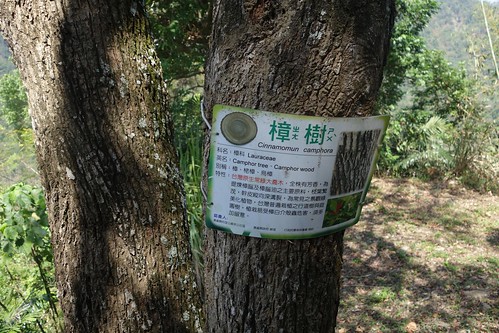
Camphor is of the same genus as Cinnamon.

So my wife comes home today and proudly wins high fives all around with some Quick Thinking in the face of a scammer:
As she is exiting an ATM at the post office across from police station, a woman comes up to her.
"Are the ATM machines broken?" the woman asks.
"Sure, they are fine, no problem," my wife says.
"Which one did you use?"
"The one on the left, it's fine."
The woman's brows turned mean. "I just took out money and I was short a $1000 NT bill. You must have it," she accused.
My wife rose to the occasion. "There was a woman there before me, I am sure she has it."
"Oh..."
I don't know what that has to do with Dictator Xi of China meeting President Trump of the US at Mar-a-Lago (Wiki), but I am sure your imaginations can make a connection. This meeting is set up for Thursday, and the world is on pins and needles, or perhaps Xanax, contemplating its possibilities.

Mar-a-Lago is a good choice. Xi will surely feel right at home in south Florida, where the population is geriatric, income inequality is high, and everyone lives in gated communities under constant surveillance.*

One thing that is different: the Obama Administration's deference to Beijing and its diffident, dilatory policies have been replaced by Trump's confident trolling. Roughly in tandem with the announcement of the meeting with Xi came the news that the US will announce a major arms sale to Taiwan in April. Trump then trolled China with the possibility of selling THAAD and F-35s to Taiwan (Japan Times). Trolling one's interlocutors with abusive announcements even as you are talking to them is a bog-standard Chinese tactic. I admit to being amused to see Trump hoist Beijing by its own rhetorical petard.

That said, everyone is quite nervous because the Chinese have realized that the need to cultivate the President's family, particularly his son-in-law, to make progress with the Trump Administration. Many articles on it this week -- this one from Josh Rogin is good -- and there's a collection of remarks from China/Taiwan waters at NBR if you are interested in political analysis as well as some fine remarks from Richard Bush -- but this remark pretty much summed it up:
It’s so great that the American political system resembles China’s political system enough for the Trump administration for have its very own princeling.
Drezner also noted:
But it is hard not to conclude that Trump and Kushner are spectacularly out of their depth on these issues. Worse, Trump displays no metacognition whatsoever: He doesn’t know what he doesn’t know, and probably never will. He and Kushner will therefore sell off core national interests and investments at cut-rate prices.
I don't believe Trump will sell off any fundamental American interests. What no one seems to have noticed about the deals that Trump makes is that he never pays. Trump's tactic is to troll some possibility, like THAAD for Taiwan, and use that as a vapor threat to extract concessions. He's not going to hand over assets when he can extract favors by trolling with them. After all, assets are only useful if you hold them.

Of course, China follows the exact same tactic. They troll and then don't pay. They don't give up assets, and they don't make deals that don't favor them. China follows agreements to the most minimal, stingy, letter of the law possible, if it follows them at all. If they make some investments in the US it will be purely cosmetic, and if they buy more exports it will go on loudly for a while until the program is quietly ended. The Middle Kingdom either fears you or accepts your submission, but it doesn't bargain with you, because in China, win-win means either way, I win.

Both sides are interested in appealing to domestic audiences, Xi to the CCP, Trump to his base. Thus, what will happen is that Trump will troll, Kushner's business interests will get quietly fed and watered by way of courtesy, nothing major will happen, China will sour on feeding the Trump family businesses sooner or later, and the quadrille of US-Japan-Taiwan-China relations will go on until China begins the war it is building toward. But at least the media has something to write about.

This point is made by a Chinese writer at the strongly pro-China East Asia Forum:
But the ecology surrounding the relationship between Beijing and Washington is still fragile. The past warns against predicting breakthroughs from the Florida summit. The number of times Xi met with Obama surpassed that of all their predecessors combined since 1971. While there is no evidence to conclude that bilateral ties worsened from those high-level meetings, there is still room for the relationship between China and the United States to improve.

This time round, ‘get tough on China’ is more the norm than the exception among US foreign policy protagonists. Many American pundits blame the Obama administration for having failed to ‘stand up to China’ on just about every issue area from trade and cyber security to North Korea and the South China Sea. Never mind the contrast between Obama’s declarations that ‘prosperity without freedom is just another form of poverty’ in philosophising a strategic ‘pivot to Asia’, and Xi wondering why foreigners view China as a threat when his country no longer exports ideology or poverty.

Trump is therefore challenged to prove that the United States can, after all, stand up to China. Another group of Americans encourages Trump to live up to his own tweets about China. So far Trump and his team have chosen to resist the pressure.
Asian nations are also looking at this, and you know that Trump and Abe of Japan exchanged a few words about it. There are many many pressures in the international system shaping outcomes.

Taiwan? The US has promised to brief Taipei before and after the talks. Seems like business as usual.

This piece at the National Interest raises an interesting and even worrisome point: it's too early for a summit...
Lastly, the Trump administration itself is not ready for the summit. The Department of State lacks necessary personnel across the board, including a deputy secretary and assistant secretaries. Even though the administration is claiming that it is considering every measure on the table with regard to North Korean nuclear weapons, it lacks the capability to craft and implement policy. The Pentagon is in a similar situation, and one can only expect that the National Security Council is also overwhelmed with a myriad of fast-moving crises around the world. Secretary of State Rex Tillerson’s visit to Japan, Korea, and China has already proven that the upcoming presidential summit will not lead to any substantial accomplishment. In addition, messages from Trump and Tillerson conflict with one another.
The Trump Administration has been incredibly slow in getting people on board. Would be nice if some of those names that were mooted months ago finally made it on board.

*My Florida friend says wrong
_______________
Daily Links:
_______________________
Don't miss the comments below! And check out my blog and its sidebars for events, links to previous posts and picture posts, and scores of links to other Taiwan blogs and forums!

Tuesday, December 13, 2016

Another Trumpfest *sigh*

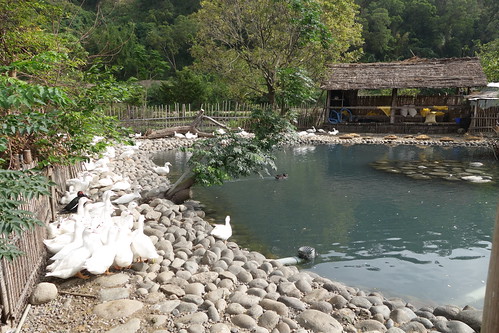
A duck enclosure. The white ones are farmed. They don't fly away because they are too fat -- ducks are like dogs, we were told, they eat and eat. The black ones are wild visitors living the easy life.

So much headache this week. I think I'm going to invest all my retirement funds in tranquilizers, since everyone in DC must be taking them by the handful now...

Yeah, hopefully Trump will start trolling on another topic, so I don't have to write any more posts like this and can go back to writing on domestic events.

Wilfred Chan, whose stuff is excellent, observed what I have been saying publicly and privately in a Tweet:
Suggestion: whenever you feel rising panic about a China thing, look to see how Taiwanese people are reacting. They've dealt with it decades
Watching these panics happen periodically is very instructive in maintaining that Zen-like calm in the face of hyperventilation in the Commentariat. I also recommend dogs, whiskey, and bicycling...

...my very sharp man Solidarity, now studying in the US and new proud father (congrats!) also tweetly observed:
If I were Zhongnanhai I'd be wondering how else to take advantage of Western media liking me better than they do the incoming US president
I made a mistake, actually. When I pointed out that the media was teaching China what topics were safe for it to be tough on, I forgot that it was also teaching our future President what topics were sensitive enough for successful trolling.

As for Trump's most recent remarks, J Michael Cole said it in one China, Many Trumps:
But one thing is certain: the likelihood that the United States will scuttle “one China” is next to nil, as such a policy goes against even what the more creative (and pro-Taiwan) of Trump’s advisers on Taiwan and China, people like John Bolton, have argued over the years. In Bolton’s case, his argument has been that dual recognition might be possible, albeit under a “one China” framework. The logic behind this is that there is nothing in the United States’ “one China” policy that prevents dual recognition. (Whether such an argument would be palatable to Beijing or Taipei is a different question altogether.)
This is exactly right: not much will change because Trump is surrounded by people who will keep policies that help Taiwan in place and expand around the edges where they can. Whenever there is policy change, there is pushback from opponents who are powerful and heavily invested in the current framework. Leaders might make noises about revolutionary change, but change usually occurs incrementally, if it happens at all.

You're just watching that pushback against Trump's possible future policies in realtime...

A couple of small things... many pieces contended that Taiwan was a "core interest" of China. The is one of the ways the media noise helps conceal what is actually going on, supporting Beijing inadvertently. Taiwan is not a core interest of China. Let's spell this out for future reference:
Taiwan is not a core interest of China. Annexing Taiwan without interference from other Powers is the core interest at stake here.
PRC nationalism has now invested Taiwan with deep expansionist significance -- two generations have been brainwashed. It will be difficult for the PRC to decouple itself from this train. Let's hope it can find a way, but in the meantime... keep talking to the individual Chinese you meet.

The overreading into Trump's remarks (On video) was comical. Many commentators over-read "I heard the call was coming probably an hour or two before" to mean he never knew about the call, but the comment was not meant in so literal a way. Much of the noise is driven by the media's profound anti-Trump bias. And no, I am not defending Trump (pointing out media bias is not the same as defending Trump). Nor am I a neo-con (now that's comedy -- I'm so pink there's a shoot-on-sight order on me in Saudi Arabia).

Is Taiwan going to be used as a bargaining chip? It some ways it always has been, but no, the Trump Administration isn't going to sell Taiwan for oil drilling rights for Exxon or for lower tariffs on US goods or for a different currency policy. Could things get worse? Well, the NY Times sententiously warned us that Bad Things Could Happen. Salvatore Babones laffed:
The NYT warns that China could buy Airbus, trade with North Korea, burn coal, snub Taiwan, and trade with Iran. So?
Things China is doing anyway. Ye gods.

Yes, our newspapers are always pointing out what China could do to the US. We never hear what could happen in return. A tit for tat trade war helps no one, which is why it won't happen.

Meanwhile, Trump's foreign policy trolling is a success: that much less attention and space in the mainstream media is given to his Administration picks....
______________
More Links:
Excerpt from Nelson Report and State Department Briefing on this mess: click on Read More

Tuesday, August 02, 2016

Way Cool: Cache of Japanese Military Maps of Asia

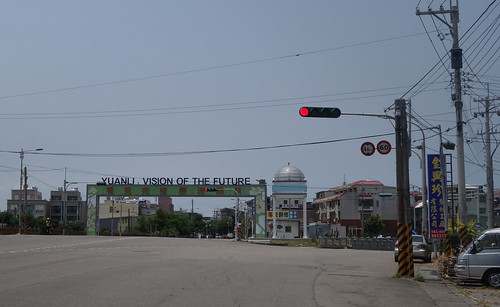
Yup: Yuanli's town slogan is "A vision of the future."

A friend passed this around Facebook: a trove of Japanese military maps made prior to WWII with incredible detail and information. A teaser...
These maps were captured in the waning days of World War II as the U.S. Army took control of Japan. American soldiers confiscated thousands of secret Japanese military maps and the plates used to print them, then shipped them to the United States for safekeeping.

..........

Not surprisingly, the Japanese surveyors weren’t always welcomed in other countries. In 1895, angry locals in Korea killed several assistants on a Japanese survey team, Kobayashi writes. (Japan annexed Korea in 1910 and held it until the end of World War II.) Two decades later, Japan sent secret survey teams into China. These men disguised themselves as traveling merchants and made their maps equipped only with a compass and by counting their steps to mark distance.

In the age-old tradition of cartographic copying, the Japanese often built on maps they’d captured from their foes, adding their own notes and details on top of the original. Cyrillic script is visible in the Japanese map above of Vladivostok, Russia, for example. Naturally, their enemies did the same thing. The formerly classified U.S. Army map of Okinawa below, printed in 1945, is based on a captured Japanese map.
Stanford is currently putting the maps online. There is a topical index here and many maps of Taiwan -- here is one collection, the red not yet digitized, the green are accessible. Here is a Keelung map, and here is a Taichung map at 1:50,000. Click somewhere inside the viewing frame to see the map, it sometimes doesn't appear unless you click in that frame. Sometimes you have to grab and move the map around in the viewer to actually see it, they digitized a lot of unnecessary area around the map, so the first thing you see sometimes is a lot of useless gray area (on some maps click on the upper right corner of the map box for full screen and move the image around til you see the map). The maps are fully zoomable. Way cool.
_______________________
Don't miss the comments below! And check out my blog and its sidebars for events, links to previous posts and picture posts, and scores of links to other Taiwan blogs and forums!
Wednesday, March 30, 2016

Xi's visit to Czech Republic: protests and positives

The First Foundation is thataway.

Czech Taiwan and China security expert Michal Thim just posted this to Facebook

++++++++++++

Toward the end of the video (on Youtube), a Chinese woman (I will leave her possible affiliations to everyone's own considerations) tells a Czech citizen that he is not "welcome here". Here means Prague, and she is a part of large group of Chinese "volunteers" who moved around in a buses, ostensibly to welcome Chinese President in Prague, and confronted protesters, especially those who were holding Tibetan flags. In some places they obstructed view with huge PRC flags they carried, or using the buses they rented.

On related note, one of online news sites reported that the Chinese embassy instructed (although it was careful enough not to be direct coordinator, some shady Czech-Chinese Commerce Association was) "volunteers" to tear down undesirable flags, make noise, not to openly provoke, but not to be afraid to confront either. Source is one of the Chinese students who spoke on condition of anonymity. The "volunteers" consisted of people who work in the Czech Republic for Chinese companies like Huawei, students, and also "tourists".

Of course, there was no need to mobilize Chinese citizens who reside in the Czech Republic, Chinese Embassy could just let the protesters protest and deal with the official business. But none of this is exactly new. We have seen it prior to 2008 Olympics in places like Paris or in London last year. I actually have hard times to understand it because in the end of the day, it is counter-productive. I can see in online discussions that many people who otherwise would not care are outraged with the spectacle, by apparent disinterest of Czech police to protect constitutional rights of Czech citizens, and by the kowtow approach the Czech President demonstrates.

On a positive note, the treaty on partnership that was signed yesterday is a standard text that other EU countries signed with China, which means it does not contain any concessions on Taiwan or Tibet. Chinese side tried, the Czech government did not concede.

_______________________
Don't miss the comments below! And check out my blog and its sidebars for events, links to previous posts and picture posts, and scores of links to other Taiwan blogs and forums!
Tuesday, March 03, 2015

Musings on the Strange Pro-China Left

A wedding dress shop in Sandimen.

SCMP reports on a PRC general who threatened Taiwan while kvetching about Hong Kong.
Sun had been discussing the important role of competition in Sino-US ties and maritime territorial disputes in the East and South China seas, when he touched on the risk China faced in terms of subversion campaigns by foreign states.

"Hostile forces have always attempted to make Hong Kong the bridgehead for subverting and infiltrating mainland China," Sun said. "The illegal Occupy Central activities in 2014 came as minority radical groups in Hong Kong, under the instigation and support of external forces … orchestrated a Hong Kong version of a colour revolution."

He said the central government had shown firm support for the Hong Kong government in dealing with the protests, and that Beijing's defence of "one country, two systems" should also serve as a warning to Taiwan's pro-independence forces.
It is an article of Chinese propaganda that the Hong Kong protests were controlled by foreign forces (read: The US). This has been picked up by weirdo pro-China left as an article of faith. Indeed, there's a fellow on Facebook whom I religiously follow because he reliably forwards the pro-China propaganda line, which helps me separate out the propaganda from the reality.

David Lindorff, a progressive writer with experience in East Asia, has addressed this in an excellent piece at Counterpunch last year.
A number of progressive and left-leaning writers in the US have jumped on a report by Wikileaks that the neo-con dominated National Endowment for Democracy (NED) and various other US-government linked organizations with a history of subversion and sowing discord abroad are operating in Hong Kong and on that basis are making the leap of “logic” that the democracy protests in Hong Kong must therefore be a creation of US policy-makers.

As a progressive, Chinese-fluent journalist who has spent years working in China and especially Hong Kong, and who has spent decades exposing the secret workings of US agencies and their network of fake NGOs in support of US empire, as well as their anti-democratic activities here in the US, I can understand why people might be suspicious, but I want to explain that Hong Kong is not Ukraine or even Venezuela or Brazil.

...

To suggest, for example, that long-tested leaders of Hong Kong’s democracy movement like Martin Lee Chu Ming, Emily Lau, or labor and democracy activist Lee Cheuk Yan, are “in bed with” the NED because they might have attended some NED event or that 17-year-old student protest leader Joshua Wong Chi-fung is working for the US because he and his father allegedly once visited the US Consulate in Hong Kong, is both nonsense, and the height of imperial-minded arrogance. Lee, Lau and Lee are virtually the MLK, Mother Jones and Cesar Chavez of the Hong Kong freedom struggle and worked at great personal sacrifice to win more freedom and local control from the British long before China was in charge of the territory! And Wong, despite his tender years, clearly has courage and a mind of his own. Visiting the US Consulate is a commonplace event in Hong Kong, and that action signifies nothing. (By the way, what are the odds the NED or CIA would opt to go with a 17-year-old kid to organize this massive protest? Seriously? That’s about as likely as that the International Muslim Conspiracy to Create a Sharia Law America would have selected a young Kenyan-born black child as their vehicle to become their Manchurian-candidate president and then subvert the US. The truth is this kid, who won his organizing spurs at 14 opposing a politically-guided Hong Kong history curriculum, has won his current surprising position of influence through conviction, intellect, guts and charisma.)
If/when China occupies Taiwan, that the anti-China protests are US-organized will be the China propaganda line. If you spend time among the fifty-centers in online forums, you can already hear that Taiwan independence is a US plot, a rather comic complaint considering the long history of US opposition to Taiwan independence.

Resistance in Hong Kong to China's suppression of local identities and substitution of its constructed "Chineseness" takes many forms. The same thing is happening in Taiwan (see the recent flap over KMT propaganda history in the textbooks), but because the faux "Chinese" identity is offered in a democracy, resistance is formalized and more powerful. We must not forget that inside China, where outsiders do not see very well, these same processes of obliteration of local identities are going on -- they are occasionally reported on in the foreign media as articles on how China is bringing Mandarin to everywhere in China, where the reporter is either unable or not permitted to see/report on what is going on. What's actually happening is that it is crushing local ethnic groups, which we outsiders have trouble seeing as ethnic groups because the rubric of Chineseness is so deliberately protean and obscuring, meant to hide these colonial processes. Beijing operates an empire that is desperately struggling to become a state, and part of that process is the elimination of local identities. Hence Hong Kong...

Note that the general in the SCMP piece again refers to 1C2S. That line exists for domestic consumption only, to raise resentment among the Chinese against Hong Kong and someday, Taiwan. "Look how well we are treating them (better than we treat you)." Since Chinese do not hate Taiwan, resentment is the next best approach to getting them to acquiesce to an invasion of Taiwan. The "two systems" doesn't mean anything more than the "autonomous" in Tibetan Autonomous Region.

The Left's obverse of the pro-China left is the anti-Japanese militarism left, which is almost completely delusional. For example, John Feffer at FPIF just produced a wonderfully droll piece entitled Is Japan's Prime Minister the Next Putin? Yes, China is building fake islands in the South China Sea (what could be more Putin than that?), stealing islands from the Philippines, creating illegal ADIZs over Japanese territory, and threatening to murder Taiwanese wholesale and plunge the region into war. But respond to that? You're Putin!

The complaints about the treatment of Okinawa are totally on point, as are the complaints about the burgeoning security apparatus in Japan. I would be more accepting of them, however, if there were complaints about China's similar trashing of Xinjiang with military bases, and similar complaints about China's far more pervasive security apparatus. But the Left is a desert on China...
_______________________
Don't miss the comments below! And check out my blog and its sidebars for events, links to previous posts and picture posts, and scores of links to other Taiwan blogs and forums!
Tuesday, February 24, 2015

Case No. 59213: China Specialists Don't Get Taiwan

A ladybug predating.

I often complain about how China specialists just don't get Taiwan. Here is another example of it. taiwansecurity.org published an interview with longtime, well-known China specialist Andrew Nathan last week about Beijing and Taiwan. He replied to one question on the Sunflowers.
I think that they had already learned that to settle what they call “the Taiwan problem” peacefully, which is their goal, they are going to have to win over public opinion in Taiwan—the people, the voters. They knew that. But to me, the lesson of the Sunflower Movement is—but I don’t know if Beijing understands the lesson the way I do—is that you can’t win over public opinion strictly with economic benefits. I think Beijing’s strategy had been that we will take care of the Taiwan economy by opening up our markets, by giving privileges to Taiwanese investors and others, and sending tourists, and so forth, and the Taiwan people will understand that their economic interest is in the same basket with us. It turns out that the Taiwan people are instead resentful of growing economic dependence on the mainland. They’re not very trusting of how that economic influence will be used by Beijing. The Chinese leaders are still in some ways Marxist, they still believe in economic materialism, the idea that people will respond to economic incentives. They seem to have a hard time getting a grip on the idea of identity and self-dignity as an important factor that people sometimes fight for.
We just had this problem with Denny Roy, which I commented on below. Once again we see the false idea that Beijing offers those generous economic incentives. But everyone in Taiwan can see that (1) Beijing is not offering generous terms (2) it is only doing econ agreements because it wants to hollow out Taiwan's economy because of (3) it wants to bind Taiwan to China and annex it while destroying the economic basis for Taiwan's independence. The result of the China engagement has not been positive economic benefits for Taiwan, but stagnating wages, reduced democracy, increased smuggling and gang activity, and so on.

China specialists need to face this fact squarely: there are no generous economic benefits from Taiwan's economic involvement with China. That golden age passed in 2008, six years ago. Instead, the people of Taiwan experience assaults on their independence and democracy on one side and the hollowing out of their economy on the other, along with China's continued interference in FTAs and other international agreements. They know that the benefits of the trade relations go to a few big businessmen. They know the tourism profits are taken by a handful of Hong Kong-based tour agencies, while the locals get low paying service jobs while Chinese tourist facilities destroy local lands and the tourists themselves overrun whatever place they go into, driving away locals. As Ian Rowen has trenchantly observed, tourism is a territorial strategy of China in Taiwan. They know that China has special zones on its coast to poach Taiwan's agricultural technology. The public here is well aware that everything the public was told about China by the Ma Administration has turned out to be a lie. You'd think the message would have gotten out by now to the China specialists who study this stuff... no wait, why do I think that?

The whole idea of "generous economic benefits" is Chinese propaganda. Stop forwarding it, scholarly folks.

As a friend of mine commented so much better than I could on Nathan's remarks about China's authoritarian government and Taiwan's shifting democracy:
LOL. Poor China. they must be having fits according to Nathan because of that protean democratic process. They don't know who's in charge in Taiwan; or for that matter, the US, the UK, France, Germany, Japan, Korea, India, Australia, Canada...
Nathan also answers the question about what if China became democratic.
If Beijing became a democracy in some authentic sense, I believe that the problem of Taiwan’s relationship to the PRC would then be much easier to resolve peacefully. And I guess I gave in my earlier remarks already the logic of why I think so. The Taiwan people do have an economic advantage in close relations with China, but they don’t want to make that into a political relationship because they don’t trust the authoritarian regime. But if China had a truly democratic regime—I’m not saying a U.S.-type regime or any particular format, but something that was really democratic with political freedom and political security—then I think the Taiwan people would gradually grow to trust the government in Beijing and they would understand that this mainland China political entity has a security interest in an arrangement where both their own and Taiwan’s security will be guaranteed, and we need to provide that to them, and it’s not going to be a threat to us. That kind of a thought would grow in Taiwan.

And then I think on the Chinese side, they would also be willing to negotiate with the Taiwanese for their interests in more autonomy and they could—over the years, many different formulas have been vetted about confederation, and so on—they could probably solve the problem.
There's already poll data on this. As Emerson Niu's survey
Q4. If only small political, economic, and social disparity exists between Mainland China and Taiwan, do you favor or not favor Taiwan unifying with China?

Not Favor: 56.4% 
Favor: 36.4%
NA: 7.2%
...and that data is years out of date. Things are even stronger now. Why do people in Taiwan reject being annexed to China? The reason is simple: they have their own identity, the Taiwan identity. China has a different identity (see Don Rogers' work on the young). Authoritarianism is an issue, but even if China became democratic, the identity issues that separate the two sides would remain (see Scotland, Catalonia, Slovakia, etc). Taiwanese would see a democratic, non-threatening China as "at last! we can be free!" and that the peaceful resolution would result in an independent Taiwan, which most everyone here wants to see.

In any case no one in Taiwan would imagine that a democratic China would keep its word in some kind of security treaty. The Taiwanese would much rather be security linked to Japan and the US, two nations that don't want to annex the island. Nothing in the basic equation of the Taiwan-China-Japan-US quadrilateral would change.

I'm just curious about people who think that China will be less willing to use force if it is democratic. The history of the western democracies does not make one sanguine in this regard....

Finally, Nathan remarks...
And then I think on the Chinese side, they would also be willing to negotiate with the Taiwanese for their interests in more autonomy and they could—over the years, many different formulas have been vetted about confederation, and so on—they could probably solve the problem.
How kind of Beijing to grant us the status of an autonomous satrapy and refrain from murdering us wholesale! Never mind that Taiwan would be negotiating for less autonomy than it has now (and why would it do that?). This remark: "they could probably solve the problem" elides so much. The problem is not between Taiwan and China as something that could "be resolved" by the two sides sliding closer to each other. Taiwan is not the cause of the problem, and thus, nothing it can do will resolve it, save surrender.

The problem is Beijing's desire to annex Taiwan. Only Beijing can resolve that problem.

UPDATE: Some good comments below.
__________________
Daily Links:
_______________________
Don't miss the comments below! And check out my blog and its sidebars for events, links to previous posts and picture posts, and scores of links to other Taiwan blogs and forums!
Saturday, August 30, 2014

The Economist: one drop in the tsunami of stoopid

Another lovely Taiwan riding day.

I'm blogging on this because I fear that if you read this article in which the Economist explains why China and Taiwan are divided, your IQ may plummet. Just consider this my small public service in defending the world from the ongoing tsunami of stoopid in the media. Why O why can't we have a better media?

The stoopid starts at the very beginning. With the title: "China and Taiwan are divided." But of course, China and Taiwan aren't "divided." The KMT and CCP governments wish to annex Taiwan to China, whose sovereignty over Taiwan is not supported by any international treaty. It is they who are divided. There is no division between Taiwan and China, because there was never any unity (Added: I discuss this in a post above).

The Economist simply leaves out all the issues -- the fact that for all of Chinese history Taiwan was considered to lie outside China, until the mid-1930s when Chinese expansionist thinkers began to imagine they could grab it. Or the 1895 declaration of independence. Or the island's current undetermined status under international agreements and US and UK policy. Bye-bye.

Consider also how writers on the Taiwan-China problem have incorporated the trope "province of China in the 19th century" into the way they think about Taiwan's relationship with China -- as if it actually meant something. It means precisely nada. That's one of the double standards we use in thinking about Chinese claims, which we apply to no other claims. For example, Algeria was a department of France for over a century, Taiwan a province of the Qing for less than a decade. I look forward to the Economist's next brilliant article on how Algeria and France are divided.

It always saddens me that allegedly democracy and law-supporting media organs can't clearly lay this out for the public. Instead, we just get parroting of Chinese claims when what we should get is subversion and deconstruction of them.

The Economist goes on to present "history":
... Taiwan has since become a democracy, but resentment of the KMT runs deep among many of those who were living on the island before the KMT took refuge, and the descendants of such people. Their identity with greater China is weak. Some want Taiwan to abandon any pretence of a link with China and declare independence. 
This is another common trope in the media -- downplaying support for independence. It's not "some" who want, but a comfortable majority. But for the Economist to maintain the fiction that China and Taiwan "divided" -- it's actually the KMT and the CCP which are divided -- it must downplay support for independence in Taiwan. But it gets worse -- the Economist actually treats democracy as if it were a bad thing. It urks up:
But perhaps an even bigger reason why the Chinese and Taiwanese presidents have yet to meet is that the Chinese civil war is not officially over. The government in Beijing does not recognise the government in Taipei, and thus does not accept that it has a president. Although the two sides stopped lobbing shells at each other in the 1970s and began talks in the early 1990s, progress has been slow. Discussions were held only through intermediary bodies, while Taiwan’s democratisation soon intervened. Taiwan’s then president and KMT leader, Lee Teng-hui, organised the island’s first direct presidential elections in 1996. In an appeal to native Taiwanese, he shifted his government’s rhetoric to talk not of "one China" but of two states. This effectively granted recognition to the government in Beijing, but it also infuriated it. The Communist Party feared a slide towards Taiwan’s formal declaration of independence and tensions flared. China lobbed unarmed missiles into the Taiwan Strait; America sent aircraft carriers to warn it off. The victory of Mr Lee in the presidential elections, and of the pro-independence Democratic Progressive Party in two subsequent ones, stymied further progress in cross-strait talks.
The brilliance of this paragraph lie in its author's utter blindness to what he is writing -- he opens by saying that the issue between the KMT and CCP is the Chinese Civil War, which is rank nonsense. The Chinese Civil War is a dead letter. The real issue is that -- as he bass-ackwardly identifies further on -- the people of Taiwan don't want to become part of China. If Taiwanese supported annexation to China at the same levels they now support independence, then we would have become part of China decades ago.

The only reason the CCP even talks to the KMT is because the KMT represents its best shot at annexing Taiwan without a war. "Resolving" the Chinese Civil War is actually a rhetorical cover that the CCP and KMT use to justify their talks on how best to annex the island to China and what the take-home for the KMT will be. Thanks, Economist, for repeating that bit of propaganda as if it actually meant something.

Indeed, the only reason we're having a China-Taiwan discussion is because China threatens to maim and murder Taiwanese if it doesn't get to annex Taiwan. Otherwise the Taiwanese would be ignoring Beijing, Chinese Civil War or no.

But look at how the Economist treats democracy -- first it "intervenes" in the glorious progress of annexing Taiwan to China and then it "stymies further progress." That rotten democracy! How dare it!

Read it again -- the author of the piece is lamenting the fact that a democratic island of 23 million people with close relations with the western democracies whose economy is of global importance was not making progress in being annexed to China.

Does it get any more stoopid than that?

The reason we can't make "progress" in cross-strait talks isn't anything that happens in Taiwan -- it is because China is completely belligerent and inflexible. Instead of clearly pointing this out, the Economist puts forth a series of common tropes here

-- false equivalence: Taiwan resistance and Chinese aggression are treated as if they were two equal sides of the same issue.

-- that China is provoked and infuriated and has no agency of its own in the Taiwan-China relationship. Poor China, stop it before it shrills again!

-- that "tensions flare" on their own, like Immaculate Conceptions, without the intervention of human agency. As my readers know, tensions flare because China chooses to ramp them up. Tensions are a policy tool for China. D'oh.

-- that President Ma is a "less confrontational" president (because he and Beijing are allied in annexing Taiwan to China! D'oh!): a common media trope is to assign the adjective "confrontational" or "provocative" to Taiwan while ignoring China's belligerence...

...because when you demand that a territory annex itself to your nation, point your military at it, and say that you will plunge the region into war if you don't get your way, you're not being confrontational, you're being statesmanlike. And when you resist that, you're confrontational.

*sigh*

Divided? The real division is between the people of Taiwan and the democracy they cherish, and the Chinese nationalists on both sides of the Strait who desire to suppress that democracy and annex Taiwan to China. But it appears that we will never see any discussion of that in the Economist...
__________________
Daily Links:
______________________
EVENT: Second World Congress of Taiwan Studies: Call for Papers

The Second World Congress of Taiwan Studies will be held at the School of Oriental and African Studies (SOAS) June 16-18, 2015. The Congress is being co-organized by Academia Sinica and the SOAS Centre of Taiwan Studies.

Click on READ MORE...

Sunday, June 29, 2014

Zhang Visit Unravels

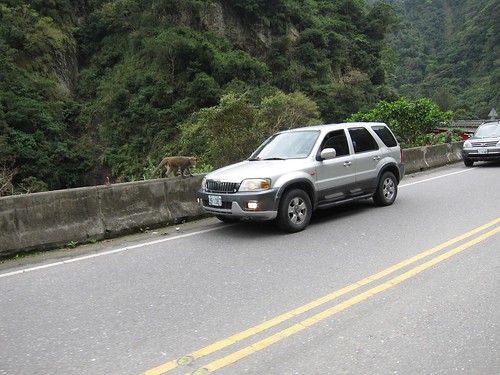
A monkey inspects a vehicle on the 23 near Donghe.

The visit of China's Taiwan Affairs Office head Zhangzhijun ended ignominously as he fled the island in the face of relentless public protests. WSJ scribes:
China's top cross-strait negotiator, in Taiwan on a landmark visit, canceled three public appearances at the last minute Saturday after protests against his bridge-building trip turned violent.

Zhang Zhijun, head of Beijing's Taiwan Affairs Office, is the first ministerial-level Chinese official to set foot on Taiwanese soil after both sides split 65 years ago. Mr. Zhang's office said his four-day trip, which started on Wednesday, is to "listen to the voice of the Taiwanese people at the grass root level" as both sides strive for further reconciliation.

In a text message to reporters on Saturday morning, Taiwan's Mainland Affairs Office, responsible for coordinating the trip with its Chinese counterpart, said the changes were made in response to a spate of "conflicts" in recent days.

On Friday evening, during his visit to the southern city of Kaohsiung, members of the pro-democracy Black Island Nation Youth Front threw white paint and bundles of paper ghost money at Mr. Zhang's vehicle as he was getting out of the car. Mr. Zhang wasn't hurt but several security agents were splashed with paint.

Earlier that morning, also in Kaohsiung, a young male protester sustained a laceration to his forehead during a violent quarrel with a group of China supporters in front of the hotel where Mr. Zhang was staying. The Chinese envoy was also almost hit by a water bottle thrown by a Taiwan independence activist as he arrived at the city's high speed railway station.
There were many other incidents, including protesters following Zhang everywhere he went holding signs saying there was one country on each side of the Strait. Kaoshiung Mayor Chen Chu mildly criticized the protesters, probably because Zhang had been slated to meet with her, an event that caused much speculation in the international media about China attempting to enhance relations with the DPP in case they win in 2016. The visit featured the usual ineptly staged official appearances, including a visit to Atayal country where the Atayal people were dressed up in quasi-Amis gear, and a visit to the Mazu temple in Lukang.

The Mazu temple visit is quite interesting. The goddess Mazu has become an important symbol of annexation over the last few years (see this and this in-depth piece). The Lukang temple is the rival Mazu temple to the big Mazu temple in Dajia. In the rear of the Lukang Mazu temple is a small portrait of Shih Lang, the general who invaded and annexed Taiwan to the Qing Empire in 1683. One wonders if they wanted to incorporate that into the visit. My friend Drew tells me that even as the big Mazu temple in Dajia acts as an important nexus of religious fervor, pro-annexation politics, and cross-strait organized crime, many less important Mazu temples around Taiwan are cutting their ties to their parent temples in China (Taipei Times story on the allegations of police and gangster use of violence against protesters)(the Foreigner has some tart comments).

Taiwan Explorer was among the many who just didn't get it:
Let's ask ourselves an honest question: Does violence really offer any viable solution here? As much as I admire the passion for democracy and independence by those young activists, throwing bottles and paint at a foreign government representative will not change things in your favor. And the excessive police force and disregard for accredited journalists casts another dark shadow on the current government, that barely anyone sees as capable to lead Taiwan. In light of these two factors, I'm rather pessimistic about what Taiwan really got out of this meeting, but one thing is sure - the discourse in Taiwan has not moved beyond the usual blue-green rhetoric. While protests were expected and necessary, the violence was counterproductive. You can't talk with someone who is shouting, or throwing things at you. If one day we have a green government, and a representative is sent to China for talks, how would Taiwanese feel, if Chinese protesters physically threatened that representative?
"Taiwan" wasn't supposed to get anything out of this meeting. It was political theatre staged for the audience at home in China -- Gary Rawnsley has great review of these aspects at CPI -- and to get the international media to gush Chinese propaganda about the "warming relations" and "China's softening point of view" and "first minister in 60 years!" and similar garbage. Taiwan Explorer is quite right: you can't talk to someone who is shouting at you or throwing things at you, but he misses a key point: you have to sincerely want to talk to them. And of course, Zhang did not want sincere talks. He was just there to create media spectacle (as Taiwan Explorer noted), which the international media breathlessly reported. Well, he got his spectacle...

The protests were never about talking to Zhang. They were there to subvert and destroy the media narrative that Zhang was trying to create. In that they were successful.

The visit did showcase an important aspect of Chinese soft power -- I didn't see any international media reporting the visit for the sham it was. To understand that, you had to read, well, people writing on social media, not the media. Indeed, AP's report was unmitigated shit from an alternate universe:
Dialogue between China and Taiwan opened in 2008 after Beijing set aside its military threat to sign economic agreements with Taipei and Taiwan President Ma Ying-jeou agreed to put off political issues to build trust and improve the island's economy.
...as if the DPP never negotiated with China and when did Beijing set aside its military threat!? Thanks, international media. As long as you guys write like that, we bloggers will always have readers.

Taiwan Explorer ends by asking how Taiwanese would feel if Chinese physically threatened a pro-Taiwan representative sent to China for talks. That's easy to answer. They wouldn't like it. We know that because pro-Taiwan types are rather regularly threatened when they advance pro-Taiwan views in overseas venues. We know that because, well, all of China policy toward Taiwan is essentially a violent threat to murder and maim Taiwanese in order to annex their island; that threat is indeed the only reason anyone bothered to pay attention to Zhang. Bottom line: if Zhang's nation didn't threaten to toss missiles at Taiwan, its representatives wouldn't be met with thrown bottles and paint.

UPDATE: Anon below observes...

"members of the pro-democracy Black Island Nation Youth Front threw white paint and bundles of paper ghost money at Mr. Zhang's vehicle as he was getting out of the car. Mr. Zhang wasn't hurt but several security agents were splashed with paint.

Earlier that morning, also in Kaohsiung, a young male protester sustained a laceration to his forehead during a violent quarrel with a group of China supporters in front of the hotel where Mr. Zhang was staying. The Chinese envoy was also almost hit by a water bottle thrown by a Taiwan independence activist as he arrived at the city's high speed railway station."

Did you notice how we hear clearly who threw things at the envoy, but the injuries to protesters are in passive voice? This comes up again and again in international media. Radicals and troublemakers on the pro-Taiwan and 'something happened' to protesters, no idea who did it.

_____________
Daily Links:
_______________________
Don't miss the comments below! And check out my blog and its sidebars for events, links to previous posts and picture posts, and scores of links to other Taiwan blogs and forums!

Wednesday, April 30, 2014

The Black Water Ditch and the Chinese Claim to the Senkakus

DSC_0016
Another great trip out to Little Burma in Taipei, on Huaxin Street near the Nanshijiao MRT station (Exit 4, head past the KFC and McDonald's).

Work! What's that? I'm blogging! I've long wanted to take a moment and review a very specific and bogus claim that Chinese expansionist scholars typically use to argue that the Senkakus are Chinese: that a black ditch/trough formed the boundary between China and the Rykyus (Okinawa) which would put the boundary north of the Senkakus, which would thus have been Chinese in the 17th century.

Han-yi Shaw's thesis on how China owns the Senkakus appears to be the origin of the claim. He makes the claim as follows on page 48 and subsequent pages. I reproduced it as an image:


This passage appears to say that there is a ditch that demarcates the Ryukyus from China. In the next paragraph on p 49, he writes:


Note how he specifically says "Viewed together" these constitute proof that the ancient Chinese (who were actually Manchus by this point) saw the Senkakus as part of China. In the first section, he states that the boundary is a trough, while in the second he refers to the Black Water Trough which demarcates Fujian waters. He then goes on to claim that the Okinawa Trench is the Black Water Trough/Ditch.

The only problem with this claim is that it is absolute nonsense. ADDED IN 2017: The Black Water "Trough" in the Ryukyus is not the Ryukyu Trench, but is the traditional name for Kuroshio Current as it winds up the west side of the Ryukyus. The Black Water Ditch/Trough does not refer to any trench in the ocean, which the premodern Chinese knew nothing about. Shaw is counting on his reader's ignorance of the ancient texts and references to make a case that never existed.

There is a Black Water Ditch associated with Taiwan, however, which is the cause of much confusion, including this writer's.

To understand where the Black Water Ditch associated with Taiwan was in ancient Chinese texts, there are several good works that mention it. Macabe Keleher's Out of China, on Yu Yonghe's diary of his visit to Taiwan in 1697, is a must. Emma Teng's Taiwan's Imagined Geography is another gem.

Fortunately, Lawrence Thompson has a piece in the Harvard Journal of Asiatic Studies from 1968: The Junk Passage Across the Taiwan Strait: Two Early Chinese Accounts (link).

Thompson's first account is that of Yu Yonghe. Yu crossed over to Taiwan in 1697, one of the earliest accounts of the passage, a dangerous and unpredictable one. Yu writes:
22nd. At dawn we crossed the Black-water Ditch. In the passage to Taiwan it is the Black-water Ditch that is most dangerous. [The current] flows from north to south; its source is unknown. The ocean water is a true green, while the ditch water is as black as ink. Its condition is also rather filthy,20 and that is why it is called a "ditch." It is about a hundred 1i wide. The swirling waters flow swiftly, and sometimes a foul odor assails one. There are also snakes with red and black mixed patterns and two-headed serpents that swim around ships. The helmsman will cast paper ingots [into the ditch], holding his breath in fear lest [the vessel be swept] southward by the current to one knows not where.21 The Red-water Ditch is not very dangerous and people regard it as nothing serious. But the two ditches being entirely in the middle of the ocean, it is difficult to understand why, with the agitation of wind and waves, they never become intermingled with the green water.
Yup. The Black Water Ditch lies does indeed mark the boundary between Fujian/Xiamen, except that boundary, an informal one, is between the Penghu/Taiwan and Xiamen. Yu actually reaches the Penghu in the very next diary entry, the next day.

But wait! The Black Ditch issue is even more interesting. Because in the second account, in June of 1763 the traveler leaves Xiamen, goes over to Penghu, and then hits the Black Water Ditch:
According to the navigator-quartermaster, when the night is quiet and the waves are still, one may be able to hear the sounds of dogs and chickens on Taiwan. I did not [have the opportunity to] test this . ...
After the noon meal a north wind suddenly began to blow. In crossing the sea, Experience has shown that the north wind in the sixth and seventh months soon brings typhoons. The navigator-quartermaster wanted to return and moor at P'eng-hu [harbor] to wait until the typhoon was over, but after talking it over with the captains (of the other ships), our captain felt that we had already been held up too long. Moreover, they relied upon the fact that a typhoon had not immediately begun, and so in the afternoon we crossed the Black-water Ditch. The water of the sea [in this place] flows contrary to the prevailing current, And it is the most dangerous place in the passage to Taiwan. The water was a more intense black. One must trust to the wind to get across.... When the ship crossed the ditch, the water was stinking with a noxious vapor that rose (because of poisonous snakes in it). I was afraid to come out and look at it. The navigator-quartermaster said that they had often lowered the lead-tube coir rope to the limit of a hundred and several tens of hsiun (8oo-goo feet), but they had never found bottom and did not know how deep it was4.... At evening the wind grew stronger and the waves were like hills. I suddenly heard a clamor under the ship, a sound like ten thousand horns blown at once in the middle of the earth, and I was even more frightened. When I questioned the navigator-quartermaster, he said that when the wind rises croakers hurry under the ship and blow all evening; when they gasp at the surface they produce this sound ....
What? They crossed the Black Ditch on the other side of the Penghu, between Taiwan and the Penghu? This is explained in a fascinating footnote, which takes its explanation from a text written in 1807:
"The Black-water Ditch is the place which forms the boundary dividing P'eng-hu and Hsia-men. It is about sixty or seventy li wide and the most dangerous place in all the ocean. Its depth is unfathomed, and the water is as black as ink. The current is violent; in form it is a slight depression (see note 20 above). If a vessel is lucky enough to have a favoring wind and sail quickly, she will cross [the ditch], being tossed this way and that. If she is delayed, then the waves will buffet her, and she may easily lose her bearings. "[Note that there are two black-water ditches: the one to the west of P'eng-hu is perhaps eighty-odd 1i wide and forms the boundary between P'eng-hu and Hsia-men. The water there is as black as ink, and it is called the Big Sea. The one to the east of P'eng-hu is also eighty-some 1i wide, and it forms the boundary between Taiwan and P'eng-hu. Its name is the Small Sea. The water of the Small Sea is even blacker than that of the Big Sea, and its depth is unfathomed. When the wind is calm in the Big Sea (a ship) can still anchor; but it cannot anchor in the Small Sea, which is more dangerous than the Big Sea. This is a distinction that has never been made in previous accounts.]"
In fact, not only were there two Black Water Ditches, one each in the Big and Little Seas, Chinese sailors operating between Taiwan and Xiamen referred to several bands of colored water, including red, white, and greenish-blue, which they used to identify their progress across the Strait (the footnotes are the most interesting part of Thompson's paper). Even more misleadingly, in some confused modern descriptions, the Strait itself is sometimes called the Black Ditch.
_______________________
Don't miss the comments below! And check out my blog and its sidebars for events, links to previous posts and picture posts, and scores of links to other Taiwan blogs and forums!

Thursday, April 10, 2014

Another in the continuing run of ECFA successes

IMG_7903
Lost a toy on the roof...

ECFA struck again in March, delivering massive gains in exports to China. Hahaha, no, slowly declining trade with China. Of course! ECFA missed the golden age, which was during the Chen years, and now as China upgrades manufacturing technology, it is starting to render Taiwan producers either irrelevant or vulnerable.
Exports to Southeast Asia—Taiwan's second-largest overseas market after China and accounting for about a fifth of all exports—gained 5.7% after a 4.8% growth in February.

.....

However, China stood out as a weak spot. Last month, Taiwan's exports to China fell 3.7% from a year earlier, after a 11.3% increase in February. It was largely due to China's increasing reliance on locally-produced raw materials and components, Taiwan's government said Monday. Taiwanese TV panels, once a major export to China, are also losing out to the Chinese who have more advanced technology, the government added.
The real area of gain for Taiwan is South and Southeast Asia, and that's where the national effort should be focused. The long-term trend for China isn't good. And if Taiwan could fix its South China Sea policy, it might have an advantage over China. But the current administration....

As for the yammering punditocracy that argues for the inevitability of China's annexation of Taiwan via trade, perhaps the trend here might have an effect. But I'm not holding out any hope.....

Anyone who looks at the promises from ECFA will see the same ones as for the services pact....
________________________
Daily Links:
_______________________
Don't miss the comments below! And check out my blog and its sidebars for events, links to previous posts and picture posts, and scores of links to other Taiwan blogs and forums!
Monday, February 10, 2014

Hegemonic Warfare watch: US Rejects Nine-Dash Line

Making Longan cakes.

Ka-boom! Uncle Sam's representatives call on China to explain what it is doing in the South China Sea.
The United States for the first time has explicitly rejected the U-shaped, nine-dash line that China uses to assert sovereignty over nearly the whole South China Sea, experts say, strengthening the position of rival claimants and setting the stage for what could be an international legal showdown with Beijing.

Washington has always said that it takes no position on competing territorial claims in the South China Sea among China, the Philippines, Vietnam, Malaysia, Taiwan and Brunei and opposes any use of force to resolve such issues.

But U.S. Assistant Secretary of State for East Asian and Pacific Affairs Daniel Russel in effect ended the ambiguity last week when he testified before the House of Representatives Committee on Foreign Affairs, experts say.

Russel said that under international law, maritime claims in the South China Sea "must be derived from land features" and that any use of the nine-dash line by China to claim maritime rights not based on claimed land areas "would be inconsistent with international law."
The piece further observed:
Unlike other countries, Beijing's claim to up to about 90 percent of the South China Sea is not based on claims to particular islands or other features but on a historical map China officially submitted to the United Nations in 2009.

The map contains a nine-dash line forming a U-shape down the east coast of Vietnam to just north of Indonesia and then continuing northwards up the west coast of the Philippines.

The nine-dash line has been considered by many experts as incompatible with the 1982 United Nations Convention on the Law of the Sea (UNCLOS), which rejects historically based claims.
This is a major shift in the declared US view. Sadly the US has not signed onto UNCLOS, meaning that its position is compromised. It is also compromised by its many years of silence on this issue. Still, it is nice to hear the US for once coming down on the side of right. Brookings has a longer review here.

In addition to the UNCLOS violation the US identifies, Philippines has previously contended that China is not an island nation and cannot make such claims. Manila has taken China to the international court, which China has ignored (also here for the facts on China's claims). If Manila wins, presumably this will impinge on the ROC claim, which is identical to the China claim because the ROC claims to rule China and everything that China rules, and also includes Mongolia in its "China."

South China Sea? Arunachal Pradesh? The Senkakus? Which war will we get? Probably not even Beijing knows.
______________
Daily Links:
_______________________
Don't miss the comments below! And check out my blog and its sidebars for events, links to previous posts and picture posts, and scores of links to other Taiwan blogs and forums!
Friday, December 20, 2013

Max Baucus? I think it be the cows, sir.

East of Dongshih, a couple of years ago, with my man Drew. 

Quote of the day: A friend passed this one around while discussing the Baucus appointment as Ambassador to China. BR Myers:
"The question of where Europe ends and Asia begins has troubled many people over the years, but here's a rule of thumb: if someone can pose as an expert on the country in question without knowledge of the relevant language, it's part of Asia. "
Dem Senator Max Baucus to become the new ambassador to China? The reason is obvious: it goes moo and then gets injected with drugs before being killed and chopped up for sale to Asia. Baucus was at the forefront of efforts to get Taiwan to accept ractobeef (for example). He's from the great state of Montana, noted for its wide open spaces filled with cattle, who outnumber Montana residents by a three to one margin, 2.6 million of the four legged future exports. Commonwealth ran a piece on Baucus last year:
Senator Baucus, 71, is none other than the "commander-in-chief of American beef" contributing to the maelstrom that is currently sweeping Taiwanese society. A Democrat from Montana, Senator Baucus has lived in Washington, D.C. for 34 years. His seniority makes him the third most powerful man in the Senate, behind only the heads of the Democratic and Republican party caucuses.

.....

Senator Baucus is sure to be prominent wherever U.S. beef is promoted internationally. Despite the opposition of local farmers, no matter how numerous, Japan, South Korea, Chile, Columbia and Panama have all caved in to trade pressure from the U.S. and opened their markets to American beef.

Naturally, Baucus is an instrumental figure at U.S. trade negotiations around the world. While in China imploring Vice Premier Wang Zhishan to allow the renminbi currency to appreciate, the Senator took advantage of the occasion to pressure the Chinese government to open its market to U.S. beef.
Pretty obvious what is going to happen with China: the US is going to try to crack that market. This analysis observes:
While a limited number of countries including Australia, New Zealand and Uruguay have formal access to China, ‘front door’ trade is not the only way into the market. Official import volumes do not reflect other beef imports making their way into the country via the ‘grey channels’, which consist mostly of uncertain volumes of buffalo exports from India that are imported by Vietnam and Hong Kong, then re-exported into China.

Despite US beef also entering China via grey channels, ongoing trade restrictions limit the competiveness of US exports including the ban of growth promotant – ractopomine – and BSE disease (bovine spongiform encephalopathy or ‘mad cow disease’) history.
Right. The US is clashing with China on any number of fronts, the relationship is fraught, war is looming, and what kind of ambassador do we get? A single minded promoter of beef interests! *sigh* Taiwannews says he's been "deepening" the US-China relationship for two decades... does Baucus speak Chinese? Nope. Both the WaPo and Taiwannews pieces point out that appointing Baucus solves some domestic Congressional issues for the Administration. CSM points out that Baucus has been interested in China for years:
Lampton says he got the impression from the informal conversations on China that Baucus was interested in expanding his knowledge of Asia as other senators “from the agricultural states between the Appalachians and the Rockies” had done before him.

Two examples are Jim Sasser, the former Tennessee Democratic senator who served as ambassador to China in the late 1990s, and Mike Mansfield, the Montana Democrat who was the longest-serving US ambassador to Japan but who actually started his lifelong Asia focus as a result of a short stint as a Marine in China.

“It was clear from those [Senate] meetings that [Baucus] saw Mansfield as a great statesman,” Lampton says, “and I think he saw that as the kind of role he’d like to play.”
Mansfield was seen in many quarters as too sympathetic to the Japanese... let's hope Baucus gets good advice.

Meanwhile, US beef is once again surging into the Taiwan market. Although the ractobeef controversy knocked beef exports to Taiwan back, US marketers say they are recovering ground lost to Australia and New Zealand:
This year, U.S. beef has made great strides in regaining lost market share in Taiwan. Through the first nine months of 2013, sales of U.S. beef have grown nearly 214 percent in value to $199 million, taking 41 percent market share versus 34 percent for Australia and 20 percent for New Zealand.
I seldom eat beef in Taiwan; you can't know what you're getting.
_______________________
Don't miss the comments below! And check out my blog and its sidebars for events, links to previous posts and picture posts, and scores of links to other Taiwan blogs and forums!

Sunday, December 15, 2013

Hegemonic Warfare Watch: ADIZziness, while in Taiwan... *Sigh*

Well, well. The depressing global situation, which pits hegemonic powers against each other, when they need to be attacking global warming and the global economic downturn, just got a little more depressing this week with the US claim that a Chinese ship had attempted to ram a US ship (or create a collision -- take your pick) shadowing the task force around the Chinese carrier Liaoning (WashTimes, Reuters, WantChinaTimes). Such ramming actions are normal for the Chinese, as we have seen over the years, and the incident has the ring of truth.

Meanwhile, back in ADIZ land, the commentary on China's new ADIZ is like a signal of how provocative and threatening it is. James Holmes points out what so many of us have been saying, that China's policies are calculated.
Moltke the Elder maintained that the strongest form of warfare is strategic offense combined with tactical defense. In practice that means wresting something from an outmatched or unready opponent and daring that opponent to take it back. Since defense is stronger than offense according to Clausewitz, seizing a disputed object preemptively confers advantages. It compels the opponent to undertake a costly offensive; he might find himself cast as the aggressor, with all the political baggage that entails. In short, an enterprising power can obtain what business folk call a “first-mover advantage” (hat tip: Toshi Yoshihara), preempting competitors in a contested theater or other dispute.
The Diplomat also hosted a very nice piece on rationalist explanations for a war between Japan and China. The South Koreans responded to China's move by extending their ADIZ a week ago, a nice tit for tat move. The US has assured Japan it will not recognize Beijing's demands in the ADIZ.

Zach Keck argued in The Diplomat that the ADIZ threatens Taiwan more than Japan. The ADIZ itself has exactly zero effect on reinforcements to Taiwan from Japan by either the Japanese or the US, it is just dotted lines on a map and has no physical existence. If China attacks Taiwan it will have to interdict that area whether or not there is an ADIZ; if China attacks Japan it will have to interdict that area as well whether or not there is an ADIZ. More importantly, The Diplomat hosted a fine piece that explained China's need for the Su-35: its superior range. Range is a key strategic factor in a fighter aircraft, the famed Japanese ace Saburo Sakai once remarked that if German fighters had possessed better range the Germans would have won the Battle of Britain. Increased range is useful tactically since it enables longer periods in combat over the target area, but strategically, if your aircraft outrange the enemies, you can send planes over areas where he cannot. And that is a priceless advantage.

Keck's argument also depended on his claim that the Senkakus are part of Taiwan. How much longer do we have to see this silliness? They were never part of Taiwan.

At Bloggingheads Toshi Yoshihara discusses the ADIZ (video).

Meanwhile back in Taiwan President Ma met with AIT Chair Burghardt over the ADIZ. The Ma government's weak response -- the ADIZ is "unhelpful" was criticized at home and likely, in Washington, hence the appearance of Burghardt in Taipei. The director of AIT in Taipei issued a statement...
AIT Director Christopher J. Marut today commented on Taiwan’s response to China’s announcement of an air defense identification zone. Director Marut said, “The United States appreciates Taiwan’s constructive response to Beijing’s November 23 announcement of an East China Sea ADIZ. The U.S.-Taiwan unofficial relationship is in great shape. We are working well together.”
Just take all those sentences and convert them to negatives, and I suspect you'll get his actual meaning. Well, we all on the pro-Taiwan side warned them what Ma would mean. The US government supported Ma twice. Now they are getting what they deserve. Unfortunately it is we in Taiwan who are going to pay the price for the Administration's short-sightedness and venality. At least the government has acquired much needed Apache helicopters.
____________________
Daily Links:
_______________________
Don't miss the comments below! And check out my blog and its sidebars for events, links to previous posts and picture posts, and scores of links to other Taiwan blogs and forums!