Showing posts with label Taiwan identity. Show all posts

Tuesday, April 25, 2017

MEDIAFAIL: Taiwanese are not "ethnic Chinese"

Namaxia_63
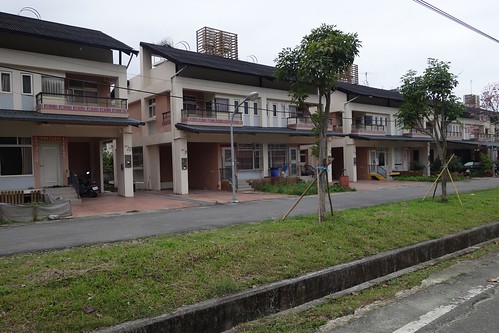
Housing for aboriginal people.

One of the ways the foreign media serves Beijing is by recapitulating its propaganda frameworks -- in this case, that the Taiwanese are "Chinese" and there is no such thing as "Taiwanese". This claim is a standard claim of those who would annex Taiwan to China. Indeed, China's claim on Arunachal Pradesh in India is supported by official claims that the area's Tibetan people are "Chinese" and thus the region is "China".

Local media worker Ralph Jennings is one of the chief purveyors of this nonsense. See for example, this transcendentally stupid article on Chinese tourists,
Tourists from China eagerly report that strangers politely stop to give directions and shopkeepers respond professionally to inquiries. This treatment compares to China where an annoying number of strangers are surly or vague when interrupted by a question. The level of courtesy found in Taiwan fosters an appreciation of the location itself as well as a reminder that ethnic Chinese on either side easily have it in them to be polite.
.... "ethnic Chinese on either side" is a pro-China frame, reductive and wrong. There are many other examples: here, here, here, and here.

Reuters seems to have picked this up as well. In an article on how Taiwan's economic policies are its own worst enemy, it claims....
The capital of Taipei shows what an advanced ethnically Chinese economy can achieve under a democracy: a comfortable, low-key lifestyle.
This may come as a shock to the media, but Taiwan does not exist so the media can make smug contrasts between democracy in "ethnic Chinese" cultures. We have democracy here in Taiwan precisely because locals resisted the Chinese culture brought over by the KMT, with its authoritarianism and authority-based values, fake family values, empty democratic values, Confucianism bereft of humanity, and violent suppression of dissent.

The basis of their resistance was, of course, Taiwaneseness.

This "culture iceberg" is a common image, with many variations. But note that when people talk about "culture" they are usually referring to the parts that are easy to see: language, food, holidays, dress (though even in Taiwan they are different). The parts that are below are difficult for the untrained to see or think about and so are never referenced in discussions like those in the media. Wouldn't it be awesome if the media consulted anthropologists the way they consult financiers?

For Taiwan, for example, one might add...
  • the experience of Dutch, Qing, Japanese, and KMT colonization, the experience of being settlers, being a settler region, and interactions with and resistance to the distant, different state
  • the existence of the frontier and the Other in the interactions between aboriginal peoples and the incoming Hoklo and Hakka settlers, and its shaping of culture, building forms, and landscapes in Taiwan, and the continued existence of aborigines as distinct Other in the present day
  • the ideal of democracy and its application in resistance to Japan and the KMT. Remember the first elections were held under the Japanese.
  • democratization and the lived experience of democracy
  • steady and rapid long-term capitalist economic growth and relative affluence
  • Pervasive Japanese influences in food, hygiene, expectations of social progress and order, and so forth
  • Pervasive US influence via increasing globalization and close economic, social, political, and military ties.
  • the experience of China's desire to annex Taiwan and suppress local identity via both KMT colonization and PRC aggression
...that is only a small sample of the vastness of the differences in Taiwan experience. I haven't even addressed defining "ethnic Chinese" since the constructs we generally use to discuss "Chineseness" are themselves the result of Beijing's propaganda as the Imperial Capital struggles to suppress local cultures and languages across its vast empire via the creation of a common "culture".

Hence, the categories ordinary people use to think about and define "what's Chinese?" are usually categories constructed by expansionist politicians in Beijing. While it might be entertaining to imagine international media workers struggling to define "ethnic Chinese", it would not be very enlightening (it is never defined in the text, of course).

The short form of this is: Taiwanese are "ethnic Chinese" to the extent that Americans are "ethnic United Kingdomers".


But another way to think about it is provided by Geert Hofstede's Cultural Dimensions, widely used in business and other research as a shorthand for describing cultural patterns. Hofstede has surveyed the world's nations to develop a crude way to compare them on several dimensions of deeper behavioral attitudes. Anthropologists laugh, but it is a useful shorthand for twenty years of fieldwork and does enable comparisons, since the surveys are the same for all people surveyed.

I compared China and Taiwan using his tool. Note the blindingly obvious differences in everything except "long term orientation" (definitions are onsite).

You want to claim Taiwanese are "ethnic Chinese?" Evidence please. Otherwise, stop saying what isn't true.

UPDATE: An anthropologist observed to me:
The idea that "Taiwan proves Chinese people can be X" (polite/democratic/etc.) is just racist. The use of the term "ethnic" in there just serves to hide the implicit racism.
_______________________
Don't miss the comments below! And check out my blog and its sidebars for events, links to previous posts and picture posts, and scores of links to other Taiwan blogs and forums!

Saturday, April 15, 2017

Geneticizing Ethnicity: A study on the “Taiwan Bio-Bank”

Taiwan as an island country is an immigrant society where interethnic marriages have been common....
This interesting 2010 paper Geneticizing Ethnicity: A study on the “Taiwan Bio-Bank" (Tsai Yu-yueh) has some useful history of how Taiwan's colonial governments classified the people who live here (which is not necessarily the way they themselves thought about it).

I put that quote from the abstract there because it is striking how the author is struggling for inclusive language, which sadly negates the historical experience of Taiwan's indigenes. Another way to look at is to say that Taiwan is a settler and colonial society... but to use that language is to recognize that the Han are latecomers to whom Taiwan does not belong.

The chart above is taken from the paper, and shows how in the Qing Era, the Manchu state organized Taiwan into 3 groups of settlers and 2 groups of indigenous people. The Japanese inherited these categories but consolidated them into the Fujian and Guangdong Han -- though each province sent both Hakkas and Hoklos to Taiwan -- and, until 1935, the Raw and Cooked aborigines. In 1935 the nomenclature changed and the Cooked Aborigines became the Plains Aborigines, while the Raw Aborigines became the Mountain Aborigines.

The Japanese retained these categories because the presence of aboriginal peoples in Taiwan highlighted the need for a "civilizing mission" (colonization) and helped define the difference between "modern" Japan (no savages here!) and "primitive" Taiwan (savages abound!)

The KMT inherited that division, but then repositioned its census categories. The Plains Aborigine category was abolished "because it was believed that they had been assimilated into Han Chinese society", say the authors. Because so many Hakkas had lost the ability to speak Hakka by 1945, they were characterized in that first census as Hoklos.

I suspect the Plains Aborigines were deleted because by abolishing that category, on the practical level, the Pingpu people could then make no claims on land, especially KMT land, which after all was seized from the Japanese, who had seized it from the Plains Aborigines in many cases. Further, once the Pingpu were gone as a recognized people, there is no prior claimant to the plains, meaning that there is no visible reminder that Taiwan does not belong to the Han. The mountain peoples can then be dismissed as "ethnic minorities", exactly the strategy followed by the Han chauvinists running China. Recognizing this, Pingpu activists have fought a decades-long struggle for recognition and land rights.

In 1954 the KMT switched to a nine-group system. After the ending of the security state in the 1990s, the oft-quoted four group system of Hoklo, Hakka, Mainlander, and Aborigine grew. The paper attributes it to a 1993 proposal by DPP politician Yeh Chu-lan. The categories had been in common use for quite some time before that, though. Note that the KMT kept track of "home province" of mainlanders since that was used in certain government applications where jobs or other opportunities were distributed by province of origin, a way to screen out Taiwanese.

The reality is that these groups are fluid and flexible, and people often change their identities over time. As the paper notes:
In fact, during the past few centuries, many people in Taiwan have changed their ethnic identities for one reason or another. Take a recent case for example. A survey conducted by the Council of Hakka Affairs in 2004 showed that when questionnaires about one’s ethnic identity were provided with multiple-choice answers, subjects tended to disclose their Hakka identity more easily, increasing the number of those who identify themselves as Hakka (Xingzhengyuan kejia weiyuanhui 2008).
Another issue is blending:
Xu (2002) investigated interethnic marriages for three generations of the “four great ethnic groups.” The rate of interethnic marriages among those married before 1961 was 12.8%; for those who married between 1961 and 1981, the figure was 21.5%; it grew to 28.2% among those married after 1981 (see Table 1). As the following tables show, the rate of interethnic marriages in the third generation of Hoklo was 15%, 63.4% in Hakka, 82% in Mainlanders, and 38.2% in aborigines (Tables 2, 3, 4, and 5). Although the rate of interethnic marriages among Hoklo remained low, those of the other three groups were very high.
And of course, the group "Aborigines" lumps together disparate peoples, and makes the differences and conflicts between them disappear, repositioning them as an identifiable Other. It is interesting to imagine a modern anthropologist landing in Taiwan in 1400. How many different groups would she find it useful to define?

Looking at Lumley's old piece in The Anthropology of Chinese Society entitled "Subethnic Rivalry in the Ch'ing Period", it is easy to see why the settler population was classified by place of origin rather than what we would call ethnicity. During the 19th century Chinese settlers in Taiwan not only saw themselves through the Hoklo-Hakka lens, but also through a Changchou-Chuanchou lens (and others) based on their place of origin. These groups venerated different deities and had other differences, and extensive political and commercial rivalries.

The Hakkas spoke four different but mutually intelligible versions of Hakka, and did not usually have ethnic/place of origin conflicts amongst themselves, since they were generally scraping out a living in harder areas and were less wealthy, and were surrounded by indigenous and Hoklo communities that feuded with them.

The Hoklo, by contrast, did confront rivalries amongst themselves. For example, the famous Lungshan Temple in Taipei served as a military command center in the 19th century for Hoklo settler groups feuding with incoming settlers from Tungan, and then later, for feuds between Chuanchou  and Changchou settlers. Throughout Taiwan there were temples that served as such military command centers for both Hakkas and Hoklos in these feuds.

Needless to say, these place-of-origin distinctions have disappeared. Yet, had they been maintained by the census, by temple practice, and by marriage and feuding practices, we might be discussing ethnicity and origins in very different ways today. Instead, the KMT switched to a "provincial" level of definition for Taiwan's myriad peoples because that definition was more useful in generating a distinct Mainlander identity as the basis for KMT colonial power and in populating the bureaucracy and military with its people.

The groups we used today hardly begin to reflect the ethnic diversity of modern Taiwan, where numerous children are born to foreign mothers. That is why so many people are turning to the useful rubric of "Taiwanese" to swallow up all this immigrant and settler diversity.
Discussing the difference between the four great ethnic groups, some sociologists state that none of the groups is a concrete reality. Systems of ethnic categorization amount to ideologies. What we should be asking is when, why, and how this classification became so important.
Lurking behind these categories is the hazy idea of "blood" and genetic origins, which the author argues are dangerous misconceptions: these groups are not identifiable by genes though many believe they are. That is why the current government needs to move forward on the idea of a national citizenship by birth and immigration, and reject the "blood"-based citizenship idea of the KMT.
_______________________
Don't miss the comments below! And check out my blog and its sidebars for events, links to previous posts and picture posts, and scores of links to other Taiwan blogs and forums!

Saturday, March 25, 2017

Taiwan News Latest: Taiwan, the once and future Austronesian Ocean State

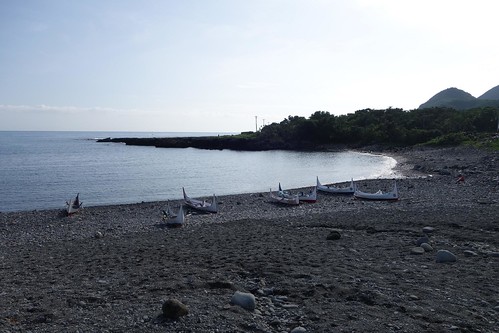
Boats on Lanyu

I was inspired by the discovery of what might be the skeletons of African slaves in the Spanish cemetery in Keelung. Relecting on Taiwan's diverse ethnic roots, I noted in my latest Taiwan News piece:
I often reflect on these facts when I read some reporter describing the people of Taiwan as “ethnic Chinese” or when people refer to themselves as having "Taiwanese blood." These ideas are vapid political constructs whose intent is overtly nationalistic: to claim a people is “ethnic Chinese” is to veer dangerously close to arguing that Beijing should be annexing them. Or when people write about Taiwan’s “deep historical links to China”, actually less than four centuries old, but ignore Taiwan’s thousands of years of historical links to Austronesian peoples and trade and emigration networks that spanned half the globe, from Madagascar to New Zealand and Hawaii.
These rich historical connections can be used by Tsai and the DPP to posit another kind of rhetoric of identity for Taiwan, one rooted in its Austronesian roots, that can link it to the nations that are the focus of its southbound policy.

Previous Taiwan News commentaries are gathered on this page.
_______________________
Don't miss the comments below! And check out my blog and its sidebars for events, links to previous posts and picture posts, and scores of links to other Taiwan blogs and forums!
Tuesday, February 23, 2016

Echoes

131-Tou6323
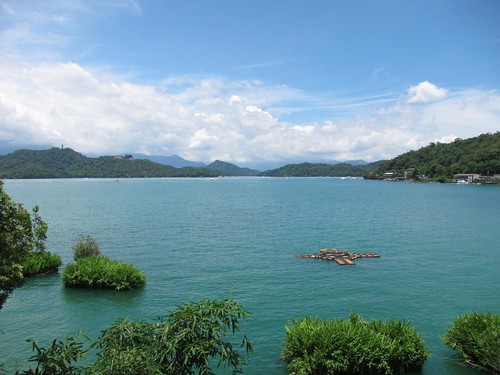
Sun Moon Lake
Simon, who was also the Gauleiter of the neighbouring Gau Trier-Koblenz, later Moselland (Gauleiter being a title denoting the leader of a regional branch of the Nazi party), led a propaganda and later terror campaign, known as Heim ins Reich, to convince the population that they were ethnic Germans and a natural part of the Third Reich. His objective was "to win Luxembourg back over to the German nation as soon as possible."[2] He was convinced that Luxembourgers only needed a level of education and enlightenment in order to voluntarily declare their loyalty to Germany.[2] He deduced this from his belief that they were, in fact, German "by blood and by descent".[2] To the Gauleiter, Luxembourgish independence was an "absurd idea," which existed only because the monarchy and government had nurtured it: if the Luxembourgers were shown evidence of their belonging to the German nation, the will to be independent must disappear.

...In October 1941, the German occupiers took a survey of Luxembourgish civilians who were asked to state their nationality, their mother tongue and their racial group, but contrary to German expectations, 95% answered "Luxembourgish" to each question.[7] The refusal to declare themselves as German citizens led to mass arrests.[2]
(Wiki)
_______________________
Don't miss the comments below! And check out my blog and its sidebars for events, links to previous posts and picture posts, and scores of links to other Taiwan blogs and forums!