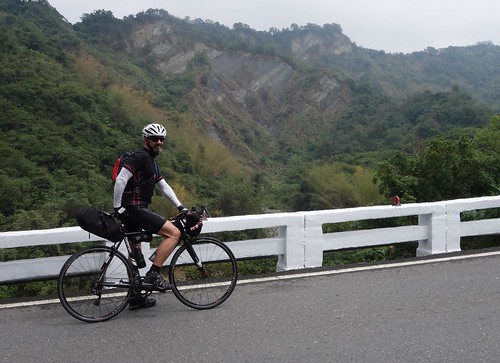
Above awesome cyclist Mark Roche takes a break on the epic first day of riding out to Namaxia.
A gray day, but great friends to go to Namaxia with. Unfortunately I planned a route that was too taxing for me, and so had to take it easy on day 2. But a good time was had by almost all... click READ MORE for pics and commentary...
Showing posts with label Chiayi. Show all posts
Monday, April 03, 2017
Monday, September 16, 2013
Alishan Take Three
James checks his pics. Not a great day for pics; by the time we got up high, the rain and fog was rolling in. Moral of the story: you can never start too early in the mountains. Yet it was still a surpassingly lovely ride.
Another weekend, another ride. This time I avoided the growing horror of President Ma Ying-jeou's mind-numblingly stupid assault on Wang Jin-pyng by hiding in the mountains for a lovely two day ride over two of my favorite roads, the 169 up Alishan, and the 159A into Chiayi city, which is really the prettiest road on the island. Click on READ MORE to read more....
2
Comments
Labels:
aborigines,
Alishan,
biking,
Chiayi,
tea,
Yunlin
(Permalink)
7:37 PM
Wednesday, March 06, 2013
The Taiwan Badlands
This weekend I had the opportunity to spend some time in the Taiwan Moonscape, the area of badlands in southern Taiwan. I had never seen the area up close and personal, merely ridden through it on a bike. One thing I hadn't understood was how big they were. The map below should give some idea of the extent of this 100,000 hectare formation which crops out as badlands in the area around Tianliao, with a thickness variously given as 3-4 kms (source), spreading across southern Taiwan from Chiayi to Kaohsiung. Mudstone formations are also found in Kenting near Hengchun and in Taitung. Walking around in the area naturally caused me to wonder: what was its origin?
Extent of the badlands in southern Taiwan, the Gutingkeng Formation (source).
Taiwan's badlands are unique, being the only badland formation on earth in a tropical area with good rainfall. The others in Italy, the US, and elsewhere, are all in arid or semi-arid regions. Badlands typically consist of weak sedimentary rock and fall into two basic types: calanchi, with pinnacles or sharp peaked ridges, as in Taiwan, and biancane, which are more rounded.
This paper on the history of the rivers in the area observes that the badlands are undergoing uplift. As the Philippine Plate shoves its way northwest toward China, it pushes the crust up, causing the area to tilt toward the ocean and lifting it up. The effect of this uplift can be seen in this picture below, which shows how the rock layers lie on their sides perpendicular to the ground, instead of parallel to it:
The mudstone exposed in the foothills area of southwestern Taiwan is a sedimentary rock formed several million years ago (source). It is usually referred to as Pleistocene in origin. It is cut through with layers of limestone in places, which are quarried by Taiwan's ubiquitous gravel industry. The mudstone area is also the location of mud volcanoes, which track one of the region's major NE to SW running faults. At the famous hot springs site of Guanziling the hot springs crop out through this deposit of mudstone.
The mudstone layer itself, as far as I was able to ascertain, is a deposit of marine sediments that formed during the late Cenozoic period (Pliocene/Pleistocene) as a giant sedimentary basin was gradually filled in with silt and clay and then uplifted to its current position by the action of the Philippine Plate.
One interesting idiosyncrasy of these badlands is that the bare slopes are mostly south facing. The reason for this is solar radiation (source), not monsoon rains or typhoons as one might think. During the long dry season, the sun heats the slopes, making them inhospitable to vegetation, and causing them to crack, speeding weathering. The result is the south-facing bare slopes so typical of the badlands area. According to this article, because of the massive precipitation and sedimentation, the Erhjeng River, which drains the area of mudstone, yields 1.3 x 10⁷ tons of sediment annually, the highest rate of sediment discharge in Taiwan.
_______________________
[Taiwan] Don't miss the comments below! And check out my blog and its sidebars for events, links to previous posts and picture posts, and scores of links to other Taiwan blogs and forums! Delenda est, baby.
Extent of the badlands in southern Taiwan, the Gutingkeng Formation (source).
Taiwan's badlands are unique, being the only badland formation on earth in a tropical area with good rainfall. The others in Italy, the US, and elsewhere, are all in arid or semi-arid regions. Badlands typically consist of weak sedimentary rock and fall into two basic types: calanchi, with pinnacles or sharp peaked ridges, as in Taiwan, and biancane, which are more rounded.
This paper on the history of the rivers in the area observes that the badlands are undergoing uplift. As the Philippine Plate shoves its way northwest toward China, it pushes the crust up, causing the area to tilt toward the ocean and lifting it up. The effect of this uplift can be seen in this picture below, which shows how the rock layers lie on their sides perpendicular to the ground, instead of parallel to it:
The mudstone exposed in the foothills area of southwestern Taiwan is a sedimentary rock formed several million years ago (source). It is usually referred to as Pleistocene in origin. It is cut through with layers of limestone in places, which are quarried by Taiwan's ubiquitous gravel industry. The mudstone area is also the location of mud volcanoes, which track one of the region's major NE to SW running faults. At the famous hot springs site of Guanziling the hot springs crop out through this deposit of mudstone.
The mudstone layer itself, as far as I was able to ascertain, is a deposit of marine sediments that formed during the late Cenozoic period (Pliocene/Pleistocene) as a giant sedimentary basin was gradually filled in with silt and clay and then uplifted to its current position by the action of the Philippine Plate.
One interesting idiosyncrasy of these badlands is that the bare slopes are mostly south facing. The reason for this is solar radiation (source), not monsoon rains or typhoons as one might think. During the long dry season, the sun heats the slopes, making them inhospitable to vegetation, and causing them to crack, speeding weathering. The result is the south-facing bare slopes so typical of the badlands area. According to this article, because of the massive precipitation and sedimentation, the Erhjeng River, which drains the area of mudstone, yields 1.3 x 10⁷ tons of sediment annually, the highest rate of sediment discharge in Taiwan.
_______________________
[Taiwan] Don't miss the comments below! And check out my blog and its sidebars for events, links to previous posts and picture posts, and scores of links to other Taiwan blogs and forums! Delenda est, baby.
2
Comments
Labels:
badlands,
Chiayi,
geology,
history,
Kaohsiung,
moonscape,
Tainan,
Taiwan history
(Permalink)
9:57 PM
Monday, November 26, 2012
Too bad you missed it: Alishan
This weekend I repeated a ride that Drew and I had done back in Dec of 2010, Taichung to Caoling on Day 1, then Caoling up Alishan to Fenchihu and then down to Chaiyi city on the glorious 159甲 on Day 2. The ride up Alishan and down the 159甲is one of the loveliest on the island and I had long wanted to repeat it. But there was a problem: on that ride, I was pretty wiped out after the climbing on Day 1 and had to walk a long stretch of the brutal 169 on Day 2. This time I was determined not to fail. I had the 11-32 cassette on my bike (I have a SRAM Apex groupset) swapped for an 11-36. With a 50-34 compact dual up front, this gave me a 34/36 for a climbing gear. Last weekend I tested it: could I spin more and go up hills more easily? It seemed so. Bring on Alishan!
A gazillion pics in this post. Click on READ MORE below to see them. Drew's wonderful posts on the ride may be accessed here.
Subscribe to:
Posts (Atom)

