Showing posts with label status quo. Show all posts

Saturday, October 04, 2014

Beijing Blows up US' Taiwan Policy in Hong Kong

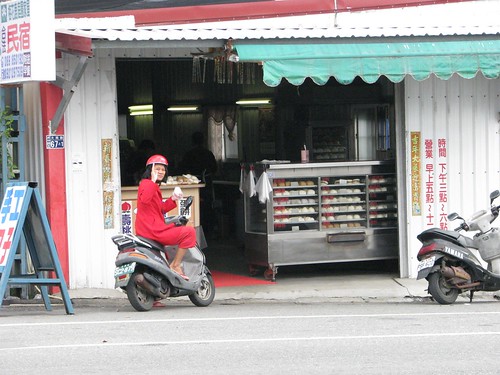
A hearty east coast greeting at a mantou shop.

A couple of commentators are out in front advocating that US Taiwan policy needs to change. Denny Roy in The Diplomat observes that Taiwan: a status upgrade is now available:
Such an upgrade of U.S.-Taiwan relations is overdue. Now is a good time to implement it. Not only is the usual worry about hurting U.S.-China relations dormant, but additionally an improvement in U.S.-Taiwan relations, one of Beijing’s biggest fears, would signal to the Chinese government that outlaw behavior will not serve China’s interests.
Roy noted that the Ma government has begun distancing itself from Beijing's policies in the South China Sea. This week Ma issued a clarification of the ROC's claims, wholly invented in the 20th century, to the South China Sea islands.
Mr Ma was clear that the claim was limited to islands and 3 to 12 nautical miles of their adjacent waters. There were, he said, “no other so-called claims to sea regions”.
The claims are absurd to begin with, and this sort of backing down is very welcome. Meanwhile Gary Schmitt of AEI scribes in the Weekly Standard:
The reality is that Taiwan’s underlying skepticism about unification with China under any model has been readily apparent for anyone who took the time to keep track of what the Taiwanese people were saying as opposed to focusing on some imaginary diplomatic breakthrough that the acolytes of Henry Kissinger and Zbigniew Brzezinski were dreaming of, hoping for. Washington needs to come to terms with the point that democratic Taiwan is not headed toward some form of association with the PRC and should build policies that reflects that point.
Both Schmitt and Roy contend it is time for a change. Always nice to see the pundits catch up with this blog....

Beijing's deployment of proxies/gangsters to smash the protesters in Hong Kong has hardened Taiwan's resolve to remain out of Beijing's clutches. In doing so, it has made obvious how obsolete the US policy urge to sell out Taiwan in order to please Beijing is now. Although those of us who watch Taiwan have always known that. You can look back into the polling as long as you want -- here is a 2000 poll in which over 70% reject one country, two systems even if Taiwan gets a better deal than Hong Kong....

Indeed, it also highlights a couple of other issues. When the Sunflowers occupied the Legislature, Ma could not send in the gangsters, even though they did show up and there were some isolated attacks on protesters. The reason was simple: his party has to win elections. But the Hong Kong government doesn't.

The strong negative response here in Taiwan also shows how empty the pro forma references to the "status quo" are. In the recent essay by your trusty writer and my man Brian B, The Coming Taiwan Independence Surge, we referred to this poll from the pro-China TV station TVBS last year, which said...
Asked about their position on cross-strait relations, 66 percent of respondents supported the “status quo,” 24 percent wanted independence and 7 percent supported unification with China, according to the survey conducted by cable news channel TVBS between Thursday last week and Monday.

However, the poll found that most respondents favored independence over unification if they were asked to choose between just those two options, with 71 percent supporting independence and only 18 percent supporting unification with China.
When they are not forced to make a choice, everyone makes the same choice: status quo. But when forced to make a choice, independence is strongly preferred. What this really means is that on that terrible day when Beijing nixes the possibility of the status quo, everyone is going to opt for independence.

US policy really ought to reflect that fact.
_______________________
Don't miss the comments below! And check out my blog and its sidebars for events, links to previous posts and picture posts, and scores of links to other Taiwan blogs and forums!

Thursday, October 28, 2010

The People Hosed of Cairo

Cecilia: I just met a wonderful new man. He's fictional but you can't have everything.

President Ma Ying-jeou was at it again with the Cairo Declaration and Taiwan's status this week, another in the long line of examples of the constant KMT iteration of the falsehood that the Cairo Declaration and the Treaty of Taipei are the legal basis for the ROC claim to have "recovered" Taiwan for China. This week was especially egregious, for he added a claim about President Truman:
The 1943 Cairo Communique, worked out by the ROC president Chiang Kai-shek (蔣介石), then-US president Franklin Roosevelt and then-British prime minister Winston Churchill, said Japan should return Taiwan, Penghu and other territories in northeast China that it had “stolen” from the Chinese, Ma said.

The Potsdam Declaration of 1945 reaffirmed the Cairo Communique and gave the ROC the right to take sovereignty over Taiwan and Penghu, he said.

According to Ma, in its Instrument of Surrender, Japan accepted the terms of the Potsdam Declaration and former US president Harry Truman also accepted the idea that sovereignty over Taiwan was settled as the US Department of State said that the US and other Allied powers accepted the exercise of Chinese authority over Formosa, which was surrendered to Chiang.
Ma's claims about Cairo are the more complex of the two sets of claims here, so we'll first look at what Truman said. Ma refers to Truman's "1950" statements in his remarks (see the Taiwan Today piece). In 1950 Truman made two major statements on the status of Formosa. Remarks about the status of Formosa are included in his famous June 27, 1950 announcement:
The attack upon Korea makes it plain beyond all doubt that communism has passed beyond the use of subversion to conquer independent nations and will now use armed invasion and war. It has defied the orders of the Security Council of the United Nations issued to preserve international peace and security. In these circumstances the occupation of Formosa by Communist forces would be a direct threat to the security of the Pacific area and to United States forces performing their lawful and necessary functions in that area. Accordingly I have ordered the 7th Fleet to prevent any attack on Formosa. As a corollary of this action I am calling upon the Chinese Government on Formosa to cease all air and sea operations against the mainland. The 7th Fleet will see that this is done. The determination of the future status of Formosa must await the restoration of security in the Pacific, a peace settlement with Japan, or consideration by the United Nations.
However, on Jan 5 of that year Truman issued a statement on the status of Formosa in which he appears to accept Chinese sovereignty over Formosa (extract here).
"A specific application of the foregoing principles is seen in the present situation with respect to Formosa. In the Joint Declaration at Cairo on December 1, 1943, the President of the United States, the British Prime Minister, and the President of China stated that it was their purpose that territories Japan had stolen from China, such as Formosa, should be restored to the Republic of China. The United States was a signatory to the Potsdam Declaration of July 26, 1945, which declared that the terms of the Cairo Declaration should be carried out. The provisions of this declaration were accepted by Japan at the time of its surrender. In keeping with these declarations, Formosa was surrendered to Generalissimo Chiang Kai-shek, and for the past 4 years the United States and other Allied Powers have accepted the exercise of Chinese authority over the island.

"The United States has no predatory designs on Formosa, or on any other Chinese territory. The United States has no desire to obtain special rights or privileges, or to establish military bases on Formosa at this time. Nor does it have any intention of utilizing its Armed Forces to interfere in the present situation. The United States Government will not pursue a course which will lead to involvement in the civil conflict in China.

"Similarly, the United States Government will not provide military aid or advice to Chinese forces on Formosa. In the view of the United States Government, the resources on Formosa are adequate to enable them to obtain the items which they might consider necessary for the defense of the island. The United States Government proposes to continue under existing legislative authority the present ECA program of economic assistance."
It might be possible to read: "...or on any other Chinese territory." as Truman saying Formosa is Chinese territory. To put that in its proper context, the KMT had just retreated to Taiwan in Dec and suddenly, after saying Formosa was irrelevant, the US did an about face and began to prepare a policy that shifted between saying Formosa was irrelevant and that it was important, because it did not appear that the Communist Chinese would have any trouble taking Formosa when they got around to that task -- thus the declared policy of the US was to simply let the chips fall as they may. This Time article from 1951 gives a sense of that. Hence, Truman is not saying that Formosa belongs to China. He is merely announcing that the island was not a strategic interest of the US and that there the US had no dog in that fight and no designs on any Chinese territory, however such territory may be construed.

The clear indication of the June 27th statement, however, is that the US position was that the status of Taiwan is undetermined. That has been the US position for all of recent history down to the present day.

However, let us recall some salient facts: (1) Truman can't dispose of Formosa. In 1950 the US didn't own it; Japan did. (2) The Formosans themselves weren't consulted on the issue. Lest you think that is some idealistic modern interpretation that didn't apply in those hard-nosed days, Chen and Reisman's seminal review of the issues for the Yale Law Journal in 1971 (Who Owns Taiwan: the Search for an International Title) observed of the Cairo Declaration that in its own League of Nations context:
As to environing international norms, it is sufficient to note that the doctrines of self-determination and the prohibition of use of force for territorial changes, as embodied in many resolutions of organs of the League of Nations, had transformed the component of acquiescence of the indigenous people into a peremptory aspect, and a virtual requirement of lawful transfers of territorial title. Hence, even assuming that the Cairo Declaration, as reinforced by the Potsdam Declaration, had been intended by the parties to it to create new international rights, such an intention would have been limited by international law. Jure gentium, the Cairo Declaration could mean only that the participants agreed to recognize a Chinese acquisition of Formosa if the inhabitants of Formosa indicated that they desired to be part of or to be governed by China.
In other words, Cairo, Potsdam, Truman, Mao, whatever is said and done, in the end, no legal transfer of territory can take place without the consent of the population. Even by the norms prevailing in 1943.

Shifting to the Cairo Declaration, several things may be noted. First, here is the text:
The Three Great Allies are fighting this war to restrain and punish the aggression of Japan. They covet no gain for themselves and have no thought of territorial expansion. It is their purpose that Japan shall be stripped of all the islands in the Pacific which she has seized or occupied since the beginning of the first World War in 1914, and that all the territories Japan has stolen from the Chinese, such as Manchuria, Formosa, and The Pescadores, shall be restored to the Republic of China. Japan will also be expelled from all other territories which she has taken by violence and greed. The aforesaid three great powers, mindful of the enslavement of the people of Korea, are determined that in due course Korea shall become free and independent.

With these objects in view the three Allies, in harmony with those of the United Nations at war with Japan, will continue to persevere in the serious and prolonged operations necessary to procure the unconditional surrender of Japan.
The Cairo Declaration is not a treaty and has no force. It is merely a declaration of common aims, subject to any changes the future might bring. The language of the CD was adopted as a sop to keep Chiang Kai-shek in the war. The US clarified its position on Cairo in a statement issued Dec 27, 1950:
The Cairo Declaration of 1943 stated the purpose to restore "Manchuria, Formosa and the Pescadores to the Republic of China." That Declaration, like other wartime declarations such as those of Yalta and Potsdam, was in the opinion of the United States Government subject to any final peace settlement where all relevant factors should be considered. The United States cannot accept the view, apparently put forward by the Soviet government, that the views of other Allies not represented at Cairo must be wholly ignored. Also, the United States believes that declarations such as that issued at Cairo must necessarily be considered in the light of the United Nations Charter, the obligations of which prevail over any other international agreement.
That is also the UK position. George Kerr observed:
This [the Cairo Declaration] was not a carefully prepared State Paper but rather a promise to divide the spoils, dangled before the wavering Chinese. It was a declaration of intent, promising a redistribution of territories held by the Japanese. None of the territories mentioned in the document were at that moment in Allied hands.
Similarly George Kennen wrote:
No one seems to know from what deliberations this declaration [Cairo] issued; it was apparently drafted, at the moment, by Harry Hopkins, after consultation only with the President and the Chinese visitors.
I bet your head is nodding. Chen and Reisman point out two major issues, (1) the norms of the day (paragraph noted above) and (2) the capacity of the participants:
As to the capacity of the declarants, three states were simply not empowered under the principles and peremptory procedures of the Covenant of the League of Nations then in force, to decide that the territory held, and formerly recognized as validly so held by another, could now be forcibly removed from that state.
So much for Cairo. The real reason President Ma and other KMT fantasists keep referring to Cairo and to Truman and to Potsdam and the Treaty of Taipei is simple: under the postwar treaty arrangements codified in the San Francisco Peace Treaty, Japan gave up sovereignty over Taiwan and no recipient is named. Thus, under international law, the status of Taiwan is undetermined. Note that Ma generally omits discussion of the SF Peace Treaty, since to mention it instantly invalidates his case.

The purpose of this heightened exposure for Cairo and the like is simple: I believe it is the KMT plan to establish a basis for Chinese sovereignty over Taiwan without ever setting the matter before the people and legislature of Taiwan. By pretending that Taiwan has already become part of China -- and always has been, hence it was "returned" -- a 'stealth annexation' of Taiwan can be accomplished, and a plausible fait accompli offered to the world.
_______________________
Don't miss the comments below! And check out my blog and its sidebars for events, links to previous posts and picture posts, and scores of links to other Taiwan blogs and forums! Delenda est, baby.
Saturday, October 23, 2010

US-Taipei Disarray and the Status Quo

Staunch Taiwan supporter Arthur Waldron on Taiwan, China, the US, and Defense in the Jamestown brief. The piece gives a picture of disarray within the Ma government, caught by surprise by the sudden Chinese aggressiveness in recent months....
I made a plunge into the world of Taipei gossip and rumor, within which I have some relatively reliable sources. I heard, from the blue camp, a distinctly dispiriting account of the Ma administration. The government, so the analysis went, had staked, if not everything, then "ninety percent" on improving relations with China. Clearly, they had made some gains. On the trip home, I ran into a responsible American official who described the recent Economic Cooperation Framework Agreement (aka ECFA, signed June 29) as "amazingly" favorable to Taiwan. Yet, little consideration, my Taiwan sources told me, had been given to the need for an alternative approach, should China prove uncooperative.

Some among the blues said that even the ostensibly urgent appeals to the United States for advanced fighter aircraft and other weaponry had been undercut, via back channels that told the Washington administration that Taiwan did not really want approval of the weapons (this would have been before the sobering events of the summer). Other sources reported that the United States was aware of traffic between China and Taiwan that undercut the latter's public position. None of this seemed on the face of it implausible, given that when out of power the Kuomintang had stifled funding in the Legislative Yuan (Taiwan's parliament) for the Bush administration's unprecedented comprehensive arms sales offers to the island. Had they not done so new F-16s may already be flying in the skies over Taiwan.

...............

The new cold breeze blowing from China, however, looks to have had some effect on Taiwan, and is likely to continue to do so. A foreigner who had recently met with a number of regional governments told me that in his opinion not one expected anything other than trouble from China in the years ahead. As already mentioned, Taiwan's government would seem to have slowed down the rate at which it has been embracing cooperation with China. As a coalition of other Asian states takes shape to counter-balance China, I argued in my presentation at the conference, it was unlikely that democratic Taiwan would take the side of a dictatorship against other democracies (among other things the military would never stand for this—I was told), and even more unlikely that the United States would seek to force a democratic country like Taiwan to make terms with a would-be regional hegemon.
Meanwhile Nat Bellocchi on the Status Quo:
However, during the administrations of former presidents Lee Teng-hui (李登輝) and Chen Shui-bian (陳水扁), it was also used by the US to dampen initiatives that were perceived as “rocking the boat.”
This was the same point I made a few days ago: the Status Quo evolved into a cage for Chen Shui-bian and Lee Teng-hui. But there was never any criticism of the Chinese missile build up in terms of the Status Quo. Now that Ma is in power and the KMT is sleeping with its pals from Beijing, there is no mention of the Status Quo at all. It has disappeared from the conversation.

The Status Quo was leverage. A tool, now tossed away.

Those bars of Status Quo could have imprisoned Ma just as effectively as they had Chen -- and been a moral bludgeon against Beijing. The US could have growled a few warnings, noting that Ma and the KMT had no majority support for the project of annexing Taiwan to China, and based them on the Status Quo. That now represents another blown opportunity -- now China is suddenly becoming more aggressive, and the KMT plan to put Taipei in China's orbit has stalled thanks to splits within his own party, as Waldron documents above, and effective opposition in the form of election defeats and low poll numbers. Had the US insisted on the Status Quo as a living policy, it might now be in a better position to re-incorporate Taiwan into the Japan-Taiwan-US security alliance.

Maybe it's not to late to start talking about the Status Quo. Could give those in the KMT and in the Ma Administration policy cover and the space to advocate a retrenchment at a greater distance from Beijing.
_________________
Daily Links:
_______________________
Don't miss the comments below! And check out my blog and its sidebars for events, links to previous posts and picture posts, and scores of links to other Taiwan blogs and forums! Delenda est.

Wednesday, June 13, 2007

Pinning Down that Elusive Status Quo

US Ambassador Harvey Feldman, who led the drafting of the Taiwan Relations Act, weighed in at the Heritage Foundation last month with a review of what the Status Quo is.

At the most obvious level, the status quo is an entity called China on one side of the Taiwan Strait and an entity called Taiwan on the other. The claims each makes certainly are part of the status quo and so deserve some consideration.

The Chinese government asserts something it calls "the sacred One China Principle" which, when it speaks to the people of Taiwan, goes like this: One China is the China that will be created by the necessary and inevitable unification of Taiwan with the mainland. But when China addresses an international audience, it goes like this: There is only one China in the world, and Taiwan is a province of that China whose only lawful representative is "the people's government in Beijing." This is the formula used to block Taiwan's participation in the World Health Organization and other international bodies.

Back in the days of one-party authoritarian rule on Taiwan, Taipei claimed to be the seat of the legitimate government of all China, including not only Taiwan but Mongolia and Tibet as well. And the United States recognized it as such, more or less, up to January 1, 1979, when diplomatic recognition switched to Beijing. "More or less," because after President Nixon's visit to China in 1972 and the issuance of the Shanghai Communique, diplomatic niceties aside, America dealt with the government in Beijing as the government of China and the government in Taipei as the government of Taiwan. Despite the subsequent change in diplomatic relations, it still does. And we recognized Mongolia many years ago.

In 1991, a dozen years after the U.S. switched diplomatic recognition to Beijing, the Taipei government stopped claiming to be the legitimate government of China and asked to be recognized only as the government of the territory it obviously controls, Taiwan and associated islands. But the government still calls itself, formally, "The Republic of China" (ROC for short), its name under a constitution written for all of China, adopted in Nanjing in 1947, and brought to Taiwan by Chiang Kai-shek in 1949. That constitution has been amended many times, for example to eliminate the seats of those who claimed to represent mainland districts not under ROC control since 1949, but it remains in force.

The U.S. regarded neither the amendments nor dropping the claim to be the legitimate government of all of China to be changes in the status quo—or at least not changes that merited some statement of displeasure. After all, it would be a bit difficult to insist that the ROC should maintain its claim to legally govern all of China when the U.S. recognizes another in that role. But were the Taipei government to call the mainland-issued 1947 constitution null and void, drop the name Republic of China, and call itself something simple and descriptive like "Taiwan," the U.S. would likely denounce these actions as a most grievous unilateral change in the status quo. China would regard it as intensely provocative.

Feldman's article is a good basic review of what the Status Quo means from an American perspective. Note that the way the Status Quo is understood and constructed by all sides, China's diplomatic isolation of Taiwan is not treated as a violation of the Status Quo -- if Costa Rica jumps ship, that's too bad, but events that happen within the Taiwan Straits are regarded as potential violations of the Status Quo. In other words, in addition to the Status Quo's increasingly wongheaded basis, it is manifestly incomplete, with competition between Taiwan and China likely to occur anywhere in the world.

Several conservative scholars are attempting to reconstruct recent US policy, which is tilting toward China -- State Department maps list Taiwan as part of China -- and return it to the days prior to Henry Kissinger, when the US was quite clear: the status of Formosa was undetermined:

Actually, no. In fact, the U.S. makes no formal statement at all about Taiwan's status. In the communiqué establishing diplomatic relations with the People's Republic of China, the U.S. "acknowledged" the Chinese position that there is but one China of which Taiwan is a part. That word, "acknowledged," is diplomatic jargon meaning "we understand that is your claim." Washington has never said it regards Taiwan as a PRC province. Nor, when various Taiwan spokesmen assert that the island republic is a separate, independent sovereignty, has the U.S. contradicted that claim. It is true that both the Clinton and George W. Bush administrations have said they would not support Taiwan's membership in international organizations that admit only states. But in this, they appear not to have read American law carefully enough.

Wish more people understood things this way.


Friday, June 08, 2007

Costa Rica Says Hasta La Vista, Baby.

International news was made again as Costa Rica switched recognition from Taiwan to China. Reports filled the world media:
Taiwans News.Net

A joint communique, signed on June 1 by Chinese Foreign Minister Yang Jiechi and his Costa Rican counterpart Bruno Stagno Ugarte, says the two governments, 'in accordance with the interests and aspirations of the peoples of the two countries, agree to establish diplomatic ties at ambassadorial level beginning June 1, 2007.'

'The Costa Rican government recognizes that there is only one China and the government of the People's Republic of China is the sole legitimate government representing the whole China. Taiwan is an inalienable part of the Chinese territory,' it says.

Costa Rica established diplomatic relations with the then Chinese government ruled by the Kuomintang party in 1941. In 1949 the Kuomintang authorities moved to Taiwan and the People's Republic of China was founded.

'For Costa Rica this is an act of foreign policy realism that promotes links to Asia,' said Costa Rican President Oscar Arias. 'It is my responsibility to recognize a global player as important as the People's Republic of China.'

Arias, who received the Nobel Peace Prize in 1987 for his efforts to end civil wars then in Central American countries, said his decision was based on the deep trade relationship between the two nations.

AP reports that the payola for recognition diplomatic strategy was outmatched:

Taiwan's foreign minister ordered ''extreme precautions'' be taken Thursday to hold on to the island's allies in Latin America after Costa Rica switched diplomatic relations to political rival China, further isolating the Taipei government.

Costa Rican President Oscar Arias blamed Taiwan's meager aid for the switch and warned the island would lose more allies unless it was more generous with its aid.

''I was always critical of the Taiwanese, and I can say now that I always told them . . . if you want to have friends in the world, you should be more generous,'' he said.

He cited as an example Taiwan's $20 million aid offer to Haiti, arguing that the island should give ``10 times that, $200 million, because that's nothing to you, seeing the reserves you have.''

''Considering the few friends they have, they don't treat them very well,'' Arias said of Taiwan, adding: ``Without a doubt, we will get more help from China.''


The Domino effect was cited in another AP report:

In May, Nicaragua's Vice President Jaime Morales raised the possibility of cutting ties with the island when he told Huang that "we as a sovereign country choose who our friends are" and that he "doesn't deny the reality that China represents economically, commercially and geopolitically."

Analyst Andrew Yang of the Taipei-based Chinese Council of Advanced Policy Studies said the Costa Rican decision would likely create a chain reaction. "Probably Nicaragua and Panama are next and then maybe Paraguay," he said.

But the local pro-KMT English rag, the China Post, assured its readers that the other nations will stand firm:

Two of Taiwan's diplomatic allies in Central America, Guatemala and El Salvador, have each announced that they will maintain diplomatic relations with Taiwan.

The two countries made their announcements after Costa Rica, formerly another ally of Taiwan in Central America, switched its diplomatic allegiance from Taipei to Beijing Wednesday.

According to Spanish news reports by the Associated Press, Salvadoran President Antonio Saca said at a news conference Wednesday that his nation would like to develop relations with China, but only on the condition that China not ask his country to cut its ties with Taiwan.

This kind of thing is one of the inevitable results of living inside a cocoon called the Republic of China. That state is a virtual government whose time has passed. There's not much else to be done or said, except play out the string. Perhaps when it reaches the end there will be new thinking in Taipei about the island's international role. Many commentators are arguing for some kind of quasi-state-freeport solution for the island's status. That's certainly interesting, but it doesn't do squat about our expansionist neighbor across the Straits.

In the meantime, to return to the discussion of the Status Quo , it is interesting how China's continued suppression of Taiwan's international presence is not regarded as a status quo violation.....

Thursday, June 07, 2007

Asia Times on the Outdated Status Quo

"For though I am free from all men, I have made myself a slave to all, so that I may win more. to the Jews I became as a Jew, so that I might win Jews; to those who are under the Law, as under the Law though not being myself under the Law, so that I might win those who are under the Law; to those who are without law, as without law, though not being without the law of God but under the law of Christ, so that I might win those who are without law. To the weak I became weak, that I might win the weak; I have become all things to all men, so that I may by all means save some."

One of the important themes of this blog is the Protean Status Quo, that elusive creature that lives in the Taiwan Straits, rarely surfacing long enough for positive identification. This week the Asia Times has a good article on how it has become outdated, a position that has been argued for since the 1990s.

Former assistant secretary of state for East Asian and Pacific affairs James Kelly infamously defended another cliche of the US China policy during a House of Representatives International Relations Committee hearing in 2004 - the US one-China policy.

When asked to define this relic of the Cold War, Kelly stated: "I'm not sure I very easily could define it. I can tell you what it is not. It is not the one-China policy or the one-China principle that Beijing suggests, and it may not be the definition that some would have in Taiwan."

Today, the Taiwan Strait is one of the flashpoints in the world and no one, not even the high-level officials in the US State Department can clearly define the policy that is supposedly one of the fundamental pillars in the US-Taiwan-China relationship.

Just like the one-China policy, the policy of adhering to the status quo has deteriorated into a mantra where no one bothers to examine the content and review the background that first lent credence to the rhetoric. It is almost as if the status quo in the Taiwan Strait will be magically preserved as long as people keep reciting it. It is a policy of wishful thinking.

Ho's piece ends with a devastating observation:

During the height of the US civil-rights movement in 1963, a Newsweek poll showed that almost 75% of white Americans asked, "Why do the civil-rights leaders have to insist on equal rights for negroes so immediately?

"Why can't blacks accept the status quo?" they asked.

The piece was in response to Sen. Barack Obama's meeting with Chinese officials last month. Obama did not leave the cliched "No unilateral changes in the Taiwan Strait!" position. As many Congressmen are making Presidential runs, they are struggling with defining a position on Taiwan and China -- Obama's move was to adopt the Establishment position. By contrast, Republican right-winger Ron Paul showed total cluelessness on the issue last month, terming the Taiwan-China issue a "civil war" as if it were still 1950 in a CNN interview in May.

The Status Quo still has some mileage in it, I think. It is important to recognize that it is fluid and dynamic, which is why it is so hard to pin down. While this flexibility looks like hypocrisy, it gives the US-China-Taiwan (-and Japan) relationship wiggle room. Unfortunately, many in the US have come to see the Status Quo as whatever makes China happy, meaning that the US position has become a slow drift toward the China side, and that China can manipulate the US to do its bidding simply by "being provoked." Conservative commentators have been arguing recently that we need to recover the position we held until the early 1970s: that the status of Taiwan was undetermined. No one is listening at the moment, but that position is probably the only possible ethical grounding for a continued and flexible Status Quo.

In sum, the problem is not that the Status Quo has become obsolete. It is that the ethical understanding that underpins it -- the assumption that Taiwan is part of China -- makes no sense now. The search for a new Status Quo need not mean the end of that useful concept, but only its grounding in a sensible long-term ethical orientation.


Thursday, March 15, 2007

Loch Ness and the Taiwan Strait

Loch Ness and the Taiwan Strait have something in common. They are both home to elusive, difficult to see or photograph creatures that excite all who come into contact with them, and exasperate the duly constituted authorities, even though they agree that their continued existence is good for the locals.....

John Tkacik published an excellent piece in the Taipei Times today outlining some of the issues regarding Taiwan's homegrown version of Nessie, the Status Quo. Tkacik, a longtime supporter of the island who grew up in Taiwan and went to international school in Taipei as a wee lad, has very interesting comments on Washington's policy drift (the piece is top-drawer and should be read in its entirety):

Beyond that third point, Kelly had to admit he was "not sure" he "very easily could define ... `our' one China policy." Nonetheless he continued, "I can tell you what it is not." It is not the "one China" principle that Beijing suggests, and it may not be the definition that some would have in Taiwan. Alas, that is as close as a State Department official has ever come to defining "our one China policy" in private or in public. Nor, as it happens, has any US official ever "defined" the "status quo as we define it."

Which raises two core questions for US policy: First, what are the "use of force" and the "threat of force" and what, exactly, is Taiwan's status, as far as the US is concerned? And second, what is the US going to do if either side does something the US "does not support?"

The fact is that Washington has no answers to these core questions -- either publicly or in confidential policy documents circulated among decisionmakers. Hence, Washington's political leaders should not be surprised when Washington's Delphic pronouncements are interpreted arbitrarily in both Beijing and Taipei.


As Tkacik notes, as a result of Washington's lack of a clear public or private policy, Beijing just does whatever it damn well pleases. The antidote to Beijing's growing awareness of Washington's weakness and vacillation is a clear statement of policy in response to Beijing's recent changes in the status quo, such as the missile buildup and the revolting Anti-Succession Law:

The US government must also understand that so long as Taiwan refuses to accept Beijing's sovereignty, Beijing's long-term strategy will be to isolate Taiwan in the international community to the most extreme extent possible.

Thus, when China gets obstreperous on the Taiwan issue, White House and Cabinet spokespersons should publicly articulate the common-sense stance that "the United States does not recognize or accept that China has any right whatsoever under international law to use or threaten the use of force against democratic Taiwan." (This has the advantage of actually being US policy, but it has never been stated in public.)

In background to journalists and reporters, US "senior officials" could explain that even a Taiwanese declaration of independence would just be "words on paper" and would not change any country's behavior or affect China's security posture? This wording would make it clear that the US does not now recognize, and never has recognized, China's territorial claims to Taiwan.


I should add that one consequence of the policy drift in Washington is that without clear guidance from policymakers at the top, the US State Department is for practical purposes increasingly adopting a pro-Beijing position on the Taiwan question. After all, Beijing is the only one with a clearly defined position: Taiwan is mine Mine MINE! Almost by default, State has defined the status quo as "whatever is acceptable to Beijing." It goes without saying that this lack of will or leverage in our East Asian policy is yet another pernicious effect of our criminal, and criminally stupid, war in Iraq.


Friday, February 16, 2007

Beijing Correspondent Actually on top of things

I often complain about Beijing correspondents and their utter lack of understanding of Taiwan, but Rowan Callick at The Australian offers an article that is a rare exception to that rule.

The indictment of Taiwan's charismatic opposition leader Ma Ying-jeou for embezzling $420,000 has thrown into further turmoil an already turbulent political scene there.

The wife of President Chen Shui-bian was indicted last year for corruption, and prosecutors said that only the President's immunity prevented him from being charged too.

In both cases, the leaders have fallen foul of funds placed at their personal disposal.

In the President's case, this was a fund intended for secret diplomacy - for courting countries, including Pacific Island nations, to recognise Taipei rather than Beijing.

In Mr Ma's case, it was a fund allocated to him as then mayor of Taipei for discretionary outlays relating to his work, such as contributions for funerals for prominent citizens.

The heads of all government departments are granted similar allowances, and investigations are now likely to multiply.

Commentators in Taiwan are divided as to whether the recent prosecutions illustrate the exemplary independence and toughness of the courts, or their politicisation.

Cahill appears to be aware that Ma has actually taken the money, what the money is for, and the difference between the Chen case and the Ma case. It's unusual to see a Beijing correspondent do so well (compare this awful piece from J. Watts of the Guardian)

One item that is commonly stated about Ma by both local and international media is this:

The prosecutors are alleging that Mr Ma - a Harvard-trained lawyer....

Is Ma a lawyer? Last I heard he never passed Taiwan's tough bar exam.

Unfortunately the article still makes pro forma claims about China and Taiwan:

If Mr Ma beats the charges and goes on to defeat the DPP's candidate - at this stage likely to be hard-working Premier Su Tseng-chang - he would be unlikely to champion what Beijing calls reunification.

But China could at least be confident the status quo will be maintained, whereby Taiwan does not step from de facto independence to claim formal independence.

Mr Chen is edging towards this, with new moves to change the names of government corporations from "China" to "Taiwan". The postage stamps will from February 28 use the name Taiwan, not the Republic of China.

"At least China could be confident..." Isn't it time for correspondents to acknowledge that Taiwan has a point of view too? We only hear about what China thinks....balance, please! Note how the correspondent places the onus on that horrible Chen Shui-bian for changing the status quo by changing the name of the Post Office. Apparently China increasing the missiles facing Taiwan by 100 annually has no effect on the status quo and need not be mentioned in any context where the status quo might be threatened by name changes. I can imagine what conversations must sound like in the offices of pundits around the globe:
SMITH: Did you hear? The Chinese dropped a nuke on Taipei.
JONES: well, just as long as they didn't change the status quo.
Still, despite its adherence to journalistic convention on China, it shows a pretty good knowledge of the issues surrounding Ma Ying-jeou.