Showing posts with label Okinawa. Show all posts

Tuesday, June 03, 2014

Just a note on the Senkakus/Diaoyutai mess

Oops.

Jon Sullivan over at the U of Nottingham tweeted round this paper on the Senkakus/Diaoyutai and western and eastern systems of international governance (the next paper in that file discusses Taiwanese netizen attitudes towards the Senkakus and sovereignty). It makes some interesting points and is constructed in a very articulate and smooth propagandistic way. However, it contains an interesting anecdote about the Senkakus that I hadn't heard before....
...when former US President Ulysses Simpson Grant was visiting China and Japan in mid-1879. Grant agreed to mediate the dispute at the request of Li Hongzhang and Prince Gong, and offered a proposal with American diplomats in Japan as a basis for negotiation. The proposal suggested dividing the Ryukyu Islands into three parts: the central part would belong to the residual Ryukyu Kingdom protected by Chinese and Japanese consuls, the southern part would belong to China, being close to Taiwan, and the northern part would belong to Japan, being close to Satsuma (Kagoshima).
Think about it for a second. If the Manchus thought the Senkakus were part of their colonial empire, they would have said "we already own that, the issue is the islands to the north." But no one did. Instead, Grant had to suggest that the southern islands of the Ryukyus be annexed to Taiwan... because they weren't at that time. D'oh.
_______________________
Don't miss the comments below! And check out my blog and its sidebars for events, links to previous posts and picture posts, and scores of links to other Taiwan blogs and forums!

Wednesday, April 30, 2014

The Black Water Ditch and the Chinese Claim to the Senkakus

DSC_0016
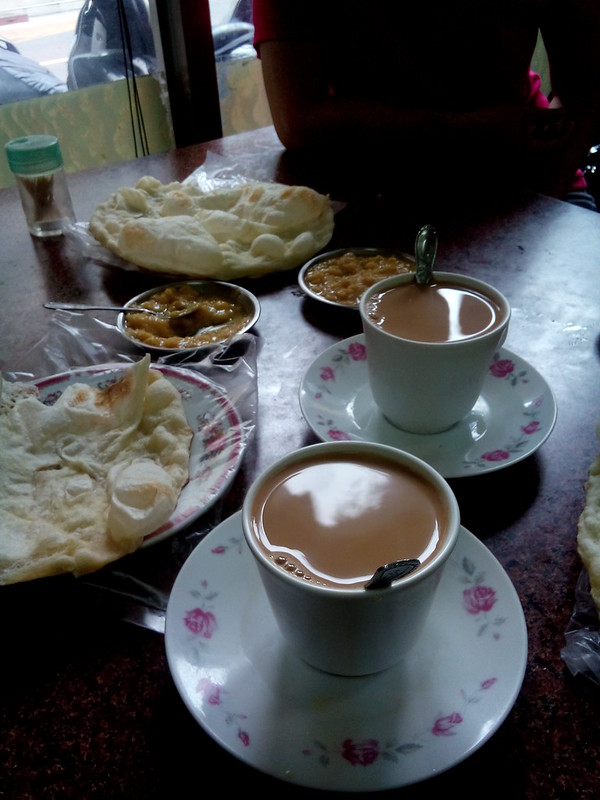
Another great trip out to Little Burma in Taipei, on Huaxin Street near the Nanshijiao MRT station (Exit 4, head past the KFC and McDonald's).

Work! What's that? I'm blogging! I've long wanted to take a moment and review a very specific and bogus claim that Chinese expansionist scholars typically use to argue that the Senkakus are Chinese: that a black ditch/trough formed the boundary between China and the Rykyus (Okinawa) which would put the boundary north of the Senkakus, which would thus have been Chinese in the 17th century.

Han-yi Shaw's thesis on how China owns the Senkakus appears to be the origin of the claim. He makes the claim as follows on page 48 and subsequent pages. I reproduced it as an image:


This passage appears to say that there is a ditch that demarcates the Ryukyus from China. In the next paragraph on p 49, he writes:


Note how he specifically says "Viewed together" these constitute proof that the ancient Chinese (who were actually Manchus by this point) saw the Senkakus as part of China. In the first section, he states that the boundary is a trough, while in the second he refers to the Black Water Trough which demarcates Fujian waters. He then goes on to claim that the Okinawa Trench is the Black Water Trough/Ditch.

The only problem with this claim is that it is absolute nonsense. ADDED IN 2017: The Black Water "Trough" in the Ryukyus is not the Ryukyu Trench, but is the traditional name for Kuroshio Current as it winds up the west side of the Ryukyus. The Black Water Ditch/Trough does not refer to any trench in the ocean, which the premodern Chinese knew nothing about. Shaw is counting on his reader's ignorance of the ancient texts and references to make a case that never existed.

There is a Black Water Ditch associated with Taiwan, however, which is the cause of much confusion, including this writer's.

To understand where the Black Water Ditch associated with Taiwan was in ancient Chinese texts, there are several good works that mention it. Macabe Keleher's Out of China, on Yu Yonghe's diary of his visit to Taiwan in 1697, is a must. Emma Teng's Taiwan's Imagined Geography is another gem.

Fortunately, Lawrence Thompson has a piece in the Harvard Journal of Asiatic Studies from 1968: The Junk Passage Across the Taiwan Strait: Two Early Chinese Accounts (link).

Thompson's first account is that of Yu Yonghe. Yu crossed over to Taiwan in 1697, one of the earliest accounts of the passage, a dangerous and unpredictable one. Yu writes:
22nd. At dawn we crossed the Black-water Ditch. In the passage to Taiwan it is the Black-water Ditch that is most dangerous. [The current] flows from north to south; its source is unknown. The ocean water is a true green, while the ditch water is as black as ink. Its condition is also rather filthy,20 and that is why it is called a "ditch." It is about a hundred 1i wide. The swirling waters flow swiftly, and sometimes a foul odor assails one. There are also snakes with red and black mixed patterns and two-headed serpents that swim around ships. The helmsman will cast paper ingots [into the ditch], holding his breath in fear lest [the vessel be swept] southward by the current to one knows not where.21 The Red-water Ditch is not very dangerous and people regard it as nothing serious. But the two ditches being entirely in the middle of the ocean, it is difficult to understand why, with the agitation of wind and waves, they never become intermingled with the green water.
Yup. The Black Water Ditch lies does indeed mark the boundary between Fujian/Xiamen, except that boundary, an informal one, is between the Penghu/Taiwan and Xiamen. Yu actually reaches the Penghu in the very next diary entry, the next day.

But wait! The Black Ditch issue is even more interesting. Because in the second account, in June of 1763 the traveler leaves Xiamen, goes over to Penghu, and then hits the Black Water Ditch:
According to the navigator-quartermaster, when the night is quiet and the waves are still, one may be able to hear the sounds of dogs and chickens on Taiwan. I did not [have the opportunity to] test this . ...
After the noon meal a north wind suddenly began to blow. In crossing the sea, Experience has shown that the north wind in the sixth and seventh months soon brings typhoons. The navigator-quartermaster wanted to return and moor at P'eng-hu [harbor] to wait until the typhoon was over, but after talking it over with the captains (of the other ships), our captain felt that we had already been held up too long. Moreover, they relied upon the fact that a typhoon had not immediately begun, and so in the afternoon we crossed the Black-water Ditch. The water of the sea [in this place] flows contrary to the prevailing current, And it is the most dangerous place in the passage to Taiwan. The water was a more intense black. One must trust to the wind to get across.... When the ship crossed the ditch, the water was stinking with a noxious vapor that rose (because of poisonous snakes in it). I was afraid to come out and look at it. The navigator-quartermaster said that they had often lowered the lead-tube coir rope to the limit of a hundred and several tens of hsiun (8oo-goo feet), but they had never found bottom and did not know how deep it was4.... At evening the wind grew stronger and the waves were like hills. I suddenly heard a clamor under the ship, a sound like ten thousand horns blown at once in the middle of the earth, and I was even more frightened. When I questioned the navigator-quartermaster, he said that when the wind rises croakers hurry under the ship and blow all evening; when they gasp at the surface they produce this sound ....
What? They crossed the Black Ditch on the other side of the Penghu, between Taiwan and the Penghu? This is explained in a fascinating footnote, which takes its explanation from a text written in 1807:
"The Black-water Ditch is the place which forms the boundary dividing P'eng-hu and Hsia-men. It is about sixty or seventy li wide and the most dangerous place in all the ocean. Its depth is unfathomed, and the water is as black as ink. The current is violent; in form it is a slight depression (see note 20 above). If a vessel is lucky enough to have a favoring wind and sail quickly, she will cross [the ditch], being tossed this way and that. If she is delayed, then the waves will buffet her, and she may easily lose her bearings. "[Note that there are two black-water ditches: the one to the west of P'eng-hu is perhaps eighty-odd 1i wide and forms the boundary between P'eng-hu and Hsia-men. The water there is as black as ink, and it is called the Big Sea. The one to the east of P'eng-hu is also eighty-some 1i wide, and it forms the boundary between Taiwan and P'eng-hu. Its name is the Small Sea. The water of the Small Sea is even blacker than that of the Big Sea, and its depth is unfathomed. When the wind is calm in the Big Sea (a ship) can still anchor; but it cannot anchor in the Small Sea, which is more dangerous than the Big Sea. This is a distinction that has never been made in previous accounts.]"
In fact, not only were there two Black Water Ditches, one each in the Big and Little Seas, Chinese sailors operating between Taiwan and Xiamen referred to several bands of colored water, including red, white, and greenish-blue, which they used to identify their progress across the Strait (the footnotes are the most interesting part of Thompson's paper). Even more misleadingly, in some confused modern descriptions, the Strait itself is sometimes called the Black Ditch.
_______________________
Don't miss the comments below! And check out my blog and its sidebars for events, links to previous posts and picture posts, and scores of links to other Taiwan blogs and forums!

Thursday, May 09, 2013

Hegemonic Warfare Watch: China wants Okinawa too

Onion harvest near Checheng in Pingtung.

In the People's Daily, two "scholars" argue that Okinawa is Chinese, a pattern that has been emerging more and more in the last few years. The Chinese government coyly refused to take a position (bloomberg)....
China refused to confirm that Okinawa belongs to Japan after two Chinese scholars suggested re-examining the ownership of the archipelago that includes the island, adding to tensions over a separate territorial dispute.

Agreements between allied forces during World War II mean the ownership of the Ryukyu Islands may be in question, the researchers said in a commentary in the People’s Daily, the Communist Party’s main newspaper. Asked if China considers Okinawa part of Japan, Foreign Ministry spokeswoman Hua Chunying said scholars have long studied the history of the Ryukyus and Okinawa.

“It may be time to revisit the unresolved historical issue of the Ryukyu Islands,” Zhang Haipeng and Li Guoqiang of the China Academy of Social Sciences wrote in the commentary.
Willy Lam, longtime China commentator, was quoted in several articles as saying that this appears to be a negotiating tactic to put pressure on the Japanese to give way in the Senkakus, but to my mind this is only the latest in a gentle, long-term escalation which will one day result in the same pattern of visa games and attempted marginalization of Okinawa that Beijing has already deployed against Taiwan and Arunachal Pradesh. I have noted on several occasions that in the minds of  right-wing Chinese expansionists Okinawa, the Senkakus, and Taiwan are linked, which is one reason why nationalist ideologues like Ma Ying-jeou constantly link Taiwan to the Senkakus. This thing with Okinawa will only get worse over time, because the leadership in Beijing seems to believe its own propaganda, and there will always be "scholars" willing to shove things further to the Right in order to further their own careers.... there's a structural aspect to authoritarian governments that advocacy of radical positions often gets greater attention from the few at the top....

Reuters reported:
China criticized Japan on Thursday for lodging a diplomatic protest against a Chinese state media commentary calling into question Japanese sovereignty over the southern Ryukyu Islands, which include Okinawa. The latest angry exchange could further strain tense relations between Asia's two-largest economies, which are involved in a stand-off over a group of uninhabited islands in the East China Sea, called the Senkaku in Japan and Diaoyu in China.”
This comes hot on the heels of the standoff in the Himal between China and India. Seems like the government in Beijing is manufacturing some nationalist sentiment ahead of bad economic news, etc.

It will be interesting to see if the Taiwan government comes out with some nonsense about how the ROC owns Okinawa.....

RELATED: Japan and Taiwan failed to set rules for fishing in the Senkaku area in the first round of the negotiations....
______________________
Don't miss the comments below! And check out my blog and its sidebars for events, links to previous posts and picture posts, and scores of links to other Taiwan blogs and forums!

Wednesday, January 30, 2013

The Senkakus Irritant Watch: Bandwagoning Edition

Remember when Ma Ying-jeou said Taiwan was going to be a "peacemaker, not a troublemaker"? I bet you already forgot that. I bet you forgot that one of Ma's priority pledges before the 2008 campaign and early in his first administration was repairing relations with the US. Remember when Ma was pragmatic, along with his China policies? The p-word has dropped from the media. Yup. That thwap-thwap you're hearing is me patting myself on the back. Again (brace yourself, rant coming).

A new report from CRS was profiled in the Taipei Times today. The report, Maritime Territorial Disputes in East Asia: Issues for Congress (online at FAS), says that Taiwan puts pressure on Japan in parallel with China.
One issue for U.S. policy concerns trends across the Taiwan Strait since 2008, particularly the question of whether Taiwan’s moves to engage more closely with the PRC have created a greater willingness in Taipei to cooperate with China on issues in which it sees their interests as aligned, such as in the East China Sea. Some analysts argue that there is an issue for U.S. policymakers surrounding whether Taiwan coordinated with the PRC in asserting sovereignty of the Senkaku Islands against Japan amid rising tension in September 2012. Beijing has urged cooperation over the islands to advance cross-strait ties. Taipei’s officials have denied cooperating with the PRC. Even without explicit coordination, the parallel actions of the PRC and Taiwan in the current East China Sea flare-up have added pressure against Japan. Both the PRC and Taiwan deployed government patrol ships and military assets that raised concerns about the potential for accidental collisions and the escalation of tensions.

On September 25, 2012, Taiwan deployed 12 Coast Guard ships that escorted 60 fishing boats and fired water cannons toward Japan’s patrol ships. Furthermore, Taiwan dispatched military systems sold by the United States during the incident.
The government in Taipei is clearly attempting to stoke the Diaoyutai issue at home, to drum up some faux nationalism and to divert attention from the many problems the economy is facing. During recent exercises the military wore patches saying "The Diaoyutai are ours!" (DefenseNews). In the most recent exchange of water cannon fire between ROC coast guard vessels and Japanese ships, Chinese ships were hanging around. The two sides probably aren't actively coordinating, but of course they don't need to. Everyone knows the score and knows how they should behave.

For quite some time I've been arguing that the Ma Administration is deliberately using issue such as the beef issue and the Senkakus to perturb and irritate relations with Tokyo and Washington. People are finally starting to notice this (similar argument today in Taipei Times). Now the Congressional Research Service has called attention to the possibility.

I've heard US officials are unhappy with the incidents in the Senkakus. When Chen Shui-bian had a couple of democratic referendums, US officials excoriated him publicly. When Ma Ying-jeou's military confronts Japan in the Senkakus as China shadows events, a place the US is bound by treaty to defend, the US....oh yeah, what has the US said? Nada. All I can say is, Ma is just lucky he isn't pushing a referendum. Then he'd really be in trouble.

Let's not forget, the ROC is also strengthening its presence on the South China Sea islands. As if it wants to irritate relations with nations to the south.....

Really, what did the US expect when they supported Ma? That he would support them? This is a guy who spent his early life being groomed as an ROC ideologue.This is a guy who wrote his thesis on how China owns the Senkakus. This is a guy who dresses up and performs the Confucian rites with children dancing to him like an old-time emperor (remember? Vaguely, you do). This is a guy whose public speeches are filled with open references to Han Chauvinist ideology. This is a guy who publicly speaks as if Taiwan, the Senkakus, and Okinawa all belong to China. This is a guy who thinks he is President of China.

Good luck getting him on board, Washington. I'm sure you'll hear some very pretty words. Would you be having this problem if you'd supported Tsai Ying-wen? As my man Drew remarked today:
It seems the pragmatists were both Chen and especially Lee (those pro-independence firebrands) who maximized Taiwan's international space, saw China's bluffs, but recognized the value of engagement with caution without compromising their principles or spurning valuable allies. They were not dreamy Greater China ideologues. Funny that.
________________
Daily Links:
_______________________
Don't miss the comments below! And check out my blog and its sidebars for events, links to previous posts and picture posts, and scores of links to other Taiwan blogs and forums! Delenda est, baby.
Friday, November 19, 2010

Tkacik on Cohen, AJISS on Okinawa

I blogged a few posts down on the source for the arguments of Jerome Cohen and John Van Dyke at the Council on Foreign Relations (CFR) and in several newspapers and other venues for Chinese sovereignty over the Senkaku Islands. Today John Tkacik, writing the South China Morning Post (and brave of them to publish it, too), destroyed a specific claim of Cohen and Van Dyke's, observes:
He and Jon M. Van Dyke are entitled to their own opinions about the Senkaku Islands [known as the Diaoyus in China] - but, alas, not their own facts ("Lines of latitude", November 10).

Even Taiwan's President Ma Ying-jeou would reject their assertion that the islands "have proved incapable of sustaining human habitation".

As Mr Ma pointed out in his magisterial 1981 Harvard Law School thesis "Legal Problems of Seabed Boundary Delimitation in the East China Sea" (p. 93), the main Senkaku Island, Uotsuri, possesses "a [fresh water] spring big enough to accommodate 200 people". He noted that in the early 1900s "an enterprising Japanese named Koga brought scores of seasonal workers, food and supplies each year" to the island where he built "houses, reservoirs, docks, warehouses and sewers".

Mr Ma is hardly a cheerleader for Japan's title to the islands.

However, he acknowledged that Koga's son continued a fish processing operation on the island until the early 1940s when the settlement's population had grown to 248, according to Okinawa Prefecture household registry records.

Uotsuri was evacuated during the second world war, and the United States military, which occupied the islands of Okinawa Prefecture from 1945 until 1972, used the island for naval gunnery practice, all the while paying an annual rent for the privilege to the Koga clan.
The irony of using the thesis of President Ma, an ardent supporter of China's manufactured claim to the Senkakus, to knock this claim is especially delightful. I wonder what kind of signal the Cohen/Van Dyke piece sends to our ally Japan and our rival China, hosted as it is on the website of the major US foreign policy organization.

A publication on a related island reached my inbox today, this one on Okinawa, from AJISS, which looks at the changing US posture in Asia....
Due to a recent shift in American policy toward China, Okinawa is becoming of increasing strategic importance to the United States. This was manifested in the power game between Japan, the US and China in the East China Sea triggered by the September collision between a Chinese trawler and Japanese Coast Guard vessels near the Senkaku Islands belonging to Ishigaki city, Okinawa Prefecture, Japan. The subsequent visits to Asia by US President Barack Obama and Secretary of State Hillary Clinton are now considered part of the American strategic hedge against (or a containment strategy for) China. The change in American strategy can be traced in a series of strategic documents issued earlier this year.....
_______________________
Don't miss the comments below! And check out my blog and its sidebars for events, links to previous posts and picture posts, and scores of links to other Taiwan blogs and forums! Delenda est, baby.

Thursday, March 08, 2007

F-22s to Okinawa

The Washington Times is reporting that the US has deployed its advanced F-22 fighters to Okinawa.

GINOWAN, Japan - A deployment to Okinawa by the U.S. Air Force's newest fighter jets presages plans to rapidly boost forces in the Pacific region in event of a crisis over North Korean nuclear weapons or a Chinese invasion of Taiwan.

On Feb. 17, the first of a dozen F-22 Raptor fighter jets, manufactured by Bethesda-based Lockheed Martin, completed a long-planned flight to the U.S. Kadena Air Force Base in Okinawa from Langley Air Force Base in southeast Virginia. It was the first overseas deployment for the type since its 2005 entry into service.

The Raptors represent a sweeping modernization of U.S. forces in the Pacific, including new coastal warships, ballistic missile defenses, C-17 airlifters and wheeled armored vehicles for ground forces.

Over the next five years, the Air Force will permanently station three F-22 squadrons of about 20 jets apiece in the region: two in Alaska and one in Hawaii. Europe, once a bastion of U.S. air power, isn't slated to receive any Raptors.

Friday, March 02, 2007

Okinawan Deaths in 2-28

Taiwan News tells the fascinating tale of the killings among the Okinawan community in Taiwan during 2-28.

At that time, traders and fisherman came from Okinawa to Taiwan unaware of the chaos that the February 28th uprising against the then KMT governor general Chen Yi had caused. As a result, many became embroiled in the 228 massacre and lost their lives when KMT troops, dispatched by Republic of China president and autocrat Chiang Kai-shek to suppress the "rebellion," arrived.

At that time, approximately 300 Okinawans lived in a fishing community on Keelung's Sheliao Island (now known as Peace Island).

After the end of the Second World War and the substantive take over of Taiwan after five decades of Japanese rule by the KMT regime under the cover of occupation, this community of Okinawans, as with many Japanese professionals or essential workers, had been "retained for utilization" in Taiwan after the repatriation of most Japanese.

No distinction made

When KMT troops, from of the First Battalion of the 21st Military Police Regiment dispatched by Chiang from China arrived in Keelung harbor, they did not distinguish between persons from Okinawa with Japanese citizenship or Taiwanese and thus Sheliao Island became one of the first settlements to witness the following islandwide massacre and "purification" and at least 30 Okinawans became victims along with thousands of Taiwanese.

After the 228 massacre and the "purification" of dissidents that followed, the flight of the KMT regime to Taiwan after losing the Chinese Civil War to the Chinese Communist Party's People's Liberation Army led to a deeper and more systematic "White Terror" marked by the (probably illegal) declaration of martial law on May 19, 1949 that lasted for over 38 years until July 15, 1987.

During these four decades of what one international human rights group called a "tortured silence," the story of the 228 victims from Okinawa and their right to know the fate of their loved ones and the truth behind their disappearance was buried along with any hopes for transitional justice.