Thursday, October 11, 2012

Errata: DPP Split over Hsieh for China

Oops. The TT ran a version of a Liberty Times story.... which contained some pardonable confusion.
To consolidate and integrate the party’s policies on China, Su is said to be planning to designate Hsieh as head of the reinstated committee, which was merged with the Department of International Affairs in August 2007.
The reinstated department is not the Committee, which is going to be rebooted at a later time, but the Department of China Affairs, according to corrections that arrived in my mailbox from those in the know. The idea that Su is going to appoint Hsieh is purely rumor and has no basis in fact, I am assured.
_______________________
Don't miss the comments below! And check out my blog and its sidebars for events, links to previous posts and picture posts, and scores of links to other Taiwan blogs and forums! Delenda est, baby.

Labuan Island Resorts: Malaysian Interlude III

Sabah, near the Sarawak border.

As you all know, I really love Malaysia and have gone there the last two years to enjoy a couple of weeks of cycling in Borneo each time. So when the good people at Tourism Malaysia contacted me and said write for us! I was totally happy to. Here is my third piece, this time in English, on Resorts on Labuan Island. Pictures by me too! Once again: I'm heading back to Malaysia in January, maybe the Peninsula, maybe another restful two weeks in Borneo. Would love to have you along!

This article was part of a publication for Tourism Malaysia. If you enjoyed this article and would like to find out more about travelling to Malaysia, please visit the Tourism Malaysia website如果你喜歡本文並且想要瞭解更多關於去馬來西亞旅遊的知識,那麼請訪問馬來西亞旅遊網站 
_______________________
Don't miss the comments below! And check out my blog and its sidebars for events, links to previous posts and picture posts, and scores of links to other Taiwan blogs and forums! Delenda est, baby.

Tuesday, October 09, 2012

Export Boom?

Weekended in Hong Kong this week. 

Exports in September rose 10.4%, welcome news to Taiwan's export driven economy. TT reports:
Outbound shipments totaled US$27.17 billion last month, up 10.4 percent from August and marking the highest level in 14 months, the ministry said in a report.

These drove exports in the first nine months to US$223.56 billion, down 3.9 percent from a year earlier, the report said.

“The recovering demand from the Asian region made Taiwan’s exports last month report a double-digit growth from a year ago,” Yeh Maan-tzwu (葉滿足), director of the ministry’s statistics department, told a press conference.
Growth had fallen 4.2% in August year-on-year. Are we getting a recovery? Everyone says the same thing: too early to tell. Another source noted:
The rise in September exports was led by demand from China (including HK, 8.4% MoM), ASEAN (16.8%) and Japan (22.7%). The increase in Chinese demand was seen in both consumer goods and capital goods – electronics (11.3% MoM), optical instruments (11.3%), chemicals (19.0%) and minerals.

This should be in part due to the modest improvement in China’s domestic demand on the back of policy stimulus measures. The temporary factors could have also been at play, such as the launch of new smartphone products that coincided with China’s golden week holiday this year.

Meanwhile, as a result of the ongoing China-Japan political tensions, Chinese manufacturing firms may temporarily switch their import orders from Japan to the alternative suppliers in the region, which could benefit Taiwanese exporters of electronics components.
Digitimes had some data via the MOF:

It also observed that....
Among different categories of Taiwan-made products, electronics had the largest export value of US$7.747 billion in September, growing by 8.6% on month and by 10.5% on year.
The government was cautiously optimistic about growth in the near term, but we'll have to see whether the international financial houses change their low estimates of growth for Taiwan this year.
________________
Daily Links:
_______________________
Don't miss the comments below! And check out my blog and its sidebars for events, links to previous posts and picture posts, and scores of links to other Taiwan blogs and forums! Delenda est, baby.

Saturday, October 06, 2012

Hsiao and Hsiao Score in The Diplomat

A load of persimmons on its way to market.

The Diplomat hosts another good piece by Russell Hsiao and Michael Hsiao....
While such official statements reflect the different interpretations of the “status quo” between Washington and Beijing, such ambiguity does not necessarily serve U.S. interests in the long term since it is based on a flawed premise guiding Washington’s views of cross-Strait relations. These scales are preventing policymakers in Washington from shaping a course of action in the Taiwan Strait which could be more conducive to its values and interests in the region. To be sure, there is a bureaucratic tendency in Washington to observe events in the Taiwan Strait in binary terms: independence or unification, ergo war or peace respectively. The line of argument goes: If Taiwan asserts de jure independence, then Beijing – under its anti-secession law of 2005 – would invade Taiwan. Alternatively, if the two sides of the Taiwan Strait were to unify, then there would be peace. This is a false choice – and one that plays into Beijing’s hand.

Furthermore, this view does not hold water since Taiwan is neither moving toward so-called independence nor unification, and the belief that it is in Washington only hamstrings the latter’s ability to exploit the opportunities that exist in the current situation. In other words, U.S. policy has become shackled to the mirage of inevitability. Moreover, the strategy is inherently reactionary and prohibits Washington from taking action that could secure its interest by forfeiting its decision-making to Beijing. And based on the increasing power disparity in the Taiwan Strait, Beijing defines what it means to be independent and what unification means. In other words, Beijing defines the terms for peace and war. This kind of “status quo” is unsustainable.


To be sure, over the last decade, there appears to have been a fundamental shift in the Taiwanese electorates’ attitude that all political parties vying for power would have to accept. Specially, Taiwanese voters’ have moved away from supporting either “unification” or “independence” as immediate political goals.In fact, according to a September 2011 public opinion poll conducted by Taiwan’s Mainland Affairs Council, that asked respondents their positions on cross-Strait relations, 87.2 percent stated they support maintaining the “status quo,” while only a combined 7 percent of respondents indicated they want unification or independence “as soon as possible.” According to a more recent August 2012 poll, the Taiwan Mood Barometer Survey (TMBS) by Taiwan Indicators Survey Research (TISR) -- a new polling agency-- only 18.6 percent of Taiwanese say the two sides of the Taiwan Strait should “eventually” unify, while 66.6 percent disapprove of the path toward unification. Taiwan is a status quo power, China is not.
The middle two paragraphs contain observations that I've made for many years on this blog. It's good to see them on a website with a wide audience like The Diplomat. Hsiao and Hsiao don't mention how Beijing deploys "being provoked" as a policy action to gain leverage over the media and over analysts in foreign lands, but manipulating US opinion into this either annexation/or independence mindset is one of its most successful and pernicious effects. As I've also noted, because Washington starts coughing up furballs whenever Taiwan makes independent sovereignty noises, Beijing can use the threat of war as leverage to transfer tension in the Beijing-Washington relationship to the Washington-Taipei relationship.

Unfortunately the last paragraph fundamentally misinterprets Taiwanese voters in two important ways. First, voters have not "moved away from" either supporting independence or annexation, because they had never moved toward one or the other of these options. At no time has a significant minority, let alone a majority, of voters opted for either. Second, the key point here is not that Taiwanese appear to support the status quo because it saves them from making a choice; but rather, they support the status quo because it is a form of independence and at the moment, the only form of independence available to them. This means that the public will inevitably be made unhappy by moves that place the island closer to China, politically (though they are delighted with the opportunity to exploit China's economy), while moves that slouch towards meaningful independence, such as joining the UN (near-90% support), will make them happy.

Thus what politicians must really respect is the fact that Taiwanese don't want to be part of China and moves in that direction will make them unpopular, as actually happened to Ma in his first Administration. Hsiao and Hsiao could also have included the fact that large majorities, typically around 70%, identify themselves as "Taiwanese", another thing that politicians have to respect. That is why the "status quo" to the Taiwanese is not a nether region between the Scylla of annexation and the Charybdis of independence, but treated by Taiwanese as an inferior but still desirable form of independence. And why every four years Ma Ying-jeou magically becomes Taiwanese for about three months, until he performs some kind of Confucian ceremony in a temple, which I believe is to cleanse himself of any residue of Taiwaneseness that may be still be clinging to him post-election....
_______________
Daily Links:
  • DPP demands economic officials be replaced.....
    The opposition parties listed a number of indicators: Taiwan ranked last in GDP growth in the second quarter among 12 Asian countries; it has the highest unemployment rate of the four Asian Tiger economies; its consumer price index hit a four-year high in August; and the composite index of monitoring indicators flashed a 10th straight “blue light” last month, indicating that the economy remained mired in a slowdown.
    ....Nothing will change, but at least displeasure is being indicated.
  • Lai Fu-shun with excellent piece in the Taipei Times on who really owns the Diaoyutai/Senkakus.
_______________________
Don't miss the comments below! And check out my blog and its sidebars for events, links to previous posts and picture posts, and scores of links to other Taiwan blogs and forums! Delenda est, baby.

Thursday, October 04, 2012

Income gap/income stagnation

Ta-ken, Taichung.

On one of the lists I frequent we were discussing the reasons for Taiwan's stagnating income and slowing economic performance, stimulated by a recent short piece in WSJ which touches on some of the issues. A friend point me to this MUST READ article in Commonwealth on the tax situation here in Taiwan.... as I've noted before, the wealthy simply don't pay taxes:
Jim Huang is 35 years old, a member of the third generation of a powerful political family in Taiwan. He does not have a job, but he's doing just fine.

In Taiwan, he lives in a 660 square-meter luxury apartment on ritzy Renai Rd. that he inherited from his father, and he also owns property in Los Angeles, Shanghai and Germany.

Through overseas trusts, Huang also holds stocks in the United States, Hong Kong and Taiwan worth more than NT$1 billion. With the help of two private banking advisers and their use of hedging techniques in the equity and futures markets, he earns a 6 percent return, or roughly NT$50 million a year, on his investments regardless of whether markets are bullish or bearish.

But Huang now faces a major decision. The United States Internal Revenue Service has aggressively pursued overseas assets of Americans in recent years to boost tax revenues, and Huang, who has American citizenship, is thinking about giving it up.

"The United States is cracking down hard. I've been thinking that it might be better to come back and be Taiwanese," says Huang, which is not his real name. "In any case, when you add it all up, the tax burden here is really low."

Because Huang's investments are channeled through a complicated array of overseas trusts and multilayer reinvestment structures, Taiwan's National Tax Administration has him classified as a "low-income household." In 2011, he paid less in taxes than his driver, just one example of how Taiwan has become a low-tax paradise for the wealthy.
Some stats from the article:
  • "...Taiwan's ratio of tax revenues to GDP, known as the national tax burden ratio, fell from 20 percent in 1990 to 11.9 percent in 2010, the world's sixth lowest and even below those of Singapore (13.5 percent) and Hong Kong (13.9 percent), which are known as low-tax havens." 
  • "Taiwan's effective personal income tax rate is only 5.96 percent, the 10th lowest in the world."
  • "In 2010, the central government budget was 18.9 percent of GDP, the sixth lowest of any country around the globe."
  • "...[estimates] there are 96,000 high net-worth individuals in Taiwan. Their assets have grown by 30 percent over the past four years to NT$10 trillion, or roughly 10 percent of all the wealth in Taiwan. Banking executive: "According to our internal numbers, private banking customers pay about 8 to 10 percent of their income in taxes every year."(highest marginal personal income tax rate is 40 percent and alternative minimum tax is 20%).
  • In the five years from 2006 to 2010, household wealth in Taiwan grew by NT$24.6 trillion, according to DGBAS figures. Of that, NT$16.6 trillion, or nearly 70 percent, resulted from capital gains on stock transactions, which are not taxed in Taiwan, and profits from property transactions, which are taxed at very low rates.
Yes, that's right. I blogged on this before (Chen Shui-bian died for your sins). As the Commonwealth article notes, many rich investors have never paid taxes on their capital gains. The recent capital gains tax is a mere fig leaf and changes little. The assessed value on land, the real prize in the game, has not been changed since 1987. The result of the low assessed land value is described in the article as it talks about a luxury apartment sale:
On a profit that was in fact NT$82 million but assessed by the government at NT$15.25 million, the investor paid a land value increment tax of NT$3.05 million, an effective tax rate of 3.71 percent. Even when deed taxes and other fees are added, the investor's tax liability was still under NT$4 million, or lower than 5 percent, the lowest marginal rate on personal income taxes.
The effects of this non-taxation of wealth are totally pernicious. In the go-go days of the 70s and 80s Taiwan's thriving small and medium-sized businesses (SMEs) were funded by informal methods, since the banks were government-owned and generally didn't lend money to SMEs. In other words, local savings were sourced through a variety of methods as local start-up capital for manufacturing businesses which in turn generated growth and new savings, leading to a virtuous cycle of savings and investment. Today Taiwan's wealthy park their wealth overseas -- instead of capital staying local and driving new business growth, it enters vast international pools of global capital and is invested in securities which are backed by other securities or by global stocks, producing no new business growth at home. Taiwan's incorporation into the global financial system has meant that it is essentially being strip mined of its growth capital, siphoned off to global financial networks. Untaxed, too.

The wealthy also invest in land and real estate at home. The assessed value the government uses to calculate the tax on the land has not changed since 1987. This means that real estate is effectively a tax shelter. That's why the $82 million in profits on that house above were only taxed at $15 million. Observe, dear reader, that the government's pious moves to keep government property on or off the market or to play with the interest rates or to assure the public that those big Chinese buyers are just around the corner are just diversions meant to keep the public's eye off the ball, which is the assessed value. That has to be raised. Note also that the luxury building boom is not a construction boom of future apartments for buyers with money returning from China or from Chinese investing in Taiwan. The construction companies are building tax shelters for the rich.

Of course there are a number of other issues. The economy has transitioned from manufacturing to low paying service McJobs. A big chunk of capital has gone off to China, where many businesses struggle to survive and few really make it rich. This is one reason that Korea has done better than Taiwan, it has less exposure to China (and a much bigger domestic economy with global-scale manufacturers). One of the rich ironies of the Ma Administration's China Cargo Cult is that as Taiwan ties itself closer to China Taiwan's trade with that nation is actually in decline. Even worse, the article notes:
Tung Chen-yuan, a professor with the Graduate Institute of Development Studies at National Chengchi University and a former deputy chairman of the Mainland Affairs Council, says that over the past 10 years, Taiwanese businesses in China have paid nearly NT$3 trillion to the Chinese government, roughly twice Taiwan's total annual tax haul.
The article ends with a former finance minister noting how completely stupid it is to believe that tax cuts for the wealthy stimulate the economy -- actually, they simply transfer wealth to holders of wealth while killing economic growth. As we have seen in the US, and are experiencing now in Taiwan.

The China Times offered an editorial last week after the Labor Minister resigned in the wake of the failure to raise the minimum wage, and offered some dramatic stats on the stagnant income....
Official statistics show that income recipients in Taiwan earned NT$611,134 on average in 2011, down NT$3,882 from the previous year and declining to the level of 1998. The level is now 52 percent lower than South Korea, which had lower salary levels than Taiwan in the past, and barely half of Singapore's.
Now you can see one reason why we have a constant flow of foreign-directed controversies -- the Diaoyutai insanity, the Ractobeef mess with the US  -- keeping the media and public looking outward rather than inward towards the true source of the nation's problems -- because a lot more people are going to die from lack of an adequate income than from eating ractobeef.
___________________
Daily Links:
_______________________
Don't miss the comments below! And check out my blog and its sidebars for events, links to previous posts and picture posts, and scores of links to other Taiwan blogs and forums! Delenda est, baby.

Wednesday, October 03, 2012

Taipei Sticker Madness

According to a knowledgeable analyst here, this sticker is being promulgated by the Taipei City gov't and is  going up in government offices of Taipei City. The blue section says "The Diaoyutai are the ROC's."

Great idea. I really love it. It signals that the city's KMT administration lives in an ROC ideological bubble. It does not contain a single Taiwanese/Taipei face, landmark, or artifact -- it is basically an announcement that the ROC doesn't have any link to the island and people of Taiwan, and doesn't care about them. Great work, KMT. I'm sure the DPP will have lots of fun deriding it.
_______________________
Don't miss the comments below! And check out my blog and its sidebars for events, links to previous posts and picture posts, and scores of links to other Taiwan blogs and forums! Delenda est, baby.

Tuesday, October 02, 2012

US sends signal of displeasure over Diaoyutai/Senkaku Mess? Probably not...

My friend Steve Fenton took me up to this interesting little temple in the hills outside Taichung city, where inside reside statues of Jesus, Mohammed, Buddha, Confucius, and a Taoist deity. Apparently the Michael Jordan statue is still under construction... 

The local papers of all political stripes were abuzz with the fact that senior US officials skipped the annual US-Taiwan defense industry meet up, an act into which they read deep political content. The Taipei Times described...
Senior US defense and diplomatic officials will not attend this year’s Taiwan-US Defense Industry Conference, organizers said on Sunday, an unexpected absence that has given rise to speculation about the reason why, ranging from a dispute over aggressive efforts to secure the sale of F-16 aircraft to Taiwan’s role in the Diaoyutai Islands (釣魚台) dispute.
But this report came from both the pro-KMT UDN and the pro-DPP Liberty Times. The KMT news organ had a gossipy article about the issues:
An informed source pointed out, on condition of anonymity, that Washington was discontent with the fact that a few days ago, Taiwanese fishermen, escorted by ROC Coast Guard cutters, sailed into the waters surrounding the Diaoyutai Islands under the slogan of the “defending our livelihood, safeguarding our fishing rights,” giving rise to a bitter confrontation between the Japan and ROC Coast Guard, and both sides even used water cannons against each other. The same source indicated that Washington was reluctant to see an increasingly strained dispute over the Diaoyutai Islands; however, “Taiwan’s actions may even aggravate the Diaoyutai Islands dispute, so Washington found it quite inappropriate.”

The same source pointed out that the US and Japan had signed the Treaty of Mutual Cooperation and Security and Washington had repeatedly emphasized that “the Senkaku Islands (Diaoyutai Islands) were included within the scope of the Mutual Security Treaty between the US and Japan.” He added that if the territorial dispute over the Diaoyutai Islands became increasingly tense, US would likely become embroiled in the dispute.
That's one theory. The second theory was that Washington was peeved about the F-16 mess....KMT again....
With regard to the grounds on which the US senior officials were said to boycott the conference, US government had not publicly made any response at press time. A figure who previously attended the conference several times disclosed that the US-Taiwan Business Council, the organizer of the US-Taiwan Defense Industry Conference, had probably annoyed the ruling Democratic administration by repeatedly urging Washington to sell F-16 C/D fighter jets to Taiwan.
According to the Taipei Times report, Taiwan representative office officials in the US gave the second explanation: annoyance with the US-Taiwan Business Council, which had pressured the Administration to sell F-16s, and had aligned itself with Sen. Coryn's holdup of Obama Administration appointments over the sale, which would have benefited his home state of Texas. The China Post noted that the event is "dominated by Republicans" and the US is in the midst of a presidential election campaign. US officialdom said the problem was scheduling difficulties (State Dept statement).
______________
Daily Links:
  • I blogged over at DKOS on the Senkakus/Diaoyutai Mess, a mashup of two previous blogposts this week. I hope to find time this week to try and crack the editorial pages of WSJ or WaPo. 
  • Some urging the hiring of more foreign laborers
  • Taiwanese to get visa-free entry into the US for one month. And US ractobeef now hitting shelves in Taiwan. Just a coincidence, I'm sure. 
  • Great pic collection on Facebook: Lumber camps 1910-40
  • DPP heavyweight Frank Hsieh to visit China. Jaw-jaw beats war-war any day. Who knows? Perhaps the Chinese might grow up. Or the horse learn to sing. 
  • SPECIAL: My friend Greg McCann's new book is reviewed in the Taipei Times today. Greg works on national parks and tigers in Southeast Asia, tromping to the remotest areas, at a time when journalists and environmentalists are being attacked and even killed in defense of the looting and pillaging of Southeast Asia's paper parks. I admire Greg very much; he not only can talk the talk, but he walks the walk too. Buy his book and support his work. The Amazon link is here, and for some background, here is his interview on Mongabay.
_______________________
Don't miss the comments below! And check out my blog and its sidebars for events, links to previous posts and picture posts, and scores of links to other Taiwan blogs and forums! Delenda est, baby.

Monday, October 01, 2012

Ishioka Lives!


I was looking at bike routes today and as my eyes swept across Shigang town and there was a RR station -- in Japanese! Ishioka is Shigang ("rock ridge") in Japanese. Interestingly, the railway line, an old spur line that ran from Houli Station out to Dongshi during the Japanese period, has been turned into a bike trail (green line) and the rails are long gone. Cool that Google still preserves the old meaning and the old station location. None of the other stations on the line are still marked on Google.
_______________________
Don't miss the comments below! And check out my blog and its sidebars for events, links to previous posts and picture posts, and scores of links to other Taiwan blogs and forums! Delenda est, baby.

Daily Links, Oct 1, 2012

Guguan_26
Appallingly gorgeous day on the road up to Guguan yesterday. Fall in Taiwan is fantastic.

One thing you should be reading today: Gordon Chang's Is China Burning? Both China-Japan economic relations and the current Senkakus mess are reviewed:
Because senior Party leaders are failing to maintain unity at home, it’s likely they will continue to press Tokyo over their claims to the Senkakus. In recent weeks, Beijing has upped the stakes by sending patrol vessels and threatening to flood the disputed area with “more than 1,000” craft.

Unfortunately, Beijing in recent years has lost its ability to compromise its territorial claims, some of which are outlandish. Beijing has laid down a marker for itself and cannot yield an inch. This makes each claim a flashpoint.

And Tokyo is beginning to realize there is no appeasing Chinese leaders. On the 14th, the official China Daily, by making a reference to Kume in the Ryukyus, laid the historical groundwork for raising a claim on that Japanese island chain, which is near the Senkakus. Said Hissho Yanai, a Japanese activist, to the New York Times, “If we let them have the Senkaku Islands, they’ll come after all of Okinawa next.”
Charles accelerates around a curve.

BLOGS:


Just above Guguan town Steve's chain weakened and threatened to break. Charles attempted to fix it, but to no avail. So Steve and I headed back to town where Steve repaired the chain in proper manly fashion, by bashing it with a hammer, which is what real men do when duct tape and WD40 don't work, while I, effete English instructor, went along to supply translation.

MEDIA:


EVENTS:
  • Neil Wade leads another expedition to Snow Mountain, Nov 9. Places still open.
  • Taichung AmCham Walkathon Oct 28, for KIDZ charity, registration at 1:30, walk begins at 2. At the MetroPark.
  • Sixth Annual Chili cook off  第6屆美墨辣肉醬烹飪大賽 Zhong Ming Park, 424 Huamei St 忠明公園, 台中市西區華美街424號 (2012 Book Exchange site... NOT SOHO STREET) October 13th from 12noon - 9pm 10月13日 中午12點-9點
_______________________
Don't miss the comments below! And check out my blog and its sidebars for events, links to previous posts and picture posts, and scores of links to other Taiwan blogs and forums! Delenda est, baby.

Sunday, September 30, 2012

Sunday Links

Did 120 kms today to Guguan and back. Lovely skies and a strong tailwind made the ride a joy.

Too busy to blog today, so enjoy a few links:


_______________________
Don't miss the comments below! And check out my blog and its sidebars for events, links to previous posts and picture posts, and scores of links to other Taiwan blogs and forums! Delenda est, baby.

Saturday, September 29, 2012

Paper on Parade: The Diaoyutai Islands on Taiwan’s Official Maps: Pre- and Post-1971

 
At this moment, for example, in 1984 (if it was 1984), Oceania was at war with Eurasia and in alliance with Eastasia. In no public or private utterance was it ever admitted that the three powers had at any time been grouped along different lines. Actually, as Winston well knew, it was only four years since Oceania had been at war with Eastasia and in alliance with Eurasia. But that was merely a piece of furtive knowledge which he happened to possess because his memory was not satisfactorily under control. Officially the change of partners had never happened. Oceania was at war with Eurasia: therefore Oceania had always been at war with Eurasia.

I cracked open the mail this morning and found to my joy that longtime reader and friend FM had alerted me to this paper entitled The Diaoyutai Islands on Taiwan’s Official Maps: Pre- and Post-1971 (Asian Affairs: An American Review, 39:90–105, 2012) by Ko-hua Yap, Yu-wen Chen, and Ching-chi Huang. Many thanks, FM! (apologies to Scott Simon, still have to finish my post on his excellent paper on headhunting. Mea culpa, mea culpa, mea maxima culpa).

As I noted yesterday in the long post, and many times in the past, the Senkakus "dispute" dates from the announcement of oil there in 1968. What Yap et al do in this paper is go over in fine detail the same information that the blogs I've pointed to present for Taiwan, with some delicious discoveries. I will leave out their discussion of certain international cases that might bear on the Senkaku issue and move along to their map presentation. Onward!

Yap et al succinctly summarize the issues:
"This research report is the first to present irrefutable evidence of the ROC government’s change of position from excluding to including the Diaoyutai Islands in the ROC’s territory in the early 1970s. The evidence lies in cartographic information produced by the ROC government before the 1970s, which had always tacitly assumed that the Diaoyutai Islands were part of the Ryukyu Islands, not under the ROC’s sovereign control. Not until 1971 and 1972 did the Taiwanese government modify official maps—such as national atlases, military topographic maps, and maps in national textbooks—labelling the Diaoyutai Islands as part of Taiwan or using the “Taiwanese name” (i.e., Diaoyutai Islands, Tiaoyutai Islets) to identify these islands."
The first case they present is one of the things I mentioned yesterday: the Taiwan Statistical Abstract. From 1946 to 1971, they observe, this text identified the northernmost point of Taiwan as Pengjia Islet, one of the three small islands off the northeast coast of Taiwan. But on Dec 2, 1971 the Executive Yuan announced that the Senkakus/Diaoyutai belonged to China and were administrated by Yilan county. The 1972 abstract was then duly altered, and Kuba Jima and Taisho Jima in the Senkakus were presented as the northernmost and easternmost points of Taiwan, respectively, thus creating a great trivia question for stumping the locals.

They then move on to the official maps. First they present the National War College maps, which as I noted yesterday, between 1959 and 1972 identified the Senkakus as Japanese and even used their Japanese names for them, never noting any controversy. They write:
"Evidence of the ROC’s shift of stance on the Diaoyutai Islands is also displayed in the NWC productions. For instance, in the National Atlas of China Vol. 1, the theme of which is Taiwan Province, the Diaoyutai Islands were not included in the first (1959), second (1963), or even third (1967) editions. It was only in 1972, when the fourth edition of the National Atlas of China Vol. 1 was published, that the Diaoyutai Islands were shown as part of Taiwan’s territory."

The figure above shows the 1959 map (unchanged in 1963 and 1967) of Taiwan from the National Atlas of China Vol I. The 1972 map, shown below, has suddenly added the Senkakus as the territory of China in the new inset box on the left. Then they, note, something else new appeared on this map:
It is equally interesting to note that, on the copyright page of the revised version, a line states that “the delineation of boundaries on the maps must not be considered authoritative.” This line never appeared in the original edition or in any other volumes of the National Atlas of China or the Grand Atlas of the World.
Yap et al argue that (obviously) the line appeared there because the mapmakers knew perfectly well that they could not backdate their claim to the Senkakus because the previous maps undermined their claim. Further, they note, the revision was prepared in a rush and the proofreaders appeared to have missed that the index still referred to the Senkaku Gunto under the Ryukyus.


This map is from the world atlas in the pre-1972 edition and shows the Senkakus as part of the Ryukyus. Note that the Japanese names for the islands are used (color image) and that there is no warning that there is a controversy over the islands. After that, the Senkakus are referred to as the Diaoyutais and are identified as Chinese.

The next example Yap et al refer to is the national junior high school textbooks, which I also mentioned yesterday. As everyone knows, these were produced by the government. Again, until 1970, these showed the Senkakus as Japanese and used the Japanese names for them. Without mention of controversy. And again, in 1971, after the ROC reversed 60 years of placid acceptance of Japanese sovereignty over the Senkakus, the group of islands magically morphed into the Diaoyutai and were part of the ROC.

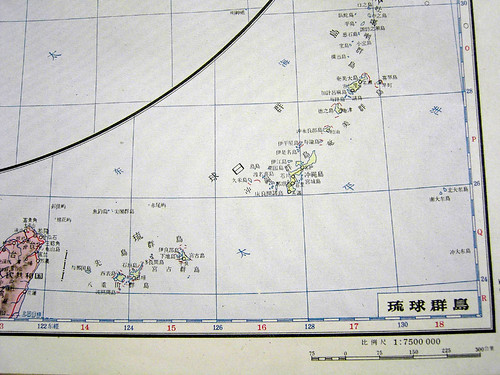
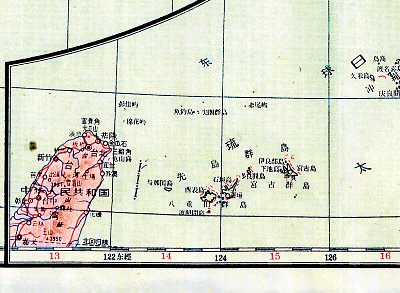
Military topographic maps are my favorite case in this study, producing a hilarious moment of unintentional insecurity about the map. Yap et al first put up a figure showing the 1962 topographic map set produced by the Combined Service Forces (CSF). That map has a set of dashed lines showing a boundary which put the Senkakus inside Japanese territory and noting that it derived from the Treaty of San Francisco. It did not, I should observe, note that there was any controversy. Then comes this flash of comic brilliance in the 1975 CSF map:


The dotted lines and warning about the SF Peace Treaty are gone, and some kindly bureaucrat has drawn a line to the Senkakus, in case the hapless reader missed the fact that they have always been Chinese, for every last second of the last 5,000 years.

Excellent work, Yap et al!
_______________________
Don't miss the comments below! And check out my blog and its sidebars for events, links to previous posts and picture posts, and scores of links to other Taiwan blogs and forums! Delenda est, baby.

Round up: One Third of Taiwan firms in China Kaput?

Taipei rush hour traffic insanity.

China Post posts:
Taiwan's intelligence chief yesterday warned that one in every three Taiwanese companies based in China are facing closure this year due to rapidly decreasing profits, a media reports said.

Another 30 percent of Taiwanese firms are also “struggling” in China, Tsai Der-sheng, head of the National Security Bureau, told a parliamentary session without giving details, the United Evening News reported.

“There is both risk and opportunity to invest in China. However, we can not deny the benefits of economic exchanges between Taiwan and China despite the growing risks,” he was quoted by Taiwanese news radio BCC as saying.
Several articles were also pointing out that as China's demand falls, so will world commodity prices (for example). At home labor is furious that the minimum wage was not raised while this week 100,000 teachers also carried out a variety of protests aimed at the government for not carrying out its promises. At least some overseas firms are reinvesting back home. Fortunately and surprisingly manufacturing seems to in a cyclical upswing, reports the government. With firms like Apple and Amazon rolling out new products, Taiwan's makers could remain solid for the rest of the year, pulling the economy up a little. The ban on sales of government land will remain in force except for case by case decisions. Meaning that sweetheart deals can still be available....
____________________
Daily Links
_______________________
Don't miss the comments below! And check out my blog and its sidebars for events, links to previous posts and picture posts, and scores of links to other Taiwan blogs and forums! Delenda est, baby.

Friday, September 28, 2012

Senkakus Round Up... Again

Moon over Taipei, Tokyo, and the Senkakus last night.

UPDATE: Bruce Jacobs guts Han-yi Shaw, Feb 2013.

Lots of fun in the Senkakus this week! Mutual pissing contests! Media misreporting! Peripatetic right-wing cheerleader Niall Ferguson even weighed in, apparently undaunted by his total lack of knowledge about the issue...... long post follows.... UPDATED: Don't miss post above this one on how the ROC maps were altered to reflect new Senkakus claim


Japanese vessels spray pro-China vessels, click if the video above doesn't work.

MESSING AROUND
Taipei Times has some barebones reporting on the latest stupidity (Reuters too):
Coast guard vessels from Taiwan and Japan dueled with water cannons yesterday as Taiwanese fishing boats sailed close to the disputed Diaoyutai Islands (釣魚台) to assert Taiwanese sovereignty over the islets.

The fishing boats came as close as 3 nautical miles (5.5km) to the Diaoyutais, known as the Senkakus in Japan, but were thwarted from making a possible landing by Japanese coast guard vessels, which deterred the protesters from approaching any further.
The fishing boats, according to local media reports, had been paid for by the head of the WantWant group, the ardently pro-China Robert Tsai (蔡衍明), who has been in the news recently over his attempts to grab a chunk of Taiwan's media market. J Michael argues that the mess was driven by local fisherman's issues. Tsai, however, is not involved because he supports the good fishermen of northern Taiwan.

MA GOV'T
The Ma government probably should have never permitted this, especially with a Japanese envoy visiting Taiwan this week to discuss the Senkakus. Yet there it is: not only did Coast Guard vessels confront the Japanese, which must have been fun for everyone, but the Ma government also sortied fighter jets to monitor the situation, according to the Taipei Times. Unbelievable stupidity. Remember when Ma was "pragmatic"? Promised to be not a troublemaker but a peacemaker? All the Serious US analysts backed him and claimed that those of us shrill, small voices who correctly identified him as a weak, pro-China ideologue were wrong. LOL.

It should be noted that effectively, when the Ma government and the Beijing government tag-team Japan, the Ma government is working with China, whatever their denials.

As Ma dithers with these islands, Taiwan's economy continues to slide. Despite the constant reiteration of the word Taiwan in connection with the Senkakus, the public is not rallying to this cause, but appear rather to be wondering WTF Ma can be thinking. Polls bear this out -- Ma's disapproval ratings reached 71%, with only 16% approving in the last TISR poll, and 13% in the TVBS poll.

Something is up. As a smart observer of Taiwan's political affairs pointed out to me last night in a conversation in which both parties, astonishingly, were sober -- no state to be discussing politics in -- Ma has replaced the envoy to the US with King Pu-tsung, his longtime right-hand man. He has also replaced the head of the Mainland Affairs Council and the head of the Straits Exchange Foundation with people loyal to him. The envoy to Japan has been recalled. Something is in the air, he argues, probably after the leadership change in China and the Lunar New Year. Note also that China has scrambled its Taiwan affairs people.

MEDIA FAIL
The international media has once again predictably failed to accurately represent what is going on. Despite the harm false balance has done in so many areas, the media continually reaches for it. The result is that the international media legitimizes China's claims with every article, by treating them on par with Japanese sovereignty and by refusing to do any digging in the background of the "dispute". The "deeper" pieces attribute the current mess to current domestic political issues in both countries. This "dispute" has been simmering for the last two decades. There is always something going on domestically that can be blamed for its revival at any given time.....

Han-yi Shaw
The NYTimes took things a step further the other day with the publication of a right-wing Chinese propaganda screed from Han-yi Shaw, who has been writing on this topic for about 15 years, introduced by Nicholas Kristof (who has been claiming the Senkakus are Chinese for a while). Here is the image that the NYTimes published with the piece:
Here is what Shaw wrote near the bottom:
And according to Taiwan gazetteers, “Diaoyu Island accommodates ten or more large ships” under the jurisdiction of Kavalan, Taiwan.
Heh. The Chinese text he highlights, presumably from the Chen Shouqi text on the right, actually says something like "the Diaoyu Island can hold 1000 large ships." Not ten, but a thousand. Is Shaw deliberately mistranslating, mistaken, or is it that the gazetteer he cites is not the one in the picture?

In 1999 the U of Maryland reprint series (take a moment to examine its editorial board and their output and you will know its politics) published his magnum opus on why Senkakus are Chinese. In it he also cites the Qing Gazetteers.

The Revised Gazetteer of Chen Shouqi published in 1871 is the document displayed in the photo above, according to the NYTimes caption. Shaw describes it...


Note that in this case he correctly translates this as "1000" ships. But, he says in the magnum opus, there is a 1722 gazetteer that has the "TEN" ships.....


I'm sure you've noticed the similarity in language, especially the Chinese. I can't find an image of that passage online, but this ROC Ministry of the Interior site scribes:
In volume 2, Military Defense 武備, Huang listed the patrol routes of the naval forces of Taiwan Prefecture, stating “in the seas north of Taiwan is an island Diaoyutai where a dozen large ships may be anchored.” Subsequently, Fan Cheng’s 范成Revised Gazetteer of Taiwan Prefecture 重修臺灣府志(1747) and Yu Wen-yi’s 余文儀Continued Gazetteer of Taiwan Prefecture 續修臺灣府志(1764) reiterated Huang’s references. In 1871, Chen Shuo-qi’s 陳壽祺Recompiled General Gazetteer of Fujian重纂福建通志further listed Diaoyutai Island under Kavalan Office (now Yilan County) of Taiwan in Volume 86: Coastal Defense and Strategically Important Places in all Districts《卷八十六.海防.各縣衝
Aha.... what we have is genetic....one writer reproducing another in a downward transmission. A friend suggested that it is likely that the 1871 gazetteer isn't even thinking about the Diaoyutai Islands at all, because there is no harbor in the Diaoyutai capable of holding a thousand ships and the Diaoyutai were never under Gemelan administration (documents, please). The key is the phrase "north of the mountain" which signals that this prodigious harbor is north of Gemelan (Yi-lan) past the mountain. And sure enough, north of Yi-lan over the mountains on the northeast end of Taiwan is the fine natural harbor of Keelung. Were the writers of these gazetteers hazy on the geography and simply get confused over what harbor they were talking about? Check out a map and see where the Senkakus are relative to Taiwan.....

...but it appears that what Shaw did in the NYTimes article is select the first (text) and last (image) in a sequence of writers copying each other over 150 years, and presented that as authoritative. His quote is compiled of TWO different texts as if they each maintain the same thing, and he refers to the gazetteers using the plural.....
  1.  “...Diaoyu Island accommodates ten or more large ships” (1722 text)
  2. under the jurisdiction of Kavalan, Taiwan." (1871 text)
...but only the 1871 gazetteer makes the claim of Qing administration. AFAIK the others do not. Since Han settlement in the Yi-lan area dates from the beginning of the 19th century, the 18th century gazetteers most emphatically did not place the Senkakus under Gemalan/Kavalan administration, which did not exist. They merely note that the islands had a fine harbor that could hold ten ships. 

But there are a couple of deeper issues I'd like to point out. Han-yi Shaw's use of gazetteers written by is itself suggestive. Dear reader, ask yourself why Shaw simply doesn't show us the many maps produced by Qing authorities that show how the Senkakus belonged to the Qing/Taiwan throughout this period.


The answer is obvious, and this excellent post, much updated over the years, has it. Go and look at many maps listed there produced by during the Qing of Taiwan and make your own judgement. I've discussed Shaw's use of gazetteers in this old post. Further, most of my readers have some familiarity with the literature from foreigners on Taiwan -- does anyone know of anything written by a foreigner in the 19th century that identifies the islands as belonging to the Qing government or being under its Taiwan administration? Finally, had the islands been administrated from Taiwan prior to 1895, Japan probably would have made public note of that fact. Since it owned Taiwan after 1895, this might well have buttressed its claim. But perhaps not.....

The NYTimes piece leaves out a key piece of information that makes Shaw's position more rational than it really is, because if the paper's gentle readers saw it in print they would immediately realize an inconvenient truth: that Han-yi Shaw is a right-wing Chinese expansionist following a Chinese-invented Sinocentric form of sovereignty that hands all of Asia to China. Here is what he says in the long paper:
...Many Chinese scholars have argued that when evaluating the various historical evidence put forth by the Chinese side, one must not fail to recognize the important political realities of the time from which they originated, namely, an era characterized by the East Asian World Order (otherwise known as the Chinese World Order).

The underlying concern is the following: whether principles of modern international law, which has its origin in the European tradition of international order, can properly judge a territorial dispute involving countries historically belonging under the East Asian World Order with fundamentally different ordering principles from its European counterpart. First and foremost, it should be noted that the East Asian World Order was a system of international relations characterized as Sinocentric and hierarchical rather than one based on sovereign equality of nations. Under such a framework, relations between nations were not governed by principles of international law known to the West, but instead by what is know as the "tributary system" instituted by China.
It looks like Shaw claims that there are Chinese scholars arguing that if China says someone paid tribute to it at some point in history, China can determine the sovereignty in its favor. I doubt one can find many Korean, Mongolian, Tibetan, Japanese, Thai, or Vietnamese scholars to support this. It is hard to imagine a mindset more self-serving and expansionist than this. Imagine if the NYTimes column had been fronted by this nonsense. Instead, Shaw cleverly frames it as an attack on Tokyo's position rather than an announcement of his own with copious evidence, maps, and charts.

One of the ways that westerners exoticize China is that we accept these completely laughable, simpleminded, and historically inaccurate and anachronistic claims, whereas if Italy demanded the Mediterranean and France based on Rome, or Ankara was claiming the entire North African seaboard, Bulgaria, and Saudi Arabia based on the Ottomans, or the Macedonians wanted a chunk of India because Alexander once battled there, everyone would immediately realize how fantastically archaic this kind of thinking is. There is no "East Asian World Order"; that is merely a modern Chinese fantasy retrojected into the past to bolster up modern Chinese expansionist claims. As I noted when I first saw this:
Another issue is the conception of 'China' that existed prior to the Qing. Emma Teng's magnificent book on Qing travel writing in Taiwan, Taiwan's Imagined Geography, is online on Google books. I suggest a careful reading of the introduction -- one of Teng's major points is that pre-Qing China saw itself as a land power only, and saw the sea as its boundary -- the island of Taiwan was considered a distant land across the water which, as Qing official and visitor Yu Yonghe noted in his diary, had never in history sent tribute to China. Shaw's analysis above, which drags up navigational and defense records from the Ming, simply ignores the evidence from maps and texts, as well as scholarly publications and analyses of this body of material, that shows that the Chinese never thought of the sea as a place to extend borders across. Thinking about a China that included islands over the water within its own boundaries was, as Teng notes, a Qing innovation. Teng observes:
"The deeply ingrained notion that the seas defined the natural limits of the Chinese realm underlay the reluctance to annex Taiwan. As the Kangxi emperor's advisors argued, 'Since antiquity, no oceanic islands have ever entered the imperial domain.'"
Thus, one of the most important functions of the constant iteration of “5,000 thousand years of history!” is that it creates in the minds of hearers an entirely fictive politico-historical continuity that China uses to buttress these very real and very dangerous territorial claims. 

But all this is really beside the point. As I've noted countless times before, between 1895 when Japan declared the Senkakus annexed, and the late 1960s, none of the Chinese governments protested this move. Indeed, in numerous published maps and texts, they stated that the Senkakus were Japanese and never hinted of any controversy.  The idea of a "dispute" is a purely post-1970s claim; prior to the discovery of oil there were no such claims made. 

Again, that excellent map post has many examples of maps issued by various institutions in Beijing and Taipei that include the Senkakus in Japanese territory and do not mention any controversy. For example, this 1958 map from the Beijing Map Publishing Company, and a 1959 map from the same outfit. Nor is the 1953 Renminerbao article I posted on before the only example of Beijing including the Senkakus with Okinawa in a text -- here is another from that post. Similarly, between 1946 and 1971 the Taiwan Provincial Statistics Guide repeatedly identifies Pengjia Islet as Taiwan's northernmost point. A 1970 junior high text issued by the government has the Senkakus as part of the Ryukyus and uses the Japanese name for them....National War College maps issued in Taipei between 1959 and 1972 show the Senkakus as Japanese and even use the Japanese name for them, not Diaoyutai. UPDATED: If you've come here via a direct link, don't miss this post two posts above this one on a recent academic paper that discusses these maps in detail). UPDATED: If the ROC really thought the Senkakus belonged to it, why didn't ROC representatives bring that up when they discussed territory when negotiating the Treaty of Taipei? But of course they never did. 

One could multiply such examples. 

This is why the Japanese government maintains "there is no dispute" since it knows perfectly well (who better?) that the controversy dates from the announcement of oil underneath the islands and did not exist prior to that time. 

What has really happened here is that the East Asian World Order as deployed in the service of Chinese expansion means that when China wants to expand, it will rummage through its history to find justification for said expansion. Thus, the real inconvenient truth is that the Senkakus are Japanese and the Chinese claim is simply naked expansionism. 

The even more inconvenient truth, as I have noted several times on this blog, is that many Chinese, especially on the right, argue that Okinawa is Chinese, "stolen territory" -- in Chinese minds, and on Chinese maps, the two are linked. WaPo had a piece on it a few months back....a taste:
In a fiery editorial this month, the Global Times newspaper urged Beijing to consider challenging Japan’s control over its southern prefecture of Okinawa, an island chain with a population of 1.4 million people that bristles with U.S. military bases.

“China should not be afraid of engaging with Japan in a mutual undermining of territorial integrity,” the Communist Party-run paper declared.

Maj. Gen. Jin Yinan, head of the strategy research institute at China’s National Defense University, went even further. He told state-run radio that limiting discussion to the Diaoyu was “too narrow,” saying Beijing should question ownership of the whole Ryukyu archipelago, which by some definitions extends beyond Okinawa.
Coming next in the script, when China feels powerful enough, is Okinawa, linked in Chinese minds to the Senkakus. The East Asian World Order is just a Chinese language version of that old tune, the Greater East Asian Co-Prosperity Sphere, the Cape-to-Cairo Railroad, Manifest Destiny, and Lebensraum. Hopefully, this time around it will not  be necessary to turn the globe into a killing ground to make people see how evil and dangerous such thinking is.

MORE:
_______________________
Don't miss the comments below! And check out my blog and its sidebars for events, links to previous posts and picture posts, and scores of links to other Taiwan blogs and forums! Delenda est, baby.

Tuesday, September 25, 2012

Inflation over time


A graphic from Apple Daily, Sept 24, reminds us why the Ma Administration is thrusting Taiwan into the Senkakus mess: because the gov't needs a good distraction. Inflation ticks along at a steady pace, normal but painful in a nation with stagnating salaries. The list shows the price changes in goods since 1998, including rent -- a 30 ping apt has risen from $15K to $22K a month, not one of the bigger rises. Ordinary people are being forced out to the Taipei burbs.... or farther. Masking the effects of price rises is the Taiwanese habit of living at home until marriage, meaning that many people are being subsidized by the wealth their parents accumulated a couple of decades ago in the waning days of the go-go era.

Not all of this is under government control, and it is notable that water and electricity remain cheap -- water is the same price it was 13 years ago. Where the government can intervene to keep prices low, it has -- yet low water and electricity costs keep Taiwan investing in heavily subsidized water and electricity hungry industry, instead of clean industries of the future.

Youth unemployment is rising, as the overall unemployment rate reached 4.4%, according to the government's figures. Monthly employee overall compensation actually fell marginally. The NT is on the rise, hurting exports too.....

ADDED: The Cabinet refused a raise to the minimum wage too...
_______________________
Don't miss the comments below! And check out my blog and its sidebars for events, links to previous posts and picture posts, and scores of links to other Taiwan blogs and forums! Delenda est, baby.

Monday, September 24, 2012

Daily Links, Monday, Sept 24, 2012

What's out there?

BLOGS:


MEDIA:


_______________________
Don't miss the comments below! And check out my blog and its sidebars for events, links to previous posts and picture posts, and scores of links to other Taiwan blogs and forums! Delenda est, baby.