Showing posts with label Olympics. Show all posts

Monday, August 15, 2016

Blast from the Past: Competing in the 1960 Olympics under the name "Formosa"

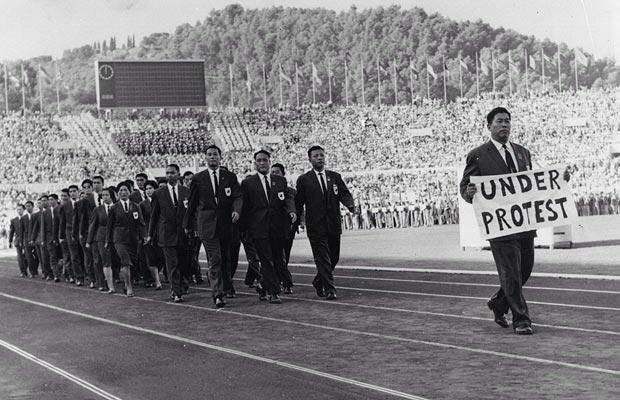
Protesting at the 1960 Olympics (Getty). Wiki has another image.

A 1960 Taiwan Review/Today article notes:
The World-Telegram and Sun on September 1 also editorialized that sport and politics were mixed when the athletes from the Re­public of China were "forced" to represent only the island of Taiwan in the current Olympic Games in Rome.

In a comment entitled "Sports and Politics," the Scripps-Howard paper criticized the conduct of Avery Brundage, the newly re-elected President of the International Olympic Committee.

"Avery Brundage likes to say, as head of the International Olympic Committee, that 'sports and politics do not mix'. Yet he was the center of a furor last year over the admission of the Republic of China to the 1960 Olympic Games only as representative of Taiwan (Formosa)—thereby implying that the Communist regime is the legitimate government of China.

"The Brundage viewpoint prevailed and Nationalist China did send a team to Rome as representative of Taiwan. But on the opening day when the athletes circled the stadium, a Chinese marcher held aloft a placard that said: 'Under Protest.' It drew widespread cheers.

"A few days ago Mr. Brundage was reelected unanimously as president of the IOC. That came about, according to sports writers on the scene, because Soviet opposition to him was withdrawn. Some observers pointed out, according to John P. Carmichael, Chicago Daily News sports editor, that 'the USSR surrendered on Brundage, after the IOC agreed to insist that the Republic of China athletes be forced to represent only the island of Formosa.
This book available on Google books observed that in the "key political fight" of the Olympics, ROC officials had called the US embassy in Rome to try to get them to have Avery Brundage let them compete as China. The athletes of the ROC delegation did not want to march, but the IOC officials wanted them to. When the march came, not only did the ROC group carry the placard, but they wore jackets with the Nationalist Chinese insignia on them. However, according to the author, the US embassy officials observed "glumly" that the protest went largely unnoticed by the crowd.

Maybe we should petition to use the name Formosa again, since we used it once already...
_______________________
Don't miss the comments below! And check out my blog and its sidebars for events, links to previous posts and picture posts, and scores of links to other Taiwan blogs and forums!

Sunday, August 26, 2012

Blast from the Past: 1976


_______________________
Don't miss the comments below! And check out my blog and its sidebars for events, links to previous posts and picture posts, and scores of links to other Taiwan blogs and forums! Delenda est, baby.

Friday, August 10, 2012

Olympic flag success

Some good progress on international issues made these Olympic games by Taiwanese the world over. First, the stream of complaints led the London Olympic games committee to reverse its decision on representations of the ROC flag....

Hsu Mien-sheng (徐勉生), the director-general of the ministry’s Department of European Affairs, described the move as a “gesture of goodwill” extended to Taiwan after an ROC flag was removed from an array of 206 national colors, representing the nations competing in the Olympic Games, in a London street. The display was organized by the Regent Street Association.

The Taipei Representative Office in the UK had reached an understanding with the LOCOG that Olympic-venue security staff would allow spectators to dress in the colors of the ROC flag, paint the ROC flag on their faces, or bring small ROC flags with them to the venues, Hsu said.

.....

The association was “overloaded” with telephone complaints and e-mails from UK politicians, ordinary British citizens and people from other countries about the replacement of the ROC flag in the display, Hsu said.

Some members of the UK parliament also sent letters to the association to express their disapproval and demand a remedy, Hsu added.
Can't wait until some low-level Chinese athlete stages an over-the-top protest. Another change widespread this time around is that the sports media is using the ROC flag to represent "Chinese Taipei" and often using "Taiwan" as well when they list medal counts. Good work, folks.
_______________________
Don't miss the comments below! And check out my blog and its sidebars for events, links to previous posts and picture posts, and scores of links to other Taiwan blogs and forums! Delenda est, baby.

Tuesday, July 24, 2012

Olympic Flag goes AWOL

Images like this are flying around the net. Apparently Beijing has been able to make the ROC flag disappear from the line-up of Olympic flags in London.
_______________________ 
Don't miss the comments below! And check out my blog and its sidebars for events, links to previous posts and picture posts, and scores of links to other Taiwan blogs and forums! Delenda est, baby.

Friday, July 17, 2009

China Boycotts Opening Ceremony at Which Ma Appears as Prez

Luckily for the world, China does not play politics with sports. Otherwise the Chinese delegation might have boycotted the World Games Opening Ceremony in Kaohsiung today....

...oh wait. They did boycott the opening ceremony....

Boycotts during international sporting events are an old Chinese habit -- see the 1956 Olympics (boycotted because Taiwan competed under the name "Formosa") and the 1976 Olympics (boycotted in confused temper tantrum). Today's boycott was interesting because its context was the "improved relations" and "lowered tensions" in the Taiwan-China relationship since Ma saved us was elected.

Mercury News' John Ryan noted:
Remember that beautiful display at last summer's Olympics? Remember how China was able to influence nations, including the United States, to ignore its human-rights abuses and embrace this global celebration? Remember the glorious togetherness of setting aside differences for the pure joy of sporting competition and artificial singing?

Yeah. That is so 2008.

Thursday morning in Taiwan, the 100-person Chinese delegation boycotted the opening ceremonies of the World Games, a 21-sport competition of non-Olympic sports such as sumo and rugby. According to the Associated Press, the move was seen as a rebuke of Taiwan's president, Ma Ying-jeou, who presided over the ceremonies. In his 14 months, Ma has worked to improve relations with the mainland instead of fighting for Taiwan's independence; China, which has not recognized Taiwan's sovereignty since the 1949 split, apparently believed attending the ceremony would legitimize Ma as president.
Max Hirsch of Kyodo describes the (non) event....
Some 70 Chinese athletes are scheduled to compete in eight events at the games to be held through July 26 in Kaohsiung, including sumo wrestling, water skiing and martial arts, according to Taiwan's government-funded Central News Agency (CNA).

However, none of them had registered by Thursday despite their arrival this week in this southern port city, according to the Cabinet-level Sports Affairs Council.

During the ceremony's introduction of countries and athletes, just one person held the Chinese flag when China was announced, while the majority of other national teams were represented by teams of athletes.

The single flag-bearer for China, who appeared to be a local Games staffer, was met with a mixed reaction of boos and cheers from a packed stadium of some 50,000 spectators.
From an earlier article:
Indeed, the Chinese teams plan to skip the ceremony in a decision that was reached between them and Taiwan's official Chinese Taipei Olympic Committee, said Wu Yu-sheng, a prominent lawmaker, according to CNA.

For China, the opening ceremony is controversial, as Taiwanese President Ma Ying-jeou plans to preside over the event in his capacity as president, while the island's national flag will likely be prominently displayed -- reminders of the island's de facto sovereignty.

China claims Taiwan as part of its territory awaiting unification, while the self-ruled island insists on safeguarding its independence from the mainland.
Nice reworking of the Formula describing Taiwan's (n0n)-relationship to China there, Max. At Global Post John Adams described:
Due to China's sensitivities, Taiwanese athletes must also compete as "Chinese Taipei", under a special flag – even though they're on their own soil (Taiwan is not allowed to fly its national flag at World Games venues).

That's the result of a compromise struck to allow Taiwan to participate in global sports events.
It's easy to see why Ma has poo-poohed claims that his unopposed run for KMT Chairman is meant to give him a grand enough title to enable him to meet with Hu Jintao of China. If China cannot even bring itself to attend a minor ceremony like this because Ma is attending in his capacity as President, how would they address him in China if he met Hu? I mean besides Humble Petitioner Before The Imperial Throne....

This little bit of political theatre that China is engaging in may well be staged for Ma's benefit. After all, Ma's unopposed "election" for KMT Chairman is really an assessment of his support in the party rank and file, among other things. By showing up in his formal role as ROC President at a meaningless minor international sports fete, where China refuses to show because it is "angry", Ma gets to look like he is standing up for sovereignty in a way that costs him nothing serious with China but plays very well among local voters -- and elections, both his own Chairmanship "race" and local city/county elections, are only a few months away.

It will also help mitigate the image at home and abroad that Ma has of being Beijing's tool. "See? Beijing is peeved at him! That shows that he and Beijing are not in bed together." Whether or not Ma has Beijing's active help, it's a useful bit of political theatre for him that costs him nothing and reaps concrete benefits.

REF: China's Foreign Policy In Sport

_______________________
Don't miss the comments below! And check out my blog and its sidebars for events, links to previous posts and picture posts, and scores of links to other Taiwan blogs and forums!

Tuesday, August 26, 2008

Paper on Parade: China's Foreign Policy in Sport

With the Olympics receding into history, and with gymnast He Kaixin looking forward to her 15th birthday, now is the perfect time to check out a recent publication in China Quarterly entitled "China’s Foreign Policy in Sport: The Primacy of National Security and Territorial Integrity Concerning the Taiwan Question" (2008, volume 194). Junwei Yu, the author, is quite clear about authorial intent, announcing:

This article argues that from the outset, China’s foreign policy in sport vis-a-vis Taiwan has placed national security and territorial integrity in front of all other objectives. My intention is to show how China singles out this priority and formulates policy around it.

At the international level sort, Wei points out, can be used to declare recognition or non-recognition, express various forms of foreign policy stances, or even enhance the national welfare. In China's drive to annex Taiwan, it takes on a security policy role.

The China-Taiwan first popped up on the international stage in 1952 at the Helsinki Olympics. The PRC was allowed to attend, so naturally Chiang Kai-shek withdrew Taiwan. The favor was returned in 1956, when China notified "Taiwan province" it could be part of the Chinese Olympic delegation. But Taiwan was permitted to compete, and so China withdrew from the Melbourne Olympics in '56.

It was ping-pong diplomacy that got Taiwan kicked out of the Olympics and subordinated to the Chinese:

The diplomatic debacle of UN expulsion produced a domino effect within the world of sports. Firstly, a group led by Iran and Japan orchestrated the admission of the PRC into the Olympic Council of Asia (OCA) in 1973, and simultaneously expelled Taiwan from the organization. The following year, Taiwan was variously excluded from the governing bodies of fencing, wrestling, volleyball and weightlifting, and had its basketball membership suspended. At the outset, China vowed to drive Taiwan from the IOC by using the countryside-surrounding-city tactic, through which countries that supported China began to expel Taiwan from individual sports federations. According to the IOC charter, if a country could not preserve membership in at least five international associations affiliated to the General Association of International Sports Federations, its membership with the IOC would be automatically revoked.

The recognition of the PRC by the US in 1979 further isolated Taiwan but ironically, since the PRC permitted Taiwan to continue to compete in sporting events, gave it the opportunity to compete as an equal even if the names ROC and Taiwan were not permitted. There was diplomatic huha, but the spineless IOC abjectly surrendered to China and the name Chinese Taipei was used. These arrangements were formalized in 1981 and known as the Olympic Formula.

Yu moves on to discuss the Zhonghua vs Zhongguo Taipei. Remember how there was an agreement? And the Chinese government, ever the trustworthy partner and brimming over with Olympic goodness and decency, said that its media had always had the habit of using Zhongguo Taipei and they really didn't mean it? Wei observes that it isn't some informal tradition -- it's orders from the top:

According to China’s official document ‘‘Opinions on how to correctly use propaganda phrases involving Taiwan,’’ promulgated in 2002: ‘‘In international sporting competitions held by us [China], the Taiwanese delegation can use the Chinese words Zhonghua Taibei, but our media reports should still call them Zhongguo Taibei.’’

Intent on creating the idea that Taiwan is a province of China, the Chinese press the IOC on any appearance of the ROC emblems. In 1988 the IOC nearly revoked Taiwan's membership when the bobsled team was found to have the ROC logo on their helmets. The IOC, which rolled over and barked for China when He Kaixin had to be 14 15 16 years old, sent Taiwan a stern letter about this horrible violation. In Atlanta 1996 a Taiwanese student waving an ROC flag during a table tennis match was (shamefully) arrested and fined by the American police, and in Sydney in 2000 a Taiwanese was asked to remove a baseball cap with the ROC flag. These were not official Taiwan reps, but ordinary people. Apparently free speech rights disappear whenever China needs them to. Who needs soft power when the IOC is your bitch?

Things became even more complicated when Taiwan under the Lee and Chen Administrations had an actual foreign policy (remember those days?). And China remains China:

....in principle [China] does not send groups or athletes to international sporting events held in Taiwan; and it tries to prevent Taiwan from using attendance at international sporting events to sabotage the ‘‘Olympic formula." China only selectively follows its guideline for attendance at international competitions held in Taiwan. It will indeed send athletes to tournaments in Taiwan if they have a reasonable chance of winning a medal, and forego those in which their chances are slimmer.

Because IOC practices tend to filter down to other organizations, Yu points out, China uses this leverage to try and compel Taiwan to appear in the "Cs" when sports organizations are introduced, thus reinforcing the fantasy that Taiwan is part of China. All of the moves we saw China make this summer to suppress Taiwan's space are part and parcel of its long-term sports policy to isolate and eventually annex Taiwan. Nor is this policy limited to sports participation: in 1994 when President Lee Teng-hui was invited to attend the Asian Games in Hiroshima, China threatened to withdraw from the games if Lee was permitted to attend, creating a "massive political firestorm" in the IOC. As always, the IOC kow-towed and Lee was forced to say no to the invitation. If games are held in China, China will not issue Taiwan officials games ID, but instead forces them to come on mere Taiwan compatriot visas. This is not limited to major sporting events either...

In 2004, Taiwan’s first lady Wu Shu-chen (吳淑珍) led Taiwan’s paralympic delegation to Athens and this invited protest from China, which demanded that the International Paralympics Committee (IPC) ask Wu to suspend all public activities and cancel her National Paralympics Committee Card, a top-class VIP card given to delegation leaders. But this time, Taiwan gained the upper hand. Huang Chih-fang (黃志芳), a technical staff member for the Taiwan delegation, threatened to hold a conference and divulge all the official documents exchanged with the IPC, showing the committees its biased treatment towards the island. The tactic worked, and the first lady maintained her accreditation and was able to attend the opening ceremony.

Naturally China blocks Taiwan's hosting of sports events whenever possible, including its attempts to host the 1998 and 2002 Asian Games, the 2001 and 2007 World University Games, and the 2009 East Asian Games.

Good thing China doesn't politicize sports!

The paper ends with a short discussion of the 2008 Olympics and a review of the possibilities if Taiwan were to declare independence during the games. This section will be familiar to anyone who has followed recent events, so I have omitted it (and also because it is the weakest and most poorly-written part of the paper, referring to Lu Hsiu-lien as a "hardliner" and using the Chinese code term "de-sinicization.") The history presented in the paper, however, forms an important background to understanding how China's Olympic behavior was neither new nor petty, but in fact represented policies and behaviors that have been part of China's annexation drive for most of the last forty years.

Saturday, August 16, 2008

World turned upside down: Taiwan baseball team loses to China

A bitter pill for Taiwan indeed....as Reuters reports:

China, playing in their first Olympic baseball competition, upstaged Taiwan 8-7 on Friday in a game that went into extra innings and stopped work in Taipei as incredulous fans watched events unfold on television.

The game was so important that Taiwan's baseball chief had offered to resign if his team, officially named "Chinese Taipei" because of political sensitivities with China, lost. Other heads could roll as well, he said ahead of the Olympics.

"It's just like in history," said Mao Ai-fen, a government employee in the northern Taiwan port city of Keelung. "Last night we lost to (former coloniser) Japan, and today we lost to the Communist bandits. This is totally outside expectations."

Added a man surnamed Huang, 50, as he watched the action on television in downtown Taipei: "They should all go jump in the sea. This is the end for the Taiwan team."

Baseball represents one of Taiwan's few medal hopes at the Games. China had only qualified by virtue of hosting the Olympics.

Brutal, just brutal.

Monday, August 04, 2008

Shocked by Chinese Taipei

A squirrel on the NCKU campus.

Captain Renault: I'm shocked, shocked to find that gambling is going on in here!
Croupier: Your winnings, sir.

Just last week the President and his KMT cronies were hailing the use of Zhonghua Taipei (Chinese Taipei) to designate Taiwan in the State media in China for the Olympics as a major diplomatic victory. And then today the Taipei Times announced that CCTV had used Zhongguo Taipei (China Taipei).

The Presidential Office yesterday expressed “shock” over China’s description of taekwondo Olympic gold medalist Chu Mu-yen (朱木炎) as being from Zhongguo Taibei, but stopped short of criticizing Beijing.

.....

On Friday, President Ma Ying-jeou (馬英九) said official Chinese media had stopped referring to Taiwan as Zhongguo Taibei (中國台北, Taipei, China), using instead Zhonghua Taibei (中華台北, Chinese Taipei), calling the development a diplomatic victory.

Wang yesterday declined to speculate on whether Beijing would repeat the “technical error” while Chinese Nationalist Party (KMT) Chairman Wu Poh-hsiung (吳伯雄) is attending the Games.

Now, I know dear readers, that you are nodding to yourselves: "See? We knew those Chinese would renege on the deal faster than you can say USS Kitty Hawk." Alas, I fear they are keeping the deal...just not the deal that had been openly arranged between Beijing and the government of President Jellyspine Ma....

...for you see, had this been a DPP government, we wouldn't be fighting over Zhongguo or Zhonghua. We'd be drawing the line at Taiwan. So guess what? The CCP and the KMT have neatly arranged it so that everyone in Taiwan is now committed to Chinese Taipei!

That didn't take long, did it?

The term Taiwan has vanished from the lexicon of the sovereignty debate and will from now on be used solely to placate the domestic masses. No doubt it will be resurrected briefly for six weeks in 2012. In the meantime, we've become something like part of China. Not quite there, but this death by a thousand cuts diplomacy is really quite slick. Too bad the KMT can't manage the domestic economy as well as it can handle dismantling all that the DPP fought for over the last eight years.

The second use of this Name Game controversy was obscuring another one: notice that there was almost no local debate over the order in which Taiwan would march in the opening ceremonies. This is classic KMT strategy -- invent/use one controversy to obscure a DPP success or a KMT failure. Taiwan is now marching in the Cs, right after the Central African Republic and right before -- you guessed it -- China Hong Kong and China Macao. Feiren observed to me the other day: remember the Olympic Torch debate that had the Torch coming into Taiwan from a place that wasn't China? The order of Taiwan in the ceremony replicates the Torch path. Only thanks to the noisy controversy about noises, nobody really protested (except for one of Taiwan's Olympic athletes the other day. Someone gets it....and the DPP, of course).

Speaking of the Beijing Olympics, many observers have pointed out how China's use of the Torch to signal the vassalage of the states it passed through replicates Nazi Germany's invention and use of the Torch. But another Nazi-Beijing connection came out today with the story of how Albert Speer Jr, the son of the Nazi production czar, designed the Beijing Olympic venue with his father's plans in mind. Further commentary will now cease, since we have violated Godwin's law most severely....

Sunday, August 03, 2008

Two From FAPA

Found a couple of interesting things from FAPA in my mailbox today. First, FAPA passed along its commentary on the recent letter from 14 Senators expressing their displeasure with the way China abuses Taiwan in the WHO.

++++++++++++++++

For Immediate Release August 2, 2008

CONTACT: Iris Ho (202)280-0166; irisho@fapa.org

SENATORS CRITICIZE SECRET CHINA-WHO M.O.U. AND BUSH ADMINISTRATION's LACK OF INITIATIVES IN BRINGING TAIWAN INTO THE WHO In a letter to President Bush dated August 1, 2008, five Senators led by Senator Sherrod Brown (D-OH) express disappointment about the World Health Assembly's (WHA) decision last May to again exclude Taiwan from participating in the annual weeklong meegmail.com, hju.ting in Geneva and urge President Bush to seek inclusion of the 23 million people in the World Health Organization (WHO).

For the past twenty years, Senator Sherrod Brown has been a leading voice in both Houses of Congress for the inclusion of the 23 million people of Taiwan in the World Health Organization.

The Senators write: "We regret that the Administration was not able to find ways to make Taiwan's voice heard in the World Health Organization (WHO). Taiwan's participation is vital if we are to effectively combat global health threats. We urge you to support and advocate for Taiwan's membership in the WHO."

They continue: "Very little progress has been made since Public Law No. 107-10 mandated the Secretary of State endorse "meaningful participation" for Taiwan in the WHA. We are concerned that the recent report by the State Department to Congress regarding Taiwan's participation in the WHO did not mention any administration initiatives in this regard."

In a thinly disguised jab at the secret Memorandum of Understanding that China concluded with the WHO in 2005 allowing China to determine which information from the WHO reaches Taiwan, if any, the Senators add: "In addition to supporting Taiwan's full membership, the United States must oppose any effort by China to interfere with the exchange of information between the WHO and Taiwan. The effectiveness of the WHO relies on the direct flow of information among health experts. Any efforts to curtail the free exchange of information unnecessarily threatens global health and the safety of every nation."

They conclude: "As global health threats emerge, the public health of our nation increasingly depends on cooperation and communication between every nation. It is in America's best interest to ensure that Taiwan is a full member of the WHO."

FAPA President Bob Yang, PhD states: "We agree with the Senators that the secret PRC-WHO M.O.U. needs to go. This arrangement is not only inconceivable, it is likely unlawful for a multilateral international organization to make bilateral arrangements with one of its members. The bottomline is that the United States and the rest of the world should express its outrage - not only about this M.O.U. arrangement but about China' continued playing of politics with the lives of the people of Taiwan."

2008年8月2日 美參議員抨擊世衛與中國秘密備忘錄,不滿布希政府欠缺協助台灣參與世衛實質行動 參議員布朗與4位同僚於7月31日 聯署致函布希總統,對於今年五月世衛大會再次拒絕台灣參與深表失望。他們並希望布希總統能夠協助台灣兩千三百萬人民被容納在世衛組織內。參議員布朗自十多年前還是眾議院成員時,就帶頭發起美國國會支持台灣參與世衛,是台灣爭取世衛參與最忠實的國際友人,每年在美國國會以引進議案,發表聲明或是致函等方式,十多年來毫不間斷,為台灣爭取世衛權益不餘遺力。 議員們在信裡表示:「我們很遺憾行政部門無法找到適當管道,讓世衛聽到台灣的聲音。如果我們要有效率地抵抗對全球衛生系統的威脅,台灣的參與是非常重要的。我們籲請您支持台灣世衛會員籍。」 「自從您簽署第107-10號法律,明文規定國務卿支持台灣有意義的參與世衛年度大會,此議題並沒有太大的進展。我們尤其擔心最近國務院呈報給國會的報告裡,並沒有提到任何行政部門在這方面的努力。」 由於中國在2005年與世衛秘書處秘密簽署一份備忘錄,允許中國自行單方決定哪些世衛資訊可以傳達台灣,議員們在信裡表達嚴重的關切。「除了支持台灣的完整會員籍外,美國必須反對任何中國意欲干涉世衛與台灣之間的資訊交流。世衛的效率建立在衛生專家們之間意見與資訊的自由交流。任何阻撓資訊自由交流的意圖,將威脅到全球衛生體系與各國的健康安全。」 議員們在信函結尾表示:「當全球健康體系受到威脅時,美國本身的公衛更須逐漸依賴世界各國之間的合作與溝通無阻。也因此,台灣成為世衛完整會員國一員是符合美國的利益之內。」 FAPA會長楊英育表示:「我們和這幾位參議員的看法一致,世衛與中國的秘密備忘錄必須立即中止。這份備忘錄不僅令人難以想像,一個國際組織私下與某一會員國簽署文件可說是違法的,並違背其他組織會員國的權益。最終底線是,美國與國際社會應該針對備忘錄,以及中國持續耍手段,將政治置台灣人民性命之上表達最嚴重的抗議。」


The Honorable George W. Bush
The White House1600 Pennsylvania Avenue NWWashington, DC 20500 Dear Mr. President: We were again disappointed by the World Health Assembly’s (WHA) recent decision to continue its ban on Taiwan’s participation. We regret that the Administration was not able to find ways to make Taiwan’s voice heard in the World Health Organization (WHO). Taiwan’s participation is vital if we are to effectively combat global health threats. We urge you to support and advocate for Taiwan’s membership in the WHO.Very little progress has been made since Public Law No. 107-10 mandated the Secretary of State endorse “meaningful participation” for Taiwan in the WHA. We are concerned that the recent report by the State Department to Congress regarding Taiwan’s participation in the WHO did not mention any administration initiatives in this regard. Public health threats like Severe Acute Respiratory Syndrome, Extensively Resistant Tuberculosis, and the H5N1 virus are not constrained by national boundaries. Taiwan’s exclusion from the WHO creates a dangerous gap in the exchange of information among countries and puts global health security at risk. Taiwan’s expertise and leadership in combating these global threats must be fully utilized in the global effort to fight these diseases.We agree with recent statements of former Senator Bob Dole, highlighting that “The ca se for admitting Taiwan into the WHO could not be clearer,” as well as his assertion that that there must be a major diplomatic push to support Taiwan’s candidacy. In addition to supporting Taiwan’s participation, the United States must oppose any effort by China to interfere with the exchange of information between the WHO and Taiwan. The effectiveness of the WHO relies on the direct flow of information among health experts. Any efforts to curtail the free exchange of information unnecessarily threatens global health and the safety of every nation. As global health threats emerge, the public health of our nation increasingly depends on cooperation and communication between every nation. It is in America’s best interest to ensure that Taiwan is a member of the WHO. We look forward to hearing from you on this important issue. Sincerely, Sherrod Brown, Jon Tester, Johnny Isakson, David Vitter, Joseph Lieberman

+++++++++++++


This was followed by a letter from 22 Taiwanese organizations to the IOC...

August 2, 2008

CONTACT: Iris Ho (202)280-0166; irisho@fapa.org

22 TAIWANESE AMERICAN ORGANIZATIONS URGE IOC PRESIDENT TO USE “TAIWAN” DURING BEIJING OLYMPIC GAMES INSTEAD OF “CHINESE, TAIPEI”

In a letter dated July 31 to Mr. Jacques Rogge, the President of the International Olympic Committee (IOC), the heads of 22 Taiwanese American organizations urge Mr. Rogge to accord Taiwan during the Beijing held Olympic Games the name it deserves: "Taiwan."
Because of pressure from China, Taiwan has been forced for the past three decades to participate in international sports events under th e English tit le "Chinese Taipei," based on a protocol signed with the IOC. An agreement signed between the two sides of the Taiwan Strait in Hong Kong in 1989 states that all sports teams or organizations representing Taiwan will follow IOC regulations when participating in sports events in China.

The letter was triggered by recent discussions in Beijing about whether the title of the Taiwanese Olympic team should be changed from "Chinese Taipei" to Zhongguo Taibei or "China Taipei. " This would lend further credence to China's irrational and unrealistic claims over Taiwan.

The organizations write: "We call on you to rethink the designation given to the nation of Taiwan by the IOC. We recommend that you adopt the straightforward and realist name "TAIWAN" in place of the outdated and denigrating moniker "Chinese Taipei."

They continue: "Recently China attempted to further degrade Taiwan by publicly calling it "China Taipei." This was in clear violation of the IOC decision of 1979. China's nefarious act flew in the face of its own bilateral agreement with Taiwan of 1989 regarding the correct Chinese language translation of "Chinese Taipei." Instead of being a gracious host of the 2008 summer Olympic Games, China is usurping its position to lay territorial claim over Taiwan."

They conclude: "To ensure that the Olympic motto "Citius, Altius, Fortius" encourages fair athletic competition rather than sinister Chinese maneuver to annex Taiwan, we urge you to accord the island na tion the name it deserves. That name is TAIWAN."

FAPA President Bob Yang, Ph.D. comments: "Chinese Taipei" and "China Taipei" are names concocted by communist China to further bully Taiwan in the international community into accepting that Taiwan is a part of China. It is incontestable reality though that Taiwan is not a part of China. It is therefore high time that the international community open its eyes and face and accept the reality that Taiwan is a sovereign independent country whose name is=2 0"Taiwan" - nothing more, nothing less."


2008年8月2日
台美人呼籲國際奧委會主席於北京奧運上稱呼台灣,而非中華台北


22個台美人社團領袖於今日連署致函國際奧委會主席羅格(Jacques Rogge),呼籲他在北=E 4奧運典禮上以「台灣」之名稱呼台灣。

台美社團領袖們主要是有鑑於目前台灣國內就中華台北或是中國台北名稱的相關辯論,有感而發並進而發起這項聯署信函。

信中表示:「我們希望您能重新審視奧委會給=E 4台灣的=E 5稱。我們建議您採取直接與符合現實的做法,以=E 5灣之名稱呼台灣,=E 8不是過時與有損國格的中華台北。」

「近來中國一再稱呼台灣為中國台北,這是很明顯的違反國際奧委會1979年的決議。中國醜惡的行為與1989年簽署的雙方協定背道而馳。中國原本應是一個大方的奧運地主國,卻反而企圖藉名稱炒作,侵佔台灣B 8權。」

「為了確保奧運精神能夠鼓勵公平的選手競爭,而不是中國意欲併吞台灣,我們呼籲您給予這個島國她值得的名稱:台灣。」

FAPA會長楊英育表示:「中華台北與中國台北都是共產中國為了恐嚇台灣,脅迫國際社會承認台灣為中國的一部份所衍生出來的名稱。台灣很明顯地不是中國的一部份,國際社會應該認清接受台灣是一個主權獨立的國家的事實。」


July 31, 2008

Mr. Jacques Rogge, President
International Olympic Committee
Chateau de Vidy
Lausanne 1007
Switzerland

Dear Mr. Rogge:

We, the under signed representatives=2 0of Taiwanese-American and allied organizations, call on you to rethink the designation given to the nation of Taiwan by the International Olympic Committee (IOC.) We recommend that you adopt the straightforward and realist name "T AIWAN" in place of the outdated and denigrating moniker "Chinese Taipei."

Much has changed since that fateful decisi on of the IOC in 1979. During the ensuing thirty years, Taiwan has evolved from a land occupied by the Nationalist Chinese to a free and democratic country. In the process, the people of Taiwan have come to view themselves as distinct and separate from the citizens of China. In poll after poll, the vast majority of the island's inhabitants identify themselves as Taiwanese rather than Chinese. Equally important, Taiwan has satisfied all the qualifications of a state according to the Montevideo Convention. The three democratically elected Taiwan presidents-Lee Teng-hui, Chen Shui-bian and Ma Ying-jeou, have all proclaimed that the sovereignty of Taiwan belong to the twenty-three million people of Taiwan. Given these facts, "Chinese Taipei" is hardly a fitting designation for Taiwan in international sports or other activities.

Recently China attempted to further degrade Taiwan by publicly calling it "China Taipei." This was in clear violation of the IOC decision of 1979. China's nefarious act flew in the face of its own bilateral agreement with Taiwan of 1989 regarding the correct Chinese language translation of "Chinese Taipei." Instead of being a gracio us host of=2 0the 2008 summer Olympic Games,
China is usurping its position to lay territorial claim over Taiwan.

To ensure that the Olympic motto "Citius, Altius, Fortius" encourages fair athletic competition ra ther than sinister Chinese maneuver to annex Taiwan, we urge you to accord the island nation the name it deserves. That name is TAIWAN.

Sincere yours,

Fred Baehner, President American Taiwan Society Jack Chen, President Austin Institute for Taiwan Studies Adam Huang, President Chhong-Bi Memorial Fund Kang-Hou Wang, President Dr. Kang-Lu Wang Memorial Foundation Terri Giles, Executive Director Formosa Foundation
Pearl Tang, President Formosan Association for Human Rights Bob I. Yang, President Formosan Association for Public Affairs Mary Helen Cruz, President Friends of Taiwan, Inc. Je-Chin Han, President North America Taiwanese Professors' Association Sue Lee, President North America Taiw anese Women's Association Jung Tsai, President North American Taiwanese Medical Association Ben Pin-Shuo Liu, President Professor Chen Wen-chen Memorial Foundation
Josephine Pan, President Taiwan Elite Alliance David Lai, President Taiwan Hakka Association for Public Affairs in North America Ma-chi Chen, President Taiwanese American Federation of Northern California Ron Shieh, President Taiwanese Association of America Tzuhui Chen, Spokesperson Taiwanese Collegian Fred H. Wang, President Taiwanese Hakka Association of America Peter N.P. Lo, President Taiwanese Hakka Association of the World Susan Chang, President World Federation of Taiwanese Associations C.K. Kuo, Coordinator World Taiwanese Congress James S. Chen, Chairman World United Formosans for Independence-U.S.A.

+++++++++++++


Tuesday, July 29, 2008

Olympics and Sovereignty in Crisis

Ah, the world was different back in the 1960s, as Newsweek relates in a piece adapted from a new book on the 1960 Olympics:

The context was different, but the central political question as the Rome Olympics neared was the same as it is now: how should the world deal with China? The issue was debated that year by Vice President Richard Nixon and Sen. John F. Kennedy during the presidential campaign, and Brundage and the IOC became embroiled in it as well. The United States did not recognize Mao's mainland government, Mao did not recognize Chiang's island government and the IOC had nothing but trouble with both. Not long after the People's Republic withdrew from the Olympics, the IOC ruled that Taiwan could no longer call itself the Republic of China at the Olympics because it did not represent the geographical entity of China. It could march in the opening ceremony only as Taiwan or the other name for the island, Formosa.

Suddenly Brundage went from being called a tool of American foreign policy to being labeled a communist sympathizer. Right-wing groups in the United States mounted an intense letter-writing campaign denouncing him. The State Department, while claiming to be free from political involvement in the Olympics, began a lobbying effort to persuade the IOC to overturn the decision. The Taiwanese, in diplomatic cables with Washington, went so far as to suggest that perhaps they should introduce Brundage, a known philanderer, to some of the "fleshpots of Rome" to help the cause. When all else failed, the United States urged Taiwan to boycott the Olympics rather than accede to the change in nomenclature, which was taken as a symbolic victory for the Reds in the cold war.

Taiwan might have boycotted, the writer says, but it had a great decathalete named CK Yang who had a pretty good shot at a medal. Eventually he took silver, outdone by his close friend Rafer Johnson.

It seems a simpler time, the Cold War, when everything was so black and white, compared to today, when we just had to worry about global flash heating by nukes, instead of global warming by Hummers. But today's China Olympics offer all kinds of new wrinkles, as the Taiwan News notes in another of its hard-hitting editorials this week, pointing up the problem that the resolution of the China Taipei vs. Chinese Taipei mess implies for Taiwan's sovereignty:

First, the flap was "settled" through secret negotiations conducted by KMT Spokesman Lee Chien-jung, a close associate of former KMT chairman Lien Chan, through the KMT-CCP "party-to-party dialogue" platform, evidently behind the backs of both National Council on Physical Fitness and Sports Chairwoman Tai Hsia-ling and Mainland Affairs Council Chairwoman Lai Shin-yuan.

Unless authorized in advance by the MAC, Lee's actions reflect the creeping domination of the functions of Taiwan's democratically elected government, including the management of external affairs, by the KMT itself.

"Conflicts of interest"

Even if Lee did receive secret authorization, the fact that the KMT and not the authorized Strait Exchange Foundation played the key role in the resolution of this flap reflects a dangerous and anti-democratic concession by the elected government and casts open the door to major "conflicts of interest" given the lack of political transparency and legislative regulation or oversight over KMT-CCP interactions.

Second, the prominence of the KMT-CCP platform, as shown by the agreements reached by PRC State Chairman and CCP General Secretary Hu Jintao and KMT Chairman Wo Po-hsiung in late May and Lee's resolution of the Olympic moniker flap, confirms that the party to party platform is now the genuine "Track One" in the cross-strait relationship.

The KMT-CCP dialogue served as a "track two" mechanism when the KMT was in opposition, but since Ma and the KMT took power May 20 and agreed to accept the "Consensus of 1992," which Beijing has declared is equivalent to its "one China principle," there have been no political hindrances between the two governments.

Therefore, the legally authorized and regulated channel between of Taipei's Straits Exchange Foundation and Beijing's Association for Relations Across the Taiwan Strait should be the sole platform for bilateral talks on all issues.

However, Beijing's provision of "results" to the Hu-Wu talks and Lee's mission aim to show that the KMT-CCP party-to-party platform is the genuine "Track One" in cross-strait relations.

In line with the current practice of the PRC and the past of the KMT party-state, the two parties will make the important policy decisions and the two governments, through the SEF and ARATS, will executive the details.

The result will be the denigration of Taiwan's democratically elected government to a subordinate position under both the KMT and CCP parties.

The negotiations are party-to-party, not state to state. Not authorized body to authorized body. As I observe when former TSU legislator Lai Shin-yuan was appointed to the MAC post, it did not mean that she would be able to safeguard Taiwan's sovereignty or that Lee Teng-hui would have finger in this pie, as he does in some many others. It meant, in the final analysis, that the MAC would not be a major player in cross-strait policy formulation and negotiations. This has come true. Lai has been reduced simply to giving her opinion on events.

In the Party-State politics of the KMT, the Party is the state, and the government is just one more apparatus in the Party's system of rule. In a real democracy political parties do not conduct negotiations on behalf of the nation, especially secret negotiations. Especially with counterpart Party-State systems, authoritarian in nature, and inimical to the future of democracy and independence on the island.

Sovereignty. Enjoy it while it lasts, folks.

Saturday, July 19, 2008

The Name Game

China continues to screw with Taiwan's Olympic team. Readers may recall that the Torch, with its totally politicized route, was still permitted by the Chen Administration to enter Taiwan, until at the last minute China demanded that protests along the route be banned.

Now, in another last minute deliberate undercutting of its "partner" China has been changing the way it refers to Taiwan -- thereby violating signed agreements -- and Taiwan's KMT Sec-Gen says the island may boycott the Olympics as a result:

KMT Secretary-General Wu Den-yih said Wu Poh-hsiung will travel to Beijing to attend the opening of the 2008 Olympic Games Aug. 8 and the Taiwanese baseball team's first match against the Netherlands Aug. 13 if the Chinese authorities respect Olympic protocol and refer to the Taiwanese team as "Zhonghua Taipei" or "Chinese Taipei, " rather than "Zhongguo Taipei."

"We will opt for boycotting the Olympics if Beijing maneuvers to belittle Taiwan by playing a word game," Wu Den-yih said.

He made the remarks after Chinese Central Television and Xinhua news agency referred to Taiwan's Olympic delegation July 16 as "Zhongguo Taipei" when reporting that Taiwan had selected its Olympic team.

Due to pressure from China, Taiwan has been forced to participate in international sports events under the English title "Chinese Taipei" since 1981, based on a protocol signed with the International Olympic Committee (IOC).

According to an agreement signed between the two sides of the Taiwan Strait in Hong Kong in 1989, all sports teams or organizations representing Taiwan will follow IOC regulations when participating in sports events in China.
The 1989 agreement says:

On April 6, 1989, Lee Ching-Hua, the then Secretary General of the Chinese Taipei Olympic Committee, and He Zhenliang, the then Chairman of the Chinese Olympic Committee (of the Mainland), signed an agreement as follows:

“The participation in sports events, meetings, or activities by sports teams and sports organizations from the Taiwan area shall abide by the pertinent provisions of the International Olympic Committee. In all documents, manuals, letters sent, name tugs made, as well as broadcasts produced by the host (namely, the organizing entity), in so far as a sports team and sports organization from the Taiwan area is referred to in the Chinese language, it shall be “zhong hua tai bei (Chinese Taipei).”

Ed Wong had a nifty piece on the Zhonghua vs Zhongguo debate last week in the NYTimes. Hopefully it will dawn on the KMT at some point that all their service to Beijing is symbolized by this debate right here: China is not going to cooperate, and in the end they will be betrayed.

Saturday, July 12, 2008

Taiwan Indigenous People to Perform at Olympic Ceremony

SCMP reports:

To ensure details of the event remain a surprise until the last minute on August 8, design and production teams as well as the cast had to sign a confidentiality agreement before they were allowed to work on the programme. Any breach could result in jail sentences of up to seven years, according to a media report.

But snippets of details about the much-hyped show have started to trickle out.

Indigenous people from Taiwan are expected to give a four-minute performance at the ceremony. The 100-odd performers, singers and dancers from major aboriginal communities on the island will showcase their cultural rituals, including the Bunun tribe's world-famous eight-note harmony of the Rice Harvest Song and the Tau tribe's hair dance.

Indigenous legislator Kao Chin Su-mei, who was contacted by the Games organising committee to arrange the presentation, will shepherd the troupe to Beijing on July 28 for rehearsals with mainland troupes inside the "Bird's Nest" stadium. Ms Kao Chin declined yesterday to reveal details of the performance, saying that she was not supposed to say anything according to the agreement with Beijing.

However, she stressed that indigenous people could seize the opportunity of the Olympics' opening to proudly present their unique culture to the world.

Sources said members of the opening-night performance committee were expected to go to Taiwan next Friday to discuss details and logistical support.

Taitung county commissioner Kuang Li-zhen has applied to the island's Mainland Affairs Council for permission to go to Beijing to take part in the opening because a number of performers are from Bunun and Tau tribes in that eastern county. "This is the best time to promote Taitung's indigenous culture and attract tourists to visit Taitung," she said.

Sunday, July 06, 2008

Playing Politics with the Olympics: Taiwan vs. China

Ed Wong of the NY Times offers a fairly good discussion of the Taiwan-China Olympic relationship in the NY Times that highlights many of the stupidities that result from China's politicization of the Olympics. To wit:
Sports announcers in China often use the name Zhongguo Taipei when talking about Taiwanese athletes, and signs at sports events on the mainland display that name.

“I’ve been to competitions in China where a few referees say, ‘You’re Zhongguo Taipei,’ ” said Mr. Chang, the table tennis player. “We say, ‘No, we’re Zhonghua Taipei. They say, ‘Why?’ Sometimes the mainland athletes also joke about that.”

Tsai Chen-wei, president of the Chinese Taipei Olympic Committee, said he would complain to the International Olympic Committee if mainland officials insisted on calling the Taiwanese delegation by the wrong name. “If they want to change our name, it’s annoying,” said Mr. Tsai, a former rugby player with a gruff voice. “I might end up putting myself in danger. I’m the president, so I have to defend this name.”

Telephone and written inquiries on the subject of Taiwan made to the Beijing organizing committee for the Summer Games went unanswered.

Mr. Tsai said people might also see political significance in the repositioning of the Taiwanese delegation in the opening ceremony.

In past Games, when delegations marched into the Olympic stadium in alphabetical order by their English names, the Taiwanese athletes entered with the T countries. In Beijing, delegations will march in according to their Chinese names. That eliminates any suggestion of the name of Taiwan, Mr. Tsai said, and puts the delegation of Chinese Taipei next to that of the Central African Republic. “We prefer T,” he said.

Wong's discussion of the Torch relay:

As early as last year, political tensions between China and Taiwan made their mark on the coming Games. The Taiwanese government led by Chen Shui-bian, then the president, who tried to move Taiwan closer to formal independence, decided in April 2007 not to allow the torch to pass through the island because the flame would then go on to Hong Kong, signifying that Taiwan was part of China.

That canceled an agreement Mr. Tsai had signed in Beijing in December 2006 allowing the torch to come through Taiwan. Mr. Tsai said in the interview that he was disappointed with the government’s decision.


In fact the Torch was never more than a political ploy of China's, as Max Hirsch reported a while back.

Printouts of the Web site provided by Taiwan Thinktank yesterday, dated Thursday 8:51pm -- a half hour after Beijing announced, amid fireworks and celebrations, that Taipei would be included in the relay -- showed the committee's official list of locales to host the relay. Taiwan was marked by its absence.

Another reason Taipei rejected Beijing on the Torch, in addition to its attempt to annex the island to China, was that Beijing insisted at the last minute that the Torch route be clear of protesters and of references to the ROC. Even Ma Ying-jeou complained that he could not accept that the ROC flag could not be displayed on the Torch route.

The Wong piece article is long and contains lots of interesting comments and anecdotes. Have at it!

Friday, May 02, 2008

Chinese Violence in Auckland

A friend of mind offers this excellent, thoughtful, long and very detailed blog post about the "protests" by Chinese in New Zealand.

“Kill the pig! Cut his throat! Kill the pig! Bash him in!” - William Golding, Lord of the Flies

Sunday afternoon saw Auckland subjected to a mass display of ugly Chinese nationalism. Thousands of Chinese gathered in Aotea Square for what was billed as a “celebration” to “support the Beijing Olympics” and promote “peace and harmony’. In reality the event was clearly a political rally. Olympic references were drowned out by nationalistic flag waving and chanting. The chauvinistic demeanor of the majority, coupled with a lack of policing, encouraged a large and hostile minority to indulge in physical intimidation and random violence. Within a few minutes of arriving at the event I was assaulted and abused, getting rescued from the hostile crowd by a protest marshal. The marshal then politely asked me to leave, because the event was, in his own words, “not safe for New Zealanders”.

So what exactly happened here?

Go read. It didn't seem to make the world news. It's ridiculous that China, so strongly politicizing the Olympics in every way, shape, and form, criticizes others for responding to its politicization of the Olympics.

Friday, April 25, 2008

Torch in Oz: Priceless Commentary

A classic piece on the Torch in Oz. The whole thing must be read, from the Chinese guards in a shoving match with Aussie police, to Beijing's busing in protesters to drown out the pro-democracy voices:

If I hadn't seen the circus with my own eyes, I'd think the $2 million we spent running a torch around Canberra yesterday was wasted.

But I watched almost every comical minute of that three-hour relay of the Beijing Olympic torch and thought - hallelujah! - money well spent.

Far from blowing yet more cash on the most overhyped sports day in history, we'd been given a lesson on truth and politics that's worth even Kevan Gosper's head in gold.

I don't think we'll soon forget seeing Australian police wrestling the Chinese "flame attendants" - actually members of China's People's Armed Police - in a confrontation over who had the right to guard the torch.

Priceless! Here was a rehearsal for the first Australia-China war, live on television. How I laughed.

I loved in particular how our nervous police tried repeatedly to shove those blue-tracksuited Chinese ones out of camera shot so at least viewers wouldn't
see they'd been conned by their politicians. I mean, weren't we promised by our Prime Minister those Chinese guards wouldn't be there?

Don't miss the rest.... It's too bad the Torch didn't come here. It would have been an awesome experience.

UPDATES: More on the situation in Australia from The Age and The Daily Telegraph. UPDATE II: Maddog has video in the comments below.

Wednesday, April 09, 2008

Politicizing the Olympics in the Diaspora

The intense three-sided competition between Taiwanese and diaspora Chinese (PRC + KMT) in the US was on display in San Francisco in the Christian Science Monitor this week:

Betty Yuan left Taiwan for San Francisco in 1981, when mainland China was just beginning to open its economy.

Now, a booming China is hosting the 2008 Olympics and is sending the Olympic torch to San Francisco. To celebrate, Ms Yuan will be helping deploy costumed performers, tai chi practitioners, and children's artwork along Wednesday's torch route.

But she is upset about the demonstrations planned by thousands of Tibetans, Burmese, Falun Gong believers, and others to protest China's human rights record.

"We are disappointed that some politicians and interest groups are threatening to stage protests and ruin the Games, for the sake of bad-mouthing and insulting China," she said in a statement in Chinese she released as head of the Northern California Chinese Culture-Athletic Federation.

For decades, the Chinese community in San Francisco has been broadly divided between mainlanders and the numerically smaller but more prosperous and influential Taiwanese, who are traditionally critical of the Communist regime in Beijing. Yet, many Chinese-Americans including Taiwanese like Yuan support the Games and denounce the human rights protests reflects the power of ethnic pride over politics – but also a shift in the diaspora's attitude toward Beijing in recent years.

It is easy to see that the writers have confused pro-KMT organizations with Taiwanese organizations, a common error. What the article really shows is how the pro-China Return to Zion theology of the KMT entails an inevitable drift towards Beijing over time on the part of KMT organizations as Taiwan democratizes. As any perusal of the websites of overseas Taiwan organizations like FAPA would show, the Taiwanese organizations support the Tibetans. It's a shame the piece is so confused on this topic, and did not include any of those voices.

It's also hilarious -- but also ominous -- to see US-based organizations, whatever their ethnic bent, reproducing the bombastic, illogical, and anti-democratic rhetoric of Beijing. If they are treated as 'Bots for Beijing, they have only themselves to blame.

Finally, complaints from Chinese about foreigners "politicizing the Olympics" are laughable hypocrisy. China has heavily politicized the Torch and demanded that pro-democracy politics, public protests, and other political activities abate during the Olympics, and used the Olympics as a lever to gain political ground in overseas Chinese communities, as this article shows. Further, those of us who have followed Taiwan's participation in international sporting events over the years can recall numerous instances of Chinese demanding the removal or alteration of flags, physical attacks on spectators and athletes, obnoxious protests, insistence on downgrading or eliminating Taiwan's participation in events, denials of visas, and so on. When it comes to the depoliticization of international sports, China has no ethical leg to stand on. Perhaps there is some standpoint from which people can plead that the Olympics not be "politicized," but until such talk includes withering criticism of China's constant politicization of international sports in general, and the Olympics in particular, it will be little more than special pleading on Beijing's behalf.

UPDATE: As Thomas reminds me below, China boycotted the 1980 Olympics.

Tuesday, September 18, 2007

Beijing's Imperial Torch Route

Bad-faith, in-your-face negotiations are normal for China. Anyone recall how Beijing "ordained" a Bishop for its faux Church during negotiations with the Vatican, or how it flew an ambassador to India for talks, only to have him claim an entire Indian state? The latest example of this is the negotiation over the Olympic Torch. The IHT reports:

After a month of talks in which both sides made important concessions, Tsai Chen-wei, chairman of the Taiwanese Olympic committee, flew to Beijing on Sept. 6 to sign an accord on the matter.

But within 24 hours, he returned to Taipei empty-handed.

At the last moment, Taiwanese officials say, Beijing had added a stipulation that only the Olympic flag of Chinese Taipei - the name under which the island competes in the Olympics - could be on display as the torch crossed the island.

"They asked us not to show any other kind of flag, including our national flag," said Chen Ming-tong, chairman of Taiwan's Mainland Affairs Council, the island's top policy agency for relations with China.


China was afraid that people here would do exactly what many of us have advocated: let the Torch in, and then protest along its entire route:

Negotiations now appear to be stalled, and it seems unlikely that the torch relay, crossing five continents from Athens to Beijing, will include Taiwan.

Some officials in Taipei say they suspect that Beijing decided it would be handing the Chen administration a propaganda coup if mainland television audiences watching the relay saw footage of thousands of happy Taiwanese waving the island's national flag.

Even worse, from Beijing's point of view, supporters of Taiwanese independence could have taken the opportunity to demonstrate with separatist slogans or symbols.

Political analysts in Taiwan say China's anger over Chen's decision to push ahead with a referendum on the island's bid to join the United Nations under the name of Taiwan could have contributed to the breakdown.

Taiwanese officials say the Chen administration was prepared to agree that the Chinese Taipei Olympic flag would be the only one officially displayed. That flag, which bears the emblem of Taiwan's Olympic committee on a white background, has been used since the 1984 Games.

But officials say they would be powerless to stop Taiwanese citizens from waving the flag of the Republic of China, the island's official name - or any other flag, for that matter.

"In an authoritarian country, it may not be a problem at all," said Taiwan's foreign minister, James Huang. "But in Taiwan, things do not work in the Chinese way.

"The Taiwanese government cannot agree to issue an order that disrespects and infringes on the rights of the people, and the people will not allow it to do so."

During the negotiations, Taiwan had dropped its objection to the torch being passed from Taiwan to Hong Kong and then Macao - a link that the Chen administration had complained would suggest that Taiwan was part of Chinese territory.

And China had relented on characterizing the Taiwan leg in the official program as part of its domestic route. Instead, in what appeared to be a significant concession from Beijing, Taipei was to be listed as one of the "overseas" cities hosting the relay.

It looks like we won't get the Torch, and we'll miss an important chance to display Taiwan's desire for independence to the audience in China. In the end -- that's the audience we have to reach.


Friday, August 10, 2007

Australian IOC Member pressures Taipei to cave on Torch

Australia's IOC rep is putting pressure on Taiwan to cave on the Torch. Al Jazeera has the call:

An Australian senior member of the International Olympic Committee, Kevan Gosper, has warned Taiwan to comply with China's planned route for the torch relay which includes Taipei, or "get out" of the committee.

Taiwan has okayed plans to have the torch on its soil but not for the run through the capital city on its way to Hong Kong.

The Taiwanese government said a torch relay through Taipei would "degrade" its status as an independent state, a claim Beijing is extremely sensitive to.

Taiwan was allowed to continue to compete in the Olympics under the name of Chinese Taipei.

In advising the Chinese Taipei Olympic Committee, Gosper said it "should stick by their agreement".

"They should recognise that they have a special status in the IOC and get on with it or get out," he was quoted as saying in The Australian.

Gosper said he did not know if the issue could be resolved but made it clear which party the IOC would be backing on the torch relay row.

Gosper's position on sports and politics is laid out in an interview here. Originally he called for a boycott of the Moscow Olympics, but later he changed his mind:

When did that change of heart occur for you?

I think the longer I was inside the IOC. I was only a very new member in 1980 and there was a long period before that, since I'd been a competing Olympic athlete, where I was caught up in the corporate community. In the corporate community I had a lot of dealing with government, I had a father who served in World War II in the Pacific islands, I'd been brought up to respect the government's view on matters, particularly when they used terms of national interest, but then as you get older and more experienced in the world, and particularly in international sport, you recognise the amount of good it brings. You can be very quickly used as a tool of politicians in certain parts of the world for their own interest rather than for the concerns of young people and athletes.


Yes, it's true. It is easy to become a political tool of certain politicians......

The Australian frames the story with more drama:

THE Beijing Olympic torch relay has emerged as a new flashpoint in tense China-Taiwan relations, with Australia's senior International Olympic Committee member, Kevan Gosper, warning Taipei to comply with Beijing or "get out".

Note the construction: relations are "tense" and the torch is a "flashpoint." Raise your hand if you think conversations like this are taking place in Beijing:

"I...must....push...the....button!"
"No, Comrade! No!"
"I cannot help it! Chen Shui-bian has provoked us again! Relations are tense! The Torch isn't going through Taipei! It is a flashpoint! I....must...."
"Comrade! Think of all the people who will die! Think of China! Think of your proxy investments in BenQ and TSMC!"
"You are right, old friend. Anyway, the button doesn't work. Hasn't worked in years. State-run firm installed it, you know. Now I just text message the Fukien command on my new pink clamshell cellphone. You like it? I got it on special at....."

In so many media presentations on Taiwan-China relations, relations are always said to be "tense." I mean, what could be less dramatic than a million Taiwanese businessman in China and $100 billion in investments? Makes better copy to talk about those "tense" relations than complex, multi-textured relations where "tension" is largely a media event. It is sobering, from the "tension" point of view, to recall that the busiest air route in the world is between a place in China and a place in Taiwan.

IMHO, the Torch should be permitted to pass through whatever part of Taiwan Beijing wants to send it through -- accompanied by protests every step of the way. Here is a worldwide event that Taipei can use to provide priceless publicity for its cause.

Wednesday, July 18, 2007

China and Taiwan in the Media

More fun out of China. First, Reuters reports that Chinese dancers stole the ROC flag, claiming that Taiwan is not a nation.

"This incident made us really mad. They have never tried to steal our flags before," said Antonio Chen, director general of the ministry's West Asia department. "Usually (China) goes through diplomatic channels to protest against us."

First, on July 4, the 10-person Chinese troupe removed Taiwan's flag from the Israeli stage, Chen said. Later in the day, Taiwan's 10-strong troupe carried the flags back on stage, he said.

The next day, the Chinese Embassy in Israel protested, saying Taiwan was not a nation. The organisers decided to ban all flags except the host's, Chen said -- but the China dancers displayed theirs again at a parade, prompting Taiwan to do the same.

Taiwan asked that its group be separated from the Chinese dancers at future annual events, Chen said.

A local newspaper then reports that the High Speed Rail, always hungry for money, is worried that Chinese investment may leak into its funding portfolio:

Taiwan High Speed Rail Corp (THSRC, 台灣高鐵) could have difficulty getting its hands on a NT$15.8 billion (US$481.3 million) loan from US investment bank Lehman Brothers given government concerns that it may involve funds from China.

"We have followed the rules in applying for the loan ... We can only wait for the government's final decision," THSRC spokesman Arthur Chiang (江金山) said in a telephone interview yesterday.

THSRC, the operator of the nation's high speed rail, secured a NT$65.5 billion syndicated loan from Lehman Brothers and seven local banks, including Taipei Fubon Bank (台北富邦銀行), Taishin International Bank (台新銀行) and Fuhwa Commercial Bank (復華銀行), in May.

Of the total, Lehman Brothers will provide NT$15.8 billion, with THSRC using the right to develop five major stations -- Taoyuan, Hsinchu, Taichung, Chiayi and Tainan -- for 50 years as collateral for the loan.

As Lehman Brothers and IBM Corp had established a China Investment Fund with an initial capitalization of US$180 million last October, some Taiwanese officials have voiced concerns that the loan might involve Chinese funds, allowing China to control the right to develop THSRC stations, the Chinese-language China Times reported yesterday.

Chinese investments are banned in Taiwan.


Some Chinese investment here might be just the trick to give the economy a push, guys.

Next, the IHT reports that US intelligence is concerned about China's growing belief it can localize a war over Taiwan:

A U.S. intelligence officer on Tuesday said China appeared to have too much confidence that it could manipulate the scale of a war with rival Taiwan.

Lonnie Henley, an East Asia specialist in the office of the Director of National Intelligence, said Chinese officials are increasingly studying the concept of "war control" to evaluate scenarios should fighting break out with Taiwan.

"Their confidence in their ability to modulate the intensity, scope, pace, etc., of the conflict is probably misplaced, and that is dangerous for all concerned," Henley told an audience at the Carnegie Endowment for International Peace.

Finally, AP reports that Olympic officials from Taiwan are meeting their counterparts in Beijing to discuss everything except the torch:

A Taiwanese Olympic official will meet with Beijing counterparts next month to discuss procedures for the 2008 Beijing Summer Olympics, but the contentious route of the torch relay will not come up, a Taiwanese official said Monday.

Earlier, Taiwanese cable TV news station CTI reported that the torch's route could be on the agenda during the meeting, which in addition to delegates from Taiwan and China, will also involve representatives from other members of the International Olympic Committee.

In April, Taiwan scuttled plans to be part of the elaborate torch relay that will cross five continents in the immediate run-up to the games. The move embarrassed Beijing officials, who announced the route only two hours before the Taiwanese backed out.

Speaking to The Associated Press, the Taiwanese Olympic official said the island would send a midlevel representative to the August meeting, which would concentrate on logistical arrangements for the summer games.

This article has a really interesting formulation of the "they split amid civil war" catechism:

The torch relay controversy highlighted the prickly relations between China and Taiwan, which split amid civil war more than five decades ago. China wants Taiwan to unify, but the democratic island has repeatedly refused.

Note that it works in something about Taiwan's democracy, and doesn't say "RE-unify." That's progress, baby, an excellent formulation that actually starts to approach reality. I had the chance to speak with an international news reporter on this topic last week, and he pointed out that it is hard to find a pithy way to describe the truth -- that China and Taiwan didn't split, since Taiwan was then part of Japan, and it was the KMT and the Chinese Communists who split. He also added that split, which can be transitive or intransitive, was an excellent verb. I admit the grammar angle hadn't occurred to me.

Saturday, June 23, 2007

Wow! CS Monitor Really Fouls One Up

The Christian Science Monitor, which sometimes does good work on Taiwan, published absolute dreck the other day on the Olympic Torch refusal by Taiwan. The writer, Peter Ford, has clearly spent too much time hanging out with people who support Beijing, resulting in a one-sided and viciously slanted piece on Taiwan and the Torch. The lowlights.

Beijing Olympic officials were shocked, two hours after they announced the torch's 85,000 mile route last April, when Taiwan said it refused to be a part of it.

Chinese and International Olympic Committee officials had thought Taiwan was agreeable to a diplomatic fudge, under which the torch would travel from Vietnam to Taiwan to Hong Kong, which has been part of China for ten years.


Shocked I tell you shocked to find gambling here! Hard to see how Beijing could have been "shocked" by Taiwan's decision to refuse the Torch, since the media had been reporting for weeks before that Taiwan would refuse the route if Beijing politicized it. Beijing had defined Taiwan as a "domestic route" which of course the Taiwanese refused to accept. Note how the anti-Taiwan frame is established in the opening paragraph:

An awkward hiccup has interrupted Beijing's otherwise smooth preparations for next year's Olympic Games: Taiwan has upset its plans for the Olympic torch's worldwide "journey of harmony" by refusing to host the flame.

A neutral position would have mentioned Beijing's politicization of the Torch route, and Taiwan's refusal together. But the opening frame makes it clear that poor China is just a victim of Taiwan's irrational opposition to rationality and order.

Note also that the Torch began as a Nazi idea ('36 Olympics) to display Gemany’s intention to grab the nations to the south and east of it, where it sent the Torch on its last leg. The Torch is inherently political. Nor was much attention paid to the fact that the last two non-China legs were Vietnam and Korea, two traditional vassal states of China. The foreign media has really missed the boat on the import of the Torch route….

On the next page Ford blathers:

"The government has also sought to foster a Taiwanese identity separate from its citizens' Chinese identity, defying the "one China" policy on which US policy towards the region is based and prompting repeated diplomatic warnings from Washington not to provoke Beijing."

Since when does the CS Monitor correspondent determine what the political identity of the people of Taiwan is? All Ford had to do was note that identity is a hotly disputed topic here. Instead, he adopts Beijing's position that the separate Taiwan identity is merely the artificial development of the current government, not a social evolution dating back to the 19th century. Observe also that Ford argues that this identity is defiance of Washington, not Beijing. Yet US policy has always been that the status of Taiwan is undetermined -- meaning that Ford's interpretation of "One China" is the same as Beijing's.

In point of fact, the majority of people here identity themselves as Taiwanese, a point made again and again in major polls. By contrast, the “Chinese” identity of the locals here is purely an idealized political construction of the KMT government (does Ford honestly think our local aborigines are Chinese?)

Ford should simply note that there are two or more opinions on the identity issue, instead of declaring one right and all others wrong.

And, as always, two other points should also be made. Taiwan does not "provoke" Beijing -- that is a pro-Beijing construction. Beijing chooses to be provoked, since 'being provoked’ brings Beijing leverage over US policy. Finally, let us recall that the Shanghai Communique, that brilliant act of Realpolitik that originated the "One China" policy, was constructed without consulting the people of Taiwan. If you decide someone’s fate without consulting them, you can hardly blame them when they laugh at you and reject your position.

Ford goes on:

That decision was consistent with President Chen's efforts over the past seven years to distance Taiwan from mainland China in symbolic ways, most recently by changing the name of the island's postal service from "China Post" to "Taiwan Post." Now Chen is promoting a referendum on whether the government should seek United Nations membership as Taiwan, having lost its seat to the People's Republic in 1971.

Again the lack of understanding. The “China Post” postal service was the “Taiwan Post” well into the KMT era, and throughout the Japanese era. In fact, by the time the Qing Dynasty established its first modern post office in 1896, Taiwan had already hosted two governments issuing stamps, Liu Ming-chuan's, and the 1895 Taiwan Republic. Ford has the facts correct, but the lack of context and the dim understanding of the history suggest that he has spent too much time listening to Beijing-centered discussions of Taiwan. Chen’s move was not to “change the names” but to “restore” them. No correspondents complained when the KMT eliminated all the “Taiwan” from the Taiwan Telecommunications (in 1996!), Taiwan Shipbuilding, etc. The entire nature of this complaint is pro-China. As I have noted before, it is perfectly normal for nations, especially in democracies, to assert their identity by removing markers of the previous colonial regimes – actions the CS Monitor has not criticized when taken by E. European nations with respect to Russia, or African and Indian subcontinent nations with respect to the UK. Jim Mann has noted in his recent work The China Fantasy how dissidence and democracy in the Chinese context are downplayed and patronized in the western media. Here is an excellent example....

UPDATE: I should add that "Taiwan" didn't lose its UN seat. That was the Republic of China, and it did not "lose" the seat, but voluntarily gave it up when the PRC entered the UN.

Ford then repeats Beijing's critique of Chen's behavior:

It also matches a pattern whereby Chen has sought to ratchet up tensions with the mainland, rallying his political supporters, whenever he has found himself in domestic difficulties. Currently his wife is under indictment for corruption, as are two top aides and two cabinet ministers. Prosecutors say they have enough evidence to indict the president, too, but that he is protected from charges by presidential immunity.

Note again how China is presented as the helpless victim of Chen's actions. China has no agency of its own -- it must respond to Chen and it can't stop itself. The reality is that building the Taiwan identity is an ongoing political process of the DPP that extends back thirty years and has no relationship to the current corruption investigation. Never mind, of course, for diverting attention from an indictment, nothing beats Ma Ying-jeou's shameless announcement of his presidential candidacy on the day he was indicted.....

....The reader might argue with me and say that no mention of Ma is necessary here, but then...Ford gives us four paragraphs of Ma Ying-jeou:

With the stakes so high, "Taiwan should become a responsible stakeholder in this part of the world, and should not provoke mainland China," argues Ma Ying-jeou, candidate in next year's presidential elections for the opposition Kuomingtang (KMT) party, which favors eventual reunification with the mainland.

Mr. Ma is promising closer ties with Beijing and holding out the prospect of a peace treaty, ending the technical state of war that has persisted since Chinese Nationalist forces retreated to Taiwan in 1949 in the face of the victorious Communist army.

He advocates sidestepping the contentious issue of sovereignty, which is "a problem we may not be able to solve in our lifetimes." But he argues that "we can manage it in such a way that it does not disrupt more urgent questions" such as economic ties.

Ma thinks this can be done by simply agreeing with Beijing's insistence that there is only one China, but leaving unsaid exactly what that means, without specifying which of the two entities that call themselves "China" is part of the other.


That's right. Chen's corruption investigation receives prominent mention, but there is no mention of the investigation into and actual indictment of Ma for doing the same thing Chen did. No mention is made of Ma's own corruption investigation. No mention is made of his Party's close ties to the government of China. Instead, Ma is presented solely in a positive light, and his position is given in detail, at least as much as can be given with a position as vapid as Ma's.

The entire article is Beijing-centric, poorly contextualized, and shows little sympathy toward our democracy here. I hope that in the future the CS monitor will source its reports from journalists whose understanding of the Taiwan issue is not so heavily colored by the authoritarian yearnings of China.