Tuesday, August 18, 2015

Mid-week links

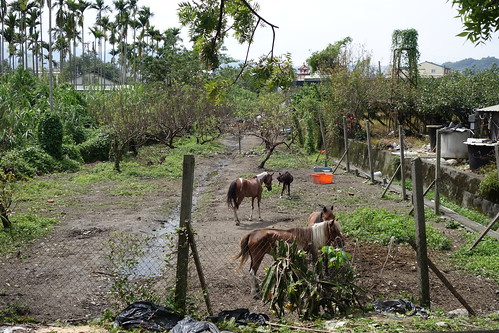
Ponies for bringing in the crowds on weekends.They park them in front of a local restaurant/cafe.

Too lazy to blog, too rainy to ride. I think I'll just go sink some battleships in World of Warships. Meanwhile, enjoy some links...
_______________________
Don't miss the comments below! And check out my blog and its sidebars for events, links to previous posts and picture posts, and scores of links to other Taiwan blogs and forums!
Sunday, August 16, 2015

The Once and Future Soong

random20.jpg
Wherever you are, there are wedding photos.

The latest Taiwan Indicators Survey Research (TISR) poll shows that Hung is now at 13.9% support, consistent with other polls. With Hung fading and unlikely to recover, the race is shaping up to be a two-way contest between Tsai Ing-wen and James Soong, a mainlander and KMT heavyweight who left the KMT to found the PFP and run on his own in the 2000 election, which he nearly won. How well Soong does will depend on his ability to attract faction politicians out of the KMT and into his party. To do that, he is remaking himself once again...

Frozen Garlic describes how Soong, who had until his appointment as Provincial Governor been little more than a standard KMT party insider, changed himself into a real politician....
However, as governor, Soong completely reinvented himself. He claims that he followed the example of his mentor, CCK, by getting out of his office and meeting with ordinary people. In fact, Soong did travel all over the island, meeting with regular people. Less obviously but more critically, he also met with lots of local politicians. In fact, this was the key to Soong’s governance model. Instead of sitting in an office, letting other people make financial decisions, and approving the paperwork, Soong went to township mayors, asked them what they wanted, and personally approved the funds. In doing so, he created an image of a compassionate leader who would do whatever was needed to solve problems. He also created a group of local politicians who were politically in debt to him personally. Township mayors are nothing to sneeze at. They control the local mobilization networks and distribute quite a bit of patronage. Back in those days, people who had descended from the central bureaucracy simply didn’t engage local people as an equal, but Soong actually wanted to listen to their problems and work with them to get things done.
Better than any other mainlander politician, Soong understands that the colonial rule of the KMT depends on its ability to manage and placate its Taiwanese support networks, and he is a master at positioning himself as a speaker for the Taiwanese KMT. Like Chiang Ching-Kuo, he cultivates a Taiwanese power base as an alternative power base to the cliques among the high-ranking mainlander politicians.

 In 1994 the Provincial Governor position became elected, says Frozen, and Soong again showed masterful political skills. Attacked by the DPP for not speaking Taiwanese, Soong learned it, then picked up a little Hakka and some phrases in aboriginal tongues. He won the election handily. His recovery was amazing -- he'd resigned in 1992 as KMT Sec-Gen to take responsibility for the KMT's poor showing in the Legislative Elections that year and initially no one thought Soong would win. The Provincial Governorship transformed his political career.

When Lee Teng-hui became president, Soong was one of the men who'd supported him against the KMT bitter-end authoritarians led by Hau Pei-tsun, the "non-mainstream" faction. But as the 1990s drew to a close, Lee turned against Soong and began to promote Lien Chan. To me the reason for this is clear: Lee knew that the popular Soong could lead a resurgent KMT to victory and maintain that party's grip on power, a grip Lee was committed to destroying. So he promoted the ungainly, unpopular Lien Chan over Soong to ensure the KMT's defeat. That is a common conspiracy theory among KMTers, and I see no reason to doubt it.

Although initially, as Froze recounts, Soong was more popular than the DPP's Chen Shui-bian or the KMT's Lien Chan, the Chunghsing Bills Scandal hurt him, and Chen squeaked through with a 3% victory in 2000, with the KMT candidates collecting 60% of the vote in total. Lien and Soong eventually mailed in their campaign in 2004 and blew that collective 20%  advantage. How has Taiwan's electorate shifted? Together the two mainlander candidates at the moment are polling at 35% of the electorate.

The 2000 election also featured Soong attempting to remake himself. This classic 1999 interview in the Washington Post with "democratic reformer" Soong is another milestone in the awfulness of Beijing reporters working on Taiwan:
At the center of a preelection brawl is James Soong, a 57-year-old powerhouse in the ruling Nationalist Party, whose businesses have made it the world's richest. He is also an architect of Taiwan's democratic reforms.
Frozen notes that Soong was a hardline unification supporter in the Chen era. He was always that way. In the WaPo interview Soong shows a deep understanding of the usefulness of democracy, and also says that Taiwan should have a plebiscite on any agreements with China (note how many of his positions were DPP policies). Unlike most mainlander politicians, Soong has mastered the knack of invoking democracy without sounding insincere; indeed, his ability to project sincerity and interest in others is one of his greatest political strengths. In 2000 Soong also positioned himself as a champion of Taiwanese:
Despite the fact that both the KMT's Lien Chan (連戰) and the DPP's Chen Shui-bian (陳水扁) have expressed their willingness to visit China if elected, Soong voiced a decidedly conservative opinion.

"If China refuses to respect the dignity of the Taiwanese, I would not visit China if I am elected. If Taiwan's people fail to iron out their differences, what subject can we talk to the Chinese about?" he said.
Recall his 50 year peace proposal? He said that it should be signed as the "Republic of China", a position similar to that of Hung Hsiu-chu's peace treaty today. It was similarly panned by critics.

Soong has always made democratic noises, but a wonderful piece at Thinking Taiwan by the always awesome Anonymous observes....
As professor Jim Lee (李筱峰) has written in 1994 and 2003 essays (which have recently gone viral on the PTT board and make up the source material for this article), Soong played a major role in suppressing freedom of the press and freedom to use the Taiwanese language during his five-year-and-seven-month tenure as director-general of the Government Information Office (GIO) from 1979-1984. At the GIO, Soong played a major role in suppressing democratic publications and free journalism in an era that included the Formosa Incident, pressure on emerging dangwai (黨外, “outside the KMT”) and democratic movements, and apparent secret police murders of “enemies of the state” like Professor Chen Wen-chen (陳文成) and the family of Lin I-hsiung (林義雄). He also helped implement the elimination of the Taiwanese language from broadcast media.
Until his election to the Provincial Governorship, Soong had always been a loyal servant of the KMT ruling class. Indeed, he was one of 60 individuals selected by Lee Huan at the direction of Chiang Ching-kuo in 1976 for the high level training course at the elite party school, an indication that quite early he was seen as being ideologically sound enough to be groomed for higher things. That class also included Lien Chan and Wu Po-hsiung.

In 1999 I was teaching at a private university in a small southern town. The university was owned by a deeply pro-Soong family, and the staff was also strongly pro-Soong. "Why do you support him?" I asked a group of them once. "Because he is a gentleman." I read that as "he is of the class we perceive as being proper to rule over us." Things are different today. The Taipei Times noted:
In addition to post-Sunflower movement (and possibly post-anti-curriculum movement) younger people more willing and eager than ever to learn about the nation’s intentionally buried history, along with the fact that the PFP and its leader are more likely than ever to crowd out the KMT’s support in the coming elections, it is not surprising that the questioning is more vociferous.
The internet has made Soong's long history of repression and ardent pro-unification positions easy for anyone to access. And you know they will.

It's probably too late for Soong to win the presidency, but it will certainly be fun to watch whether and how faction politicians realign themselves between the KMT, the PFP, and independent runs as Hung's support continues to slowly dwindle to the Deep Blue core. Break out your popcorn! The fall election seasons promises to be full of KMT rancor and desperate attempts to replace Hung, along with the sincerity and laughter of the once and future James Soong.

REF: Don't miss this fine article on Soong from longtime Taiwan observer Bo Tedards. 15 years old, but still great.
_______________________
Don't miss the comments below! And check out my blog and its sidebars for events, links to previous posts and picture posts, and scores of links to other Taiwan blogs and forums!

Friday, August 14, 2015

1950s 1 min film from missionary group on aborigines

1950s Missionary film on bring Christianity to the aborigines
_______________________
Don't miss the comments below! And check out my blog and its sidebars for events, links to previous posts and picture posts, and scores of links to other Taiwan blogs and forums!
LOLs and Polls

DSC07526
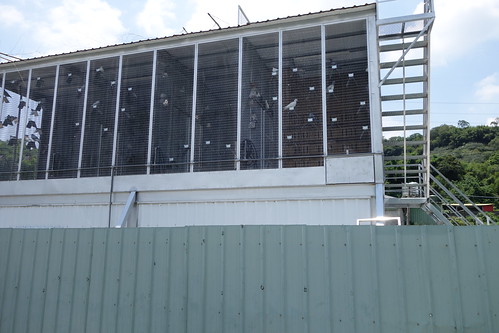
Pigeon coop in Miaoli

Polls
Solidarity on Twitter:
ジェームス ‏@jmstwn: Hung's pro-unification views a problem for central and southern legislators, while her support of 4th nuke plant a headache for northerners
A few polls out this week. First, the Taiwan Competitiveness Forum, which is a laughably pro-KMT organization, commissioned a poll showing what everyone knows, that Soong's presence in the race hurts the KMT (FocusTaiwan). The poll had Tsai over Hung 36 to 26 to Soong's 15. Note that it is an outlier, most polls are finding Soong ahead of Hung, as the Taipei Times observed. The poll head observed:
When asked about Soong's impact on the race, 73.1 percent of respondents said Hung's support base will be eroded while 8.5 percent said he will draw votes away from Tsai's support base.

.........

An overwhelming majority of respondents (96.6 percent) said Soong's participation would make a Tsai victory more likely, compared with only 1.9 percent who felt his entry into the race made it more likely that Hung will win.

TVBS polls were in the news this week. @FormosaNation sent the above images around Twitter. The upper image shows Tsai ahead of Soong and Hung 38-20-17 (compare to the TCF poll above), but more importantly, Tsai is ahead in all important geographic areas of Taiwan. The poll also had Hung's support falling in crucial over-40 age brackets. It's becoming a two-way race between Tsai and Soong at the moment, with Hung threatening not merely to lose, but to become irrelevant. But it's early, and Soong still needs the support of the local factions if he is going to mount a serious campaign. Otherwise both Soong and Hung could fade into irrelevance.

Another flap this week was the nuclear flap, in which KMT Chairman Eric Chu said that the goal is a nuke free nation, while KMT Candidate Hung calls for nuclear power plants (Taipei Times). Not surprisingly, Chu is mayor of new Taipei city, where three of the nation's four nuclear generating stations are located.

Hickey Flap
Dennis Hickey, the longtime pro-KMT commentator, contributed some dreck to The Diplomat on how the students protesting the curriculum were a Middle Eastern rent-a-mob (several people attempted to reach out to Hickey about this) and quoting the KMT's international spokesman as if he were asserting facts. The KMT then attempted to use the article to show that the US government didn't like DPP Presidential candidate Tsai Ing-wen (DPP response)(J Michael Cole at Thinking Taiwan) in the best "foreigners validate" style. It seems obvious that the KMT fed Hickey that information and then used it against Tsai, a tight little loop of faux validation. Not the first time...

Tainan and Prosecutor Transfers
Three prosecutors on the bribery case against Speaker Lee of the Tainan City council have been promoted. Some pan-Greens contended it was the usual transfer of people who find against the KMT, but the Taiwan Law Blog observed that evidence for that is  not strong. Yet, Tim maddog reminded me that such transfers/promotions occurred when judges found against the KMT in the Ma and Chen cases...

J Michael Cole wrote on the Control Yuan's impeachment of William Lai, the popular mayor of Tainan. Lai appears to have set himself up thanks to his stubbornness, but he does have a strong point. Note that Speaker Lee, who allegedly committed bribery to win the speaker's seat, was arrested while attempting to flee to China -- yet makes bail even though he is an obvious flight risk, a common pattern among alleged KMT lawbreakers. Speaker seats are much sought after since they determine the agenda, which is going to include lots of public construction contracts that are perfect for cronies. Because of the way Taiwan institutions are set up, where people on committees defer to the wishes of committee heads as if they were dictators, the speaker probably has even more power than it appears on paper. Frozen Garlic ripped the Control Yuan on this a couple of weeks ago.

DPP
Candidate Tsai Ing-wen announced that the popular mayor of Kaohsiung, Chen Chu, would be her campaign manager. Chen Chu is widely said to be a candidate for the Veep slot, or more likely, for the Premiership once Tsai is elected. The reason I haven't been blogging much on the DPP is that party strategy for the moment is to let Hung Hsiu-chu talk herself into irrelevance.

________________________
Daily Links:
_______________________
Don't miss the comments below! And check out my blog and its sidebars for events, links to previous posts and picture posts, and scores of links to other Taiwan blogs and forums!
Japan-era Airplane ID chart

Issued in Taiwan by Japan during the war, an airplane ID chart.
_______________________
Don't miss the comments below! And check out my blog and its sidebars for events, links to previous posts and picture posts, and scores of links to other Taiwan blogs and forums!

Monday, August 10, 2015

Post Typhoon shorts and links

Solidarity.tw sent around this pic of cosplayers using the downed trees left by Soudelor as props... it could have been worse. There's plenty of damageporn around the net, easy to find. I'm not linking to any. Except for a few mountain communities that were pretty hard hit, especially scenic Wulai, it was a pretty moderate typhoon, blowing things around and raining hard. I drove home on the motorcycle, was nearly blown down a couple of times.

Lots happening. China's economy is slowing, even as Taiwan's exports are falling. That's bad news for locals. Until the US restores its middle class with a high minimum wage and universal health insurance and Europe gives up its austerity madness, the world economy will continue to slide. This will not be good for political stability in Asia. At home Taiwan's economy still suffers from the problems we've seen for the last two decades, says the National Audit Office:
Taiwan's economic growth was in line with government predictions, the NAO said, referring to results from the 2014 government general report, yet the labor market still sees low pay and overworking. Both factors result in an unfavorable environment for retaining or attracting talent, said the NAO.
Everyone in Taiwan with skills knows that they can go elsewhere and find work that stops at 5 o'clock and wages that enable them to raise a family. The Ma government, despite controlling both the legislature and the executive, has done nothing about wages, cost of living, etc. Why do you think everyone views the KMT with disgust?

James Soong, just entered the race on Thursday, wants Ko Wen-je, the current Taipei mayor, to be his Veep candidate. Ko has said no several times already. Lots of people are speculating about what will happen, but fundamentally, it's not that difficult. (1) A bunch of legislators will leave the KMT and join Soong. The PFP will swell, the KMT will shrink. (2) Wang Jin-pyng will lead a group of Taiwanese legislators out -- lovin' the way that Soong's attacks on the KMT for holding Taiwanese in contempt reveal the way things are among the mainlander ruling class -- and the PFP will do well and the KMT will take a huge blow. (3) No one leave the KMT.

No matter how you slice it, it's temporary. Eventually, if the KMT doesn't get lost in its ideological wilderness, it can recover some of those factions, if not the legislators themselves. Cold hard fact: Soong can't win, which means that, unless (1) or (2) happens in abundance, his campaign will gradually become irrelevant and Hung will pick up steam as pan-Blues reluctantly decide she is their only choice (a huge block of Blues will stay home, in that case -- recall the 2004 legislative election when 600,000 Blues stayed home). Another one: Soong is 73. As soon as he dies, the PFP withers to a Taiwanese faction alliance, and then to nothing. Every Taiwanese legislator can see these facts and unlike the KMT ruling clique, they are politicians without ideological crosses to sacrifice themselves on. My bet: most will stay in the KMT, as will Wang Jin-pyng.

In Taiwan politics since 1950 the KMT has struggled to suppress cross-regional alliances of local factions from forming -- since, in one sense, that's what the KMT is, so any alliances of Taiwanese threaten its power and, at the same time, its power base. Perhaps out of this wreckage something like that might emerge, or the PFP might grow into that in a decade, but I rather expect it will shrivel to meaninglessness like the New Party. At the moment the best positioned party for the long-term is the DPP...

The pan-Blue camp, distressed at the splits among the Blues, keeps generating rumors that Chairman Eric Chu will somehow replace their hopeless candidate Hung Hsiu-chu, who seems to relish her "death before dishonor!" role of losing KMT candidate. The KMT news organ reports that she maintains she will never be replaced. Happy to hear that. The Taipei Times had a more thorough report on the same topic, with comments from KMT legislators worried about Soong. Solidarity on a KMT legislator who dropped out to find meaning of life.

Key news: the government is running scared. Although university and high school teachers remain a politically cowed group as a whole, though there are wonderful exceptions, it's not enough: the government is proposing "politically neutral" education.
Premier Mao Chi-kuo (毛治國) last week suggested the possibility of drafting a political neutrality in education act, and said he hoped that, with the establishment of a transparent and credible mechanism, the educational environment would not be dominated by a single ideology.

Referring to a dispute over controversial changes to high-school social studies curriculum guidelines, which critics say reflect a “China-centric” view, Mao suggested at a Cabinet meeting on Thursday that by adopting such an act, political neutrality in education would have a legal basis, and educational content would not be dominated by a single specific value.
.
By "politically neutral" the premier means "pro-KMT." When my son took his Taiwan history class in college, the teacher opened the class by saying that Taiwan had experienced four waves of colonization: Dutch, Qing, Japanese, and KMT. The KMT would like to rule out statements like that, and laws like this are aimed at it. They would also like to repress activist teachers, like this guy who actually won NT$300,000 from the city of Taipei for being beaten by police during the Sunflower Occupation last year (progress!). The KMT would also like to fence in the DPP's ability to change the curriculum, and a law like this is just the ticket. Scary, eh?

That's why the DPP must win the legislature.
__________________
Daily Links:
_______________________
Don't miss the comments below! And check out my blog and its sidebars for events, links to previous posts and picture posts, and scores of links to other Taiwan blogs and forums!

Friday, August 07, 2015

Taiwan and Cocaine in the Japanese era

eedafgh.jpg
Fill er up.

There's a blurb in George Kerr's immortal Formosa Betrayed where he discusses the tons of coca leaf that vanished when the KMT took over Taiwan in 1945. That little remark is a clue to vast network of coca growing and processing that helped fund the Japanese colony in Taiwan, but was also part of a larger worldwide explosion of coca growing in the colonies of imperial powers of Europe as well. Consider:
The rapid rise of the Dutch to prominence in the world coca and cocaine trades took interested parties by surprise, especially the Peruvians, who until 1900 felt they enjoyed a natural birthright to the world coca market. In 1904 the Dutch island of Java (now part of Indonesia) exported only 26 tons of coca leaf; this figure soared to 800 tons in 1912 and 1,700 tons in 1920, glutting the world the world market. The Dutch built an especially productive and integrated industrial cocaine regime, but it was dismantled by decree almost as quickly as it arose.(p332)
The British also took an interest in coca production in India, but German chemists produced the cheapest cocaine out of Peru, driving most other nations out of the business at the turn of the century, and making the nation the world center of coca leaf and cocaine production. Even the Japanese bought land in Peru, and a thriving expat community helped run the cocaine business in that country.

According to the Gootenberg book cited above, Japan's interest in cocaine grew out of the State's involvement in the production of drugs. A Japanese chemist who had worked for Parke-Davis during heyday of its production of cocaine (as an anesthetic) returned to Japan and brought his expertise in cocaine manufacture with him. By the 1910s Japan's big sugar interests in Formosa had begun to invest in coca production. By the 1930s Japan was one of the largest makers and sellers of cocaine in Asia. Gootenberg observes that you can view Japan's production of cocaine as part of the larger Japanese policy of economic self-sufficiency and state-capital marriage (recall that Japan didn't define some drugs as legal and others as illegal like the US; it had no "drug problem"), or you can see it as something increasingly sinister and illicit. The latter view predominated in the US and among nations interested in stamping out the trade after 1930.

Gootenberg writes in another paper:
By 1920, Japan itself produced more than 4,000 lbs. of cocaine, which then doubled to 8,000 by 1922 (see TABLE 4). Official figures for the 1930s shrunk to just under 2,000 lbs., if considered by some historians and contemporary League officials as doctored for international consumption. (This is a hard charge to prove, though Karch has tried by putative estimates of coca-alkaloid capacity.) Exports across Asia officially dropped to negligible levels, though complaints registered about Japanese firms and reporting, as well as cases of deliberate smuggling (such as the “Fujitsuru” and “Taiwan Governor” brand vials in India). Other specialists have noted growing diplomatic cooperation between Japan and international drug officials, at least until the invasions of Manchuria and China, when opiates became a major issue. The firms making cocaine and morphine were among Japan’s largest: Hoshi, Sankyo, Koto and Shiongo Pharmaceuticals, and enjoyed growing links to major trading trusts (such as Mitsui and Mitsubishi) and to interlocking governmental, colonial and military officials. In 1934, we know that Taiwan’s [Chiayi] district kept 694 acres under intensive coca cultivation (by Taiwan Shoyaku and Hoshi); earlier plots on Iowa Jima and Okinawa fall off the record. About 300,000 pounds of Formosan leaf were harvested annually in the late 1930s.
In yet another work, Gootenberg says that by the late 1920s Taiwan was producing 3 tons of cocaine per year (Columbia produced 350 tons in 2010 according to the UN), a figure he questions in one of his books (below). The major producers were Sankyo and Hoshi Pharmaceuticals, which combined had 684 acres under cultivation in Chiayi.  Jennings' book on Japan's opium policies in Korea says in a footnote...
By the mid-1920s, Hoshi's Taiwan plantation was producing an average of 40-50,000 pounds of dried coca leaves per year, while his Peru operation average 20-25,000 pounds a year. The raw coca was shipped to Japan for processing, and most of the cocaine probably wound up in the illicit traffic in China.
Hoshi was thick with the Opium Monopoly in Taiwan and knew Goto Shinpei. In Taiwan he bought semi-refined morphine from the Opium Monopoly, shipped it back to Japan, and processed it into heroin, perfectly legal in those days. Having vanquished the opium laws, Hoshi then branched into cocaine. Gootenberg says that Formosan coca leaf had three great advantages: the Foreign Office handed out permits for it like candy, it was much cheaper to ship it to Asia than Peruvian cocaine, and it had more alkaloids than Peruvian leaf (in fact yielded twice as much cocaine as Andean coca). Gootenberg writes:
Once the refined cocaine was produced in Tokyo, Japanese law made disposing of the cocaine an easy matter. Smugglers did not even bother to repackage the standard 700-gram packages they bought from wholesalers. As a result, the brand names of the Japanese manufacturers such as Hoshi Pharmacueticals, Dai Nippon, and Sankyo Pharmaceuticals, were as well known in Calcutta as they were in Tokyo, even though medicinal cocaine exports to India were nil. 
Hoshi would also be involved in attempting to set up cinchona production for quinine in Taiwan's mountains, cultivating the first cinchona trees in 1922 and producing the first quinine in 1934 (link).

For a period in the late 1920s and early 1930s, according to Gootenberg, the Taiwan military government took over production of cocaine at one of the local firms, supplying its own label for the packaging which said "Taiwan Governor General, Central Factory." That label eventually supplanted the other leading Japanese label in India, and the British Governor-General there complained loudly about it. The Imperial Military was deeply involved in the drug trade, as papers unearthed by the US Occupation showed, escorting tramp steamers laden with opium and apparently, carrying cocaine from Taiwan to China after the war began.

Gootenberg also presents some simple calculations based on South American and Javanese examples that the Japanese were vastly underreporting their cocaine production in Taiwan, which he contends should have been nearly 7 tons annually. The Japanese "cooked their books" as the US Occupation showed; during the 1920s Japan was importing a million pounds of coca leaf from Java alone, and Japanese also operated coca plantations on Iwo Jima and Okinawa. In fact after the 1920s Japan's problem was disposing of all this production, since cocaine became little used in medicine.

The war ended this "autonomous" Japanese sphere of cocaine production; the fact that Japan's production was beyond western ability to control was likely the real driver of US complaints about Japan's cocaine trade. The British also feared competition with opium from cocaine, while the US, the moral crusader on drug use, coincidentally had no colonies which produced cocaine.

Coca plants will grow most anywhere; it is something of a historical accident that today South America and not Taiwan or Java is the world center of the trade, a result of the US victory in WWII and Japan's destruction of the coca plantations in Java. Imagine the alternate universe where I am posting pictures of coca plants on farms in Chiayi during my rides there...
_______________________
Don't miss the comments below! And check out my blog and its sidebars for events, links to previous posts and picture posts, and scores of links to other Taiwan blogs and forums!

Economic downers

No matter how deep you are in the mountains, there's always some McDonald's trash around.

The latest economic news is in and most of it is not good. ECFA has once again boosted Taiwan's exports to new heights failed to drive growth...

Taiwan's exports have fallen for the sixth straight month:
Taiwan's exports suffered a 11.9 percent year-on-year decline in July, the sixth consecutive month in which they registered a drop, according to customs statistics released Friday by the Ministry of Finance.

July exports amounted to US$23.55 billion, while imports in that month fell 17.4 percent year-on-year to US$19.93 billion, the tallies show. The trade balance for the month was favorable, reaching US$3.62 billion, the ministry said.
This came on the heels of news that economic growth is in a long term slump, with second quarter growth the worst in three years:
Taiwan's gross domestic product (GDP) for the second quarter of this year rose 0.64 percent from a year earlier, compared with an earlier forecast of a 3.05 percent increase, according to an advance estimate released by the government Friday.
Bloomberg reported:
Taiwan’s exports have fallen in five of six months this year as demand waned in the top destinations of China and the U.S. The island’s manufacturers are also battling with mainland firms upgrading their supply chains, while local consumption has been hurt by a fall in property and share prices.

“With its heavy concentration in the electronics sector, second-quarter GDP was hurt by the unusually low level of activity in the electronics supply chain,” said Wai Ho Leong, a Singapore-based regional economist at Barclays Plc. “This was then compounded” by the stock slide, he said.
At least our Forex holdings are at record levels.

To the extent that people vote their pocketbooks, this is good news for Tsai Ing-wen. it will undermine both the KMT's claim to economic management prowess, and any promises that KMT presidential candidate Hung Hsiu-chu will make about the economy. Unlikely though it might be, it may help James Soong, if he can somehow evoke the spirit of the miracle years and Chiang Ching-kuo....

But it's very bad news for the people of Taiwan...
_______________________
Don't miss the comments below! And check out my blog and its sidebars for events, links to previous posts and picture posts, and scores of links to other Taiwan blogs and forums!

Typhoon Short Shorts

Staying dry here... tiny gusts of wind and blowing rain, but nothing serious. Typhoons just nod at Taichung. We feel a terrible sympathy for the people in the mountains, however. Tim maddog passed around this map from Weather Underground for the typhoon.

CURRICULUM PROTESTS
Before we get started, New Bloom made a handy graphic guide for the revisions to the history curriculum, both what they are, and understanding why they were made. The modern history graphic is here, the pre-modern one is here.

Two things to keep in mind: (1) the pro-China revisions are only half the problem. The other half of the problem was (2) the Ministry of Education's violations of process. Democracy is commitment to democratic processes. The students understand that -- the Ministry of Education? Not so much... to compare, Tu Sheng-cheng, the Minister of Education in the Chen Administration, compares the two revision processes in an interview.

The students wound up their protest, the typhoon giving them an excuse to leave. They claimed success, having forced the government to send the curriculum back to a "review committee" which will no doubt return it unchanged. New Bloom, which has been writing lyrically on the Occuption, observed:
Though this, of course, marks the end of the occupation itself, certainly, the movement is far from finished. However, what we might beware of at this time is that charges may be filed against student occupiers for defacing the courtyard of the Ministry of Education and for property damage, much as charges were filed against Sunflower Movement occupiers last year for damages caused to the Legislative Yuan. And what remains to be seen is what the next step of the movement will be.
The movement needs to spread to every school with walkouts, sit-ins, and teach-ins. It ain't over yet....

One thing that people have not been commenting on is that the revisions, by making the history of Taiwan totally Han-centric, eliminate the aborigines. The Taipei Times had some reporting on that. Let's hope the aboriginal communities stop voting for the KMT, which so obviously despises them...

The best moment this week was the comical affair of alleged gangsters dressing up in Imperial Japanese Army uniforms and marching to DPP HQ to protest the DPP being brainwashed by Japan. No seriously:
“We want to thank the DPP for educating the children in Taiwan to love our Empire of Japan. This is something that our own Japanese kids would not do, and something we could not force the Taiwanese to do in our 50 years of Japanizing education,” a man dressed up as a Japanese Imperial Army commander said through a loudspeaker, with a Japanese accent. “Therefore, we are here to present our certificate of gratitude to the DPP today.”
The journalist J Michael Cole has some excellent pics, here's one from Twitter. This comedy combined two great loves of locals, gangsters and skits. But recall that Chang An-le, the famed gangster known as White Wolf, spent many years in China. This may cause gales of laughter in Taiwan, but it might play better across the Strait, which may have been where it was really aimed. It does give us a glimpse of the bubble world in which these people live...

Speaking of pics, Frozen Garlic got out to take a few pics at the protests.

ELECTION
James Soong video ad: reclaim Taiwan pride. Soong's ad of himself covered with mud, symbolizing that he has been reborn from his sins, is brilliant, but appears lifted from a local artist's work. Unfortunately, he then  made a joke about having people shot as in the good old martial law days. This resulted in many vocal complaints about his joking. The arrogance of the mainlander ruling class at work... and note, though "restitution" has been made to families of the victims, no one has ever been punished.

Feeling the creeping ghost of irrelevancy, KMTers panned Soong's entry into the race, claiming he had wandered from the Holy Principles of Sun Yat-sen and (more importantly) Chiang Ching-kuo. They called for Pan-Blue unity.

Like Hung, Soong has a heavily documented past. Maddog has been reminding us of this video of Soong saying that he would lead a mob to attack and kill Chen Shui-bian if the then-president didn't respond to the demands of the nationalist protest against him. If you read Chinese, this PPT post on Soong is popular at the moment.

MEDIA
Love this FocusTaiwan (gov't website!) headline: Latest Poll Puts James Soong Ahead of KMT Candidate. What? They couldn't remember her name?
The latest poll gives Tsai Ing-wen (蔡英文), candidate of the Democratic Progressive Party, the lead at 36 percent in a three-way race, compared with Soong's 24 percent and Hung's 17 percent.
Taiwan Today spun that one really hard: Taiwan Readies for Tight Presidential Race. How tight? The government rag reported:
Hung, who garnered 17 percent support in the poll, is led by Soong at 24 percent and Tsai at 36 percent. A total of 23 percent remain undecided. Regarding the eventual winner, Hung was picked by 7 percent, Soong 8 percent and Tsai 59 percent. A total of 26 percent stated that they did not know.
Why does that paragraph strike you as awkward? Because logic dictates the leading figure goes first. Unless you have KMT logic guiding you: across the entire article, every time the candidates are mentioned, Hung's name is mentioned first. Note also that the article talks about Hung a lot, Soong a bit, and Tsai... not at all. The pettiness of KMT supporters knows no limits. It's easy to see why no one takes that magazine seriously.

Liberty Times has Tsai at 35, Soong at 24, and Hung at 29. It's going to be a long election.

Hey, whatever happened to all those "whatever happens, a woman will be president" articles in the media?

The Economist logged a piece on the curriculum protests:
Above all, the new guidelines recast Japan’s colonial rule from 1895-1945. Unlike many who came to Taiwan with the KMT, Taiwanese with deeper roots on the island often emphasise the Japanese contribution to Taiwan’s modernisation. And even when they acknowledge Japanese colonial cruelty, the violence of Chiang’s regime after Japan’s surrender often overshadows it. The new guidelines insist that what was known as “Japanese rule” be referred to as “Japanese colonial rule”; Taiwanese women forced to serve in military brothels should be properly acknowledged. That is only right. But what sticks in the craw of native Taiwanese, given the brutality of Chiang’s dictatorship, is that the KMT’s occupation of Taiwan should be described as a “glorious retrocession”.
This article is more sympathetic to the pro-Taiwan side than I had thought when I first read it; the Economist has been drearily pro-KMT in recent years. But note that although it focuses on the curriculum revisions, it omits, as Ben at Letters from Taiwan pointed out on Twitter, any mention of the other half of the problem: the black box process by which the revisions were made.

Alas, I must refer to Dennis Hickey's crazed piece in The Diplomat. Hickey writes:
Many predict that Taiwan’s Democratic Progressive Party (DPP) will return to power in 2016. The party has sought to “rebrand” itself as a “responsible” alternative to the ruling Kuomintang (KMT). But U.S. defense planners cannot help but wonder if the DPP will seek to entrap the U.S. in a cross-strait crisis in an effort to achieve its dreams of independence from China. Tsai Ing-wen, the DPP presidential candidate, has done little to assuage such fears. The candidate’s positions on many of the most important issues of the day remain opaque and unclear, especially her plans for handling relations with Beijing. And despite its lead in the polls, there are concerns that the DPP has given up on democracy. For example, it is reportedly embracing a Middle Eastern practice known as “rent a mob” and subsidizing extremists who attack Taiwan’s government ministries. This makes it increasingly difficult for Americans to sensibly argue that Taiwan is a “model of democracy.”
 Note that Hickey's citation for support of Tsai's weaknesses are two articles in the Diplomat by the KMT international spokesman Eric Huang. Hardly a neutral assessment.

But the latter half of the paragraph, in brown?

Sadly, I've lost all respect for Hickey as a commentator, analyst, and above all, human being.
______________
Daily Links:
_______________________
Don't miss the comments below! And check out my blog and its sidebars for events, links to previous posts and picture posts, and scores of links to other Taiwan blogs and forums!
Thursday, August 06, 2015

Soong: He's In!

Stalls await owners in front of a major temple in Changhua.

Months of exciting speculation are now over -- with more months of exciting speculation ahead!

Yes, James Soong, former KMT heavyweight, leader of the People First Party (PFP), a sort of KMT-lite, has officially declared his candidacy. FocusTaiwan reports:
James Soong (宋楚瑜), chairman of Taiwan's minority People First Party (PFP), announced Thursday that he will run in the presidential election to be held next January to help the country rise above political confrontations and to "find a roadmap for Taiwan's future."

Soong, 73, made the announcement as Tsai Ing-wen (蔡英文), candidate of the opposition Democratic Progressive Party (DPP), appears to enjoy a healthy lead over the ruling Kuomintang's (KMT's) Hung Hsiu-chu (洪秀柱) in the race to succeed President Ma Ying-jeou, who will step down next May after two four-year terms.

Reading from a statement, Soong promised that if he wins the election, he will strive to forge a consensus among political parties in order to resolve the thorny issues that have dogged Taiwan for years.
Let's not forget what Soong is: a mainlander and supporter of "unification". He is also a canny politician and popular with the over-50 crowd. It's going to be a long campaign, but over time people will start to remember that he served the KMT security state and its dictators his whole career and that he worked to suppress Taiwanese culture and Taiwanese democracy. Stories of his alleged corruption from his time as provincial governor are going to ricochet around the media and wherever people gather to talk politics.

Polls have him splitting the Blue vote with Hung, plus perhaps picking up a few independents, leaving Tsai with a comfortable plurality of the vote. At the moment, many are saying they will vote for Soong, so he will poll well. A couple of KMT lawmakers have already gone over to him (Story of one). But remember that in 2012 he consistently polled between 6 and 10% -- then got 2.7% of the vote in the actual election.

Much will depend on how many and which politicians will follow him out of the KMT, and also what deals he can make with the DPP. The coming weeks will see intense speculation about Wang Jin-pyng, the KMT Speaker of the Legislature and Taiwanese heavyweight, as a possible Vice President or as the leader of a group of Taiwanese faction politicians who have left the KMT for the PFP. But remind your friends who say they will vote for him that the PFP is simply the KMT spelled differently -- a group of local faction politicians making a living on government patronage funding, led by a member of the mainlander ruling core.

Sound familiar?

Meanwhile, back in KMT Classic© land, Eric Chu -- remember him? He's the Chairman of the Party, although he's been eclipsed by Ma Ying-jeou, who has handed him Ma v2.0 in the form of ideological twin Hung Hsiu-chu, the Party's current presidential candidate. Today the KMT announced that Chu is Hung's "campaign chairman". I kid you not:
Yesterday evening, Hung Hsiu-chu (洪秀柱) , Deputy Speaker of Legislative Yuan and KMT Presidential candidate, said that she had requested Chu to assist her and Chu promised to join hands in her campaign. Therefore, according to Hung, her campaign office would not look for another campaign chairman; however, a campaign manager would play the role of a bridge between the KMT and Hung’s aides. Yiin Chii-ming (尹啟銘), a former Economics Minister and president of the National Policy Foundation, the KMT think tank, has been appointed Hung’s campaign manager.
Yes, Chu will be a "bridge" between the campaign and the KMT even though Hung's campaign manager is already head of the Party think tank -- the campaign is totally integrated into the Party. The Hung campaign basically handed him a title and told him to go in a corner and sit facing the wall til the campaign was over. As David on Formosa remarked on Twitter today, no one has squandered so much political capital so quickly.

Think the Economist will write again about the charismatic Chu? Bwahahahaha.
_______________________
Don't miss the comments below! And check out my blog and its sidebars for events, links to previous posts and picture posts, and scores of links to other Taiwan blogs and forums!
Tuesday, August 04, 2015

Rounding up the Student Protests

DSC07512
Small roads through the tea farms in Nantou: a pleasure.

The big confrontation occurred yesterday afternoon. TT reported:
Talks between Minister of Education Wu Se-hwa (吳思華) and students over the curriculum controversy fell apart yesterday, with students storming out of a Ministry of Education (MOE)-sponsored forum in tears.

“What in the world are these talks supposed to be?” Northern Taiwan Anti-Curriculum Changes Alliance convener Chu Chen (朱震) said. “What I see is a failure of education and a policy that has gradually moved away from the masses.
The KMT had been split on whether to hold special legislative session on curriculum guidelines, but then voted unanimously not to hold a special session. Chairman Chu, always positioning himself as a moderate, said he'd have to respect the will of the KMT. Note that Hung is on the side that doesn't want a session, and affirms control of executive over education. One can only imagine what her educational changes are going to look like. Solidarity wrote of the "unanimous vote":
Do the math. KMT legislators do not actually unanimously support this bold decision. The KMT caucus has 64 members (usually 65 but Chi Kuo-tung 紀國棟 was expelled for criticizing the party and his replacement hasn’t arrived yet). One of these 64 has openly called for abolishing the new curriculum. Another, the speaker, used political capital to try to get this session called. The party chairman himself wants such a session to be held, but with other bills included. The 15+ sitting legislators who absented themselves from this meeting (a quarter of the caucus) did so intentionally, having seen what was coming. I’d bet they are Wang, the representatives in swing districts, and the rest of Wang Jin-pyng’s 王金平 Taiwanese faction. Anyway, this goes to show that Ma and his acolyte Hung are running this party now.
Solidarity pointed out on Twitter that the KMT legislators leading the "no special session" push are from deep Blue districts. His excellent piece at Ketagalan, which summarized the protester-Minister Wu dialogue, observed:
From the beginning, this felt like the Taiwanese reincarnation of the dialogue between the Umbrella Movement students and the pro-Beijing government of Hong Kong. The fundamental problem with both discussions was that the government negotiators had no authority to compromise, and they couldn’t admit it. For Chinese nationalists like President Ma, this round of textbook revisions is a matter of long-term political life and death, as they believe the Taiwan-centered history taught since President Lee’s time is the root cause of the strong opposition the current generation of youth have against them. They feel they can’t afford to give in. In a way, the Sunflowers had it easier: They just had to block something that hadn’t happened yet, but these high schoolers need an actual reversal, and one that would lose the KMT face and quite possibly the votes of their strongest supporters.
That's basically it. The function of the Ministers, as Solidarity observed, is to hand down Party decisions. Recall that the KMT regards the government as both an extension of itself, and subordinate to itself. Since the Party is always right, the rules are for governing others. Hence the Minister's repeated bizarre claim that the process is not important since the outcome is acceptable (to the Party). For people raised on democratic ideas of rule of law and democratic process, like these students, such claims are incredible.

Indeed, the KMT news organ carried the KMT Chairman Eric Chu's assertion that the Executive was a higher power than the Legislature:
In response, KMT Chairman Eric Chu (朱立倫) stated yesterday that the power to adjust textbook guidelines belonged to the executive branch rather than legislative branch, so any extraordinary Legislative session should not solely deal with the textbook revisions, adding that bread and butter bills should also be discussed. KMT Presidential candidate Hung Hsiu-Chu (洪秀柱) pointed out that she supported the KMT caucus's decision. The Presidential Office and the Cabinet reiterated the support for Minister Wu's decision, adding that the bottomline was that the legislative power should not be higher than executive power.
The KMT Chairman pronounces, then everyone follows suit. The Word actually came down from Ma, but it is interesting that the leader who pronounces is not the Executive, but a Party head, who has nothing to with the balance of powers in the government.

Brian Hoie of New Bloom, who was with the students in the Occupation, wrote a summary of Day Five:
During the press conference students did not press that one of their demands had been for Wu to resign but Wu, for his part, stressed that textbook revisions were legal even if perhaps flawed. Wu has become an object of popularly mockery on the Internet since the meeting, however, because of a piece of footage from the meeting in which rolled his eyes in response to being questioned by a teacher, then attempting to quickly mask this through quickly smiling. We might also note that Wu was unwilling to reveal the names of those who were in the textbook revision committee. Nevertheless, the meeting ultimately came to nothing.
Minister Wu's eye-rolling quickly went viral; he said he was exercising his eyes because they were tired (h/t Solidarity). View the gif here.

The KMT attacks on the students basically involve claiming that they are DPP tools. When your ideology says you are the Party of Right, all opposition can only stem from a conspiracy of Satan, AKA the DPP. Frozen Garlic, the cynical political scientist at Academia Sinica, rebuts:
[This] charge can be dismissed relatively straightforwardly. After all, almost all accounts of Taiwan’s current student movement (except for those coming from the KMT) indicate that the students are acting on their own initiative. This has been true of all the recent protest movements, from the Wild Strawberries to the Dapu protests to the Sunflower movement. In all cases, the youth have been thoroughly disappointed by the tepid DPP opposition and have sought to take matters into their own hands. The DPP has generally voiced support more in an effort to avoid appearing totally out of touch with activists’ concerns than in an effort to guide them in any particular direction. The notion that the DPP is the guiding hand behind the students is simply at odds with almost all accounts of the factual events.
Dai Lin, whose suicide riveted the nation and inspired the young activists, is portrayed in KMT propaganda as troubled and depressed, and his suicide is explained as having nothing to do with the protests. If you can stomach it, see this CNN iReport on the Student Protests, with KMT-slanted reporting. It's vile.

These protesting students have grown up entirely within the curriculum changes since the post Lee Teng-hui era. Liu and Hung (2002) describe the changes of that era:
In the 1993 Social Studies syllabus, the historical content was outlined in a concentric pattern: Taiwan-China-world. The scope of ‘the native place’ (xiangtu) was confined to county, town, and city. Taiwan itself was no longer defined as a mere ‘local community’. The affiliated islands, Kinmen and Matsu, were also included in the textbooks. The coverage of Taiwanese history was expanded to a whole book. Chinese identity and Taiwanese identity coexisted in the curriculum, and the distinction between the two was made clearer than it had previously been. For example, the title ‘the Chinese living environment’ was replaced by ‘the living environment in Mainland China’, thus distinguishing political China from geographical China—or ‘mainland China’ from Taiwan.

In addition, as already mentioned, the rise of Taiwanese identity has led to the establishment of two new subjects. One is ‘Native Place Teaching Activities’ for Grade 3, and the other is ‘Understanding Taiwan’ (Renshi Taiwan) for junior high level, both subjects focusing on the history, geography, and society of Taiwan. The goals of ‘Understanding Taiwan—Society’ are defined as ‘reinforcing the understanding of the social environment of Taiwan, Penghu, Kinmen and Matsu’, ‘cultivating the sentiment of love for the community and the nation,’ and ‘developing a consciousness of the ‘living community’ (sheng ming gong tong ti).’3 The goals of ‘Understanding Taiwan—History’ include ‘understanding the history of the ancestors of each of the ethnic groups in Taiwan, Penghu, Kinmen and Matsu’, although the teaching materials studiously avoid references to past conflicts between Han settlers and aboriginal tribes, instead painting a highly misleading picture of harmonious and peaceful co-existence. In the appendix to the syllabus, the significance of this new subject is emphasized: this is the first time that Taiwanese history has ever been taught as a formal subject at junior high school level.
Note that the rise of the Taiwanese identity was already in place prior to the new curriculum. As an acquaintance observed, when he returned to Taiwan in 1991 there were already bookstores dedicated to Taiwanese history and culture. When I was studying Chinese that same year in Taipei, I purchased the old Shifan University texts, which still used phrases like "communist bandits" and "retake the mainland". But I bought them off the junk pile for 10 NT each; new texts more locally centered were already taking their place.

Chris Hughes tabulated some of the changes that took place as the Chen Administration assumed power in 2000 (link):
The appointment of Professor Tu Cheng-sheng (Du Zhengsheng), an LSE alumnus as head of the National Palace Museum in May 2000, has been even more controversial. Tu had in fact been singled out as one of the chief architects of ‘de-sinification’ well before the Chen administration came to power because he had been influential in steering a re-orientation of the school curriculum and teaching materials to learning more about Taiwan and less about China in the late 1990s.6 Having stewardship over the museum that was once used by the KMT as a kind of cultural umbilical chord linking Taiwan to China’s grand tradition, Tu incurred the wrath of many critics when he proceeded to label the Chinese artefacts as ‘Chinese’ and established a gallery devoted to Taiwanese culture.

The reorientation of education that Tu had begun under Lee Teng-hui also continued under the Chen administration. Already in March 2001 the Ministry of Education had produced a policy on ‘Nativisation of Education’ (bentu hua jiaoyu), according to which junior and middle school pupils have to select to learn a ‘native language’ (xiangtu yuyan) from Hokkien, Hakka and an aboriginal language. The controversial Know Taiwan (renshi Taiwan) textbooks became teaching material for history, geography and social studies from the academic year beginning in August. A Native Education committee (bentu jiaoyu weiyuan hui) began to revise the Know Taiwan curriculum in 2002 and the following year published a draft outline for a new high school history curriculum in which Chinese history since the mid-Ming Dynasty became part of ‘World History’. An increasing emphasis on native culture can also be seen in the way that the Ministry of Education has actively promoted and funded the establishment of departments of Taiwan Literature in national universities since 2000. When Tu Cheng-sheng was appointed Minister of Education at the start of Chen’s second term in May 2004, accusations of ‘de-sinification’ reached a new height of intensity.
The "Getting to know Taiwan" of the Lee era was removed from the curriculum under the Chen Administration, which instead spread Taiwan across the entire curriculum (link). Hughes also notes that the Chen Shui-bian Administration put a halt to the military indoctrination of young males in KMT ideology, an important source of KMT control. Taiwanese history was added to the civil service exam, and the government made great efforts to push Taiwan Studies at home and abroad. Chen's changes drew protests from Beijing.

Another change in the educational system is that there are now new outlets and new ways for people to enter college, getting around the old testing system. The function of the old testing system was powerfully authoritarian. By creating intense competition for coveted places, it prevented the students from building bridges to each other (and if they did, the Party maintained political officers in the schools to monitor the students' political beliefs). The massive homework loads reduce time for young people to learn and act on politics, while the parents reinforced the System's control by forcing the kids to do the home and shoving them in cram schools seven days a week. All of this is slowly changing...

The Chen Administration made subtle but powerful changes in Taiwanese life that have shaped the way these students rooted their identity in Taiwan. It vastly expanded cultural programs and also focused on the environment in its sloganeering, fostering a sense of shared place and culture. It also engaged in "Branding Taiwan" (link):
Believing that culture is economically beneficial, the CCA joined forces with the Industrial Development Bureau (Ministry of Economic Affairs) to encourage the development of creative industries, funding modern designs to present Taiwanese culture. In a speech about future CCA policy, then chairwoman Tchen Yu-chiou openly asserted that “using branding techniques to build and introduce an image of contemporary Taiwan to the world, cultural and creative industries will be the most important force.
Don't laugh; people identify with brands, sometimes very strongly. The branding created an awareness of Taiwan as distinct that made a foothold in minds abroad, which was also reflected back to Taiwan as validation by outsiders, a virtuous cycle of Taiwan identity building.

DPP policy thus was a multifront attack on the monolithic, faux, totalizing, authoritarian version of Chinese culture offered by the KMT and CCP. It was highly successful.

The new leisure culture, made possible by shrinking the work/school week from 6 days to 5, has also helped grow Taiwaneseness. "Being Taiwanese" for the 45 and under generation now includes the physical actions of climbing Jade Mountain, swimming Sun Moon Lake, and biking around the island. This involves inscribing oneself physically on the terrain while immersed in it: grounding local identity in a relationship to the land. Many of these kids will go on to do all these things.

They are the most active, socially aware, and involved generation in Taiwan, ever. I bless them every day.

REF:
2002. M. Liu, L C. Hung. "Identity issues in Taiwan’s history curriculum". Int. J. Educ. Res. 37 (2002) 567–586
_________________
Daily Links:
_______________________
Don't miss the comments below! And check out my blog and its sidebars for events, links to previous posts and picture posts, and scores of links to other Taiwan blogs and forums!
Monday, August 03, 2015

FAPA Statement on the Curriculum Protests


For Immediate Release
Washington D C - July 31st 2015
Contact: (202) 547-3686
FAPA statement on heavy-handed handling of the student protests against history textbook amendments by the Ma administration


Climbing through the weekend

Aboriginal inhabitants? What aboriginal inhabitants? Han-centric history is just one aspect of Taiwan's Han-centric thinking.

This week did some wonderful rides out of my Taichung base, stretching my injured legs a bit. Felt good. Thursday went the length of Baguashan and down Fengbai Road into Ershui. Saturday did the awesome ride through the Nantou tea areas on the 149, 212, and 151 to the 162A with its spectacular descent. Sunday went back to an old favorite of mine, Pinglin Road. Come below the break to enjoy...

A few candidate posters....

A candidate in Fengyuan in Taichung has large, professional looking posters. Click read more to see more....

Sunday, August 02, 2015

Student Protests Rivet Nation


Via New Bloom: video history of student protest at MoE

Keeping up: New Bloom's facebook page is constantly updated. They put together and posted the video above. There's a live feed here. Note that New Bloom has posted that there is a water cannon vehicle present, presumably because it will be used.

Rocked first by the suicide of Dai Lin, Taiwan was then shocked by the open letter from his mother. Solidarity has the translation, which you should read. I can't read it without crying at the naked realization at the end...
The one who’s sick is this society. It’s the adults. It’s the parents who were brainwashed, like me. You were a little prince who always had pure thoughts. You completed your mission. You made public opinion boil over all right. You’ve made us brainwashed adults rethink things.
She's saying what so many of us have been saying for ages: the over 45 group is the most timid, brainwashed, strawberry generation of them all. It's not a coincidence that support for KMT presidential candidate Hung Hsiu-chu is strongest in that group. She also wrote an open letter angrily denying KMT claims that the DPP was operating the students. Remember, in the KMT ideological bubble, only conspiracy by the evil enemies of Chineseness can explain anti-KMT stances, because the KMT is always right.

The convener of the curriculum committee that made the changes was on a political talk show. See why the changes were made (Taipei Times):
Asked what kind of impact the curriculum adjustments had on the KMT’s campaign for next year’s presidential and legislative elections, Wang said they had created a strong cohesive force among pan-blue supporters.

“A lack of ‘national goals’ is a critical problem facing the KMT. The party requires more convincing rhetoric to persuade the public and that was exactly what we aimed to achieve through the curriculum changes,” Wang said in the article.
Were the changes made for educational purposes, or to bring the curriculum in line with the Constitution, as KMT presidential candidate Hung has claimed? Nope: according to the leader of the changes, they were purely political and overtly pro-KMT. What's scary is that these people are so deep in their bubble that they thought asserting that the capital was Nanjing was "convincing rhetoric."

My man maddog was having a good laugh on Twitter about the changes, putting up this image:
Don Rodgers put his finger directly on the fundamental issue at Thinking Taiwan:
The Ma Ying-jeou (馬英九) government is once again facing off against a group of young protesters who oppose the government’s policies and procedures. The current protest is directed at the government’s efforts to change the content of history textbooks. This is another in a long series of protests that addressed a wide range of issues including property rights, freedom of the press, labor rights, environmental issues, and most famously opposition to the Cross-Strait Services Trade Agreement (CSSTA) that led to the Sunflower occupation of Taiwan’s legislature last year.

The young protesters in Taiwan are frequently described as being “anti-China” and driven by their strong sense of Taiwanese identity. This is partially accurate. The young people in Taiwan are definitely strongly Taiwanese identified, but they are not necessarily “anti-China.” To understand these protests it is essential to understand that the young are strongly democratic. They were born into and fully believe in democracy in their country. Thus, it is not surprising that one thing that the protests have in common is anger over the government’s lack of transparency and respect for democratic procedure. It is therefore more accurate to describe the students as “pro-democracy” or “anti-authoritarian” than “anti-China.” It is also important to note that a significant percentage of the population in Taiwan supports the student protesters.

Since Ma took office in 2008, his administration has demonstrated neither a strong interest nor any level of competence in managing domestic politics. Ma’s government has been insular and arrogant, frequently responding to criticisms with a condescending attitude. Decisions are made behind closed doors with little if any effort to consider the preferences of the voters. The decisions are then foisted upon the people with the message that the government knows best and the people must agree.

It is not surprising, then, that the young protesters have consistently criticized the government for its “black box” decision-making procedures. For example, in an April 2014 interview, Wei Yang (魏揚), a leader of the Sunflower movement stated, “The government and the civil society had no communication. There were no comprehensive impact assessments. There were no deliberations about the trade pact. We called it a black-box operation, and this is outrageous to the people.”
I've written several times about how the Taiwanese have incorporated democracy into their identity, and among the young, this incorporation is a fusion. This generation, I would always add, is also the first in the modern era to grow up with poorer economic prospects than the previous one. These ideas of democracy are butting up against a school system designed for authoritarian control from start to finish.This protest is only the beginning of the long struggle against it, one in which many parents are engaged as well, attempting to find or construct democratic, human-centered alternatives.

Wuer Kaixi, the Tiananmen dissident who is now running for office in Taichung, published a great piece at Thinking Taiwan this week saying that it is time for Taiwanese to take things into their own hands. It observes:
Actively changing the constitution and the laws to recognize the PRC will come at a small price and will also give a voice to the people, challenging China and the West to release Taiwan from its shackles, while also fundamentally changing the way we think about cross-strait policy. Compromise is not the way forward, and patience is simply a delay tactic. Only by taking the initiative can the people of Taiwan take control of their fate.
It seems that, that when the KMT die-hards hype the pro-China changes to the curriculum as "according to the Constitution", they are just setting up "the Constitution" as the target for the next great youth movement.

This is only the beginning...
___________
Daily Links:
_______________________
Don't miss the comments below! And check out my blog and its sidebars for events, links to previous posts and picture posts, and scores of links to other Taiwan blogs and forums!