Showing posts with label Obama. Show all posts

Wednesday, March 15, 2017

Wash Times: Trump Administration to give arms Obama Admin blocked

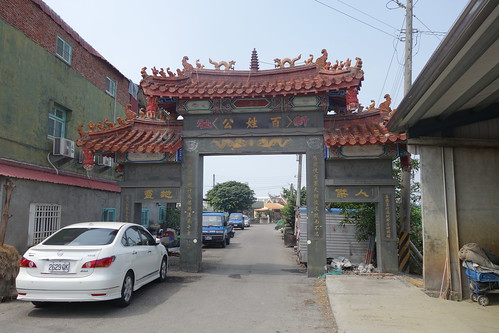
The red letters of this temple gate say "new village".

From the Nelson Report. A good example of how the Chinese shaped Obama Administration China policy via the threat of China's "anger." *sigh*. ADDED:  Rupert Hammond-Chambers said on Twitter that the Obama Administration was concerned about the climate deal with China. LOL. As if either the Trump Administration or Beijing would adhere to it.....

+++++++++++++++

A COMING TRUMP DECISION...REVISE AND EXTEND THE OBAMA ARMS SALE PACKAGE TO TAIWAN...Loyal Reader Bill Gertz has an interesting piece in The Free Beacon with a headline accusing President Obama of a last-minute cave-in to China, cancelling a $1-bil arms sale package. But Your Editor's reading of the piece is it seems to report that on balance, the cancellation is really just a "postponement", since Obama assumed the Trump folks will certainly come up with their own.

And the Gertz argument also encompasses the possibility that Obama was spooked by the Tsai-Trump phone call and didn't want to add to Beijing's angst, and thus prompt a dangerous over-reaction from Xi...surely a legitimate concern?

CSIS's Bonnie Glaser agrees with some of that, followed by Bill's original piece:

Chris,
I think Gertz is right that State and Defense approved the package and the White House killed it. It is possible that the decision was made after the Tsai-Trump phone call not to notify Congress of the pending sale. But it is also possible that the Obama administration did not want to approve an arms sale in its final days because it didn't want to offend China and undermine the President's legacy with Beijing. It doesn't make sense to me that Obama officials would have wanted to leave the package on the table for the next administration. The Obama team anticipated that there would be a lot of friction with China under Trump. It would have made more sense to approve the package in December so there would be less pressure on the Trump administration to make an early arms sale, which would further exacerbate tensions.

Obama White House Blocked Needed U.S. Arms Sale to Taiwan
Trump set to sell more arms

BY: Bill Gertz
March 14, 2017 5:00 am

The Obama administration blocked a $1 billion arms sale to Taiwan in December that was needed to improve the island's defenses despite approval from the State Department and Pentagon, according to Trump administration officials. The scuttling of the arms package was a set back for U.S. and Taiwanese efforts to bolster defenses against a growing array of Chinese missiles and other advanced weaponry deployed across the 100-mile Taiwan Strait.

The action coincided with a controversial pre-inaugural phone call Dec. 2 between then-President-elect Trump and Taiwan's President Tsai Ing-wen. It could not be learned if the arms package, which was ready to be announced publicly in December was derailed by the Obama administration because of the phone call.

The new Trump administration is now preparing to provide more and better defensive arms to Taiwan, said administration officials familiar with internal discussions of the arms sale. The new arms package, however, is not expected to be made public until after Trump meets with Chinese leader Xi Jinping next month. White House officials said the meeting is set for early April at Trump's Mar-a-Lago estate in South Florida.

Secretary of State Rex Tillerson also will visit China later this month. Taiwan is expected to be a major topic of discussion for both the summit and Tillerson's visit. "There's a process for these things that's being followed," a White House official said of the arms package. "The Trump administration takes America's commitment to Taiwan's security very seriously."

Other officials said the arms package was set for release to Taiwan and formal notification to Congress in December. But National Security Council staff officials blocked it, setting back the process of supporting Taiwan with defensive arms considerably. The approximately $1 billion included parts and equipment needed for the Taiwan military's ongoing modernization of its arsenal of 1980s-era F-16 jet fighters along with additional missiles.

The approved package was held up by Avril D. Haines, the Obama White House deputy national security adviser. Haines did not return an email seeking comment. Former Obama administration spokesman Ned Price confirmed that the administration held up the arms package. He told the Washington Free Beacon that neither Haines nor others in the Obama White House "unilaterally blocked the package that was under discussions, which was relatively modest."

"In consultation with State and DoD, the Obama administration decided not to move forward with it in the final days of the administration," Price said, adding that one factor was that "we thought it would be a useful package for the next administration to pursue in their time because it was well-calibrated to strike the balance we typically try to achieve consistent with our commitments under the Taiwan Relations Act." One administration official said the package also included communications, intelligence surveillance, and reconnaissance gear that would bolster the Taiwan military's command and control systems.

This official said one positive aspect of the failure to send the latest arms is that pro-China officials in the U.S. government who oppose helping Taiwan will no longer be able to argue internally that the United States had fulfilled its obligations under the 1979 Taiwan Relations Act with the package. The act requires the United States to provide Taiwan with defensive weapons. "Now we can start from scratch with a truly useful arms package once the assistant secretaries are in place," the official said, referring to working-level political appointees at the Pentagon and State Department.

State Department spokesman Mark Toner had no immediate comment. pentagon spokesman Cmdr. Gary Ross said he does not discuss "pre-decisional matters."

"The objective of our defense engagement with Taiwan is to ensure that Taiwan remains secure, confident, free from coercion and able to engage in a peaceful, productive dialogue to resolve differences in a manner acceptable to people on both sides of the Taiwan Strait," Ross said, noting U.S. arms sales support that goal. "We strongly believe that our policy has contributed to stability in the Taiwan Strait by providing Taipei with the confidence needed to pursue constructive interactions with Beijing."

The official Taiwan government office in Washington had no comment on the arms package. Taiwan officials are looking forward to working closely with the Trump administration in upgrading defenses. The Taiwanese are considering the development of indigenous fighter aircraft and submarines and are hoping the United States can provide technology for the arms.

Former State Department official John Tkacik said the failure to release the arms package in December was a mistake. "It is truly alarming that the White House, in its last month, would ignore a defense transfer recommendation endorsed by both the State and Defense Departments, especially after the incoming president had already signaled his support of a strengthened security relationship with Taiwan," Tkacik said.

Tkacik said it is likely that Obama administration officials in charge of Asia policy, after eight years of giving the Chinese free rein in Asia, were unhappy with Trump's tough posture toward Beijing. "If the new National Security Council can't move forward afresh with strengthened defense supplies to Taiwan, given State and Pentagon recommendations to do it, I'm afraid the new administration will lose its momentum, like Obama's people did, and simply resign itself to letting Beijing take over in Asia," he assed.

Randall Schriver, a former assistant secretary of state and assistant secretary of defense, said the Trump administration should increase arms transfers to Taiwan. "China's growing capabilities combined with an intent to put greater pressure on Taiwan should compel us take a serious look at increasing our security assistance to Taiwan including support for its indigenous submarine program and making available a [vertical, short-take off and landing] fighter aircraft," he said.

Rick Fisher, an expert on Asian military affairs, also voiced concern. "It is extremely disappointing that the Obama administration would not release this final arms sales package before leaving office, but at a deeper level, that it did not exercise the leadership to accelerate this F-16 upgrade package first approved in 2011," said Fisher, senior fellow at International Assessment and Strategy Center. The delay in upgrading the jets means China has gained six years on deploying advanced fighters jets and next generation short and medium range ballistic missiles that threaten Taiwan.

Fisher warned that China is preparing for a possible invasion of Taiwan in early 2020 and the Trump administration should provide new military capabilities for the island to help deter any Chinese attack. "We are really up against the wall; if we cannot devise the right package of fifth generation capabilities, be it new F-35 fighters, submarine technologies, new, cheap, long range anti-ship cruise missiles and energy weapons, then we will face the threat of Chinese invasion of Taiwan perhaps as soon as the early 2020s," Fisher said.

Taiwan in January began upgrading its force of 144 F-16s. The jets will be outfitted with active electronically scanned array fire-control radar that analysts say can detect radar-evading stealth aircraft. New avionics equipment also is being added along with advanced AIM-9X Sidewinder air-to-air missiles. The last arms package for Taiwan was announced in December 2015 and was worth $1.83 billion. It included two Perry-class Frigates, Javelin anti-tank missiles, TOW anti-tank missiles, and amphibious assault vehicles. Command and control hardware, F-16 gear, Phalanx Close-In Weapons Systems and Stinger surface-to-air missiles were also part of that package.

In December, China's military conducted a show of force with a squadron of jet fighters and a bomber that circled Taiwan Dec. 10. U.S. EP-3 and RC-135 reconnaissance aircraft shadowed the Chinese jets during the incident, along with a long-range RQ-4 Global Hawk drone aircraft. The Chinese saber rattling against Taiwan coincided with Trump's phone call with Tsai.

China also protested a provision of the fiscal 2017 defense authorization bill that was signed into law in December. The new law contains language calling on the Pentagon to conduct a program of senior military exchanges with Taiwan. Current policy has limited military exchanges between U.S. and Taiwanese officers despite a requirement under the Taiwan Relations Act for the United States to defend Taiwan against a Chinese attack.

The phone call between Trump and Tsai in December was the first time an American president had spoken directly to Taiwan's president in decades and prompted protests from Beijing, which views Taiwan as a break away province. The United States does not accept China's interpretation of the so-called One-China policy and regards the Beijing-Taipei dispute over Taiwan's status as unresolved.

"Interesting how the U.S. sells Taiwan billions of dollars of military equipment but I should not accept a congratulatory call," Trump tweeted Dec. 2. Trump has taken a hard line against China, mainly over unfair trade and currency practices. After the Dec. 2 call, he also suggested the United States might abandon the One China policy and adopt more favorable Taiwan policies. However, Trump later reiterated U.S. support for the American interpretation of the One China Policy.
_______________________
Don't miss the comments below! And check out my blog and its sidebars for events, links to previous posts and picture posts, and scores of links to other Taiwan blogs and forums!

Sunday, December 18, 2016

Thanks, Obama. =UPDATED=

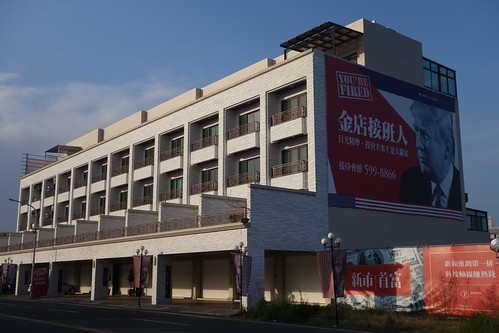
This developer must have been overjoyed when Trump was elected President

Surveying the media over the last few weeks, I can confidently say that Donald Trump is a magician. All he had to do was say Taiwan accio! and suddenly everyone in the media became a Taiwan expert...

*********
UPDATE: Why did Taiwanese get upset in response to the use of the word autonomy? Because in PRC lexicons it is part of the one country, two systems program for annexation and occupation of Taiwan. Note that the speaker is talking in response to Obama.
China’s “one country, two systems” model is to a large degree about Taiwan remaining autonomous, a Chinese academic said on Saturday.
See?
*********

...Speaking of people at the presidential level talking wrongly about Taiwan, lots of Taiwanese were shocked to hear Obama replicate Beijing's expansionist language as he "explained" China using the "poor, put upon China" motif and as a special bonus, used the term "autonomy" as if Taiwan were (already) part of the PRC. Obama's remarks were in response to a question:


+++++++++++++

Q Your successor spoke by phone with the President of Taiwan the other day and declared subsequently that he wasn’t sure why the United States needed to be bound by the one-China policy. He suggested it could be used as a bargaining chip perhaps to get better terms on a trade deal or more cooperation on North Korea. There’s already evidence that tensions between the two sides have increased a bit, and just today, the Chinese have evidently seized an underwater drone in the South China Sea. Do you agree, as some do, that our China policy could use a fresh set of eyes? And what’s the big deal about having a short phone call with the President of Taiwan? Or do you worry that these types of unorthodox approaches are setting us on a collision course with perhaps our biggest geopolitical adversary?

THE PRESIDENT: That’s a great question. I’m somewhere in between. I think all of our foreign policy should be subject to fresh eyes. I think one of the -- I’ve said this before -- I am very proud of the work I’ve done. I think I’m a better President now than when I started. But if you’re here for eight years, in the bubble, you start seeing things a certain way and you benefit from -- the democracy benefits, America benefits from some new perspectives.

And I think it should be not just the prerogative but the obligation of a new President to examine everything that’s been done and see what makes sense and what doesn’t. That’s what I did when I came in, and I’m assuming any new President is going to undertake those same exercises.

And given the importance of the relationship between the United States and China, given how much is at stake in terms of the world economy, national security, our presence in the Asia Pacific, China’s increasing role in international affairs -- there’s probably no bilateral relationship that carries more significance and where there’s also the potential if that relationship breaks down or goes into a full-conflict mode, that everybody is worse off. So I think it’s fine for him to take a look at it.

What I’ve advised the President-elect is that across the board on foreign policy, you want to make sure that you’re doing it in a systematic, deliberate, intentional way. And since there’s only one President at a time, my advice to him has been that before he starts having a lot of interactions with foreign governments other than the usual courtesy calls, that he should want to have his full team in place, that he should want his team to be fully briefed on what’s gone on in the past and where the potential pitfalls may be, where the opportunities are, what we’ve learned from eight years of experience, so that as he’s then maybe taking foreign policy in a new direction, he’s got all the information to make good decisions and, by the way, that all of government is moving at the same time and singing from the same hymnal.

And with respect to China -- and let’s just take the example of Taiwan -- there has been a longstanding agreement, essentially, between China, the United States, and, to some degree, the Taiwanese, which is to not change the status quo. Taiwan operates differently than mainland China does. China views Taiwan as part of China, but recognizes that it has to approach Taiwan as an entity that has its own ways of doing things. The Taiwanese have agreed that as long as they’re able to continue to function with some degree of autonomy, that they won’t charge forward and declare independence.

And that status quo, although not completely satisfactory to any of the parties involved, has kept the peace and allowed the Taiwanese to be a pretty successful economy and a people who have a high degree of self-determination. But understand, for China, the issue of Taiwan is as important as anything on their docket. The idea of one China is at the heart of their conception as a nation.

And so if you are going to upend this understanding, you have to have thought through what the consequences are, because the Chinese will not treat that the way they’ll treat some other issues. They won’t even treat it the way they treat issues around the South China Sea, where we’ve had a lot of tensions. This goes to the core of how they see themselves. And their reaction on this issue could end up being very significant.

That doesn’t mean that you have to adhere to everything that’s been done in the past. It does mean that you’ve got to think it through and have planned for potential reactions that they may engage in.

++++++++++++++
Many people were shocked to see that Obama had used "autonomy" as if Taiwan were Tibet or Xinjiang. This goes to the core of how they see themselves. Wrong in two ways: one China is not a case of China seeing itself, but a case of expansionism dressed up as a historical wrong. And second, once again we get an explanation of how people feel that doesn't include the Taiwanese side. Let's put that back in (h/t to Wilfred Chan):
More than 80 percent of respondents self-identified as Taiwanese, compared with 8.1 percent who identified themselves as Chinese and 7.6 percent who identified as both in the poll, whose wording asked respondents if they viewed themselves as “Taiwanese,” “Chinese” or had “other thoughts.”

When asked to choose between eventual independence and unification with China, more than 51 percent said they favored independence, while 15 percent favored unification and 25 percent favored maintaining the “status quo.”

“The results represent a historic peak for identification as Taiwanese and show that it has decisively replaced identification as Chinese as Taiwan’s mainstream ethnic identification,” foundation chairman You Ying-lung (游盈隆) said, attributing respondents’ relatively high support for independence to the poll’s focus on an eventual future rather than the immediate choice used in many surveys.
Does Obama even really know what US policy is on Taiwan and its status? You can't tell from this answer. Nowhere does Obama apply terms like ally, friend, democracy, security, trade, relationship, to Taiwan. It's classic Obama vacu-speak, pretty speech that says nothing. You certainly don't get a sense from this that President Obama understands China as an expansionist power.

Obama using Beijing propaganda to explain China? That's a great victory for Beijing.
_______________________
Don't miss the comments below! And check out my blog and its sidebars for events, links to previous posts and picture posts, and scores of links to other Taiwan blogs and forums!
Friday, April 19, 2013

Pivot Divot

Two women assemble stacks of beer cans as temple offerings. Any country where they offer beer to the gods is all right with me.

"For years we thought of ourselves as a production oriented company, meaning we put all our emphasis on designing and manufacturing the product. But now we understand that the most important thing we do is market the product. We've come around to saying that Nike is a marketing-oriented company, and the product is our most important marketing tool." -- Phil Knight, CEO of Nike.

John Pfeffer at FPIF scribes:
The Obama administration has revived the old Clinton dream of rebranding the United States as a Pacific power. But there are two reasons why this new pivot doesn’t really exist except at a rhetorical level.

During the 1990s, the Clinton administration was successful in turning around the U.S. economy, at least in terms of shrinking deficits, encouraging impressive economic growth, reducing unemployment, and improving median wages. In other words, the United States was in a good position to take advantage of cooperation with Asian economies.

Today, by contrast, the U.S. economy is in difficult straits. Unemployment remains high, and growth anemic. Projected budget cuts may well send the economy into a downward spiral. The Obama administration bills the Trans-Pacific Partnership (TPP) as a vehicle for growing its members’ economies. But the reality may well be closer to the North American Free Trade Agreement (NAFTA), which only contributed to the hollowing out of the U.S. manufacturing sector as companies fled south and north of the border.

The most buzz about the Pacific pivot, however, has been on national security. Having presided over military fiascos in the Middle East and Central Asia, the Pentagon is planning a move to calmer waters. Former Pentagon head Leon Panetta announced, for instance, that the United States would devote 60 percent of its naval warships to the region, up from 50 percent.

But that’s about it, actually. There will be some rearrangement of existing U.S. forces in Asia, with some Marines heading to Australia and an expansion of facilities on Guam. But this shell game of “strategic realignment” is largely an effort to reduce the U.S. military footprint on Okinawa, again something promised a while ago by Bill Clinton.
"Rebranding" is exactly what is going on. The Pivot is an exercise in branding, it is like all branding in that it is an exercise in creating the perception of value where no real value exists. Ironically, in the corporate world, where do branded products actually get manufactured? In China, of course. I noted last year that actual force redeployments were thin upon the ground. Dean Cheng at Heritage has also argued that the Pivot is more rhetoric than reality. Really, it is something marketed to the folks at home...

....while in the world outside, the deadly stupid business of producing terrorists in Central Asia and the Middle East via Obama's continued pursuit of Bush-era violence goes on, while Asia gets... warm fuzzies. The Pivot is also a classic example of how Obama always says the right thing and then does whatever the Bush Administration did. As I've noted, our policy has essentially become pacifying Afghanistan using American blood and treasure, in order to make it safe for Chinese expansion into Central Asia. Calling such a policy idiotic would be a compliment...

Wendell Minnick wonders aloud in DefenseNews whether the Senkakus mess will be the undoing of the Pivot....
America’s strategic rebalancing toward the Pacific — known as the “Asia pivot” — could meet its first unwanted test over the Japanese-controlled Senkaku Islands, now being challenged for control by China.

Could the Asia pivot’s true fulcrum be located on these desolate, rocky outcrops in the East China Sea? China, which calls them the Diaoyu Islands, claims they were stolen from it after World War II. Over the past two years, Beijing has taken aggressive actions to intimidate Japanese Coast Guard vessels in charge of safeguarding the islands’ territorial boundaries.

There are concerns an accidental war could be triggered by miscalculation or by China, in the spirit of nationalism, taking a calculated risk by invading the islands.

The question many are asking is: Would Washington fulfill its defense treaty obligations with Japan by taking an active military role to remove Chinese forces from the islands? Or would the U.S. hesitate for political and economic reasons to placate China? If so, what would this mean for regional confidence in America’s commitments to peace and stability?

This could be America’s “Suez moment,” said Paul Giarra, who heads Global Strategies & Transformation, a national defense and strategic planning consulting firm in Washington. It could be the moment when America, hobbled by massive debt, domestic political spasms and the lingering wounds of two exhaustive wars, finally realizes, as did Great Britain during the Suez crisis of 1956, that its ability to fulfill its international strategic commitment in a complex, multipolar world ends.
The remainder of the article is devoted to consideration of specific scenarios. One of the most critical costs of the Bush-Obama madness in the Middle East is its effect on Asia. Hadrian built walls as much to prevent imperial overstretch as to keep the people on the other side of the wall out of the Empire; the US should borrow that policy. But we won't...

The same theme runs through this article that runs through many similar articles about Taiwan: would the US really go to war over the Senkakus/Taiwan/Scarborough Shoal? The commonality, of course, is the declining power of the US. There's a whole industry back home devoted to writing about how the US isn't really in decline, but everyone out here can smell the carrion odor.

Including Beijing. The reciprocal of the question beginning Would the US.... ? is of course When will Beijing....?
__________________
Daily Links:
_______________________
Don't miss the comments below! And check out my blog and its sidebars for events, links to previous posts and picture posts, and scores of links to other Taiwan blogs and forums!

Saturday, April 21, 2012

US-Taiwan relations

IMG_0972
Blogger switched me over to the new blogger look today. The new Google reader look was just awful, like watching an iceberg melt in a dull gray ocean against a flat, overcast sky. Then they decided to change Gmail to a similar look. Felt rather like a prisoner on death row with only one tiny overhead window in the cell. Now this week they've switched Blogger over to the same look, like an aged leper, painful to behold, and uglier than the first 500 sins committed by drunken soldiery plundering a captured city. I know it's a revolutionary idea, but why not simply give the user a choice of looks and styles? Imagine that.... Fortunately they are letting users revert to the easy to use old look.

Lots going on this week with US-Taiwan relations and East Asian foreign policy affairs. At the CSIS forum, American academics emphasized that Taiwan remains a vital interest of the US:
Answering a question from the audience, Gregson dismissed the idea of the US abandoning Taiwan to foster a better relationship with China.

“Abandon Taiwan? Absolutely not,” he said, adding that the US had vital interests in the region.
Gregson was speaking at a forum on “US Strategy in Asia and Taiwan’s Future” hosted by the US-based think tank Center for Strategic and International Studies (CSIS) and Tamkang University’s Graduate Institute of International Affairs and Strategic Studies.

At a roundtable discussion, US economic adviser Kevin Nealer said the US would like to see Taiwan join the Trans-Pacific Partnership (TPP) in its formative stage to help shape the regional economy.
“We think it’s in our interests. We think it’s in yours,” he said.

Abe Denmark, a senior project director for political and security affairs at the National Bureau of Asian Research, presented his views on the US’ new strategic guidance released by the US Department of Defense earlier this year.

Denmark said the US’ rebalancing strategy in Asia has three implications for Taiwan — although Taiwan is not specifically mentioned in the guidance.
I can't help but note that people are constantly talking about this "rebalancing" or "pivot" as if something is actually happening. Hello! Can anyone point to abundant concrete examples of this new policy? Troop and ship redeployments? Drawdown and termination of the stupidity and folly in Afghanistan? Increased investment in weapons systems needed to fight wars in far-off Asia? It looks for now like another of the endless examples of Obama trying to create reality through better rhetoric. Indeed, the US has "rebalanced" by increasing its outrageously stupid and criminal drone war in the Middle East. Future historians will be driven to opium consumption when they contemplate the monumental stupidity of US Middle East policy under Bush Lite and Obama.

J Michael Cole, tiger of many talents, left his spoor in The Diplomat with a sturdy piece on what the US needs to do if it wants to deter a clash over Taiwan -- make the island bristle with missiles:
Although MTCR play an important role in countering proliferation, their enforcement on Taiwan, a state that has no expansionist ambition whatsoever, while China continues to extend the range and precision and destructiveness of its own missile arsenal thanks to technology passed on by (or stolen from) Russia, makes no sense. In light of this, and to rectify the “balance of terror” in the Taiwan Strait – which under current conditions is one-way – the U.S. should within reason allow Taiwan, if not quietly assist it, to develop longer-range ballistic and cruise missiles, as well as artillery capable of acting in a counterforce role, and coastal suppression munitions, which is already found on some of Taiwan’s air-launched Harpoon missiles. Dispersing the deployment of such forces, as well as making them mobile through the use of transport erector launcher (TEL) vehicles rather than fixed bases, would also increase the deterrence value.

In return, Taiwan should commit to ensuring that whatever missile technology is acquired from the U.S. won’t be proliferated, while boosting efforts to ensure that critical information isn’t passed on to, or stolen by, China. While self-evident, Taiwan should also commit to a no-first-use policy, thus making its offensive capability a purely defensive one. One advantage for the U.S. in adopting such a strategy of assistance for Taiwan is that the political cost of doing so in terms of Washington’s relations with Beijing would likely be smaller than, say, in releasing F-16C/Ds or approving a submarine program. Another benefit in the long term is that the resultant deterrence capability for Taiwan would make war in the Strait less, rather than more, likely, as the cost for the PLA of launching an attack on Taiwan would have been increased. For Taiwan, embarking on such a program would prove far less straining on its finite military budgets than the acquisition of billion-dollar platforms of questionable utility in a modern Taiwan Strait context.
I've been saying this for years. It's time to give Taiwan what it needs to keep Chinese forces at bay until the cavalry arrive. Missiles are a cheap and useful deterrent.

Also, a couple of weeks ago a delegation of the US Republican Party visited Taipei. Here's a key part of their report:
American-Taiwan relationship issues raised by Taiwan officials during our meetings included:

1. Their desire to purchase F16 C/D aircraft as well as other sophisticated military hardware.

2. They would also like to receive Visa Waivers.

3. Concern that South Korea would soon receive tariff- free status, putting Taiwan at a commercial disadvantage.

At our meeting with AIT, the issue of American beef and pork imports was discussed. Taiwan does not allow American beef or pork to be imported because of their concern over a chemical feed additive, ractopamin, that we consider safe, so their market is off-limit to US farmers. AIT said that pork producers are a powerful political block in Taiwan.

Taiwan now has robust economic ties with mainland China. Many manufacturers have their products made in China. There are now hundreds of weekly flights between the two countries, with thousands of mainland Chinese visiting Taiwan. Many believe that with more mainlanders visiting Taiwan, they will learn about a free society and may have a better understanding of how democracy works. During the recent presidential election, millions of mainlanders intently followed the election on the internet.

As Taiwan seeks a closer relationship with mainland China and as their economic ties with China become intertwined and increasingly dependent, they are keenly aware of the precarious position they may be creating. One graphic statement by the Vice President of the KMT, the political party in power, illustrated this concern. He stated that Taiwan is “Dancing with a wolf…while holding a dagger at its side for protection …the dagger representing American strength and support.”
Curiously, the KMT continues to insist it wants F-16s -- remember when the party blocked them from reaching the floor of the legislature more than 60 times during the Chen era. They are just playing a game....

Just for fun: Lee Teng-hui this week said the Senkakus actually belong to Japan. ChinaSMACK picked up some of the reaction from the Chinese netizens. They've imbibed PRC propaganda so deeply that I've come to believe that a democratic China would be just as expanionist.
_______________________
Don't miss the comments below! And check out my blog and its sidebars for events, links to previous posts and picture posts, and scores of links to other Taiwan blogs and forums! Delenda est, baby.

Wednesday, August 03, 2011

Like Everything Else, Obama's Taiwan Policy is a Failure.

DSCF7274
An egret at Gaomei Wetlands.

Factoid of the week, nature: Between 1970 and 1999, Taiwan supplied 384 Mt yr of suspended sediment to the ocean. This represents 1.9% of estimated global suspended sediment discharge and yet is derived from only 0.024% of Earth’s subaerial surface."(source)

Factoid of the week, politics: The presiding judge in the Lee Teng-hui trial is none other than Chou Chan-chun (source). You may recall he was the judge who was swapped out of the Chen Shui-bian case after he ruled in a way the KMT didn't like.

Factoid of the week, military: I'll bet you didn't know Taiwan has an aircraft designated the F-CK-1.

Today both India and the US reported massive cyberbreaches originating in China [UPDATED: worldwide, greatest cyberattack in history, multiple media reporting. Guys, this is a declaration of war]. Yet nothing is done about this behavior, which must be Beijing-government sanctioned. It's time for the US to take action. But apparently the only way that one can provoke the Obama Administration into acting is to either be a small Muslim country or a US government whistle-blower.

The Taiwan Link, who posts sparingly but always magnificently, has a great long piece on the Obama Administration's failing Taiwan policy (Recall Schriver last week as well). I too was optimistic in Jan of 2009 that the dangerous drift of America's East Asia policy under the Bush Administration would be abated:
One had high hopes for the Obama team as it entered office in January 2009. The administration’s Asia team members included seasoned, strategically-minded veterans, such as Assistant Secretary of State Kurt Campbell, Assistant Secretary of Defense LTG (ret) Chip Gregson, and Principle Deputy Assistant Secretary of Defense Derek Mitchell. The two latter focused much of their time on Central Asia issues, despite having significant “boots on the ground” time in Taiwan. Chip Gregson has departed, and Derek Mitchell has been nominated to serve as Special Representative to Burma. Replacements have yet to be confirmed, including nomination of Mark Lippert as Chip Gregson’s replacement.

Sharp, seasoned Pentagon staffers with years of China/Taiwan policy experience within the Office of Secretary of Defense (OSD) include retired Navy Captain Joe Skinner and Principal Director Dave Helvey. The Deputy Assistant Secretary of Defense with direct oversight of Taiwan policy is long time Dianne Feinstein staffer Mike Schiffer. Most likely focused on Korea, Japan, and China military-to-military issues, Schiffer has made few public statements indicating strong support for Taiwan’s position. His former boss, Senator Feinstein, has been a leading proponent of China and advocate of U.S.-China relations. At the same time, she has questioned U.S. security assistance to Taiwan (see below).

Highly sensitive to how Taiwan arms sales could affect the U.S.-China military relationship, Secretary of Defense Robert Gates and Under Secretary of Defense Michelle Flournoy have been less vocal than their predecessors on Taiwan issues. In fact, Secretary Gates was quite sensitive to Chinese concerns regarding arms sales, without much apparent concern for Taiwan. Deputy Secretary of Defense Bill Lynn, who served as a senior Raytheon executive for seven years, appears to have recused himself on Taiwan issues. Lynn has announced his departure later this summer or Fall, and a replacement has yet to be named.
The entire piece must be read, it nicely stitches together all the pieces of Obama's failing Taiwan policy and its continuity with Bush's similar failed policies. For example, The Taiwan Link observes that the issue is not limited to F-16s but takes place across all areas of Taiwan policy...
The Obama administration also has deferred resumption of trade and investment framework agreement (TIFA) talks. Taiwan’s restrictions on market access for U.S. beef have been cited as one rationale for freezing TIFA talks for the past four years. Unlike Taiwan, the U.S. Trade Representative has included the beef issue in trade negotiations with South Korean counterparts. Other Taiwan-related negotiations, including visa waiver and extradition initiatives, appear stalled. In the meantime, the director of China's State Council Taiwan Affairs Office Wang Yi visited Washington in late July 2011 to lobby senior US officials against arms sales.
These are all things I've complained about on this blog. The Taiwan Link appears optimistic only in his view that Congress can balance the Executive. Despite the letter circulated this week from 181 Congressmen on the F-16 sale, Congress isn't going to take independent action on this issue. Note that the US consulting with China on arms sales to Taiwan violates both the terms of the Taiwan Relations Act and the Six Assurances that Reagan gave. What Status Quo?

The Diplomat hosted a piece this week on whether the US and China are doomed to clash (answer = d'oh). With clashes more or less inevitable, shouldn't we be seeing a major effort to shore up our East Asian allies? Yet the upcoming round of defense cuts will likely produce more retrenchment in Asia, rather than the rational and intelligent choice of pull outs from our stupidity in Iraq and Afghanistan and our illegal Libya intervention to focus on the world's most important region. Future historians will be driven to drink attempting to understand how a great nation could drive itself into the ground so rapidly and invest so long in projects so completely inimical to the health and welfare of its own future.
________________
Daily Links


_______________________
Don't miss the comments below! And check out my blog and its sidebars for events, links to previous posts and picture posts, and scores of links to other Taiwan blogs and forums! Delenda est, baby.

Sunday, October 24, 2010

China Policy Infighting In Washington

Geertz's latest Inside the Ring at the Washington Times outlines some of what we've been hearing for the last year:
With President Obama set for a major trip to Asia next month and the Obama administration nearing the halfway point of its first term, U.S. officials tell Inside the Ring that a heated policy debate is under way over how to deal with China.

Two camps in the policy dispute involve one powerful faction that favors past policies of conciliation and concessions in relations with China — described by one official as the "kowtow" group. A second, more centrist, group is characterized as "sad and disappointed" by China's across-the-board refusal to work cooperatively with the United States for the past two years.

The policy debate is almost totally hidden from public view and only occasionally surfaces in public through statements or public speeches by faction members.

China's diplomats and intelligence officers are said to be aware of the debate and the U.S. officials said the Chinese are actively trying to influence it behind the scenes through their supporters in and out of government.
"Through their supporters in and out of government." Yeesh. Geertz adds:
The kowtow group is headed by Deputy Secretary of State James Steinberg and includes White House National Security Council Asia Staff Director Jeff Bader, and his deputy, Evan Medeiros, a China military expert. Officials at the U.S. Embassy in Beijing also support continuing the current U.S. policies aimed to avoid upsetting Beijing's communist leaders.

According to the officials close to the debate, this group and its supporters in departments and agencies, including the intelligence community analysis groups, believe they must protect China from critics who they claim want to turn it into an enemy by following U.S. policies that will not upset Beijing.

.....

The centrist faction is being called the "sad and disappointed" group whose most senior members are Secretary of State Hillary Rodham Clinton and, although not technically a policy official, CIA Director Leon E. Panetta. Included among the sad and disappointed group are Kurt Campbell, assistant secretary of state for East Asia, and Wallace "Chip" Gregson, a retired Marine three-star general and assistant defense secretary for Asian and Pacific security affairs.
Bader came out of a company that does business with China (see this article) -- that complicating factor almost never appears in news reports -- but like many other areas of governance, foreign policy often represents a case of regulatory capture by the concerned private interest.

As I've noted before, advocacy of the position that "we shouldn't anger Beijing" simply gives the CCP a veto over US China policy. Not only that, but as the article notes, Adm. Willard has been sidelined for speaking out for a tougher US line -- meaning that criticizing Beijing can get you in trouble -- thus handing Beijing a veto over who gets to participate in the policymaking conversation.
_______________________
Don't miss the comments below! And check out my blog and its sidebars for events, links to previous posts and picture posts, and scores of links to other Taiwan blogs and forums!

Sunday, April 11, 2010

Obama steps forward in China relations


Karl at Liyutan. Yeah, I bring all my dates there.

An look at recent progress in China-US relations from John Pomfret, the former veteran Beijing correspondent, appeared in WaPo this week, generating much commentary around the blogosphere. An excerpt:
"It was exceptionally deft handling of the Chinese. It was a choreographed diplomatic deal," said Bonnie S. Glaser, an expert on China at the Center for Strategic and International Studies. "There was a recognition on the part of U.S. officials that China was ready to reengage but needed help to get out of the corner that they'd put themselves into."

The "handling" began days after Obama's Feb. 18 meeting with the Dalai Lama, whom Beijing has described as a "splittist" intent on fragmenting China. Weeks before, the United States had announced that it was going to sell $6.4 billion in weapons to Taiwan, China's nemesis, sending relations into a tailspin.

......

Steinberg and Bader visited China from March 2 to 4 and were confronted by angry Chinese officials making demands. First was that Obama never again authorize the sale of weapons to Taiwan. Second was that the president never again meet with the Dalai Lama.

But behind the Chinese bluster, the two Americans sensed that Beijing was looking for a face-saving way for Hu to attend the nuclear summit. Once they returned to the United States, more talks were held with China's outgoing ambassador, Zhou Wenzhong, and its new one, Zhang Yesui, even before Zhang formally presented his credentials to the U.S. government.

To mollify Beijing, the United States offered to reaffirm, in a public setting, its policy that there is "one China." At the same time, it also agreed to China's request that the new ambassador be granted a meeting with Obama. In return, U.S. officials requested that China take part in talks on imposing sanctions on Iran -- which it had refused to do.

The US did reiterate the One China policy, which is different from China's -- it doesn't include Taiwan in that. The requirement that the US reiterate the One China policy shows how much China's bluster is aimed at satisfying its domestic critics, as is the fact that the tensions -- which it is almost wholly responsible for -- had to be handled privately.

Note that the media once again forthrightly failed to pinpoint the source of tensions: it is China, not weapons sales to Taiwan. So often when China-Taiwan-US tensions occur in the mainstream media, they are referred to in the passive voice. Sad.
As for China, Zhu Feng, director of the international security program at Peking University, said he thinks Beijing needed to calibrate its responses better. "Yes, Taiwan and Tibet are both Chinese 'core interests,' " he said, "but if an arms sale is strictly defensive, why is it automatically counted as a grave violation to China's core interests?
New media propaganda theme being pushed out of China: Taiwan is a "core interest" -- yea, Beijiing has the same interest in Taiwan that a thief has in his neighbor's television...

Pomfret made a significant error in quoting Steinberg as saying the US "opposes" Taiwan independence and in representing his remarks. Steinberg said, with practiced diplomatic nuance.
Indeed, this past year we just marked the 30th Anniversary of the normalization of our relationship with the People’s Republic of China under that one China policy. We’ve made clear that we do not support independence for Taiwan and we oppose unilateral attempts by either side to change the status quo. And we in particular welcome recent improvements in cross-Strait relations and hope that they will continue to expand, and we urged our counterparts in Beijing to continue to work to that end. That PRC-Taiwan dialogue contributes to the objective of a peaceful resolution that has been long central to our approach.
The US does not support Taiwan independence, which is diplomat-speak to avoid saying that the US opposes it -- since we do not oppose it. Beijing correspondents... *sigh*

Also on tap on US-China relations was a good piece from Nat Bellocchi in the Taipei Times today on what Obama should tell Hu when they meet.
_______________________
Don't miss the comments below! And check out my blog and its sidebars for events, links to previous posts and picture posts, and scores of links to other Taiwan blogs and forums!

Thursday, December 17, 2009

What the Health Care Debacle Teaches About the future of US-Taiwan Relations

Every great magic trick consists of three parts or acts. The first part is called "The Pledge". The magician shows you something ordinary: a deck of cards, a bird or a man. He shows you this object. Perhaps he asks you to inspect it to see if it is indeed real, unaltered, normal. But of course... it probably isn't. The second act is called "The Turn". The magician takes the ordinary something and makes it do something extraordinary. Now you're looking for the secret... but you won't find it, because of course you're not really looking. You don't really want to know. You want to be fooled. But you wouldn't clap yet. Because making something disappear isn't enough; you have to bring it back. That's why every magic trick has a third act, the hardest part, the part we call "The Prestige"."

Glenn Greenwald, one of America's most insightful bloggers, nails progressives, Dems, the corporate world, and Obama in a brilliant post on Obama's duplicity in the health care debacle: the truth is that Obama never intended to get a public option passed:
As was painfully predictable all along, the final bill will not have any form of public option, nor will it include the wildly popular expansion of Medicare coverage. Obama supporters are eager to depict the White House as nothing more than a helpless victim in all of this -- the President so deeply wanted a more progressive bill but was sadly thwarted in his noble efforts by those inhumane, corrupt Congressional "centrists." Right. The evidence was overwhelming from the start that the White House was not only indifferent, but opposed, to the provisions most important to progressives. The administration is getting the bill which they, more or less, wanted from the start -- the one that is a huge boon to the health insurance and pharmaceutical industry.
The entire piece is well worth reading, as is most anything Greenwald writes: the Lieberman Criticism, the attacks on the Blue Dogs, it was all KMT-style political theatre. What this all means for Taiwan should become clear as we explore the announcement of weapons sales to Taiwan.....

The New York Times reported on Tuesday the 15th that the Obama Administration was going to sell weapons to Taiwan....
The Obama administration will proceed with arms sales to Taiwan despite recent protests by China, an American official said Tuesday.

The official, Raymond Burghardt, is chairman of the American Institute in Taipei, the de facto United States Embassy in Taiwan.

Speaking from Hawaii, where he lives, he said that sales of arms to Taiwan were consistent with what White House officials have been saying was President Obama’s policy. “No one should be surprised when we move forward with them,” he said.

Mr. Burghardt declined to say exactly when Mr. Obama would notify Congress of an arms sale. The American relationship with Taiwan, which China considers a renegade province, is one of the most delicate diplomatic issues between Beijing and Washington. The United States takes no position on the sovereignty of Taiwan, but acknowledges that Beijing claims that there is only one China.
(As an aside, could there be a luckier man than Burghardt, living in Hawaii but making frequent trips to Taiwan? I want that job!). The arms package (1) doesn't include the F-16, and (2) the Obama Administration declined to say exactly when it would go through. So here we have a package whose arrival is some time in the distant future, and which doesn't include the one thing that is really needed. Yes, we have a pattern here. J Michael Cole of the Taipei Times followed up with one of his patented penetrating analyses, pointing out that the arms package could be an expensive illusion:
The “new” arms package recently touted by US officials has yet to be confirmed by US President Barack Obama. Nevertheless, supporters of Taiwan are already hailing the news as a great victory, of Obama “thumbing his nose at the Chinese,” as Foreign Policy recently put it.

There are signs, however, that there is less to the news than meets the eye.

From what has been made public, the Obama administration could release PAC-3 interceptor missiles, UH-60 Black Hawk helicopters, as well as an operations deal for the “Po Sheng,” or Broad Victory, command and control program and design work on diesel-electric submarines.

Not only are the 66 F-16C/D fighter aircraft that Taiwan has sought for years missing from the list, however, there is also nothing new in the “new” arms package proposed by the administration.

“The real question,” Wendell Minnick, Asia Bureau Chief at Defense News, told the Taipei Times on Sunday, “is what is ‘new’ in the arms pipe that hasn’t been in there since 2001. And there is nothing, which is ominous.”

All these items were approved by former US president George W. Bush in 2001. Also problematic is the fact that the design work on the submarines would be both costly and may not even result in actual subs. Even if it did, it would only be many years from now and make an insignificant contribution to Taiwan’s current and mid-term defense requirements.
Let's see -- Ma and the KMT have been making noises about soft power, and about waiting patiently for weapons -- it's not unreasonable if they take years, says Ma. The KMT doesn't want weapons, and what this whole three year long three-card monte game with she-will-sell-weapons, she-won't-sell-weapons appears to mean is that the Administration does not plan to help Taiwan upgrade by selling it new weapons, either. They'll probably keep dangling the F-16s in front of us like a salty snack held just above the nose of a Golden Retriever. In the Cole piece long-time Taiwan watcher John Tkacik peers through the magician's stagecraft, echoing what I said the other day:
“I suspect that if Obama approves a new arms package, Ma’s government and the [Chinese Nationalist Party, KMT]-dominated Legislative Yuan will, once again, go out of its way to temporize, shilly-shally and complain about the costs, utility, and political tensions with China of the sales — and use those factors as excuses to stall procurements. That way, Obama can say ‘it’s Taiwan’s fault’ and [President] Ma [Ying-jeou (馬英九)] will say ‘it’s the Americans’ fault.”
Ta-da! The Obama Administration fufills its Pledge to sell weapons to Taiwan. It's just like Obama's health care reform (and it pleases the same consituency): you can have what you already would have had, if we hadn't taken any further action at all. What this means for Taiwan's future, with the corporate side eager for "cooperation" with China, isn't good.
________________
Daily Links
  • Marketplace with my friend Mark Forman about Taiwan, IT, and branding.
  • Spencer with excellent piece on traffic cams in Taiwan, with comparisons to US traffic cams, and links to Google Maps.
  • This is what Afghanistan is really about: gas pipelines.
  • Ma again pushes the line: if we move closer to China, we will become more globalized. In the KMT view, sinicization = globalization.
  • AFP once again completely fails to get Taiwan correct. The poll asks: Do you think that cross-Strait political negotiations should be held to achieve mutual recognition during the tenure of President Ma Ying-jeou? Yes 57% Ask yourself if this is equivalent to AFP's report that Fifty-seven percent said Taiwan's President Ma Ying-jeou should negotiate with Beijing to prevent war and secure peace . Really, I have no idea why they bother to spend money to keep people out here. They could source from Xinhua with exactly the same effect. DPP poll on same topic discussed at Taiwan News. Have fun with them both.
_______________________
Don't miss the comments below! And check out my blog and its sidebars for events, links to previous posts and picture posts, and scores of links to other Taiwan blogs and forums!

Friday, November 06, 2009

The Once and Future US Retreat on China's Colonial Expansion?

Apologies for the light blogging; just swamped with work this week.

The US State Department's latest version of its background notes on Taiwan are out, so it is appropriate that we glance at US-Taiwan-China relations....

The Taipei Times hosted a commentary today from former Japanese diplomat Hisahiko Okazaki. Its major point:
Through the 37-year history of US-China engagement, the US has consistently retreated in the war of semantics about Taiwan. The US has been unable to muster points against the steel wall of one-party dictatorship. It lost inch-by-inch every time. Each time, however, Washington reassured the US public that its position hadn’t changed.

How deceptively the US position had eroded can be seen in the comments made by Clinton. He began his remarks on the “three nos” by stating that he was reiterating US policy on Taiwan but not specifying the time of the previous remarks, whether it was during his meetings in Beijing or much earlier. Then national security adviser Sandy Berger said the US had simply repeated its basic position.

In fact, the US has consistently shifted its position. It started with an admirably objective statement by then national security adviser Henry Kissinger in 1972: “The US acknowledges that all Chinese on either side of the Taiwan Strait maintain there is but one China and that Taiwan is a part of China.”
The piece isn't bad in its intent, but that last paragraph is completely wrong. The Kissinger statement marks the beginning of the retreat, not the last outpost of sanity, for Nixon had agreed to throw Taiwan under a large public transportation vehicle (see here, here for fascinating Nixon/Kissinger exchange on Taiwan independence movement)....
However, accounts of President Nixon's secret talks with PRC Premier Zhou Enlai in China in 1972 reported that Nixon made promises on the question of Taiwan in return for diplomatic normalization that went beyond the communique issued at the end. The Carter Administration later called the promises: "Nixon's Five Points." Also, according to Assistant Secretary of State Stanley Roth's March 1999 testimony, Nixon pledged no U.S. support for Taiwan independence (second time after Kissinger's 1971 promise): "We have not and will not support any Taiwan independence movement." With the release on December 11, 2003, of declassified memoranda of conversation of the secret talks between Nixon and Zhou, there was confirmation that Nixon stated as first of Five Principles that "there is one China, and Taiwan is a part of China. There will be no more statements made -- if I can control our bureaucracy — to the effect that the status of Taiwan is undetermined." (source)
The Nixon-Kissinger dialogue linked above highlights another ridiculous aspect of the Shanghai Communique: nobody consulted the people of Taiwan. If you don't consult the people whose fates you are deciding, you can't blame them for refusing to go along. In fact Washington's position hasn't changed: the status of Taiwan is undetermined, as it most recently reiterated in 2007 when UN Sec-Gen Ban Ki-moon rejected Chen Shui-bian's letter. What has changed is the obfuscation that swirls around that position, as well as the strategic calculus in Asia, and of course, the effectiveness of PRC propaganda.

Meanwhile SCMP reported today that the Chinese want Obama to sell out Tibet:
Diplomats from the world's two most influential nations are still negotiating details of the summit between Obama and his Chinese counterpart, Hu Jintao. The Chinese side has suggested Obama state that "Tibet is part of China's territory and the US opposes Tibetan independence", the Chinese envoys say.

Obama will visit Shanghai and Beijing between November 15 and 18. An agreement on this most sensitive political issue would be a triumph for Beijing and could help end deadlock on strategic issues, though human rights campaigners and the US Congress would be bound to criticise it.
The article says that while it is not likely Obama will make a public declaration, a behind-closed-doors agreement is not out of the question. Brrr.....
_______________
Daily Links
_______________________
Don't miss the comments below! And check out my blog and its sidebars for events, links to previous posts and picture posts, and scores of links to other Taiwan blogs and forums!

Saturday, October 10, 2009

Obama wins Nobel Peace Prize and other Saturday observations


My friend Drew and I took the road to Da Hsueh Mountain today, northeast out of Dongshih, climbing to 1000 meters along ever-more lovely mountain road on a perfect day for biking. Highlight of the trip, though, took place in Fengyuan. As we rode, a cyclist on our side of the street but going in the opposite direction, looked at me as we passed. Instead of a robust "How are you!" or "Hello!", he leaned over all googly-eyed, peered at me, and bellowed: "D-u-m-m-b-l-l-e-d-d-o-o-r-r-e-e!" Drew and I nearly fell off our bikes laughing.

Yesterday night I got on Facebook and saw that everyone was talking about Obama winning the Nobel Peace Prize, which, like probably everyone else at first encounter, I thought was some brilliantly wicked viral internet joke. I'm not going to comment on the award itself; from the Taiwan perspective, what interests me is the Prize Committee's rationale, which only partly appeared to reference Obama's accomplishments, but also appeared to be aimed at encouraging him to end the wars in Afghanistan and Iraq, as well as rally support for his policies in the world. Given while the work is in progress and the issue still in doubt.

This is very suggestive, because here in Taiwan the KMT and the CCP are negotiating for a "peace agreement" whose ultimate purpose is to annex the island to China. The "process" is still ongoing. Anyone see how the Prize Committee's rationale applies here? "Let's give'em an early Nobel to keep the peace process moving along." Yes, I think we just moved a step closer to the Hu-Ma Lovefest Male Pattern Baldness Nobel Prize Tour of 2011.

Meanwhile lots of fun this week in Taiwan. The Taipei City government has decided to change the name of the unlucky Neihu MRT line, because in local culture, you can change your luck by changing your name....
Following a similar practice, Taipei Mayor Hau Lung-bin is considering changing the name of the newly added MRT line whose streak of bad luck seems to be continuing without an end in sight.

The bad luck line is now known as the Zha-Hu line from Muzha, where Taipei City Zoo is located, to Neihu via Songshan Airport. The last syllables of Muzha and Neihu make up Zha-Hu, which is a homophone of the Chinese word of “cheating at the Mahjong table.”

Hau and his Taipei MRT executives are convinced the bad name of the line is bringing bad luck. The line has been plagued by frequent problems since it opened on July 4.

One of the new names they are considering is the Wen-Hu line. Wen is the first syllable of Wenshan, the district where Muzha is located, meaning Literary Mountain. The district is known for the good tea it produces.

.....

Asked why Zha-Hu has had so many problems, the source quoted a geomancer as stating Zha, which means wood barrier, is on the waters of Hu, which is “lake.”

“Wood on lake waters drifts,” the geomancer intoned. “It's only natural that the drifting causes many and frequent delays,” he claimed.
This is actually not uncommon -- I blogged on another case of this a few years ago. Again, it shows how fate in Taiwan is regarded as deterministic and changeable by human action, like a river whose course can be diverted, but if left untouched, will cause disaster. One also has to admire the poetic invention of the geomancer. If only real poets were paid as much....

Turning serious, in Hualien county there are now three KMTers running for the county commissioner position, but only one is party-approved. The other two are renegade local politicians. Though Kinmen split, in Taitung and Yilan the party averted splits. It wouldn't surprise me if the KMT actually emerged stronger from this streamlining, cramming scores of local factions into far fewer elected positions, like an airplane entering a tunnel and emerging looking like a train. The adjustment process will get an easement when the municipalities are upgraded next year -- the county commissioners will preside over an increased government workforce, which means new positions will open for appointees from their parties -- pals from local factions. And even if a renegade is elected, there will not be fundamental changes in things. Moreover, nothing has happened to the party's grip on the flow of monies out of the central governments and into local faction coffers. Perhaps the DPP will pick up a seat here and there as the factions fall out among themselves....(KMT plans to discipline splittists)
_______
Daily Links
_______________________
Don't miss the comments below! And check out my blog and its sidebars for events, links to previous posts and picture posts, and scores of links to other Taiwan blogs and forums!

Thursday, October 08, 2009

Good Writing and Good News

The Ma Administration is feeling the sting of foreign criticism, responding to an editorial criticizing the Rebiya Kadeer vsa denial in the Asian Wall Street Journal with this letter. It's a wonderful bit of evasive nothing:
First, the decision of not allowing Ms. Kadeer to visit Taiwan has been made in accordance with Article 18 of Chapter 4 of the Immigration Act, "Entry of Aliens and Exit of Aliens." This article stipulates that the National Immigration Agency shall prohibit an alien from entering the ROC if he/she is believed to endanger national interests or public security. This does not mean, however, that the ROC government disrespects freedom of expression. Indeed, the documentary about Ms. Kadeer's life has been shown at many venues in Taiwan.
Note that the government more or less blandly affirms that Kadeer has terrorist links and claims it carried out the action in accordance with some vague law. The letter then indignantly attempts to rebut WSJ's argument that the KMT Administration is aping Beijing's authoritarian ways. Ironic, in light of the latest kow-tow yesterday to Beijing, in which the government changed TAIWAN WELCOMES THE NBA to TAIPEI WELCOMES THE NBA. Excellent work by the WSJ.

Another good piece making the rounds was a surprisingly good op-ed by Philip Bowring in the NYTimes yesterday:

The most striking evidence of a desire to please Beijing — at the expense of the liberal values which have gained Taiwan much praise in recent years — was the denial of entry to the exiled Uighur leader Rebiya Kadeer. This was done in the name of “national interest,” apparently linked to the finalization, expected soon, of a memorandum of understanding on cross-strait financial links.

For sure, the memorandum would be a major advance, enabling banks in particular to escape the confines of Taiwan, with its low growth and surplus savings, for the fast-growing mainland. And it would bring more mainland capital to local stocks and property. But the government of President Ma Ying-jeou may have forgotten that Taiwan’s national interest as an independent state, albeit one that may one day merge with the mainland, sometimes requires sacrifices. The degree of autonomy that Rebiya Kadeer has been seeking for Uighurs is a fraction of that enjoyed by Taiwan or even Hong Kong.

Bowring stays within the bounds of conventional establishment readings of Taiwan (financial agreement is good, Chen Shui-bian "provoked" Beijing) but he points out that Taiwan is moving closer to China than need be -- and how often do commentators notice that?? -- and also raises the issue of the worrying anti-democracy developments on the island. Wonderful job!

Still, the piece closes on an entirely conventional note:
None of this is likely to help Taiwan’s relations with its main supporter, the United States. Chen upset a natural ally in George W. Bush by needlessly provoking Beijing in an attempt to score political points at home. Now the KMT seems to have gone to the other extreme....
"...needlessly provoking Beijing..." The error here is profound, and I've discussed it before, but let's say it again: since all pro-Taiwan activity "provokes" Beijing, the idea of "needless provoking" is nonsense. Being provoked is a policy choice for Beijing, not a visceral reaction. Note how different the discussion is when China pulls the same crap with India -- issuing special visas (as with Taiwan) and claiming that everyone in Arunachal Pradesh is "Chinese". Yet only a madman would claim that India "provokes" China. It's true: Taiwan is unique.

Bowring also adds:
Taiwan lacks a strategic view of itself and how to balance relations with the Chinese mainland, the United States and the global economy with liberal democracy and de facto independence.
A nation can probably balance liberal democracy and global economic participation, but the sad fact is, the closer Taiwan moves to China, the farther it moves from democracy. Commentators haven't yet grasped that. They will.

More important is the charge that Chen Shui-bian screwed up US-Taiwan relations. This is often stated by US officials, but recall that the Bush Administration lowered relations with Taiwan and refused to sell it weapons in Bush's second term, leading to Taiwan supporters to charge Bush had instituted a veritable freeze. The Bush Administration found Chen a convenient whipping boy for that catastrophe disguised as a US government was also out to kow-tow to China. Chen was only partly to blame for the problems in US-Taiwan relations.

The Obama Administration demonstrated how far the Bush Administration had gone when the news came out yesterday that for the first time since the Clinton Administration, a US cabinet official was going to visit Taiwan. Gen Shinseki, currently Sec of Veterans Affairs, will be coming. This welcome development is in stark contrast to the Bush Administration's eight years of neglect and attempts to curry favor with China. The attempts to placate China have not yet run their course -- witness the President's refusal to meet the Dalai Lama -- but I suspect even the most ardent Sinophile in that Administration will eventually come around.
______________
Daily Links:
SPECIAL: Rethink Afghanistan, huge new documentary asking the nation to reconsider that stupid war. $300 billion annually so our leaders can feel like they run a Great Power.
_______________________
Don't miss the comments below! And check out my blog and its sidebars for events, links to previous posts and picture posts, and scores of links to other Taiwan blogs and forums!

Tuesday, June 30, 2009

Richard Bush asks what the continued military build up means

J Michael Cole over at Far Eastern Sweet Potato led me to this article by longtime Taiwan analyst Richard Bush III at Brookings. Coupled with the comments surrounding the possibility of selling F-16s to Taiwan that appear to identify China as the source of the "Taiwan problem," it seems that US analysts are at last waking up and getting a whiff of that expansionist cup'o'java that China has been serving us for the last twenty years..... Bush writes in an opening paragraph more notable for its misrepresentations than its illuminations...

In the relations between Taiwan and China, something intriguing happened between last spring and this spring. I refer not to the impressive progress that the two sides have made since Taiwan President Ma Ying-jeou took office in May 2008. They have restored dialogue mechanisms; concluded agreements to enhance cooperation in the areas of trade, transportation, finance, and crime control; and made possible Taiwan’s participation as an observer at the annual meeting of the World Health Assembly. This significant progress occurred against the backdrop of fifteen previous years of deepening mutual mistrust, which led Beijing and Taipei each to craft policy based on fears of the other’s intentions rather than hopes for cooperation.
Messages:
  • The KMT-Beijing united front against Taiwan independence and democracy is "impressive progress."
  • The Chen and Lee Administrations were eras of "deepening mistrust." No mention is made of all the "impressive progress" in "trade, transportation, finance, and crime control" made under those Administrations, particularly the Chen Administration. The past in which the DPP initiated and pursued contacts is now down the memory hole. The connection between the current KMT and past DPP policy is now down the memory hole as well. This line has been the one taken by US analysts since the Ma election campaign began two years ago.
  • There are "two sides" -- not two groups of Chinese nationalists searching for a way to annex Taiwan to China without appearing to ever cross the Rubicon of annexation.
  • "deepening mutual mistrust" Taiwan does not threaten China in any way; the threat is entirely one-sided. "Mistrust" from the Chinese side simply implies the belief that the DPP will not lie down for Beijing.
  • The military build up during the Lee-Chen era was OK since it was aimed at Taiwan independence and democracy types. Now that Ma is in power, suddenly the military build up has become a problem that China has created (Bush states this below). What a difference a year makes....
Bush goes on to wonder why on earth China didn't reduce its military build up since it has an ally in power in Taipei....

Still, it is startling that Beijing did not adjust the procurements and deployments that are most relevant to Taiwan in response to Ma’s taking office. After all, what drove China to its military buildup was its perception of threatening intentions of Ma’s predecessors. He on the other hand has pursued a policy of reassurance and reconciliation. We can imagine several possible reasons.

The first is bureaucratic: that the PLA procures equipment on a five-year cycle, and the adjustment to Ma will begin in the cycle that begins in 2011. The second concerns threat perception: PLA and other leaders do not believe that the threat of separatism has disappeared. Pro-independence forces could return to power and China must be prepared. The third possible reason is institutional. The PLA is increasingly a corporate entity that has its own view of how, within broad policy parameters, to protect China’s national security. It could be some combination of the three. We simply do not know.

China’s failure to adjust has important implications for the future of cross-Strait stability, because it affects the sustainability of Ma Ying-jeou’s policies. In his electoral campaign, he argued that that the best way to ensure Taiwan’s prosperity, security, and dignity in the face of a more powerful China to reassure and engage Beijing. His appeal, therefore, defines what he must achieve to secure re-election in 2012 for himself and his party. Moreover, Ma has made very clear that China’s existing military capabilities are an obstacle to creating a truly stable cross-Strait environment. As he told The New York Times last year, “We don't want to negotiate a peace agreement while our security is threatened by a possible missile attack.”

This paragraph is quite interesting. Bush of course knows that Ma is not in charge of the cross-strait negotiations, but nevertheless organizes the paragraphs around Ma's 2012 policy needs. Gone of course is the mention that the KMT fought the special arms purchase and, a couple of years back when Ma asked in a speech in London that the missiles be removed, repudiated that position -- the KMT thought it was perfectly acceptable for missiles to be pointed at its children. The idea that Ma thinks negotiation with missiles pointed at Taiwan is impossible is manure meant to fertilize re-election prospects -- the current government has no problem negotiating with China on all sorts of things with missiles pointed at it.

What Bush doesn't note is the speed at which things are occurring here, both domestically and in the cross-strait relationship. The military build up is there to spur that process along, and to create in locals a sense of resignation, of the inevitability of anschluss. I believe, as do others watching the process unfold, that the KMT and CCP want the anschluss to take place by 2011, the 100th anniversary of the ROC, especially since Hu Jintao steps down in 2012. Unlike many whom I know are beginning to privately wonder whether we'll have an election here in 2012, I am totally confident we will.

The second to last paragraph is absolutely wonderful and it echoes the logic in the post below: if the build up continues, it is obviously proper for the US to sell Taiwan weapons....
If by its actions Beijing demonstrates a continuing desire to increase Taiwan’s sense of insecurity, then it is proper for the United States to reduce it through arms sales and other forms of security cooperation. We should, of course, provide systems that strengthen Taiwan’s real deterrent, not those that are useful primarily as political symbols (China can easily tell the difference). True, continued arms sales will damage U.S.-China relations, but we are responding to a problem that China has itself created.
Note that in addition to the direct public link between arms sales and the Chinese military build up, we also have Bush's hint of "other forms of security cooperation." Jim Steinberg, who was important in crafting the Clinton expansion of contacts with Taiwan that the Bush Administration curtailed, is once again in high position. I am curious to see what meanings "other forms of security cooperation" takes on in the Obama Administration.

Further, Richard Bush here also directly states that the problem is of China's own making. Perhaps US analysts will take that next step and re-examine their rhetoric about Chen "provoking" China. After all, if China continues its build up when it has a Chinese nationalist ideologue in office in Taiwan, it is obvious that the previous military build up cannot have been in response to Taiwan independence, but must instead stem from some other motive -- the same one that has compelled it to annex Tibet and take aim at the territories of most of its neighbors.

______________
Daily Links
_______________________
Don't miss the comments below! And check out my blog and its sidebars for events, links to previous posts and picture posts, and scores of links to other Taiwan blogs and forums!

Sunday, March 08, 2009

China Dissents, Taiwan Represents

This story broke today about more calls for democracy and for an independent judiciary in China.
VETERAN communists including Mao Tse-tung’s surviving personal secretary, who is 91, have braved the wrath of party leaders in an appeal for more democracy in China, an end to censorship and an independent legal system.

Sixteen party veterans made the call in a letter to President Hu Jintao, ostensibly to voice concern at the lack of public scrutiny of China’s £400 billion economic stimulus package.

“We fear that the privileged class and corrupt officials will make use of this to fatten themselves,” they wrote. “If the relationship between party and people is destroyed in this way, social conflict will become acute.”

The text, published by the intellectual magazine Zheng Ming in Hong Kong, expounds a liberal agenda echoing Charter 08, a mass petition for democracy that is circulating in China despite an official ban.

“We should practise democratic elections, democratic policy-making, management and supervision, entrusting people with the right to know, to participate in politics, express their views and supervise their government,” the letter said.
...while apparently a letter to Obama is being circulated among Chinese dissident communities overseas asking that the Charles Freeman not be appointed NIC chief. The New Republic has it and a list of 87 signatories.

The calls in China keep coming. Taiwan can inspire them -- but only as Taiwan, and not as a satrapy of the Empire of Beijing or as a security state run by A Certain Political Party. That is why the independence and democracy of Taiwan is so important, not only to the 23 million people of Taiwan, but also to the 1.3 billion people of China.

Why am I restating this blindingly obvious point? Because the subject of the letter, Chas. Freeman, doesn't get it. He has said that annexing Taiwan to China....:
It would, however, eliminate the only conceivable cause and venue of armed conflict between the United States and China. And it would maximize the influence of the values Taiwan exemplifies on the mainland.
The reality is, as we are experiencing now, is that as Taiwan moves closer to China, it moves farther from democracy.

Don't forget to check out my blog sidebars for events, links to previous posts and picture posts, and scores of links to other Taiwan blogs and forums!