Monday, April 18, 2016

As the legal system grapples with overseas gangster crimes, the Minister of Justice produces unprofessional KMT screed

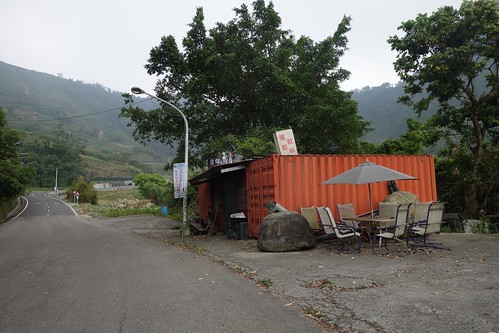
Stop in. Have a drink.

CLARITY UPDATE: Need to make clear. The 45 Taiwanese entered Kenya illegally and thus, based on its own laws, Kenya can deport them back to their point of origin, which was China. Kenyan government officials made this clear. Article 43 of Kenya's immigration law specifies that the default option is to return them to point of origin, and also specifies that once a person is found to have entered Kenya illegally, then they can be deported at the Cabinet Secretary's whim. This was not an abduction/kidnapping. This is a deportation back to port of embarkation. That is why China got them. It did not need to make a formal request, because someone probably explained to the China police, who had been there since Dec 2014, that if they waited, the prisoners would be deported back to China.

The Taipei Times reported on the bizarre and revealing complaint of Minister of Justice, which she acknowledged, had been written largely by herself....
A statement issued by the Ministry of Justice (MOJ) late on Saturday has further fueled conflict between lawmakers and Minister of Justice Luo Ying-shay (羅瑩雪), with netizens accusing Luo of treating the ministry’s Web site as her personal Facebook page.
The netizens were quite right, in their way, but then so was Luo.
“As you all know, cross-strait ties are complicated. It is not like the other side [of the Taiwan Strait] will agree to whatever we say. Just like in Taiwan, not all students listen to their professors,” the statement said.

Under the 2009 Cross-Strait Joint Crime-Fighting and Judicial Mutual Assistance Agreement (海峽兩岸共同打擊犯罪及司法互助協議), everything ranging from exchanging criminal intelligence resources and launching joint investigations to handing over evidence can only be carried out following cross-strait negotiations, the statement said.

“The ministry is not entitled to make any unilateral decisions,” it added.

The statement went on to blast lawmakers, saying they were shifting blame onto the ministry over the release of 20 Taiwanese fraud suspects deported to Taiwan from Malaysia on Friday last week due to a lack of evidence, which is still in China’s hands and has yet to be referred to Taiwanese authorities.

“These lawmakers act as if China is at the ministry’s beck and call, and have no regard for the time needed for bilateral negotiations. They denounce China, on one hand for the sake of sowing hatred and social divisions, and on the other hand, they ask the ministry to obtain relevant evidence from China,” the statement said.

“Such manipulation of populism is likely to have a disastrous effect on Taiwan. Please, lawmakers, if you truly love Taiwan, stop now before going too far. Give Taiwan a break,” it said.
It's high comedy to listen to KMTers plead to pro-Taiwan types to "give Taiwan a break" but however unprofessional this screed was, Luo was right: there isn't anything that the Ministry of Justice can do. This was a screw-up by MOFA that dates back over a year, with deep roots that go back to wrongs like the KMT's refusal to create an independent Taiwan and the vicious Han Chauvinism at the heart of the KMT identity, which regards brown people as not worthy of relations.

One interesting thing in this mess is the reference to inciting "social divisions" (= saying out loud that Taiwanese are not Chinese) and "populism". These are classic KMT propaganda tropes. Last year then-presidential candidate (now KMT Chair) Hung Hsiu-chu gave us a  stellar example of this.
Governing the country through populism: The final, most extreme example of this is obviously the Nazis. The Nazis ceaselessly created enemies within the country to control the entire society. Think about it: Although Taiwan isn’t that extreme, isn’t our situation like that? It’s like that classic saying: “When the Nazis were killing the Communist Party, I wasn’t in the Communist Party, so I said nothing. When Nazis killed the Jews, I wasn’t a Jew, so I said nothing. When the Nazis killed the Catholics, I was a Protestant, so I said nothing. When the Nazis arrested me, there was no one there to speak for me.” Isn’t this kind of scene a little familiar to us?

When soldiers are bullied by populism, we aren’t soldiers, so we don’t speak. When teachers are bullied by populism, we’re not teachers, so we don’t speak for them, either. When civil servants are bullied by populism, we aren’t civil servants, so we don’t speak for them, either. But don’t you worry that on the day when you’re bullied, there will be no one to speak for you?

There’s no shortcut to resisting populism. The people in society who are willing to listen to reason can only choose to stop being a silent majority...
The strike at "populism" reflects, as I noted them, the colonialist fear of majority rule, supported by reference to three strong supporters of the KMT, the military, the educational bureaucracy, and the civil service. ADDED: Ben Goren pointed out on Twitter that the "students-professors" remark was a slap at the Sunflowers.

The China Post ran a good article outlining some of the problems with Taiwan's organized crime against China. In my opinion the Kenya case was not a signal to the incoming Tsai Ing-wen Administration, but a signal to Taiwan that China is fed up with being targeted by Taiwan scammers, about which the government does nothing. The article observes...
According to police statistics recently released by the Chinese-language United Daily News, Taiwan authorities have brought back more than 6,000 nationals involved in fraud charges from overseas since 2005.

Another statistic shows that cross-border fraud rings involving Taiwanese citizens made 4.7 billion phone calls to potential victims in mainland China from January to June 2015 alone.

As noted by China's Taiwan Affairs Office (TAO), Taiwanese cross-border scams have conned billions of renminbi out of Chinese citizens every year, which is one of the main reasons Beijing would forcibly send the Taiwanese who were believed to be responsible for fraud schemes to China despite Taiwan's strong protest.

....

Another reason for rampant phone fraud in Taiwan, as pointed out by Taiwanese lawmakers, is that the local court treats scammers "too leniently."

Taiwan's Criminal Code stipulates that those convicted of fraud through the use of telephones or other communication equipment will face imprisonment of not more than five years.

For instance, in June 2011, in a joint effort with Indonesian police, Taiwan managed to have 100-plus Taiwanese fraud suspects operating in the East Asian country returned to Taiwan.

However, a court later gave 26 of these 100-plus suspects lenient sentences: 17 were given suspended sentences, eight were offered the option to pay fines in exchange for jail terms, and only one was sentenced to a year in prison.
In fact, the China Post commentary admits, many citizens support China in this because they want to see the alleged scammers punished, which Taiwan is not doing (a fact which few commenting on this case are mentioning). Almost everyone in Taiwan has a friend or family member who has been victimized by scammers. I can name 3 people in my family, and several of my neighbors. China, the commentary observes, gives such people ten year sentences.

The fraud rings have evolved, moving out of Taiwan and further across the Indo-Pacific region, to get out of the reach of China, as I was noting a few days back....
The CIB said that cross-country fraud rings have migrated from Taiwan to China, and now to countries in Southeast Asia and Africa.

From 2004 to 2008, annual fraud cases passed the 40,000 mark, though after the Cross-strait Joint Crime-Fighting and Judicial Mutual Assistance Agreement came into effect in 2009, cases have fallen to 30,000.

Fraud rings have since moved their operations and platforms to third countries such as Indonesia and the Philippines after 2010, the CIB stated.
According to the media, the Ministry of Foreign Affairs (MOFA) is finally bestirring itself. In 2014 40 Taiwanese were arrested in Egypt for phone scams. They were subsequently sentenced to a year in prison and now MOFA is assuring us that when the sentences are finished they will be repatriated to Taiwan. Unlike the Kenya case...

Meanwhile the legislature is attempting to come to grips with the problem. Hung Tz-yung, my own legislator, made a few proposals...
Meanwhile, Hung Tzu-yung (洪慈庸) of the New Power Party is promoting an amendment to Article 7 of the Criminal Code to remove a provision that limits the application of the law in the event that the offenses are committed outside the Republic of China (Taiwan).

Currently, for offenses committed outside R.O.C. territory, the Criminal Code only applies if they are serious crimes punishable by at least three years in prison, according to the provision.

Hung said due to this restriction, Taiwan nationals arrested overseas for operating cross-border telecommunications fraud scams cannot be charged according to the Criminal Code after they are deported back to Taiwan, because the offense carries a sentence of merely one to seven years.

In many cases, she said, those involved in cross-border fraud scams were only given light sentences and were even acquitted, inviting criticism that Taiwan is a “haven for fraudsters.”
She's absolutely right. The incoming Justice Minister said there is no need to revise the law...
Taiwan's Criminal Code stipulates that those convicted of fraud through the use of telephones or other communication equipment will face imprisonment of not more than five years, Chiu said in a radio interview.

In 2004, however, the nature of the penalties for fraud offenses was revised to "one offense, one penalty," Chiu said, explaining that this means that the court can build up sentences based on the number of victims.

If moves are made to revise the code, "all (the relevant) sentences will be aggravated, and Taiwan will as a result become a country that has adopted heavy penalties," he said.

As it stands today, a defendant convicted of multiple fraud charges can be sentenced to up to 20 years in prison, depending on the severity of the crime and the judges' discretion, the minister-designate said.

Sure, judges have discretion, but they use it to avoid punishing the criminals. For example, in the 2011 case of the 14 scammers which Manila had sent to China, after they were returned they were tried, and all were permitted to pay fine. None served time.

KMT Chair Hung Hsiu-chu said something had to be done, because exporting fraud rings is very embarrassing.

Indeed, it is embarrassing. In fact, it is costing Taiwan the moral high ground in the international media, and permitting the PRC to completely play the government. As Solidarity noted in an email this morning, the suspects repatriated from Malaysia were immediately released. The Taiwan government claimed that the PRC had not provided the evidence against them, so it had to release them. Solidarity pointed out that the PRC may have withheld the evidence deliberately to provoke this outcome, so it could criticize Taiwan.

But news reports indicate that Taiwan did indeed have some evidence: transcripts of the police interrogations from Malaysia. No doubt the prosecutors could have found a reason to hold the men, had they really wanted to. Once again, the KMT government fumbled the ball -- it didn't even go through the motions of making sure the men were held for a few days until China delivered the evidence. It didn't even bother to save face by claiming that the men had been released "by mistake" -- "well dang, we tried to notify them to hold them men, but our message arrived to late." It simply handed China another PR opportunity, as the international media are reporting.

UPDATE: Ah, internet surfing. This from the 2011 case in which Phils sent 14 accused to China instead of to Taiwan, causing an uproar:
Some academics said the case had less to do now with Manila than Beijing, mostly because of imprecise language in the cross-strait agreements, including the Agreement on Joint Cross-Strait Crime-Fighting and Mutual Judicial Assistance.

“There was nothing wrong with the decision by the Philippines,” said Yang Yun-hua (楊雲驊), an assistant professor of law at National Chengchi University, in terms of jurisdiction and the location where the crimes were committed.

While under Taiwan’s criminal law, crimes committed in China are treated as if they occurred in Taiwan
— the result of an antiquated Republic of China Constitution — this clause is not fully understood by other countries, he said.

UPDATE: The pro-KMT China Times lays down some smack on all the noise-makers:
But one cannot ignore the importance of the principle of international cooperation in mutual assistance in criminal justice. We must not level groundless accusations against Kenya and the Mainland. The law is the law. The Ministry of Justice has explained. The Mainland demanded that the suspect be prosecuted or tried on the Mainland. The request was in accordance with the rules of the principle of international cooperation in mutual assistance in criminal justice. Kenya repatriated the suspects to the Mainland, based on the principle of top priority in criminal jurisdiction by the country where the crime is committed. Kenya accepted that the Mainland requested China; hence it transferred the suspects to Mainland China. That is political reality. All Taiwan can do is ask the Mainland to handle it in accordance with pertinent cross-Strait agreements. Taiwan is in no position to level groundless accusations.

UPDATE: Good comments below, guys. Thanks!
_______________________
Don't miss the comments below! And check out my blog and its sidebars for events, links to previous posts and picture posts, and scores of links to other Taiwan blogs and forums!

Sunday, April 17, 2016

Hey Robert Ross, How's that fading independence movement treating ya?

It's Laiji, one of my favorite places in Taiwan.

Hey, Taiwan history buffs, today (Apr 17) is the anniversary of what important document in Taiwan history?

Several years ago I put a note in Google Calendar to remind myself that this month is the 10th anniversary of one of most vapidly pro-KMT, endlessly clueless articles ever published on Taiwan, Robert Ross' immortal Taiwan's Fading Independence Movement. It was published in Foreign Affairs, which would publish a hamster writing on international relations in Urdu, provided it was sufficiently anti-Taiwan. Reflect for a moment on the fearsome ignorance of its first two sentences.
Political developments in Taiwan over the past year have effectively ended the independence movement there. What had been a major source of regional instability -- and the most likely source of a great-power war anywhere in the world -- has become increasingly irrelevant.
My old post on it is still as relevant as ever. I just thought I'd post on this as I contemplate a populace which, in the under-45 demographic, is post-independence: it has already embraced independence and has moved on to other things.

So Robert Ross, how is that fading independence movement treating ya?

Yeah, I thought so.

Meanwhile, it is scary to realize this blog is old enough to refer to stuff posted on it more than a decade ago. I need to get a life...
_______________________
Don't miss the comments below! And check out my blog and its sidebars for events, links to previous posts and picture posts, and scores of links to other Taiwan blogs and forums!

Saturday, April 16, 2016

Kenya Deportations: Complicity, due process, Tsai Ing-wen....

Campgrounds springing up everywhere nowadays wherever land owners can clear flat space.

“If you know it is a scam ring, do not participate in it. Do not make the world 
think that Taiwanese are all involved in these kinds of [shady] businesses,” he said.

Vox had a nifty piece on the Kenya deportation mess which tried to explain what is going on. Unlike most of the pieces in the media, this once actually referred, if sketchily, to the cross-strait organized crime nexus.
These Taiwanese have attracted such interest from Beijing because they are allegedly members of Chinese and Taiwanese criminal gangs who frequently work together, Richard Bush, director of the East Asia Policy Center at the Brookings Institution, explained to me.
Kudos to someone for actually pointing that out.

Let's explore this for a second. There's a massive outpouring of indignant nationalist feeling, coupled with government protests and legislative posturing, right now in Taiwan, directed at China.

What's China? It's that wonderland where scores of Taiwanese criminals from local gangsters to corporate embezzlers, people largely connected to A Certain Political Party, have fled while on bail. There they reside in perfect safety, unmolested by either the Chinese or Taiwanese governments. The Taiwan government has obstinately refused to close this loophole despite long-simmering public anger about it. No complicity there!

But let's also remember, as I am fond of pointing out, that one of the chief beneficiaries of the cross-strait rapproachment and business investment over the last two decades is cross-strait organized crime, which operates banks, stolen art networks, and movement of individuals for escape from the law, sex work, and ordinary labor. Neither government disturbs these extensive networks. Indeed there are places where spouses of major criminal figures involved in these cross-strait criminal networks have run for public office under the umbrella of A Certain Political Party. It's these networks that facilitate the escape of wanted individuals from Taiwan to China. It's these networks, as China correctly if hypocritically notes, that operate globally, and move as pressure on them shifts.

You'll forgive me if, looking at this Kenya case, I've come to the cynical conclusion that the Taiwan government is only worried about its criminals going to China if there is some possibility that they might actually be prosecuted.

Two other things need to be pointed out. First, was this move in Kenya directed at the incoming DPP Administration? Don't make me laugh. It had nothing to do with that. It was, as I said yesterday, part of China's campaign against phone scammers around the Indo-Pacific rim. China itself said this over a year ago.

Here is a report from the Kenyan newspaper The Nation (ah, does that bring back memories) dated Jan 15, 2015 (and CS Monitor but The Nation report is better). Please note that this was a year ago:
The Chinese Government has formally asked Kenya to hand over 76 of its citizens who are facing cyber-crime charges in Nairobi.

The suspects arrested in Nairobi had stolen close to Sh1.5 billion from their victims in China through electronic fraud, Chinese authorities revealed, as they pushed Kenya to have them extradited.

.....

According to the police in Nairobi, the 76 Chinese and one Thai national were arrested in the upmarket Runda Estate for operating an illegal telecommunications system.

.....

China’s argument has been that the suspects are part of a global syndicate targeting China and that other groups had been arrested in the Philippines, Indonesia, Singapore and Egypt over the last two years.

In December, a Chinese police team came to Nairobi to, according to the embassy, “jointly investigate” the case with their Kenyan counterparts. However, the group is said to have pressed for a handover of the suspects.
So... anyone want to argue that the PRC government, 16 months ago, presciently arranged to have 8 of the Taiwanese suspects sent to jail for a year on bogus document charges (oh yeah -- acquitted on "all charges"? Bullshit!) so that the group could be bundled onto a plane right on time for it to be a message to the newly-elected Tsai Ing-wen Administration? Be serious.

But let's yak for a minute about "due process". Suddenly lots of people talking about due process. Well, the report from a year ago clearly indicates that China was asking about this well over a year ago. Taiwan had over a year to publicize the case and to secure due process, if it cared to.

Due process? Two cases this week -- a bunch of alleged Taiwanese scammers were repatriated from Indonesia. No noise from Beijing, as I noted in the post below. Another crew deported from Malaysia as well. China had reportedly asked about them, but from the media reports it wasn't clear whether Kuala Lumpur had decided to check with Beijing, or whether Beijing had acted on its own.

What happened to the crowd from Malaysia? As soon as they arrived in Taiwan, they were released, due to a "lack of evidence." An NPP legislator was out today complaining the whole thing was a setup. Indeed a KMT politician  admitted yesterday that light sentences for criminals returned to Taiwan were a problem.
When asked how the KMT caucus would respond to speculation that the Kenya incident was a warning from Beijing against the new government, Lin said: “We have to face reality as well; we had given light sentences to the fraudsters after they were extradited back to Taiwan, which had resulted in certain consequences.”
Note that the question asked whether Beijing was warning the new Administration. A KMT politician, instead of running with this softball question and lambasting the incoming Administration, refocused the incident on a real complaint: the kid gloves Taiwan gangsters get, not the sexy cross-strait framework that sells papers and enables international media workers and commenters to avoid cognitively demanding tasks like searching Kenyan newspapers on Google. My god! Beer please.

More seriously, the KMT politician essentially said what everyone knows: the government is complicit. Period.

Complicit. So if you talk to me about due process, I'm going to talk to you about complicity. Why on earth would any government send accused Taiwanese back to Taiwan? You are entitled to ask about due process only when you engage in it. Of course China very rationally grabbed those Taiwanese alleged scammers. The bad guys were going to get away, and China had been pursuing them for ages.

That release of accused scammers from Malaysia was exactly what China had complained about: when prisoners get sent back to Taiwan, they are immediately released. The KMT government goes right ahead and validates the Chinese complaint in the most clueless, arrogant manner possible: right in the middle of this hoo-ha, it releases a batch of returned accused criminals. It did this even though 32 accused remain in Malaysia, almost as if it were goading China to apply more pressure. It couldn't have at least gone through the motions of keeping them in custody for a few days?

Luckily for all concerned, the government took a strong stance:
In a statement issued Saturday, Cabinet spokesman Sun Lih-chyun (孫立群) said Premier Simon Chang (張善政) made it clear that the government will not condone any criminal acts involving its nationals, during a meeting held on related issues Friday.
It will, however, release them as soon as they get to Taiwanese soil.

I guess due process applies only to Taiwanese gangsters in Kenya. Once they are in Taiwan, foreign governments don't get any "due process" to work up a case against them and the victims lose all their "due process". Never mind that the alleged criminals are free to go back to their alleged work, defrauding victims both local and international, who aren't important anyway because they are victims, sheep born to be sheared, in the due process of things as they are. Poo-tee-weet.

Meanwhile the legislature was screaming that China really ought to show the evidence against the deportees. LOL. Despite overwrought claims that cross-strait agreements on crime were dead, the Taiwan government is sending a large delegation to China to handle the case on Monday.

So what is all this nationalistic noise about? Seems like there was some serious la-de-da in the Ministry of Foreign Affairs in getting these people back to Taiwan -- if that is what was wanted. Maybe all this noise is to conceal the fact that MOFA simply screwed up or really just didn't give a damn about the fate of a bunch of alleged vicious low-lives -- or worse, tossed China a bone by permitting the suspects to be deported there, then pretended to be upset about it.

It's not a coincidence that outpourings of puerile nationalism occurred when the alleged illegal fisherman was killed in Phils a couple of years ago, and again when some alleged gangsters are sent off to China. Like I said two days ago, all this static is just white noise concealing a basic fact nobody wants to talk about: from tuna poachers to phone scammers, one of Taiwan's chief exports is organized crime.

UPDATE: I was wrong. The Thai national was returned to Thailand.
_______________
Daily Links:
_______________________
Don't miss the comments below! And check out my blog and its sidebars for events, links to previous posts and picture posts, and scores of links to other Taiwan blogs and forums!

Friday, April 15, 2016

Friday Links

DSC01477
A True Jesus Church in Hualien
_______________________
Don't miss the comments below! And check out my blog and its sidebars for events, links to previous posts and picture posts, and scores of links to other Taiwan blogs and forums!

What? China didn't ask for those Taiwan fraudsters in Indonesia?

AlishanDM_DSC01805
Chiayi hills.

FocusTaiwan yesterday reported on a case of alleged Taiwanese fraudsters in Indonesia being arrested.
A Taiwanese official based in Indonesia said there have been many cases of Taiwanese and Chinese nationals entering Indonesia to engage in telecom fraud.

Unlike the recent incident in Kenya, however, there have been no reports of Taiwanese suspects being deported to China, the official said.

The official was referring to Kenya's recent controversial decision to hand over to China a total of 45 Taiwanese nationals who allegedly were members of various Kenya-based telecom fraud rings targeting Chinese victims.

In cooperation with Taiwanese and Chinese police, Indonesian law enforcement officers last August busted an international fraud ring based in Indonesia, arresting 82 Taiwanese suspects and seizing IDR$10 billion
The Kenya incident is not about Tsai Ing-wen or Ma Ying-jeou. It does not signal a new normal. It is not related to the Hong Kong booksellers. It appears to be related to the ongoing pattern of Chinese investigation of international telephone fraud against its own citizens, something the Chinese state has a right and a duty to do. I might add that it helps Taiwanese, since they are also victims of these fraudsters.

However, if China's actions continue being misrepresented, they just might conclude there is no point in not being a$$holes in the future.
_______________________
Don't miss the comments below! And check out my blog and its sidebars for events, links to previous posts and picture posts, and scores of links to other Taiwan blogs and forums!

Thursday, April 14, 2016

=UPDATEDX5= Kenya Deportations: Taiwan drinks the heady gaoliang of febrile nationalism

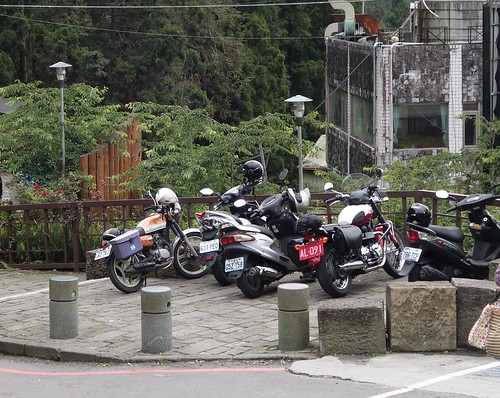
Our bikes in Fenchihu on Sunday. We stopped to snack, parked by the motorbikes by the roadside. "You can't park them there," a vendor warned us. "The cops will give tickets to people who park in the street because people walk there. Better park them on the sidewalk." 

'Sovereign, like love, means anything you want it to mean; 
it's a word in dictionary between sober and sozzled.' -- R. Heinlein

(Updates at bottom)

So much going on in this crazy case of deportation of alleged Taiwanese fraudsters from Kenya to China. Haven't seen such a display of dysfunctional, febrile nationalism like this since Philippines coast guard evil Philippines coast guard shot murdered tuna poachers totally innocent Taiwan fishermen in Philippines waters Taiwanese waters (old post). The collective IQ of Taiwan's chattering classes has just gone kerplunk! somewhere into the Indian Ocean east of Mombasa. *sigh*

Lost in the tumescent twaddlenoise over this case is an opportunity for Taiwan. It also shows once again how the international media functions as a soft power tool for Beijing. I hope to work up a fuller treatment of that for something like CPI or Ketagalan out at the end of the week, but we can shed some light on it using this case...

Let's grab a couple of news reports first: from Reuters in the Kenyan Star Newspaper (how that brings back memories for me!):
The Kenyan government said the people were in Kenya illegally and were being sent back to where they had come from.

Kenya does not have official relations with Taiwan and considers the island part of China, in line with Beijing's position.

Taiwan's Foreign ministry said one of the Taiwanese sent to China was also a US national. The US State Department said it was aware of that report but was not able to discuss it at the moment "due to privacy considerations."

....

The Taiwanese government was incensed that Kenyan authorities used force , including tear gas, to get deportees out of a police station and into a plane on Tuesday. It has accused China of kidnapping eight of its nationals.

"They came from China and we took them to China. Usually when you go to another country illegally, you are taken back to your last port of departure," said Kenyan Interior ministry spokesman Mwenda Njoka.

He could not say which city in China they were being returned to, but Kenya Airways and China Southern both fly to Guangzhou.

Kenyan Foreign Affairs CS Amina Mohamed said Taipei had not contacted Nairobi about the matter. The protests came via a media briefing in Taiwan.

"We don't have official relations with Taiwan. We believe in the 'One China' policy. We have diplomatic relations with China. We haven't seen the official protest, we are actually hearing it from the media," Mohamed told Reuters.

A group of eight left on Friday and a second group of 37 Taiwanese nationals were in the process of leaving on Tuesday, Taiwan's Foreign ministry said.

Chinese Foreign ministry spokesman Lu Kang said Beijing approved of Kenya's upholding the 'one China' principle. He declined to elaborate.
Now yesterday from the Taipei Times the Ministry of Justice said that the deportations were legal and China had every right...
However, they said that Beijing acted in conformity with the principles on legal jurisdiction in having them deported to China, where the targets of the fraud schemes reside.

Tai Tung-li (戴東麗), deputy director of the ministry’s Department of International and Cross-Strait Legal Affairs, told a news conference in Taipei that the government had asked Beijing to deal with the eight Taiwanese in accordance with the Cross-Strait Joint Crime-Fighting and Judicial Mutual Assistance Agreement (海峽兩岸共同打擊犯罪及司法互助協議), and that they be released and sent back to Taiwan.

“Chinese government officials said they are investigating the Taiwanese suspects for fraud involving phone scams. As these cases took place in China, they were asserting their legal jurisdiction in having the Taiwanese suspects forcibly taken to China,” she said.

Tai said that the Chinese Ministry of Public Security had informed Taiwan’s Criminal Investigation Bureau that the eight were held in custody in Beijing on Monday, and promised to handle the case in accordance with the cross-strait legal agreement.

The government will send a delegation to China to negotiate the case, Tai added.
According to information released by Chinese authorities, the victims of the phone scams originating in Kenya were all Chinese citizens — not Taiwanese — so the suspects were deported to China for investigation, Tai said.

“The telecommunication facilities used to make the telephone calls were based in Kenya, so the fraud schemes took place outside of our country, so Taiwan does not have jurisdiction [over the case],” Tai said. “Therefore, China’s handling of the case conforms to principles of international criminal jurisdiction.”

As for reports that the Kenyan court had acquitted the eight, Tai said: “They were found not guilty on three of the charges, which were operating a telecommunications enterprise without a license, operating radio communications without a license and organized crime. The ruling did not involve the fraud charges. From an objective point of view, China made the deportation request to investigate the fraud charges.”
Today, thanks to the sudden wave of insensate nationalism sweeping the nation, the Ministry attempted to appear to reverse its position. Read what they said closely: same as yesterday, just different words.

Ibtimes report here observes:
The repatriated group's lawyer Steve Isinta said that police had told the group held at the police station to get ready because they would be leaving soon. He later received a message from one of his Taiwanese clients saying: "It's not our people coming for us," referring to the fact that Chinese officials had arrived at the police station instead of Taiwan representatives. Isinta said he did not hear from them after that.

Isinta told Quartz: "It was illegal for them to be deported. To be deported you have to have broken the law. It's because of pressure from China."

Isinta said that most Kenyans do not understand the controversy behind the deportation, nor do they care. Isinta has filed a motion to take the country's attorney general and the police chief to court over the detention and deportation of his clients following their acquittal.
Indeed, that last claim about Kenyans not caring seems quite true. I looked at a couple of papers, and the Kenyan papers seem to be relying on outside media services for their reports, like this AFP story on it in the Daily Nation.

The Daily Nation also featured another piece from AFP, which observed:
Asked to comment on the row Monday, China's foreign ministry said it needed to check on the details but "the One China policy should be upheld".
Check this Xinhua report (link) on the Public Security Ministry's comments on the case in Chinese. It focuses entirely on the criminal aspects, which are extensive. China says these and similar frauds have been raping Chinese citizens and all the victims are Chinese in this case. According to Xinhua, the gang set up in "dens of fraud" in Nairobi, and made internet calls to Beijing, Jiangsu, Hunan, Sichuan and nine other provinces and municipalities posing as Chinese public security authorities to commit fraud with initial estimates of millions of dollars. Old people, students, savings, -- all gone. The piece also complains that Taiwan just lets people go once they've been sent back here. China is not exactly blameless (can we have back all the criminals from Taiwan who have taken refuge there?) but they do make some strong points. It even refers to cooperation with Taiwan over similar fraud cases in SE Asia.

What's not in the report? Not even a boilerplate reiteration of sovereignty.

The foreign ministry spokesman just thanked Kenya for upholding the 'One China' policy and the foreign ministry backed that, but to my knowledge no official word concretely connected this case with the cross-strait sovereignty. No one has said "We deported them to China because they are all Chinese." The 'One China' mentions were boilerplate, trotted out on all diplomatic occasions. The same automated, unconscious words would have been uttered if Kenyan officials had hosted a tea party for Chinese diplomats.

This did not prevent BBC, always ready to screw Taiwan, from cleverly interpolating this boilerplate into its report (4th sentence) to make it look like the extraditions were related to the One China policy. Nice work, whoever did that.

Taiwan and all of its commentators here and abroad were presented with a golden opportunity NOT to make this thing about sovereignty, but instead to treat the case as a normal event between normal countries. To normalize relations between China and Taiwan. To say offhandedly "We hope that Chinese authorities will adjudicate the case in accordance with established international procedures and China-Taiwan agreements, and we are closely monitoring it. Now, moving on to the issue of falling exports and tax revenues..." That common sense move is exactly what our Ministry of Justice tried to do two days ago. Kudos to them.

Of course, Taiwan also had a chance to decouple an issue from the simpleminded sovereignty discussions in the international media. Tired of the international media's ignorant, interminable focus on Cross-Strait sovereignty issues? Stop playing that game. Instead we got total mediafail by our commentariat. The NYTimes report by the refreshingly competent Austin Ramzy was quite restrained, basically focusing on the diplomat spat, indeed, it was way more restrained than our own media. That's what we on the pro-Taiwan side should have encouraged all across the media, domestic and abroad.

Great job, guys.

Taiwan spokesman extraordinaire J Michael Cole is in CNN today on the issue, clearly identified as part of a Tsai Ing-wen funded organization (if Cole had China links, they probably would not have been so clearly identified). Sadly, Cole decided to run with the sovereignty issue and argue for other, more dubious links to odious Chinese behavior, when it could have been downplayed...
Besides the fact that the individuals were cleared of all crimes by a Kenyan court, their extradition to China, ostensibly due to pressure from Chinese officials, raises essential questions about the future implications of the "one China" policy in a time of greater Chinese assertiveness.
It didn't have to raise any "essential questions". It could have been kept as a simple issue of crime under international law. Sometimes a cigar should be permitted to be only a cigar: Cole should have moved to dampen the flames, not pour oil on them. I also can't resist pointing out that the individuals were not "cleared of all crimes" by the Kenyan court. They were cleared off all the crimes the Kenyan authorities brought to the court -- the fraud charges were withheld as the Taiwan Ministry of Justice said, probably because China wanted to prosecute those (that may have been why the Kenya authorities cleared them, so there would be no tussle about where they serve their prison sentences). China appears to have wanted to send a message, not about sovereignty, but about international crime (read the Xinhua report again. Note emphasis on tawdry fraud crime). It's been doing that for years, btw.

It doesn't raise any essential questions also because it has happened before, as I noted yesterday when I observed that everyone was barking up the wrong tree. In 2011 Philippines sent a bunch of alleged fraudsters back to China. Please enumerate the repercussions of that... O yeah, there weren't any. Well, there were -- all that assiduous pursuit of fraudsters in SE Asia by China over the last few years was probably a factor that sent them off to Kenya in the first place, where things are congenial for financial criminals.

Cole (and many others) have placed the extradition of alleged gangsters accused of being engaged in fraud in the context of the kidnapping innocent booksellers in Hong Kong (see this Reuters piece, for example). Turning fraudsters into heroes of dissent is a leap into an abyss where nobody should be going. Once again, the opportunity to normalize this behavior and separate it from the vile kidnapping of the booksellers by emphasizing the differences in the case was thrown away -- instead the abnormality and evil of the kidnapping of booksellers is blurred, denigrated.

Not only that, but the Hong Kong booksellers aren't even the right context -- the 2011 Philippines deportees are, and China's campaign against fraud in SE Asia. This is not a political crime issue, but a gangster crime issue.

Even the use of the term "kidnapping" is ill-advised. I do not know what the correct legal term should be, either deportation or extradition, but these men weren't "kidnapped". They were acquitted and given a fixed time to leave the country, then bundled off to the place they came from (you can't fly directly to Nairobi from Taipei, and the cheapest flights go through China. Hence Kenya seems to be correct). That's how the system works. People get deported to countries they are not citizens of all the time. That could have been invoked in this case -- instead of focusing on "China as China" the commentary could have stressed "China as a foreign country". You know, normalizing its distance from Taiwan.

It's quite true that China rushed to get them -- because once they got back to Taiwan, they would be out of Beijing's reach.

Cole claims that the 2009 crime-fighting agreement is a "dead instrument." Two days ago the Ministry of Justice said that China had notified Taiwan that the case will be handled in accordance with that. Let's wait and see on that, shall we?

Taiwan really ought to be going to bat for international law and its cross-strait agreements on crime, as the Ministry of Justice initially attempted to do. International law is one of the things that helps keep Taiwan out of Beijing's clutches -- heck, we could even have leveraged Chinese victimhood to support international law, in this case. Maybe we could have used this to get some of our own criminals there sent back...

Another lesson here is how, if you don't suppress the media's urge to make everything about the sovereignty issue, it will go right ahead and keep pointing that out, thus helping Beijing enforce its claims and make them known to the world.

Not only that, but once you claim that this is Beijing making trouble for Tsai, you've made trouble for Tsai that you didn't have to make.

Great work all around, folks.

It will, of course, have a temporary impact on Taiwan's attitudes toward China, but since they were largely negative anyway...

Finally, just as in the Philippines case, all this noise about "kidnapping", sovereignty, and the China threat may be out there to obscure an important truth that no one in Taiwan wants to face: one of Taiwan's chief exports is organized crime.

UPDATE: Julian Ku, the international law professor who tried to claim it was perfectly legal for China to maim and murder Taiwanese and annex their island (his political allegiance should be obvious if you find some of his stuff, so filter whatever he says hard), is cited in this NYTimes piece. NYTimes observes:
Deporting suspects to third countries is not illegal under international law, said Julian Ku, a professor of international law at Hofstra University.

China also has the right under international law to prosecute people suspected of committing crimes directed at Chinese territory, Mr. Ku said. “China makes a lot of bad arguments, but this one is pretty good,” he said.

But, complicating matters, China and Taiwan have abided since 2009 by their Cross-Strait Joint Crime-Fighting and Judicial Mutual Assistance Agreement, which formalized criminal-justice cooperation and established a procedure for each side to return the other’s citizens in legal cases. In a 2011 fraud case, 14 Taiwanese suspects who had been deported from the Philippines to China were sent back to Taiwan under the agreement.

Some experts suspect that China’s change in strategy is a deliberate warning to Taiwan’s newly elected president, Tsai Ing-wen, who will take office in May and has advocated an approach to cross-strait relations that is more cautious than her predecessor’s.

“The Chinese are definitely trying to send a message,” Mr. Ku said. “Before this case, the Taiwanese were used to being consulted by China. The level of trust that made the agreement work seems to have broken down.”
Recall that in the 2011 case, it took months of negotiations to get back the Taiwanese Manila sent to China. They didn't just send them back right away as NYT could be read to imply. Same thing will happen here.

Again, there's a context missing: if all those Taiwanese criminals residing in China who haven't been sent back are not a message to Ma Ying-jeou (and Chen Shui-bian) how is it that this one case is a message to Tsai Ing-wen? The Kenyan investigation long predates Tsai Ing-wen's election. The timing is a coincidence, unless you want to argue that Beijing arranged it with Nairobi (feel free). Because the negotiations will drag out for months, it is way too early to say how and whether China is cooperating.

UPDATE 2: Taiwan Law Blog summarizes the three positions of Taiwan, China, and Kenya.

UPDATE 3: Here is the Kenya Star Jan 2015 report of the original arrest of the Kenya 8, originally in Dec of 2014. You want to claim this is about Tsai Ing-wen, go right ahead. I'll laugh at you. Note that the list of charges is consistent with that offered by the Ministry of Justice in its original statement.
The eight were arrested at Ngong Avenue, Ngong, in December.

Their arrest came after 77 Chinese were arrested following a fire outbreak at their Runda, Nairobi, residence.

The 77 have denied the charges of illegally running a telecommunication system, conspiring to commit a felony and engaging in organised criminal activity.

Police suspect the foreigners may have been involved in bank fraud, money laundering and other serious financial crimes in other countries using the telecommunication equipment seized.
Here is what the Ministry of Justice said:
As for reports that the Kenyan court had acquitted the eight, Tai said: “They were found not guilty on three of the charges, which were operating a telecommunications enterprise without a license, operating radio communications without a license and organized crime. The ruling did not involve the fraud charges. From an objective point of view, China made the deportation request to investigate the fraud charges.”
The Ministry of Justice's initial statement that fraud charges were not pursued appears to be correct.

Now here is the follow up Jan 27 report from The Star. Note that the timing of the case was fixed back in Jan, when the men began serving a one-year term.

Here is another report of Taiwanese operating an illegal radio station (?) but I don't know if these are the same guys sent to China this week. This appears to be a related report from Dec of 2014. Tentatively, the 8 and 37 Taiwanese all appear to have been discovered in the same fire, but were handled separately.

UPDATE 4: Commenter observes:
According to today's China Post here is what happened to the Taiwanese that were eventually sent back from the PI five years ago.

"Two were found not guilty, while the rest were handed sentences ranging from one year and four months to three years and eight months under combined violations.

However, no one was jailed as the case allowed them to convert imprisonment into fines, Sun stated."

It confirms what China has been complaining about, and why they went to prosecute these people themselves.
UPDATE 5: Ministry of Justice testifies about Kenya case:
However, Chen stated that the preliminary investigation showed that the international fraud ring only targeted Mainland Chinese, and that there were no Taiwanese victims. “In spite of this, we will still send people to the Mainland to learn more about the case. In the past, Taiwanese suspects in similar cases were repatriated to Taiwan, but were later released because we had no jurisdiction. Therefore, this time we should be more cautious in dealing with the case,” stressed Chen.
UPDATE 6: The Nation newspaper of Kenya reported in Jan 2015 that China was asking for the prisoners. Taiwan has had a whole year to act on this. Either the diplomatic corps didn't care, or it was incompetent. It didn't move until it became a nationalist issue in Taiwan, and the government had to stoke cross-strait emotions to cover up the fact that it had dilly-dallied for a year, done nothing, and then been blindsided. Taiwan had a whole year to secure "due process".  Posted on it several posts above this one.

REF: The 2011 Phils case and China power.
_______________________
Don't miss the comments below! And check out my blog and its sidebars for events, links to previous posts and picture posts, and scores of links to other Taiwan blogs and forums!
Tuesday, April 12, 2016

Deportations from Kenya to China: you're asking the wrong question

Longtime and well known expat Donovan Smith, who is part of the Compass Magazine team and is also the ICRT central Taiwan news man, enjoys the 149A below Caoling. 

LOL. Concerns were raised among Taiwan observers when eight Taiwanese acquitted of fraud in a trial in Kenya were handed over to Chinese authorities this week. In 2011 Philippines sent a group of fraudsters off to China. It took months of negotiation to get them back.

Most of the discussion has focused on the sovereignty issue, and warning that this is ZOMG A BIG DEAL with REPERCUSSIONS for the incoming Administration. But note how the outline of the two cases, Philippines and Kenya, are the same: a mixed group of Chinese and Taiwanese accused of fraud, and Beijing gets the Taiwanese deported back to China.

Taiwanese are regularly involved in crimes abroad, but deportations back to China are rare. In fact, one never hears that China has asked for Taiwanese criminals to be returned to it rather than Taiwan. People asking about the effect this kidnapping on Taiwan's place in the world or sovereignty or cross-strait relations are asking the wrong question, probably because they are permanently trapped in the media matrix where everything Taiwan is related to China by refracting it through the lens of cross-strait politics, and no other meanings are possible.

I love Kenya but honesty compels me to admit that Kenya is a major transit state for money laundering, drugs, and other illicit activities. It is the "single easiest place in the world" to carry out illicit financial activities, in fact. I suspect that those Taiwanese were deported back to China because they knew something about illicit activities of China in Kenya, and Beijing wanted to have a little chat with them before they were handed back to Taiwanese authorities.

UPDATE: Another 37 forced on plane to China, bringing total to 45. If this is a sovereignty thing aimed at Tsai Ing-wen or Ma Ying-jeou, why do they need them all? Completeness is only necessary if you want to make a clean sweep of something. Like if you want to make sure of how much a group of people knows about something...  Also it's fan-feces time, as some news media reporting that at least one abductee has a US passport.
_______________
Daily Links:
_______________________
Don't miss the comments below! And check out my blog and its sidebars for events, links to previous posts and picture posts, and scores of links to other Taiwan blogs and forums!

Monday, April 11, 2016

Call of the East: A Romance of Far Formosa (1914)

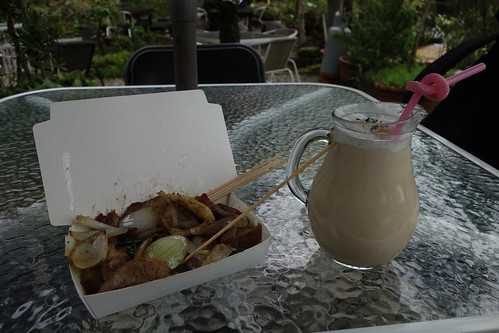
A lifegiving meal of fatty pork with onions and milk tea, which has genuine healing powers. 

Jonathon Benda alerted me to the existence of this book. The full text is on the net in the Internet Archive and at Project Gutenberg. The story is set in the Sino-French war of 1884-5, and one of the background characters is Dr Mackay, the famous missionary.
"Then Keelung is in the hands of the French?"

"Yes. That is if by Keelung you mean a strip of a few hundred feet wide around the harbour. But the hills all around that again are occupied by the Chinese."

"Little difference that will make," said Carteret. "The Celestials have had all they want. At the first sign of a French advance they'll run, and never stop running till they reach Taipeh."

"I'm not so sure about that," replied Gardenier, a trifle coldly. "In the first place, the French have no land forces with which to make an advance. In the second place, the Chinese are better fighters than you give them credit for, Mr. Carteret. All they need is a good leader, and I believe that they have such a man in Liu Ming-chuan."

"And in the third place," said Beauchamp, "the Keelung climate is enough to defeat the French if there were no Chinese. By the time their transports arrive the northeast monsoon will be about due. Then the Lord help them! One of the wettest spots on earth. Boville, what is the annual rainfall over there?"
Of course, it is a romance...
Miss MacAllister did not wait to be urged, but responded at once. Her voice was a rich, strong soprano. With a verve and fire worthy of her choice, she sang Lady Nairn's stirring war-song, "The Hundred Pipers." To the insistent demand for another song she replied with "The March of the Cameron Men." With her stately figure at its full height, head thrown back, and eyes which seemed to look away beyond her tropic surroundings to the hills of old Scotland, she sang as if possessed by the spirit of generations of Highland ancestors.

Sinclair, from his place over by the mantel-piece, was looking at her with undisguised admiration.

"Isn't she magnificent ? Yon's a prize for some man! ... Sinclair, man, why don't you go in and win? If you don't try, I'll be ashamed of you, whatever."

It was McLeod. He was speaking in a low tone, only for his friend's ear. But he who had been the personification of coolness during the typhoon was now fairly quivering with excitement. The songs of his people had fired his blood.

"You needn't be ashamed of me, Mac. I'm going to try."

"Good for you ! I'll back you to win."

"Don't stake too much on me, Mac. I'm new to this game. You might lose heavily. Carteret is ahead of me."

"That dirty snob ! " exclaimed McLeod in a tone of disgust. "He wants her in just the' same way as he wants every pretty woman he sees. And then her money would help to repair the Carteret fortunes."
_______________________
Don't miss the comments below! And check out my blog and its sidebars for events, links to previous posts and picture posts, and scores of links to other Taiwan blogs and forums!
NTU summer Asian arts program

Scooter trippin' on the 169 this weekend.

NTU sent this around:

Dear Colleagues in East Asian Studies,

National Taiwan University is offering a unique "East Asian Performing Arts" summer program this July. We would be most grateful if you could encourage your students to apply at this link: http://goo.gl/JCyM7A

For more information, please see below:

This program offers an introduction to key forms of performing arts across East Asia. Over the course of two weeks, students will attend a series of lectures focusing on two intimately connected art forms—theater and music—to be given by notable scholars and specialists in the fields from some of the most prestigious research institutes in Taiwan.

The lectures will introduce the history and practice of performing arts in pre-modern and contemporary China, Taiwan, Japan, Korea, and Southeast Asia. Live demonstrations by actual performers, visitations of sites or collections featuring related artifacts, and screenings of films on performing arts will be incorporated whenever possible to give students a taste of theater and music in action.

Sample courses include (NTU reserves the right to slightly modify the program with advance notice):

♦ Introduction to East Asian Performing Arts: Mapping the Field
♦ China Theater: History of Theater in China + Kunqu Opera
♦ China Music: History of Music in China + Nanguan Music
♦ Taiwan Theater: Taiwanese Opera
♦ Taiwan Music: Aborigine Music
♦ Japan Theater: Noh Drama / Kabuki Theater in the Visual Arts
♦ Korea Music: 20th Century Colonial Period Music
♦ Southeast Asia Music: Myanmar Classical Music
♦ Asian Theater in Films: “Farewell My Concubine”
♦ Concluding Lecture
_______________________
Don't miss the comments below! And check out my blog and its sidebars for events, links to previous posts and picture posts, and scores of links to other Taiwan blogs and forums!

Friday, April 08, 2016

Tax evasion: A man, a plan, Panama!

DSC01571
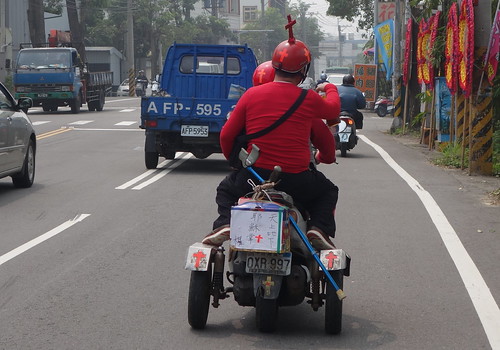
The Jesus helmet, for when Jesus placards on your scooter aren't enough.

Lots of comments on the Panama Papers and Taiwan, but the key one is here:
When news of the leaks broke on Sunday, some local media initially linked several prominent Taiwanese to the latest tranche of leaked documents. The names included President-elect’s brother, Tsai Ying-yang, and the heads of several companies such as Ting Hsin International Group, Taiwan Semiconductor Manufacturing Company (TSMC) and Advanced Micro Devices (AMD).

Chen, however, said such information was exposed by ICIJ in 2013.

While the ICIJ on its website notes that there are“legitimate uses for offshore companies, foundations and trusts,” the Panama Papers leak points to widespread illegal or unethical operation of offshore accounts and companies to evade taxes. The latest release of data has sparked tax evasion investigations into possible tax havens, causing the Prime Minister of Iceland to resign.
There are indeed legitimate uses. Many people have offshore companies for a wide variety of reasons. Taiwan's laws, it was explained to me by a corporate law office employee the other day, are hugely restrictive. For example, let's suppose a group of investors wants to form a company. Under Taiwan law, they have to have face to face meetings once a month (this has been changed to virtual meetings in recent years). They can't conduct things via email or snail mail. In many jurisdictions shareholders and founders regularly and normally make contracts among themselves about how the company is going to be conducted, defining who might run the firm and what percentage of profits or shares they might get. Such contracts are iffy under Taiwan law. And so on. In order to run companies the way they want, it's perfectly normal for people to offshore their firms. So let's wait and see what comes out...

...though as he noted, the legit activity tends to take place in the British Virgin Islands and similar. Panama is for illicit stuff since it isn't party to many international agreements on laundering, etc.

FOARP passes along a theory that many have been theorizing since this news broke -- the PRC hasn't made Panama switch recognition because so many corrupt officials have money there:
Interestingly, the Panamanian government even sought to switch recognition to the PRC as recently as 2009, only to be rebuffed by the PRC government out of an apparent desire not to breach the diplomatic truce between the two sides of the Taiwan strait. Funnily enough, despite the end of the "truce" with the recent establishment of diplomatic relations between the Gambia and the PRC after their 2013 breach with Taipei, there has not been any sign, yet, of movement in the Panamanian case despite the long-expressed desire to switch recognition.

The suspiciously-minded might suspect that the PRC leadership are purposefully delaying the switch as the "Panama Route" is rumoured to have proved useful for them and their families. However, there is not nearly enough evidence at the moment to draw this conclusion - but if Panama's diplomatic switch from Taipei to Beijing is significantly delayed, you might be forgiven for thinking that their motive in doing so may have something to do with keeping the "Panama Route" open.
_______________________
Don't miss the comments below! And check out my blog and its sidebars for events, links to previous posts and picture posts, and scores of links to other Taiwan blogs and forums!
Thursday, April 07, 2016

The slowly growing marriage "crisis" in Taiwan

DSC01589
My good friend Eva, one of Taiwan's many attractive, accomplished unmarried 30-somethings.

Apple Daily ran a short piece on stats from the Ministry of Interior on marriage in Taiwan, noting that the reason for the falling rate of marriage, which matches Taiwan's falling birth rates, is commonly known as "2 Low 4 High"...
根據《好房網》報導,截至2014年底為止,內政部統計30至34歲人口有將近5成未婚,25至29歲的未婚比例更高達8成。統整出結果後發現,就是這以下「2低4高」的因素讓七年級生、甚至八年級生遲遲不敢成家生子。

According to a report from HouseFun News, as of the end of 2014, statistics from the Ministry of the Interior showed that 50% of those aged 30-34 remain unmarried, while for the 25-29 group the figure was 80%. Overall statistics show that the "2 Low, 4 High" keep those born in the 80s and 90s from forming a family and having children.
The two lows are the low salaries and low social welfare benefits for having children. The four highs are long work hours, high cost of children, high price of housing, and the high hidden costs (such as the health effects on the woman). Housing is an especial obstacle since custom requires that the man have purchased a house.

To which I would add that many females aren't getting married because of social factors not included here. Intelligent and accomplished females have great trouble finding mates in most places, but in Taiwan especially, where there is a widespread preference among males for women less intelligent than they are. I bump into this problem again and again in my interactions with older male grad students: "Why don't you ask X out? She's good looking, and super smart." "She is too smart" comes the unvarying answer. Females, especially those living alone and employed, come to treasure their personal freedom and dread the terrible family obligations that local culture places on them -- weekends wasted visiting the in-laws, the necessary service to the mother-in-law, the fulfilling of expected roles and behaviors on a constant basis. Consequently many choose to remain unmarried. Males can live with mom without stigma. Society also has become more relaxed about couples living together and about homosexuality.

Recall too that at the bottom of the social pyramid, many Taiwanese working class females can't find husbands because those men have imported a wife from China or Vietnam. Our picture of the single woman as a self-aware independent unmarried Taipei office girl is unrepresentative. There is also a group of females who are kept home to take care of mom and dad and who are told that marriage would be leaving the family and thus, betraying it. I have met several such females, and I suspect the pressure must be subtle and widespread.

As people enter their 30s their friends start going through divorces, and their picture of marriage becomes less and less positive. Why get married?
_______________________
Don't miss the comments below! And check out my blog and its sidebars for events, links to previous posts and picture posts, and scores of links to other Taiwan blogs and forums!

New KMT Chair Hung makes a classic move

Rice.

Solidarity.tw translated a UDN article on new KMT Chairwoman Hung Hsiu-chu's appointments to positions within the KMT:
Days after naming members of her campaign team to party posts (S.tw: see below), new KMT Chairwoman Hung Hsiu-chu (洪秀柱) tonight announced a second round of personnel appointments. She named a record seven people as KMT deputy secretaries-general:
-Legislator Lin Teh-fu (林德福) (S.tw: KMT legislative caucus secretary-general, and deep-blue representative of Hung’s home district of Yonghe),
-Taitung County Council Speaker Rao Ching-ling (饒慶齡)
-Chiayi City Council Speaker Hsiao Shu-li (蕭淑麗)
-Former Legislator Lin Kuo-cheng (林國正) (Kaohsiung 9)
-Former Legislator Yang Chiung-ying (楊瓊瓔) (Taichung 3)
-Former Pingtung City Mayor Yeh Shou-shan (葉壽山)
-Former Pingtung County Chapter Chair Chang Ya-ping (張雅屏)
What kind of list is this? It's a list of local KMT Taiwanese faction politicians. Chiayi City Council Speaker Hsaio Shu-li is from the (in)famous Hsiao faction in Chiayi, whose members have scrawled their names as graffiti on many a jail cell. Yang Chiung-ying is a local faction politician from Tanzih where I live -- she was the politician Hung Tz-yung defeated in the last election. Lin Guo-cheng is a former city councilman from Kaohsiung. Etc. The Taipei Times has a list here of other appointments.

The KMT news organ observed:
A Hung staffer went on to say that Hung had short-listed candidates for KMT Vice Chairman, KMT secretary-general, and other senior party executives. However, some of the candidates were professors who had to consider whether they could take an extended sabbatical in the middle of an academic year. Some were also political appointees of the outgoing Ma administration, who would be available only after leaving office on May 20. The staffer commented that “the entire personnel line-up would be determined no later than May 20.”
These are classic Old KMT moves: appoint local faction politicians to party positions lower down in the organizational list, to help bind the factions to the leadership -- note how the list is mostly people from the center and south. Several were council speakers, highly desired positions for their ability to dole out government patronage to cronies. Bringing in KMTers temporarily parked at universities for party and political positions is a classic Old KMT move -- the problem is that they go back to universities when they are done, which doesn't help the party. She is also going to bring in people from the Ma Administration.

What's not being brought in? Young people bristling with energy and ideas. Outsiders. This is management by formula, not reform. Note that none of these people can challenge Hung because they are Taiwanese and do not possess a national following, they are just being put on ice until they run again in 2018 and 2020. She is merely re-affirming KMT control of its local networks. Moreover, anyone she appoints now will have little time to effect change, because Hung is going to face election again late next summer. These are smart moves, however, and obviously someone is giving her good advice.
______________
Daily Links:
_______________________
Don't miss the comments below! And check out my blog and its sidebars for events, links to previous posts and picture posts, and scores of links to other Taiwan blogs and forums!

Wednesday, April 06, 2016

Scott Simon: Dogs and their humans in the world of Gaya

Japanese era photo of Saisiyat hunters and their hunting dogs

As a lifelong dog lover, I was absolutely delighted, and then deeply moved, to read this article by anthropologist Scott Simon in American Anthropologist: Real People, Real Dogs, and Pigs for the Ancestors: The Moral Universe of "Domestication" in Indigenous Taiwan (Nov 2015) (link).

This paper discusses the relationship between the Truku, dogs and pigs, and how state power in the form of colonial regimes and colonial modernity has impacted those relationships and the relationships between these three types of sapient beings and Gaya, the "sacred ancestral law". It's not just deeply insightful, it's moving and beautiful. Just a couple of paragraphs:
Like Amazonian hunter-gatherers (Kohn 2007), Seejiq describe dogs as sentient and intentional beings with whom humans can communicate. They know the names of dogs, identify their companion humans, and relate stories about their hunting exploits. They observe that dogs exhibit individual preferences in selecting friends or mates. Gaya demands hunters to be modest about their own abilities, yet they brag about the abilities of their dogs. When people eat outside, perhaps around a fire on winter evenings (Figure 4), they allow dogs to approach and eat with them. This relationship has not changed much since the Japanese colonial period, when ethnographers expressed surprise about sharing tables and even bowls with dogs. Kim (1980:189), three decades later, likewise considered sharing a table with dogs to be among the “unpleasant experiences” of fieldwork. Yet excess sentimentality attached to dogs is not appreciated. Contrary to Yi-Fu Tuan’s definition of pets that includes bringing them into the house (Mullin 2007:293), the norm is to keep dogs outside. It is considered cruel to tie up dogs, even if many people still feel the need to do so.

.......

The Seejiq affirm sovereignty when they say that their Gaya is efficacious, even better than state law, in managing multispecies relations. In one story, a police officer stopped an elderly Seejiq hunter, confiscated the serow (a mountain goat) he had caught, and took it home to eat. A few days later, the brakes on his brand-new motorcycle failed and he careened off a cliff to his death, an unlikely accident that people explained by saying Seejiq ancestors had punished him. Indigenous people everywhere seem to delight in revealing differences in the way they relate to animals as compared to the dominant groups. These conversations are prompted by conflicts over both material and abstract issues, such as hunting regulations and sovereignty, but also by relatively mundane conflicts, such as garbage collectors poisoning dogs. When indigenous people talk with anthropologists about cultivating trust with prey animals or affirm ontological difference in their relationships to animals, they assert moral superiority over colonial and postcolonial power. For peoples whose life projects are endangered by outside forces, calling attention to different ways of relating to animals is a means of positioning themselves as sovereign peoples.
Track down a copy of this paper. Well worth reading for the lovely prose, the beautiful stories it tells, and the deep insights it offers. The final paragraph hits like a sledgehammer.
_______________________
Don't miss the comments below! And check out my blog and its sidebars for events, links to previous posts and picture posts, and scores of links to other Taiwan blogs and forums!

Tuesday, April 05, 2016

Nantou: 101 + 56 = Staggering

DSC01676
Drew on the 56

Slow news week and I haven't felt much like blogging. But with the excellent weather, it's time for some serious riding. Monday Drew took Eva and myself down to Nantou to do the awesome 投56, 20 kms of desolate hills, via the 投101 through the tea districts above and east of Lugu. Gorgeous. As always, click on read more to see more... UPDATE: Drew's write up is pure poetry.

Saturday, April 02, 2016

Sunday Linkfest

Hualien mountain roads: there isn't much there...

_________________
Daily Links:
_______________________
Don't miss the comments below! And check out my blog and its sidebars for events, links to previous posts and picture posts, and scores of links to other Taiwan blogs and forums!