Showing posts with label KMT assets. Show all posts

Saturday, July 30, 2016

The KMT Assets Bill: transitional justice in action

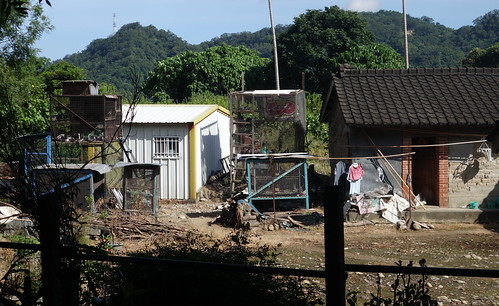
Pigeon cages.

This week the focus was on the asset bill directed at the KMT. The bill has solid support: yet another poll came out showing public support for the recent passage of the KMT assets bill: 53.9% say that it is an important step in transitional justice. Solidarity translated the recent TISR poll on it, noting that 61% support the bill and only 11% believe the KMT's story on its assets. The public is on board with the idea of KMT assets being transferred to the state as a form of transitional justice...

The legislature approved the law on Monday. The Taipei Times reported:
The legislature yesterday passed legislation governing ill-gotten political party assets, which states that all properties obtained by political parties after 1945 — not including party membership fees and political donations — are to be considered illegal and must be returned to the state.

...

The act states that all assets of a political party are considered frozen the moment the act is promulgated, with violators facing a jail term of up to five years. Any attempt to avoid, deny or obstruct investigations into party assets could lead to a fine of between NT$100,000 and NT$500,000.

The legislature also voted to approve a key provision of the act that stipulates that assets obtained since Aug. 15, 1945, would be subject to the proposed law.

....

The DPP moved to amend the official name of the draft from the “act on handling ill-gotten party assets” (不當黨產處理條例草案) to the approved version to include assets held by the KMT’s affiliate organizations, such as the China Youth Corps and the National Women’s League of the Republic of China, as the funding of these organizations has always been included in the party’s fiscal budget.
Several pieces of interesting information here. First, the KMT has a year to do the accounting. Lots of stuff will disappear -- I hear interesting stories from my friends in the financial community about seedy attempts to sluff off these assets. Second, the law does have language allowing for seizure of assets if they have been offloaded. Third, only 31 legislators voted against the legislation from the KMT, which has 35. This means that four legislators defied their party. The KMT wants to send the bill for constitutional review -- the courts are packed with KMTers from the previous Ma Administration -- but it needs 38 votes -- 1/3 of the legislature. It is now attempting to find votes from other parties.

Ralph Jennings, the Taipei-based journalist, who manages to be both cynical and centrist at the same time, had a really great comment on the assets bill in our ICRT radio broadcast of the other day. He pointed out that the KMT will likely tie up all these asset seizures in court for years to come. That to me suggests the ultimate solution may well be a massive settlement. But that's years off...

This tale is only beginning...
_____________
Daily Links:
_______________________
Don't miss the comments below! And check out my blog and its sidebars for events, links to previous posts and picture posts, and scores of links to other Taiwan blogs and forums!
Saturday, February 20, 2016

Meandering through the Party and Legislative Politicking

A friend near Baling. 

So much to catch up on! The KMT Chairmanship struggle is still a two woman race between Hung Hsiu-chu, the reactionary mainlander former presidential candidate, and Huang Min-hui, a Taiwanese faction politician from a family with long service to the KMT. Remarkable to think that if Chen Chu succeeds Tsai Ing-wen to the Chairmanship of the DPP, the president and heads of both major political parties will be female come May. This demonstrates not merely female power but continuity of female power, since the previous party heads will have both been female.

Interestingly, few of these powerful females are married. There are basically only two ways to become a powerful woman in Taiwan: as a wife delegated by a male when he is unable to carry out the duty (a favorite route of gangsters who run their wives for office while in prison) or as a public virgin. This situation was highlighted this week when TV personality Clara Chou criticized incoming NPP legislator Hung Tz-yung (my district!) for dating someone, saying she should be focusing on learning her job. Chou was probably just jealous, since Hung is 1000X more attractive than her, an authentic Taiwanese woman like so many I have known: beautiful, kind, warm, polite, well spoken, and made of steel.*

Hung's alleged sally into the world of romance also highlights another aspect of legislative power in Taiwan: she was said to be dating a reporter (who is now head of the Taichung City media organ, Donovan tells me). Many politicians have married reporters and TV anchors.

Meanwhile back in the KMT Hung Hsiu-chu and Huang Min-hui both courted the Huang Fuhsing, the Old Soldiers, this week. These Deep Blue seniors are crucial to winning the election, and they love Hung Hsiu-chu. Smart politician Jason Hu, the former Taichung mayor and briefly a potential candidate for party chair, said he was supporting Hung, an important indication that he thinks she will win. Hu no doubt has his eye on the long term and is courting the Old Guard, since next August there will be another KMT Chairmanship election at which point whoever wins in March will likely step down.

The courting of the Old Soldiers is a reminder, as a longtime observer put it on Twitter, that the KMT "cannot, will not, must not learn from their mistakes". They will likely ensure that no real change will occur. Note that neither Hung nor Huang is a "reform" candidate by any means. The KMT's downward spiral will continue, to the benefit of Taiwan and its democracy.

Speaking of not getting it, the legislature swung into action, with a flurry of draft bills being put forward and the KMT blocking the party assets law...
More than 100 draft acts sailed through their first readings and were referred to legislative committees for review and deliberation during the morning meeting, including draft bills on governing political parties; amendments to the Referendum Act (公民投票法) and the Disaster Prevention and Protection Act (災害防救法); setting up reciprocal offices with China; and the much-discussed legislation on the presidential transition of power.

What did not get through were four bills aiming to deal with ill-gotten party assets proposed by DPP lawmakers, which the KMT caucus opposed and were sent back to the Procedure Committee.

KMT caucus whip Lin Te-fu (林德福) said the regulation of political parties’ assets could be included in the proposed political party act, adding that the KMT opposed the DPP’s bills because they are “apparently targeting [the KMT].”

DPP Legislator Su Chih-fen (蘇治芬) blasted the KMT’s move on Facebook, saying the KMT “still does not understand why it has been spurned by the public even after its 2014 and 2016 electoral routs.”
Recall that the Referendum Act is set up deliberately to make it impossible for public referendums to pass. Hopefully that will change. The Parade and Assembly Laws, deployed against protesters repeatedly over the years, are a holdover from the authoritarian days. Su Chih-fen, readers will recall, was one of the DPP politicians who was prosecuted in the opening days of the Ma Administration in 2008 when it went after the DPP (see this old post). She was of course found innocent. The KMT held a public meeting on the asset issue, with Huang adopting a cautiously conservative position (Hung was not present).

Gwen Wang, always excellent, set forth the great changes in this new legislature. Among the many changes she identified was the rise of the New Power Party (NPP)...
To continue their momentum, its five legislators will have to show the voters that they are not merely junior partners to the DPP, but a real “third force” in the political spectrum different from the KMT and the DPP. During the 2016 elections campaign, DPP presidential candidate Tsai Ing-wen lent her support to the NPP with herself and several DPP heavyweights, including the Tainan and Kaohsiung Mayors, attending many rallies held for NPP candidates. The close collaboration between the NPP and the DPP will be the “baggage” that the legislators will have to get rid of first, should they want to be a real alternative to the traditional blue and green camp rivals. As Dr. Hsu Szu-chien (徐斯儉) of Academia Sinica commented, the NPP has to walk its own path because society is looking expectantly towards the NPP, to see whether they can be a real watchdog in the parliament.
...I should add that the Taichung mayor backed our NPP candidates and attended their rallies as well. The NPP came out this week with proposals for a parliamentary system. At present, with the KMT not yet eliminated, this is probably a bad idea -- indeed, it is something the KMT has called for as a tactic to weaken and cage a DPP presidency.

But to the extent that the NPP plays watchdog, it will set itself against the DPP. More importantly, the NPP has to differentiate itself because we need a viable alternative to replace the KMT as the second largest party.

The danger here, as I see it, is that the Legislature is inherently in opposition to the Presidency in Taiwan, and that dynamic could well continue under the Tsai Administration. Wisely, the Speaker is Su Chia-chuan, who is close to Tsai and was her running mate in 2012.

*Yes, I am crushing hard
__________________
Daily Links:
_______________________
Don't miss the comments below! And check out my blog and its sidebars for events, links to previous posts and picture posts, and scores of links to other Taiwan blogs and forums!

Monday, December 15, 2014

Eric Chu in the limelight

From the most recent TISR poll, the old Global Views survey. Note that satisfaction with Ma is just 12.7%, dissatisfaction at 78%. The DPP approval rating is 43.7% to the KMT's 21.4%

Some good commentary out there on Eric Chu, who is set to become the new KMT chairman next month since no one is running against him.

One thing that has really excited everyone watching is Chu's call for constitutional reform and his support of a national meeting on the matter. Of the two great pieces out today, first read Ben on the Constitutional Reform issue, arguing that the key issue is the Birdcage referendum law, which exists to prevent the public from having real referendum powers. If we see change in that, it might be meaningful. This is important because the mechanism that Chu has proposed to change the constitution is a public referendum, as WantWant reports.

 Frozen Garlic contends in the other excellent one out today:
First, the proposal to adopt a parliamentary system seems extremely hurried and might not be well thought out at all. This is not a minor change. It would impact everything in the entire political system, and we haven’t even begun to think about the first-order impacts, much less the third-order impacts. Moreover, every parliamentary system is somewhat different; there isn’t a simple off-the-shelf model that you can buy at your local Carrefour. It’s one thing to ask for a parliamentary system; it’s quite another to hammer out all the little details. Who gets to have the first shot at forming a coalition government? How will confidence votes be handled? Will the president continue to be directly elected? What happens to the National Security system?
The ROC government was never more than the candy shell over an authoritarian party-state, so making it work as a democracy has always been problematic. Because of this, when links inside the ruling party are poor, the government is even crankier and more inoperable. Commonwealth observed of the KMT's reform moves:
For the KMT to make a fresh start, the new chairman must take big, bold steps to reform. One component of this is for the Central Standing Committee (CSC) – often accused of "sharing business interests with China" – to return to functioning as a platform for diverse opinions.

A former director of the KMT's Organizational Work Committee relates that, among the current 39 members of the Central Standing Committee, apart from seven directly appointed by the party chairman, the other 32 are elected by party members, among which "close to 10 have commercial interests related to China."

The reason such a situation has taken shape is that in China "the title of Kuomintang Central Standing Committee member opens a lot of doors and gets you places, so some people end up competing for seats in order to achieve that type of elevated status," says the source, intimately familiar with the party's workings.

Central Standing Committee elections are frequently plagued by rumors of vote buying. Consequently, when Ma Ying-jeou took over as party chairman he set up the "Zhongshan Council" for direct handling of important party affairs and political decision making. This move effectively relegated the Central Standing Committee, reputedly the party's highest agency of power, to a discussion group that "hears reports" and "makes recommendations."
The Central Standing Committee was full of people like Lien Chan and other core elites who did not like Ma Ying-jeou, hence his relegation of them to secondary status with the ironically-named Zhongshan Council. But this meant that the KMT was effectively split into a pro-Ma inner circle and Ma-Opposed camps, which weakened it, and which Ma institutionalized. Ma's weaknesses are innumerable, but among the most important is an inability to conciliate -- his model for rule, I am ever more convinced, is the dictator Chiang Kai-shek. The creation of competing bodies performing the same function is a classic move of dictators everywhere. The Central Standing Committee's close business links with China are probably what Chu is criticizing when he talks about compradores... more on that.

Chu also said that the current government system means that those who screw-up are not accountable to the people, in which "power and responsibility do not match each other." Its instability is obvious: Ma is on his fifth premier, only one less than Chen Shui-bian, whom he used to criticize for regularly change premiers.

A closer reading of the Commonwealth piece, however, shows that the KMT isn't going to change its cross-strait sell-out policies, nor is it going to change its presentation of them. Su Chi, long close to Ma, is quoted therein:
In cross-strait political discourse, from the Ma Ying-jeou administration's "economics first, politics second" stance during its first term, to "economics only, forget politics" in the second, the administration's total emphasis on economics placed the Taiwanese people's focus on the economic balance sheet of cross-strait interaction. Moreover, the emphasis was placed narrowly on who benefits and who loses out, neglecting the fact that the value of cross-strait reconciliation is not measured exclusively in economic dividends, but also security dividends, international relations dividends, and political dividends.

"Unless this part is explained clearly, misunderstandings result," Su Chi reminds.
The KMT always claims that its pro-Big Business, pro-China policies are rejected because they are not properly explained. The KMT is never actually wrong. It just doesn't communicate well. One wonders, as Froze notes below, how much headway Chu can make against these entrenched interests and attitudes.

Even more fascinating is to watch Chu's "stand" against the "compradore faction" of the party, the big names who have been making the big money off their party connections over the years. Chu has even promised to give the ill-gotten party properties back to the people. Chu complains that the party's policies benefit the rich, recognition that the public perceives the party to be the party of big business. Quite true, but as Frozen Garlic observes, that is where the rubber meets the road.
He said a lot of great sounding things on Friday, but now he will actually have to deal with the consequences of those statements. If he doesn’t do something with party property, people will ask questions. Lien Chan and Wu Po-hsiung aren’t just going to ignore his comment about “compradore-style figures.” Most importantly, Ma Ying-jeou is not just going to yield to Chu’s ideas about economic policies. Chu might complain that Ma’s policies unfairly benefit the richest people, but Ma is still in charge of the government and he doesn’t seem to want to reverse six years of economic “achievements.” The business world isn’t going to sit idly by if Chu tries to change the economic policies they want. They have lots of power within the KMT, and they will defend their interests. Chu is going to have to engage in a full-blown power struggle to force the cabinet to follow his new line. Otherwise, Chu is going to look pretty weak if he, as KMT party chair, is calling for one set of policies and President Ma continues to push ahead with his entirely different political priorities.
Moreover, as Froze notes, Chu's media darling days all over. He'll be a national figure, facing a national media that has deep knowledge of the island's political machinations and little patience with its politicians.

There's been complaints that Chu is just the second coming of Ma Ying-jeou. Chu promised to do something about the party assets -- well, so did Ma in 2009. In fact Ma did as early as 2006, and in 2000 none other than Honorary Chairman Pickled in Brine Lien Chan, when he ran for President in 2000, promised to do the same. In other words, making noises about getting rid of the Party's ill-gotten assets isn't something that one does when one is a reformer. It's part of the package of noises that anyone who assumes control over the KMT and aspires to higher positions must reproduce, because it is a widely supported centrist position, not because they actually mean it. Chu's position on the party assets may well be a signal that he is going to run for President in 2016 even though he insists he is not going to.

Another interpretation is that if a much weaker candidate than Chu runs in 2016 and is beaten, which is highly likely, then Chu will oh-so-sorry have to step down from the KMT Chairmanship to "take responsibility" and what a coincidence, reform will go unaccomplished. Hey, he'll say, it wasn't my fault, we just didn't win the election. So he wouldn't actually have to carry out reform -- not enough time, you know -- but he can still wear the mantle of reformer when he goes into the trenches in 2020 as the Presidential standard bearer. So all this noise he is making now is just positioning...

Of course, he could actually mean what he says....

Indeed, here's an editorial in the pro-KMT China Times from 2009:
Today Ma Ying-jeou is again in charge of the party. He has proudly waved the party flag on behalf of candidates for the year-end elections. When Ma Ying-jeou declared his commitment to clean government and political reform, people were inspired. Political momentum accumulated. But he has now declared his intention to enforce strict party discipline. He has promised that he will strictly punish those who have disobeyed the party decision and run for public offices. But they doubt Ma will hold up if they give him the cold-shoulder treatment. Ma Ying-jeou has been in charge of the affairs of state for a year and a half. He is being pulled in several directions at the same time. He has not demonstrated sufficient courage and determination. As a result, his leadership has been subjected to constant challenges. Candidates for City Mayor and County Executive offices have thrown their hats in the ring without consulting him. Even incumbents who were elected on the basis of Ma's endorsement are ignoring the party leadership, and bent on rebellion. During the party chairmanship election, the turnout in many constituencies was low. The percentage of invalid ballots was high. Quite a few former "Team Ma" legislators with reputations for integrity and many outspoken and forceful County Executives and City Mayors have all gradually withdrawn their candidacies for membership in the KMT Central Standing Committee. When asked why, they replied without enthusiasm, and sighed, "Let him (Ma) find out what it's like to have a Central Standing Committee not consisting of his own people!"
Already by 2009 Ma had alienated the bottom of his own party. Is Chu headed for that? We can only hope.

As I said, the close business links of powerful KMTers with China are probably what Chu is criticizing when he talks about compradores, but let's not forget that Chu's Dad-in-law Gao Yu-ren (高育仁) was a central standing committee member of longstanding with nearly half a century of service to the KMT in various positions. His father is the former speaker of the "Taiwan Province" legislator. Chu is a princeling, in other words (on his mother's side he is from a family of DPP politicians, which may help his relations with that party, and he and Taipei mayor-elect Ko Wen-je are old school classmates and friends of long-standing). But as the national media begins to focus on Chu, these relations -- his father-in-law was forty years in Tainan politics -- and Chu's own deals in the past are going to come under far more heightened scrutiny than Chu may be able to handle.

I'm going to go roast some popcorn now...
______________________
Daily Links:
_______________________
Don't miss the comments below! And check out my blog and its sidebars for events, links to previous posts and picture posts, and scores of links to other Taiwan blogs and forums!

Sunday, July 24, 2011

KMT wealth management

The incomes of the two major parties in Taiwan were revealed yesterday by the Ministry of the Interior:
The Chinese Nationalist Party (KMT) made NT$3.5 billion (US$121.5 million) last year, primarily on business investments, far outpacing the amount made by the Democratic Progressive Party (DPP), information from the Ministry of the Interior (MOI) showed.

Stock dividends accounted for almost NT$2.9 billion last year and made up more than four-fifths of the KMT’s total earnings, raising concerns about the extent to which the party depends on earnings from its assets and not donations.

The figures, published on Thursday by the ministry, reveal that political contributions to the KMT amounted to NT$240 million, or 6.9 percent of its earnings. It also earned NT$251 million in vote subsidies and an income of NT$76 million from party dues.

The DPP, meanwhile, received NT$192 million in political contributions and a total income of NT$626 million.
The article points out that the bulk of the investment income comes from two party-owned investment companies. President Ma, currently Chairman of the KMT pledged years ago to get rid of the party assets, which the KMT claims have been placed in trust. These assets were accumulated during the martial law era when the KMT ran the KMT party-state. The party should have been stripped of them years ago.

If the KMT made $2.9 billion from stock dividends, then, given a 5% return on investments, the KMT must have something like $60 billion NT, or $2 billion US, in investment assets.

One wonders which companies are the target of those investments. As a friend of mine pointed out to me yesterday, the people and party running the current cross-strait economic interaction -- which largely benefits big business -- are also the people and party running the KMT. But there's no conflict of interest there, of course. The assets are in trust. In fact the KMT even forgot they had them.... damn the DPP for reminding them during every election....
_______________________
Don't miss the comments below! And check out my blog and its sidebars for events, links to previous posts and picture posts, and scores of links to other Taiwan blogs and forums! Delenda est, baby.

Sunday, March 29, 2009

KMT Wins in Da-an

The KMT won in the by-election in Da-an district in Taipei. The pro-Green Taipei Times notes:
The Chinese Nationalist Party (KMT) breathed a sigh of relief after its candidate, Chiang Nai-shin (蔣乃辛), defeated Democratic Progressive Party (DPP) candidate Chou Po-ya (周柏雅) in the legislative by-election for Taipei's Da-an District (大安) yesterday.

Chiang received 46,065 votes (49 percent) over Chou's 36,465 (39 percent), winning by less than 10,000 votes in a district that is traditionally a KMT stronghold.

In the legislative election last year, the KMT captured 66 percent of the vote for the seat to the DPP's 32 percent.

Independent candidate Yao Li-ming (姚立明), who has the backing of the New Party, failed to split the pan-blue vote and garnered only 9,868 ballots.

The Green Party's Calvin Wen (溫炳原) captured 1,058 votes. Independent candidates Liu Yih-jiun (劉義均), Chao Yan-ching (趙衍慶) and Chen Yuan-chi (陳源奇) received 645 votes, 46 votes and 39 votes respectively.

Voter turnout was a low 39.12 percent.
Coupled with the defeat in the Miaoli by-election a few weeks ago, the KMT appears to have been given a warning by the voters, said many observers in both the Taipei Times report, and the China Post. Both elections were characterized by low turnout, so it is hard to get a sense of where the electorate lies. Still, in solidly KMT Da-an district, the DPP did well. Another China Post article on the DPP response noted:
[DPP Chairman] Tsai said she was very glad to see the rise in the ratio of votes captured in the by-election, which she attributed partly to Chou as the best candidate of the party and partly to concerted efforts by all the party members.

This is the first time for the KMT's vote-capturing rate to fall under 50 percent, indicating that the KMT's dominance isn't unshakable on one hand, and the DPP's efforts to seek reforms have been recognized by the public on the other hand.

Tsai said she's sure that the DPP will stand up in the short time to live up to people's expectations, adding that her party will work harder to solicit more supporters in the year-end elections of county magistrates and city mayors.

For his part, Chou said that the election result is quite an encouraging development to the DPP, indicating that the DPP can still tap into the KMT's political stronghold in the Daan District as long as it works harder and harder.

Chou said excitedly that three vote-casting stations in the only borough headed by a DPP member all witnessed his votes outnumbered his rival Chiang Nai-hsin of the Kuomintang. “This has never happened before,” Chou stressed.
The KMT's control of local-level governments was made use of in this election, as local government employees were allegedly busted campaigning for the KMT while in uniform, as maddog reported (with video!).

The legislature meanwhile was busy passing "a general amnesty for corrupt KMT officials" as the China Post reported, with the headline saying that the sunshine law was aimed at Chen Shui-bian, whose trial started this week, though the text did not mention the ex-president. Said the pro-KMT paper of new language added to the bill that targeted officials and their families and forced them to account for their possessions and cash holdings:
“Both paragraphs which will be added to the act as amended won't be retroactive,” [Justice Minister] Wang told the judicial committee meeting.

The remarks hit the hornet nest.

Lawmaker Tsai huang-liang, DPP legislative caucus deputy whip, fired a broadside at Wang for “getting at the opposition party” and “shielding the Kuomintang.”

“Those who need to be required to explain are former Kuomintang officials,” Tsai said. By making the law non-retroactive, he added, none of them could be prosecuted.

Tsai asked Wang why Lien Chan, a former vice president and premier, couldn't be required to explain how he has come into a vast fortune, most of which probably was doubtfully acquired by his father, who was a minister of the interior.

“I don't know,” Wang replied. “I am sorry.”

Lee Chun-yi, another DPP legislative caucus deputy whip, charged that all those Kuomintang government officials who have unlawfully acquired assets in the past are now let to go scot-free.

“It's a general amnesty for those corrupt Kuomintang officials,” Lee pointed out. “The people can't accept the amendment,” he added.
The whole point of the charade, the DPP charged, was to make it look like the KMT-controlled legislature was actually doing something -- just in time for the by-election taking place in Da-an District.

_______________________
Don't miss the comments below! And check out my blog and its sidebars for events, links to previous posts and picture posts, and scores of links to other Taiwan blogs and forums!

Wednesday, February 06, 2008

KMT Found Guilty in Asset Case

AFP reports:

Taiwan's main opposition Kuomintang (KMT) party said Wednesday it would appeal a ruling ordering it to return land reportedly worth hundreds of millions of dollars to the government.

The Taiwan High Court on Tuesday reversed a previous verdict and ruled that the KMT should return eight plots in Taipei county as the party had violated national property law.

"We are surprised by the High Court's decision and basically we would appeal the ruling," said KMT spokesman Huang Yu-chen.

Local media said the 5,000-ping (4.1-acre) land has a market value between 3.5 to 4 billion Taiwan dollars (109-125 million US).

The KMT's assets have been a major target of attacks by the ruling Democratic Progressive Party (DPP) in the run up to the January parliamentary elections and the March presidential polls.

Once one of the world's wealthiest political parties, the KMT said in a first ever report on party assets in 2006 that its wealth had shrunk to around 27.7 billion dollars after huge investment losses in the 1990s.

The KMT traces much of its wealth to its origins in pre-communist China, but it has been accused of illegally amassing a fortune through cozy business links while in power.


How this will affect the election is difficult to say, since voters do not appear to care whether their man is corrupt. It does give a little weight to the DPP's accusations, but the asset referendum was the last election, not the current one. The last paragraph is quite intriguing...it isn't 'cozy business links' that are allegedly the source of the KMT's wealth, but outright looting of government coffers -- as with the land that was the cause of this case....