Thursday, August 04, 2016

Understanding Tsai's Apology to Aborigines as a Pro-independence move

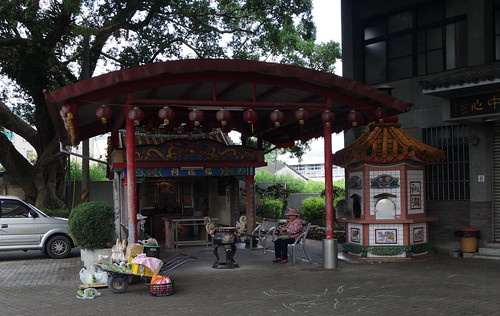
A vegetable seller breaks for a chat at a local temple.

One of the sharpest observers of Taiwan and its aborigines I know articulated a key issue with Tsai's apology in a comment on the post below this one about the apology:
The real key issue is that Tsai's apology shifts the official view of Taiwan from the primordialist standpoint of Chinese sovereignty as outlined in the two Chinese nationalist programs (ROC and PRC, to one of coloniality, and therein robbing the ROC and PRC of their territorial claims, which seek sovereignty in the integration of a Han racial nation. Tsai has effectively moved the goalposts and repositioned Taiwan outside of the Chinese nationalist paradigm.
KMT Chairman Hung, who understood this intuitively, attacked the apology:
Hung questioned whether or not Tsai was making use of aboriginal perspective of history to eliminate Han Chinese People’s perspective of history, or even engaging in desinicization to create a new perspective of history. “It is inevitable that people will question the DPP’s real motives,” added Hung.
Remember, in the KMT political lexicon, desinicization is a code term for removing markers of KMT colonialism in Taiwan -- which is exactly what Tsai was doing.

In the discourse of Chinese expansionism, which seeks to expand China out to the old Qing borders, the Qing (and other governments of China) were not imperialists or colonialists, but were Chinese and their lands China. Hence, the current wave of expansion is "rectification of the borders" and the variegated peoples in China are Chinese.

That means that in the Chinese expansionist view, Taiwan can never be a colonial holding, but is China, and colonialism cannot occur there, just as Tibet and Mongolia and Xinjiang can never be the objects of Han/Chinese imperialism, and the peoples of China are not peoples subjugated and assimilated by the dominant Han majority via the familiar processes of ethnic chauvinism and colonial expansion, but non-Han minorities who just happen to live in China (and whaddya know, how'd they get there?).

Tsai's apology drove a truck through this formula by acknowledging that the Han project in Taiwan is a colonial project. If it is a colonial project, then Taiwan is not a part of China, but a colony separate and different from it, where Han people do not belong, but have entered from the outside. Tsai implicitly recognized some kind of aboriginal claim to Taiwan. She also identified the aborigines as specific and diverse groups some of which she named, against China's presentation of all aboriginal groups as a single minority "mountain people", a minority that just happens to live in China (and whaddya know, how'd they get there? Because they weren't colonized or anything). Further, by presenting the apology as a form of transitional justice, she also aligned it with the movement for transitional justice in Taiwan against KMT colonial power, and with the Taiwan identity that is slowly obliterating the "ethnic" differences long exploited by the KMT. A shrewd political move.

The apology also recognizes that there can be no transitional justice without transitional justice for the aborigines. Otherwise transitional justice would be little more than a negotiation between privileged Han groups...

MEDIA: A sharp new PHD alerted me to the fact that AP caught some of this as well:
Tsai was elected by a landslide in January elections that have thrown a shadow over the island's relations with China, which claims Taiwan as a part of its territory from ancient times. Her view of Taiwan as a colonial society clashes with Beijing's claim that the island has always been an inherent part of China, which must eventually be reunited with the mainland, by force if necessary.
Kudos to whoever wrote that.

UPDATED: The Granite Studio takes note.
_____________
Daily Links:
_______________________
Don't miss the comments below! And check out my blog and its sidebars for events, links to previous posts and picture posts, and scores of links to other Taiwan blogs and forums!

Tuesday, August 02, 2016

President Tsai Ing-wen apologizes to the Aboriginal Peoples of Taiwan

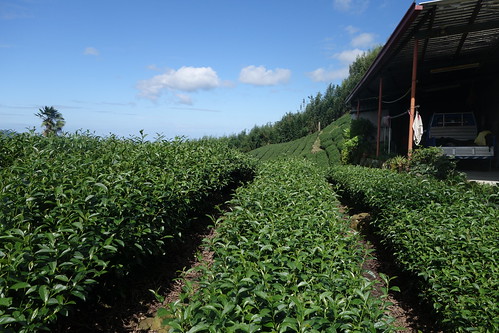
Tea near Shijhuo

Austin Ramzy reports in NYT reported on Tsai's history-making apology to the Aboriginal Peoples of Taiwan:
Taiwan’s earliest known residents are believed to have come to the island 6,000 years ago or earlier from Southeast Asia and are part of the Austronesian peoples who range from Madagascar to Polynesia. When Han settlers from mainland China began arriving in the 17th century, indigenous peoples, particularly those on Taiwan’s western plains, faced assimilation, loss of land and outright violence.

Today, indigenous groups face high levels of unemployment, low wages and less access to education and other services.

“Another group of people arrived on these shores, and in the course of history, took everything from the first inhabitants who, on the land they have known most intimately, became displaced, foreign, non-mainstream and marginalized,” Ms. Tsai said.
This apology was preceded by demonstrations, chronicled by Brian Hoie at New Bloom.
In particular, indigenous demonstrators were demanding concrete action on the economic inequality and unequal distribution of resources faced by indigenous. As a result of economic inequality, the average life expectancy of indigenous are 8 to 9 years less than their Han counterparts in Taiwan, for example. Moreover, apart from that traditional ways of life continuing to be threatened, indigenous communities face the threat of land seizures and appropriations, it also is that the Indigenous Basic Law is sometimes not enforced except at a local level, and even then, the Indigenous Basic Law has its own flaws which remain to be rectified.
After the speech, there were more demonstrations, but several knowledgeable individuals present said that the demonstrators were different from the ones who had been there the evening before the speech, and appeared to be fakes aimed at the cameras.

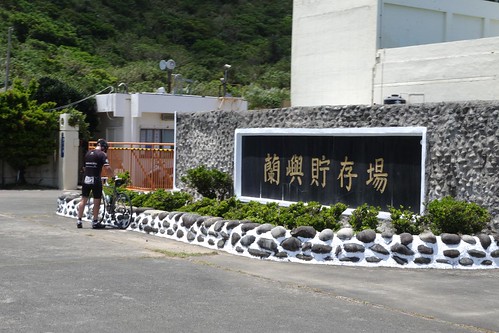
My friend Drew at the nuclear waste dump on Lanyu in 2014

There were many high points. Among them, Tsai mentioned the obnoxious nuclear waste dump on Orchid Island...
I will also direct relevant agencies to present an investigative report on the decision-making process of nuclear waste storage on Orchid Island. Before finding a permanent solution for the nuclear waste, we will provide the Yami tribe appropriate compensation.
...a perfect metaphor for the way the Han treated the Aborigines historically. The dump needs to be moved, and the Aboriginals compensated. The Lanyu people complained that Tsai's words contained nothing concrete and did not specifically mention removal.

Another highly welcomed note was the recognition of the Pingpu (lowland) aborigines as a formal group:
At the same time, under the principle of respecting the Pingpu ethnic group's self-identity, and recognizing their identity, we will examine relevant laws before September 30 of this year, so that Pingpu ethnic group identity will receive the rights and status it deserves.
The Pingpu were shapers of the Taiwan identity and the culture of the Han colonizers in ways that are little understood, just as the European encounter with the peoples of eastern North America had a huge impact on the subsequent American culture.

Tsai also addressed the ongoing sore point of aboriginal hunters arrested for legally hunting on designated lands.

These were all things that were welcomed by many listeners who were not aborigines, but they did not go far enough for many aboriginal groups. For example:
“The problem is that [Tsai] has chosen not to return to [former president] Chen Shui-bian’s (陳水扁) New Partnership quasi-state relationship, not even mentioning it in her remarks,” said Association for Taiwan Indigenous People’s Policy president Yapasuyongu Akuyana, who is a Tsou.

Chen, of the Democratic Progressive Party (DPP), in 2002 signed a New Partnership Accord promising autonomy and partnership through state-to-state relationships with Aborigines, but the accord was ignored by the government of former president Ma Ying-jeou (馬英九).
Aboriginal desire for a return to the quasi-state relationship had actually been mentioned in news reports of the previous day. KMT aboriginal legislators stayed away, another demonstration of the way the KMT remains out of touch. Taiwan Law Blog observed that Tsai did not mention any of the international laws and agreements on aboriginal peoples.

Words are nice, but now, we need to see action.

UPDATE: KMT Chairman Hung's hilarious words from the KMT News Organ:
Hung questioned whether or not Tsai was making use of aboriginal perspective of history to eliminate Han Chinese People’s perspective of history, or even engaging in desinicization to create a new perspective of history. “It is inevitable that people will question the DPP’s real motives,” added Hung.

REF: Apology in English translation (original Chinese)
__________________
Daily Links:
_______________________
Don't miss the comments below! And check out my blog and its sidebars for events, links to previous posts and picture posts, and scores of links to other Taiwan blogs and forums!
MediaFail: Where is Beijing's anger?

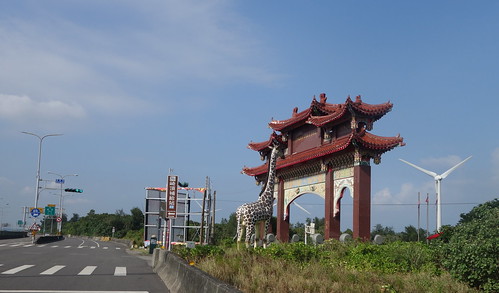
Not enough kitsch in your life? Just drive here. 

From the very widely-reproduced AFP article:
The test of the U.S.-made Patriot Advanced Capability-3 (PAC-3) system will be launched at the White Sands Missile Range, New Mexico, in early July, a defense ministry source told AFP, in a move likely to irk Beijing even though it was arranged before Tsai took the helm.
Chinatopix:
Reports said Taiwan would test-fire its Patriot Advanced Capability-3 (PAC3) missile system for the first time in New Mexico in July, which military experts said would surely infuriate China.
From The Diplomat:
In July, Taiwan will test-fire its Patriot Advanced Capability-3 (PAC-3) missiles at a U.S. missile range. The test, though scheduled under Taiwan’s previous Kuomintang government, stands to raise tensions between Taiwan and China.
Of these, by far the most common was the AFP report, which was picked up by SCMP, the Japan Times, Yahoo.com, and others. AFP is very effective at what it does, as I've complained many times.

Many of us have noted over the years the way the media writes "X is happening soon! China will surely be angered!" which maintains the idea that Taiwan is the cause of tension. AFP's nonsense here is a good example. The missile test passed a couple of weeks ago.

Where is the anger?

But you won't see any of these media sites issuing a clarification or acknowledging and correcting the "error"...
_______________________
Don't miss the comments below! And check out my blog and its sidebars for events, links to previous posts and picture posts, and scores of links to other Taiwan blogs and forums!
Way Cool: Cache of Japanese Military Maps of Asia

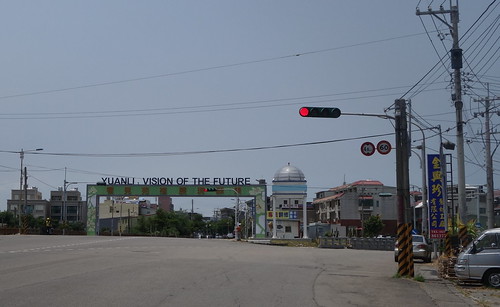
Yup: Yuanli's town slogan is "A vision of the future."

A friend passed this around Facebook: a trove of Japanese military maps made prior to WWII with incredible detail and information. A teaser...
These maps were captured in the waning days of World War II as the U.S. Army took control of Japan. American soldiers confiscated thousands of secret Japanese military maps and the plates used to print them, then shipped them to the United States for safekeeping.

..........

Not surprisingly, the Japanese surveyors weren’t always welcomed in other countries. In 1895, angry locals in Korea killed several assistants on a Japanese survey team, Kobayashi writes. (Japan annexed Korea in 1910 and held it until the end of World War II.) Two decades later, Japan sent secret survey teams into China. These men disguised themselves as traveling merchants and made their maps equipped only with a compass and by counting their steps to mark distance.

In the age-old tradition of cartographic copying, the Japanese often built on maps they’d captured from their foes, adding their own notes and details on top of the original. Cyrillic script is visible in the Japanese map above of Vladivostok, Russia, for example. Naturally, their enemies did the same thing. The formerly classified U.S. Army map of Okinawa below, printed in 1945, is based on a captured Japanese map.
Stanford is currently putting the maps online. There is a topical index here and many maps of Taiwan -- here is one collection, the red not yet digitized, the green are accessible. Here is a Keelung map, and here is a Taichung map at 1:50,000. Click somewhere inside the viewing frame to see the map, it sometimes doesn't appear unless you click in that frame. Sometimes you have to grab and move the map around in the viewer to actually see it, they digitized a lot of unnecessary area around the map, so the first thing you see sometimes is a lot of useless gray area (on some maps click on the upper right corner of the map box for full screen and move the image around til you see the map). The maps are fully zoomable. Way cool.
_______________________
Don't miss the comments below! And check out my blog and its sidebars for events, links to previous posts and picture posts, and scores of links to other Taiwan blogs and forums!
Monday, August 01, 2016

China Tourism Numbers: Massaged?

Period
Chinese
HKK + Mac
All China
MovChi  
MovHkk
Dec 13
240,629
122,365
362,994
Up
Up
Jan 14
268,861
73,629
342,490
Up
Down
Feb 14
305,390
91,294
396,684
Up
Up
Mar 14
361,470
98,332
459,082
Up
Up
Apr 14
377,197
146,097
523,294
Up
Up
May 14
333,845
116,585
450,430
Down
Down
Jun 14
315,166
133,550
448,716
Down
Up
Jul 14
343,709
132,831
476,540
Up
Down
Aug 14
312,549
147,903
460,452
Down
Up
Sep 14
341,729
105,865
447,591
Up
Down
Oct 14
347,778
95,217
442,995
Up
Down
Nov 14
332,517
99,443
431,960
Down
Up
Dec 14
346,941
135,024
481,965
Up
Up
Jan 15
321,458
74,302
395760
Down
Down
Feb 15
406,239
97,216
503,455
Up
Up
Mar 15
279,703
114,473
394,176
Down
Up
Apr 15
358,798
145,479
504,277
Up
Up
May 15
372,766
124,758
497,524
Up
Down
Jun 15
308,087
139,920
448,007
Down
Up
Jul 15
352,625
142,515
495,140
Up
Up
Aug 15
367,736
160,829
528,565
Up
Up
Sep 15
345,243
118,255
463,498
Down
Down
Oct 15
386,663
113,549
500,212
Up
Down
Nov 15
357,655
118,026
475,681
Down
Up
Dec 15
327,129
164,275
491,439
Down
Up
Jan  16
366,409
93,448
459,857
Up
Down
Feb 16
405,307
114,431
519,738
Up
Up
Mar 16
363,878
164,894
528,772
Down
Up
Apr 16
375,567
110,716
486,283
Up
Down
May 16
327,254
125,302
452,556
Down
Up
Jun 16
271,478
143,276
414754
Down
Up

Inspired by this article on Thai tourism and challenges to the Tsai Administration in a Thai newspaper, which said...
Taiwan used to be a popular destination for Thai tourists and workers during the boom years of the 1990s and 2000s. Thailand was among the top-three largest Asean points of origin for tourists visiting Taiwan last year, numbering 70,000. But after Japan granted visa-free entry to Thai tourists three years ago, many have headed northbound with a near-record high of 1 million visitors last year.
....I was studying the tourism numbers wondering if the Thai tourism mini-boom would offset the loss of Chinese group tourists, when I went "huh". If you look at the movements of the numbers something interesting occurs in Oct 2015, when Taiwan officials started claiming that there would be big tourism cuts, because of the election...
Ko Mu-chou (柯牧洲), vice chairman of the Taipei Association of Travel Agencies, said Chinese provincial-level travel authorities have been notified that they are required to cut the number of Taiwan-bound tourists by 95 percent during the period between Dec. 16 and Jan. 15.
MAC dismissed such claims as hyperbolic, saying a fall was possible, but 95% was absurd.

The interesting thing about the numbers to me is when you look at the right hand columns. These two columns show the movement in the numbers over the previous month. Note that prior to October of 2015, there were many months in which the numbers moved in tandem: if tourists from China rose, so did tourists from Hong Kong and Macao. Since October of 2015, the only month where the numbers moved in tandem was February, which boasts Chinese New Year. In all other months they've moved in opposite directions.

If might be a coincidence, but it almost looks like someone is quietly managing the numbers to keep them at a target ratio of between 450,000 and 500,000, permitting the Hong Kong numbers to quietly rise even as the Chinese numbers noisily fall. Alas, the sample is too small to show a definite trend, but it is suggestive.

But -- how long can such management be maintained...?
_______________________
Don't miss the comments below! And check out my blog and its sidebars for events, links to previous posts and picture posts, and scores of links to other Taiwan blogs and forums!
Book Review: Taiwan: A History of Agonies by Ong Iok-tek

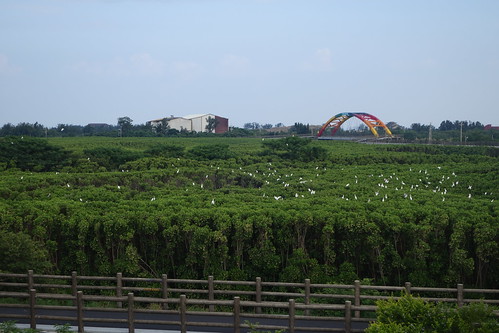
Egrets resting on mangroves (I think) near Hsinchu.

Taiwan: A History of Agonies
Ong Iok-tek
Avanguard, Taipei
367 pages
450 NT

Many years ago I was given a copy of this book in Chinese. Like thousands of others who love Taiwan and have come to support independence and democracy on the island, Taiwan: A History of Agonies was an inspirational text for me. Everyone from exiles in the US in the 1970s to Sunflower leaders has read this book, and its influence on the movement in decades following its publication in Japanese and later in Chinese (in 1977) should not be underestimated. It is one of the formative texts of the movement.

Jerome Keating wrote of it:
To place Ong in context, he was born in Taiwan in 1924 during the Japanese colonial era, and was a contemporary of Su Beng (史明, b.1918), a historian and Taiwan independence advocate, former president Lee Teng-hui (李登輝, b. 1923) and democracy pioneer Peng Ming-min (彭明敏, b. 1923), all Taiwanese who studied in Japan.
Like Su Beng, whose Taiwan's 400 Year History awaits an English translator (a very short version is available, published back in 1986), Ong originally published in Japanese, and this version is apparently translated from the Japanese.

Illuminated throughout by Ong's perception of Taiwan as a colonial subject, the book is filled with juicy details...
From 1882 to 1891 northern Taiwan had to depend on the mainland for supply of thousands of dans of rice due to a rapid increase of population in the north and consecutive years of poor harvests. In the same period, however, southern Taiwan continued to export rice to the mainland-- an awkward phenomenon basically caused by overall political inefficiency and poor transportation system that had hindered Taiwan's sound growth into a single economic unit. The immediate reason, however, was that more advanced foreign steamships (mostly of the British) were readily available to bring in rice from outside. Shipping rice from down south with local junks was much too inefficient (p129-30).
and the mastery of first-hand experience and discussion:
The New Citizens Society published a monthly The Taiwan Youth (publisher: Ts'ai P'ei-huo) after a revolutionary magazine in China The New Youth. Political movement will start with enlightening and propaganda. This is another formula. The magazine title "The Taiwan Youth" was later changed to "Taiwan" and again to "The Taiwan People's Weekly". As publication was made possible at the turn of era to Showa, in Taiwan, it grew into a daily called "The Taiwan New People Daily" (publisher: Lin Hsien-t'ang) in January 1929. The paper was to become the most powerful weapon for later political movements in Taiwan (p182-3)
Ong's take on the land reform, so famous among historians...
Whatever the contradictions, the Chinese have one common interest -- that is, to live off the Taiwanese. No sooner had the Kuomintang landed in Taiwan than they embarked on a series of land reforms. In fact, it was indispensable for the Kuomintang to be the one and only mega landowner in Taiwan just to secure an abundant supply of inexpensive food. Such land reforms were made a sample of the Kuomintang's benevolent policy and highly praised as such by ill-informed foreigners.

...

A year after the 2.28 Rebellion, the rice famine still lingering, Wei Dao-min implemented an urgent policy to adopt surplus rice legislation. All large and middle-sized landowners with over ten hectares of land (35.8% of all arable land, 2.7% of all landowners, or over 9,000 farming households) were ordered to deliver surplus at low prices. The landowners were furious but had to comply to avoid imprisonment.(p233-4)
The remainder of the passage goes on to describe how the farmers were immiserated by the land reform and agricultural fell into a permanent state of impoverishment and decline despite its economic importance.

The book ends with the history being brought up to the present by Ong's daughter. This is a masterful work whose final chapter calling for Taiwan independence is heartbreakingly powerful. It should be in the library of everyone interested in the history of the island and its democracy.

REF: Jerome Keating's Review from the Taipei Times
_______________________
Don't miss the comments below! And check out my blog and its sidebars for events, links to previous posts and picture posts, and scores of links to other Taiwan blogs and forums!