AP reports
:
The United States said it will supply relatively low-grade radar equipment to Taiwan's air force, an announcement that comes less than a week after the island's president urged Washington to provide it with new F-16 fighter jets.
U.S. State Department spokesman Philip J. Crowley said Tuesday that the U.S. sale includes "defence services, technical data, and defence articles" for Taiwan's air defence system, and radar equipment for the island's Indigenous Defence Fighter jets.
Crowley did not put a monetary figure on the deal or identify the American companies involved.
The U.S. is obligated by law to provide Taiwan defensive weapons.
The US is not obligated by law to provide Taiwan with defensive weapons, but media outlets still keep repeating that claim. The sale would be in lieu of new F-16s; which the KMT Administration claims it wants (but fought against during the DPP Chen Administration). Instead, existing aircraft would get upgrades. Washington under both Obama and Bush has continued to be craven on that score.
A weakened Taiwan is an invitation to war in East Asia. Taiwan needs these fighters not merely to hold off China in an all-out, send-in-the-troops-in-fishing-boats scenario, but also in case of a limited war, such as a blockade. Taiwan's ability to break such a blockade on its own is a form of deterrence as well. Further, in the future Taiwan may have a government that actually gives a shit about the future of the island, and thus Taiwan need weapons to be a credible ally in likely future conflicts.
Note that I am not asking for the F-16s, I am merely observing. Washington has obviously lost its nerve, or else is waiting for Beijing to do something so heinous that F-16s become a rational and accepted response. Hopefully the latter, though I strongly doubt it.
Speaking of observing, one ominous trend that needs to be nipped in the bud is the rise of a more sophisticated pro-Beijing apologetics, such as that of
Mark Valencia in the Taipei Times last week. I was traveling and couldn't respond but sorely wanted to. Given the startling pro-Beijing nature of the piece with its numerous omissions and distortions, I was kind of surprised to see that the Taipei Times even ran it. One thing it makes clear is that some of you edumacated types out there with Taiwan-related passions need to be submitting more commentaries!
Valencia is a scholar who has written at length on sovereignty issues involving China's claims to areas in its littoral. He writes from a pro-Beijing perspective -- for example, read
this longer piece on the East China Sea disputes carefully. Note in his description of the dispute between China, Taiwan, and Japan over the Senkakus he never forthrightly states that China did not begin claiming the islands until after Japanese scientists said there might be oil nearby in 1968. I've already posted before how PRC and ROC maps pre-1968 either show the Senkakus as Japanese, or show them as next to Taiwan without being part of China. If there were any doubt on that score, I have a copy of a
Renminerbao piece from 1953 that not only says the Senkakus are Japanese but also uses the Japanese names (in Chinese) to identify them. John Tkacik, who collects such things,
wrote a couple of years ago:
In my collection of maps, I have a facsimile of plate 18 of the Zhonghua Renmin Gongheguo Fen Sheng Ditu (People’s Republic of China Provincial Map) of “Fujian Province, Taiwan Province” published in mimi (confidential) form by the Zhonghua Renmin Gongheguo Guojia Cehui Zongju (Headquarters, National Surveillance Bureau), Beijing, 1969, which identified the Senkaku Islands as the “Jiange Qundao” — using the Chinese characters for the Japanese name “Senkaku Island Group” — rather than the Chinese name “Diaoyu.”
In other words, until 1969 China treated the Senkakus as Japanese. Valencia's Taipei Times piece contains the same telling kinds of omissions. Observe first that China's own actions are consistently omitted or downplayed. Consider:
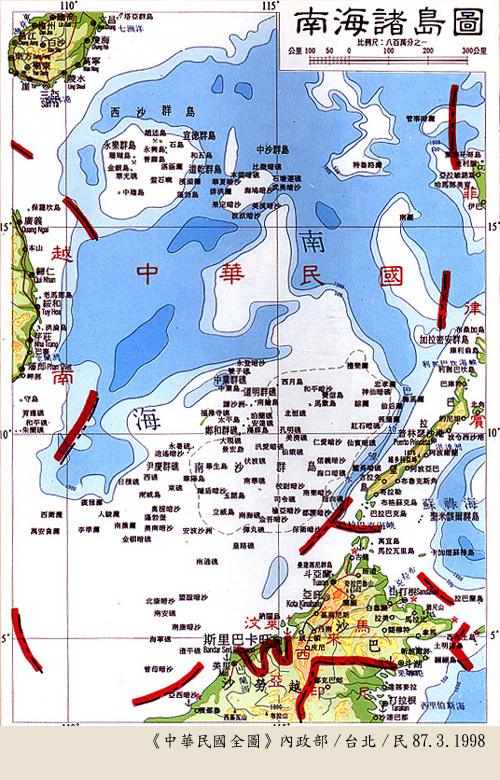
However, despite US arrogance, offering to “facilitate” multilateral talks on the South China Sea disputes — which is what really infuriated Beijing — it is clear that China has been its own worst enemy in this matter. It refused to file a joint claim with Malaysia and Vietnam to the continental shelf in the South China Sea. It then filed an objection to their claim, and attached a map with its nine-dash line ambiguously claiming most of the sea.
It publicly categorized the South China sea as a “core interest” akin to Tibet and Taiwan, ie something it would fight over, and allowed its Ministry of Defense spokesperson Geng Yansheng (耿雁生) to say “China has indisputable sovereignty of the South Sea and China has sufficient historical and legal backing” to underpin its claims.
These actions and accompanying large military exercises in the area provided a diplomatic opportunity for the US and pushed the ASEAN countries into the US corner.
"China has been its own worst enemy." To say someone is their own worst enemy is to accuse them of something akin to klutziness, not malice -- it downplays the intent of their actions. Valencia also accuses the US of arrogance although it is China that has claimed the entire South China Sea and refuses to negotiate and said it would go to war with anyone who objected -- what could possibly be more arrogant? Finally "observe" (you can't because they've been omitted) that the reason Vietnam and everyone else has been pushed into the US corner is because of China's military build up, threats, and recent actions, such as regularly seizing Vietnamese trawlers. All gone.
Valencia earlier had stated:
The activities of the US EP-3 planes and Navy ships, the Bowditch and the Impeccable, probably collectively, have included the active “tickling” of China’s coastal defenses to provoke and observe a response, interference with shore-to-ship and submarine communications, “preparation of the battlefield,” using legal subterfuge to evade the consent regime and tracking China’s new nuclear submarines for potential targeting as they enter and exit their base.
Few countries would tolerate such provocative activities by a potential enemy without responding in some fashion. These are not passive intelligence collection activities commonly undertaken and usually tolerated by most states, but are intrusive and controversial practices that China regards as a threat of the use of force.
Actually, these are intelligence collection activities commonly undertaken by the Powers. During the Cold War Russian and US signals intelligence constantly tested each other in just this way. In fact they still go on today (
Russians buzz US carriers). Valencia
elsewhere refers to Chinese vessels behaving in similar manner towards the Japanese! And recent Chinese aggressive moves against the Japanese are omitted here (it goes without saying). Who can forget the Chinese sub that surfaced inside a US carrier group? Valencia can, apparently. Because everyone knows it is arrogant, threatening, and provocative when the US does it, but it is only klutzy when China does.
BTW, which Asian nation has the largest signals intelligence fleet?
In other words, Valencia omits any information that might cast Beijing in a negative light, including the whole context of the growing regional fear of China's aims (except for a single fleeting reference about China's aggressiveness toward conflicting claims at the beginning), and then gives us a selectively Beijing-centric view of affairs, complete with the telling us again and again how Beijing feels (but not how Taiwan, Vietnam, Malaysia, or the US feel):
- and China’s angry response
- but are intrusive and controversial practices that China regards as a threat of the use of force
- which is what really infuriated Beijing
- If anything, it may have convinced Beijing that the die is cast. It could confirm its worst fears, that the US is stealthily trying to draw ASEAN or some of its members together with Australia, Japan and South Korea into a soft alliance to constrain, if not contain, China.
Beijing’s struggle to break out of these constrants, politically and militarily, will set the stage for rivalry and tension in the years ahead.
The ending of the piece is quite sick: it would be unnecessary to "constrain" China through "soft alliances" if China were not an active and growing threat to many of its neighbors. No one talks about US "constraint" on Japan or Taiwan or Malaysia because those countries are not a problem for their neighbors the way China is. More and more China is reminding me of Japan in the 1930s, which had no trouble getting the resources it needed to continue both its economic expansion and its war in China, but nevertheless complained that it was encircled. Similarly, China has no trouble getting access to the resources it needs for growth within the current system -- just as Japan does today. There are no constraints on China's growth, as the last two decades should make clear. All this military expansion is simply unnecessary and counterproductive. In the final analysis, it is clear China does not want military expansion to grab resources; what it wants is resources to support more expansion. Just like Tokyo
c. 1939.
In the Japanese case the war against the US is conventionally explained as a war for oil and other resources, in which Japan was "forced" to engage because the US cut off its oil and it couldn't leave China or end the fighting there. In 1940 after Japan moved into French Indochina the US placed its first serious sanctions on Japan, but did not cut off oil for fear of provoking Japan. In 1941 Japan further moved into the French colony, and the US responded by shutting off the oil. Conventional explanation says that Japan attacked Pearl Harbor because of the oil cut off, since it planned to Dutch Indonesia and British Malaysia to grab their oil and other resources.
However, during the debates in Japan over what to do, an often neglected event occurred. The equivalent of the minister for natural resources informed the cabinet that the oil cut off was no problem. All Japan had to do was wait a year or two, and he could have a coal-to-oil program using the plentiful supplies of Manchurian coal at Japan's disposal. Japan could have as much oil as it wanted. No war was necessary. Nobody listened.
Japan insanely attacking the US and setting its people back a generation in progress. The US insanely attacking Iraq, and persisting in its lost cause in Afghanistan, blowing up its budget and cheating its own people at a time of desperate need. China now engaged in a needless military build up to annex territories of its neighbors, reducing its ability to increase its own living standards and heading for needless war that will further impair the progress of its people.
Stop the insanity. And please, stop shilling for it too.
___________
Daily Links:
_______________________
[Taiwan] Don't miss the comments below! And check out my blog and its sidebars for events, links to previous posts and picture posts, and scores of links to other Taiwan blogs and forums!