Showing posts sorted by date for query portugal. Sort by relevance Show all posts

Tuesday, July 29, 2014

Tuesday Lazy Links

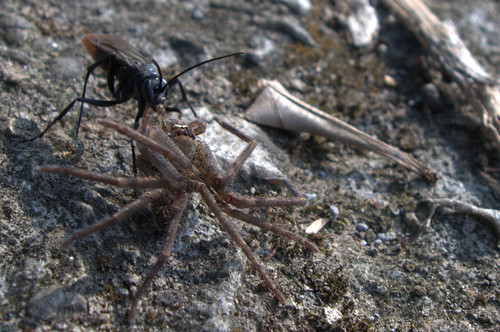
A wasp drags a paralyzed spider back to her lair to lay her eggs in its body.

Lovely day. Feeling lazy....
_______________________
Don't miss the comments below! And check out my blog and its sidebars for events, links to previous posts and picture posts, and scores of links to other Taiwan blogs and forums!

Monday, March 12, 2012

Taiwan: Greece to Come?

Having fun in a pause between rainfalls. This is a crop; the original is here. I love capturing reflections in water bubbles...

After the election I argued in the Taipei Times that one of the hidden factors in the election of President Ma was the growing wealth divide in Taiwan....
During the 1990s, when then-president Lee Teng-hui (李登輝) was midwifing the birth of Taiwan’s democracy, he essentially made a grand bargain. In return for their silence in his struggle to fend off the Chinese Nationalist Party’s (KMT) regressive right wing and its last-ditch defense of the party-state, it was decided that those who had grown wealthy by suckling off the party-state teat would not have their wealth taxed away through a progressive tax system, particularly a tax on Taiwan’s most important investment, land. Subsequent administrations have also found it politic to keep this bargain.

.....

Such individuals might have concluded that, if Tsai had won Saturday’s election, there would have been a significant reduction in their wealth if a fairer tax system were implemented, especially the paper wealth generated by the Taipei property bubble. Since Ma can be trusted to make noise about fairness, but to do little concrete, he was their obvious choice.

The property bubble is doing more than distorting the economy; it is distorting the nation’s politics as well. Observers have often remarked on Taiwan’s unfinished transition to democracy, yet they have seldom overtly argued that a critical factor in this is the regressive tax system.

As social inequality continues to grow, expect this wealthy class and its class interests to be a silent, but powerful driver of KMT success.
A similar political deal helped impoverish Greece, Spain, and Portugal, while in the US, the transfer of the nation's wealth out of the hands of its producers and into the pockets of a tiny coterie of fantastically rich individuals is having the same negative effect on the public purse, the ability of the nation to invest in its future, and on its democracy.

Surprisingly, the pro-KMT China Times came out with an interesting piece this week on the untaxed wealthy in Taiwan and their distorting effect on the nation's finances.
台灣稅賦公平嗎?一般民眾薪資所得每分錢都得乖乖繳稅,支撐了整個台灣主要綜所稅的來源,但炒房、炒股族卻可享有龐大「租稅優惠」,這部分「遺漏」的資本利得稅,估計每年大概在一千一百到一千五百億之間。

Is Taiwan's tax system fair? Every penny of the general public's wages are obediently taxed to support the whole of Taiwan's main resource of comprehensive income tax, while families with real estate and stocks enjoy huge tax incentives. The capital gains tax on this part of the "missing" taxes has an estimated value of NT$1.1 trillion to $1.5 trillion.
After the article details some of the taxes that have gone missing and their effects, it notes....
換句話說,不動產炒作者與股巿炒手至少年享逾千億元的「租稅優惠」!台北大學財政系教授蘇建榮就指出,依據國際貨幣基金會(IMF)提供資料顯示,當前台灣財政問題核心在於長期的「結構性財政赤字」,形成的原因除了政府支出結構外,主要是「長期的減稅制度」所造成。

In other words, real estate and stock market speculators enjoy tax breaks worth at least NT$1 trillion! Su Jianrong of the National Taipei University Department of Finance pointed out that International Money Fund (IMF) data show that the core of Taiwan's financial problems is the long-term structural deficit. In addition to the expenditure structure of the government, the main reason for the formation of the long-term structural deficit is long-term tax reduction.
...concluding:
長期的減稅制度不僅造成政府財政虛弱,入不敷出,更重要的是政府許多重要的政務,包括提高社會福利、補助弱勢民眾、加強教育投資等,都沒有能力再作擴充。最後必然造成國家與民眾受害。

This long-term tax system not only causes weak government finances, meaning that the nation is living beyond its means, but many important agendas of the government, including improving social welfare, subsidies to vulnerable populations, and increasing investment in education, cannot be expanded. In the end, it will inevitably lead to the victimization of both the nation and its people.
As long as the the government remains KMT, it is highly unlikely this will be fixed. This is a far more ominous issue with far greater ramifications for the future than the level of ractopamine in US beef -- which points to one of the important functions of the constant churning of minor issues like beef: it keeps the public nicely distracted...

UPDATED: Summary of interview this week of Control Yuan President Wang Chien-hsien, who said the government should impose taxes on stocks and real estate. Wang was forced to step down in 1992 when he attempted to levy a tax on real estate transaction based on the market price.
During an interview with the Taipei-based China Times, Control Yuan President Wang Chien-hsien (王建煊) indicted that in order to seek tax fairness and justice, the government should levy a capital gains tax on stock and real estate sales. In particular, he noted, the land value increment tax should be levied “based on market prices” on high-value real estate transactions as well as transactions of non-self-use residences. He went on to say that this would not require any Constitutional amendment, and the government would face less difficulty compared with imposing a new tax on securities exchange gains, so a capital gains tax on real-estate sales should be taken into consideration first. The increase in revenues from this tax could be used to subsidize first-time housing buyers, he noted.
_______________________
Don't miss the comments below! And check out my blog and its sidebars for events, links to previous posts and picture posts, and scores of links to other Taiwan blogs and forums! Delenda est, baby.

Tuesday, July 13, 2010

Israel Wants ROC Schindler in ROC Textbooks

Kuomingtang News reports that the government of Israel wants former ROC diplomat in Germany to be remembered in local textbooks for saving Jews from the Holocaust:
During World War II, Ho Feng-shan, then Consul-General of the Republic of China at Vienna, issued more than 2,000 visas to Jews, helping them to leave for Shanghai to escape Nazi Germany’s genocide. Raphael Gamzou, head of the Israel Economic and Cultural Office in Taipei, recently told Wang Fan-sen, vice president of Academia Sinica, that Israel hoped that the ROC Government would include Ho’s righteous deeds in its history textbooks.
Wiki has an entry on Ho:

After "Kristallnacht" in 1938, the situation became rapidly more difficult for the almost 200,000 Austrian Jews. The only way for Jews to escape from Nazism was to leave Europe. In order to leave, they had to provide proof of emigration, usually a visa from a foreign nation, or a valid boat ticket. This was difficult, however, because at the 1938 Evian Conference 31 countries (out of a total of 32 which included Canada, Australia, and New Zealand) refused to accept Jewish immigrants due to their fear of Nazi Germany. The only country willing to accept Jews was the Dominican Republic, offering to accept up to 100,000 refugees on generous terms. [2] In spite of the prohibition of the Chinese Ambassador to Berlin Chen Jie (陳介), who planned to strengthen the relations between his country and Germany, Ho continued to give visas on humanitarian grounds. Chen Jie sent an agent to Vienna Embassy to investigate Ho's activities. He spread the rumor that Ho was selling the visas. The agent arrived unexpectedly but, as he did not find any evidence about the false accusation, he had to return to Berlin empty handed. [3] At the time it was not necessary to have a visa to enter Shanghai, but the visas allowed the Jews to leave Austria. Many Jewish families left for Shanghai, whence most of them would later leave for Hong Kong and Australia. Ho continued to issue these visas until he was ordered to return to the ROC in May 1940.

The exact number of visas given by Dr. Ho to Jewish refugees is unknown. It is known that Dr.Ho issued the 200th visa in June 1938, and signed 1906th on October 27, 1938. How many Jews were saved through his actions is unknown, but given that Ho issued nearly 2,000 visas only during his first half year at his post, the number may be in the thousands.

Another tidbit about Ho:
At one point the building that housed the ROC consulate in Vienna was confiscated by the Nazis on the ground that it was a Jewish property. The ROC government refused Ho’s request to relocate the consulate, but Ho paid out of his own pocket and move the consulate to a smaller place. While there Ho continued to issue visas to Austrian Jews until he was ordered to return to China in May 1940.
Ho's forty years of service to the ROC government received its due reward. In 1985 he was accused of embezzlement and stripped of his pension. From this article that relies on the testimony of his son, a local academic, in describing the affair:
Sadly, the name of the human rights hero was tainted with an impeachment for embezzlement in 1985, where he was charged by a former subordinate of embezzling US$300 and other minor counts.

Ho Feng-shan's son, Ho Mon-to holocaust director of clinical research at the National Health Research Institute, has sought to have his father's name cleared since 1978, when he was elected as a member of the Academia Sinica.

Having collated records from evidence given by his father and written documents, Ho Mon-to and his younger sister became even more convinced their father was falsely accused and determined to put the record straight.

"When my father was appointed ambassador to Colombia, from Bolivia in 1970, he refused to recommend his subordinate to a consular position. This led to the subordinate's accusations two year later," said Ho.
Ho shows the complexities of diplomats from authoritarian states in Hitler's Germany. Ho would go on to serve the Chiang government during its murderous, authoritarian heyday. Similarly diplomats from Portugal, Japan (Sugihara, who also resigned in protest about Japanese treatment of Chinese in Manchuria, and Yoshiro Fujimura, behind one of the individual attempts to end the Pacific War in 1945), Spain, Italy and other authoritarian states saved thousands of Jews during the war.
__________
Daily Links
_______________________
Don't miss the comments below! And check out my blog and its sidebars for events, links to previous posts and picture posts, and scores of links to other Taiwan blogs and forums!

Sunday, June 27, 2010

Taiwan's A Whale Goes off to save Gulf

Thanks to commenter MX for this great story of a Taiwanese vessel off to save the Gulf of Mexico....
With no assurances it will be allowed to join the Gulf of Mexico oil spill cleanup, a Taiwanese-owned ship billed as the world's largest skimming vessel was preparing to sail Friday evening to the scene of the Deepwater Horizon disaster.

The 'A Whale' skimmer, 3 1/2 football fields long and 10 stories tall, was photographed in Norfolk, Va., on Friday. June 25 2010

The ship -- the length of 3 1/2 football fields and 10 stories high -- is designed to collect up to 500,000 barrels of oily water a day through 12 vents on either side of its bow. It docked in Norfolk en route to the Gulf from Portugal, where it was retrofitted to skim the seas. The ship and its crew of 32 were to leave Virginia waters Friday evening.

The owners of the "A Whale" said the ship features a new skimming approach that has never been attempted on such a large scale. They are anxious to put it to its first test in the Gulf.

"We really have to start showing people what we can do," said Bob Grantham, project coordinator for TMT Group, a Taiwan-based shipping company.

The company is still negotiating with the Coast Guard to join the cleanup and does not have a contract with BP to perform cleanup work. The company also needs environmental approval and waiver of a nearly century-old law aimed at protecting U.S. shipping interests.
The A Whale holds a million barrels of oil. Another story from Virginia notes:

Nobu Su, the CEO and founder of TMT Group, a Taiwanese shipping company, described the engineering behind his latest creation as "totally not common sense and totally against the rules."

Speaking in shirt sleeves and a blue baseball cap on the docks of Norfolk International Terminals, Su was referring to the special holes he had cut into the sides of his massive vessel, named A Whale.

As designed, the giant skimmer would roll across the Gulf "like a lawn mower cutting the grass," Su said, ingesting millions of gallons of oily water through the small slits.

The tainted water would then fall into huge storage tanks in the belly of the ship. There, oil would separate from sea water. The toxic stuff would be collected and disposed of, the water returned to the Gulf.

"A large-scale disaster needs a large-scale solution," Su told a crowd of reporters, shipping executives and regulators.

A Whale could handle 500,000 barrels of oily water a day, or slightly less than what all the skimmers now in the Gulf have gathered in more than 60 days on the job, Su said.

A no-brainer? Not quite.

Because the vessel is Taiwanese and was built in South Korea, it needs an exemption from the Jones Act, a federal law requiring commercial ships doing business in U.S. coastal waters to be American-flagged.

America's can-do spirit is alive and well....in Taiwan.
_______________________
Don't miss the comments below! And check out my blog and its sidebars for events, links to previous posts and picture posts, and scores of links to other Taiwan blogs and forums!

Friday, April 16, 2010

In which Taiwan News rips the China Post which compares Tsai Ing-wen to Hitler and can't get a single thing right

China Post editorials often pathetically attempt to get your attention like a skanky, three dollar whore motioning to you from a dark street corner, but on Monday the Post went all out for the consumer dollar with a piece so bad it makes a skanky, three dollar whore look downright geisha-like by comparison. Yes, that's right: Not only did the Post apparently utterly misrepresent the facts, it even offered a bonus comparison of DPP Chairman Tsai Ing-wen to Adolf Hitler and southern and central DPPers to his mesmerized followers. The CP wrote:
The opposition party has prepared a booklet, titled “Unspeakable Secrets of the ECFA,” which lists all the points of debate for its chairwoman to argue against President Ma, who wants to have the agreement concluded before the end of next month, if at all possible to prevent Taiwan from being marginalized in the emerging Asian free trade zone. The only line of argument against the ECFA, as revealed by the little book on her debate strategy, is that it is a conspiracy of the Kuomintang to let its Chinese born chairman sell out the native-born islanders of Taiwan.

It is ludicrous to argue that Ma is planning a sellout of Taiwan. Even if he dreamed of presenting Taiwan to the People's Republic on a silver platter, he couldn't make his dream come true. The plain truth is that nobody in the world can sell out Taiwan to China. But it makes sense for the opposition party to continue to accuse Ma of the conspiracy to win the upcoming mayoralty elections in five special municipalities and pave the way for Tsai to bear its standard in the presidential election of 2012. Like Adolf Hitler endlessly chanting Nazi mantras to mesmerize the Germans into following him, the DPP chairwoman simply has to drone on Ma's conspiracy to consolidate the party's power base in central and southern Taiwan.
The English cheerleader of a party that has killed as many people as the KMT has, led by a politician who spent the formative years of his political career fighting democratization, simply isn't the position to spew like that. Absolutely shameful. Fortunately, Taiwan News came out with a ripping hot editorial on this today -- why not a bit earlier in the week, like Thursday or Friday, when events were a bit fresher? But never mind that. Here it is in all its restrained but penetrating glory:

+++++++++++++

The war of words over the drive by President Ma Ying-jeou's rightist Chinese Nationalist Party (Kuomintang) government to sign a bitterly controversial "Cross-Strait Economic Cooperation Framework Agreement "with the People's Republic of China reached a new nadir this week.

In an editorial published Monday entitled "Is the ECFA debate necessary?", the China Post claimed that opposition Democratic Progressive Party Chairwoman Tsai Ing-wen, who is scheduled to debate the wisdom of the so-called ECFA with Ma April 25, would primarily focus her objections by `equating the pact with an act of selling out Taiwan."

The editorial indicated that its judgment was based on a booklet, "Unspeakable Secrets of the ECFA," which it claimed was prepared by the opposition party and "lists all the points of debate for its chairwoman to argue against President Ma."

According to the China Post,"the only line of argument against the ECFA, as revealed by the little book on her debate strategy, is that it is a conspiracy of the Kuomintang to let its Chinese born chairman sell out the native-born islanders of Taiwan."

Regretfully, with these statements, the China Post editorial writer revealed that he or she had not even bothered to glance at the actual document, a book whose title is more correctly translated as "ECFA: Unspeakable Secrets?", which has been published not by the DPP headquarters but is now being published in its third printing by the independent if pro-green Taiwan Thinktank.

In fact, nowhere in this 220-page book can a diligent reader find any mention of what the China Post calls the "only line of argument against the ECFA" and Tsai herself has never issued such an ethnically loaded charge.

Go read a book

If the China Post editorial writer had bothered to even examine its table of contents, he or she would have discovered that the Taiwan Thinktank book mostly concerns economic issues, notably the potential negative impact of the ECFA on worsening Taiwan`s dependence on the PRC's unstable economy, the likely negative impact on wages and employment and tangible risks to domestic market oriented industries and even high technology sectors such as electronics.

Only 13 of 69 "questions and answers" in an introductory section, evidently the so-called "debating points," are concerned with the pact's political implications and none speak of "conspiracy."

Only one answer stated that the reason why he Ma government has refused to consider contingency alternatives to the ECFA could be "perhaps stupidity or perhaps for the sake of eventual unification."

In the interests of fairness, the book also reprints the July 31, 2009 presentation by the Chung-Hwa Institution of Economic Research of an ECFA feasibility study commissioned by the Ministry of Economic Affairs.

Moreover, the book includes a lengthy section on alternatives to the Ma-brand ECFA drafted by Taiwan Thinktank Chairman and former Council for Economic Planning and Development chairman Chen Po-chih, a former economic adviser to former president and ex-KMT chairman Lee Teng-hui as well as to the former DPP governrment.

Chen's six alternatives range from delaying negotiation of an ECFA until the formation of a domestic consensus on a negotiating and adjustment strategy, holding negotiations with the PRC on tariff reductions on individual sectors and encouraging Taiwan manufacturers to invest in Association for Southeast Asian Nations member countries to gain tariff free entry into the PRC market.

Moreover, Chen provides a rigorous critique of the questionable economic assumptions underlying Ma's ECFA strategy and sketches the outlines of an alternative "Taiwan-centric economic strategy."

De-legitimizing dissent

Ironically, the China Post editorial provides far more tangible evidence than the Taiwan Thinktank book of the Ma government's intentions to dispense with Taiwan's sovereignty with its bald statement that "ECFA is not an agreement between two sovereign states in international law" but is instead "an arrangement between two political entities which have been engaged in a civil war."

Such a definition could well confirm the fears of many Taiwan citizens that the ECFA is not an agreement between two sovereign states or even between two equal member economies of the World Trade Organization but will be a "domestic arrangement" similar to the "closer economic partnership arrangements" signed between Beijing and the PRC's "special administrative regions" of Hong Kong and Macau.

Indeed, such an domestic "arrangement" would actually assign to Taiwan a level of dignity even less than Hong Kong and Macau are granted in their CEPAs with Beijing since the positions of the two former colonies as PRC "special administrative regions" are guaranteed by international treaties between the PRC and Great Britain and Portugal, respectively.

Acceptance of such an "arrangement" would not merely "sell out" but give away the hard-won people`s sovereignty won by the 23 million Taiwan people through our "quiet revolution" of democratization after four decades of KMT authoritarianism.

Finally, there is the question of the purpose of this transparent and unprofessional distortion.

The obvious aim is to discourage readers from even looking at the Taiwan Thinktank book or familiarizing themselves with the DPP's actual discourse on the ECFA and to block our citizens from realizing that there are feasible economic alternatives to the Ma government`s blind rush to sign this dangerous pact by June.

Ultimately, there is only one statement in this editorial that we can wholeheartedly concur, namely that the April 25 debate should be "over how the two leaders envision Taiwan`s future."

++++++++++++++
__________
Daily Links:
  • Tung Blossom Festival info page
  • Chen Shui-bian, detainee, detention extended two more months, because he might flee, collude, etc. Thanks, KMT, you've saved the DPP a ton of Chen-induced headaches
  • Meta-linking: Taiwan in Cycles with links to recent rides on Taiwan blogs.
  • Taiwan dollar hits 20 month high
  • Obama Justice Department: no trials for those who tortured or for other potential war criminals. We must look forward, after all. But if you were a whistleblower who exposed the NSA's abuses? 10 years for ya.
_______________________
Don't miss the comments below! And check out my blog and its sidebars for events, links to previous posts and picture posts, and scores of links to other Taiwan blogs and forums!

Monday, July 30, 2007

Taiwan Rulz in E-Gov

According to this librarian blogger....

The Taubman Center for Public Policy at Brown University in Rhode Island has just released its 7th annual ranking of e-government initiatives.

The findings are based on the analysis of 1,687 government websites in 198 different nations. The types of websites analysed included executive offices (president, prime minister, ruler, party leader, or royalty), legislatures, major courts, and major agencies and ministries.

Among the major findings:

  • 28 percent of government websites offer services that are fully executable online, about the same as last year
  • 96 percent of websites this year provide access to publications and 80 percent have links to databases
  • 29 percent (up from 26 percent in 2006) show privacy policies, while 21 percent have security policies (up from 14 percent in 2006)
  • 23 percent of government websites have some form of disability access, meaning access for persons with disabilities, the same as last year

On a ranking scale of 0 to 100, the study concluded that South Korea offered the best e-government services of any country with a score of 74.9%.

Other countries in the top 10 were, in descending order: Singapore, Taiwan, United States, Great Britain, Canada (6th place with a score of 44.1%), Portugal, Australia, Turkey and Germany.


Taiwan has actually come in first three times in this survey. These largely successful e-government initiatives date back to the Lee Teng-hui era, to that most important of policymaking bodies you've never heard of, the RDEC.

Sunday, July 15, 2007

Revolting Story of EU Kow-tow to China

Here's something sick from the Economist:

China tells the EU to dump on Taiwan. The EU asks “How hard?”

ASK officials in Brussels about relations between China and the European Union, and you will soon hear the word “values”. A recent EU strategy paper on China calls on Europe to pursue a “dynamic relationship with China based on our values”, notably including democracy and human rights.

Try telling that to Taiwan. It is about to receive a stern EU injunction to act “sensibly and responsibly” by scrapping a planned referendum asking voters whether they would like the island to seek membership of the United Nations under its historic name, the “Republic of China”, or just “Taiwan”.

What could be sicker than the EU serving China? Not much. BTW folks, the Republic of China is not Taiwan's historic name, but its official one.

Why is the EU meddling? Taiwan is a thriving democracy and big trading partner (almost as important as India or Brazil). The explanation is simple and unedifying: the EU is doing China's bidding. Chinese rulers regard the Taiwan referendum as a sneaky step closer to an eventual declaration of formal independence by the island.

The conventional wisdom is that China is concerned about a formal declaration of independence by Taiwan. But they have to know that there is neither the political consensus nor the Constitutional possibility of such an event occurring. Since they have the veto in the UN, they also know that Taiwan will never enter the UN under its own name.

So what is Beijing up to? They know from their pals in the KMT that the UN referendum is an election year ploy that will have no real effect on anything. So this isn't about "Taiwan independence" really. It's about stopping or defusing an election year ploy, on behalf of its allies, the KMT. It is also part of its long-term policy of making Chen Shui-bian look like a "radical."

The Economist then goes on to explain what is going on:

China expends extraordinary energy on pestering other governments to preserve the strange limbo inhabited by Taiwan, a self-governing island of 23m that it insists is a wayward province. Whenever Taiwan irks China, its ambassadors appear at foreign ministries worldwide, demanding that Taiwan be rebuked.

An internal EU memorandum sheds light on the way such strong-arm diplomacy works. Prepared by officials working under Javier Solana, the EU's foreign-policy supremo, it describes a meeting, late last month, between the Chinese ambassador to the EU, Guan Chengyuan, and a top Eurocrat. According to EU note-takers, Mr Guan called the referendum provocative and destabilising, and said China wanted EU support, as it did not want to have to use “the last resort”—an apparent reference to its threat to use force, if necessary, to “reunify” Taiwan.

The memorandum records Mr Guan's EU host as agreeing that a referendum is against Taiwan's own interests, and offering to send a “clear and forceful” message to Taipei to that effect. America, which has many reasons to seek China's diplomatic goodwill, has publicly rebuked Taiwan over the referendum. The EU, in contrast, will stick to private warnings for the moment, to avoid “playing into the hands” of Taiwan's “populist” president, Chen Shui-bian, by giving him “undesirable” publicity.

Portugal, which took over the six-month rotating presidency of the EU this month, has duly drafted a private warning to Taiwan, saying that a referendum risks raising tensions and would be “unhelpful”. A parallel message is to be sent to China, urging restraint.

The Economist writer then demonstrates a good grip on things, rare in foreign correspondents:

UN membership for Taiwan is a long-lost cause, and Mr Chen's referendum plan is at heart an electoral ploy ahead of next year's presidential poll. But that is the sort of thing that happens in a democracy. One dissenting EU diplomat says the Union is pretending there is “moral equivalence” between Taiwanese election politics and Chinese threats of violence. Certainly, this is not how most people understand the EU's oft-professed values.

Remember how the EU criticized Estonia for removing markers of Russian colonialism there, and for wanting to join the UN? Hey wait....that never happened. Hypocrisy, thy name is politics.

Meanwhile back in Taiwan, former DPP presidential candidate Peng Ming-min, who has been working on independence for the island since the 1960s, had a few public words for the EU yesterday.

A former senior presidential adviser, Peng Ming-min (彭明敏) said on Thursday that although the EU considers the lucrative Chinese market important, it should give Taiwan's democracy a chance.

Speaking at a seminar hosted by the Taipei Representative Office in Belgium, Peng said that poor cross-strait relations still posed a danger, even though other problems across the globe have meant that the international community has paid less attention to the issue.

While cross-strait economic relations are increasing, progress was lacking on the political front, Peng said.

MISINFORMED

Peng said many of the perceptions held by Western countries on cross-strait issues were incorrect and disputable, including the "one China" policy, the emphasis on the maintenance of the "status quo," and calls for Taiwan to engage in a dialogue with China and not to provoke China.

Taking the "one China" policy as an example, Peng pointed out that Taiwan, which has been operating independently over the past several decades, is a sovereign and democratic political entity.

"The claim that Taiwan, which is totally different from China, is `part of China' is obviously made with disregard to this reality," Peng said.

On the "status quo" that some countries had asked both sides of the Taiwan Strait to maintain, Peng argued that no one was able to define the concept because the situation was always changing.

For instance, Peng said, China's military buildup is a strategy to change the status quo, while Taiwan's arms procurement and even economic growth are also changing the status quo.

"After taking into account all these factors, the so-called `status quo' is totally meaningless," he said.


It's a shame that the EU is taking the anti-democracy position here. At least they did not do so publicly.

Longtime commentator Ting-i Tsai also had an excellent article on the referendum bid in the Asia Times:

The DPP could present the referendum as a move to expand Taiwan's diplomatic space in the face of rejection, but most academics in Washington see it as an exercise in political cynicism, designed to capitalize on the failure of Taiwan's UN bid in September by consolidating voters' anger toward mainland China.

Harvey Feldman, senior fellow for Asian studies at the Heritage Foundation, a co-author of the US Taiwan Relations Act, and one of the creators of the American Institute in Taiwan, noted that the idea "is mostly an attempt to mobilize the [ruling 'pan-green' coalition] base and make sure it votes. As far as getting into the UN is concerned, it is an essentially meaningless gesture."

Dennis Hickey, professor of the Missouri State University's political science department, echoed Feldman, arguing, "In Washington's view, domestic politics is driving the Chen administration to once again engage in provocative behavior - activities that outrage Beijing - in order to realize some domestic political gains."

But Hickey added that the referendum may not have long-term repercussions: "A termination of American support for Taiwan is not in the cards - after all, Chen is a lame duck."

What will happen? Nothing. The referendum will be held, it will pass or fail, UN entry will fail, the smoke will clear, everyone will realize that nothing has happened, and life will go on. China might complain, but note that it never takes concrete moves -- it never seizes businesses or blocks investment or refuses visas to Taiwanese. "Being provoked" is an event that happens only in the international media. It doesn't take place in the real world.

As I said, this isn't about responding to Taiwan independence. That is only the excuse. The international media is reading China's move incorrectly, I think. This is about helping out the KMT in its quest to gain the presidency by getting other nations to put pressure on the DPP to stop engaging in an internationally meaningless election ploy that will help the DPP get elected.


Friday, February 09, 2007

How dangerous is it to drive on the Beautiful Isle?

When I was in LA last week I had occasion to consult the traffic fatality data for Los Angeles County (available on the NHTSA website). Last month, the Taipei Times reported:

As a result of the measure, however, the bureau said that although traffic citations had decreased from an average of 20 million per year before 2005 down to 10 million per year in 2005, deaths caused by traffic accidents had risen from 4,322 in 2002 to 4,735 in 2005.

The death toll was projected to reach to 5,000 last year.

The nation's death rate resulting from traffic incidents is higher than that of the US and Japan, the bureau said.

While about 21 individuals per 100,000 people died in traffic accidents in Taiwan last year, the number was about 15 in the US and seven in Japan.


The US figure is 14.66 per hundred thousand, for Taiwan it is 21, and for LA county? It's a piddling 7.55, or about one-third of the figure in Taiwan. Sadly, the government pledged a decade ago to reduce the death rate to under 9 per hundred thousand....

Naturally, though, things are not that simple. Facts are constructions of methodologies, and each country has its own. How does Taiwan stack up? The problem may be illustrated by this comment in a New Zealand government report from September of last year:

While ascertainment and recording of road traffic deaths is high in countries like New Zealand, there is still country to country variation in completeness of reporting, and some definitions, as outlined in the previous report. These include the time period following the crash in which deaths must occur in order to be counted as traffic deaths. The standard is now 30 days, but it is not universally applied, even in neighbouring countries. A traffic fatality in Spain, Greece and Portugal is one that occurs in the first 24 hours, in France 6 days and in Italy 7 days. Variation also occurs in whether crashes on private roads are included, and whether confirmed suicides or natural deaths are included. There has been considerable improvement in standardisation of these measures in the past decade in IRTAD member countries.

This problem is a common one anytime mortality rates are discussed. For example, the US is often pummeled for having high infant mortality rates, but if you look up the country-by-country definition, in some countries, even advanced ones, it isn't counted as an infant until it has been out of the mother for 24 hours. You can do wonders for your mortality statistics if you don't count the babies who die in the first 24 hours as being born. For traffic fatalities, the US uses the thirty day standard. Taiwan, according to what I have been able to dredge up, uses two different definitions, one by the Dept. of Health, the other from the police (ten year old data) who use a 24 hour standard. Consequently, the DOH reports twice as many fatalities as the police do. Since so many accidents are not reported to the police, some adjustment for undercounting must be made. I cannot find any data on how suicides are accounted for, or whether pedestrians killed on sidewalks in Taiwan by motorcycles are counted.

To expand on some comments I made over in the realm of Roy on a post on driving, when I was in LA, I walked all the way up Santa Monica Blvd, save a section by bus, from Ocean Ave, and cut over to Wilshire and back to UCLA, a couple of hours in all (one of my favorite things to do is to walk all the way across a city taking pictures). Perhaps LA drivers were not on their game that day, but not once did I see a red light run. Not once did I see anyone make an illegal turn on left. Not once did I saw drivers continue to make left turns after the light changed or rush into the intersection in the time both lights were red, or run the red light while the left turn signal was green but the straight signal was red. Nobody ran the length of a line of cars waiting to make a left to line up in front. Nobody was committing traffic infractions in front of a policeman, an event I have video'd and photo'd many times in Taiwan (I did see cops pull cars over twice for infractions). At the entrance ramp for the 405 expressway in front of the Federal Building on Wilshire, though the traffic had backed up onto Wilshire, I saw no cars attempting to run the length of the line of waiting vehicles and push their way in at the exit, which is par for the course in Taiwan -- though I stood there for several minutes watching for just that. Instead, people patiently lined up and waited. The traffic flowed. Tellingly, at rush hour in LA it was not necessary to have the police physically directing traffic at intersections.

I'm sure veteran LA drivers have seen all those things once or twice. But you don't see them day in and day out in LA, like you would in Taiwan.

I was thinking about this as I was waiting to make a left today, and the driver behind me, impatient, attempted to make a blind left turn on the inside of my left. We long-term expats have gotten so used to living in Taiwan that we've become habituated to it, and the differences between Taiwan and a country where the traffic is well regulated and drivers have internalized civic culture are harder for us to see. Laugh though we may, in some ways it's the indignant letter-to-the-editor-writing newbies who might have a better handle on how things stack up between Over Here and Over There.

Friday, March 17, 2006

2006 Environmental Performance Index: Taiwan Rises

My friend Ian tipped me off to the new 2006 Environmental Performance Index, in which Taiwan seems to have done well. Last year's Index was a spectacularly bad job. This year does not seem to have seen any improvement.

The report once again ranked The Beautiful Isle 24th in the world.

1 New Zealand 88.0
2 Sweden 87.8
3 Finland 87.0
4 Czech Rep 86.0
5 Unit Kingdom 85.6
6 Austria 85.2
7 Denmark 84.2
8 Canada 84.0
9 Malaysia 83.3
10 Ireland 83.3
11 Portugal 82.9
12 France 82.5
13 Iceland 82.1
14 Japan 81.9
15 Costa Rica 81.6
16 Switzerland 81.4
17 Colombia 80.4
18 Norway 80.2
19 Greece 80.2
20 Australia 80.1
21 Italy 79.8
22 Germany 79.4
23 Spain 79.2
24 Taiwan 79.1

The US ranked 28th. The report remains as clueless about Taiwan as last year and the methodology and definitions do not seem to have undergone any major changes, so rather than repost, you can review what I wrote in my previous analysis of this.

Saturday, October 22, 2005

Gavin Menzies and Ming Voyages

I am sure that many of you have seen Gavin Menzies' 1421: The Year China Discovered the World and wondered about it. This Erik-Van-Daniken-meets-ancient-China codswallop was debunked in a post to H-ASIA today.

H-ASIA
October 21, 2005

Popular History and Bunkum -- on *1421, The Year China Discovered
America*
************************************************************************
From: Geoff Wade <arigpw@nus.edu.sg>

Dear H-Asia members,

I have just submitted the following complaint against Transworld
Publishers of Britain to the Consumer Complaints body of the United
Kingdom

http://www.consumercomplaints.org.uk/index.asp

The complaint derives from Transworld publishing and advertising
"1421: The Year China Discovered the World" , authored by Gavin
Menzies, as a work of history, which I believe is a violation of the
British Trade Descriptions Act of 1968

Best wishes,

Geoff Wade

#########

Copy of complaint submitted:

I purchased a copy of Gavin Menzies' "1421: The Year China Discovered
the World," published by Transworld, on the basis that it was
classified as "History" in their catalogue. A detailed reading of the
text revealed that the work is a fairtytale and fiction of the worst
kind. I detail some of the outrageous fiction perpetrated within the
volume:

Claims by Mr. Menzies followed by facts

1. Claim: Four eunuch admirals�-Hong Bao, Zhou Man, Zhou Wen and Yang
Qing --led fleets to the Americas, Australia, Greenland and the
Antarctic during voyages between 1421 and 1423.

Fact: There are no Chinese or other texts which suggest in any way
that these four eunuchs, or any other Ming commanders, traveled
anywhere at all beyond Asia, the Middle East and the East coast of
Africa. All other voyages derive solely from Mr. Menzies'
imagination. Further, the currents, winds and dates Menzies cites in
support would not have carried the ships anywhere near where he
claims. In short, there is no archaeological, textual or archival
material to support the Menzies thesis as set down in *1421*. In this
book Menzies intentionally distorts known materials and deliberately
alters known facts in order to support his thesis.

2. Claim: Sailors and concubines from these fleets settled in the
Americas, Australia, New Zealand and islands across the Pacific. In
evidence, he cites studies of "recent" inflow of "Chinese genes" and
"East Asian DNA" into the Americas.

Fact: There is no evidence of Ming settlement sites in, or even Ming
knowledge, of these places until the arrival of the Jesuits in China
in the 16th century. The genetic evidence on which Menzies relies is
provided by a company whose genetic tests have been labelled a "scam"
by Stephen O'Brien, the US National Cancer Institute's laboratory
chief.

3. Claim: There exists a range of wrecks of the ships from these
voyages spread around the world, and these are proof of the voyages
claimed by Menzies.

Fact: Not one wreck which can be linked with the eunuch voyages in
the first 30 years of the 15th century (or indeed any Chinese wreck)
has been identified outside of the Asian region.

4. Claim: The Ming voyagers built celestial observation platforms at
24 places across the Pacific and Indian Oceans. Menzies names and
provides coordinates for these platforms. (*1421*, pp. 416/17, 457)

Fact: There is no textual or archaeological evidence to even begin to
suggest that the Ming voyagers built observation platforms anywhere
in the world. Again, their existence derives only from the fertile
imagination of Mr. Menzies.

5. Claim: The Ming armadas left a range of other built structures
around the world, particularly in Australasia and the Americas,
including the Newport Round Tower, the Gympie pyramid and other
structures and mines. They also left a ship's slipway made of stones
on the Bimini islands in the Caribbean.

Fact: Not one of the structures Mr. Menzies cites has been shown to
have any links with China. The Bimini "slipway," which is in any case
parallel to the shore, has been shown to be a completely natural
formation.

6. Claim: The Chinese "were aware that the earth was a globe and had
divided it into 365 and a quarter degrees (the number of days in the
year) of latitude and longitude." (*1421*, p. 449)

Fact: There is no evidence that during the early Ming, the Chinese
had any knowledge of the earth as a globe and certainly none that
they were aware of latitude and longitude.

7. Claim: The Ming voyagers surveyed South America, Antarctica, North
America and the Atlantic as well as Australasia. "The whole world was
accurately charted by 1428." (*1421* p. 411)

Fact: There is no text or other evidence which suggests that the Ming
voyagers went anywhere near these places and no Chinese maps which
indicate any surveying of these places. Further, there are no
contemporary Ming artifacts found in any of these regions.

8. Claim: A range of European maps show anomalies which can only be
explained by accepting the Chinese voyages proposed by Mr. Menzies as
having taken place

Fact: The cartographic anomalies which Mr. Menzies points to, real or
imagined, can be explained through many avenues, the most likely
being that Arab navigators, who had been traveling these waters for
600 years before the Chinese, had produced maps of areas they traveled
to.

9. Claim: Mr. Menzies noted that the Venetian Niccolo da Conti was
the crucial and only link between Chinese and European cartographers.
Menzies claims that he participated in the voyages over several years
and carried Chinese maps back to Europe. He notes that Da Conti "had
spent years aboard a junk of the treasure fleet" and that "Chinese
maps passed from Da Conti to Fra Mauro, and from him to Dom Pedro of
Portugal and Prince Henry the Navigator." (*1421*, pp. 369, 84-87,
92-93)

Fact: Da Conti, who left us detailed accounts of his travels,
recounts neither meeting any Ming envoy in Calicut, nor traveling on
any Chinese ship for even a day, nor seeing or receiving any Chinese
maps showing a new world. The utter and complete contempt for truth
with which Menzies depicts these events is disheartening.

10. Claim: Mr. Menzies claims that a number of mylodons (a type of
giant sloth) had been taken from South America to New Zealand and
China by the Ming ships.

Fact: All available evidence suggests that the Mylodon has been
extinct for several thousand years, which militates somewhat against
the likely veracity of Mr. Menzies' claims in this respect. But such
sloppy research is found throughout the volume. He notes, for
example, rubber trees in Malacca 450 years before they had been
introduced from South America by the British, etc., etc. ad nauseam.

#####

In short, all major claims within the work are fictional.
Representing this work as history is a flagrant violation of the
Trade Descriptions Act of 1968 which makes it an offence both to
apply a false description to any goods and to supply or offer to
supply any goods which have a false trade description applied.

To be an offence the Act notes that the indication must be false to a
material degree. To represent fiction as history does indeed meet
this criterion.

The role of the Local Trading Standards authorities is to enforce the
provisions of this Act and they are able to take whatever steps they
consider necessary to prevent others from being deceived. I trust
that appropriate action will be taken in this case.

If you require further information, please do not hesitate to contact
me.

###############

I do not know if similar legislation to the British Trade
Descriptions Act exists within the United States, but William Morrow,
the publishers of the US edition of the book "1421: the Year China
Discovered America", and an imprint of Harper Collins, lists the
book under Non-fiction/History/World:

Harper here

With best wishes,

Geoff Wade
National University of Singapore

***********************************************************************
To post to H-ASIA simply send your message to:
<H-ASIA@h-net.msu.edu>
For holidays or short absences send post to:
<listserv@h-net.msu.edu> with message:
SET H-ASIA NOMAIL
Upon return, send post with message SET H-ASIA MAIL
H-ASIA WEB HOMEPAGE URL: http://h-net.msu.edu/~asia/