Showing posts with label overfishing. Show all posts

Thursday, October 01, 2015

Fishing Excerpts and Links

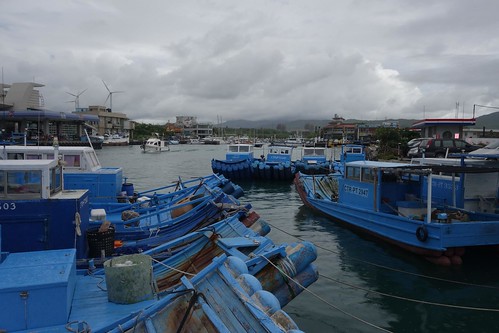
LanyuDanno_2015_1
Fishing boats in Houbihu harbor

The EU threatens Taiwan with sanctions for overfishing:
The European Union is threatening to take trade action against Taiwan and the Comoros if they do not contain within six months illegal and unregulated fishing, which is a major contributor to the depletion of key commercial stocks
which reminded me that I wanted to post on this. This journal article on Taiwan fishing boats and safety observes that overfishing has increased the risk to Taiwanese fishing boats...:
According to Taiwanese fisheries regulations, the captain and the chief engineer must be of Taiwanese nationality for fishing boats below 100 tons. Boats over 100 tons require another Taiwanese chief mate. With the recent increases in oil prices and the stagnant fish prices, most fishermen hire foreign workers to cut down costs. Taiwanese fishing boats are now manned by one Taiwanese captain and all-foreign crews.

....

On the other hand, over-fishing has caused the degradation of marine resources, so Taiwanese fishing boats must travel far from traditional fishing areas to catch fish, even in facing the increased vessel risk. The lack of willing Taiwanese crewmen introduces risk to the Taiwanese fishing industry as a whole. Since the youngest do not like to work in the fishing industry, the captain is forced to employ foreign crewmen with the introducing tensions.

In Taiwan, the majority of fishing boat captains and crewmen inherit their father's work and are not well-educated. The quality of crewmen is irregular. Therefore, the leadership and experience of the captain are often insufficient.
Fishing factoid (source):
"Tuna flesh turns brown and unappetizing for sashimi unless it is treated very carefully. Normal freezing temperatures are not suitable, but if tunas are frozen at -60C they can be frozen for months or years at sashimi-grade quality."
Years? That same chapter says that Taiwanese fishing boats operate in the Atlantic to poach tuna, which they then say was caught in the Pacific. They defended this practice with the usual "everyone does it" but interestingly, when Japan accused Taiwan in 2004 of laundering tuna in this way, the government in Taiwan didn't do anything because of the importance of the port of Kaohsiung in southern electoral politics.

Readers with much experience in the political economy of agriculture will recognize this problem described in this paper on Subsidies to Tuna Fishing:
Tuna fisheries in the Western and Central Pacific Ocean are among the most valuable resources in the region. These fisheries, worth an estimated $4.1 billion each year, play a pivotal role in supporting incomes and development goals in the region. However, due to the twin, and potentially inter-related effects of harmful fishing practices such as the use of fish aggregating devices, overcapacity, and fisheries subsidies, many of these tuna fisheries are currently at risk of over-exploitation—putting the livelihoods of countless local fishers at risk. This study finds that government fisheries subsidies in the region represent 37% of the ex-vessel value of tuna fisheries in the region. Fuel subsidies are estimated at US$ 335 million and non-fuel subsidies are estimated at US$ 1.2 billion for the year 2009. Developed countries are responsible for more than half of the subsidies spent in the predominantly developing region, underlying the fact that the majority of tuna value extracted from the national waters of developing countries in the region benefit larger, developed countries. The total resource rent, or return to society, from tuna fisheries, once adjusted for subsidies is a net negative US$750 million in 2009. Fisheries subsidies are enabling foreign fleets to operate at sub-market rates, putting local fleets out of competition for their own fishery resources.
This paper, which proposes closing the high seas to all fishing, notes that the big losers economically would be South Korea, Japan, and of course, Taiwan.

Old posts: Greenpeace occupy action on Taiwanese boat overfishing, background on Phils killing of Taiwanese boat captain mess.
_____________
Daily Links:

Tuesday, May 14, 2013

More on the Phils/Taiwan Fisherman Mess

Delivering veggies in Tsaotun

The Taiwan Coast Guard has a couple of reports on its website about this (like to thank the anonymous commenter on a previous post). This one says the shooting occurred at "approximately 164 nautical miles south-east of Eluanbi (latitude 20 degrees 07 minutes east longitude 123 degrees 01 minutes)". The CNA graphic complete with a bit of unseemly nationalistic blood, has it located....

It is difficult for me to look at that graphic and not see the Taiwanese boats as operating in Philippines waters. In fact (read on below!) Manila has it in a slightly different location. Fortunately the CNA went out and solicited the unbiased opinions of experts from Taiwan who assured us the Taiwan boats were operating legally:
Hu Nien-tsu, director of National Sun Yat-sen University's Center for Marine Policy Studies, said that according to Article 51 of the 1982 United Nations Convention on the Law of the Sea, as a neighboring country to the Philippines, Taiwan's fishing boats have rights to legally operate in the Bashi Channel as well as rights to exercise their traditional fishing rights within the Philippines' archipelagic waters.

The article stipulates that an archipelagic state shall "recognize traditional fishing rights and other legitimate activities of the immediately adjacent neighboring states in certain areas falling within archipelagic waters."

Hu said that when disputes arise, it is necessary for the Philippines to reach bilateral agreements with Taiwan.

Liu Fu-kuo, a researcher at National Chengchi University's Institute of International Relations, also said that the Philippine coast guard officials' decision to fire at the Taiwanese fishing boat is against international law and other laws related to the sea.
Here is Article 51 of UNCLOS.
1. Without prejudice to article 49, an archipelagic State shall respect existing agreements with other States and shall recognize traditional fishing rights and other legitimate activities of the immediately adjacent neighbouring States in certain areas falling within archipelagic waters. The terms and conditions for the exercise of such rights and activities, including the nature, the extent and the areas to which they apply, shall, at the request of any of the States concerned, be regulated by bilateral agreements between them. Such rights shall not be transferred to or shared with third States or their nationals.
The Taipei Times, in an empty and jingoistic editorial the other day, also referred to UNCLOS.
By opening fire on the Taiwanese fishing boat and killing the fisherman, the Philippines has violated the UN Convention on the Law of the Sea, which bans use of force against any unarmed fishing boat. The Ma administration should not passively wait for “positive responses” from the Philippines.
This pious reference to UNCLOS is somewhat ironic, given that the Republic of China is not a signatory (Wiki).

The editorial refers to the South China Sea and disputed waters, but the area in question is not either. Bringing up tensions and mixing up waters east of the Philippines with waters west of them is simply an attempt to snow the reader with appeals to nationalist emotions. Sad.

I got to wondering about the whole "traditional fishing grounds" claim, which is popping up in the media. Here is a paper on the history of longline tuna fishing in Taiwan. It notes:
When tuna longlining fishing was first introduced to the Toko and Takao fishing ports, local fishers only used sail-powered boats in coastal waters. They even believed, wrongly, that sail powered longliners were more suitable to harvest tuna than motored vessels. However, the situation gradually changed after the mid-1910s when Taiwan’s tuna fishing industry gradually expanded its fishing territories to greater distances which only motored vessels could reach.
Prior to the Japanese period, ships from Taiwan were not motored and did not go far from Taiwan's coastal waters. It was the Japanese who encouraged the development of the industry, and drove its southward extension, which reached 250 miles from Taiwan only in 1928, according to the paper.

This is worth stating out loud, and it applies to the Senkakus as well: these do not appear to be "traditional" fishing grounds. Neither are the Senkakus. Both became accessible to Taiwanese only after the Japanese introduced motor technology to local fishermen and encouraged Taiwanese fisherman to venture further south. Taiwanese fishing in Philippines waters is an extension of Japanese colonial policy. The idea that they are "traditional" is simply a way to do an end run around UNCLOS so Taiwanese fisherman can continue to poach fish in other people's waters -- and in the Senkakus case, attempt to buttress China's claim to the Senkakus.

It should be mentioned that Japan and the Philippines both have formal defense treaties with Uncle Sam.

Meanwhile the President continues to demand that Manila give... (KMT news organ).
The 72-hour deadline set by President Ma for the Philippines will expire at midnight today. It demands an official response about the incident involving a machine gun shooting on the ROC fishing vessel Guang Da Xing No. 28 (廣大興28號) by a Philippine coast guard cutter, killing its skipper Hung Shih-cheng (洪石成). During interpellations in the Legislative Yuan yesterday, Foreign Minister David Lin (林永樂), stated that according to the information that the Ministry of Foreign Affairs (MOFA) had on hand, the government of the Philippines would issue a statement in response to Taiwan’s demands, explaining Manila’s position on the issue today.
The "tough" response of Taipei should be set against the more mild responses from Beijing to the deaths of its fisherman at the hands of South Korea and Russia in the last couple of years, a sharp observer of Taiwan pointed out. The government's demands are (CNA):
Taiwan has demanded a formal apology from the Philippines, compensation for the victim's family, an investigation into the incident and punishment for the perpetrators, as well as open fishery agreement talks with Taiwan as soon as possible.

If Manila does not issue an appropriate response by midnight Tuesday, the government said it will "immediately" suspend the processing of applications by Filipinos seeking employment in Taiwan, recall its representative to the Philippines and demand that the Philippines' representative to Taiwan return to Manila.
Taipei has already done that before, in 2011, as I noted in the post below. In fact some people are wondering aloud whether this is payback for that humiliation Manila handed Taipei two years ago. In 2006 Philippines Coast Guard boats killed another Taiwanese sailor.

The Manila Times had a report from AFP, the Philippines press being occupied with the elections there:
But Philippine coastguard spokesman Commander Armand Balilo said the incident took place in Philippine waters and the Filipino personnel had been properly carrying out their duties to stop illegal fishing.

"If somebody died, they deserve our sympathy but not an apology," Balilo told reporters.

Balilo said the incident happened just north of the main Philippine island of Luzon in the Balintang channel, which is part of the Philippines' territory and not claimed by any other country or Taiwan.

"This is part of Philippine waters," he said.

Balilo said the 30-metre (100-foot) coastguard vessel initially saw two fishing vessels and tried to approach them. He said the coastguard crew fired at the smaller of the two vessels after it tried to ram the Filipino boat.

"They fired at the machinery to disable it. They were able to disable the vessel although they were not aware at the time that somebody had been hit," he said.

Balilo said the coastguard quickly left the area after it saw a third vessel, "a big white ship", come into view.

"Our people felt threatened so they left the area," he said.
Note that the two nations locate the incident in different though close places. President Aquino appealed for calm in Taipei.

Taiwan media are reporting that there is going to be a joint investigation. Let's hope there's a video out there that can help settle this mess.

Scary and sad, so many times when I look at pieces in English about this mess, I see little or nothing about the Philippines' claim that the boat was trying to ram the Philippine Coast Guard vessel (China Post, Commentary in TT). Merely the summary that the fisherman was shot. It's as if the Philippines vessel had no motive for its action.....

The KMT news piece had a comically sad comment at the end....
In addition, Minister Lin also pointed out that the Mainland was not a positive factor in the matter of concluding a Taiwan-Philippines fisheries agreement, adding that one of the main reasons that Taipei and Manila had failed to conclude an agreement after five rounds of fisheries talks was precisely the “One China factor.” He noted that the Philippines was rather concerned about the Mainland’s views, adding that, “the Mainland has not given us a helping hand in this matter.”
What? Beijing not helping Taipei in an international agreement? Who could have predicted that?

REFS: J Michael Cole's piece in The Diplomat, which mentions another aspect: an ongoing cyberwar between hackers from both countries.
_______________________
Don't miss the comments below! And check out my blog and its sidebars for events, links to previous posts and picture posts, and scores of links to other Taiwan blogs and forums!

Sunday, May 12, 2013

Irritated Bellow Syndrome: Taiwan fisherman killed by Philippine Coast Guard, Media Feeding Frenzy Ensues

A couple of herons contemplate eastern Taichung, and are not impressed.

Unless you've been living in a cave or a foreign country, it's been impossible to miss the unseemly mess over the death of a Taiwanese fisherman at the hands of Philippines Coast Guard sailors. Let's roll that news:

(A Taipei Times report)
A total of 52 bullet holes were found on the Kuang Ta Hsing No. 28, Liu Chia-kai (劉嘉凱) from the Pingtung District Prosecutors’ Office, said after examining the 15-tonne vessel that is registered in Liouciou Township (琉球), Pingtung County.

Investigators found 10 holes on the port side, where the bullets penetrated parts of the boat that are quite thick. This means they may have been fired from “heavy weapons,” such as machine guns, Liu said.

..............

Taiwanese fisherman Hung Shih-cheng (洪石成), 65, was killed when the Philippine Coast Guard vessel opened fire in the incident on Thursday.

Prosecutors said Hung was killed by a bullet that penetrated the right side of his neck. Liu has asked that Hung’s body be taken to Kaohsiung for forensic examination.
My man Ben observes:
Neither too did this tragedy just happen absent any historical trend.  Conflicts between Taiwanese boats and Filipino fishing boats and the Philippines Coast Guard have been escalating in this same area for a number of years, most usually around the time of the tuna fishing season.

Watchers of the region will also have noted that the Philippines got a very figuratively bloody nose last year when the Chinese, using fishing boats which were then augmented by ‘Maritime Surveillance’ vessels and PLAN ships, literally invaded and occupied the Scarborough Shoal effectively annexing the area that is roughly 220km from the Filipino mainland.  This timeline shows that the spat between China and the Philippines over the Scarborough Shoal has a long history. It could be then that the PCG personnel on board the Bureau of Fisheries and Aquatic Resources (BFAR) vessel that confronted Hung’s boat were over zealous, keen not to be embarrassed again.  This fatal incident, deriving from an almost annual showdown over access to valuable catch, might then be seen as an act of aggression displacement.  Not being able to displace the Chinese from their waters, they may have projected that frustration onto Taiwanese boats instead.  The difference in these incidents is that Scarborough Shoal is much closer to the Filipino mainland than the area in which the Hung shooting took place.  There is therefore lots of room for interpretation of whether the BFAR vessel had any authority to act in the area.  
As usual, with international incidents of this nature, there are multiple competing accounts of what happened and where.  Largely absent in the Taiwanese media is the claim by the PCG that Hung’s boat was one of four that were accosted and which refused to leave.  Also absent is their claim that Hung rammed his boat repeatedly into the BFAR vessel.   It boggles the mind, given all the brinkmanship by fishermen, Coast Guard and pseudo-naval vessels in the South and East China Seas in the last three years, that someone was not recording events on camera for evidence in this incident.  The Philippines certainly did not help their case when they initially denied being the area and then admitted firing on the craft.  That does not lend an air of credibility to their version of events but since there seems to be no video (or none made available to the media) the confrontation remains at the level of ‘he said, she said’.  
Ben's observations are spot on and his post should be read in its entirety. The mess has been escalated by our Golden Retriever media in Taiwan, which adopts the attitude of China (several locals I spoke to made this comparison) and seldom criticizes the actions of Taiwan abroad. I doubt many Taiwanese are really aware of the way Taiwanese fishing boats plunder the waters of other nations (I reviewed their behavior last year in this long post). Ben notes that this context is vital to understanding this incident... For example: "gang-rape of tuna" in Philippines waters shows how large the stakes are....
“Let us say there are eight fishing vessels that regularly poach in the waters of Aurora province daily from January to July, that means a total haul of 27,000 tons of tuna per factory ship during the period or 216,000 metric tons of tuna for all eight fishing vessels regardless if they are Japanese, Korean or Taiwanese," Hicap said.

According to Pamalakaya’s computation, the owners of the eight fishing vessels could have earned as much as $ 1.274 billion, or $160 million per fishing vessel, in just six months from tuna poaching in Aurora and other tuna-rich waters of the Philippines.
Such poaching also has another negative effect on Philippines: Taiwan longliners dump their hauls in local markets in the Philippines, driving down prices and hurting local producers, according to this paper.

In any case, President Ma Ying-jeou delivered an inevitable ultimatum to the Philippines government, politically necessary since the local press was in a typical frenzy...
The administration of President Ma Ying-jeou (馬英九) yesterday gave the Philippines 72 hours to arrest those responsible for the death of a Taiwanese fisherman, issue a formal apology and compensate the victim’s family.

If Manila failed to respond to these demands within 72 hours, the government will freeze Philippine worker applications, recall the Republic of China (ROC) representative in Manila and ask the Philippine representative to return to Manila to help in the investigation, Presidential Office spokesperson Lee Chia-fei (李佳霏) told a news conference last night following a national security meeting presided over by Ma.
Since Taipei can seriously hurt Manila by denying applications for workers (and it has done that before, in 2011 over the deportation incident -- see below), it seems likely Manila will bow to the inevitable. The President did provide one moment of crass comedy when he asked for ten seconds of silence on behalf of the dead Taiwanese fisherman and then counted down the seconds out loud.

China jumped into the dispute, issuing condemnation of Philippines, the "most barbaric" country in the South China Sea. LOL. But this move highlights how, though there is no evidence for overt cooperation between Beijing and Taipei in fostering Chinese territorial expansion, situations like this give Beijing the opportunity to push such claims and to further prop up its claim to Taiwan, and give the appearance of cooperation between Taipei and Beijing, an important propaganda goal of Beijing. This propaganda campaign, as J Michael observes, is then picked up by local critics of Ma as if it were real, further helping Beijing.

Some of you might recall the 2011 flap over the deportation of Taiwanese fraudsters from Philippines to China (long post with many links). In that incident, Taipei put into place a go-slow on worker applications. Manila-Taipei relations, as that post noted, are not in good shape despite the economic links between the two nations.

RELATED:
  • China's escalating claims on its neighbors, from Heritage
  • Long piece on the history and growth of Taiwan's tuna fishing, but no mention of conflicts with other nations.
_______________________
Don't miss the comments below! And check out my blog and its sidebars for events, links to previous posts and picture posts, and scores of links to other Taiwan blogs and forums!

Monday, October 15, 2012

Greenpeace Occupy Action on Taiwan overfishing

Taiwan's fishing practices are a sore point with Pacific nations and with world environmental groups. Case in point: Greenpeace occupied K-town shipbuilding yard this week to bring attention to the problems of Taiwan's massive fishing fleet. Activists unfurled banners......
The Fisheries Agency yesterday denied accusations that Taiwan is complicit in overfishing in the western and central Pacific Ocean, saying the building of fishing vessels is strictly controlled by the government and that all newly built fishing vessels are replacements of old boats.

.......

Greenpeace said the agency agreed in 2008 to follow the Western and Central Pacific Fisheries Commission’s (WCPFC) advice to limit the number of fishing days for its purse-seine tuna fleets in an effort to help Pacific tuna stocks recover from overfishing. However, it still allows the shipbuilding industry to build bigger ships with larger storage capacity, Greenpeace said.

It said the agency approved 22 new big purse seine ships between 2007 and this year, accumulating a total tonnage of 38,988 tonnes worth of new purse seines boats in five years — five times greater than the the tonnage of Japan, 14 times that of China and 38 times that of South Korea.

Banner in Kaohsiung (source). FTV video. Blog post of participant, with many pics.

Greenpeace's own press release stated:
Taiwan’s Fisheries Agency (FA) had agreed in 2008 to follow the Western and Central Pacific Fisheries Commission’s advice to reduce fishing effort by limiting the number of fishing days for its purse-seine tuna fleets (1).

......

Instead, the FA has sidestepped the regulation and is allowing its industry to build bigger ships with larger storage capacity, directly undermining efforts to rescue tuna populations.

Taiwan's Fisheries Agency approved 22 new big purse seine ships between 2007 to 2012. And the total new purse seine tonnage is 38,988 tons (3).

Taiwan's distant water fishing fleet mainly operates in the Western and Central Pacific Ocean, home to more than 60 percent of the world's tuna. Taiwan has the most fishing vessels in the region – 72 purse seiners and 1,600 long liners (4). In addition, half of the US purse seiners are owned and operated by Taiwanese companies.
Greenpeace has been tracking this issue for some time. Last year there was some media coverage of its report on how Taiwan's nearby waters are fished out. Notably:
Greenpeace says that 75 percent of the nearly $388 million spent by the Taiwan Fisheries Agency to subsidize Taiwan's distant water fishing fleet from 2002 to 2010 was earmarked for "enhancing the fishing capacity."
The subsidies explain why Taiwan's fishing fleet is so enormous. Seafood is the one area in which Taiwan is "self-sufficient" but this self-sufficiency is an illusion possible only because Taiwan continues to gain access to distant waters to fish. In fact, the massive harvest goes largely to exports to Europe, Japan, and the US.

Taiwanese boats operate all over the world. For example, this year a report on Somali waters observed that the still-plentiful tuna catch there supported large Taiwanese vessels hiring gunman from Sri Lanka to protect their boats. They sold the tuna at a profit in Japan because Japanese domestic regulations forbade hiring protection.

However, as Pacific Island papers have long reported, a (perhaps large) portion of the "Somali" catch is actually taken illegally in the EEZs of Pacific Island nations and then transferred to other boats in international waters, and reported as caught in Somalia. A report from a few years ago described this:
Japan says "fish laundering" was occurring on a wide scale. The tuna pirates meet shadowy cargo vessels on the high seas and transfer their catch. It is then taken to Japan where, depending on the state of quotas and placement of legal ships, the cargo ship declares the fish came from the South Atlantic or the Indian Ocean. Mostly it has been illegally taken out of the South Pacific.

Tokyo gave the example of Lung Yuin, a Taiwanese company-owned freezer cargo ship flying a Panamanian flag, carrying frozen bigeye tuna to Japan.

When authorities inspected it, they found that the tuna had been caught by 25 Taiwanese vessels and three Vanuatu flagged fishing boats owned by Taiwanese companies. All 28 boats had given false information about where they had caught the fish, while Lung Yuin had two log books-one true, the other false.
The Somali "pirates" are in fact the ritual scapegoats for the real, serious, and destructive acts of piracy against small Pacific nations carried out by the major Asian fishing nations every day, piracy used as political theatre. Imagine if the US navy deployed its fleet to stop that smuggling, worth hundreds of millions, instead of piracy by Somali freelancers, worth hundreds of thousands.

REF:


_______________________
Don't miss the comments below! And check out my blog and its sidebars for events, links to previous posts and picture posts, and scores of links to other Taiwan blogs and forums! Delenda est, baby.