Showing posts with label identity politics. Show all posts

Saturday, April 15, 2017

Geneticizing Ethnicity: A study on the “Taiwan Bio-Bank”

Taiwan as an island country is an immigrant society where interethnic marriages have been common....
This interesting 2010 paper Geneticizing Ethnicity: A study on the “Taiwan Bio-Bank" (Tsai Yu-yueh) has some useful history of how Taiwan's colonial governments classified the people who live here (which is not necessarily the way they themselves thought about it).

I put that quote from the abstract there because it is striking how the author is struggling for inclusive language, which sadly negates the historical experience of Taiwan's indigenes. Another way to look at is to say that Taiwan is a settler and colonial society... but to use that language is to recognize that the Han are latecomers to whom Taiwan does not belong.

The chart above is taken from the paper, and shows how in the Qing Era, the Manchu state organized Taiwan into 3 groups of settlers and 2 groups of indigenous people. The Japanese inherited these categories but consolidated them into the Fujian and Guangdong Han -- though each province sent both Hakkas and Hoklos to Taiwan -- and, until 1935, the Raw and Cooked aborigines. In 1935 the nomenclature changed and the Cooked Aborigines became the Plains Aborigines, while the Raw Aborigines became the Mountain Aborigines.

The Japanese retained these categories because the presence of aboriginal peoples in Taiwan highlighted the need for a "civilizing mission" (colonization) and helped define the difference between "modern" Japan (no savages here!) and "primitive" Taiwan (savages abound!)

The KMT inherited that division, but then repositioned its census categories. The Plains Aborigine category was abolished "because it was believed that they had been assimilated into Han Chinese society", say the authors. Because so many Hakkas had lost the ability to speak Hakka by 1945, they were characterized in that first census as Hoklos.

I suspect the Plains Aborigines were deleted because by abolishing that category, on the practical level, the Pingpu people could then make no claims on land, especially KMT land, which after all was seized from the Japanese, who had seized it from the Plains Aborigines in many cases. Further, once the Pingpu were gone as a recognized people, there is no prior claimant to the plains, meaning that there is no visible reminder that Taiwan does not belong to the Han. The mountain peoples can then be dismissed as "ethnic minorities", exactly the strategy followed by the Han chauvinists running China. Recognizing this, Pingpu activists have fought a decades-long struggle for recognition and land rights.

In 1954 the KMT switched to a nine-group system. After the ending of the security state in the 1990s, the oft-quoted four group system of Hoklo, Hakka, Mainlander, and Aborigine grew. The paper attributes it to a 1993 proposal by DPP politician Yeh Chu-lan. The categories had been in common use for quite some time before that, though. Note that the KMT kept track of "home province" of mainlanders since that was used in certain government applications where jobs or other opportunities were distributed by province of origin, a way to screen out Taiwanese.

The reality is that these groups are fluid and flexible, and people often change their identities over time. As the paper notes:
In fact, during the past few centuries, many people in Taiwan have changed their ethnic identities for one reason or another. Take a recent case for example. A survey conducted by the Council of Hakka Affairs in 2004 showed that when questionnaires about one’s ethnic identity were provided with multiple-choice answers, subjects tended to disclose their Hakka identity more easily, increasing the number of those who identify themselves as Hakka (Xingzhengyuan kejia weiyuanhui 2008).
Another issue is blending:
Xu (2002) investigated interethnic marriages for three generations of the “four great ethnic groups.” The rate of interethnic marriages among those married before 1961 was 12.8%; for those who married between 1961 and 1981, the figure was 21.5%; it grew to 28.2% among those married after 1981 (see Table 1). As the following tables show, the rate of interethnic marriages in the third generation of Hoklo was 15%, 63.4% in Hakka, 82% in Mainlanders, and 38.2% in aborigines (Tables 2, 3, 4, and 5). Although the rate of interethnic marriages among Hoklo remained low, those of the other three groups were very high.
And of course, the group "Aborigines" lumps together disparate peoples, and makes the differences and conflicts between them disappear, repositioning them as an identifiable Other. It is interesting to imagine a modern anthropologist landing in Taiwan in 1400. How many different groups would she find it useful to define?

Looking at Lumley's old piece in The Anthropology of Chinese Society entitled "Subethnic Rivalry in the Ch'ing Period", it is easy to see why the settler population was classified by place of origin rather than what we would call ethnicity. During the 19th century Chinese settlers in Taiwan not only saw themselves through the Hoklo-Hakka lens, but also through a Changchou-Chuanchou lens (and others) based on their place of origin. These groups venerated different deities and had other differences, and extensive political and commercial rivalries.

The Hakkas spoke four different but mutually intelligible versions of Hakka, and did not usually have ethnic/place of origin conflicts amongst themselves, since they were generally scraping out a living in harder areas and were less wealthy, and were surrounded by indigenous and Hoklo communities that feuded with them.

The Hoklo, by contrast, did confront rivalries amongst themselves. For example, the famous Lungshan Temple in Taipei served as a military command center in the 19th century for Hoklo settler groups feuding with incoming settlers from Tungan, and then later, for feuds between Chuanchou  and Changchou settlers. Throughout Taiwan there were temples that served as such military command centers for both Hakkas and Hoklos in these feuds.

Needless to say, these place-of-origin distinctions have disappeared. Yet, had they been maintained by the census, by temple practice, and by marriage and feuding practices, we might be discussing ethnicity and origins in very different ways today. Instead, the KMT switched to a "provincial" level of definition for Taiwan's myriad peoples because that definition was more useful in generating a distinct Mainlander identity as the basis for KMT colonial power and in populating the bureaucracy and military with its people.

The groups we used today hardly begin to reflect the ethnic diversity of modern Taiwan, where numerous children are born to foreign mothers. That is why so many people are turning to the useful rubric of "Taiwanese" to swallow up all this immigrant and settler diversity.
Discussing the difference between the four great ethnic groups, some sociologists state that none of the groups is a concrete reality. Systems of ethnic categorization amount to ideologies. What we should be asking is when, why, and how this classification became so important.
Lurking behind these categories is the hazy idea of "blood" and genetic origins, which the author argues are dangerous misconceptions: these groups are not identifiable by genes though many believe they are. That is why the current government needs to move forward on the idea of a national citizenship by birth and immigration, and reject the "blood"-based citizenship idea of the KMT.
_______________________
Don't miss the comments below! And check out my blog and its sidebars for events, links to previous posts and picture posts, and scores of links to other Taiwan blogs and forums!

Saturday, March 25, 2017

Taiwan News Latest: Taiwan, the once and future Austronesian Ocean State

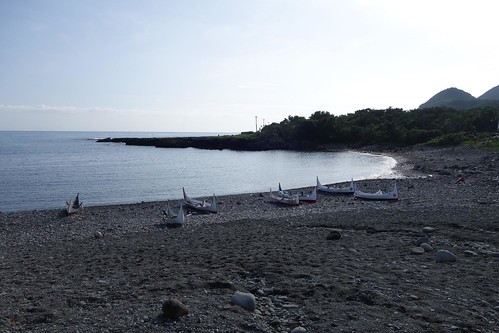
Boats on Lanyu

I was inspired by the discovery of what might be the skeletons of African slaves in the Spanish cemetery in Keelung. Relecting on Taiwan's diverse ethnic roots, I noted in my latest Taiwan News piece:
I often reflect on these facts when I read some reporter describing the people of Taiwan as “ethnic Chinese” or when people refer to themselves as having "Taiwanese blood." These ideas are vapid political constructs whose intent is overtly nationalistic: to claim a people is “ethnic Chinese” is to veer dangerously close to arguing that Beijing should be annexing them. Or when people write about Taiwan’s “deep historical links to China”, actually less than four centuries old, but ignore Taiwan’s thousands of years of historical links to Austronesian peoples and trade and emigration networks that spanned half the globe, from Madagascar to New Zealand and Hawaii.
These rich historical connections can be used by Tsai and the DPP to posit another kind of rhetoric of identity for Taiwan, one rooted in its Austronesian roots, that can link it to the nations that are the focus of its southbound policy.

Previous Taiwan News commentaries are gathered on this page.
_______________________
Don't miss the comments below! And check out my blog and its sidebars for events, links to previous posts and picture posts, and scores of links to other Taiwan blogs and forums!
Thursday, February 18, 2016

Social media moments as news: "Taiwan Mothers Alliance" protests Sunflower history in history textbooks

The transcript is given on Youtube:
The start of the new academic semester has led to the latest textbook controversy. Parents are upset that new freshman high school civics textbooks include passages about the student-led Sunflower Movement of 2014. Parents argue that illegal activities shouldn’t become part of the curriculum, though civics teachers say the movement is now part of history, and shouldn’t be regarded as controversial. Opening Hanlin Book Publisher’s high school freshman civic textbook, one can read a passage about the student Sunflower Movement. This text has angered the Taiwan Mothers’ Alliance who took to Facebook to protest. The group questions how an act of civil disobedience could become teaching material. However, some civics teachers simply don’t agree. Huang Yi-chung Civics Teacher I think these mothers are making too much of a fuss. The student Sunflower Movement took place in 2014 and was a major protest movement which took place in Taiwan. It’s only natural to discuss major social movements in civics classes. Huang says that civics textbooks need to include current events and the more recent the better. However, students are divided over the issue.High School StudentI think this is actually good subject material because it''s a current event. If the Wild Lily Movement and 228 became part of our curriculum, then why can’t this subject?High School StudentI don’t think it’s suitable because this subject is quite controversial.Of six domestic publishers of civics textbooks, so far only Hanlin and Lungteng have included the student Sunflower Movement in such textbooks.
It's cool that two publishers included the Sunflower movement, crucial to understanding the victories of Tsai Ing-wen and the DPP in 2014 and 2016.

The complaint is on Facebook here. It calls the Sunflowers an "illegal violent protest" although the violence was all police inflicted (oh, and some was offered by gangsters as well, but I guess mothers don't mind gangsters). The group posted again on it here, defending its position against the overwhelming abuse of netizens and complaining that their private information had been made public on the net (which sucks). Apple Daily report.

Many changes occurring as a result of the DPP victories as everyone bends with the new wind. We can expect to see more things like this in textbooks -- they were a huge influence under the Chen Administration as well. Under the Ma Administration, the rise of social media and the intensive use of the traditional PTTs helped expand Taiwan consciousness among the young and counteract Ma's pro-China propaganda offensives, as well as coordinate social movements. Mark Harrison, longtime scholar, has a great piece on the effect of social media, both on the election, and the international media.
From the early 2010s in Taiwan, student activists began deploying these communications tools to create new political practices. They undertook a series of protest movements against the Ma government over media ownership, urban development and cross-Straits relations that culminated in the Sunflower Movement of 2014, when several hundred university students occupied the legislative assembly over democratic oversight of the Cross-Straits Trade in Services Agreement. From inside the legislative chamber, they used social media with such sophistication that they were able to circumvent Taiwan’s traditional news media and create an alternative public sphere across Taiwan and globally.
People who deride Taiwanese for putting food pictures on Facebook are forgetting that Facebook is not where the young go to engage in political talk: that's the function of PTTs.
_______________________
Don't miss the comments below! And check out my blog and its sidebars for events, links to previous posts and picture posts, and scores of links to other Taiwan blogs and forums!
Wednesday, January 27, 2016

Ketagalan Travel and the Taiwanese Identity

I am in Ketagalan Media today:
The international media, always fifteen years behind events, has discovered the rising Taiwanese identity among the young. Commentators variously attribute it to the rise of democracy, the Chen Shui-bian era reforms to education, student activism, and other causes. But there is one element they miss: travel...
Go to Travel, and the Taiwanese Identity to see the rest....
_______________________
Don't miss the comments below! And check out my blog and its sidebars for events, links to previous posts and picture posts, and scores of links to other Taiwan blogs and forums!
Saturday, October 24, 2015

What is The Assassin Really About?

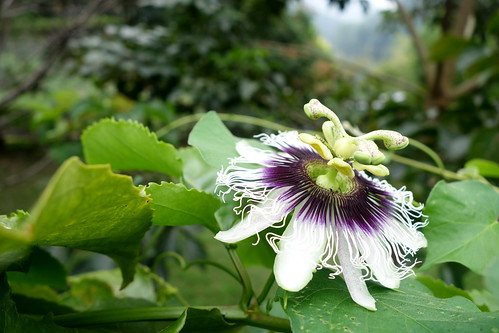
Passion fruit flower.

Locally-based scholar Kerim Friedman observes on Facebook of Hou Hsiao-hsien's new film, The Assassin:
I'm also concerned about the film's politics. It seems to suggest that an independent break away province -- which unlike a neighboring state that was seized by the emperor, has been building up rapport with the people for 50 years (sound familiar?) -- is needlessly antagonizing the emperor. Doesn't this sound like Beijing's line, in which Taiwan is always cast as the troublemaker? It does call for a peaceful resolution to the division and recommends allowing the break-away governor's children time to grow up, but the politics are pretty far from what I think most Taiwanese would feel comfortable with. Surely something has been written about the film's politics?
Hou is a pro-annexation mainlander with close ties to China. He thinks of himself as a leftist, one of the many strains of Leftism that has a strong right-wing nationalist Chinese component. In other words, not much of a Leftist.

During the Chen Administration Hou helped feed the KMT propaganda line that Chen Shui-bian was "stirring up ethnic divisions" by founding the Ethnic Equality Action Alliance in 2004 (Taipei Times). Ostensibly devoted to the noble cause of ethnic equality, in reality its purpose was to attack the Chen Administration since it was, among other things, looking into Taiwan's past. You see, looking into 50 years of martial law and official terror is "creating ethnic divisions"... the Taipei Times noted at the time:
Representative figures from this group immediately launched an attack on the pan-green camp, accusing it of fomenting ethnic hostility more frequently than the pan-blue camp does. They said with a straight face that stronger ethnic groups are more inclined to bully weaker groups and to manipulate ethnic issues.

Brian Hoie has discussed the pro-independence left and the pro-annexation left at New Bloom:

_______________________
Don't miss the comments below! And check out my blog and its sidebars for events, links to previous posts and picture posts, and scores of links to other Taiwan blogs and forums!

Monday, January 26, 2015

Catching Up

Taipei Mayor Ko Wen-je with very high approval ratings. 68% satisfied, 13% not satisfied.

Sorry, been busy. But with the semester over... oh heck, I'll still be busy. But let me sneak in a blog post...

The Taipei Times reports on NCCU's survey, which probably underestimates the numbers:
The university’s Election Study Center poll showed that 60.6 percent of respondents regard themselves as Taiwanese, while 23.9 percent support Taiwanese independence.
If you go to the main page, you'll soon find that the NCCU format uses the choices of unification, maintain status quo, independence, or no answer. The "maintain status quo" types are largely pro-independence and see the status quo as the best form of independence they can get at the moment. Hence, the actual support for independence is closer to 70%.

About this fact:
Meanwhile, the number of respondents identifying themselves as Chinese was more than 20 percent in 1992; was first exceeded by the number who self-identified as Taiwanese in 1995; fell to less than 10 percent during the DPP administration from 2000 and 2008; and dropped to less than 5 percent after the KMT returned to power in 2008, the center said.
...my friend Donovan Smith observed that since a large number of those identifying as Chinese must be the imported Chinese wives of locals, the actual number of Taiwan-bred individuals identifying as Chinese is tiny.
_____________________
Daily Links:
EVENTS: Dr Fell over at SOAS sends around:
  • We are recruiting for our MA in Taiwan Studies: http://www.soas.ac.uk/taiwanstudies/mataiwanstudies/ If you know of suitable candidates, please do encourage them to apply. I've also attached our latest flyer which introduces our courses and programme.
  • We have another very rich programme of events this term, including a special edition launch, book launch and a series of documentary film screenings with director Q&As.
  • http://www.soas.ac.uk/taiwanstudies/events/
  • We are also busy preparing for the Second World Congress of Taiwan Studies to be held at SOAS June 18-20. I look forward to seeing many of you there in June!
  • Please also don't forget to lobby your librarians to purchase the full list of books in the Routledge Taiwan Series!
  • http://www.routledge.com/books/series/RRTAIWAN/

_______________________
Don't miss the comments below! And check out my blog and its sidebars for events, links to previous posts and picture posts, and scores of links to other Taiwan blogs and forums!
Monday, August 18, 2014

A Cole-Sullivan TwoFer + links

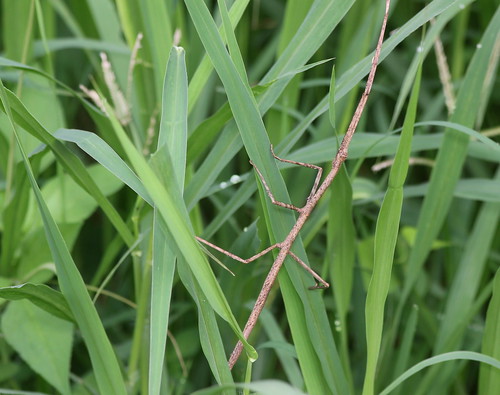
Out walking the dog, found this beautiful walking stick.

Taiwan expert Jon Sullivan with an excellent piece on the DPP, Taiwan identity, social class issues, and politics at The National Interest. He scribes:
Notwithstanding underlying trends in public opinion, a spate of recent academic publications suggests that this may indeed be happening. They suggest that a new economic cleavage based on class has not just mitigated national identity, but has replaced it. Because of the unusual equality of growth during Taiwan’s “economic miracle,” combined with the dominance of national identity during the democratization process, class has not been particularly salient in Taiwan. But since the global financial crisis, exacerbated by ECFA, Taiwan has seen the emergence of inequalities that it hasn’t witnessed in generations. The reality for many Taiwanese is stagnant or declining wages, unaffordable houses, unemployment, poor social mobility and feelings of relative deprivation and economic insecurity. Reflecting on these developments, Tsinghua University scholar Zheng Zhenqing says that “under the influence of the global financial crisis, a new axis of class politics has emerged.” Wu Yushan at Taiwan’s Academia Sinica agrees that “class politics based on wealth gap has become new driving force of party politics [. . .] the dominant social cleavage [has shifted] away from identity towards distribution.” Qi Dongtao at the National University of Singapore similarly argues that class divisions and class awareness have increased dramatically since ECFA. When the global financial crisis decimated Taiwanese exports, President Ma and the KMT promoted growth by opening up to the Chinese economy via the vehicle of ECFA.
This is a really excellent piece. But there's a connection missing. The Taiwanese identity is still driving politics, and the emerging class politics we see in Taiwan is just the other side of the Taiwanese identity coin: it was always driven in part by economic injustice. Taiwanese have always resented how the mainlander-run political order extracted the surpluses they generated and handed them out among the mainlander population, most of whom were left out of the economic miracle since they lacked the kind of sophisticated production and financial skills and resources that the Taiwanese possessed. This economic cleavage produced two privileged classes: mainlander bureaucrats and soldiers who lived on the surplus produced by the Taiwanese, and the extremely wealthy capitalist class which had intimate connections to the top of the KMT and exploited those connections to make money off upstream industrial development (like plastics), finance, and land development. The Taiwanese identity is in large part a response to the colonial processes that underlie KMT control of Taiwan's economic flows.

Thus, the economic justice issue is a Taiwan identity issue, one bleeds into the other. The driver of both is of course China. Taiwan expert Ketty Chen observed this in her extensive and excellent piece on the SOAS conference this summer:
Lastly, the SOAS conference also brought to the forefront an issue that cannot be ignored – the influence of China, as the China factor was one of the reasons for the student occupation of the Legislative Yuan and the Sunflower Movement. Moreover, the movement against media monopoly, the demolition of Mainlander communities in Taipei, land expropriation in Miaoli County and elsewhere in Taiwan, all in the name of progress, development and investment, all bear the influence of China.
Sullivan knows this, of course; few understand Taiwan politics better than he does. That is probably why he confidently expects the Taiwan identity to become a huge driver of politics in the future -- especially as the current young generation matures (talking about my generational issues). But he could hardly talk about economic justice in the relatively conservative National Interest.

Meanwhile over at Sullivan's wonderful China Policy Institute blog, J Michael Cole has a piece arguing that it is Time to Bring the Orphan In From the Cold:
Although Washington might operate under the assumption that limiting the DPP’s room to maneuver—or killing its chances of being re-elected—is to the U.S.’ advantage, such a strategy is terribly short sighted. Independence, the “status quo,” and anything short of “one China,” is a trump card not only for the DPP, but also for the many KMT voters who would never agree to seeing their country absorbed by authoritarian China. Pan-blue voters might not be as vocal as their “green” counterparts on the subject, but that notion is very clear in their minds (less than 10 percent of blue voters support unification). The last thing Washington wants to do, therefore, is to deny those voters that safe zone. In fact, knowing what we know about the composition of the Sunflower Movement, it is clear that any move by the U.S. to constrain the choices of the Taiwanese (e.g., freezing the DPP’s independence clause) would only fuel anti-American sentiment on the island, which certainly isn’t to Washington’s advantage. The more the U.S. forces Taiwanese in a direction that they don’t want to go, the greater the risks of instability on the island. Repeats of the Sunflower occupation, which will certainly occur if the government makes any concessions on Taiwan’s sovereignty, can only further weaken Taiwanese society and invite Chinese intervention (on this aspect, recent developments in Crimea should dispel any notion that authoritarian governments such as those in Moscow or Beijing will be deterred by fears of retaliation or sanctions when acting within what they regard as their immediate neighborhood). Washington officials should realize that a strong, confident, and united Taiwan, one that doesn’t feel isolated or forced to make choices it would rather not make is in the U.S.’ interest.
Cole is largely right, but I would go further to contend that letting the KMT run Taiwan is against US interests, because the KMT is a pro-China party and because it will be less likely to cooperate with the US when China finally moves on the Senkakus or something big in the South China Sea. This is evident in how the Ma Administration constantly moves to irritate Washington (here and here, but especially here and here), to contravene its policies and stir up trouble with Japan. Anyone seriously think a DPP president will call in the Japanese ambassador to upbraid him about the Senkakus?

The other point that I constantly make is that the everywhere else around the periphery of China, the US is taking steps in concert with local governments to resist Chinese expansionism. But with Taiwan the US is encouraging Chinese expansionism. How's that again? Does the US really want to give up 23 million people, an army and an air force, and a forward position with a fellow democracy, and then fight a war with China over the uninhabited Senkakus or Spratlys? The truth is that Taiwan is an asset that US thinkers can't seem to imagine how to use.

Sad, that.
__________________
Daily Links:
_______________________
Don't miss the comments below! And check out my blog and its sidebars for events, links to previous posts and picture posts, and scores of links to other Taiwan blogs and forums!
Monday, July 07, 2014

Performing the Taiwan Identity

A bike path near Dahu in Miaoli.

My friend Mark Roche, who is one of the most knowledgeable and active foreigners on cycling, camping, and hiking on Taiwan, was observing on Facebook that it was difficult for him to get information on the upcoming Sun Moon Lake swim. This Sunday event, a single day, consists of a swim across the lake which now has 27,000 participants and surges in growth every year. What used to be a fun athletic event is now an exercise in mass stupidity. The obvious solution to the burgeoning population of swimmers is to conduct multiple swims over a month or several months, spread out that surge of wealth and tourists for the lake, and reduce the possibility of deaths. Because that would be the intelligent way to do it, the authorities probably won't adopt it.

One reason the S and M Lake swim has become so popular is sociopolitical: it has now become one of the defining activities of the emerging Taiwan Identity. Other activities involved in this include cycling round the island (the premier activity of the Taiwan Identity, which many of the young engage in), cycling over Wuling, and climbing Yushan. Many locals have explained this to me.

Here is an interesting and I think neglected aspect of the emerging Taiwan Identity: a portion of this identity can be created and displayed to others through the performance of outdoor activities, through group or mass participation. My perception is that this is quite unusual in the Chinese cultural sphere, and shows how Taiwanese are different from Chinese. It also shows how Taiwanese have incorporated many aspects of modernity -- in this case exercise and outdoor exploration -- into their new identity, which is, like so many social identities, experienced and displayed via acts of consumption (in this case, outdoor tourism). It also has an aspect of "claiming" -- becoming or taking control of a place by physical performance. I'm sure there's a PHD thesis in here somewhere...
_______________________
Don't miss the comments below! And check out my blog and its sidebars for events, links to previous posts and picture posts, and scores of links to other Taiwan blogs and forums!

Friday, February 07, 2014

What is that thing called Taiwanese identity?

Sashimi, a Taiwanese dish.

Lorand Laskai writes in The Diplomat from Tainan on the KMT's de-Taiwanization policy and the history textbook revisions.
The potential hazards of a hostile occupation—Taiwanese protesters dying under PLA fire, freedom fighters waging guerrilla campaigns from house to house, and the international backlash that these images would set off—would very likely restrain Beijing from moving its threats beyond words. The Chinese Communist Party (CCP) derided the foreign adventurism that landed the U.S. in Iraq, gleefully denoting the event as a milestone on America’s decline. It is unlikely to risk its own quagmire, especially while development and stability at home remains fragile.

A strong Taiwanese identity thus allows the country’s leadership to call China’s bluff. It is an electoral leaven—an insurance policy, if you will—against China’s inevitable military and economic dominance, one that will also strengthen Taiwan’s hand at the bargaining table. Political scientist Robert Putnam famously argued states involved in international negotiations play a “two-level game,” whereby they must simultaneously negotiate with international partners and domestic constituencies. Here democratically elected leaders have the notable advantage of being able to use domestic constraints to extract international concessions. That is, they can creditably claim at the negotiation table that “their hands are tied”—and have poll data to back it up—helping them win concessions where they otherwise could not. A fickle electorate, like an independent-minded Taiwanese public, thus can yield important benefits.
The effect of this identity is correct, which is, as Laskai points out below, one of the reasons the KMT is trying to suppress it. Beijing will have massive problems taking over a democratic Taiwan with an independent identity, and one of Ma's tasks to pave the way for the takeover was suppressing both. But interestingly, the Taiwan identity has incorporated not only an independent settler identity, but also, Taiwan's democracy, into its idea of Taiwaneseness. Voting is something akin to a sacred rite of that identity. This means that attempts to suppress democracy will attack that identity in ways that make it defensive.

Even more interestingly, the Taiwanese identity has incorporated KMT symbols such as the flag into itself, yet it rejects the ROC's bizarre territorial claims. This means that whenever the KMT waves the ROC flag, the locals see a Taiwan flag, and flag-waving reinforces a Taiwan/Taiwanese identity rather than an ROC/Chinese identity. Re-Sinifying the locals -- by which is meant, really, recolonizing them -- promises to be a daunting task, especially since the party that is the standard bearer of the Taiwan identity, the DPP, has the institutional presence in the counties and municipalities to meaningfully resist such re-colonization of the locals.

Beijing must be very frustrated with the KMT, which has no doubt promised the moon to get its support. One wonders when the backlash from the CCP for the KMT's failures will begin.
_______________________
Don't miss the comments below! And check out my blog and its sidebars for events, links to previous posts and picture posts, and scores of links to other Taiwan blogs and forums!

Thursday, January 30, 2014

William Lai goes all presidential

Rice seedlings and an assembly line for packing them for shipment to planters.

And the Chen Shui-bian mantle shifts to Tainan Mayor William Lai (Taipei Times):
Greater Tainan Mayor William Lai (賴清德) said yesterday that his municipality refused to adopt revised high-school curriculum outlines established by the Ministry of Education, adding that all municipal high schools would keep the current outlines.
The new history guidelines appear to be largely pro-China propaganda. Lai is burnishing his local credentials and his pro-Taiwan credentials, but this is a move that will enable him to appear as a standard bearer of the Taiwan identity.... should he feel at all Presidential....
_______________________
Don't miss the comments below! And check out my blog and its sidebars for events, links to previous posts and picture posts, and scores of links to other Taiwan blogs and forums!

Saturday, November 09, 2013

Desert Chang, ROC flag, Chinese...

Gorgeous cool, breezy, sunny day on the Taichung 95 and small farm roads in the hills above Hsinshe. 60 kms in total, but over 1300 meters of climbing. Brutal, but rewarding.

Lately a number of observers have been commenting on how the ROC flag has been hollowed out by Taiwanese identification and has now become a symbol, not of ROC-ness, but of Taiwanese-ness. There is hardly a better example of this than the Affair of the Flag involving alternative singer Desert Chang and Chinese in the audience at a concert she gave in the UK. WSJ reports:
According to Ms. Chang’s account of the clash, which she posted on her Facebook page, during the concert she held up the flag, which a Taiwanese student had presented to her. When she told the audience that the red, white and blue flag represented her home, she was immediately cut off by the audience, with one fan screaming “no politics today” and “we just want to have fun” in English.
The ROC represents not China to modern Taiwanese, but Taiwan, and home.
________________
Daily Links:
_______________________
Don't miss the comments below! And check out my blog and its sidebars for events, links to previous posts and picture posts, and scores of links to other Taiwan blogs and forums!

Sunday, January 27, 2013

Richard Bush on ROC 100th, Sept 2012

Richard Bush's speech to the Academia Historica in Taipei last September, up at Brookings this month. Bush is a major US government expert on Taiwan. The speech is studded with errors and omissions, most likely the result of a need to play to its audience. I'd like to isolate a couple of points. Bush writes:
Civic nationalism, I would suggest, is becoming the dominant type for a majority of Taiwan people. It is an attachment to the island’s democratic system and its norms of popular sovereignty and majority rule. To put it simply, it is an attachment to today’s ROC and all it stands for.
The last sentence has everything backwards. Taiwanese are attached to their democracy and link it to the ROC only to the extent that the ROC equates itself to Taiwan. The Taiwanese are hardly attached to the ROC's grandiose territorial goals and do not see themselves as the rulers of China. Moreover, as I have noted here many times, prominent ROC symbols, such as the flag are increasingly being reinterpreted by the locals as symbols of Taiwan. Of course, the attachment to democracy is not an attachment to the ROC and all it stands for -- to get democracy, the locals had to fight the ROC and all it stood for. But Bush can't say that to a bunch of crusty old deep blues at a national nostalgia fest, I suppose.
These differences between ethnic nationalism and civic nationalism and between territory and the state are not simply an abstract academic matter. They have significant consequences for cross-Strait relations. A Taiwan that cannot agree on these issues is a Taiwan that is in a weaker position visà-vis the PRC.
Skipping over his remarkably bass-akwards construction of ethnic and civic nationalism, Bush has been making this point about Taiwan's lack of internal consensus for a while (for example). This point is often made, but it is never made concretely. For example, Bush has never identified what would count as "consensus" or explained how such a "consensus" would help Taiwan concretely.

Indeed, does Bush really want Taiwan to internally resolve the issue of whether it is a territory or a state? Fact is, Washington analysts like Bush would be buying ulcer medicine by the case if Taiwan ever actually came to a consensus and formally resolved the issue of whether it is a territory or a state. Because everyone who has ever lived here for twenty minutes knows which outcome the Taiwanese would prefer. The actual consensus on that issue -- do nothing, hope we can muddle through somehow -- is what keeps Washington happy.

Ironically Bush already named some of the elements of the Taiwan consensus in another piece of his, a response to Bob Sutter he co-wrote with Alan Romberg (here with my responses). The actual, real consensus in Taiwan rests on the bedrock of Taiwan's democracy and is quite clear. So is the consensus about dealing with China -- everyone wants the economic benefits, nobody wants political talks. And nobody wants to pay to clean up the mess.

Further, it is hard to see how this alleged lack of consensus makes Taiwan any weaker than it already is in talks with China. Taiwan's problems are caused by China's rampant military buildup and growing economic might. There is little Taiwan can do about that. This situation is compounded by the fact that Washington has burned trillions of dollars and tens of thousands of lives over the last decade making central Asia and the Middle East safe for Chinese investment and expansion, instead of having its eye on the ball in Asia and investing in its people at home.

The truth is that Taiwan's divisions over China mirror the Beltway's own schizophrenic behavior -- it formally defines Taiwan's status as undecided but breaks out in hives if the I-word is mentioned. It lauds democracy, human rights, rule of law, and social consensus, but then supports the KMT, the party that benefits the most from ruling a divided society with a rough, imperfect democracy. It worries about China's growing power and influence, yet trades with it, transfers new technologies to China, trains its engineers and technologists, and invites its state-run economy to play in capitalist markets. Even Washington's China experts and punditocracy fill the airwaves with China commentary and advice to the government, while quietly doing lucrative consulting deals with Beijing. In fact, it seems to me that the real division and lack of consensus lies in Washington, and that as soon as the Beltway starts providing real leadership on Asia and displays a consistent, forward-looking, and concrete policy attitude on China, Taiwan will respond.

Lead, Washington.

REF: Bush once wondered aloud why China continued with the military build up since Ma was playing ball. Washington amazes me sometimes.
_______________________
Don't miss the comments below! And check out my blog and its sidebars for events, links to previous posts and picture posts, and scores of links to other Taiwan blogs and forums! Delenda est, baby.

Tuesday, January 01, 2013

Ma's New Year Speech 2013

Daisy
Backyard daisy, up close.

Today's New Year's Day Speech from the President offered some real head-scratchers, like this statement:
In the future, the government's industrial policy must concentrate on boosting local employment and increasing people's incomes. For our policy to attract more foreign investment, we need to break free from traditional approaches, which are over-reliant on tax breaks and low labor costs.
Right, we have to break free from traditional approaches... what's the Ma Administration policy for bringing back Taiwanese firms to Taiwan? I blogged on it a while back: it's tax breaks and low labor costs -- the formation of "free economic zones" (read: traditional industrial and science parks) where labor laws don't apply and more foreign workers can be imported. Not surprisingly, the proposals have been excoriated for their obvious tendency to promote traditional resource- and labor-intensive industries.

But the really fun part was President Ma once again displaying his ideological roots in the bygone security state era with reference to the Chineseness of Taiwan, in context of cross-strait relations:
The people of the two sides of the Taiwan Strait are all ethnic Chinese. We are all descended from the legendary Emperors Yan and Huang.
Ma's powerful ideological commitments to this conception of Taiwan as "Chinese" which dominate his thinking, Han Chauvinist to the core. Note that the speech contains no references to Taiwanese culture or Taiwaneseness. Ma wrote on his Facebook page before the election, which I blogged on:
“I am a descendant of the Yellow Emperor in blood and I identify with Taiwan in terms of my identity. I fight for Taiwan and I am Taiwanese,” Ma wrote on his Facebook page on Tuesday. “In nationality, I am a Republic of China [ROC] citizen and I am the president of the ROC.”
Ma is Taiwanese only for the sake of elections, and only to the minimal extent necessary. That post contains several examples of the way Ma downplays Taiwaneseness into a subclass of Chineseness. Here in today's speech he simply eliminates the idea that there is any significant difference between Taiwanese and Chinese, and the aborigines, immigrants, and others who are Taiwanese simply vanish. Ma's thinking on this, like the KMT, is based on the archaic idea of "blood".

When Ma asserts that the people on the two sides of the Strait are Chinese he is also implicitly asserting that they are all part of China. It is an article of faith among right-wing Chinese ideologues like Ma that everyone who is Chinese should be incorporated into a single super-state. Thus, to assert that group X is Chinese is to assert that they should be annexed, as we have seen with both Taiwan and with the Indian state of Arunachal Pradesh, which PRC officials have said is Chinese since its ethnic Tibetan inhabitants are "Chinese."

Ma returns to the theme of Chineseness at the end of the speech:
My fellow citizens, please rest assured that no matter how difficult and hazardous the world may be, as long as we remain confident, work as one, seek reform, and skillfully marshal the forces of progress, we can surely achieve positive things and create a new future for the Chinese society.
...not a new future for "Taiwan."
_______________
Daily Links:
_______________________
Don't miss the comments below! And check out my blog and its sidebars for events, links to previous posts and picture posts, and scores of links to other Taiwan blogs and forums! Delenda est, baby.

Saturday, August 11, 2012

Saturday night short shorts

tofu
I got a set of 3 Meike extension tubes (NT$2100) today. Fried tofu, up close.

Don't forget, tonight is the Perseid Meteor shower. It seems here in the Chung we are under clouds all night. In all my years here this has been the crappiest summer ever: cold, wet, and cloudy. I guess Taipei is getting revenge on us for enjoying good weather all those years....

I stumbled across this interesting post on religion in Taiwan. It has some good discussion of the way religious believers are counted in Taiwan -- did you ever hear of BAROC? -- and then talks about institutions:
Although Catholicism [天主教] is a minority religion in Taiwan, it is massively institutionalized: in 2011, Taiwan was home to 9 Catholic Hospitals, 7 Catholic Clinics, 16 Catholic Middle Schools, and 142 Catholic Kindergardens and Nursery Schools (exceeding the number of Buddhist institutions in every category mentioned; see the charts for some other examples). This type of institutional depth probably produces paperwork documenting the membership of a larger proportion of their followers. Religions, also, will vary as to their requirements for people to "enroll" to receive various rites of passage (and, again, the litigious nature of baptism, marriage, etc., in the Catholic tradition is a point of contrast).

The raw data for the number of religious institutions (shown here as eight pie-charts) can be misleading in many ways: there is no correlation between the number of institutions and their number of beneficiaries. 10 small schools may have fewer students than 1 large one, and so on for the number of patients in hospitals, or the number of homeless people assisted by a shelter. There are nevertheless a few interesting facts that seem to leap off of the page here. The focus of Catholicism on early childhood education is an interesting contrast to the emphasis that Taiwanese Daoism (apparently) places on retirement homes for the elderly, and "welfare foundations" (presumably for the poor?). The underwhelming performance of Buddhism in all categories is self-evident.
I got to wondering about the numbers. There are 6 Tzu Chi hospitals alone but I couldn't think of any other "Buddhist" hospitals in Taiwan. Then I got to thinking about how "religious hospital" is defined in a way that benefits Christianity here -- after all, many Chinese medicine clinics apply spiritual principles in their healing practices. So are we really looking at a performance of Buddhism that is underwhelming, or a performance of Buddhism that is so completely diffused that we can't see it?

Le Monde has a pretty good article on Taiwan's fading Chinese identity.... with a couple of nice quotes:
For Wu Chi-chung, professor in political science at the Soochow University in Taipei: "after every presidential election, the feeling of Taiwanese identity becomes stronger. It's as if the act of voting, even for a candidate of the Kuomintang (KMT; the party in power), pushes the Taiwanese people to feel even more Taiwanese." In the eyes of younger generations, Taiwanese democracy, which has been reinforced by five presidential elections, has contributed to creating a common identity.
The reality is that the "Chinese" identity that overlaid the identities of the locals was a faux creation of the KMT, just as fakey as its mock Ming architecture. It could never last because it was founded on nothing but political propaganda. But this quote above nicely illustrates how Taiwanese have incorporated democratic practices into their evolving local identity, how valuable democracy is. The real "Chinese" identity of Taiwanese -- languages, religious practice, arts, cooking -- these are alive and well and also evolving. Which is another reason the KMT "Chinese" identity faded -- determined by diktat, it contained neither potential nor provision for its own authentic evolution at the hands of the people.

The staidly Establishment TISR, the old social survey unit of Global Views, allegedly shut down after KMT pressure in the run-up to the 2012 presidential election when it reported that Tsai was leading Ma, reports that independence is the long-term goal of a majority, 55.4%. These numbers are probably too low....

FocusTaiwan has an article on a call from the European Chamber of Commerce for Taiwan to make itself more attractive to foreign investors. The ECCT had some good suggestions for the island to go low carbon...and then:
The ECCT also said that although Taiwan provides a standard of living, the availability of English and other foreign language channels on cable TV is very poor.

For example, James said the local cable TV company servicing Taipei's upscale Xinyi District, where he lives, produces a limited number of English language channels, compared with cities in Malaysia and Singapore, where he lived previously.

Over the past 12 months, James said he has lost Star World, Universal and Diva Universal TV, which carry many popular English language TV shows, such as "American Idol" and "Law and Order."
Heartbreaking, eh? We haven't had cable TV since the 1990s. In those days it was illegal and service was excellent and the number of channels offered was enormous. Anyway, try the internet, it has a much better selection than your cable company....
_______________
Daily Links:
_______________________
Don't miss the comments below! And check out my blog and its sidebars for events, links to previous posts and picture posts, and scores of links to other Taiwan blogs and forums! Delenda est, baby.

Monday, July 30, 2012

Flag Flap!

Occupy Regent Street! This photo has been making the rounds... Since the private organization that hung the flags of the various nations on Regent Street in London kowtowed to Beijing (why?) and yanked down the ROC flag, replacing it with the Chinese Taipei rag, there's been a huge response in Taiwan. Good. But even better, the international media has quietly responded, with EPSN, BBC, and other media orgs using the ROC flag rather than the Chinese Taipei rag to represent Taiwan in their Olympic reports, plus some play in the international media for Taiwan's plight (FocusTaiwan: government regrets... Lord Faulkner of Worcester rips the organization that bent over for Beijing). (Old post: China's foreign policy in sport)

Issues that highlight Taiwan's lack of international space galvanize locals. In a culture obsessed with rank and scores, nonexistence is the unkindest cut of all. Taiwanese crave recognition. Cursed as I am, I can't help observing, though, that this flag affair shows how thoroughly the KMT has gotten locals to incorporate its symbols into their hearts. Perhaps someday it will also show how locals have reconfigured the meanings of such symbols and made them their own: everyone says its Taiwan's flag.
_______________________
Don't miss the comments below! And check out my blog and its sidebars for events, links to previous posts and picture posts, and scores of links to other Taiwan blogs and forums! Delenda est, baby.

Thursday, March 29, 2012

TVBS: Public Kinda of One Mind on One Country Two Areas

Love locks on a pedestrian bridge across the tracks at the Fengyuan Train Station in Fengyuan. Wiki: "local legend holds that the magnetic field generated by trains passing underneath will cause energy to accumulate in the locks and fulfill the wishes".

A new poll from the rabidly pro-KMT TV station TVBS shows that Ma's China policies remain unpopular, perhaps more so than they have ever been. 55% of those polled oppose former KMT Chairman Wu Po-hsiung's idea of "One Country, Two Areas", with only 19% agreeing and 27% undecided. This outcome is interesting in light of the poll's other findings....

....Since Ma took the throne in 2008, support for independence and Taiwanese identity have both been growing. The latest poll says:  69% favor independence but only 16% support unification if only these two choices are given. Consider that independence is at ~70% but objection to "One Country, Two Areas" is 15% lower. Someone needs to do some very detailed polling on what "independence" means because there are obviously some minds which find One nation, two areas compatible with independence. Perhaps a large segment of the population simply believes that all the talk is just so much sound and fury, signifying not much. After all, an announcement by an Honorary Chairman for Life who has no formal government position really means diddly -- it gives the government the chance to float the trial balloon, gauge the reaction, and deny that anything happened, if necessary.

Among the young support for independence reaches 80% -- only 12% want to be annexed to Beijing.

The numbers are similar but a little higher for Taiwanese identity. More interestingly, with three possible choices -- clever of TVBS to offer these choices -- hardly anyone sees themselves as solely Chinese (3%). 54% are Taiwanese and 40% are both.

Some 55% support Ma's handling of the cross-strait relationship, with 29% satisfied. Just 41% believe that the cross-strait agreements are beneficial to Taiwan, 25% say not beneficial, 19% have no position. 59% say Ma leans too close to China.

What it really means is that Ma has done a good job of positioning himself as a safely centrist politician -- at least 70% of the public is pro-independence, which means that 30% are not, yet Ma got 51% of the vote.   Lots of pro-KMTers are pro-independence. There was a steady stream of complaints from the public about Ma being to close to China even before the election, but Ma still won.

As I've noted before, the "Taiwanese identity" includes the KMT and thus, when people identify themselves as "Taiwanese" they are not identifying themselves as potential pan-Green voters or potential pro-independence types (more people are "Taiwanese" than support independence) or Taiwan nationalists or anything else reflecting the fantasies of certain types on the pro-Taiwan side (note how the score for the solely Taiwanese identity falls when three choices are offered). As I said before, I suspect that being "Taiwanese" is a kind of not- identity -- in this case, a large part of the "Taiwanese" identity is not-China in the way that Canada is a not-America. The "positive" identity: what being Taiwanese/Taiwan/ROC means is still being worked out.

Thus when Wu Po-hsiung goes to Beijing and says "One Country, Two Areas" that is rhetoric locals have been listening to their whole lives from people like Wu, whose behavior, after all, is part of their 'Taiwanese' identity -- indeed, if TVBS' numbers are right, about 40% of the population has a Taiwanese-Chinese identity that is congenial to if not compatible with, just that position. How can it threaten them? The constant flow of such propaganda has normalized the presence of such statements in everyday discourse and thus they can't threaten the "negative consensus" on what Taiwan is not because Wu didn't bluntly and directly say that Taiwan = China ("overlapping territories" under the One China rubric) and in any case has no power to make a formal change in the relationship. Plus ca change...

Moreover, consider an even simpler interpretation -- at any given time 50-55% disapprove of the President and 25-30% approve. This seems like something close to the "natural level" of satisfaction with the President in Taiwan irrespective of what is asked.
_______________________
Don't miss the comments below! And check out my blog and its sidebars for events, links to previous posts and picture posts, and scores of links to other Taiwan blogs and forums! Delenda est, baby.

Thursday, July 14, 2011

Ma is Taiwanese Again

Jul_random45
Took the train back from Tainan today. Great cloudy blue skies, and clean windows.

It is election time in Taiwan, so Ma Ying-jeou is going to temporarily become Taiwanese. Sure enough, President Ma responded to DPP Presidential Candidate Tsai Ing-wen's declaration of Taiwaneseness with a forthright one of his own, as a Taipei Times editorial noted today:
The Ma camp accused Tsai of manipulating populist politics with the aim of stirring up ethnic division. However, it appears that calling oneself Taiwanese is acceptable if Ma is the one doing the talking.

“I am a descendant of the Yellow Emperor in blood and I identify with Taiwan in terms of my identity. I fight for Taiwan and I am Taiwanese,” Ma wrote on his Facebook page on Tuesday. “In nationality, I am a Republic of China [ROC] citizen and I am the president of the ROC.”

......

In case Ma didn’t know, the public has noticed that whenever he starts venting hot air about being Taiwanese, it means campaign season has arrived.
My friend Thomas has already blogged on some of the pan-Blue political infighting going on over Taiwaneseness. This "being Taiwanese" declaration of Ma's is fascinating for what it reveals.

Ma is a descendent of the Yellow Emperor "in blood." In 2008 Ma was not nearly so open about his identification with China, but here he says it out loud, dragging in the racialist code for Chinese identity that is essentially a declaration of Han chauvinism. His declaration thus pits "blood" against the mere "identity" of being Taiwanese. Ma's particular program has been to treat "Taiwaneseness" as a subclass of Chineseness -- to subsume it into the Greater Han identity even while paying lip service to its uniqueness. For example, in an interview a while back:
President Ma: The idea behind the Taiwan Academies is to showcase some of Taiwan's cultural achievements over the past 60 years. I have often said that Taiwan culture is a kind of Chinese culture with Taiwanese characteristics. Its roots may have come from mainland China, but it has merged with other cultures here in Taiwan and has developed new features. This is what we wish to convey in the Taiwan Academies.
Ma sees himself as a defender of Chinese culture which is a great treasure to be handed down to subsequent generations, and Taiwan as a great bastion of Chinese culture as opposed to China, where Communism has permanently polluted it -- rhetoric out of the 1950s -- 1970s.

The Richburg interview shows this tendency toward Ma to subsume Taiwan into China again further down:
Q17. Washington Post: I understand promoting Taiwanese culture separate of mainland China is important for you, Mr. President.

President Ma: In fact, Chinese culture is consistent, including Confucianism as I have just mentioned, but actual practice is the important thing. Over the past decade or so, Confucianism has received great attention on the mainland. This is surprising, but also comforting for us to see. Many people, from students to entrepreneurs, are hiring private teachers to instruct them in Confucian philosophy. In Taiwan, however, Confucian philosophy has been taught in schools for the past six decades, and every student has studied it. If mainland China can move in this direction, I believe it will be the right direction and can promote closer cross-strait relations.
Note how Richburg invites Ma to emphasize the uniqueness of Taiwanese culture and Ma declines and responds by emphasizing that Chinese culture is consistent. He then offers -- clearly to illustrate the idea of "Chinese" culture -- a movement toward Confucianism in China while links to Confucian studies in Taiwan, which as I understand are widely detested by local students.

Thus, Ma's declaration of "Taiwaneseness" fronted with the reference to blood ties to the Yellow Emperor is just another display of his consistent downgrading of Taiwan culture. He is probably signaling to his allies in Beijing as well.

Finally, it should be noted that Ma's racialist conception of identity-via-descent is directly contradicted by the DPP view that being Taiwanese is an identity open to anyone who loves the island and that citizenship is not based on blood but on participation as a citizen in the democratic community of Taiwan. Hopefully the DPP will emphasize the themes of openness, democracy, citizenship, and Taiwan identity as one in response to Ma's 19th century Volkish view of his own identity.
__________________
Daily Links:
_______________________
Don't miss the comments below! And check out my blog and its sidebars for events, links to previous posts and picture posts, and scores of links to other Taiwan blogs and forums! Delenda est, baby.

Tuesday, May 24, 2011

Between Sozzled and Sober

Sovereignty - n. the notion that the role of government may be properly compared to that of an authoritarian father, coupled integrally with the faith of a three-year-old that "my dad can beat up your dad."

Reading the news that Taiwan may become a "meaningful" participant in UN agencies and organizations UN Framework Convention on Climate Change (UNFCCC) and International Civil Aviation Organization (ICAO), Michael Danielson over at the Taiwan Corner remarked:
Taiwan wants meaningful participation in the UN Framework Convention on Climate Change (UNFCCC) and International Civil Aviation Organization (ICAO) using the WHA model. Great idea but the important question that has to be answered is how it is possible to trust Taiwanese KMT negotiators handling the meaningful participation now that Taiwan is registered as a province of China in WHO using the WHA-model.
Sadder still, as I pointed out when this broke, the WHO isn't setting a precedent but following higher policy. The long-term implications of this endless series of damned-if-you-do, damned-if-you-don't choices aren't very pretty.

Still, moments of low humor abounded. The Taipei Times quoted.
“Chinese Taipei” stands for “Republic of China [ROC], Taipei,” Shen said, adding that the use of Taipei rather than “Taibei,” as it is written by Beijing, clearly showed it stood for the ROC and not the People’s Republic of China.
B vs P: now that's hairsplitting! As I recall, the Chinese Taipei formula was first proposed by the KMT for use in the Olympics (see this post on Beijing's foreign policy in sports for how that works in China in practice).

Front page news today in the Taipei Times: Taiwanese woman's marriage certificate in Japan says she is from China.

The documents I presented for marriage registration in Japan were my household registration transcript and affidavit to single status. Both were authenticated by Taiwanese authorities,” Lee said. “However, the marriage certificate that I got in return states China as my nationality.”

DPP Legislator Tsai Huang--liang (蔡煌瑯) said the government should be held responsible for such cases, adding that the so-called “diplomatic truce” with Beijing that President Ma Ying-jeou (馬英九) had initiated after he took office in May 2008 had “failed to defend the nation’s sovereignty” and led to an international misconception that Taiwan belongs to China.

“When the DPP was in power, Taiwan was not denigrated by Japan; its household authority clearly distinguished Taiwan from China,” Tsai said. “Under Ma’s ‘diplomatic truce’ policy, even Japan, which has been friendly to Taiwan, now lists Taiwan as a province of China.”

An anonymous official in the Ministry of Foreign Affairs’ Association of East Asian Relations said that Japan would introduce a new foreign residency permit scheme in July next year in which it would list “Taiwanese” as the nationality of Taiwanese living in Japan.

The new scheme was based on Japan’s immigration law, which was amended by the House of Representatives in June 2009. Under the existing visa system, Taiwanese are classified under “China” for their nationality, the official said.
Blaming the Ma gov't for decisions taken decades ago is kind of silly. This looks more like Japanese official laziness than official maliciousness. The China Post report contains more information:
In response to the accusations, Deputy Foreign Minister Shen Lyu-shun (沈呂巡), who was fielding questions during the hearing, said he will look into the matter and would not tolerate such a deliberate denial of Taiwan's sovereignty.

A MOFA official later informed reporters that the alien registration card that the Japanese government grants to Taiwanese citizens still lists their nationality as “China” or “China (Taiwan).”

Any foreigners staying in Japan for more than 90 days are required to register for the card.

He believed that the Japanese household registration affairs officials simply registered the woman as a Chinese national based on the information listed on the registration card.
The gods love irony and offered us a couple of painful examples this week with Croatia and Slovenia -- breakaway regions of the former Yugoslavia --  both following the policy of labeling Taiwan a province of China. This sort of policy is perfectly normal and will become increasingly normal as China's power and influence continue to wax.

The fascinating thing is the universal condemnation it evokes in Taiwan from the locals -- you know, those people who pay their taxes at the Tax Office labeled "Taiwan Province", drive on Provincial Route 3 to and from Taichung, nonchalantly refer to the island nation as a "province" in conversation, and so on. People rarely become publicly indignant over these labels though there is much private resentment. Perhaps it shows how much these pro-China local labels have become part of the  slurry of identities that Taiwanese carry around, but it may also show how other nations that use the "Taiwan, Province of China" formula become convenient scapegoats for issues Taiwanese would rather not face at home....

Not to mention, it surely must be confusing to the representatives of the sovereign nations of Croatia and Slovenia as they perform their daily tasks in Taipei.....after all, isn't it the official policy of the current government that Taiwan is part of China?
_______________________ 
Don't miss the comments below! And check out my blog and its sidebars for events, links to previous posts and picture posts, and scores of links to other Taiwan blogs and forums! Delenda est, baby.

Saturday, February 05, 2011

TVBS on Identity and Independence

TVBS released its latest poll on identity, the KMT's pro-China policies, and Taiwan independence. Take a close look at Questions 9-14 (translation by ESWN):

Q9. When these economic agreements are signed, are you confident that the government will protect the interests of Taiwan?
9%: Very confident
30%: Somewhat confident
28%: Somewhat not confident
25%: Very not confident
8%: No opinion

Q10. Some people say that the policies of the Ma Ying-jeou government are tilted towards mainland China. Do you agree or disagree?
53%: Agree
39%: Disagree
9%: No opinion

Q11. What is your attitude towards unification versus independence?
61%: Maintain the status quo
21%: Lean towards independence
9%: Lean towards unification

Q12. If the choice exists, would you want Taiwan to become an independent nation or to be unified with China?
68%: Taiwan independence
18%: Unification with mainland China
14%: No opinion

Q13. In our society, some people think that they are Chinese while others think that they are Taiwanese. What do you think you are?
72%: Taiwanese
17%: Chinese
11%: Don't know/refused to answer

Q14. What would you say that you are? Taiwanese? Chinese? Both?
50%: Taiwanese
43%: Both Taiwanese and Chinese
3%: Chinese
5%: Don't know

According to the island's most rabidly pro-KMT station, the public strongly supports independence, totally rejects the idea that it is solely Chinese, and thinks the KMT government is too close to China. Basically, everything many of us have been saying is all laid out there. Consider how slanted pro-KMT TVBS polls tend to be -- likely a methodology issue, not an inherent bias -- this poll is even more amazing. For Chinese the questions use the term 中國人.

I know of other polls that are showing similar trends -- one is due to be released later this year; can't wait to report on it.

Someone asked me whether the reunification lobby will shrink and the independence lobby grow as time goes by. I think this widespread identification with Taiwan will paradoxically lead to greater polite meaningless noise about annexation. Certainly Beijing will continue to put pressure on Taiwan firms in China to toe the Beijing line, and they are likely to respond by doing so, in order to function in that market. The powerful, growing, and stable identification with Taiwan means that they can do so secure in the knowledge that it doesn't matter. That rising Taiwan identification also means that local voters feel secure voting for local KMT candidates also in part because the KMT is part of that Taiwan identity. Hence I do not see that a growing identification with Taiwan will necessarily translate into less pro-China rhetoric in society at large or KMT losses at the polls.
_______________________
Don't miss the comments below! And check out my blog and its sidebars for events, links to previous posts and picture posts, and scores of links to other Taiwan blogs and forums! Delenda est, baby.

Wednesday, January 12, 2011

Good stuff out there today

Winding down to the end of the semester and vacation. Yay!

AP's Peter Enav's great piece on the ROC Centenary is well worth a look. Two great quotes, one from Tsai of the DPP:
"The Republic of China came to Taiwan in 1949 and became part of the history of this land," said Tsai Ing-wen, chairwoman of the main opposition Democratic Progressive Party, whose platform formally espouses independence. "We understand and respect this historical fact, and we believe we can only change the system that has existed for over 60 years through democratic mechanisms."
...and my favorite:
"My country is the Republic of China on Taiwan," said Stella Tsai, a 30-year-old bank employee. "The mainland is not included. It is an enemy of our republic."
The carefully nuanced presentation by AP, complete with the dorky "We will assimilate you!" quote from the Borg on the other side of the Strait, suggests that someone with a Beijing-centric point of view outside of Taiwan had a hand in shaping the piece. Otherwise I expect it would be a lot tougher on both Beijing and on the ROC. Still, there's much there that doesn't ordinarily appear in the media. AP's longer stuff is usually excellent. Good work, AP!

Veteran Taiwan reporter Ralph Jennings had a piece in SCMP on the failure of Ma to live up to his promises of more free trade agreements in the wake of the ECFA sell-out. An excerpt:
But Ma Ying-jeou made that pledge nearly nine months ago. The only country that has come forward to talk trade with Taiwan is Singapore. Other countries have resisted Taiwan's aggressive efforts to sign free trade agreements (FTAs), normally dominated by cuts on import tariffs, owing to domestic issues, fear of a backlash from China and likely snags over agriculture and light manufacturing.

Those setbacks could eventually put Ma's government under the spotlight as the export-reliant island has looked towards those deals as a vehicle for global expansion that would lift Taiwan's US$400 billion-plus economy.

Taiwan needs FTAs with its major trading partners to keep its key exporters competitive against regional peers such as Japan, South Korea and Association of Southeast Asian Nation (Asean) members.

The mainland forbids Taiwan's trading partners that are also Beijing's diplomatic allies from signing deals that would imply sovereignty for the island. As a result, Taiwan's main economic rivals have far more FTAs to their name, boosting their respective exporters.

Taiwan has only five FTAs, all with minor Latin American diplomatic allies.

"Ma Ying-jeou is under political and time pressure to complete FTAs with certain countries so he can deliver a promise to voters," said George Tsai, a political scientist at the Chinese Cultural University in Taipei. "But as a matter of fact it's not as simple as it appears to conclude an FTA."

Sticking points depend on the country. The US, the top prize for Taiwan because of its market size, says the timing is wrong as Congress still has not approved an FTA with fellow Asian export powerhouse South Korea despite three years of debate.

The US, Taiwan's No2 single-country export destination after the mainland, would also require an FTA covering all key sectors rather than the more narrowly focused deals popular in Asia, diplomats in Taipei say.

De facto embassy spokesman Chris Kavanagh put it plainly: "There are major obstacles in the way of a free trade agreement."

Most of Taiwan's major Asian trading partners have held back over fears of upsetting China.
Jennings notes that China has never really stated it would let Taiwan have FTAs with other nations. Indeed, as numerous commentators have noted, it is not in China's interests to do that. At minimum, Taiwan would compete with China in both industries and regions that China wants to move into. But more importantly, if China has an FTA with countries X, Y, and Z, but Taiwan does not, this puts pressure on Taiwan firms to relocate to China in order to take advantage of those FTA agreements.

Will the lack of trade agreements hurt Ma politically? It doesn't seem very likely. After all, the DPP can hardly make a huge issue of it, since the Chen Administration was hardly better. What is hurting Ma is stuff like this, in his talk on the soft power of Taiwan and making Taiwan an educational hub:
President Ma Ying-jeou noted that Taiwan has many universities that are able to provide a wide range of courses up to post-graduate level. But what makes Taiwan stand out is its strength in Chinese education, especially in traditional culture and script - the original version of Chinese characters used in Taiwan, Hong Kong, and many other overseas communities.
Some of the technology and medicine programs offered in Taiwan are super strong and they are what makes Taiwan stand out, not its use of traditional characters. Nobody from Vietnam or Indonesia or Malawi comes here because of Taiwan's strength in Chinese education. Ma is pushing a Taiwan that doesn't exist -- the "traditional Chineseness" of Taiwan -- to solve a problem faced by his parents -- the competing Chinas. Yet all things for Ma come back to its being Chinese. Meanwhile the public doesn't think of itself as Chinese, especially the young. Expect roll-back of this rhetoric as the 2012 election approaches.

A rhetoric which, btw, shows that the "pragmatic" Ma is a China-centric ideologue.
_________________
Daily Links
_______________________
Don't miss the comments below! And check out my blog and its sidebars for events, links to previous posts and picture posts, and scores of links to other Taiwan blogs and forums! Delenda est, baby.