Showing posts with label food security. Show all posts

Thursday, September 11, 2014

Oil Theatre, Act II, Scene 1

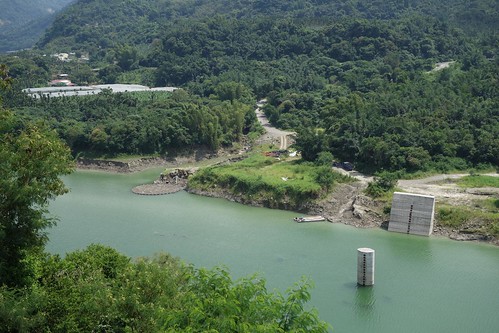
A couple of pontoon rafts and a circular corral full of wood on the Tsengwen Reservoir.

I leave for a few days on a bike ride and look what happens! The oil scandal widens. I should have left for a week, probably the entire food processing industry would have been implicated...

On Tuesday I was hardly surprised to see that the bad oil sales had been going on for 13 years, according to reports on the front page of the Liberty Times. Apple Daily, always quality, that same morning had the nude photo club taking nude pictures on the metro on its front page.

A Hong Kong firm has now been busted selling oil for animal consumption as oil for human consumption to Chng Guann, the firm that had been caught buying oil from underground oil factory and sending it up the food chain. The underground factory owner won't be a big enough scapegoat for this, I'm afraid the head of Chang Guann will have to go. No worries, some family member will take over the firm and life will go on for all. Leaders after all exist solely to be scapegoated.

News reports revealed that small vendors are not required to report their waste oil volumes. Since waste oil can be re-used, this represents a profit that has no traceable origin, a situation tailor-made for abuse. The legislature is now being urged to draft a bill and get it passed quickly, before this affects the Chinese tourism industry as some fear. Once the bill is in place and the public reassured, then things can go on as before.

The government is even implementing batch by batch oil inspection of oil coming in from Hong Kong. For a while, anyway.

There's a context that someone on the pan-Green side needs to draw out and scream and yell about, and the government likely wants to suppress, which is why they moved so fast on the oil from Hong Kong, I suppose. Recall that the Ma government's proposed Free Economic Pilot Zones will be letting Taiwan firms import raw materials and ingredients from China duty free, processing them, and then selling them as "Made in Taiwan". This is an obvious move by the Ma government to destroy the brand value of the Made in Taiwan label and increase dependency on China. But the faked oil from Hong Kong serves as a reminder that what comes out China is untrustworthy crap. It wouldn't surprise me if the authorities moved with extra speed to put this to rest before someone makes the connection...
_______________________
Don't miss the comments below! And check out my blog and its sidebars for events, links to previous posts and picture posts, and scores of links to other Taiwan blogs and forums!

Friday, December 13, 2013

Bananas and Foc and Taiwan

Part of the old Qing trench network above Keelung city used in the siege of the French.

The world of bananas we see today is not the world that existed sixty years ago. In that world the major export banana was a type called Gros Michel. It was the principal banana imported into the the US until the early 1960s.

And then came the fungus known as Fusarium Wilt, or Foc, also known as Panama disease, where it was first reported back in the 1890s. Over the next half-century Gros Michel was wiped out, with shortages allegedly inspiring the famous "yes we have no bananas" song, according to Wiki. This article observes:
Disaster struck in the mid-1950s when Panama disease turned on the Gros Michel banana. Within a few years, wholesale destruction was seen in plantations in Central America and Africa with 50,000 hectares lost in Honduras alone, said Dr. Molina. This drove the banana business to near bankruptcy and precipitated the move to the relatively less delectable, but resistant, Cavendish banana.

Originating from Southeast Asia, the Cavendish banana replaced the Gros Michel variety on a global scale. Billions of dollars in investments were reportedly spent beginning in the 1960s for the development of infrastructure to accommodate differences in growing and ripening needs of the new variety in different countries. All seemed well with Cavendish as the new banana of commerce until the Fusarium wilt Tropical Race 4 came along (source).
Today Americans and other nations into which bananas are imported consume the resistant Cavendish, which is not as delicious. Unless you have actually been to a banana-raising nation where they raise several varieties, you have probably never tasted a delicious banana.

The first problem of the Cavendish is simple, although it is resistant to some strains (called Races) of Foc, it is horribly vulnerable: all Cavendish bananas today are clones of the first plant, which means they are genetically identical. Which means that any disease that affects one can affect them all. This excellent article on Philippines says:
In the banana business, Foc is conventionally classified into four pathogenic forms known as "Races". Race 1, which destroyed the Gros Michel plantations, also attacks many local cultivars in Asia; Race 2 affects specific cooking bananas; Race 3 attacks Heliconia spp., ornamental plants that are related to bananas; and Race 4 affects a wide range of cultivars, including Cavendish and cultivars susceptible to Race 1 and 2. The extremely virulent strain of Race 4, known as 'Tropical Race 4', is a relatively recent development. Tropical Race 4 has the capacity to affect banana varieties unaffected by other Foc races.
Tropical Race 4 emerged in 1967 in Taiwan, in Chiatung, Pingtung. By the 1990s Taiwan's banana industry was devastated.

The second problem is that Foc is like some nightmare anti-banana biowarfare weapon. Once you have it, there is no economically viable treatment for it. No pesticide, no fungicide, no natural agent. Nada. You can have limited success via intercropping and other approaches, but it can hang out in the soil for decades as a saphrophyte and can travel easily carried by humans, farming machinery, or on banana plant suckers which are symptomless.

The third problem is that banana is a huge crop, third largest fruit crop in the world, and the third largest in Taiwan, with the major cultivation areas being (in order) Pingtung, Nantou, Chiayi, and Kaohsiung. In many countries it enables small growers to earn an income and is a stable source of food. Scary, eh?

The good news is that these small growers with their myriad of cultivars are a precious reservoir of banana biodiversity, since Race 4 doesn't hurt them. It only affects the export bananas, the Cavendish variety, around which the modern banana export industry is built. Scientific American reports:
Progress in creating bananas fully resistant to Foc-TR4, either by classical breeding or genetic engineering, has so far been limited. The wild Asian banana Musa acuminata malaccensis—the genome of which was published last year (A. D’Hont Nature 488, 213–217; 2012)—seems to be resistant, and researchers are experimenting with putting its resistance genes into the Cavendish. The resulting transgenic specimens have been in field trials for 18 months on contaminated ground in Australia, and are looking “very promising”, says James Dale, director of the Centre for Tropical Crops and Biocommodities at Queensland University of Technology in Brisbane, Australia. But he cautions that the full results are not yet in.
With the virus appearing in Mozambique and Jordan recently (SciAmer), moving outside Asia, the world banana industry may once again experience an upheaval...
_______________________
Don't miss the comments below! And check out my blog and its sidebars for events, links to previous posts and picture posts, and scores of links to other Taiwan blogs and forums!

Monday, November 04, 2013

The Uses of Scandal: Edible oils

Model airplane fliers in southern Taichung city.

“Coincidence was a concept he did not entirely trust. As someone who had spent his life exploring the hidden interconnectivity of disparate emblems and ideologies, Langdon viewed the world as a web of profoundly intertwined histories and events. The connections may be invisible, he often preached to his symbology classes at Harvard, but they are always there, buried just beneath the surface.”

Wouldn't ya know it? Just as (1) the President's pet prosecutor is facing indictment for leaking secrets in a prosecution case to the President and (2) the President is trying to shove a major services agreement through the legislature and (3) the President is trying to wipe egg off his face after attempting but failing to destroy a political rival, a major food scandal breaks out. What a break for the President, eh?

FocusTaiwan presents the raw data:
Ting Hsin Oil and Fat Industrial Co., a major edible oil supplier and subsidiary of the Ting Hsin International Group, was ordered Sunday to recall 21 of its oil products that used adulterated ingredients.

The Pingtung County Public Health Bureau ordered Ting Hsin Oil & Fat to recall 21 of its products that contained adulterated oils from Chang Chi Foodstuff Factory Co., the company at the heart of an edible oil scandal that has shaken Taiwan.

The products were sold under the brand of Wei Chuan Foods Corp., another subsidiary of the Ting Hsin Group and one of Taiwan's oldest food companies. All Wei Chuan-brand edible oils are produced by the Ting Hsin unit in Pingtung.

Ting Hsin Oil and Fat said Chang Chi oils were also used in its handmade soaps and lighting oils, according to a list of products containing Chang Chi oils provided by the company.

The Pingtung Public Health Bureau will fine Ting Hsin Oil and Fat between NT$30,000 (US$1,020) and NT$3 million because the Pingtung County-based oil supplier failed to provide the list immediately when Pingtung health officials visited it on Oct. 27-28.

The company did admit at the time that it had purchased olive oils and grapeseed oils from Chang Chi in July and September, and health officials seized more than 200 192-kilogram barrels of those oils Ting Hsin Oil and Fat still had in stock.
Wei Chuan is a major major brand in Taiwan, with a strong reputation for quality. This is going to hurt. There are so many threads here that this scandal touches on: food security (all of Taiwan's cooking oils are imported), food regulation (what is that?), corporate impunity (punishment? What punishment?), corporate corruption (of course it is killing its customers, it's a large corporation, isn't it?), and food scandals as background noise (going back a long way -- Yu-cheng mass poisoning incident). Food scandals are a way of life here.

But it's always more fun to play the "what's missing from this equation?" puzzle game because the politics of reporting are known by what is omitted as well as what is reported. FocusTaiwan reported earlier:
Shiu confirmed that of the 7,619 tons of crude cottonseed oil imported into Taiwan since last year, Chang Chi had imported nearly 40 percent of it and the rest went to Flavor Full, which like Chang Chi is based in Changhua County.
If you keep trolling for cottonseed oil and Taiwan on the internet, you soon come to ETaiwan news' report (read it, fascinating discourse on how to adulterate food) which will tell you that the source of the oil was China. But if you look at FocusTaiwan's pieces on the scandal, as far as I can see China is not being reported as the source of the oil. I mean, it's oil from China. Is it really even cottonseed oil? By keeping China out, the story about the edible oil scandal does not become a story that is also about Taiwan's connections with China, which might affect the services industry pact, as well as highlight the island's rapidly expanding dependence on China for cheap food.
_______________________
Don't miss the comments below! And check out my blog and its sidebars for events, links to previous posts and picture posts, and scores of links to other Taiwan blogs and forums!