Showing posts with label climate. Show all posts

Wednesday, December 23, 2015

Global Warming linked to bird species changes in Taiwan

From: Species turnover in tropical montane forest avifauna links to climatic correlates
Chi-Feng Tsaia, Ya-Fu Leea, Yun-Hsiu Chenb, Wei-Ming Chena, Yen-Min Kuoa, Global Ecology and Conservation, Volume 3, January 2015, Pages 541–552
We evidenced a 37.9% of richness attrition and a discrepancy of compositions by 30.2% from historical records dated roughly a quarter century ago, and an increased homogeneity in the mid-elevation LEF forest avifauna. These translated to a species turnover rate of 2.2% per year. In addition, greater change appeared to occur to resident species of lower or narrower elevation distribution. Our study sites were within a preserved and managed area where no habitat alterations from direct human activity were noted (TFRI data). Over the two survey periods and compared to that before 1987, however, local and island-wide weather patterns revealed growing levels of temperature fluctuation, extreme temperatures, enhanced temperature differences, and increasing counts of extreme typhoon events. These lines of evidence suggest a link of the species turnover with even recent climate change, and call for conservation concerns. To our best knowledge, this is the first document reporting the possible impact of climate change on the diversity and composition of avifauna in East-Asian tropical montane forests (Harris et al., 2011).

.....

Temperature is a major environmental factor driving range shifts and species turnover in avian assemblages across gradients (Buckley and Jetz, 2008, also reviewed in Parmesan, 2006). The mean temperatures have risen 0.6 °C in mountains, and nearly 1°C island-wide, over the past century in Taiwan (TCCIP, 2011), which are equivalent to or even greater than global averages (ca. 0.85 °C; IPCC, 2013). An increase of mean maximum temperature in the LEF accords with the trend of an increasing length of heat wave (greater than 28 °C) and a shortened cold spell (less than 10 °C) by 19 days over Taiwan since 1950 (Shiu et al., 2009). Energetics and water budget are main constraints that directly limit the distribution of organisms and their ability to persist extreme weather or environments (Root, 1988). The enhanced annual differences between the mean maximum and minimum temperatures characterize heating summers and colder winters, both expose birds to thermal stress and danger of mortality (McKechnie and Wolf, 2010). Gardner et al. (2011) further proposed body-size shift as the third response to warming in addition to distribution ranges and phenology, which requires not only extensive studies on individual species but also thorough phylogenetic analysis.

_______________________
Don't miss the comments below! And check out my blog and its sidebars for events, links to previous posts and picture posts, and scores of links to other Taiwan blogs and forums!

Monday, May 26, 2014

Global Warming and Taiwan: Impacts

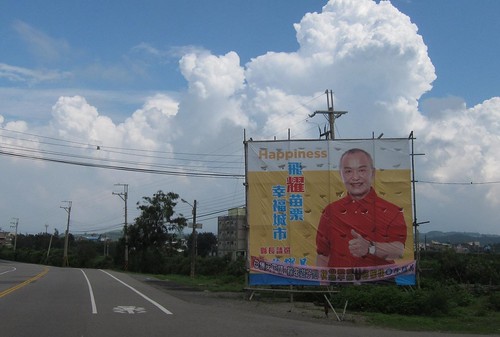
Happiness. It's what he offers.

As humans are busy boiling the earth to death, I thought I'd collect a few papers... This nifty paper has some public surveys and some thumbnail explanations of Taiwan's failure to do anything about its carbon-intensive industries in the face of global warming.
However, the EPA was enforced to adjust its position on environmental protection. It is because the Executive Yuan is lack of a adequate decision-making structure. Mitigating GHG emissions involves many sectors, but climate issue is oversimplified as a pure environmental issue by political leader in Taiwan. How to response global warming becomes environmental affairs. In these political circumstance, the EPA, one of the smallest ministries in the Executive Yuan, is appointed to manage formulation and implementation national climate policy and the legislative process of the GHGRA. In the end, the EPA can not embrace its pro- environmental position, and it is enforced to take the pro-development position, which is similar to the EPA and those EIIs.

In the level of the Legislative Yuan and the Executive Yuan. Among political leaders, climate change lends itself to gestural politics. Most political leaders claims they are willing to support for the GHGRA, and encourage the Legislative Yuan to pass this act. On the one hand, mitigating GHG emissions become a slogan of political correctness. Seldom of them doubt the necessity of reducing GHG emissions or the scientific certainty of global warming. On the other hand, the draft GHGRA has set aside from 2005 to now.

Most leader are unwilling to pass the GHGRA with legally binding targets, because reducing GHG emissions involve two controversial political issues. The first issue is to adjust domestic industrial structure through changing the long-term low-energy-price policy. Taiwan highly relies on imported energy, as Table 14 shows, but Taiwan’s government, as a typical case of the developmental state, formulated the low-energy-price policy to promote industrial development and economic growth. However, low-energy-price policy leads in the development of these carbon intensive industries. At the same time, most people in Taiwan take using low-price energy for granted. Most political leaders understand that changing low-price energy policy is necessity to meet GHG emission reduction target. However, they perceive that increasing energy price is harmful to their reelections.
And the effect on agricultural pests:
For some insect pests, such as smaller brown planthopper, rice leaf beetle, rice water weevil, Taiwan is considered the south most distribution area. Higher temperature in the summer may cause them to disappear or become the minor pests. Contrarily, for those insect pests that Taiwan is considered their northernmost distribution limit, such as the green rice leafhopper...temperature may help the insect to become more abundant (Cheng 1998).
And from this government report in Taiwan:
Continuous instrumental measurement of climate parameters in Taiwan began in 1896. This century-long record, with almost no missing data, is available from six meteorological stations (Taipei, Taichung, Tainan, Hengchun, Taitung, and Hualien) (Figure 12) maintained by the Central Weather Bureau....

....Taiwan shows a significant warming trend. The rise in annual mean temperatures over the last 30, 50, and 100 years all reflects this tendency (Figure 13). Of the six weather stations over the three periods, Taipei shows the most warming and Hengchun the least. In the last 30 years, stations along the west coast show faster warming than those along the east coast. Over the last century, warming has been most prominent in autumn. However, winter has warmed fastest in the last 30 years.

....average annual rain days in Taiwan have decreased significantly. Numbers of rain day have decreased by 4 days per decade in the last 100 years and 6 days per decade.

...Extremely hot days between 2000 and 2009 increased by more than 10 days when compared to the period from 1911 to 1920.

...Cold surge events at all six stations decreased consistently after 1985, which never occurred before 1985...

...Extreme dry spells in Hengchun and Hualien occurred more frequently in the last 30 years than in any other period...
The entire report is beautiful, filled with charts and graphs. Very useful. Finally, global warming and the plant distribution. In addition to upward migration of plants to higher altitudes to escape the heat, that one also predicts rainfall will decrease in the west and increase in the east.
__________________
Daily Links:
_______________________
Don't miss the comments below! And check out my blog and its sidebars for events, links to previous posts and picture posts, and scores of links to other Taiwan blogs and forums!

Monday, April 29, 2013

Forum on Taiwan and Climate Change

Yuanli fishing port

Policy Forum on Vulnerability, Adaptation, and Resilience: Taiwan Reflections
Organizers: IHDP, IHDP National Committee-Taipei
Center for Sustainability Science, Academia Sinica
Institute of Sociology, Academia Sinica

Time: May 19 (Sunday), 2013

Venue: Conference Room 1, Academic Activity Center, Academia Sinica

Names are being accepted until May 10 (limited to 80), email susana0816@gate.sinica.edu.tw
For program list, click on READ MORE below:

Saturday, June 16, 2012

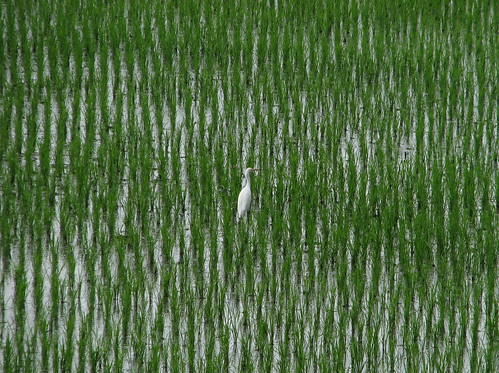
Paddy Fields in a Globalized World 2: Methane

Methane. A powerful greenhouse gas; human activities pump it out like crazy. By now educated readers are aware of the problem of methane from production of cattle and other ruminants, which worldwide accounts for 28% of methane production (EPA). Last year, I wrote a post on paddy fields in a globalized world and learned that rice paddy fields, 90% of which are in Asia, account for roughly 20% of global methane production according to most sources, though there is much variability in the estimates. They are also known to be major producers of another greenhouse gas, nitrous oxide.

The connection between human activities and a warming world, robustly-established in the climate sciences, is important because by 2050 the world will be feeding 9 billion people, meaning that rice production and its associated methane production will likely have to increase.

In Taiwan rice is generally planted twice a year. The vast majority of methane emissions take place during the second planting (here, here). Because in every country cropping practices are different, local factors affect methane output from rice farming. This paper on the methane emissions in all 15 of Taiwan's irrigation districts observes:
The amount of methane emitted in the second crop season was 7– 16 times that emitted during the first crop season. If the reduction in planted acreage proposed (12%) is during the second crop season, this will reduce the amount of methane emitted by 21% annually.

Additionally, the rice straw following the first crop harvest is ground into the soil before the rice is planted in the second crop season. The addition of ground rice straw to the soil significantly increases the rate of emission of methane in the hot and humid summer. Removing the rice straw from the soil greatly reduces the rate of emission of methane.
The authors recommend that rice straw be removed from fields prior to the second planting to reduce methane emissions. The paper dates from 2003, when Taiwan had just entered the WTO and the government had taken thousands of hectares of rice fields out of production to comply with agreements to import rice. This ironically reduced methane emissions. The paper observes that in Taiwan temperature is the major determinant of rice field methane output; it is highest in Pingtung fields and lowest in Nantou.

Another factor in rice field methane output is water and water depth. In China methane emissions fell 40% when water-saving practices were implemented that drained fields of their water three times annually instead of keeping them continually flooded. In Taiwan the effects are similar though not so dramatic. This is because when the fields are flooded, soil bacteria shift to anaerobic fermentation of organic material in the field, which creates methane. Upland rice fields, which are not flooded, produce negligible amounts of methane. Recall, however, that as my post on paddy fields noted, flooding rice fields recharges underground water sources.

Another methane reducer in Asia was the shift to artificial fertilizer and away from animal and organic waste. Differences in fertilizer type also affect methane production. Nitrogen-rich fertilizers result in much higher methane emissions, in one 2003 study in Taiwan large reductions were found if non-nitrogen fertilizers were used (another study of methane and nitrous oxides emissions from Taiwan).

Because every region has its own special methods and practices for producing rice, there is no global fix for the problem of methane production from rice fields. But it is surely something humanity will have to consider in the coming decades.

REF: Want to reduce weeds, snails and methane in rice paddies? Try ducks!
______________
Daily Links:
  • Travelscope Introduces Taiwan's Tea and Aboriginal Cultures. 
  • American surfers hit Taiwan
  • AsiaEye under the radar news
  • Ag losses from rain to top NT$500 million; expect higher food prices in local markets.
  • Five day boycott by DPP blocks vote on ractobeef. The KMT has been calling for an executive order. Note that the Ma Administration could have ended this impasse by executive order. That Ma has not suggests that he wants to use the legislature as a fig leaf for permitting ractobeef into Taiwan ("Look, the legislature decided to let beef in, my hands are tied") or as an excuse for not letting it into Taiwan. Either way, the Administration shifts the blame for the decision onto someone else. The really terrifying thing is that Taiwan's voters will return this legislature in the next election even if it votes to let in beef laced with cyanide.
_______________________
Don't miss the comments below! And check out my blog and its sidebars for events, links to previous posts and picture posts, and scores of links to other Taiwan blogs and forums! Delenda est, baby.
Thursday, December 23, 2010

Drought and Taiwan


A spider guards her eggs.

When most people think of natural disasters, the ones that spring to mind are events such as earthquakes, typhoons, or floods. Yet perhaps the most influential, and destructive, of natural disasters is one that few immediately think of: drought.

The impact of drought on history is profound. It may have been long-term drought that sent Homo sapiens out of Africa in search of new lands to colonize. In Taiwan drought has been a regular feature of the island's history. For example, the massive drought of 1638-9 was part of a larger pattern of drought across Asia that may have contributed to the end of the Ming Dynasty.

Though we often think of Taiwan as a wet, green island, droughts of varying severity are quite common in Taiwan. In the last century, southern Taiwan has undergone a long-term decline in rainfall and water shortages and droughts have become more common. In the north rainfall has increased, but in both places the number of rain-days has fallen and dry days increased. Overall, between 1945 and 1960, the island's rain patterns began to shift, with drought worsening in the south and the center but declining in frequency for all but the worse droughts in the north.1,3 Global warming, driven by human activities, is one obvious culprit: Taiwan's years with the most rain-days all occurred before 1953.2 Southern Taiwan, the island's agricultural heartland, is feeling the biggest impact.

Since 1895 Taiwan has been hit by major droughts from 1899-1902, 1906-1910, 1913-1916, 1960-1965, 1978-1980, and 1993-1997. Other important droughts occurred in 1946, 1954-55, and 2002. In several cases drought length and magnitude has apparently been influenced by volcanic eruptions, which produce years with significantly fewer rain-days.2 Sulfur-rich eruptions impact Taiwan in two ways: first, they pump aerosols into the atmosphere that inhibit precipitation; and second, they cool the surface of the ocean, reducing evaporation and moisture in the atmosphere. The El Nino-Southern Oscillation (ENSO) also affects Taiwan's droughts but the overall effect is generally much lower than that of volcanoes.4

Drought actually comes in several flavors. Meteorological drought, discussed in the paragraphs above, refers to the conventional idea of no rain. Hydrological drought is concerned with how meteorological drought plays out in local water basin systems.
It takes longer for precipitation deficiencies to show up in components of the hydrological system such as soil moisture, streamflow, and ground water and reservoir levels. As a result, these impacts are out of phase with impacts in other economic sectors.
Agricultural drought links the above two types of drought to their impact on agriculture. For example, the combination of drying from climate change and lower reservoir levels means that rice fields are often left fallow in the most productive part of the year in southern Taiwan because there is not enough water for them. Curiously, as southern Taiwan dries out, droughts appear to be starting earlier and terminating earlier.5

The changes in precipitation have had complex impacts on Taiwan. Wang6 writes:
The rapid declines both in precipitation amount and days in southwestern Taiwan for the past 60 years have resulted serious difficulty in the water resources management. For example, the extraction of surface water for the water usage in Taiwan has been diminished from 150x108 m3 in late 1970 to about 120x108m3 in 1990s, a 17% shortage of average annual demand (~180x108m3). The major water deficiency occurs in the southwestern region that has been suffered the heavy reduction of precipitation for the past decades. Groundwater has been forced to significantly increase to meet the overall water demand every year. Consequently, over-exploitation of groundwater since 1980 caused chain-series effects, such as groundwater level waning, land subsidence, seawater intrusion along the coast and groundwater quality deterioration (Wang et al., 2004). River pollution is another critical problem for the southwestern Taiwan partly due to the drop of precipitation of the past decades.
The disastrous effects of both drying and drought show how much more expensive drought is than other natural disasters -- its effects are long-term, subtle, and profound. It is sobering to imagine the south in its global context -- rainfall in southern Taiwan is three times the world average, yet the area is constantly afflicted by drought and water shortages.

The negative effects of drought -- increases in groundwater pumping, polluted water, subsidence, saltwater encroachment, and so forth -- interact with other problems generated by Taiwan's unique topography and its breakneck development. One article7 points out:
Pressure to move people inland has led to road construction and deforestation, both of which have contributed to an already high denudation rate of topsoil. As a consequence of this, thirteen rivers in Taiwan are now ranked among the top 20 worldwide in terms of sediment yield.
.....
[Rapid run-off of water resulting in water shortages] is especially serious for Taiwan because the island is so highly dissected geographically. Many places in the central mountain ranges are geographically classified as extremely dissected with a roughness of >160 m km-1... Only 0.4% of all land on Earth is dissected as much.
Luckily in 1993 Taiwan began shifting to a more conservation-oriented forest management system which has impacted this situation positively. Still, as the article above observes, inter-basin management in Taiwan is difficult because the mountains are so steep. Exacerbating the various problems are the island's water management policies, including the low price of water which encourages overuse, the lack of support for conservation, the refusal to enforce groundwater pumping rules, and the preference for large, water-intensive industrial projects, especially in the south.

What does this mean? Sometime in the next few decades these trends -- overuse of water, frenetic groundwater pumping, subsidence, seawater intrusion, drought and long-term drying -- are going to come to a head in southern and south-central Taiwan and force major changes in agricultural production and water sourcing. Perhaps someday resources such as deep-rock aquifers in Taiwan may be exploited, but at present, much of the impact of long-term warming could be mitigated by sensible water policies, enforcement of water regulations, and shifts in crop preferences and production methods. Yet there seems little momentum for that at the central government level. Hopefully one of the political parties will take get out ahead of the curve on this key issue.

REFS:
1. Historical trends and variability of meteorological droughts in Taiwan. Chen Shien-tsung; Kuo Chun-chao, Yu Pao-shan. Hydrological Sciences Journal, 54: 3, 430 — 441
2. This on volcanoes
3. The Influence of Climate Change on meteorological drought characteristic in Taiwan, BALWOIS conference paper
4. The Impact of Worldwide Volcanic Activities on Local Precipitation-Taiwan as an Example Li, et al. Journal of the Geological Society of China
5. The Impact of Climate Change on Agriculture Water Resources for Paddy Rice over Southern Taiwan
6. Precipitation Changes and Their Impacts on the Water Resources Management in Taiwan. Chung-Ho Wang
7. Island-based catchment—The Taiwan example. Chen, A. et al
8. Analysis and Evaluation of Taiwan Water Shortage Factors and Solution Strategies
Wang, CY, Wang, JB

_______________________
Don't miss the comments below! And check out my blog and its sidebars for events, links to previous posts and picture posts, and scores of links to other Taiwan blogs and forums! Delenda est, baby.

Sunday, May 09, 2010

Rising Sea Levels Threaten Taiwan

Lots of portentous stuff out there. The Arctic, warming faster than the rest of the planet as humans use the atmosphere as a waste dump, experienced rain in April, something never seen before. This April's snow cover in North America was the smallest ever recorded (won't see that in our scientifically hopeless media, but if a flake falls on Washington DC...). And rising sea levels -- much faster than IPCC predictions -- are threatening Taiwan, as AFP observes in an excellent piece of reporting:
When worshippers built a temple for the goddess Matsu in south Taiwan 300 years ago, they chose a spot they thought would be at a safe remove from the ocean. They did not count on global warming.

Now, as the island faces rising sea levels, the Tungshih township is forced to set up a new temple nearby, elevated by three metres (10 feet) compared with the original site.

"Right now, the temple is flooded pretty much every year," said Tsai Chu-wu, the temple's chief secretary, explaining why the 63-million-dollar project is necessary.

"Once the new temple is completed, we should be able to avoid floods and the threat of the rising sea, at least for many, many years," he said.

The temple of Matsu, ironically often described as the Goddess of the Sea, is only one example of how global warming is slowly, almost imperceptibly piling pressure on Taiwan.

Mountains cover two thirds of Taiwan, but the heart of the island's economy is concentrated in the remaining third, which stretches down the west coast and consists mostly of flat land near sea level.

This part of Taiwan is home to a string of populous cities, several industry zones, three nuclear power plants -- and a petrochemical complex, built in the 1990s by Formosa Plastics Group for over 20 billion US dollars.

And unlike the temple, none of these crucial economic establishments can possibly be lifted, leaving them exposed to the elements.

"If the sea levels keep rising, part of Taiwan's low-lying western part could be submerged," said Wang Chung-ho, an earth scientist at Taiwan's top academic body Academia Sinica.

An influential Taiwan documentary released earlier this year argued the risk to the petrochemical complex was very real. However, a Formosa Plastics official told AFP stringent construction measures meant there was no danger.

Still, environmentalists consider the risk too high to ignore, and they point out that it is compounded by the overpumping of groundwater both for traditional agriculture and for fish farming.

This has caused the groundwater level to fall and land to subside below sea level in some coastal areas, experts warn.

The greatest extent of seawater encroachment has been estimated to be as far as 8.5 kilometres inland with an affected area of about 104 square kilometres (40 square miles) in southern Taiwan's Pingtung county, according to a study co-written by Wang.

Once low-lying areas are routinely invaded by sea water, it is very hard to turn back the tide, analysts warned.

"They may not be restored and become wastelands within 100 years," warned Hsu Tai-wen, the head of the Hydraulic and Ocean Engineering Department of the National Cheng Kung University in Tainan city in the south of Taiwan.

.....

The authorities have started drafting the island's first climate change whitepaper, which aims to come up with comprehensive measures to prevent natural disasters caused by rising temperatures.

Apart from rising sea levels, scientists at Academia Sinica warned late last year that global warming would cause the amount of heavy rain dumped on Taiwan to triple over the next 20 years.

Businessweek reports that Taiwan is increasing its coal purchases on rising demand for power. The massive coal plant for the industrial complex in Mailiao is one of the largest single sources of atmospheric poisons in the world. When Taiwan drowns, it will be a case of suicide.
___________________
Daily Links
_______________________
Don't miss the comments below! And check out my blog and its sidebars for events, links to previous posts and picture posts, and scores of links to other Taiwan blogs and forums!

Monday, April 19, 2010

Carbon Emissions Contextualization

EPA Minister Shen promoted a new campaign to get locals to reduce their carbon emissions (Liberty Times via Taiwan Today):
Organized by the nongovernmental Taiwan Institute for Sustainable Energy, the event captured the attentions of commuters with a giant balloon display.

“Our balloon represents monthly emissions produced by one person in Taiwan,” a TISE staffer said. “The population of Taiwan generates enough emissions to fill 270 million such inflatables, which strung together could cover the distance between the earth and the moon four times.”

The TISE said Taiwan’s population is responsible for per capita emissions 2.76 times the world average, which is about 12 metric tons a year. “If a balloon were filled with this amount, it would be 10 meters in diameter, or about three-floors high,” the staffer said.

While acknowledging that people need to cut their own emissions, TISE Chairman Eugene Chien said industry must play a greater role in effecting the country’s low-carbon transformation.

Chien said the corporate sector produced almost half of Taiwan’s total emissions in 2007. “The government must place stricter regulations on high energy-consuming industries and help them transform.”

The chairman believes this measure is necessary if the Cabinet-level EPA’s goal of slashing emissions by 210 million metric tons is to be achieved by 2020.
A friend, Tammy Turner, notes (emphasis mine):
With reference to emissions targets and climate change, according to 綠盟能源與氣候變遷小組 (Energy and Climate Change working group of the Environmental Protection Union - Taiwan), there is a very big gap between what the government is doing and saying. Here's a quick translation of their Facebook post on the topic (original Chinese below):

"The enemy at the gate to a low-carbon future (in Taiwan): According to calculations, the total CO2 emissions derived from the development projects that have already been passed by the EIA commission and will go online within the next 5 years will amount to 36 million tons. Then add to this the three projects that are currently under EIA review,the Kuoguang Petrochemical Plant, fifth-stage expansion of Formosa Plastics Sixth Naptha Cracker Plant, and the Changhwa Coal-fired Power Plant, the total emissions for these projects will reach 31.34 million tons. Once these projects are passed, even if every person in Taiwan were to stop using electricity and stop driving it would be impossible to offset the increased emissions from these projects. And although the current government administration (in Taiwan) has announced emissions reduction targets of bringing emissions back down to 2000 levels by the year 2025, a gap of 100 million tons currently exists."
台灣低碳道路的大敵當前。根據統計,已經經由環境影響評
估審查通過,將在未來五年內開始營運的開發案總計溫室氣體排放量已達近3600萬公噸。而目前於審議中的國光石化廠、台塑六輕五期、以及彰化火力發電廠,三者的溫室氣體總排放量亦已達3134萬公噸。雖然開發案一但均通過,既使全台灣民眾均不用電、不開車也無法抵銷這些開發案的增量。而目前的政府喊出的減量目標,2025年回歸到2000年的排放量,則有搞達一億噸的落差。

Is the government serious? It almost looks like they are hoping they can offset the massive emissions from Taiwan's coal plants -- the one in Taichung is the world leader and the one in Mailiao is number 5, with the one coming online in Changhua number 4 -- with reductions in household emissions. Good luck with that.
_______________________
Don't miss the comments below! And check out my blog and its sidebars for events, links to previous posts and picture posts, and scores of links to other Taiwan blogs and forums!

Thursday, April 15, 2010

Seeding the way out of our continuing water problems

Taiwan is a land of water contradictions. Although we get far more water than we can use, the southern part of the island actually gives up more water to the air than it gets seven months out of the year, meaning that drought is in fact more or less normall. In recent days the government has been attempting to alleviate drought in southern Taiwan, where in some places it hasn't rained since typhoon Morakot in August of last year. Water is so scarce that in some places in southern and central Taiwan the spring rice planting was suspended. The China Post reported last month:
Although Taiwan has already entered the wet season of spring, until March 22, the total rainfall of Tainan in March is only 0.3 mm. Tainan's average rainfall in March in previous years is 35.4mm. Kaohsiung records only one mm of rainfall in March till March 22. If there is no rain before the end of March, the two areas will have the lowest amount of rain in history, according to Central Weather Bureau (CWB).

In Hengchuen (恆春), there were only 0.2 mm of rain in Feb., the second lowest amount of rain in Feb. in a century. Dawu (大武) had 11.3 mm of rainfall in Feb., the third lowest record of rainfall in Feb. since the station set up 70 years ago.
The CNA via Taipei Times described the cloud seeding attempt, which failed:
At 11am on Friday, a squad of C-130 transport aircraft released about 4,000 liters of water from an altitude of 4,500m and targeted it at the water catchment areas of Tsengwen, Wushantou and Nanhua reservoirs in Tainan and Chiayi counties. At the same time, a team from National Taiwan University (NTU) tried to seed clouds to create rain over the same areas, but neither approach worked.
The CNA report said a calcium chloride based aerosol was used in the attempt. The China Post report above noted that the problem is global warming:

Liu said the decrease in rainfall in Taiwan is influenced by the global climate change. In the past century, the surface temperature of the earth had increased by 0.6 degree Celsius and that had changed the raining patterns.

“The most pressing impact of climate change in Taiwan is the extreme rainfalls,” said Liu. “Central and southern districts of Taiwan had already suffered from draft for eight years in the last decade.”

According a research done by Liu and his team, in the last 45 years, the days with drizzles in Taiwan are halved. For central and southern districts in Taiwan, where the main water source is drizzles, would face drought much more often. And as the days with torrential rain are doubled that of 45 years ago, the risks of water hazard and landslides are also doubled.

The number of rain days annually is also declining in the north, though it is not as obvious.

REF: Wiki on cloud seeding.
_______________________
Don't miss the comments below! And check out my blog and its sidebars for events, links to previous posts and picture posts, and scores of links to other Taiwan blogs and forums!