Tuesday, August 28, 2018

2018 Election Posters: Round Three

IMG_1467
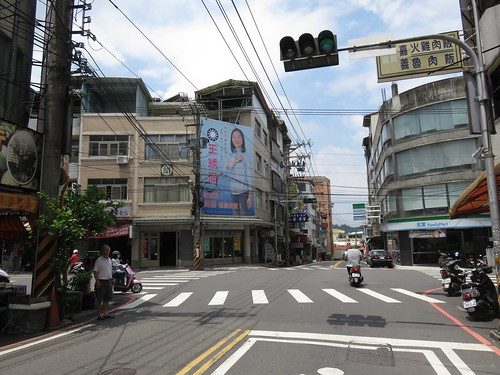
A KMT candidate dominates a Taichung intersection.

Another day, another collection of colorful election posters. Rode around in Changhua this week, a key battleground that is currently leaning KMT. You can click on any photo to be taken to its Flickr page if you want to zoom in on it. Click on READ more to see more....

Sunday, August 26, 2018

Latest for ACT: The Power of Culture in the Fight for Taiwan

Where cultures mingle...

American Citizens for Taiwan has published my latest piece for them....
Taiwanese food products have done much to raise awareness of Taiwan, as chefs in North America and Europe are learning how to make “Taiwanese pork belly sliders” (gua bao) while Taiwanese pearl milk tea is a hit in many countries. Government cultural agencies in Taiwan have put great effort into promoting Taiwan as a food destination. But because of disagreements between the pro-Taiwan and the pro-China side in Taiwan’s politics over what “Taiwan” means, and from the lack of domestic markets and infrastructure to support them, cultural products such as film and music remain unexplored realms of soft power.
This was stimulated by a conversation on Twitter that took off from the success of Crazy Rich Asians and asked what could be done for Taiwan...
_______________________
Don't miss the comments below! And check out my blog and its sidebars for events, links to previous posts and picture posts, and scores of links to other Taiwan blogs and forums!
Spanish Scholar on How China Suppressed a Taiwan Culture Event

Bullying, threatening letter sent to U of Salamanca by PRC Embassy

@Xiani_PCh
Today I decided to go public with the email #China’s embassy in Spain sent to coerce the University of #Salamanca into cancelling “#Taiwan Cultural Days” on October 2017. ENG version on the account of what happened. English version of what happened.
_______________________
Don't miss the comments below! And check out my blog and its sidebars for events, links to previous posts and picture posts, and scores of links to other Taiwan blogs and forums!

Friday, August 24, 2018

What did the south Chinese know about Taiwan and when did they know it?


From: Ptak, R. "From Quanzhou to the Sulu Zone and Beyond: Questions Related to the Early Fourteenth Century" Journal of Southeast Asian Studies 29, 2 (September 1998): 269-294, 1998 by National University of Singapore. Ptak is discussing Quanzhou's camphor trade in the early 14th century.
The next commodity, camphor, was produced in the Barus area of western Sumatra and on Borneo. The Far East also produced a substance known by this name but its chemical composition was different and it was never valued as highly as imported camphor. Song sources list foreign camphor as an import from Srivijaya and Champa. There are also references to imports from Butuan and occasional shipments by merchants from Persia, Chola and Cengtan (on the Arabian Peninsula?). It is obvious that Butuan and Champa received their camphor from Borneo while the other imports originally came from the Barus area. Wang Dayuan refers to camphor products in his chapters on Champa, Trengganu, Samudra, Xialaiwu, Danmaling (Ligor?), Brunei, Pulau Rondo (Longxianxu), Dudu'an, Srivijaya and Suluoge. Camphor, it is clear, continued to be available in the Yuan period along both the western and the eastern trunk routes.45
Ptak has written a whole book on the area's camphor trade before 1500, and obviously knows his stuff.

Quanzhou is more or less right across the Strait from Taiwan. Taiwan was absolutely stuffed with camphor trees in those days and early Chinese settlers found it right away (here for overview). Production of camphor was actually illegal until 1725, when the government became the monopoly purchaser of private camphor production. Taiwan did not become part of the global camphor trade until after 1850.

So the people of Quanzhou had rich camphor source right next to them, but went to areas south of the Philippines to get camphor, so little did they know of Taiwan.
_______________________
Don't miss the comments below! And check out my blog and its sidebars for events, links to previous posts and picture posts, and scores of links to other Taiwan blogs and forums!
Kaohsiung is underwater


Some vids of the disaster unfolding down there as the storm sits over southern Taiwan. In Taichung it is gray and raining, very depressing, but no serious flooding.

_______________________
Don't miss the comments below! And check out my blog and its sidebars for events, links to previous posts and picture posts, and scores of links to other Taiwan blogs and forums!

Thursday, August 23, 2018

Some Random Charts of Taiwan People be Passin' Around


The carbon footprint chart I put on Flickr. If you mouse over it you can zoom in on it.
_______________________
Don't miss the comments below! And check out my blog and its sidebars for events, links to previous posts and picture posts, and scores of links to other Taiwan blogs and forums!
Wednesday, August 22, 2018

The ROC loses another prop: buh-bye El Salvador

DSC_0572
These really should be weaponized. No one can resist their power.

Dammit, El Salvador. I had hoped to avoid writing a blogpost today, but then Taipei severed diplomatic relations with that nation this week after its leadership allegedly demanded exorbitant sums to maintain its recognition of the ROC, including massive payments to the ruling party. El Salvador then switched recognition to China. A Taiwan scholar tweeted around:
Recap to what happened today about #China - #ElSalvador - #Taiwan quandary: @MOFA_Taiwan refused to be blackmailed by Salvadorian government asking for exorbitant sums of money to fund 2019 elections + port infrastructure. Salvador’s been pressuring TW during past 2 months
A new thing was signaling of support for Taiwan by Republican Congressmen on Twitter who tweeted indignantly about the switch:
Ted Yoho @RepTedYoho
U.S. + like-minded countries cannot wait much longer to prevent #China ’s reach. China is actively pursuing #Taiwan’s remaining allies through diplomatic + economic coercion. We cannot stand idly by, while China bullies its way into power.

@SenTomCotton: “The Chinese Communist Party should know that every time it bullies a country into severing ties with Taiwan it only strengthens the bonds between the U.S. and the Taiwanese people.” Agreed.
Marco Rubio of Florida threatened El Salvador over the switch. Also new was that Taipei dumped El Salvador before it switched, a good move.

Solidarity commented:
ジェームス@jmstwn
Peeling off an ally after every Tsai trip abroad is one way to undermine the narrative of that trip, too
Jessica Drun posted the thoughts of one of El Savador's opposition politicians in this thread, describing them....
He regrets the decision (interestingly calls "Taiwan" "China Taiwan"), notes distance of El Salvador from community of democracies, calls the move "treasonous," and calls the move the end to a disastrous government. Interesting to see the domestic politics angle in all this.

In the media...

Chris Taylor has an excellent piece (read it!) observing that this marks the end of "dollar diplomacy". Taylor obviously knows his stuff:
The so-called 1992 consensus is subject to competing interpretations, and is widely perceived in Taiwan as an ex-post facto fabrication on the outcome of discussions between representative bodies from China and Taiwan in Hong Kong in 1992.

China takes the consensus as an affirmation of its ‘One China Policy,’ and its position that Taiwan is an indivisible part of it. Tsai, with the backing of the DPP, refuses to acknowledge the consensus.
This is probably the first piece in the international media to use the term "fabrication" in conjunction with the 1992C. Taylor also gets the connection to independence and quotes DPPer Yu Shyi-kun and turncoat Hsu Hsin-liang on the topic:
As former Premier Yu Shyi-kun, leader of a Taiwanese delegation to the inauguration of President Donald Trump, reflected, the loss of small diplomatic allies to China amounts to more domestic budget for Taiwan.

Former DPP Chairman Hsu Hsin-liang, head of Foundation on Asia-Pacific Peace Studies, which is a private think tank, has echoed such views, arguing that small diplomatic allies impose an unnecessary economic burden on Taiwan. Losing them “is not really important,” he said.
Kudos to Taylor for this excellent reportage...

The international reporting, alas, was too often the usual mix of tropes and ignorance. The Guardian wrote, for example:
The latest diplomatic switch leaves Taiwan further isolated on the international stage. Beijing claims that Taiwan, which operates under its own government, currency, and military, is an inseparable part of China and says it will not maintain ties with any country that has formal diplomatic ties with Taipei.

Relations between China and Taiwan have reached a low under Tsai, who belongs to the Democratic Progressive party, which advocates independence for the island. Since her election, Beijing has ramped up efforts to poach Taiwan’s allies. Now, just 17 countries recognise Taiwan, after Burkina Faso and the Dominican Republic cut ties and recognised Beijing instead earlier this year.
The Guardian did extensively quote Tsai and also Joseph Wu (yay!), but still The Formula there bolded in red tells us only what Beijing thinks, and not what Taiwan thinks. Typical. In the international media, Beijing's claims are almost never interrogated or challenged. The Straits Times ran a very similar quote, with Taiwan also silenced.

Note the bolded sentence in the second paragraph, in which the Guardian tells us that "relations have reached a low", apparently without the intervention of human agency. Relations are low because of Beijing's decisions. Indeed, the Guardian report assigns the blame to Tsai with "under Tsai". The piece is by the Guardian's Beijing reporter, which no doubt accounts for the slant.

Oh, and in coincidental conjunction with this event, a number of people were tweeting around that support for Taiwan independence among Hong Kong's young has risen strongly (survey). Apparently there is something about being ruled by China that just makes people yearn not to be ruled by China.

There's not much to say that hasn't already been said. The Straits Times piece, which is far better than the Guardian piece, has a nice quote from the most excellent Jon Sullivan, who gets it...
"If the ROC is completely unrecognised I believe Beijing's calculation is that it will be easier to delegitimise the government in Taipei and prime demoralised Taiwanese and international society for unification," said Jonathan Sullivan, Director of China Programmes at the University of Nottingham.
Note Sullivan's careful choice of point of view and words. "If the ROC..." -- almost every newspaper article simply says it was "Taiwan" that lost recognition. The problem with that is simple: no nation on earth recognizes Taiwan, they all recognize the Republic of China as the sole and legitimate government of China. The international media either doesn't understand this, is too lazy to explain, or prefers to emphasize Taiwan because that increases the clickbait value of the article. Thus Sullivan's precise use of "ROC" and "government in Taipei" because Sullivan understands that Taiwan has neither lost nor gained anything.

Taiwan cognoscenti understand well that the ROC is a virtual state propped up by thin threads connecting it to reality -- the diplomatic allies, control of Kinmen and Matsu (where the ROC truly resides in the hearts of many of the people), and control of islands in the South China Sea (see J Tkacik's recent excellent piece in TT on Kinmen/Matsu), and its territorial claims in the Senkakus. The SCS islands, the Senkakus claims, and the diplomatic relations are the only places where the ROC truly exercises, in evanescent form, the international powers of a sovereign state.

As Sullivan knows (and is cited on further down in the Straits Times article), many independence supporters view the loss of relations as inevitable and desirable, because each such loss brings the hated colonial ROC government to its own inevitable death, leaving only Taiwan, which will then be independent. That is why Beijing has never taken back Matsu and Kinmen -- because they give Taiwan a tenuous connection to China, and that is why it permits Taiwan to have diplomatic allies. After all, poaching them gives the media the opportunity to write lots of clickbait headlines...

Allies come and go, but Taiwan abides.
______________
Daily Links:
REF: I've placed President Tsai's statement on termination of relations with El Salvador below the READ MORE link...

Monday, August 20, 2018

Taiwan is 98% Han Chinese

Who lives here...

Hokkien immigrants to Taiwan originated from Quanzhou prefecture (44.8%) and Zhangzhou prefecture (35.2%). -- Wiki
+++

A group of South Indian merchants, most probably Tamils, financed and endowed a Hindu temple at the principal Chinese international port, Quanzhou in the twelfth century CE -- source
+++

....Yet it is clear that Quanzhou was host to traders who were themselves devotees of Shiva, and that at various times these traders amassed enough influence within the community to erect monuments to their god.

Their position within the city is further evident from the extensive iconographie material evocative of Shiva and the Shiva cult that was incorporated into the motifs of the Kaiyuan Temple, the dominant Buddhist temple of the city, during later reconstructions. Unfortunately, none of the images can be dated with any precision, but all are considered to belong to the thirteenth or fourteenth centuries. They include several uses of Ungarn and other motifs that are equally strongly connected with the god, such as the sacred cow.36 Shiva is not the only Indianized image found there; Vishnu, for example, is also featured, though less often.37 -- source
+++

A late thirteenth-century bilingual Tamil and Chinese-language inscription has been found associated with the remains of a Siva temple of Quanzhou. This was one of possibly two south Indian-style Hindu temples that must have been built in the southeastern sector of the old port, where the foreign traders' enclave was formerly located. [It reads]:
[Tamil]: "Obeisance to Hara (Siva)! Let there be prosperity! On the day Citra in the month of Chittira in the Saka year 1203 (1281 A.D.), the Tavachchakkarvarttigal Sambandhap-perumal (a Saiva religious leader) caused, in accordance with the firman (written permission) of Chekachai Khan (the Mongol ruler), to be graciously installed the God Udaiyar Tirukkadalisvaram Udaiya-nayinar (Siva), for the welfare of the illustrious body of the illustrious Chekachai Khan." -- source
+++

...Another historian records, "A large number of Moslem, Nestorian, Catholic, Manichean and Hindu inscriptions are found in the area. ... The inscriptions are in Arabic, Syriac and Tamil." -- source
+++

Cao'an (Chinese: 草庵; pinyin: Cǎoān; Pe̍h-ōe-jī: Chháu-am; literally: "thatched nunnery"[1]) is a temple in Jinjiang, Fujian. Originally constructed by Chinese Manicheans, it was viewed by later worshipers as a Buddhist temple. This "Manichean temple in Buddhist disguise"[2] is seen by modern experts on Manichaeism as "the only extant Manichean temple in China",[3] or "the only Manichean building which has survived intact".[4]

The temple is located on the southern slope of Huabiao Hill near Shedian Village just west of downtown Jinjiang.[5][6] Jinjiang is part of Quanzhou, which was known historically as "Quanzhou Prefecture"; the location is some 50 kilometres (31 mi) south of downtown Quanzhou.[4] -- Wiki
+++

...From the beginning of the Yuan, foreign troops loyal to the Mongols, from Yangzhou and Huzhou, were stationed in Quanzhou. They were allied with the Persian community in Quanzhou. During the decline of the Yuan Dynasty, the foreign troops turned against the Mongolian elites in an attempt to set up their own state. When the foreigners discovered the weakness of the Yuan troops in their attempts to suppress rebels in Xinghua, they initiated rebellion. The leaders of the rebellion were the descendants of the powerful trading families of Pu Shougeng and Nawuna, the Trade Superintendent at the time. This rebellion of foreign ethnic groups, called the Ipsah Rebellion by historians (Chen, 1992, p. 8; Zhuang, 1980b), lasted 10 years and involved a large area including Fuzhou, Quanzhou, and Xinghua. According to Maejima (1973,1974) and Zhuang (1980b), the first 5 years of the rebellion were characterized by a struggle between Persian forces in Quanzhou and Xinghua, while the latter 5 years were dominated by a rebellion started by Nawuna and Pu Shougeng descendants who wanted to expand trade but were restricted by the Mongols. Zhuang states that the immediate cause of the outbreak was the Muslim disapproval of the building of a Hindu temple on the site of the former governor’s residence (Zhuang, 1980b, pp. 23–24). -- source
+++

In the early fourteenth century, the most prosperous merchants in Quanzhou were Muslims of both Chinese and non-Chinese origin. Epigraphic and other evidence points to the strong position of this group in Quanzhou's society.

-- source
+++

The Ding or Ting family of Chendai in Quanzhou claims descent from the Muslim leader Sayyid Ajjal Shams al-Din Omar through his son Nasr al-Din or Nasruddin (Chinese: Nasulading).[62] The Dings have branches in Taiwan, the Philippines, and Malaysia among the Chinese communities there, no longer practicing Islam but still maintaining a Hui identity. The deputy secretary-general of the Chinese Muslim Association on Taiwan, Ishag Ma (馬孝棋) has claimed "Sayyid is an honorable title given to descendants of the Prophet Mohammed, hence Sayyid Shamsuddin must be connected to Prophet Mohammed". The Ding family in Taisi Township in Yunlin County of Taiwan, traces descent from him through the Ding of Quanzhou in Fujian.[63] Nasruddin was appointed governor in Karadjang and retained his position in Yunnan till his death, which Rashid, writing about 1300, says occurred five or six years before. (According to the Yüan shi, "Nasulading" died in 1292.) Nasruddin's son Abubeker, who had the surname Bayan Fenchan (evidently the Boyen ch'a-r of the Yüan shi), was governor in Zaitun at the time Rashid wrote. He bore also his grandfather's title of Sayid Edjell and was Minister of Finance under Kublai's successor.[64] Nasruddin is mentioned by Marco Polo, who styles him "Nescradin".[65][66][67] -- Wiki
+++

Quanzhou initially continued to thrive under the Southern Song produced by the Jin–Song Wars. A 1206 report listed merchants from Arabia, Sumatra, Cambodia, Brunei, Java, Champa, Burma, Korea, and the city-states of the Philippines. One of its customs inspectors, Zhao Rugua, completed his compendious Description of Barbarian Nations c. 1225, recording the people, places, and items involved in China's foreign trade in his age. Other imperial records from the time use it as the zero mile for distances between China and foreign countries. Tamil merchants carved idols of Vishnu and Shiva[38] and constructed Hindu temples in Quanzhou. Over the course of the 13th century, however, Quanzhou's prosperity declined due to instability among its trading partners[30] and increasing restrictions introduced by the Song in an attempt to restrict the outflow of copper and bronze currency from areas forced to use hyperinflating paper money. The increasing importance of Japan to China's foreign trade also benefited Ningbonese merchants at Quanzhou's expense, given their extensive contacts with Japan's major ports on Hakata Bay on Kyushu. -- Wiki
+++

Serving kung fu tea and speaking a south Fujian dialect, Guo Jingzhuan, 52, a ship owner from Shiyu village in east China's Fujian Province, is proud of his seafaring ancestry.

Almost all the residents in his village are descended from Arabian merchants, who travelled to Quanzhou hundreds of years ago, when the city was one of the world's most vibrant ports. Guo is planning to buy another 10,000-tonne freighter later this year to join what he calls the "100,000 tonnes shipping club." -- source
+++

The Fujian city of Quanzhou, today a prefecture level city of approximately 8 million inhabitants, grew to be one of the world’s largest ports during the Song and Yuan Dynasties. A main stopover in maritime silk route, Marco Polo talked about the city in his travel memoirs.

During the Yuan Dynasty it was home to an estimated 100,000 Arab traders and was also an important center of shipbuilding. Later, during the Ming Dynasty, Quanzhou helped supply and stage China’s largest period of naval exploration. Between 1405 and 1433, China launched seven expeditions under the command of Admiral Zheng He whose explorations took his fleet to Southeast Asia, Arabia and Africa. -- source
+++

....The earliest Chinese ethnic group came from the Quanzhou area of southern Fujian. They often came as shop keepers, factory owners or workers and they settled along the coasts or in ports. The immigrants from Zhangzhou, also in southern Fujian, came later and tended to settle on the inland plains and engage in agriculture. The Hakka, mainly from eastern Guangdong, came later and settled in upland areas. After the Hakka, much smaller groups came from other areas of Fujian such as Fuzhou and Xinghua. These groups tended to live in cities and engage in the three trades concerned with the three knives: tailors who used scissors, cooks who used kitchen knives, and barbers who used razors. Even in the 1970s, Quanzhou people tended to be in commerce and industry, while Zhangzhou people engaged in agriculture (C.-L. Chen 1972: 130).

The three big ethnic groups – the Quanzhou, Zhangzhou and Hakka – engaged in substantial armed struggle. Of these, only the largest group, the Quanzhou, who accounted for about 45 percent of Taiwan’s population at the end of the Manchu period (calculated from C.-L. Chen 1972: 129–130), fought among themselves on the basis of origins from different counties (Lamley 1981: 283). The Zhangzhou Hokkien, who accounted for about 35 percent of Taiwan’s population,and the Hakka, who accounted for about 13 percent at the end of the Manchu period (calculated from C.-L. Chen 1972: 129–130) remained much more united as groups (Lamley 1981: 283). Yet, even the two Hokkien groups could unite when faced with a large Hakka opponent, as in the Hsia-tan shui river basin (now the Kaoping River [453 ]) on the border of modern Kaohsiung and Pingtung in southern Taiwan (Lamley 1981: 294). -- source

_______________________
Don't miss the comments below! And check out my blog and its sidebars for events, links to previous posts and picture posts, and scores of links to other Taiwan blogs and forums!

ACT #12: US is Salami Slicing?

IMG_1320
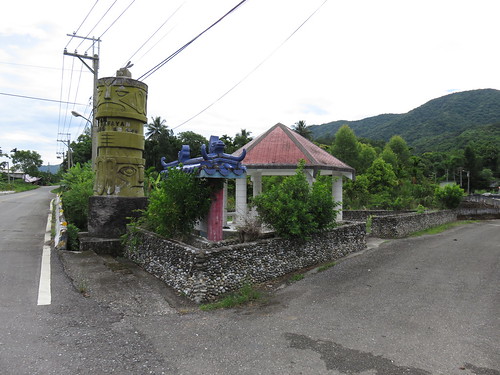
An overgrown monument to a more romantic past...

My 12th for American Citizens for Taiwan on the possibility of the US adopting China's salami slicing tactics
Are quiet port visits by US navy ships in the offing? Quite possibly. Consider that the US navy does not have to send a warship — it possesses many different kinds of vessels that are utterly unwarlike, from research vessels to hospital ships to repair vessels to ordinary cargo vessels. A smart salami slicing style move would be to send one of those, then gasp in mock astonishment when China goes into paroxysms of rage: “it’s not even a warship.” Or the US could send the USS Blue Ridge, a command ship which visited Shanghai in 2016, which would enable Washington to piously claim it is engaged in displays of evenhandedness.
Go thou and read!
_______________________
Don't miss the comments below! And check out my blog and its sidebars for events, links to previous posts and picture posts, and scores of links to other Taiwan blogs and forums!

Sunday, August 19, 2018

The 85C mess and BBC *sigh*.

Morning at Fengyuan train station

BBC's report on the 85C mess... is a mess itself.
The LA branch of Taiwanese-owned 85C Bakery Cafe gave the coffee, along with an enthusiastic welcome, to Tsai Ing-wen when she dropped in last Sunday.

But many Chinese customers - who visit the chain's branches in mainland China - were furious, calling for a boycott.

China regards Taiwan as part of its territory, and the Chinese public are often quick to jump on anything that is seen as endorsing Taiwanese independence.
Warmly welcoming Ms Tsai, the leader of a pro-independence party, was seen as unacceptable.

Yet, when the bakery chain tried some damage control, quickly putting out a statement distancing itself from pro-independence sentiments, it only sparked more anger - this time in Taiwan, where people accused the company of bowing to Chinese pressure.
That summary is pretty much correct. We will come back to the bolded parts in a second. J Michael Cole pointed out in a piece at Taiwan Sentinel that this "bottom up" nationalism in which netizens attack foreign firms who don't conform.
After photos of the encounter were made public, Chinese ultranationalists kicked into action and accused the chain, which operates 859 stores in China and made 64% of its Q1 revenue there, of supporting Taiwan independence. Threats of a boycott (described by the South China Morning Post as a “zealous online campaign”) were sent to the company’s Weibo account, and its Taiwan website was was knocked offline by what is believe to have been a cyber attack. The next day, Long Mingbiao, deputy director of the State Council’s Taiwan Affairs Office (TAO), said China would “never allow” a company that (purportedly) supports Taiwanese independence to operate in China.

Thus threatened, the company — which was founded in 2004 and is now registered in the Cayman Islands — issued a three-point apology on its China website. The company thanked the Chinese for “educating” it, reaffirmed its “firm support” for the so-called “1992 consensus,” and stated its hopes for the “peaceful unification” of the two sides of the Taiwan Strait while “opposing any behavior and remarks that separate the brotherhood of the two sides.”
Actually, it's all nonsense, as lots of companies that support independence operate in China. Cole rightfully worries about the threat of ultranationalism, but I wonder if these incidents can be taken at face value -- how much of the "ultranationalism" comes down to internet minders as orders from Beijing, so that Beijing can arrange incidents like this. But it probably doesn't need to...

But, back to the BBC. Take a look at the text bolded there. BBC in the first five paragraphs twice tells us how "the Chinese" feel. It mentions that Taiwanese accused the company of bowing to Chinese pressure, though why "bowing to Chinese pressure" is a problem is not mentioned aloud (it is assumed as subtext). A curious silence, that grows...

After telling us that Taiwan's status is a sensitive issue -- but what is its status under international law, BBC? We are never told, though that is quite clear -- its status remains undetermined. BBC never mentions that. BBC never mentions what the people of Taiwan want in the text.

Well, there's a picture caption that says "Many Taiwanese don't want to be part of China." How many, BBC? There's extensive poll data on that. Oh, there is another caption that says (in wonky English) "Taiwan remains defiant of Beijing's sovereignty claims". But why are they defiant? How is democracy mentioned in the text related to this defiance?

Those are the only things we hear about how (some?) ordinary Taiwanese feel, and they are picture captions, not main text.

The next paragraphs, one after another, offer China boilerplate...
  • China considers the island to be a renegade province...
  • China insists that other countries can only have diplomatic ties with China...
  • ...Beijing has become increasingly assertive over its claims...
What does Taiwan feel? It's a mystery. What is this independence that is sometimes spoken of in the article, yet never explained? BBC has endless space to explain to us how poor put-upon China feels, but nary a sentence in the main text on how Taiwanese feel about China... nor is any Chinese claim interrogated or deconstructed. Nor are any ordinary Taiwanese quoted about how they feel. As is so often the case in the international media, Chinese claims are repeated without challenge (consider this BBC report on the Baltics and Putin, by contrast, with its extensive man-on-the-street reportage).

BBC then gives some details of what happened in the visit to the 85C outlet. Then, back to the "analysis":
Although Ms Tsai has been a moderate voice on the independence issue since her election, she is viewed by the mainland as a dangerous separatist.
Whew! BBC almost said something about Taiwan without telling us what China felt! At least they stated that Tsai is a moderate as if that were a fact in the world. Kudos to them for that tiny advance toward truthfulness.

We then get a post from social media in China...
"85C is a 'Taiwan independence' two-faced company," said one post on social media..."
...but nada from social media in Taiwan.

BBC then describes the damage control, saying of 85C's moves...
It reiterated its "firm support" for the 1992 Consensus - a loose agreement between Taiwan and China that there is only one China, without defining what that means.
This is just plain Beijing-slanted fictionalizing. There is no "agreement" between Taiwan and China called the 1992 Consensus -- no consensus was reached at the 1992 meeting in Singapore between the unelected representatives of two authoritarian parties. Rather, after 2000, KMT and CCP politicians working to suppress democracy and independence in Taiwan agreed to pretend to each other that there was a 1992 Consensus (which they differ on!). The "agreement" is between the KMT and the CCP, not Taiwan and China. Sad.

Finally, after the company's damage control moment, we get some Taiwan point of view:
In Taiwan, it sparked accusations that the bakery was bowing to pressure from Beijing.

A spokesman for the presidential office in Taipei called accused China of carrying out an "uncivilised act" which would "hinder the world market order and freedom of speech".
An actual quote from the Presidential office. Apparently Taiwanese netizens are not worth quoting, and BBC gives us no information on independence though it gives extensive information on China's belligerent expansionism (and goes into some depth further in the article). Instead, BBC assumes "independence" without mentioning so much as a poll or the word "identity". Without that, "bowing to pressure" is meaningless.

You suck, BBC.

REF: FocusTW report, Taiwan news on the fall in stock value
_______________________
Don't miss the comments below! And check out my blog and its sidebars for events, links to previous posts and picture posts, and scores of links to other Taiwan blogs and forums!

Taipei election hilarity plus LINKZ

All roads lead to home

Hardly had I posted last week on how the Taipei election was giving me the sadz when that selfsame day the venerable Ting Shou-chung, now in his 2,461st run for Taipei mayor, decided to exceed even Pasuya Yao and restore my faith in the mainlander Old Guard's ability to lose China. Er, Taipei.

Speaking at a press conference on women and children's safety last week, Ting, the KMT mayoral candidate in Taipei, Storm Media,(my translation) reported on TingFAIL. Wanting to appear the law-and-order candidate...
Ting stressed that through past big data analysis, people with traits such as being male, not being married, living alone, unemployed, lacking in sex, and with poor interpersonal relationships may have a tendency to abuse children or randomly kill people. These people are time bombs. If you can make good use of data in the future, and cooperate with medical units, police agencies or social welfare organizations to strengthen pre-visits, monitoring, and control of these people to "reduce their harm", you can achieve crime prevention. 
In Taiwanese society, especially to the mainlander mind, the solution to all social problems is always "more control". Ting was pilloried on the net for his lack of imagination and strong need for control. Recall in the 2016 election run up when also-ran Soong said that only those who were faithful to their wives and children can be faithful to their country. In this view violators of traditional morality like single, unemployed men are violators of the Confucian order, weakening the nation...

But wait! There's more...!


Apple Daily ran this photo of Ting with his logo. JUST TAIPEI is another one of those almost-a-slogan-sounding English phrases that Taiwanese politicians love. The Chinese says "Taipei Future In [my] Hands. A typical play on words, Ting's Chinese name sounds like the phrase "in ___ hand". The screw, though, is priceless. Netizens in Taiwan are well acquainted with the many meanings of the word in several languages. This promises endless amusement.

You thought Sean Lien's hilariously incompetent campaign was an anomaly? One reason that mainlanders, especially elites, are having increasing trouble winning offices as Taiwan's democracy deepens is because part of being a colonial ruling class gives one a strong sense of entitlement. Even Ting, a longtime party stalwart in Taipei, with decades of political experience, can't overcome that handicap.

Meanwhile Pasuya Yao, the DPP's Taipei mayor candidate, upon hearing that Ting had taken out an AK-47 and peppered his own foot, decided to try and stay in the race to the bottom. Seizing upon Ting's mention of housing, Yao once again mentioned his policy of housing rent subsidies, 3K a month for singles and 5K a month for married couples. This attempt to buy votes with tax dollars met with a torrent of abuse on the intertubes, not merely for the stupidity of the policy itself, but because instead of letting Ting stew in his own remarks, Yao brought the spotlight back to himself, demonstrating both policy and political ineptitude.

It's no wonder that independent Ko Wen-je is enjoying a comfortable lead in the polling for Taipei. Keep on trucking, Ting and Yao!
__________________
Daily Links:
_______________________
Don't miss the comments below! And check out my blog and its sidebars for events, links to previous posts and picture posts, and scores of links to other Taiwan blogs and forums!
Quake Alert

Had a little quake of 4.0 in nearby Nantou, but it felt big. During the quake, which went on for a few seconds, I got this "presidential alert" on my phone.
_______________________
Don't miss the comments below! And check out my blog and its sidebars for events, links to previous posts and picture posts, and scores of links to other Taiwan blogs and forums!
Friday, August 17, 2018

Latest for ACT: A Thesaurus....

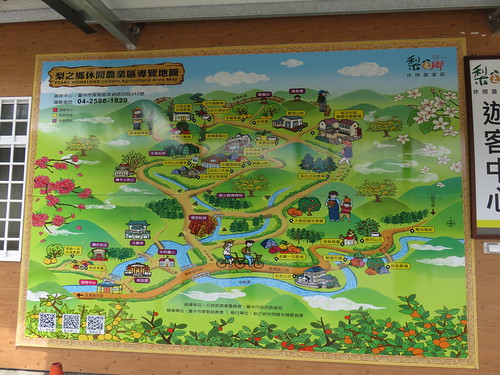
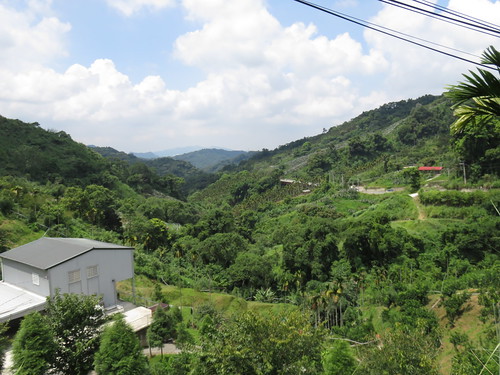
A map of a budding tourist area north of Dongshih, which has recently become targeted for development by the government as the "pear area".

Compiling a thesaurus of Beijing-talk on Taiwan...
Breaking Away = Formalizing current de facto independence. In many writings Taiwan is described as “breaking away” or a “breakaway” province. Such language implies that Taiwan is part of China, though under international law it is not. It is always better to write that Taiwan is formalizing its independence and is not “breaking away” from China.
Thanks for Andrew Kerslake and Tim Maddog for inspiration. This one will keep growing.
_______________________
Don't miss the comments below! And check out my blog and its sidebars for events, links to previous posts and picture posts, and scores of links to other Taiwan blogs and forums!

Tuesday, August 14, 2018

Miramar Developers withdraw

Local news reports that the developers of the destructive eyesore Miramar hotel have withdrawn from the project (Video above in English) and are suing Taitung County government for zillions in compensation. This post has background and links. As an observant person remarked on Facebook, the government will let the corpse sit for a while, then sell it to another developer who will begin the cycle anew.
_______________________
Don't miss the comments below! And check out my blog and its sidebars for events, links to previous posts and picture posts, and scores of links to other Taiwan blogs and forums!
DPP's Taipei Campaign is making me cry

IMG_1455
Bird of prey

Solidarity is back with a great post on the DPP's hideously silly campaign in Taipei...
On a television program a couple days ago, Yao’s campaign spokesman Hung Li-chi (洪立齊) called for DPP members whose loyalty to Yao over independent incumbent Ko Wen-je (柯文哲) is unclear–including popular DPP city councilor Kao Chia-yu (高嘉瑜)–to either leave the party or be expelled from it. Yao has given the impression this statement was unplanned but has stood by it nevertheless, saying his spokesman represents the campaign. Meanwhile, the DPP has withdrawn its endorsement of a neighborhood warden who has endorsed Ko, leading the warden to tearfully ask if it is wrong to support someone who gets things done.
After hearing Hung’s remarks, Kao said she was confident Yao would “be a hero and save the beauty”; when Yao instead affirmed Hung, Kao wrote that she would reflect on how to support Yao, but also challenged him to resign from the legislature for the sake of his campaign. Apple Daily (which has a good relationship with Kao) launched a Facebook Poll asking, should Kao Chia-yu leave the DPP, or should Pasuya Yao resign from the legislature? As of 7 pm Taiwan time on August 9, the readership overwhelmingly stood with Kao:
Kao should leave the party: 8%
Yao should resign: 92%
Yao was never meant to win, and as Solidarity notes, complains the party isn't supporting him. That's as it should be. Yao was run because DPP city councilors who feared for their seats wanted a DPP candidate to get out the vote. But it was obvious as many of us noted that a strong DPP candidate would split the non-KMT vote and likely put the KMT's Ting Shou-chung into the mayor's seat.

So instead of telling the DPP councilors to shut up and support Ko, and get support in return, the DPP decided to give them a suicide candidate who represented a middle finger to them and the voters. The only two who presented themselves were Yao and the equally hopeless Annette Lu. As a blogger Yao's self-absorbed, gaffe-ridden pronouncements are comedy gold, but as someone who loves Taiwan, they are incredibly destructive. The DPP is going to have to carry this cross for another three months and as it becomes clear even to Yao that he is not just going to lose but to be buried and the location of his grave forgotten, he is going to say even more destructive things.

Pasuya Yao is what happens to parties whose leadership won't discipline members to do the smart thing. Fortunately voters have short memories, and fortunately Ko is looking like he will win. Hopefully Yao will then be put in cold sleep and sent to colonize the Andromeda Galaxy.

Ko himself is hardly less gaffe-prone than Yao, but he is also far more practical a politician. His use of a loose form of the term "family" to describe the peoples of China and Taiwan is still causing him trouble. This week he denied that he had failed to inform the NSC of those key phrases in his speech, and once again averred his deep greenness...
“Being ‘deep green’ is my background, but the most beneficial thing for me as Taipei Mayor to do for Taiwan at present is to continue exchanges between the two cities,” Ko said. “So saying that the ‘two sides of the Strait are one family’ does not contradict my being ‘deep green.’”
The purists in the DPP who pouted when Ko used that language are why we can't have nice things. For all his alleged naivete Ko is very aware of what he has to be doing as mayor of the nation's capital and as mayor of city that is half-Blue. That is why he is getting re-elected, with the strong support of the young -- who are deep green but want alternatives to the corporate-owned, neoliberal, business-as-usual DPP. Ko was quoted in another article this week on his Shanghai Forum remarks...
“I worked at intensive care units and emergency rooms as a doctor, and doctors have a trait: We never get to choose our patients,” Ko said. “We cannot ask patients to come in only if they are affiliated with the Chinese Nationalist Party [KMT] or Democratic Progressive Party.”

He has no difficulty speaking with politicians from the pan-blue or the pan-green camps, Ko said, adding that having “practical dialogues” is his specialty, because his experience as a surgeon has made him practical and willing to listen to different opinions.

“The statement that ‘the two sides of the [Taiwan] Strait are one family’ is still a fundamental element [of my cross-strait discourse] for the time being. It does not pertain to politics, but rather to cultural and economic exchanges, as well as exchanges between private actors and between cities,” he said.
Note how his language highlights a common "neither Blue nor Green" approach taken by independent politicians, and also emphasizes the practical reality of being mayor of the national capital. Ko knows well he has strong support and can afford to point out that his opponents are being purist idiots.

Don't look for him to be presidential in 2020. He's 59 this month and will be in his mid-sixties when the 2024 election run-up begins. The 2024 election, with William Lai (currently premier), Chen Wen-tsan (the 51 year old highly popular and competent mayor of Taoyuan) and whoever else vaults to prominence, is going to be an interesting election.
__________________
Daily Links:


_______________________
Don't miss the comments below! And check out my blog and its sidebars for events, links to previous posts and picture posts, and scores of links to other Taiwan blogs and forums!