Showing posts with label economy. Show all posts

Tuesday, June 06, 2017

Reuters is... still Reuters

Rivers in full bore this week.

Salieri: How... Did my work please you?
Mozart: I never knew that music like that was possible!
Salieri: You flatter me.
Mozart: No, no! One hears such sounds, and what can one say but... Salieri!

The strongest spring rains in decades have caused agricultural losses over $2 million US, with thousands of households affected by flooding and water shortages. Unfortunately that is not enough, human scum are preying on the unsuspecting with a new variation on an old scam. Scammers are calling people, telling them their houses have been destroyed in a flood, and then demanding they deposit money in a certain account. My family members and friends have been trawled for cash this way. The scammers are hoping that they can take advantage of panic to extract some cash. These people are vermin. I hope they all end up doing time in Chinese jails...

The mention of scams, of course, leads me to contemplate the beauty of Reuters this week. As usual, Reuters inserts anti-Taiwan editorializing into its "reporting", and then appears to deliberately mistranslate China's response to President Tsai this week, so that the reader misses its import, and omits the amused reaction in Taiwan which properly contextualized the Chinese spokesman's remarks.

First, the Reuters "report" of Tsai's remarks:
Tsai said that the biggest gap between Taiwan and China was democracy and freedom, needling Beijing at a time when relations between China and the self-ruled island are at a low point.

"For democracy: some are early, others are late, but we all get there in the end," Tsai said, writing in Chinese on her Facebook page and tweeting some of her comments in English on Twitter.

"Borrowing on Taiwan's experience, I believe that China can shorten the pain of democratic reform."
Reuters childishly characterized Tsai's remarks as "needling" Beijing and then added a particular context: relations are "at a low point".

This structure is built out of three common media tropes: (1) that Taiwan "provokes" Beijing; (2) that tensions occur mysteriously for no reason, and are never assigned an identifiable cause; and (3) Taiwan's pro-democracy side is always interrogated, deconstructed, and negatively presented.

First, let's reimagine Reuters' editorializing as an actual, neutral news report:
Tsai said that the biggest gap between Taiwan and China was democracy and freedom, an argument made by many analysts of the differing cultures of the two sides. Since Tsai became president, Beijing has chilled relations between China and Taiwan.
The failure of the western establishment media to simply report, never mind resolutely protect democratic values and democratic governance, is one of the great failures of our age.

The next paragraph then gives the Beijing-centric view of things:
Beijing distrusts Tsai and her ruling Democratic Progressive Party because it traditionally advocates independence for Taiwan. Beijing says the island is part of China and has never renounced the use of force to bring it under its control.
Another common trope, in which Beijing's expansionist POV is presented with no mention of what Taiwan thinks. Why not add that polls show the majority of Taiwanese do not want to be part of China? Why not say, equally truthfully, that based on history, the majority of Taiwanese "distrust" Beijing?

Note that the word "distrust" is used to characterize Beijing. Seriously: is there anything that Beijing trusts? The word is simply an editorial insertion intended to create more negativity around the idea of independence and the DPP.

But that was only the beginning for Reuters this week. It then (apparently deliberately) mistranslated the response of China's Taiwan Affairs Office to Tsai...
China's Taiwan Affairs Office said only mainland Chinese had the right to speak on mainland affairs, while suggesting Tsai could better spend her time reflecting on "the widespread discontent" in Taiwan and the "reasons behind why cross-strait relations had reached an impasse".
However, "only Mainland Chinese" was not what the TAO official actually said, and Reuters must know this, which is why they have paraphrased, and not directly quoted that particular section of the officials remarks. The original remarks caused hilarity in Taiwan....
中國國台辦發言人馬曉光表示,「只有中國人民最有發言權」,並指讓兩岸關係陷入僵局的台灣當局和民進黨,應該進行深刻的反思。
The bolded part is the actual remark: "only Chinese people have the right to speak". The term "mainland" was nowhere used. Taiwanese were ROFL when they heard these remarks, reading them to unconsciously reveal the feeling that Tsai herself pointed to in her speech the previous day: that Taiwanese are different from Chinese. A connection Reuters could have made...

Speaking of revealing, how about yet another hidden slant? Chinese officials are quoted in the two Reuters reports:
On Friday, Chinese Foreign Ministry spokeswoman Hua Chunying said China had long ago reached a conclusion about June 4.

"I hope you can pay more attention to the positive changes happening in all levels of Chinese society," she said without elaborating.

China's Taiwan Affairs Office said only mainland Chinese had the right to speak on mainland affairs, while suggesting Tsai could better spend her time reflecting on "the widespread discontent" in Taiwan and the "reasons behind why cross-strait relations had reached an impasse".

"We are closer than any other point in history to the goal of the great rejuvenation of the Chinese people," office spokesman Ma Xiaoguang said in a statement sent to Reuters.

"(Taiwan authorities) should not divert attention and shirk responsibility while further inflaming cross-strait antagonism."
Note that while Tsai is described as "needling" Beijing, no Beijing official is described in a similar way. The TAO official "suggests" even though he is obviously abusing Tsai. Neutral language such as the word said is used to describe statements by Beijing's blowhards, which are not contextualized in any negative way -- they are not said to occur during a period of low relations between the two sides.

Tsai is thus a victim of a third common media trope, in which statements from Taiwan (run by a pro-democracy party allied to the west!) are constantly interrogated, deconstructed, and negatively contextualized, while statements from Beijing are presented without comment.

The anti-Taiwan slant is painfully obvious. And painfully sad.

Meanwhile, with lips firmly curled in a patronizing upper class sneer, the Economist discussed Tsai's economic policies this week.
...Less noticed is that Ms Tsai has, for now, won over one important group: investors. Cash inflows from abroad have made Taiwan’s stockmarket and currency among Asia’s best performers. Foreign direct investment in the electronics industry has also surged.
The Economist was obviously hoping to gleefully report that Tsai had ruined the economy, since it had spent so many years cheerleading for Ma Ying-jeou (who did vast harm to the economy and Taiwan, all unreported by the Economist). It must have been painful to them to contemplate LSE graduate and neoliberal Tsai doing well, so they hurriedly added:
The government, to be sure, cannot take too much credit...
But then, with patrician fairness, they conceded...
Nevertheless, without a deft touch from Ms Tsai, things could have been worse. It is easy to forget that, a year ago, the odds seemed stacked against Taiwan’s economy. Falling exports had tipped it into a recession. Slowing smartphone sales pointed to little relief ahead. Most worrying was the political backdrop, with Ms Tsai caught between her supporters, many of whom crave independence, and China, which demands that she acknowledge Taiwan to be part of “one China”.

Ms Tsai has, so far at least, steered a middle course, neither ceding ground to China nor taking actions that might provoke a harsh response. Investors, judging that cross-strait relations are frosty but generally stable, have felt confident enough to scoop up Taiwanese assets. The $8.3bn in foreign direct investment in Taiwan last year was more than triple the 2015 amount and the highest on record. If exports remain strong, the economy has a good chance of beating the government’s forecast of 2% growth this year.
They then discuss the good news from the economy, and close with editorializing reporting:
Ms Tsai’s economic strategy has three main prongs. First is an NT$882.4bn ($29.3bn) infrastructure stimulus, covering projects from the railways to renewable energy. Second, she wants to lessen Taiwan’s reliance on China with a “New Southbound Policy”, of closer ties with countries in South-East and South Asia. Finally, Ms Tsai is crafting an industrial policy to promote innovation, talking, for instance, about creating an “Asian Silicon Valley”.

All sensible enough, but each prong, on closer inspection, looks flimsy. The stimulus will be spread over eight years, providing a smaller boost than advertised. Variations of the southbound policy have been tried for decades: the smaller economies of South-East Asia are no substitute for the Chinese giant next door. And just about every country aspires to foster innovation; few succeed.
Note that none of the second paragraph is supported by any evidence, fact, or argument. It is pure negativity. One could just as well as have editorialized:
All sensible enough, and each prong, on closer inspection, looks intelligent. The stimulus will be spread over eight years, offering a steady boost to local governments and local economies, as well as re-orienting local patronage networks on the DPP. Variations of the southbound policy have been tried for decades: the smaller economies of South-East Asia have in recent years been better trade partners for Taiwan than the Chinese giant next door, And just about every country aspires to foster innovation; yet Taiwan has a track record of successful innovation in firms of all sizes.
But just to be certain that the reader is left with a negative feeling, the Economist concludes with a decontextualized negative quote from Gordon Sun, and then negatively again, with the worry that things might not work out. Because god forbid the western media say something positive about hoi polloi from the democracy side in Taiwan's politics. My god, do those people even know how to use a salad fork?

Oh yeah, about that Southbound policy? Taiwan News reported on the flimsy-looking Southbound policy this week:
Citing statistics compiled by the Ministry of Finance, the DGBAS said exports to the regions totaled US$21.14 billion between January and April for a gain of 15.6 percent, compared to the 13.6-percent increase in the nation’s global exports over the same period.
It's too early to say anything for certain, and the Economist could have taken that uncertain, more neutral position.

But didn't.
_______________
Daily Links:
______________________
Don't miss the comments below! And check out my blog and its sidebars for events, links to previous posts and picture posts, and scores of links to other Taiwan blogs and forums!

Saturday, July 30, 2016

China tourism query: Taiwanese are so dumb, they don't even understand their own island

One thing I like about Taiwan: dogs and cats go everywhere with their people.

A while back I was having some tests done at the hospital. I'm lying there on the table (biking bonus: resting pulse is 61) and the tech is having a chat with me while we wait for the meds to kick in: where are you from, how do you feel about Taiwan? etc. "Oh, I love Taiwan. People are so friendly." "Yes," he agreed, "we are friendly to everyone except to those..." his voice drops "mainland Chinese."

It should be obvious by now to anyone who has spent at least twenty minutes on Taiwan that (1) Taiwanese do not like their Chinese counterparts and (2) the drop in Chinese tourists is widely welcomed in Taiwan because (3) Chinese tourism, especially tour groups, is a net negative for the island.

Nevertheless, surprisingly, this got posted to ChinaPol by a leading Taiwan scholar and was leaked to me with knowing winks by several people, and crossed over to other discussion groups which I am on (this frequently happens with ChinaPol posts, it's so cute that they think they can keep stuff on the internet secret). ChinaPol has never let me join, because god knows what would happen if bloggers and other riff-raff were permitted to join. Here's the comment. After the author is surprised to find unconcern about the tour groups vanishing during a recent visit to Taiwan, the author writes:

To be honest, I’m skeptical. I heard the same thing last summer in Greece (about German tourists: who cares whether they come or not? They just stay at German-owned hotels anyway), and it sounds a lot like a rationalization. I also don’t know how pervasive these views are.

However, if what we care about here is the politics, if people believe the benefits of Chinese tourism are limited, that’s what matters. If Taiwanese have persuaded themselves that PRC tourists are not really helping the economy, reducing their numbers is not going to put pressure on Taiwan in the way Beijing might hope.

I would be interested to know if anyone is asking about this in surveys.

"Surprisingly unconcerned!" I don't know how anyone who knows anything about Taiwan could find the Taiwanese attitude "surprising". More like, inevitable...

First of all, let's look at some survey data, and then we will take the Scholar's remarks. Here is survey data from Taiwan ThinkTank on this issue from Oct 2015:
9. There is word that China will greatly reduce the number of Chinese tourists visiting Taiwan. Some believe that to avoid injury to Taiwan’s tourism industry, the new government should accede to the demand to accept the 1992 Consensus. Some others believe that the new government should use this opportunity to expand tourism from other countries and lower dependence on China. Which stance do you agree with?
Increase Tourism from Other Countries: 78.1%
Accept 1992 Consensus: 13.5%
Undecided: 8.4%

10. If the number of tourists were to increase, would you prefer more tourists from China or more tourists from other countries?
More from Elsewhere: 85.1%
More from China: 6.6%
Undecided: 8.3%
More from Elsewhere = 85%. Nobody wants more tourists from China. Taiwanese know China tourists suck. They know that Chinese tourism is part of a larger strategy to hollow out Taiwan's industries and to annex the island. They know that places where Chinese go in great numbers soon become inhospitable and bereft of locals. Many hotels don't accept Chinese tour groups -- they evade censure by having a "no tour groups" policy, which everyone understands is aimed at Chinese tour groups. Many hotels routinely place them on floors of their own, since they wreck whatever rooms they are placed in with their incessant smoking, noise, constant eating, and fights with management. They behave horribly, and why shouldn't they? They are treated like cattle, like crap, like money trees (I've had nothing but uniformly pleasant experiences with individual Chinese travelers). I know this myself, because I sometimes am stuck on those floors when I travel (management has sometimes apologized to me for that). These facts are widely reported in the media, on blogs, on Facebook, Twitter, and other social media. It's 2016, and these things should be known to people who regularly comment on Taiwan and its politics.

But what is this massive economic effect that those dumb Taiwanese who don't know their own country are missing and cover with noise that "sounds a lot like rationalization" and against which they "persuade themselves".

Taiwan's GDP in 2015 was ~$528 billion US (source) or 523 billion US (source). So around $520 billion. Let's take $500 billion as a rough GDP figure for the recent period, because it's smaller.

Tourism as a whole is 2.1% of the Taiwan economy (WTTC). In 2014, Taiwan's international tourism receipts were $14 billion dollars, according to AmCham. Looking at AmCham, in 2014 3.98 million Chinese (~40% of all tourist arrivals) visited Taiwan, spending -- according to inflated government figures -- $241.98 each a day. In our $500 billion economy, that's over $6 billion or right around 1% of the economy. Not very much [update: $242 is a daily figure. Assuming a 7 day stay, multiply accordingly to ~$7 billion. Still tiny compared to the economy as a whole. Thanks for pointing out this error, Kenneth. Remember, the government figures are inflated.]

Now let's imagine that Beijing in its fury at Tsai Ing-wen slashes tourism in half. That means the tourism sector will miss about $3.5 billion, using the inflated government numbers. In our $500 billion economy, that's... not much.

Nobody will miss the Chinese tourists except a few businesses deliberately built to exploit those always political flows. They will be featured prominently in the media, especially the pan-Blue media. But the vast majority of Taiwanese won't miss them and won't even notice they are gone. This is especially true because other inbound tourism from Korea, Japan, and SE Asia is on the rise.

Further, as AP showed years ago, the government numbers are inflated. Those billions aren't really billions. Moreover, as has been repeatedly reported in the English and local language media, tourist companies from China are slow to pay, or don't pay their debts to Taiwan firms. The recent slashes in tourism have resulted in a wave of bankruptcies here in Taiwan. Chinese tourists don't pay their medical debts either. Because this non-payment will disappear, the net effect of Chinese group tourism declines will not be very great.

But there's more. A while back I found this excellent paper looking at the overall effect of Chinese tourism even using those inflated numbers. And it was found to be tiny once you factor in everything. The paper observes, using the inflated numbers:
The results from the CGE analysis show that an increase in Chinese visitors to Taiwan is overall beneficial to the economy: the Taiwanese household’s welfare would increase by US$145.1 million (0.06%).
The benefit per household is pocket change. Again, no one will miss it -- most of it doesn't trickle down anyway, but is captured by a few firms, largely China or Hong Kong based.

But wait. What is the net benefit? Relying on the literature on the effect of tourism, there are two separate negative effects:
This, coupled with an expected appreciation in the Taiwanese dollar, means that Taiwanese computers and electrical goods become more expensive on the world market. The overall effect is a contraction of this sector with a high export component.
The first negative effect occurs because Taiwan has X capital and labor resources to put into its different markets. If lots of resources, such as investment capital and trainable labor, are going into the tourism sector because returns are suddenly good, that means they are not going into the technology export sector. That hurts that sector. The CCP and the KMT both know this -- that is why they are pushing tourism: it hurts Taiwan's real export industries. Moreover, if tourists are suddenly cut, all that investment is sunk and not easily transferred to other industries. That hurts Taiwan.

The other effect is the value of the NT dollar. When Chinese tourists enter Taiwan, in order to engage in economic transactions, they purchase NT dollars. Like any other good, when demand for money rises, the price of money rises. This pushes the NT up. That rise in the NT pushes down exports. When those tourists stop coming, the upward pressure on the NT relaxes. The NT falls slightly, helping our real exports.

Thus -- let's savor this for a moment -- when Chinese tourists fall, our tech export sector rises. And that export sector drives increased knowledge externalities, production skills, and rises in standard of living -- the tourist sector has no comparable effect.

I don't know what the numbers are, so it I don't know whether the effect of the investment shift and currency fall offsets the effect of the fall in tourists. But there is a definite upside to the drop in Chinese tourists that has nothing to with the positive effect of the tour groups vanishing from our roads and scenic areas.

The Taiwanese may or may not be aware of this, but it is abundantly clear that certain sectors of the scholarly world need to install Google in their computers.

But let's address one final point. Is Beijing "putting pressure on Taiwan?" Well, maybe...

Outbound tourism is, by definition, an import. Like any import, you send money out, and something comes back -- refrigerators, clothing, food, or, in the case of tourism, experiences.

As everyone not living in a cave knows, China's economy hasn't been performing well of late. Suppose you were Beijing and wanted to cut imports to maintain your export surplus in a time of struggling economic performance? Well, you can't really cut certain imports like oil or food or electronic parts or minerals, because you need them to make stuff that you export. But outbound tourism? That's easy. It doesn't hurt Beijing at all if tourists spend money in Szechwan instead of Suao. The overall effect is tiny, but it doesn't hurt.

Taiwan is usually one of China's top markets for outbound tourists. For example, in the second half of 2015, Taiwan was number 2. By cutting outbound tourism to Taiwan, which has always been political anyway, Beijing not only plays to the international media and academic worlds, which love a good ZOMG TAIWAN IS TENZ! story and are always happy to spread Beijing propaganda by noting that Beijing is "punishing" Taiwan, but also reduces its imports.

So what's the real driver of the tourism cut to Taiwan? You tell me.
_______________________
Don't miss the comments below! And check out my blog and its sidebars for events, links to previous posts and picture posts, and scores of links to other Taiwan blogs and forums!

Sunday, May 08, 2016

Thanks, US! Taiwan gets its WHA invite as the economy keeps tanking....

Richard Kagan sent me this nice poster he made of Tsai making Taiwan green.

Taiwan finally got its invite to observe the World Health Assembly. The Taipei Times noted the problem:
The Ministry of Foreign Affairs yesterday announced that the long-expected WHA invitation has finally arrived, yet, for the first time in history, UN Resolution 2758 and the “one China” principle are reported to have been specially noted on the invitation. This looks like manipulation by China to force president-elect Tsai Ing-wen’s (蔡英文) administration to recognize the so-called “1992 consensus.”
The Taipei Times and others are noting that these seemed aimed at Tsai Ing-wen: force Tsai to acknowledge that Taiwan is part of China. There were those who had been saying that Beijing would not even let an invite get sent out.

However, creatively exploited, Beijing is giving her an out. UN Resolution 2758 says nothing about the status of Taiwan. Tsai could probably find some language to leverage that.

It is also a very small thing, withal, and Taiwan can easily do without, if necessary. Note that if Beijing is punishing Taiwan, the punishments are not very severe.

The US led a push by several major western democracies to get this done. Great job, guys. Many thanks.

More ominous than the WHA is the evolving situation of Taiwan businessmen in China, who are facing increased hostility to their presence in China and falling levels of success, along with Taiwan bank exposure if China's economy seriously falters. The Yuan devaluation hit Taiwan's banking system hard, since so many punters were believing -- no, I kid you not -- that the Yuan would always go up...
The product causing the angst is a derivative called a target redemption forward (TRF). It pays the holder a monthly income so long as the yuan remains above a trigger price against the dollar. If the yuan falls, the investor has to payout.

For years, they seemed a sure bet to a steady income as the value of the yuan rose steadily against the dollar. The yuan's devaluation and subsequent slide have wiped away those assumptions and left many investors regretting the day they bought the product.
Banking industry analysts say the worst of the TRF crisis has passed, but Taiwan's banking industry is still vulnerable to swings in the Yuan. To use the TRF instrument, gamblers investors must make a refundable deposit with the bank which banks are liable for -- which means that they are exposed when their investors lose money.

 Taiwan's banks were seriously overexposed in China and began reducing exposure last year. 2015 was in fact the first year the industry as a whole in Taiwan experienced a loss (see Mathew Fulco's excellent piece on the shift from China towards ASEAN).

Will China use this instrument to punish Taiwan? With the economy now in recession (slowed even more than expected in Q1) and vulnerable banks, Tsai could well inherit a serious economic and financial crisis.

UPDATE: WHA invite (source)
Dr. Been-Huang Chiang   Minister   Ministry of Health and Welfare 10F. No. 488, Sec. 6, Zhongxiao E. Rd Nangang Dist., Taipei City 11558

6 May 2016

Dear Dr Chiang,

Recalling the United Nations General Assembly Resolution 2758 (XXVI) and WHA Resolution 25.1, and in line with the One-China principle as reflected therein, I wish to invite you to head a delegation from the Ministry of Health and Welfare, Chinese Taipei, to attend the Sixty-ninth World Health Assembly as an observer. The Assembly will be convened at 9:30 on Monday, 23 May 2016, at the Palais des Nations, Geneva, Switzerland and will close no later than Saturday, 28 May 2016.

I would appreciate it if you could confirm to me your attendance and the names of attendees from the Ministry of Health and Welfare, Chinese Taipei, at your earliest convenience. Registration should be completed by9 May 2016.

Upon receipt of your confirmation, the Secretariat will forward to you the relevant documentation.

Yours sincerely, Dr Margaret Chan Director-General
_____________________
Daily Links:
_______________________
Don't miss the comments below! And check out my blog and its sidebars for events, links to previous posts and picture posts, and scores of links to other Taiwan blogs and forums!

Monday, September 07, 2015

FDI and Taiwan

In her rambling manifesto (see post below), KMT presidential candidate Hung Hsiu-chu says Taiwan needs to be a better foreign direct investment (FDI) environment. Above data show FDI for Taiwan from 2006 to the present (source). If Hung plans to follow Ma policies for attracting FDI, then we'll have the same success we've had for the last seven years. As I noted two years ago, much of that FDI isn't really FDI -- it comes from the Carribean, Hong Kong, and Samoa. Probably much of it is recycled local money posing as "foreign money", and another big chunk is from China. This site notes that greenfield investments have fallen the last three years....
_______________________
Don't miss the comments below! And check out my blog and its sidebars for events, links to previous posts and picture posts, and scores of links to other Taiwan blogs and forums!

Friday, August 07, 2015

Economic downers

No matter how deep you are in the mountains, there's always some McDonald's trash around.

The latest economic news is in and most of it is not good. ECFA has once again boosted Taiwan's exports to new heights failed to drive growth...

Taiwan's exports have fallen for the sixth straight month:
Taiwan's exports suffered a 11.9 percent year-on-year decline in July, the sixth consecutive month in which they registered a drop, according to customs statistics released Friday by the Ministry of Finance.

July exports amounted to US$23.55 billion, while imports in that month fell 17.4 percent year-on-year to US$19.93 billion, the tallies show. The trade balance for the month was favorable, reaching US$3.62 billion, the ministry said.
This came on the heels of news that economic growth is in a long term slump, with second quarter growth the worst in three years:
Taiwan's gross domestic product (GDP) for the second quarter of this year rose 0.64 percent from a year earlier, compared with an earlier forecast of a 3.05 percent increase, according to an advance estimate released by the government Friday.
Bloomberg reported:
Taiwan’s exports have fallen in five of six months this year as demand waned in the top destinations of China and the U.S. The island’s manufacturers are also battling with mainland firms upgrading their supply chains, while local consumption has been hurt by a fall in property and share prices.

“With its heavy concentration in the electronics sector, second-quarter GDP was hurt by the unusually low level of activity in the electronics supply chain,” said Wai Ho Leong, a Singapore-based regional economist at Barclays Plc. “This was then compounded” by the stock slide, he said.
At least our Forex holdings are at record levels.

To the extent that people vote their pocketbooks, this is good news for Tsai Ing-wen. it will undermine both the KMT's claim to economic management prowess, and any promises that KMT presidential candidate Hung Hsiu-chu will make about the economy. Unlikely though it might be, it may help James Soong, if he can somehow evoke the spirit of the miracle years and Chiang Ching-kuo....

But it's very bad news for the people of Taiwan...
_______________________
Don't miss the comments below! And check out my blog and its sidebars for events, links to previous posts and picture posts, and scores of links to other Taiwan blogs and forums!
Thursday, June 25, 2015

ECFA success #25904: Exports, Industrial Production Slump

Rift_Jun_2015_330
Wish I could have gone to Tainan...

FocusTaiwan has the news:
Taiwan's industrial production index fell 3.18 percent to 106.71 in May from the previous year, ending 15 consecutive months of growth, according to data released Wednesday by the Ministry of Economic Affairs.

...........

In a breakdown of the production in the different sectors, the data showed that manufacturing dropped 2.57 percent year-on-year in May, mining and quarrying increased 4.71 percent, electricity and gas supply dropped 19.32 percent, water supply fell 4.21 percent, and buildings construction rose 2.45 percent.
Quarrying and mining -- essentially gravel digging in Taiwan -- and construction are two sectors tightly linked to local patronage networks that are critical supporters of the KMT. If these flows of money and work to that sector continue, it will help the KMT.

Meanwhile, ECFA continues to drive massive increases declines in exports to China. The Taipei Times reports:
The value of export orders dropped 5.9 percent annually and 4.1 percent monthly to US$35.79 billion last month, dragged down mainly by declining orders from China and Hong Kong, the Ministry of Economic Affairs said yesterday.

The value of orders from China and Hong Kong fell by US$1.17 billion from a year earlier to US$8.98 billion last month, accounting for 52.7 percent of the US$2.22 billion annual drop in overall export orders last month, the ministry said.
ECFA has had little positive effect. Our trade surplus with China is shrinking and will likely return to ~2007 levels this year. Of course, this is due in part to China's increasing ability to manufacture its own stuff, as the article notes.

UPDATE: A comment below notes:
This is a lot to drop in just a simple comment, but Taiwan will need to reckon with its longtime trade surplus eventually, not seek to achieve it across various trade relationships. Who does a cheap currency truly help? Exporters and the owners of those companies. Who's hurt? Regular households that are not employed by the export sector and being severely underpaid across decades. Taiwan's air, water, land, sweat, and blood have been sold too cheaply abroad for far too long. In the beginning, this was actually useful to develop nascent industries, but today's Taiwan is so far beyond that it is only an addiction that benefits the rich. It's madness that has to end, and if you are looking at China, what's important is that China has been copying the model of Taiwan and Japan before it, but now is being forced to reduce all surpluses and develop the domestic consumer market. Unfortunately, China is being forced to adjust prior to achieving the same level of wealth of Japan and Taiwan, but that's how it is, because the US consumer is out of money and can no longer get a poorly thought-out loan.

Taiwan would do well to prepare for a much appreciated TWD. One bright spot: there's a ton of domestic demand opportunity in infrastructure investment that the government could do, as in that regard, Taiwan's government has been relatively conservative in spending money versus other developed countries.
_______________________
Don't miss the comments below! And check out my blog and its sidebars for events, links to previous posts and picture posts, and scores of links to other Taiwan blogs and forums!
Saturday, May 30, 2015

Our Real Future of Integration with China: China warns Kinmen not to compete with Macao

Another glorious day of cycling in the mountains near my home.

Fortunately I have the text of the article, which I quote from... the key point is this:
China’s top official on Taiwan affairs has warned that Beijing will sever valuable transport and other ties with Taiwan’s outlying island county of Kinmen if it moves to develop an integrated resort.

Taiwan Affairs Office director Zhang Zhijun issued the extraordinary threat on Sunday as he toured Kinmen after talks with his Taiwanese counterpart, Mainland Affairs Council minister Andrew Hsia.

Kinmen business leaders cited Zhang as saying that Kinmen’s development “must follow the correct path” and warned the island against establishing a casino industry, “otherwise the small three links will most definitely be shut down”.

The “small three links” refer to direct transport, trade and postal connections between Taiwan-controlled Kinmen and Lienchiang (Matsu) counties and nearby Chinese port cities.
Getting gambling established on Kinmen is often mentioned as the end goal of the referendum on Matsu enabling casino gambling, since Matsu is unsuitable for a variety of reasons. The article observed:
However, since Sunday a number of DPP legislators have attacked Zhang’s comments as a slur on Taiwan’s autonomy, pointing out that China tolerates gaming facilities not only in its own territory of Macau, but also just across its borders with other countries.
How do you think Beijing will behave when it has actual control of Taiwan?

Isn't it good that ECFA has enhanced Chinese goodwill and favorable attitude towards Taiwan?
_______________________
Don't miss the comments below! And check out my blog and its sidebars for events, links to previous posts and picture posts, and scores of links to other Taiwan blogs and forums!
Friday, May 23, 2014

Capital outflow, growth, investment: an eternal golden braid

Rift Valley near Ruisui.

Arguing that the government should get moving on the "free economic zones" , a commentary in the Taipei Times gave out some interesting figures on investment and growth:
....During the 1980s, Taiwan enjoyed an average annual growth rate of 7.7 percent. That figure fell to 6.4 percent during the 1990s and 4.4 percent during former president Chen Shui-bian’s (陳水扁) two terms.

A major reason for this slowdown has been declining investment in Taiwan. The average ratio of investment to GDP was 28 percent during the 1990s and 23.1 percent during Chen’s presidency. Since 2008, the investment rate has fallen further to an average of 16.9 percent.

The outflow of capital and talent is a more serious problem. In the past six years, there has been a net capital outflow of US$202.2 billion — an average of US$40.4 billion per year. The worst capital outflow so far was in 2012, at US$52.3 billion.

Taiwan’s net capital outflow for Chen’s terms was US$105.8 billion — an average of US$13.2 billion per year.
Note how under Ma the outflow to China has accelerated -- the strategy behind ECFA is to hollow out the island's productive capacity while positioning the move within the prevailing neoliberal economic framework. The reality is insignificant investment from China, massive outflows of cash to China, and no investment in Taiwan's future. The expenditures on the fourth nuclear plant were a complete waste; we could have been solarizing Taiwan with locally-made products, driving that globally-competitive industry higher, and giving the island's wind industry a huge boost with purchases of wind.

Are we getting a boost from foreign investment? AmCham reports regularly on foreign direct investment....
Approved foreign direct investment in Taiwan was US$5.56 billion last year [2012], higher than the US$3.81 billion in 2010 and US$4.96 billion in 2011, but much lower than that of Thailand, Vietnam, Indonesia, Hong Kong and Singapore, AmCham chairman Alan Eusden said.
In 2013 the score was just $4.9 billion in "foreign" investment, with 29.2% of that coming from the British islands in the Caribbean and another 7.7% from Samoa, for a total of 36% from those offshore tax havens. That "foreign" investment is likely recycled Taiwanese cash. Thus, a little over $3.1 billion represents cash from foreigners who wanted to invest in Taiwan.

What can Taiwan do to reverse these trends?
__________________
Daily Links:
_______________________
Don't miss the comments below! And check out my blog and its sidebars for events, links to previous posts and picture posts, and scores of links to other Taiwan blogs and forums!
Wednesday, May 07, 2014

Manus Manum Lavat

Sun Moon Lake

The Ma Administration's strong support from the financial sector was on display this week as a couple of firms rushed to condemn the student uprisings as bad for the economy, thus supporting the Administration narrative. ANZ slashed its growth forecast from 3.6% to 3.1%, blaming the political problems caused by the students (FocusTw):
Following the student campaign against a trade-in-services agreement with China and the anti-nuclear protests, "the heightened political risk is bound to curtail business and consumer confidence, which will likely drag capital expenditure and household spending in the second and third quarters," ANZ said in a research note.
The students make a convenient whipping boy, but it is more likely that the swelling slump in China coupled with the austerity madness in Europe and the US will be the source of slowing growth in Taiwan than protests, which after all happen frequently. If readers recall, the KMT-led anti-Chen protests caused foreign investors to dump assets -- perhaps another, hidden reason for their prolongation, since they enabled locals to buy up foreign-held Taiwan assets -- but it seems unlikely that the same thing will happen this time.

Credit Suisse also issued a report claiming that shutting down the nuke plant will lead to higher electricity rates that will hurt Taiwan's corporate sector. Let's recall that both the Chen and Ma Administration have raised electricity prices. Ma raised them in 2012 the rescinded some of the hikes, for example, another example of his habit of proposed big policies and then folding in the face of opposition.

The China Post noted that Barclays also cut its growth forecast from 4.0 to 3.6%, but more rationally cited the slow recovery in the local economy, while Standard and Chartered remain optimistic at 3.9%.

Color me skeptical, because growth in China appears to be slowing this year, and China is rapidly displacing Taiwan's exports with its own domestic production. So don't look for anyone to explode the housing bubble here in Taiwan. I think by the end of this year we'll be lucky to come in at 3%.
______________
Daily Links:
_______________________
Don't miss the comments below! And check out my blog and its sidebars for events, links to previous posts and picture posts, and scores of links to other Taiwan blogs and forums!
Sunday, January 26, 2014

Taiwan Offshoring

FTV_Jan_2014_133
No time for blogging for a couple more days...

Commonwealth strikes again with two great pieces on offshoring Taiwan's wealth here and here.

Oh, and J Michael Cole on the truck driver who crashed into the presidential office
_______________________
Don't miss the comments below! And check out my blog and its sidebars for events, links to previous posts and picture posts, and scores of links to other Taiwan blogs and forums!

Thursday, January 02, 2014

Rounding up econ blues

Baking sweet potatoes the traditional way.

President Ma's New Years Address laid it out (President's site). The Bloomberg Businessweek report I felt overfocused on the China stuff. The real meet was the call for joining trade blocs. The President called for trade liberalization, as always, pimped his programs, and pillaged the DPP's longtime push for a drive south into ASEAN, but still said moving toward China can save the economy. We're long past that point... As The Guardian observed in an article this week that got forwarded by everyone I know, China is experiencing the same mess Taiwan is, declining manufacturing with rising housing prices.

A housing bubble is the way the financial industry skims off the wealth from the middle class and transfers it to the small circle of the already wealthy. In Taiwan this reservoir of wealth saved by the middle classes during the Miracle Economy is still vast, it is cushioning the young as they move into an economy where wages haven't moved since 1999 and where good jobs are scarce and long, brutal, unpaid hours are the norm. I got in a taxi this morning and saw that the fee had hiked $15 NT. The driver said that was the first hike they'd had in 14 years..... in China the Bubble is driven by many of the same factors driving the Bubble in Taiwan -- (1) the economy will take a massive hit if the government moves to prick the Bubble ( I predict that the Bubble will persist for several more years and that if the DPP is elected it will do nothing about the Bubble); (2) the housing industry/construction is an important conduit/recipient of government funds and helps form links that support local and central government parties and politicians; (3) Chinese want a "root", a house of their own; (4) in Taiwan the tax situation has turned real estate into a tax shelter (is it the same for China?)...

Meanwhile Taiwan is taking a beating from two directions (FocusTaiwan). The falling yen has made Japanese exports more competitive with Taiwanese exports...
In 2013, the yen fell about 21.5 percent against the U.S. dollar, while the Taiwan dollar only depreciated 2.7 percent against the greenback.
 while South Korean has aggressively moved to ink trade agreements with markets that Taiwan exports to. This represents a shift in S Korea's strategy, according to the article. Originally S Korea attempted to drive the won down and compete on price, but now the Korean government has shifted to pushing for lower tariff barriers.

Gonna be a tough 2014. Be well, my readers.
_______________________
Don't miss the comments below! And check out my blog and its sidebars for events, links to previous posts and picture posts, and scores of links to other Taiwan blogs and forums!

Saturday, November 30, 2013

Meanwhile, back in Taiwan... Economy Still in Doldrums, in case you hadn't noticed.

Rust.

The statistics bureau threw in the towel this week and sent the economic forecast below 2%...
The economy may grow by less than 2 percent for a second consecutive year after the Directorate-General of Budget, Accounting and Statistics (DGBAS) yesterday cut its GDP growth forecast for this year to 1.74 percent.

The agency’s latest forecast is 0.57 percentage points lower than the forecast of 2.31 percent it made in August and is the lowest among domestic economic institutes.
Several trends -- less manufacturing here, more Chinese local production supplanting Taiwanese goods, lower exports to the US economy, whose elites have completely mismanaged it, and of course, the salary squeeze here in Taiwan means poor consumption growth. D'oh. The whole economy must suffer so a few wealthy people can accumulate far more than they can ever need or use.

Some observations on the state of Taiwan's manufacturing:
In October, the island's year-on-year exports declined for the second month, following a steep 7-percent drop in September .

Export orders, however, which are indicators of future demand, have risen for four consecutive months, including a better-than-expected 3.16-percent gain in October .

Orders from China, Taiwan's top export market, climbed 3.2 percent, while those from the United States registered a strong 9-percent gain on year-end holiday demand.

Taiwan's industrial output also gained over the past two months, despite having fallen in six months since the beginning of the year, according to Thomson Reuters data.
TIER offers a more pessimistic evaluation, however.
In October, Taiwan's exports totaled US$26.12 billion, down 1.5% from a year earlier, while its imports fell 1.3% year-on-year to US$22.6 billion.

TIER said that while Taiwan's manufacturing industrial production index — an indicator of real production output — and export orders for October picked up slightly, the positive leads were not strong enough to offset the impact from weak exports and imports.

In November, the pricing power sub-index — which measures the ability to profitably raise the market price of goods over marginal cost — rose 0.05 points and the demand sub-index rose 0.04 points, from a month earlier, while the business environment sub-index fell 0.72 points, the raw material investments sub-index fell 0.56 points and the costs sub-index 0.01 points, TIER said.
The President continues to flounder, having bet the farm on deeper economic relations with China, which have benefited only a few wealthy families and cross-strait organized crime. Next year are local elections....
______________
Daily Links:
_______________________
Don't miss the comments below! And check out my blog and its sidebars for events, links to previous posts and picture posts, and scores of links to other Taiwan blogs and forums!

Wednesday, October 23, 2013

Econ Round Up

The Ministry of Economic Affairs put out the numbers on FDI. From Digitimes:
Taiwan's Ministry of Economic Affairs (MOEA) approved 2,308 foreign direct investment projects (except from China) totaling US$3.596 billion in January-September 2013, respectively increasing 20.40% and decreasing 8.59% on year.
......
In January-September, MOEA approved 103 investment projects proposed by China-based firms with total value of US$331.28 million. There were 310 approved projects of direct investment in China proposed by Taiwan-based companies or individuals with a total amount of US$6.354 billion, decreasing 8.28% and 21.02% respectively on year.
Looking at the numbers above, note how much "foreign" direct investment is coming from Caribbean islands. I bet a lot of that is recycling Taiwanese or Chinese money, not foreign at all, taking advantage of tax breaks and other incentives. Ditto for Samoa which comes in at number 5.

Also note that the number one foreign destination is Vietnam. Even as Ma pushes China Taiwanese are slowly shifting elsewhere. Investment in China from Taiwan declined according to the piece. Moreover, note how investment in China still dwarfs investment from China: $6.3 billion versus $0.33 billion. Remember how China was going to save Taiwan's economy and we had to have ECFA right now!!! It would be a colossal joke, if so many jobs had not been lost... ECFA was also supposed to boost FDI, but the last few years Taiwan's FDI performance has been grim...

The legislature is set to pass the NZ-Taiwan trade pact. Perhaps it will stimulate the permanently faltering economy...
Neither Taiwan's top economic planner, stung by a projection made in February that went badly wrong, or the chief of the country's statistics bureau were able to say on Monday if Taiwan's economy will grow by at least 2 percent this year.

............

She said more time was needed to assess whether the economy will be able to grow 2 percent this year given the weakness in the country's exports in the third quarter, which totaled US$76.20 billion, short of the DGBAS's projection of US$78.04 billion.

The Chung-Hua Institution for Economic Research (CIER) on Oct.15 cut its forecast for Taiwan's economic growth this year to 2.01 percent, from the 2.28 percent it estimated in July, citing lower-than-expected economic momentum in the second half of the year.

At his hearing, Kuan was given a hard time for his confident projection in February that Taiwan would see a "golden cross," with growth exceeding 4 percent and the jobless rate falling below 4 percent.
The Golden Cross comment was roasted in the Taipei Times this week as well:
During the January-to-last month period, the unemployment rate only went down 0.05 percentage points to 4.18 percent. That makes Taiwan’s job market the weakest among its Asian counterparts including Japan, Hong Kong and South Korea. Hong Kong’s jobless rate held pat in June and has stayed at 3.3 percent for four months, according to statistics provided by DGBAS. Japan and South Korea’s unemployment rates stood at 4.1 percent and 3.1 percent respectively in August, latest figures showed.
Kuan said that the remarks were a goal and indeed, that is what he actually said. The opening forecast of the year pegged growth at 3.5%, a figure which has fallen steadily over time.
__________________
Daily Links:
_______________________
Don't miss the comments below! And check out my blog and its sidebars for events, links to previous posts and picture posts, and scores of links to other Taiwan blogs and forums!

Thursday, September 26, 2013

The 1% Government

Taiwan is getting pummeled by several long-term trends  -- the financial liberalization of the late 1980s that brought in big global financial players, to Taiwan's detriment; the shift of factories and investment to China; and governance by the KMT. The trend is clear, as Commercial Times observed in another hard hitting editorial:
According to government statistics, the disposable annual income of people aged below 30 averaged only NT$366,000 (US$12,388) in 2012, lower than NT$380,000 in 1999.

In 2012, the starting monthly salaries for bachelor's degree holders averaged NT$26,000, down from NT$28,000 in 1999. The average starting salary of master's degree holders was NT$31,000, up only slightly from 13 years ago, when the average salary was NT$30,000.

There is an obvious trend in which wealth is concentrated in the hands of the older generations.

In 2010, 75 percent of residential properties in Taiwan were owned by people aged 45 or older, with homeowners younger than 35 accounting for only 8 percent. Many of these young homeowners are believed to have obtained financial support from their parents. In other words, the situation for young people is even worse than it appears.
This wealth gap between generations, as this Commercial Times points out, is cushioning the blow this brutal economy is giving the young. Meanwhile the KMT continues to serve the big money -- still no real stock tax, no change in the land tax (here), and now the premier wants to chain the minimum wage to the consumer price index (CPI), essentially freezing it at the current low level for the next few years:
Premier Jiang Yi-huah (江宜樺) yesterday decided that beginning next year, the minimum wage will be contingent on growth in the consumer price index (CPI), a policy drawing severe criticism from labor groups.

With a threshold of a cumulative CPI growth of 3 percent or higher needed before the minimum wage will be reviewed, “it is highly likely that the basic wage levels will remain stagnant in the remaining three years of President Ma Ying-jeou (馬英九) tenure,” Taiwan Labor Front secretary-general Son Yu-lian (孫友聯) said.
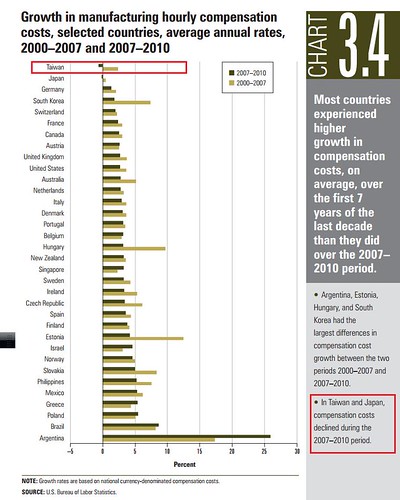
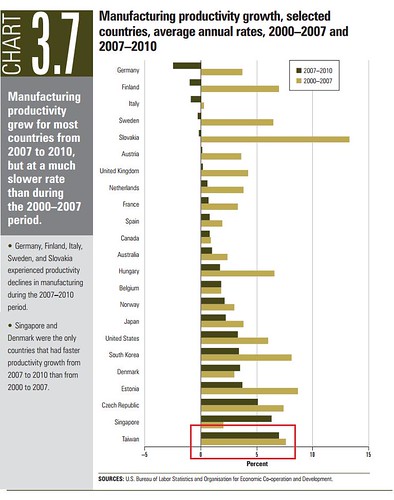
This means that the government can hold wages down without appearing to, simply by lowballing the CPI. Theoretically, wages will always remain the same relative to prices, which means that laborers will never be able to capture a larger share of the pie, at least while the Ma government is in office. Since 2007 and especially since the Ma Administration came to power, wages have regressed while productivity has boomed. Taiwan's gap between CPI changes and wage changes was the highest in the world in 2010. The Ma government wants to freeze this historically anomalous situation and treat it as the norm. The struggle for control of Taiwan between the pro-China and pro-Taiwan sides really masks the brutal and ongoing defeat of Taiwanese workers economically; it enables both parties to enlist workers on their side via their tribal social identities while screwing them out of their rightful livelihood.
_______________________
Don't miss the comments below! And check out my blog and its sidebars for events, links to previous posts and picture posts, and scores of links to other Taiwan blogs and forums!

Tuesday, August 13, 2013

Economic Round Up: Beijing to strip Taiwan banks?

So hot on the east coast this weekend, everyone is taking a dip.

With President Ma away on a foreign trip, FocusTaiwan provides some of the most recent numbers on Taiwan's economic situation....
Taiwan's exports usually post strong growth in July, but that was not the case this year. A rare monthly decline in exports was recorded in July and the annual export growth rate for the month was also lower than expected.

Even though exports rose 1.6 percent year-on-year, the growth rate fell far short of expectations, said Liang Kuo-yuan, director of Polaris Research Institute.

....

Taiwan recorded a rare 0.9 percent annual decline in exports to China and Hong Kong in July, according to customs statistics.

Another factor that affected exports in July was the 7.7 percent drop in the export of information and communication technology (ITC) products, Liang said.
According to the articles FocusTaiwan collected, Taiwan's July exports fell 4.4 percent from June but increased 1.6 percent year-on-year. In June exports had annualized growth of over 8%. A huge chunk of growth was due to mineral exports, which grew 20%, with the steepest decline in capital goods. Another signal of bad times to come: imports from the US and Japan both shrank over 15%. Since those two countries are Taiwan's most important sources of production technology and raw materials, shrinking imports should mean that producers are planning to produce less.

The Taipei Times published an excellent editorial on the economy the other day. It noted:
Taiwan’s economy lost steam again last month after exports shrank 4.4 percent month-on-month to US$35.3 billion, data released on Wednesday by the Ministry of Finance showed. That brought the nation’s exports up just 2.3 percent during the first seven months to US$175.74 billion from a year ago.

....

Taiwan’s exports to six emerging countries, including Malaysia and five other ASEAN members, showed robust growth as reflected by an annual growth of 7.3 percent in exports to US$33.45 billion in the seven-month period ending on July 31.

That makes ASEAN countries Taiwan’s second-biggest export destination, surpassing the US, Europe and Japan.

In fact, ASEAN seized the No. 2 position in 2007, when exports to those countries grew at an annual rate of 16.7 percent, outpacing China’s 12.6 percent expansion based on the statistics compiled by the Ministry of Finance.
Facts like these show the retrograde nature of Ma's go-China policy in its full light: it actually refocused Taiwan away from cultivating growing markets abroad to a stronger focus on the China market. You could hardly ask for a better strategy for Taiwan if you were an economic planner in Beijing looking at a Taiwan that was competing with your exports to the ASEAN area. I'm sure it is just a coincidence.

The services pact with China was totally ripped by Huang Tien-lin, President of First Commercial Bank, in the Taipei Times....
Why do I say this is the beginning of a disaster? You need only look at how enthusiastically the financial services industry has flocked to China. Confucius said: “Going too far is as bad as not going far enough” (過猶不及). This is a sentiment deemed fundamental to economists and yet, even now, there are many financial holding companies preparing to increase their investments in China and plough billions into local banks, mergers and acquisitions, and stocks and securities, and opening overseas branches in Fujian Province.

Initial estimates suggest that Taiwanese banks have either already transferred, or are preparing to transfer, not less than NT$160 billion in core capital to China. This is another example of integration with China that will surely see the further marginalization of Taiwan, just as the exodus of Taiwanese manufacturing to China did in the past.

Closely related to this is the deregulation of Chinese yuan deposits in February that, in the short four-month period to the end of June, has seen the accumulation of more than NT$360 billion worth of Chinese yuan in domestic and offshore accounts. This figure is increasing at the rate of NT$50 billion per month, giving a projected annual increase of NT$600 billion, a rate and amount equivalent to half Taiwan’s average annual increase in national M2 deposits — NT$1.2 trillion — in the decade from 2001 to 2011.

What is the purpose of accumulating all these yuan deposits? Naturally, they are to be used for providing financial services in China. This increase in credit financing in China means squeezing the amount of credit available to be extended in Taiwan.
Credit is a key driver of economic growth, the lubricant of a healthy economy. As Huang notes, the money flows not only will reduce investment on this side of the Strait, but also threaten Taiwan politically and socially by increasing the exposure of local banks to China's increasingly slowing economy. This "financial integration" has long been an important goal of China precisely because its political effects are so powerful. Unlike the US, Taiwan cannot simply print an enormous pile of money and save its banks. Debts owed to Taiwan banks give China additional leverage over Taiwan -- both directly: "Submit! Or we won't pay up!" -- and indirectly, since bank officials are likely to pressure the government to further align itself with Beijing in order to protect themselves from the consequences of the coming overexposure. Not that they aren't already.

Consider also: Taiwan's truly wealthy keep their wealth parked overseas or in land; savings in local banks are likely to be held by middle class and upper middle class individuals. It is they who will suffer if and when Taiwan's overexposed banks are punished by huge losses in China.

The move to China by the banks comes at a time when private domestic investment is moribund. The Economic Daily News observed:
According to the Directorate General of Budget, Accounting and Statistics, the increase in consumption was driven by rises in stock transactions and mutual fund fees. This demonstrates that the consumption increase had nothing to do with real consumption.

The rise in net exports, meanwhile, was the result of slower growth in imports, due to slower demand for equipment. Consequently, capital formation contracted 3.03 percent in the second quarter, cutting 0.52 percentage points off overall economic growth.

More worrying still, over the past five years, there have been four years in which private-sector investment recorded negative growth, despite various efforts made by the government to promote investment.
Recall also that Taiwan is not attracting much foreign direct investment; FDI was negative in 2011, positive for 2012 (source). With economic expansion slowing in Japan, and the US and Europe afflicted with austerity madness, it seems Taiwan will continue to suffer from the stupid, self-destructive policies of European and American elites.

Finally, enjoy a well written blog post on the nature of the debates over China, its credit issues, and its growth model from Michael Pettis.
______________
Daily Links:
_______________________
Don't miss the comments below! And check out my blog and its sidebars for events, links to previous posts and picture posts, and scores of links to other Taiwan blogs and forums!

Wednesday, May 29, 2013

Good-bye capital gains tax, we hardly knew ya

One of the many things this mess with the Phils has enabled the government to divert public attention from the drive to eliminate the capital gains tax. As a tax on the wealthy which kicked in when the stock market crossed 8,500, it was odious to the KMT, the island's party of the 1%. In the latest "economic stimulus" package of the government, it will be killed....
One of the measures involved the legislature passing an amendment to the Income Tax Act (所得稅法) before the current session ends on Friday to drop the 8,500-point threshold that automatically triggers the capital gains tax for individual investors, Jiang said.

The Chinese Nationalist Party (KMT) has proposed removing the requirement that the TAIEX surpass 8,500 points for the tax to be imposed and replace it with a tax on investors who sell NT$1 billion (US$33.3 million) worth of shares during one calendar year.

The premier said that abolishing the threshold would turn the economy around because it would be like “lifting the cover off a pot” to let the “suffocated” economy breathe.
Alas, removing the capital gains tax will simply result in more capital being hoarded and then shipped out of the country instead of being reinvested here and driving economic growth in Taiwan. It will only make the rich richer, and Taiwan being so expensive, the poor cannot even console themselves with babies.

UDN rightly complained:
Despite the many steps taken, however, nothing has seemed to work. The latest package focuses on expanding consumer spending, boosting domestic investment, encouraging innovation and new business start-ups, and revising the capital gains tax on stock sales. The content is not at all inspiring because it did not go beyond the existing policy framework.

Moreover, the government is planning to invest a mere NT$3.24 billion over five years in the new package. How can we expect it to rescue Taiwan's weak economy?
Figure it out. In US dollars, $3.24 billion is a little over US$100 million, or $20 million annually for the "stimulus". Peanuts.

According to the TT article, the DGBAS lowered its estimate of growth for the year to 2.4%. Recall that industrial output fell for the third straight month in April, as Bloomberg noted in its roundup of economic indicators.
____________________
Daily Links:
_______________________
Don't miss the comments below! And check out my blog and its sidebars for events, links to previous posts and picture posts, and scores of links to other Taiwan blogs and forums!

Saturday, March 16, 2013

Stanton's Speech at World Taiwanese Congress, Complete

Dusk over Taichung.

The Taipei Times ran an article today on former AIT head William Stanton's speech at the World Taiwanese Congress in Taipei: Taiwan increasingly leaning towards China.
Taiwan is actually increasingly leaning toward China, he said, and the “status quo,” as perceived by Taiwanese, was “problematic” and “an illusion,” given that China is growing ever stronger and Taiwan is increasingly dependent on China economically.

Taiwanese cannot unilaterally decide the development of cross-strait ties, Stanton said at the annual meeting of the World Taiwanese Congress in Taipei, adding that how much patience China shows toward maintaining the “status quo” remains a question if bilateral relations do not proceed the way China sees fit.
Stanton was kind enough to permit several of us to post it on the web. Below the READ MORE link is the speech in its entirety. Great job, sir.

Saturday, February 02, 2013

Pension Contention

The island of contention is in tension over public pensions with protests, criticisms, public discussions, and the like. Lots of stuff for the media to print. This week the military even slyly alluded to a legislator's affair in order to shut him up after he criticized retired military for double-dipping even though they have relatively good pensions. Yes, you know when spokesmen for the ROC's stuffy military are making veiled references to sex in KTVs, there's something serious going down.

This week President Ma released his plans to "reform" the pension system to prevent bankruptcy. The government claims that the system will go bankrupt sometime after 2019 if nothing is done about it. The president proposed:
  1. When the years of service and the age of an individual add up to 90, they can retire from the civil service. For example, if you are 60 and have 30 years of service, you can retire. The current system demands only 85. 
  2. Police and firefighters excluded from the new system, while everyone else gets a 10 year grace period.
  3. Retirement income limited to 80% of their final income. 
  4. Lowering the 18% preferential interest rate enjoyed by certain individuals to 9% in a few years. Another article stated:
    Under the plans, the 18 percent preferential savings rate would be cut to 12 percent in 2016, with a decrease of 1 percentage point every year afterward until 2020, when the rate is to be replaced with a floating interest rate.

    The floating interest rate is to be calculated by adding 7 percent to two-year certificate of deposit (CD) rates at the Bank of Taiwan, with a ceiling of 9 percent.
  5. A three-tier pension plan for civil servants.
The DPP criticized the plan as "chaotic" and laughed at Ma for piously giving up his 18%. In fact, if you peer closely, the KMT Administration reforms addressed KMT core constituencies. The Labor Insurance system is also being changed, after boneheaded investments cost it millions (here). The DPP has its own plan, raising the retirement age for civil service workers all the way to 65 by.... 2027. The DPP also wants to see the government pensions come into line with private ones. An article a couple of years ago in the Taipei Times observed:
Under Taiwan’s system, military personnel, public servants and teachers only have to work for 25 years and reach the age of 50 before they can retire. Because 25 plus 50 equals 75, some call it the “75 system.” These retirees draw a monthly pension equal to 100 percent of their salary, and they receive it for the rest of their lives. This may well be the most generous retirement pension scheme in the history of the world — even the Greeks must be envious. Taiwan’s military personnel, civil servants and teachers pay just 7 percent of their salaries for labor insurance payments, about the same as Greeks pay, and much less than the 10 percent paid by Germans.
Since government workers in the martial law era were more or less required to be KMT members and for many years after were heavily KMT members, the large civil service pensions represent a transfer of wealth from the productive private sector, predominantly Taiwanese, to the KMT and its mainlander dependents. Taiwan remains, in many ways, a colony.

Speaking of colonization, the 18% interest rate has long been a bone of contention. I posted on it a couple of years ago:
The problem is that the 18% interest is paid jointly, half from the central bank and half from the counties. The counties must raise the money on their own. These funds thus represent an additional tax on the local areas, which must be paid out of funds that could have gone for roads, schools, or parks. It goes without saying that most of the county governments in Taiwan are flat broke. It is thus not a coincidence that the indebted areas, Tainan, Pingtung, and Yunlin, are all hotbeds of Taiwan nationalism.
Say General Chen retires from the military and moves to Pingtung. Half of the 18% interest on his retirement funds come from the central bank. The other half Pingtung country has to raise on its own -- by borrowing, inevitably from the central bank. This means that the taxpayers of Pingtung county pay out the nose to General Chen and also to the bank in the form of interest on the debt, reducing county living standards. Thus lowering this rate is a highly popular move.

In addition to their origin in the KMT's wealth extraction schemes, Taiwan's pension problems also have another origin: democratization, as this paper discusses. The DPP and its tangwai predecessors had pushed for a welfare system and a national health insurance system even during the martial law era. In the early 1990s the DPP captured local government positions in part by offering voters subsidies for the aged. However, these were not tied to increased taxes. Inevitably, the money vaults ran dry in a couple of years. These DPP-run local governments then requested bailouts from the central government, run by the KMT, which naturally refused. Since then subsidy offerings have gradually become staples of local political campaigns. By mid-1990s the KMT had awakened to the fact that pensions and subsidies were a good way to buy votes with taxpayer money and to retain their seats. In 1993 the KMT proposed a comprehensive pension scheme for the elderly, and in 1995 the two parties cooperated on an agricultural pension system, which was wisely funded --hard to believe that you can use the word "wise" to describe our legislature -- by a general taxation. Things took off from there....

In all the discussion about pensions, it is wise not to lose sight of some salient facts. This government has done little to address the fundamental and growing income inequality in Taiwan. Part of the reason so many government schemes are underfunded is that Taiwan's wealthy pay relatively low taxes. Thus, the discussion about pension "reform" and "shared sacrifice" simply means that the sacrifice will be meted out among hoi polloi, to be shared among them and not the wealthy. Yet another fundamental fact: Taiwan's hidebound attitudes toward immigration, naturalization, and citizenship mean that there is not a constant infusion of new blood to help propel the economy forward and to support our rapidly aging population. Finally, the island's economic situation has to be addressed in ways that make it more attractive for locals to raise families; no one can have children when housing is skyrocketing in price and incomes are stagnant. Taiwan needs to make broader, deeper changes.
______________
Daily Links:
  • Top Five Taiwan Movies
  • Drew's staggering, awesome ride up the Wu-Ba Highway.
  • US, Taiwan agree to resume TIFA talks on a trade agreement. Now counting down 5...4...3... until some new issue regrettably emerges to [SHOCKER] stop the trade talks. Ractopork? Big Pharma? So many to choose from.....
  • AIT head Raymond Burghardt comes to Taipei to discuss "security issues." I bet someone got an earful about the Senkakus. Burghardt said that the US was committed to beefing up Taiwan's security.
  • Economic growth up Y-O-Y in the final quarter of 2012
  • Taiwan nearing FTA with Singapore.
  • South China Morning Post: Jiang appointment as Premier may revive Ma's low popularity. The government denies this is the case and its sticking to its story that it was Chen's health. However, the major media are all reporting it as a move to shore up Ma's popularity. The SCMP article has Jiang wrongly described. He was not "the island's research director" but director of the RDEC, the Research, Development, and Evaluation Commission. Its purpose is implementation and evaluation of policy and its head is equivalent to a cabinet minister; it is the most influential agency you never heard of. In the ROC system the central, provincial, and municipal governments all have their own RDECs. Head of the central government RDEC, a position that gives wide familiarity with government policy, was a position also held by Ma Ying-jeou before he held a cabinet position. Will Jiang follow the same path to power?
_______________________
Don't miss the comments below! And check out my blog and its sidebars for events, links to previous posts and picture posts, and scores of links to other Taiwan blogs and forums! Delenda est, baby.