Friday, April 14, 2006

Peking Duck on Chinese Diplomacy

The Duck had a great one the other day on China's Charm Offensive, in relation to an KHT article:

The bottom line is this: Lin said this was exactly correct. There are two Chinas and they exist in separate universes. Now, this is not any great revelation. We've discussed it here many times, especially in regard to local officials who are free to act at whim with no fear of respite or justice, existing literally in a universe apart from The central Party. Lin said the great paradox here is that despite Hu's awesome power, he is literally helpless to make any changes in China's domestic situation, only in its foreign policy (which, granted, can then in turn affect China's domestic situation).

So I've been thinking about this paradox all week. Should we admire Hu Jintao as the Bismarck or Metternich of his time, using political skill to achieve enviable results? Or should we laugh at him for being utterly impotent to effect any meaningful change in the country over which he allegedly rules? If he is so utterly incapable of halting corruption, of freeing the innocent, of enforcing the law, of imprisoning unabashed scoundrel and murderers, why6 does he even live in China? Couldn't he set up a condo in Bermuda and run China's foreign policy from there? What difference does it make? According to Lin, he's literally irrelevant to China's domestic situation.


Thursday, April 13, 2006

Poor Spelling Dooms Taiwanese Heroin Mule

Somewhere out there one of you cram school teachers failed your students....


When the officer picked up the dried fruit peels, it felt heavier than usual. Upon further examination, it was discovered that the translation of the product on the package was "Cnan" instead of "Chan." The female was taken into a room for interrogation. The officer asked her why she was bringing so many bags of dried fruit peels into Hong Kong, she said that she liked eating them. The officer opened up one bag and observed that the female became very nervous. When he opened up one of the wrapped dried fruit peels, he stripped away the paper wrappings and examined the contents carefully. The dried fruit peel was larger than normal. Upon peeling off the outer layer, he saw a white object instead of the usual seed. The 8-gram object was taken to the laboratory for testing and found to be pure Number Four heroin.
As ESWN pointed out, the case was cracked when the misspelling was noticed...

The First Formosan in Europe....

Kerim at Keywords turned me on to this great post at Savage Minds about the First Formosan in Europe -- a European fraudster....

Sometimes I stumble upon a link that forces me to drop all of my work and
shift my focus entirely. Such was the case when after lunch I learned of
George Psalmanazar, "the first Formosan to visit Europe."

"In 1704, Psalmanazar published a book An Historical and Geographical Description of Formosa, an Island subject to the Emperor of Japan which revealed a number of strange habits. Formosa was a prosperous country of wealth with capital city called Xternetsa. Men walked naked except for a gold or silver plate to cover their privates. Their main food was a serpent that they hunt with branches. Formosans were polygamous and the husband had a right to eat their wives for infidelity. They executed murderers by hanging them upside down and shooting them full of arrows. Annually they sacrificed the hearts of 18,000 young boys to gods and priest ate the bodies. They also used horses and camels for mass transportation. The book also
described the Formosan alphabet. Of course, it was all a hoax."

In fact, I came across it via this Ishbaddidle post linking to the 10 Greatest Impostors in History.


Interesting stuff!

Conference: GDPism and Risk

Hot on the heels of my post on Taiwan's economic woes comes this conference via H-Asia:

+++++++++++++++++

H-ASIA
April 12, 2006

CFP "GDPism and Risk" University of Bristol, UK, July 12-13, 2006

From: _maurizio.marinelli@BRISTOL.AC.UK_
(mailto:maurizio.marinelli@BRISTOL.AC.UK)

** Conference Announcement & Call for Papers **

The Third EASP International Conference on:

'GDPism and Risk: Challenges for Social Development and Governance in East Asia'

Hosted by:
Centre for East Asian Studies, University of Bristol, UK
East Asian Social Policy Research Network (EASP)

Co-organized by:
University of Bristol, School of Policy Studies
Kwansei Gakuin University, Japan
Governance in Asia Research Centre, City University of Hong Kong
Department of Social Work and Social Policy, University of Hong Kong
Department of Social Policy and Social Work, National Chi Nan University,Taiwan
Department of Social and Policy Science, University of Bath, UK

Supported by:
Comparative Social Policy Network, Korea
Social Policy Studies Network, Japan

Date: 12 - 13 July 2006
Venue: University of Bristol, UK
Duration:Two days

Call for Papers:

Papers are invited which address the overall theme 'GDPism and Risk: Challenges for Social Development and Governance in East Asia' and the sub-themes as below. Papers may be comparative, or case studies which have broader implications for other East Asian countries or/and for the development of theory and of research methods.

-Economic Growth and Risk Society
-Dynamics of Welfare Regimes in East Asia
-Rebuilding the Responsibility of Care Work
-Poverty, Unemployment and Social Policy
-Challenges for Governance and Changing Regulatory Regimes
-Public Intellectuals and Policy Making
-Natural Disasters and Human Vulnerability

Submission of abstract, full papers, and contributed papers:

Those wishing to present in the conference should submit a 250-300 word abstract to the EASP (easpconferences@gmail.com) by 30th April 2006. Information enclosed with your abstract should include: title of paper, your name, institution and email address. The final papers and contributed papers should be
submitted to the same address by 16 June 2006.

Keynote Speakers:

-Professor Shuan Breslin, University of Warwick, UK. (confirmed)
-Professor Paul Wilding, Emeritus Professor of Social Policy,
University of
Manchester. (confirmed)
-Professor Li Qiang, Dean, Faculty of Humanities and Social Sciences,
Tsing
Hua University, Beijing China
-Professor Jeff Henderson, Institute for Development Policy and
Management,
University of Manchester, UK
-Professor Tatsuo Oyama, Vice President and Dean, National Graduate
Institute for Policy Studies, Japan
-Professor Ian Gough, Department of Social and Policy, Deputy
Director,
ESRC Research Group on Wellbeing in Developing Countries (WeD)
University
of Bath, U.K.
-Professor Mari Osawa, University of Tokyo, Japan
-Professor Byung-Hyun Park, Pusan University, South Korea


Publication Plans:

Selected papers from the conference will be sent out for academic review and high quality papers will be published as edited volume in the newly launched Bristol-Routledge Book Series: Comparative Development and Policy in Asia: Co-edited by Professor Ka Ho Mok and Dr. Rachel Murphy and Co-published by
Centre for East Asian Studies, University of Bristol and London Routledge.

Further Information:

Details of the conference registration and all papers will be made available on the EASP website (www.welfareasia.org). For further information or comments, please contact Emma Holland (Emma.Holland@brsitol.ac.uk),
Prof Ka Ho Mok
(KH.Mok@bristol.ac.uk) or
Young-Jun Choi (y.j.choi@bath.ac.uk).

Conference Website:

http://www.bris.ac.uk/ceas/events/conferences/gdp.shtml

Dr Maurizio Marinelli
MSc Program Director and Senior Lecturer
Centre for East Asian Studies
University of Bristol
Bristol, UK
_maurizio.marinelli@bristol.ac.uk_
(mailto:maurizio.marinelli@bristol.ac.uk)

Income Inequality and the Political Economy of Taiwan

Taiwan News reports on an important roundtable that explains why Taiwanese are so dissatisfied with Taiwan's economy despite steady economic growth.

The "Taiwan Miracle" was marked by two unusual phenomena. One was the high growth rates, and the other, high income equality. These were driven by Taiwan's powerhouse small- and medium-sized enterprises (SMEs). Ignored by the government and supported by an elaborate underground financial system, they turned Taiwan into a byword in political economy circles.

However, as the economy formalized and large companies began to dominate during the late 1980s and 1990s, the miracle, like so many of Taiwan's businesses, moved to China, and income inequality began to rise as the service economy grew. Former President Lee Teng-hui's speech, read out at the roundtable, identified this problem (translation from Taiwan News):

To be frank, the performance of Taiwan’s economy in recent years really makes people worry. The economy posted some growth, but the people usually don’t perceive any gains from this growth. The pace of growth lags far behind that of South Korea, which is in the same stage of development, and other neighboring Southeast Asian countries. Looking at per capita gross domestic product for instance, Taiwan had per capita GDP of US$10,200 in 1992, while South Korea’s stood at US$7,195. But by 2004, South Korea had overtaken Taiwan with per capita GDP of US$14,098, compared to Taiwan’s US$13,260. Why would things turn out that way? This is the key topic that we need to discuss at today’s All People’s Economic Development Conference.

Lee goes on to say:

We must further point out that over the past few years, Taiwan’s economic development has not only been far from ideal, but even worse, the average citizen has not gotten the impression that our income has increased. Their impression is borne out in reality. According to figures issued by the Directorate-General of Budget, Accounting and Statistics in February, Taiwan’s actual normal salaries saw 1.28 percent negative growth last year. This was not only the second consecutive year of negative growth, but also the sharpest decline ever. According to figures released by the government, Taiwan’s GDP grew at a rate of 5.7 percent in 2004, and 3.7 percent last year. With such growth, how can it be that salaries fell for two consecutive years? It is very obvious that the purchasing power of Taiwan’s average citizen is also on a steady decline.

Is this phenomenon unique to Taiwan? If we compare wages in 2000 and 2004, actual wages in South Korea’s manufacturing industry rose 27.64 percent (during that period), while Taiwan’s rose only 2.7 percent. This means that South Korea had wage hikes that were ten-times higher than in Taiwan. When we look at these figures, we can say very bluntly that economic growth over the past few years has essentially been shared by only a minority of people rather than by everyone.

Taiwan is actually suffering from the US problem -- the rich get richer at the expense of the middle and working classes. In the US that is partly the result of structural changes in the economy, and partly the result of two decades of class warfare on behalf of the wealthy, but in Taiwan it appears to be a structural feature of the national economy:

The results of Taiwan’s “go west” experience cannot compare with the results of South Korea’s strategy of investing at home. South Korea’s accumulated investment in China reached only US$20 billion by the end of 2004, accounting for just one-tenth of Taiwan’s China investment. South Korean investment in China has, however, slightly increased over the past two years. And aside from the past two years when South Korea invested somewhat more in China, South Korea’s economy performed better than ours every year with its average per capita GDP also exceeding ours. Just because South Korea’s enterprises are using China’s resources, they are not stuck in China for the rest of their days. Also, the technological level and international competitiveness of South Korean enterprises is better than ours.

Even more frightening is that South Korea last year exported goods worth US$76 billion to China, exceeding Taiwan’s US$74.1 billion in exports to China. In the past, many scholars swore by the idea of “generating exports through investment,” which meant “generating Taiwanese exports through investment in China.” This policy clearly loses out against the South Korean experience of “investing at home, growing roots at home, and promoting exports.”

Using China’s cheap resources to raise international competitiveness, this blind “go west” strategy has only encouraged our manufacturers to pursue a competitive strategy of cost reduction and going for quantity to prevail in the market. More so it has triggered vicious price-cutting competition among fellow manufacturers so that profits shrink by the day. Therefore an active opening policy is not only unable to raise enterprises’ business performance. Giving free reins to the “go west” trend will make manufacturers aim solely for low costs, while neglecting the upgrading of basic technology and quality. That way they will naturally not be able to build their own brands and gradually lose competitiveness internationally.


Lee, whose doctoral thesis on Taiwan is about capital flows, does not mention it in his speech, but an important structural difference between S. Korea and Taiwan is the existence of chaebol, or business conglomerates. The economy of S. Korea is structured around large agglomerations of business whose activities are coordinated with the government and who receive its protection and support. In Taiwan, export growth has been driven by the activities of SMEs, who have weak links to the government, who are not supported or guided by it, and who do not listen to it (as the vast quantities of illegal investment in China show). Taiwan's government has had policies to encourage the growth of certain industries since the 1980s, but these have had mixed results. The result of the two different economic structures is that S. Korean firms invested at home, whereas Taiwan shifted its seed corn to China, damaging its future and slowing its economic growth:

Capital outflow will eat into domestic investment, causing a slump in domestic industries and an outflow of capital that used to be abundant in the past. In 2003, Taiwan’s domestic investment accounted for just 16.3 percent of GDP, failing to reach 20 percent for the third year in a row. In contrast, South Korea always kept a domestic investment level of 25-26 precent (of GDP), and in Japan that figure stood at 23-25 percent. As a result of insufficient domestic investment, domestic economic activity has weakened, factory closures are increasing, the unemployment rate is rising, and domestic consumption growth is on the decline so that the entire national income is of course unable to rise. On top of that manufacturers do not invest enough in R&D so that product competitiveness declines, which forms a vicious economic circle that is hard to break.

A research report on the link between “Taiwanese investment in China” and the “unemployment rate” found that the higher the proportion of Taiwanese investment in China, the higher the unemployment rate and the wider the family income gap. The fact that there is a direct relationship between the two proves that there is a link between the negative growth of substantive normal salaries last year and two years ago and Taiwanese manufacturers’ going west to China. This is also the major reason why the government is unable to gain the support of the people as nowadays the entire working population strongly feels stress and fear over the possible losing of their jobs.


These problems do not admit of an easy solution. It should also be obvious that the pan-Blue "It's all Chen's fault!" and the talk of the "recession" are all wrong. It is not Taiwan's economic growth that is the problem. It is rapidly rising income inequality and the hollowing out of the island's industrial base, along with the rise of the service economy, that has ordinary Taiwanese feeling like hamsters on an treadmill whose speed is constantly increasing. Neither party seems to have a firm grasp of the situation, nor a set of programs to address the issue.

Stumbled Upon on Net.....

A great overview of the history of car bombings, which started in the USA, of all places....

On a warm September day in 1920, a few months after the arrest of his comrades Sacco and Vanzetti, a vengeful Italian anarchist named Mario Buda parked his horse-drawn wagon near the corner of Wall and Broad Streets, directly across from J. P. Morgan Company. He nonchalantly climbed down and disappeared, unnoticed, into the lunchtime crowd. A few blocks away, a startled postal worker found strange leaflets warning: "Free the Political Prisoners or it will be Sure Death for All of You!" They were signed: "American Anarchist Fighters." The bells of nearby Trinity Church began to toll at noon. When they stopped, the wagon -- packed with dynamite and iron slugs -- exploded in a fireball of shrapnel.

"The horse and wagon were blown to bits," writes Paul Avrich, the celebrated historian of American anarchism who uncovered the true story. "Glass showered down from office windows, and awnings twelve stories above the street burst into flames. People fled in terror as a great cloud of dust enveloped the area. In Morgan's offices, Thomas Joyce of the securities department fell dead on his desk amid a rubble of plaster and walls. Outside scores of bodies littered the streets."

Buda was undoubtedly disappointed when he learned that J.P. Morgan himself was not among the 40 dead and more than 200 wounded -- the great robber baron was away in Scotland at his hunting lodge. Nonetheless, a poor immigrant with some stolen dynamite, a pile of scrap metal, and an old horse had managed to bring unprecedented terror to the inner sanctum of American capitalism.

His Wall Street bomb was the culmination of a half-century of anarchist fantasies about avenging angels made of dynamite; but it was also an invention, like Charles Babbage's Difference Engine, far ahead of the imagination of its time. Only after the barbarism of strategic bombing had become commonplace, and when air forces routinely pursued insurgents into the labyrinths of poor cities, would the truly radical potential of Buda's "infernal machine" be fully realized......
Enjoy....
A slow week, newswise, so bad that I was actually considering blogging on Li Ao's perpetual self-promotion machine. Fortunately the dogs needed feeding and the urge soon passed.

One welcome development this week was the decision by the President and the First Lady to sue some KMT loudmouths over claims of corruption in the First Family:

President Chen Shui-bian (陳水扁) and first lady Wu Shu-chen (吳淑珍) formally filed a lawsuit yesterday against a Kuomintang legislator over claims that the couple had accepted a political contribution and commissions from a man convicted of corruption.

Attorney Ku Li-hsiung, who is representing Chen and Wu, said that the accusation was false and was an attack on the couple's reputation. He said that Chen and Wu would be prepared to appear in court in necessary to clarify the matter.

Kuomintang Legislator Lee Chuan-chiao (李全教) at a press conference Saturday accused Chen of accepting a contribution of NT$1 million from Liang Po-hsun (梁柏薰), and said Wu received NT$8.8 million in cash coupons from Sogo Department store as a commission on a transfer of operations deal.

Wu has spent thousands of New Taiwan dollars in cash coupons at the department store, Lee charged.


Such charges are constant around here, and for years I've been wishing that the President would sue in many of these cases. It is not good for Taiwan's political climate that people are allowed to say whatever they like without putting forwarding evidence -- the mere claim, for many, amounts to evidence. Here's the "evidence":

Lee maintained that he would provide evidence to prove his accusations in court, but said yesterday that a woman surnamed Huang saw Wu's daughter Chen Hsing-yu (陳幸妤) and son-in-law Chao Chien-ming buying expensive bedding with cash coupons at a SOGO department store on October 29, 2002. Lee, however, did not produce any direct evidence to prove that the cash coupons were from the batch issued in the NT$8.8 million "commission."

No connection to the First Lady, either. "A woman says she saw your daughter using expensive coupons, so you must be on the take." Logic only a pan-Blue supporter could love. As Maddog reminds below, lets not forget Diane Lee and a case of mistaken identity that caused grave harm.

Why are these sensationalistic charges appearing now? Maddog notes in the comments on a recent set-up of a judge here by the tabloid rag Apple Daily:

Having said all that, I'll believe there was an "affair" when there's evidence. For now, it's part of the same story as the "backwards" flag: an attempt to distract the public from Ma Ying-jeou's slip'n'slide into the political abyss.

Lest we forget Diane Lee and Twu Shiing-jer!


The KMT hopes to make the public forget how bad Chen made Ma look in the recent Chen-Ma meeting. Whatever the particular impetus, the steady flow of vapor and vitriol directed at Chen deserves a slap back. Let's hope for success for the President and First Lady, one that will induce a more rational and public oriented political discourse by one and all.

UPDATE: Echo notes in the comments:

IMO, diluting the impact of Bian-Ma Meeting might not be the reason Lee Chuan-chiao (李全教) puts all his effort in for.

He is aiming himself at the upcoming election of Kaohsung Mayor, in which the competition is much tougher this year than ever. He is trying whatever he could to push himself under the spotlight, at all cost.
There are so many KMTers running for Kaohsiung mayor, I can't keep track of 'em!

Avian Flu Volunteer Program

Taiwan's CDC is apparently erecting a volunteer program through local community colleges around the island to train volunteers to educate the public about avian flu, reports Taiwan News.

Volunteers needed

The Cabinet-level Department of Health said yesterday that it is soliciting 100,000 volunteers to educate the public on how to prevent avian flu.

Shih Wen-yi (施文儀), deputy director of the DOH's Center for Disease Control, said the new project will start with 25 community universities around the country to deepen anti-bird flu education.

To prevent an avian flu outbreak in Taiwan, the CDC is working out strategies to strengthen quarantine measures on people and goods entering the island, medical care systems and community anti-bird flu education, Shih said, expressing hope that more people will join the campaign to promote anti-bird flu knowledge.

The CDC's home page is here. I sent an email to them asking if foreigners can volunteer, and offering my pudgy, balding services.

Wednesday, April 12, 2006

Towels: Taiwan invokes WTO system against China

The Financial Times is reporting that for the first time, Taiwan is going to exercise its WTO options against a Chinese import:

Taiwan said on Tuesday it planned to increase tariffs on towels imported from China to protect its local industry, the first so-called safeguard measures imposed by the island against Chinese products since the two sides joined the World Trade Organisation.

.......

The International Trade Commission, a body under the Ministry of Economic Affairs, said on Tuesday it had decided to recommend to the government that higher tariffs be imposed on certain towel products from China, but had not yet determined the exact tariff rate.

"Such import relief measures are intended to make up for damage caused by sudden import surges, therefore the tariff level has to be reasonable," said Huang Chih-tien, an ITC member. The Commission is to determine the tariff rate in another meeting on Friday.

The safeguards move came in response to a petition filed by a local industry group, which demanded that tariffs on Chinese towels – currently at 4.5 per cent – be raised to 189 per cent for three years or that import quotas be imposed.

Last month, the ITC found that an import surge from China had indeed caused market disruption at home. This is enough to allow for safeguard measures. But the government fears that meeting the towel makers' demands too easily would open a pandora's box of calls from other industries for protectionist measures against China.

Taiwan opened its market to towels produced in China in February 2002. Since then, local manufacturers' share of the domestic market has been halved from 16 per cent to 8 per cent while Chinese producers have grabbed 69 per cent, according to the Taiwanese government. Of the more than 400 Taiwanese towel manufacturers that existed a decade ago, only 78 are left, employing no more than 1,000 people.
Given the complex relations between the two economies, and the vast economic damage China can do to Taiwan, perhaps saving 1,000 towel industry jobs isn't that good an idea. Maybe the government simply intends for the WTO to kill the suggestion, thus saving it from local opprobrium.

Tuesday, April 11, 2006

Chinese Historical Review, Spring 2006 Issue

The Spring volume of the Chinese Historical Review offers two articles on Taiwan I'd love to read. It's actually published out of my alma mater, IUP...

+++++++++++++

H-ASIA
April 11, 2006

The Chinese Historical Review, Volume 13, Number 1 (Spring 2006)

From: Pan@Oswego.edu

Special Issue on Changing Perspectives on China's Pursuit of
Modernity in the Twentieth Century

*Introduction to Special Issue / Shiwei Chen

Articles

* China's Unbalanced Sex Ratios: Politics and Policy Response / Yanzhong Huang and Dali L. Yang
* An Institutional Approach to Women's Political Participation in China / Fubing Su
* The Ignored Efforts: Building a Foundation for Taiwan's Industrial Development, 1945-1952 / Linsun Cheng
* The Historical Narrative and Taiwan Identity: The State Sponsored Historical Enterprise in Taiwan in the 1950s and 1960s / J. Megan Greene
* Colonialism, Nationalism, and Difference: Reassessing the Role of Hong
Kong in Modern Chinese History / John M. Carroll
* The China International Famine Relief Commission and the Rural Cooperative Movement in China, 1923-1934 / Yixin Chen
* Rethinking May Fourth: The Vernacular Literary Movement in Wartime Chongqing / Kan Liang
* Chinese Intellectuals and Chinese Perceptions of the United States during the George H. W. Bush Administration, 1989-1992: A Case Study of CAAS Scholars / Niu Dayong

Book Reviews
* Yao Ping. Tangdai funu de shenghuo licheng (Lives of Tang Women) / By Cong Zhang
* Henrietta Harrison. The Man Awakened from Dreams: One Man’s Life in a North China Village, 1857-1942 / By Guoqiang Zheng
*Ann Heylen. Chronique Du Tourmet-Ortos: Looking Through The Lens of Joseph Van Oost, Missionary in Inner Mongolia (1915-1921) / By Tsing Yuan
* Michael Marme'. Suzhou, Where the Goods of All the Provinces Converge / By Kristin Stapleton
* Wang Xuedian. 20 shiji Zhongguo shixue pinglun (Essays on 20th century Chinese historiography) / By Q. Edward Wang

Journal Exchange Corrections

Articles appearing in this journal are abstracted and indexed in HISTORICAL
ABSTRACTS and AMERICA: HISTORY AND LIFE

For more information about The Chinese Historical Review and its subscription and submission policy, please visit: http://www.chss.iup.edu/history/chr/

Taiwan Surfer Group Blog

Those of you into surfing might want to meet up with these wild ones...

pointyhat boardriders

Taiwanese Businessmen Forced to Attend Lien-Hu Lovefest in China

Lien Chan is meeting President Hu of China beginning on Friday, ahead of Hu's trip to the US. The CCP and the KMT could hardly be more open about their cooperation. Taiwan News observes of the meeting:


Thanks to the enthusiastic participation by the KMT, the forum also provides Hu with ample ammunition in his upcoming summit with United States President George W. Bush on April 20 to blame the continuation of the cross-strait stalemate on the "unilateral refusal" of President Chen and the DPP government to engage in cross-strait talks.

Naturally, Hu will make little or no mention of the PRC's imposition of the precondition of Taipei's prior acceptance of Beijing's "one-China" principle, and thus the political surrender of our sovereignty, in exchange for the resumption of the suspended quasi-official consultations.

Despite Washington's repeated calls for the Beijing leadership to talk to Taiwan's duly-elected government and its leader, the PRC government insists on bypassing the DPP administration and dealing with only with their former foes and newfound allies in the opposition pan-KMT camp, whose power-hungry leadership is more than happy to accept Beijing's arrogant precondition.

This is a pretty good reading of what will happen. The Taipei Times reports that the regime is forcing Taiwanese businessmen in China to attend the Lien-Hu Lovefest:

China is forcing Taiwanese businesspeople to attend an economic summit between the Chinese Nationalist Party (KMT) and the Chinese Communist Party (CCP), a top Mainland Affairs Council official said yesterday.

Council Chairman Joseph Wu (吳釗燮) confirmed yesterday that Taiwanese businesspeople are being pressured to attend a two-day forum on cross-strait trade to be held by the Chinese Communist Party (CCP) and the Chinese Nationalist Party (KMT) that opens on Friday. Wu urged the KMT not to touch on issues that involve governmental authority.

The Chinese-language Liberty Times (the Taipei Times' sister newspaper) reported yesterday that the Taiwan Affairs Office (TAO) of China's State Council had issued an order to the heads of more than 80 Taiwanese business associations in China to attend the forum.

The office warned that failure to comply would result in stiff penalties, the report said.

The office has also ordered Taiwanese businesses nationwide to mobilize in Xiamen and Shanghai to greet former KMT chairman Lien Chan (連戰) when he tours those cities before heading to Beijing for the forum, the report said.

Before you all wax indignant at the odious Chinese forcing Taiwanese businessmen to kow-tow to the insufferable loser Lien Chan -- think Beijing will make them address Lien as "President?" -- take a moment and think about what a wonderful development this is. For the first time, the Chinese government is extracting a serious nationwide political price for permitting Taiwanese businessmen to operate in its territory. And it is doing so in a way that has created entirely unnecessary negative feelings:

The Liberty Times report said that many of the associations are angry that they
are being coerced to participate in what they called a meaningless event.

Nothing could demonstrate with greater clarity what China is, and convince Taiwan businessmen that they cannot ignore political issues and operate in China, because China is too caught up its own nationalist expanionism to keep itself from spanking the goose that lays the golden eggs. This alone will not cause the million-odd TaiShang to re-evaluate their investments, their factories, and their second wives. It is, however, the first of many such events that in the long run can only harm China's cause with the very people who support it the most, and the most effectively: the Taiwanese businessmen in China. Today there must be more than one association chief in China scratching his head, wondering what price they will have to pay in the future.

And all because it wants to pretend in front of its own people, in the best Inspector General style, that Lien Chan is really somebody.

UPDATE: ESWN carries the Chinese side of the story, in which Xinhua cites Taiwan businessmen as saying that the story that they were forced to come was laughable. "How can they be punished?" one respondent asked. You'd have to be extraordinarily naive not to be able to answer that question! But the Xinhua story seems plausible too.

Monday, April 10, 2006

Forumosa Gets Moderator Upgrade

"...Wishing to punch his Pimply Face, and Thinking you Shirriffs look a lot of Tom-fools."

Word has reached my shell-like ears that there's a new Sheriff in town in the Taiwan Politics Forums at Forumosa.com:
Taiwan Politics
Topics related to Taiwan and Taiwan/China issues can be discussed here. Threads dealing with Taiwan's history belong in the Culture & History thread. Please do not post articles - use links instead. Quoted sources should be limited to one paragraph in length, or less.
Moderators cranky laowai, Feiren, Chaon, TheGingerMan
No, you're not going insane. You did see that name there: CHAON. That is the self-described Cybernetic Handcrafted Android Optimized for Nullification:


Although, myself, I think it is just a Cryptically Humorous Androgynous Overbearing Nerd. According to rumor, when offered the job, he was struck dumb for almost a second. When not dressed in his Terminator body armor, CHAON looks like this:


Kudos to Maoman for making a very fine moderator selection, and for having the courage and open mind to appoint a critic of this important Taiwan expat forum to the forum management. Looking forward to great things in the Taiwan Politics Forum.....where I'll be posting shortly, just to make sure that Chaon has the required amount of headaches....

The Joy of Adult Students


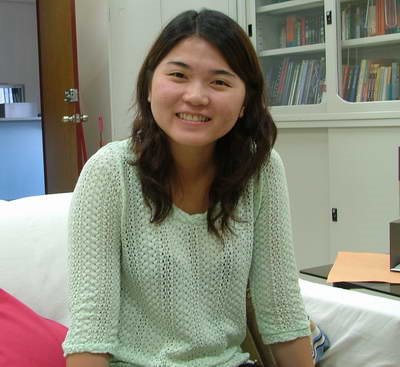
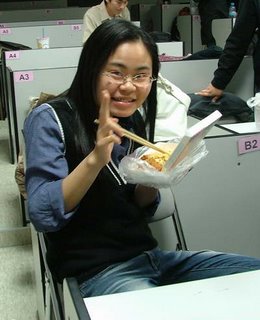
Adult economics class students

It is universally agreed, even by the students themselves, that the adult students I teach at night are lightyears better than the day students in attitude and comprehension. This manifests itself in grades -- the night students, working with the same material, get much better grades than the day students. The result is that the university administration is constantly complaining that our night students receive grades that are too high.


Becky


Charlotte: Why do we always get stuck with the short, fat, balding teachers? Aren't there any that look like Brad Pitt? Lily: Don't even talk to me about it.

The adult students are associate degree holders from two-year programs in the old vocational system, which is currently being phased out with the reforms of the last several years (or maybe not. Taiwan's reform program is a good example of mosaic evolution, in which the resultant creature exhibits a mixture of archaic and advanced traits). They attend another three years of night school, and emerge with a BA degree. Most of them are individuals who have spent some time in the world of work before returning to school to finish their degree. They thus exhibit a higher degree of maturity and dedication. Unless assigned writing homework......


Dana


Godspeed

The contrast was brought home to me by an encounter I had today with S, who came up to take graduate entrance exams for our masters program. She graduated last year having taken several courses from me over her four years. We exchanged hugs and plopped down in the stairwell to chat. Self-judgments being the most fearsome, she told me today that she wished she had gotten more out of her time at Chaoyang. But she was just too immature, she sighed. I keenly felt the lack of absolution I had to offer in my Father-Confessor role, and was reduced to murmuring quiet noises of sympathy for feelings that I could profoundly empathize with. That difference in maturity is why adult students are often far more rewarding to teach than the 18-22 crowd here at Chaoyang. No question -- I adore the young people who populate my day classes, but they can be exasperating students.


Lily


Karen
Another big difference is the variety of adults. The testing system (may its designers be perpetually forced to take tests in the afterlife) and the Ministry sorting system ensure that the student body in any particular department in a given university is more or less uniform in ability, at least in the 18-22 bracket. Though there are broad similarities, your adult classes may contain ex-infantry officers, flight attendants, international salesmen, government functionaries, and others who can bring real-world experience to their university classes.


Ariel


Simon


Denise

Unfortunately university regs permit only 8 hours a week with night classes.......


PS: I posted this mainly so I could experiment with Blogger's photo upload system. If you set to "medium" or "small" size the compression is large and the photos will not look very good if increased to 400 pixels in width so that they fill the main posting area nicely (see photo of Karen or Denise above for (un)clear example of "medium" photo which I have increased to 400 pixels in size). By setting to "large" I got better results (ex: pic of Simon).

Non-Binding Resolution on Allowing Taiwan Leaders into US

Steve Chabot and Sherrod Brown, two longtime friends of Taiwan, are pushing a non-binding "Sense of Congress" resolution to press the US government to allow Taiwanese leaders into the US.

In 1994, Congress passed a law that challenged that policy by allowing Taiwan's president and other high-level officials into the US for talks with officials on a range of issues, including matters of national security, trade and prevention of nuclear proliferation. The Chabot-Brown bill takes note of that law.

"Taiwan is one of the strongest democratic allies of the US in the Asia-Pacific region," the bill states. Yet, while US President George W. Bush in a speech in Kyoto last November praised Taiwan's democracy, that "has yet to be translated into equal treatment of Taiwan's democratically elected leaders ... while allowing the unelected leaders of the People's Republic of China to routinely visit Washington, and welcoming them to the White House."

The bill would end "all restrictions" on visits by Taiwan's president and other top officials, encourage high-level contacts at Cabinet level to "strengthen a policy dialogue with Taiwan's government," and declare it to be "in the national interest of the US to strengthen its links with the democratically elected government of Taiwan and demonstrate stronger support for democracy in the Asia-Pacific region."

The bill, which expresses the "sense of Congress," would not be binding on the administration.

A nice idea. Let's hope we see more like it, and with more teeth.