Sunday, May 14, 2006

Ma Ying-jeou Interview on ABC Radio

China Digital Times pointed me to this interview with Ma Ying-jeou on ABC radio.

HAMISH ROBERTSON: The leader of Taiwan's Opposition has called for a peace agreement with China to defer the independence issue for 30 to 50 years.

The Mayor of Taipei and head of the nationalist KMT Party, Ma Ying-jeou, says Taiwan's Presidential election in 2008 will be a chance to step away from the confrontation policies of the current Taiwanese Government.

Mr Ma, who is expected to be the KMT presidential candidate, says he'll offer to make a new start with China.

But he insists Taiwan will not accept the one country, two systems formula used for Hong Kong.

Instead, he says, a peace deal would give time for China and Taiwan to create an economic common market, and give Taiwan what he describes as "a proper international space".

Correspondents always refer to the KMT as the "Nationalist Party" even though it is the Chinese Nationalist Party. Valuable perspective disappears when that occurs.

GRAEME DOBELL: Is it going to be difficult for you to be elected as President in 2008 if you are seen by some in Taiwan as running as China's candidate?

MA YING-JEOU: Actually, what we're doing now is to find a modus vivendi for Taiwan. In the last six years it's quite clear that the policy of the DPP wouldn't really work. They don't know how to handle the economy, they don't know how to handle Beijing, they don't know how to handle Americans. So I think, by and large, the people in Taiwan hope that there will be a change of government in 2008. And our policy, towards the mainland, is a policy for peace and prosperity. But we also want to preserve Taiwanese dignity and identity.

Dobell did not let Ma control the interview like this Newsweek interview a while back. Here he asks a good question, which Ma quickly blows off. Unfortunately Dobell let him hack on the DPP without demanding a serious response to his question. Note Ma's last statement refers to Taiwanese dignity and identity. Interesting on many levels. It would have been nice if Dobell had asked Ma how he thought the KMT would preserve Taiwanese dignity and identity by annexing the nation to China. Ma also pulls out all stops in answering the last question:

GRAEME DOBELL: Can you overcome China's suspicions though? Can you get China to the negotiating table and get a peace agreement, to take the independence issue off the table for 30 to 50 years?

MA YING-JEOU: This is not something that I created, without their notice or without their knowledge, no. They have known it, and they have agreed, in principle, to have a peace agreement, to have a common market, to discuss international space with us. What I'm trying to do in the five do's, is to extend a little bit further. When I talked about a peace agreement, they didn't talk about a duration. I put 30 to 50 years to it, simply to make it work, okay. And secondly, when I talk about international space, they didn't talk about how I want to go about it. I said we have to work out a modus vivendi to be effective during the duration of the peace accord and then we should go from there, to see what kind of arrangement that would, on one hand, recognise one China. On the other hand, to let Taiwan have the international space it deserves.

Unlike the DPP, Ma has a very good understanding of how to manipulate westerners. Talking vaguely about "international space" and "what Taiwan deserves" and "modus vivendi" are very good ways to hide what an ideologue Ma really is -- notice he still adheres to the one China policy, which reveals that his long-term goal is suppression of Taiwan's international space and local identity. I hope someone calls him on these contradictions and soon.

Also observe that Ma says two things clearly (1) they have already talked to Beijing about this and (2) the 30 to 50 year treaty is strictly for outside consumption:

When I talked about a peace agreement, they didn't talk about a duration. I put 30 to 50 years to it, simply to make it work, okay.

In other words, whatever Ma says, he has no modus vivendi. Beijing wants to annex Taiwan, and it wants to annex it now. It isn't going to wait for some unspecified period in the future.

It is clear that Ma is now working hard to overcome the screw-ups in the States earlier this year, when US conservatives correctly assailed him for being China's man in Taiwan. Ma has a hard row to hoe -- one on hand always making sure Beijing knows his party still serves it, while on the other convincing westerners that he is a moderate, while placating the Deep Blues in his own party who will not tolerate any recognition of Taiwan independence and hate its growing democracy passionately. I expect that Ma will soon commence another round of saying to his own party that he really didn't mean it when he talked about Taiwan's identity and dignity.

Time someone pins down the slippery Mayor Ma.

The Steady Drip-drip of Scandals

The difficulties in promoting change in Taiwan are exemplified by the steady drip of scandals emanating from the ranks of DPP appointees. The latest round involves former Taisugar Chairman and current Financial Supervisory Commission Chairman Kong Jaw-sheng (龔照勝). Taiwan News has the story:

Taiwan's top financial regulator was suspended from duty after being questioned for his alleged involvement in a number of corruption cases while serving as the head of the state-run Taiwan Sugar Corp.

Premier Su Tseng-chang (蘇貞昌) decided to suspend Financial Supervisory Commission Chairman Kong Jaw-sheng (龔照勝) after Kong was summoned as a defendant and then released on bail by the Taipei District Prosecutor's Office on Thursday over alleged corruption. Su had designated FSC Vice Chairman Lu Tung-ying to act on Su's behalf until after Kong's case is settled, according to a press release issued by the Government Information Office.

Kong is the first cabinet member to be suspended for alleged corruption, and he is the latest victim of a number of high-profile corruption scandals under the administration of President Chen Shui-bian (陳水扁).

"After investigators handling the case had interrogated Chairman Kong, they believed there was reason to suspect he had some involvement in this case," Lin said.

Investigators had also gathered evidence from unnamed contractors and spoken to other high-level Taiwan Sugar officials in recent days, Lin said, adding that Kong had been released on bail of NT$500,000.


Kong's office was involved in a scandal in October of last year, when one of the bureaucrats Kong apparently hired was hit by an insider trading scandal. DPP legislators wisely called for Kong's head at that point, but nobody listened:

Earlier yesterday, two Democratic Progressive Party (DPP) lawmakers requested the resignation of FSC Chairman Kong Jaw-sheng (龔照勝), because he had hired Lee.

DPP Legislator Wang Shih-chien (王世堅) called for Kong's immediate resignation, saying that he had made a bad decision in hiring Lee and had done a poor job overseeing Lee's performance.

Wang threatened to launch a signature drive to request Premier Frank Hsieh (謝長廷) to fire Kong if Kong refused to take the initiative to step down.

DPP Legislator Charles Chiang (江昭儀) yesterday expressed the same opinion and asked both Kong and Lu to step down.

Chiang also questioned Lee's qualifications for his former job, alleging that he had acquired the position because of a "powerful individual."


The current assault on Kong was helped by none other than Chiu Yi, who should be serving time for his inciting a riot and leading an assault on a government building.

Independent lawmaker Chiu Yi (邱毅) supported this claim by unveiling that Wu and Kong visited the Korean resort island of Cheju-do together in October along with a businessman named Chen, whose application they are accused of approving too easily.

Kong countered the accusation by saying the trip had been personal and he had not accompanied Wu. He also pointed out that, at the time, he did not hold a public post and had not visited any casino.

Lawmaker Chiu challenged Kong's reply Wednesday by claiming Kong, Wu and Chen had all visited Cheju-do three years ago and were entertained extravagantly in an attempt to promote stock exchanges.

He suspected Cheju-do was a "paradise" where the ruling Democratic Progressive Party could launder money. He cited as another example the recent visit to the island of former Deputy Secretary General Chen Che-nan (陳哲男) and former vice chairman of Kaohsiung Rapid Transit Corp Chen Min-hsien -- two suspects involved in the Kaohsiung Rapid Transit Corp scandal.

Meanwhile, the New Tide faction within the DPP convener Tuan Yi-kang (段宜康) said the date of Kong's trip did not correspond with Wu's. He also said Wu and Kong's trip was not controversial because Wu was the chairman of Taiwan Sugar Corporation at the time and Kong did not hold any public office. Therefore, they could not be involved in any kind of scandal.

One of the fascinating aspects of these affairs is the way that allegations are made but no evidence is brought forward. Note how the DPPers respond to Chiu Yi, but none asks him for evidence demonstrating that the men traveled together illegally. Until accusers are silenced with requests for credible evidence, the steady stream of attacks, most of which are nonsense, will continue.

Saturday, May 13, 2006

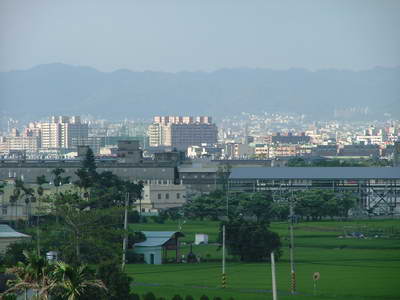
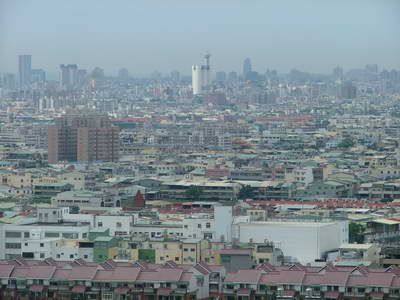
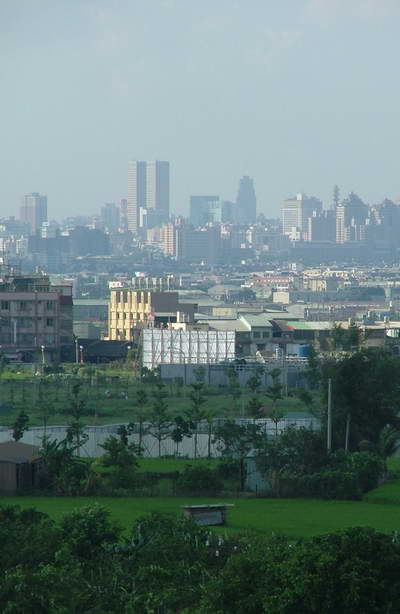
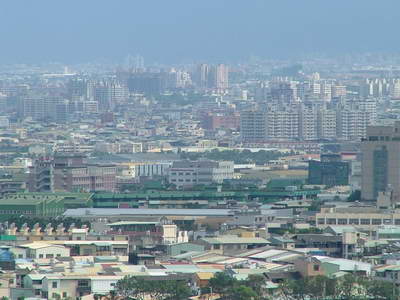
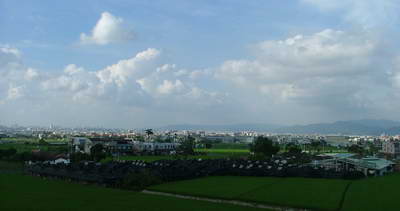
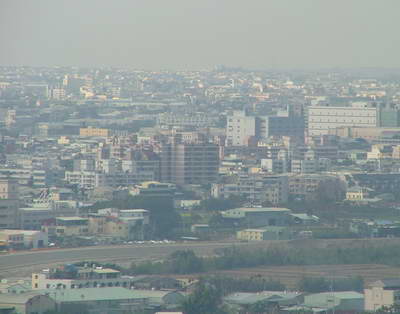
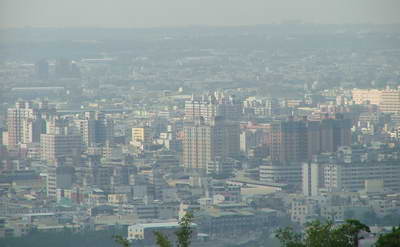
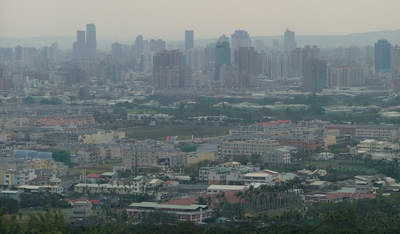
The Many Moods of Taichung


Storm over Taichung
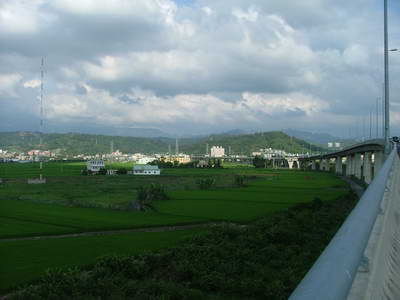
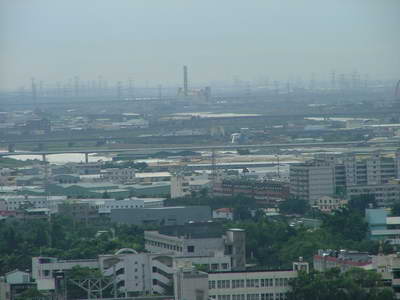
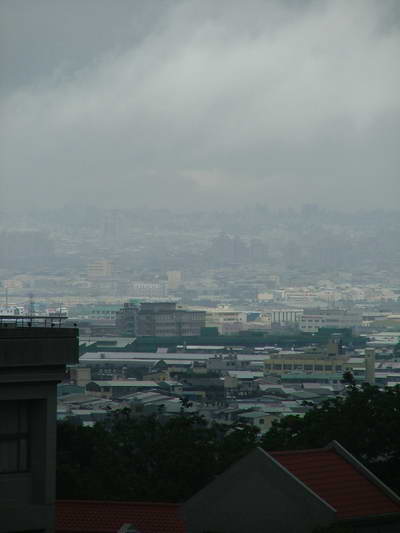
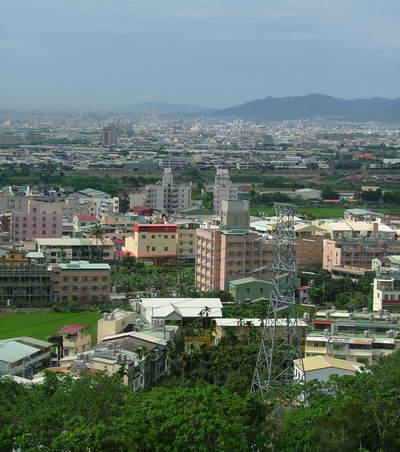
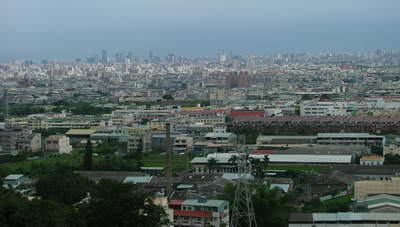
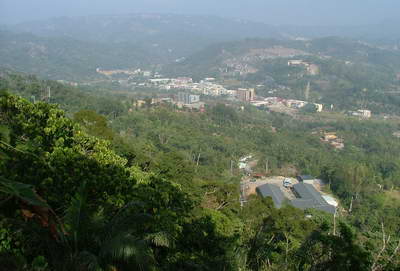
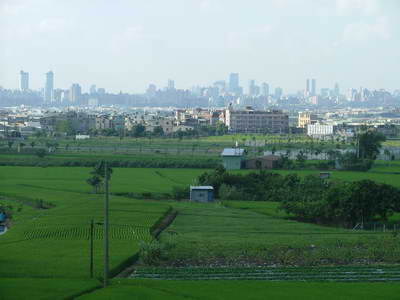
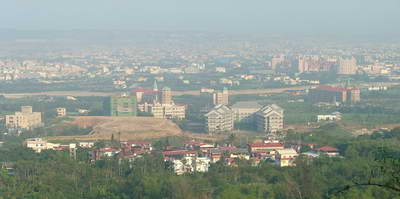
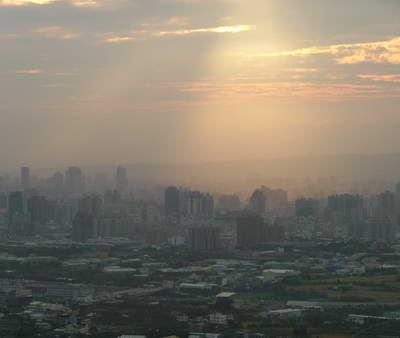
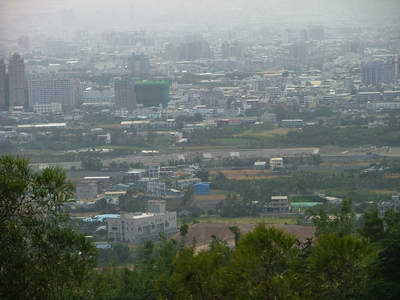
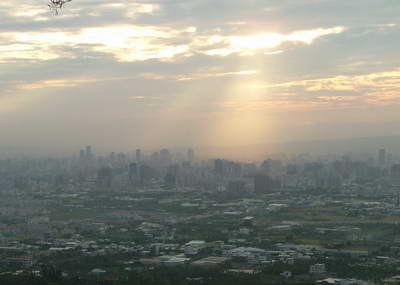
For one reason or another I spend quite a bit of time in places overlooking Taichung, giving me plenty of chances to search for that ultimate photograph of the California of Taiwan. With the first big typhoon of the season on its way today, I thought I'd take a look at the many moods of Taichung.


After the rain -- the southern part of Taichung county


Expressways and smokestacks between Taichung and Changhua


Murky skies over the city


Looking north over Wufeng, Dali, and Taiping


Tatu Mountain looms over the southwest side of Taichung


Populated areas come to a halt at steep mountain slopes


Looking toward the old downtown


Looking west toward the sea


Rice paddies abut the city


Mad crowding compelled by Taiwan's mad land use laws on display


Looking north toward the city


Buildings lit up in the morning sun


A closeup of the above


Mountain communities outside the city


Skyline over rice fields


Looking west over Tanzi, just north of Taichung


Clear skies over the city


Looking southwest toward the old downtown


Factories and warehouses north of Taichung


City, sky, smog


Tanzi and the area north of the city


Northern Taichung


The setting sun obscures northern Taichung


Tanzi


A sunbeam lights up the city

Chen Returns to Taiwan, US Congress Makes Sub Purchase Easier Than Ever!

Chen is back from his 9 day trip around the world. You know your diplomatic standing is grim when the highlight of your trip is an MOU with Qaddafi of Libya and the main headline was about getting snubbed by the US.....

The biggest advance of Chen's trip was a surprise visit on Wednesday to Libya. Chen confirmed yesterday that he met with Libyan leader Muammar Qaddafi, and that the two signed a memorandum of understanding to establish mutual representative offices and to expand bilateral commercial relations.

The president yesterday said that Qaddafi had personally given him two reasons why Libya resisted China's opposition and insisted on extending to Chen and his delegation the highest diplomatic courtesy.

First, the Libyan leader said that China itself engaged in a great deal of business activity with Taiwan, and therefore it was implausible for Beijing to try to stop Libya from having contact with Taiwan.

Second, China's military maintains relations with Israel, which is considered an enemy of the Islamic world. This has annoyed Libya and only furthered its determination to engage with Taiwan, Chen said Qaddafi told him.

Addressing a jubilant crowd of supporters outside the airport, Chen yesterday reaffirmed his determination to maximize the opportunities to increase the country's diplomatic space.

"My conclusion is: if Taiwan wants to stand up and step out in the international community, we have to make our own way. Where there is a will, there is a way ... because we are the uncrushable roses," said the president.

"Uncrushable roses?" What next? Headlines that read Chen Avers Colorless Green Ideas Do Sleep Furiously? I think Taiwan needs a better metaphor to express its will to survive.

*************
UPDATE: cleverClaire corrected me below:

The term "uncrushable roses" ("Ya bu bian de meigui”, 1957) is the title of a famous novel title by Yang Kui, a prominent writer in Japanese colonial period. In the novel he used a lone rose to represent the Taiwanese spirit under Japanese repression. (The book title was sometimes translated as "The Indomitable Rose".) It has since been used as a motto for any Taiwanese fight against foreign forces.
**************

I'm still absorbing all this drama. Lots of US Congress critters have come out in support of Chen and Taiwan, but as the Nelson Report pointed out, the Taiwan caucus is largely composed of Congresspeople who lack clout in the nation's lawmaking body. Meanwhile Congressman Ron Simmons, in whose district the submarines for Taiwan will probably be built, succeeded in getting the House to make it easier for Taiwan to buy the subs:

The US House of Representatives has given overwhelming approval to a bill intended to make it easier and more cost-effective for Taiwan to buy eight diesel-electric submarines from the US by dividing the design and construction phases and giving Taipei more options in the purchase.

The bill also contains provisions to enhance military ties between the US and Taiwan, and to penalize foreign firms that sell arms to China that could be used to attack Taiwan and engage US forces coming to Taiwan's aid.

The provisions are part of legislation that would authorize Pentagon spending and programs for fiscal 2007, which begins on Oct. 1.

The House approved the bill, 396 to 31, on Thursday after two days of lengthy debate.

The bill now goes to the Senate, where the future of these provisions are uncertain.

The Senate traditionally eliminates such narrowly-focused provisions in its authorization bills, and last year it rejected provisions identical to those in the current bill regarding US-Taiwan military relations and arms sales to China.


As the report notes, such provisions usually don't make it to the final bill. It's a nice gesture, but I did like this bit:

The submarine provision would reaffirm that the US policy is to sell the subs to Taiwan and requires the Pentagon to make available information to Taiwan on various options to help the country make good decisions on the purchase. It also calls on the Legislative Yuan to "make every effort to support the president of Taiwan" by approving funding for the purchases.

Despite positive noises from both Chairman Ma of the KMT, and Legislative Speaker Wang of the KMT, the Blues have not moved any closer to passing the arms bill. Every little bit of encouragement helps.

UPDATE: Reuters thinks it is a modest diplomatic victory for Chen...

Taiwan President Chen Shui-bian returns home from a Latin American visit on Friday after surprise stops in Libya and Indonesia that gave him a modest diplomatic victory over China but drew words of caution from the United States.

Whoa!

Syd Goldsmith's Talk on Taiwan in 60s and 70s (May 6 Meet Up)

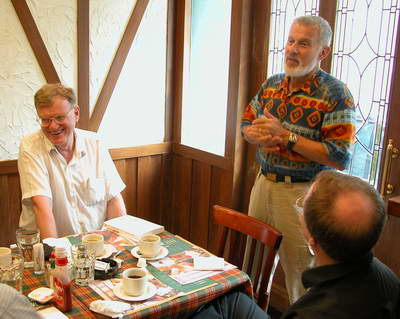
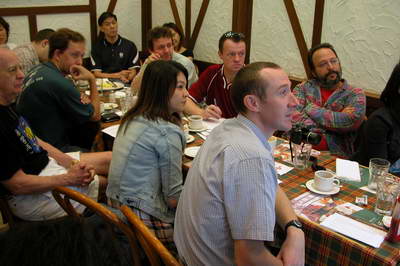
Our recent Swenson's meet-ups have been highlighted by talks given by knowledgeable and interesting foreigners about some aspect of Taiwan they know well. In April we were privileged to hear Jeff Martin discuss Taiwan's police and their relationships with the community. This month is was former Foreign Service Officer and author of Jade Phoenix Syd Goldsmith, who gave a short presentation on life and politics in Taiwan during the late 1960s and early 1970s.

[Note: I have slightly disturbed the order of the material to make it more readable. Photos are courtesy of Michael J. Klein at The New Hampshire Bushman in Taiwan and The World, and many thanks to him for providing them]

Syd began by describing life as a foreigner in Taiwan in those days. The big airbase outside of Taichung with all the US servicemen and their families. The low prices of things. The rickshaws on the streets, bicycles instead of cars and scooters. The poor quality of the roads. The massive gap in comparative wealth between the Americans and the locals. Life under KMT rule....and the changes. As Syd said, in the bad old days he drove a huge Chrysler and the locals all drove bicycles. Now he drives a beat-up Opel Corsa, and the locals all drive BMWs and Mercedes-Benzes. The TV had better programming in the bad old days too, he observed.

After this discussion, Sid moved on talk about the political atmosphere in Taiwan, beginning with some comments about being foreigners, corruption, and local politics. Syd observed that if you didn't have political opinions, it didn't bother you that MPs were found on every street corner in those days. Certainly foreigners were very secure, he said. At the time there were some 5,000 Americans at the airbase in Taichung, and another 5,000 in Taipei with a huge PX on Chungshan N. Rd. [MT: see Taipei Air Station at for some amazing photos, comments and other stuff on US serviceman living in Taiwan in those days.]

According to Syd, the giant PX allowed most of the African and South Ameerican countries that recognized Taiwan to maintain their embassies, because the US allowed other embassies to use the US PX. They then bought goods there, which they sold on the booming black market. For example, Syd said that the Haitian ambassador supplemented his income by buying several refrigerators at once, which he sold on the black market, and which became part of the "black gold" system which Syd observed was "probably more inhibited in its presence than it is today." Essentially, Syd observed, that PX served a lot of purposes, most of which were illegal and were winked at.

In those days the US presence was large but it was confined, so Americans were unknown outside of the few places where they hung out. Syd talked about how he would walk around small communities in Tainan and people would come out of their houses to gawk, and to pet his son's sandy blonde hair. Syd's novel, Jade Phoenix, is set in Tainan at this time. The American presence was important to the government, but it was "rather well-contained." Few Americans spoke Chinese or had the guts to go out on their own if they didn't. Most stayed in the border area along the Da Ya strip, which was the border between the US town and the real Taiwanese area. Syd said in answer to the question that most American presence was military, about 10,000 of them. There was only a small diplomatic presence, and a small presence of US businessmen. Syd said that despite the low level of development, you could actually fly on WWII surplus C-46s at that time around Taiwan.


He was asked about KMT involvement in the black market. Corruption was everywhere, he answered. US military personnel also purchased stuff to sell on black market, for example. Electricity was expensive, so people often sold air conditioners to make money, rather than pay for expensive electricty to cool the house. Telephones were a 6 month wait, plus $600, "plus an unspecified bribe." People with connections to get phones had important resource to sell to foreigners. Syd said that foreigners were so rich they didn't realize or perhaps didn't care how overcharged they were.

A questioner mentioned that Li Ao was in the business of re-selling refrigerators. "Li Ao was friends with everybody," replied Syd. Since you could disappear at any time, he explained, one of the ways you protected yourself was by establishing as many connections as you could. "During my time at the embassy I was approached by a lot of people whom I sure were working both sides." Syd said that they professed to be democratic activists, but the only way you could be a democratic activist and stay alive was to tell stories about those people you dealt with in the foreign community. "It went both ways - there was a lot of trading of information," Syd said.

Syd then went on to describe the situation in more detail. The political atmosphere started out with military police on major intersection in major cities. The physical geography of Taiwan politics was that the KMT headquarters was usually right across the street from the mayor's office in every city. The Investigation Bureau was usually not very far away. The KMT had a very interesting set of relationships with the folks in the countryside. The KMT was a power from elsewhere which came over and controlled the island. They had political and military control. Hence, to run for office, you had to buy your nomination from the KMT. Local factions and faction leaders for the most part dealt with the KMT because the Party had the power. There were many things that could not be done without government permission in Taiwan's environment -- licenses, permissions, everything came down from the KMT.

The KMT created thus created a symbiotic relationship with local society so that it could could suck the money out of the economy. The first step in this was taking over the assets from the Japanese. Nominations in elections were bought because you made an investment in getting elected because if got elected you could recoup the money through corruption. [MT: Lawrence Eyton's piece is a good introduction to this system as it currently operates.]

Things got intense with the escape of two political prisoners, Peng Ming-min (who would later run for President) and Lai Mao-hua (?). Lai called the US embassy and the call went to Syd, who was responsible for local politics at the embassy. Syd met him at a hotel and Lai asked for asylum. Unfortunately the request could not be granted, as it would be embarrassing to the US to grant asylum to the citizen of an allied state!

Lai was at large for 6-7 weeks. He even came to Syd's house. He was eventually caught and did a few years, getting on in 1978. Linda Arrigo confirmed this, saying she met him at that time.

Syd returned to the Peng Ming-min case. The reality was that Peng had escaped with the aid of US missionaries. The government in Taiwan blamed the US because it did not want to admit it own incompetence. Peng had simply walked through ROC customs disguised as a Japanese on a Japanese passport, assisted by US missionaries in Taiwan. [MT: a good letter about Peng's escape from the people who arranged it is here . An account of the ROC and US government diplomatic responses is here]

Syd said that at the time the CIA did relatively little collection of information because they were focused on mainland China. He did mention later that ROC intelligence was good at biographies of mainland leaders, since the US information sources on the mainland had been cut off in 1950. Taiwan was important to the US war effort in Vietnam. US military jets were routinely sent to the airbase at Tainan for repair. Hence the conduit for US knowledge of Taiwan was Syd himself in his capacity as Foreign Service Officer responsible for Taiwan politics. Syd noted that you gained much more trust if you spoke some Taiwanese, and that local democracy efforts focused on the US Congress, because the US embassy itself was so useless.

In those days, said Syd, whenever he traveled around Taiwan he had to first call on the local Foreign Affairs police. He also had to make a courtesy call to the local KMT office, the mayor, and perhaps other important politicians. Syd said that he was followed very closely, since the government was paranoid that the US might be dealing with the opposition.

Despite KMT control there were many local families who had independent power bases and were willing to challenge the ruling party. Syd exampled a woman who was the mayor of Chiayi from the powerful local Hsu family. He said at one point she was invited to go to some kind of council meeting, but fortunately didn’t go – everyone at the meeting was shot.

Syd also described how the KMT built up its strong local base by co-opting promising young locals into the party. Many of these young people had all been independence-oriented, but tended to feel that the KMT was the best route to obtaining influence. The China Youth Corps, led by the popular KMT politico Lee Huan, who was a champion of Taiwanization of the KMT, was one of the ways that young people were guided into the KMT. According to Syd, Lee Huan felt that the KMT could only retain power if it was Taiwanized. Wu Poh-hsiung, a Hakka politician who is currently the Vice Chairman of the KMT, was one of these people. Syd mentioned that the KMT had castrated his uncle.

These promising young people all went on to become county chiefs in their 30s. They came from locally prominent familes. By contrast, the tangwai politicians were generally from poor families and came up through the educational system, which ran on merit. Since they had no money, they were of no interest to the KMT. Hence only a few of these politicians came from wealthy families.

In the early 1970s there was no strong Taiwan independence movement, said Syd, echoing what Linda Arrigo had stated in her presentation in January. Either the KMT obtained pragmatic support through co-opting people through economic growth, or “people knew their place.” “There was a strong ‘know your place’ mentality,” said Syd. For most people the risk-return ration did not favor participation in Taiwan independence and democracy activities. The risks were just too great.

One oddity of the period Syd pointed out was that for the two weeks prior to elections, people could say pretty much what they wanted. Apparently this functioned as a way for people to let off steam.

Linda Arrigo asked some questions about US Taiwan policy, noting that the US had for a brief period in the early 1970s considered supporting Taiwan independence. Syd replied by saying that during the 1960s our policy was that the status of Taiwan was unresolved, “infuriating Chiang Kai-shek.” Syd, who wrote the human rights report on Taiwan, said that the US pushed for more democracy. Not a revolution – the US always prefers to deal with governments in place. US policy was to push Chiang Kai-Shek to reduce spending on the military and spend more money developing Taiwan.

I asked at that point about the claim that Taiwan independence is simply an invention of the US and Japan to weaken and destroy China. This absurdity circulates among leftists, libertarians, and some progressives, and is an article of faith in China. Syd pointed out, however, that Taiwan independence long predates American intervention on the island.

Syd then went on to note that the KMT blamed the US for its failures of the 1960s and 1970s, but the reality was that the regime was simply too corrupt. Taiwan independence did not become a movement at this time because people were simply too afraid for their lives. The modern PRC is much Taiwan in the early 1970s. Syd then told the story of the time when he had been a student studying Chinese in Taiwan in the late 1960s, prior to taking up his diplomatic post, and they had been taken on a a tour of the cells for political prisoners in Taipei, led by the head of the Political Warfare College at the time. Syd asked him what the difference was between the way social control was carried out in Taiwan and in the PRC, and he replied: “Hardly at all.”

The US strategy was to get Taiwan to democratize. It saw building up the economy as a way of building democracy in Taiwan. Like many other places, US investment in Taiwan followed military interest. The US couldn’t promote democracy because there was no organized local democracy movement, no widespread support for it, and no access to media for such ideas.

Linda Arrigo commented that another issue was that US military and CIA personnel were canned and court-martialed for contacts with Peng Ming-min and involvement in local politics. Syd wasn’t familiar with the particulars, but he knew the cases. Because of this, US missionaries in Taiwan, some of whom supported the democracy forces, distrusted the US Embassy and did not cooperate with it on democracy movement affairs.

Had there been a Taiwan independence movement in those days, and had it overthrown the KMT, the US almost certainly would have recognized it, as the US prefers to deal with governments in place, Syd observed. Linda and Syd then moved into a discussion of Kissenger’s sellout of Taiwan to China in the 1972 Shanghai Communique, when he got completely bamboozled by the Chinese, giving up Taiwan and getting nothing for it. Kissinger didn’t know anything about Asia, recalled Syd. After expressions of disgust all around, the presentation was over.

New Blogs on the Roll

Bourdieu Boy has a new blog called Taiwan/China. Literate and insightful.

Also added dieuwke.web-log.nl.

Taiwan Inches Closer to Direct Links

The BBC has the report:

After hours of talks aimed at trying to avoid a vote on allowing direct transport links, lawmakers from the governing Democratic Progressive Party and its allies took to the legislative floor holding banners and chanting.

They accused the opposition of selling out Taiwan's national interests. It was a short protest but an effective delaying tactic, as minutes later a bell rang out marking close of business for the day.

A vote on the controversial measures has now been postponed until next Tuesday.

Chen Trip Ruffles US Feathers

Reuters reports on the words of an administration official who warns about Taiwan independence:

As Chen criss-crossed the globe this week, U.S. Deputy Secretary of State Robert Zoellick told a congressional hearing that Taiwan "will keep hitting into a wall" if it kept testing the "one China" policy under which Washington switched diplomatic recognition from Taipei to Beijing in 1979.

"We want to be supportive of Taiwan while we're not encouraging those that try to move toward independence," said the State Department's number two diplomat who is charge of a new U.S. strategic dialogue with China.

"Because let me be very clear: independence means war," said Zoellick, who defended the administration against criticism by U.S. lawmakers for treating Chen in a "disgraceful" way by offering to let his plane refuel in remote Alaska or Hawaii while on his way to and from Latin America instead of stopping over in New York which he had previously done.

China, which has claimed Taiwan as its own since their split in 1949 when Communists defeated the Nationalists at the end of the Chinese civil war, has vowed to attack the self-ruled democratic island if it formally declares independence.


At the moment, Mr. Z, it is US China policy that is going to cause a war. It has tilted far too close to China, while at the same time, weakening our ability to respond to Chinese aggression by that criminal, and criminally stupid war in Iraq, which is isolating the nation diplomatically and pulverizing our economic and military strength. The US cannot on one hand follow the "One China" policy and then on the other declare that China cannot use force to annex Taiwan. Following the "One China" policy essentially concedes that Taiwan is part of China, especially in Chinese eyes, thus legitimating Chinese violence against Taiwan. After all, a nation has the right to recover territories in rebellion. In essence US policy is to go to war to prevent violence. How's that again? We need to return to the policy we followed in the 50s and 60s, which was that the status of Taiwan is unresolved.

That said, it is hard to believe that anyone really thinks Chen is going to declare independence. Does Zoellick not have anyone giving him sound advice on Taiwan affairs?

MIT Woodblock Prints back up

The new display of Japanese propaganda images from the Sino-Japanese War is now back up. This topic has been minutely dissected on the discussion lists, so I will only say that MIT screwed up bigtime taking them down. I can only wonder what exhibit this Chinese student monster will be "offended" by next. Tibetan nationalism? Taiwan independence? Mentions of Chinese internet control? The possibilities are endless.

Free Online Chinese Learning

Got this in the mail the other day:

+++++++++

Hello Michael, my name is James.... I just started a website to help people learn Chinese online for free (eLanguageSchool.net) and I think a link to my site would be a good resourse for your visitors. I encourage you to check out my site and see what you think. I'd appreciate any feedback too, since you seem to already know what you're doing. If you do decide to link to my site, you could use this link.

Learn Chinese Online

Thank you for your time.

Friday, May 12, 2006

Ryan Whelan needs YOU for political attitude survey

Ryan Whelan at Taipei Nights is doing a survey of political attitudes of local students. He needs your help.

I could use a favour from folks here in Taiwan. I'm currently conducting some research into the political views of Taiwanese youth. An element of this research is a fairly simple, short (ie. 1 double-sided page, 1-2 minute) survey. I haven't got much in the way of funding so I'm hoping some kind individuals will help me with my data collection. What I need are people around Taiwan who have access to youths (18-30). I'll mail you a suitable number of surveys and some stamps for return postage and you can get your friends/students/whomever to fill them out and then return them to me.
The whole request is on his blog.

Ma Australian Visit -- more links

From the Sydney Morning Herald:

Mr Ma, who will lead the Kuomintang (KMT, the Chinese nationalist party) into Taiwan's presidential elections in March 2008, is well aware of the Solomons problem. It has to be tackled at source, he told a lunch gathering at the Lowy Institute. "We have to develop a modus vivendi with the mainland on the international space," he said, asking why the place that makes 85 per cent of the world's laptop computers had to live with diplomatic recognition by just 25 small nations in the Pacific and Latin America.

Mr Ma will take the KMT on its comeback attempt - it ruled Taiwan for decades, until 2000 - on a platform of keeping the ambiguous status quo with Beijing.

President Chen Shui-bian cannot stand again after serving two terms, and his pro-independence Democratic Progressive Party is down in the polls.

Both Beijing and Washington would prefer a KMT president, since they fear Mr Chen and his DPP will try to nudge Taiwan towards formal independence if they spot a chance, risking a war between the two powers.
There is also an audiofile of a Ma interview online here:

http://www.abc.net.au/ra/asiapac/

(Thanks to Nick and Dave posting in the comments of the previous thread on the visit)

Open Protest Letter on Chen's Treatment by the US

Jerome Keating has developed the following letter and letter campaign to protest the treatment of Chen by the US. If you want to sign on, go here.

+++++++++++++++


Letter Protesting Taiwan's Continuing Unequal Treatment by the United States

We the undersigned strongly protest the ill-advised actions of the Department of State in refusing Chen Shui-bian, President of the Republic of China, Taiwan, appropriate transit stops in the United States as befitting the rank and position of the democratically elected president of one of the United States oldest allies in Asia.

As a consequence, this refusal has endangered the President of Taiwan and relations with the U.S. The President could not accept the snub and thus changed his flight pattern to Paraguay and Costa Rica. This change forced him, his entourage, and the crew to fly for nearly 35 continuous hours. In addition, when his route was later revealed, China used its influence to prevent Chen's plane from landing and refueling in Lebanon.

Taiwan became a true democracy in 1996. Since that time its people have freely elected their president with Lee Teng-hui being elected in 1996 and Chen Shui-bian, the current president, being elected in 2000 and re-elected in 2004. Ironically since becoming a democracy it has been increasingly difficult for the Presidents of democratic Taiwan
to receive fair and equal treatment as regards entry visas, visits to, and even transit stops in the U.S.

The refusal to allow Chen's plane to have a respectable transit stop in the U.S. where he could disembark was not just a diplomatic snub. It also was a personal attack. The State Department spokesperson would only refer to President Chen with forms of the pronoun" he" and not his proper title of President. Such actions are undiplomatic, spiteful, and petty.

The Taiwan Relations Act (TRA), enacted on April 10, 1979 when Taiwan was not a democracy, was established to maintain peace and security in the Western Pacific. As China consistently increases the number of missiles (over 800) it has aimed at Taiwan; the State Department rewards it with VIP treatment.

That same TRA states clearly in the very first paragraph regarding U.S. policy that that policy will be to "preserve and promote extensive, close and friendly commercial, cultural, and other relations with Taiwan." Now, when Taiwan has become the most promising developing democracy in Asia, it is all the more ironic that instead
of promoting "extensive, close, and friendly" relations with this democracy, the State Department treats it like a pariah.

For what reason has the State Department contradicted the express policy of the TRA and refused to treat Taiwan's president with respect? These U.S. actions border on hypocrisy, insincerity, and selective favoritism, particularly at this time when the U.S.
frequently accommodates and receives as guests the leaders of the dictatorial and autocratic one-party state of China, one of the greatest abusers of human rights in Asia and the world.

The opposition party in Taiwan, the Kuomintang, is presenting the argument that the U. S. is not a dependable partner, that Chen is not respected by the American government, and finally that China would be a better partner with Taiwan. The denial of transit rights is not just inept scheduling. It has much wider implications for the reputation of the United States as a supporter of democratic governments and leaders.

President Bush's diplomatic goal is to maintain the status quo between Taiwan and China. But by humiliating Taiwan, the U.S. unhinges the status quo from neutrality to a positive acceptance of China's policies of downgrading Taiwan's stature in international affairs. The U.S. is bending the status quo in favor of a China that claims it has the right to invade Taiwan if the island's government does not become "part" of China. This is not the way to a peaceful solution of the Taiwan/China problem. This is wrong, short-sighted and against the principles of democracy. Have we no shame?

Jerome F. Keating Ph.D., National Taipei University of Education
Taipei, Taiwan

Richard C. Kagan Ph.D. Hamline University, St. Paul, MN

Richard F. Adler BSME, JD, Taipei, Cotra Enterprise Co.Ltd

Hanna Zaborska - Shen, Polish Compatriot Movement, Taipei, Taiwan

L.C. Russell Hsiao, Taiwan Foundation for Democracy

Kiel Downey, Taiwan Foundation for Democracy

Michael Chen,Ph.D., University of Chicago

Malcolm Higgins BSc University of Warwick, UK

Elaine Salt, Taipei, Taiwan

Michael Turton
Chaoyang University, Taichung

James Ascencio, M.A., Ming Chuan University, Taipei, Taiwan

Curtis Smith, Taipei City Honorary Citizen
Taipei Archives Committee

Mark Arnold, Atlanta, Georgia, U.S.A.

William R. Stimson, Ph.D. Taichung, Taiwan

Dan Bloom, Writer, Chia-yi, Taiwan

Stuart Saunders, B Sc (UNSW), EsDesign, Neihu, Taiwan

John F. Guinane, San Jose, CA

Paul Y. Shea, Ph.D. Retiree, Hughes Aircraft Co..
Irvine, CA 92606-2600

Kimberly Hsieh, YMCA of Taiwan

Stan Yang, PhD., Unicare Biomedical, Inc.
Laguna Hills, CA 92653

Wencheng Lin, President , The Pacific Times( Los Angeles)

Mark Miller, Applied Materials, Taiwan

Raymond F. Wu, Attorney at Law, Los Angeles, CA.

Emily Murray, NeiHu, Taiwan and Vancouver, Washington

Runsun Pan, PhD , National Center for Macromolecular Imaging
Baylor College of Medicine, Houston, Texas, USA

Paul Cox, Winkler Partners Law Firm, Taipei, Taiwan

Strong C. Chuang
Ph.D. Purdue University
Chairman, World United Formosans for Independence-USA Chapter

Ming-Chung Chen M.D. Chicago

Jennifer Wen-Jia Tsao, MSc, Taipei, Taiwan

Eugene Keh-chun Yang , Associate Professor, National Tsing Hua University, Taiwan

Albert Tsai, Ph.D., Yardley, PA

Dr. Luby Liao, Math/CS Department, University of San Diego

Whuey-wen Hartman, Woodland Hills (Los Angeles), Ca.

Loo-Fei Hwang
Taipei, Taiwan

Mark B.Wilkie Dip Sec M, B.A. HC Ed Tr. Douliou, Taiwan


The above names are just a sampling of those who quickly signed this letter within a brief 10 hour period of notification. We seek means for others to share their expression of support for democratic Taiwan. We urge all Taiwanese organizations and university associations in the United States to voice their discontent to their Congressmen. We likewise urge all Taiwanese around the world to voice their anger. Feel free to use the ideas expressed above or use words of your own choosing. It is time that democratic Taiwan no longer should have to use the servant's entrance to visit the United States. It is time that democratic Taiwan no longer should peer in the window (as in Animal Farm) while the officials of the People's Republic of China feast in the main dining hall. Post this everywhere; show your strength.

Thursday, May 11, 2006

Tracking the Railroad Killer

The Chinese language has been full of reports on the progress of the man who apparently murdered his Vietnamese wife in an insurance scheme. Taiwan News has the buzz:

The case of a train derailment in March took a dramatic twist yesterday when prosecutors found new evidence against two brothers who are suspected of orchestrating the accident that left the younger brother's Vietnamese wife dead. The police yesterday ruled out the possibility that the death of Chen Shi Sheng-hong, the Vietnamese wife of Lee Shuang-chuan, was caused by external force, saying that she was perhaps poisoned shortly after the accident.

According the police, Chen Shi died of massive internal bleeding hours after the March 17 accident.

Witnesses said they saw Lee Shuang-chuan giving Chen Shi injections after dragging her to a bathroom near the scene of the accident on the day of the derailment, the police disclosed.

The police also disclosed that traces of Etumine, a strong sedative mainly administered to patients with mental illness, were detected in Chen Shi's body during autopsy. The presence of the drug gave rise to a new line of thought, as the woman was apparently emotionally healthy prior to her death.

The bizarre case, in which the husband apparently derailed not one but three trains in attempts to kill his wife for money, made headlines when the police released incorrect financial information about the alleged killer during the investigation, grossly violating his privacy.

The Chinese language media has also reported that the suspect's brother has opened a blog which he uses to taunt the police, and that the woman had been severely beaten prior to boarding the train.

UPDATE: ESWN has a piece on the brother's blog.

Ma's Australian Odyssey

Mayor Ma of Taipei was in Australia this week sucking up to local politicians. Conservative Greg Sheridan at the Australian has the story...

Ma has had a fascinating visit to Australia this week. In Sydney he addressed a big luncheon hosted by the Lowy Institute and open to the media. In Canberra he had an unofficial meeting with Gary Hardgrave, the Minister for Vocational and Technical Education. He also met senior officials from the Department of Foreign Affairs and Trade as well as ACT Chief Minister Jon Stanhope.

This is all highly notable because Canberra doesn't usually allow that kind of access for Taiwanese government figures. And Ma is in the Opposition. Interpreting the Ma visit gives us a clue to the unfolding geo-strategic calculations of Canberra, Beijing, Washington and Taipei.


Sheridan concluded that Ma and Beijing may not be a match made in heaven:

But Ma holds many positions that will annoy Beijing as much as anything Chen has done. Ma supports, for example, the passage of the special military budget that the KMT has held up in parliament just to frustrate Chen. This would mean $US10 billion ($12.9billion) worth of new military purchases for Taiwan of submarines, anti-submarine warfare capacity and so on. You think Beijing's gunna like that?

Ma says "their [Beijing's] one China is different from our one China". He does not believe unification can come about while the Chinese constitution is undemocratic. He does not believe "one country two systems", the formula under which China rules Hong Kong, can apply to Taiwan.

He believes China's anti-secession law, in which it outlines the basis on which it will take military action against Taiwan, was unnecessary and provocative. He backs a strong military for Taiwan and the resolve to defend itself. He is four square behind the US alliance.

While very appreciative of Australia's role in the region and complimentary of Australia in many ways, he also says Canberra has the reputation of being too cautious in its dealings with China and pays too much attention to Chinese diktats on how it treats Taiwan.


(Thanks to Mark Harrison at Bourdieu Boy for the tip)