A friend who is cleaning out his grandfather's closets sent this to me:
This is an article we found hidden inside an old radio from November 5th, 1977.
It describes the upcoming local elections and describes how there are 58 candidates running with 41 representing he KMT and 17 dangwai.
This election would prove to be a watershed moment in Taiwan's democratic history as one of the dangwai candidates was none other than Hsu Hsin-Laing, and the ballot irregularities in his district would go on to spark the Chung-Li incident in which the regime was forced to show its weak hand amid rioting as they could no longer, politically, respond to civil unrest with large scale state violence, paving the way for further tests of the regime by the Formosa activists.
How far we have come. Even thinking back to before Chen was elected, I remember the inevitability of the KMT. They were always going to win and always control the government. They were seen, locally, as an entrenched power that had money and decades of patronage to draw from to bend society to its will.
Things have come far... "dangwai" are the candidates from outside the KMT. They would eventually coalesce to form the DPP. _______________________ [Taiwan] Don't miss the comments below! And check out my blog and its sidebars for events, links to previous posts and picture posts, and scores of links to other Taiwan blogs and forums!
A pro-KMT concert here in Taichung. Billed as a nostalgic visit to the past through song, nothing describes the KMT better than a bunch old singers crooning tunes from the 70s and 80s. Many thanks to Drew K for sending this around, as he noted, looking backward to the glorious and idealized past is very Confucian.
THINGS TO COME: This piece from a Canadian academic on the elections is first class. It correctly describes the DPP as pro-Taiwan and ends...
But while the KMT (and the Pan Blue camp) has weathered several political crises in the past, it has never faced the very likely prospect of losing control of the Legislative Yuan and the presidency. Simply put, the party is on its heels. Though the party’s organizational basis endures and its financial assets remain more or less intact, the fact of the matter is that the leadership is deeply split, the rank-and-file are defecting, and its historical claims to economic development and cross-Strait stability are increasingly untenable and unbelievable among Taiwanese voters. How the KMT will react to its defeat in the 2016 elections and how it rebuilds afterwards are crucial developments in Taiwan’s democratic evolution.
Notably it outlines the bleak outlook for the KMT, one of the few pieces that forthrightly explains that development. The KMT probably won't be able to rebuild, which will be very good for the evolution of democracy in Taiwan. The party's financial assets are going to be hit by DPP legislation and the KMT has already started to sell them off. But the infighting over the Chairmanship and the direction of the party is going to be fierce. Former Presidential Candidate Hung Hsiu-chu has already indicated she is thinking about a bid...
Deputy Legislative Speaker Hung Hsiu-chu (洪秀柱) yesterday said that she is still seriously pondering whether to vie for the Chinese Nationalist Party’s (KMT) chair, a post that would likely be left vacant by KMT presidential candidate Eric Chu (朱立倫) should he lose the election on Saturday next week.
....
“First, it depends on whether Chu, the KMT’s incumbent chairman, would step down following the race,” Hung said.
In the event that Chu loses by only 200,000 votes or the KMT manages to maintain a satisfactory number of legislative seats, some party comrades might think that Chu should remain on the post,” Hung said.
“After all, Chu has only led the KMT for a relatively short period of time and has yet to have enough chances to reform the party,” Hung said.
.....
Hung said the KMT’s charters favors a KMT president doubling as party chair.
“That means Ma could assume the party chairmanship after Chu’s customary resignation and hold a chairmanship election after the new president is sworn in on May 20. By then, Chu could also compete for the post if he wants to,” Hung said.
Hung is the darling of the Deep Blues. Note the scenario she posits in the last paragraph: Chu steps down after losing, Ma becomes chair since the Party rulz say the president must be the chairman (har dee har har), restores grip on the party, then there is an election in May after he gives up the Presidency. With that kind of control, the likely outcome is a Ma-backed ideologue like Hung herself versus a "centrist reformer" like Chu or former Taipei Mayor Hau Long-bin, themselves both conservatives and rightists. Whatever happens, it's going to be brutal internecine combat over a shrinking resource base of money and voters.
Jon Sullivan at U of Nottingham, who puts out a steady stream of top-notch writing on Taiwan, observes how the Old Guard struggles with today's youth in SCMP. Since the November 2014 election there's been quite a bit of media notice given to the identity issue...
There is no democratic tradition in Chinese culture. Some have argued that many Taiwanese came to understand democracy via the idea of minben (民本 ) “guardianship democracy”. The attitudes towards authority that support for this notion of government are not widespread among young Taiwanese.
Those aged 19-35 are more supportive of democracy as a political system, and accepting of the noise and contention that accompanies it. And while they are more likely to call themselves Taiwanese, identification with democracy is a crucial part of this trend.
Those who have grown up under a democratic system take for granted liberal democratic norms like freedom of speech, accountability and transparency to a much greater extent than their elders, who had to “learn” them. This attitude change represents a significant challenge to the foundations of “guardian democracy”, which is magnified by the popularisation of digital and social media.
Democracy is a key part of the Taiwanese identity, and one of the important differences between Taiwanese and Chinese. Most of the discussion of differences in culture between Chinese and Taiwanese focuses on things like food and language, and fails to take into account the differing historical experience of Taiwanese, especially colonialism and democracy...
Workers were out there demonstrating against the major parties, because they've been comprehensively betrayed, as Brian at New Bloom writes:
Though mostly members of labor unions, notably also a number of students also demonstrated despite the fact that this was finals week. On stage, before the start of the march, students at performed a skit about the dilemma of overworked, underpaid laborers now denied their holidays. Amusingly, at its starting point at Freedom Plaza, the march strangely coexisted with a KMT rally. Shortly after the start of the march, the author remembers seeing a woman from the KMT rally shout, “I’ll show them!" and then wave the ROC flag at passing labor demonstrators. That much may evince the KMT’s view of labor, lip service aside.
Let's see what the Third Force does when it is in office...
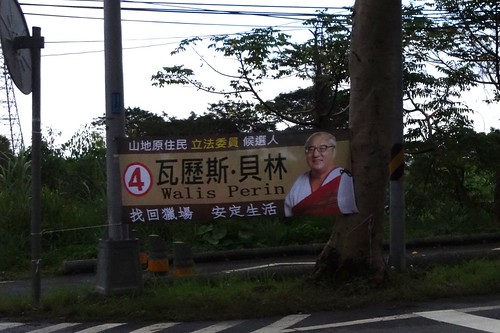
CHINA DOLLARS: Walis Perin, the aboriginal candidate (photo above shows an ad for him in Hualien), alleged that China money was going to aboriginal candidates...
Democratic Progressive Party (DPP) legislative candidate Walis Pelin yesterday said that some Aboriginal lawmakers seeking re-election in the polls on Saturday next week have committed vote-buying offenses by resorting to Chinese influence, presenting Aboriginal township mayors with vehicles and offering voters favors in China.
Speaking at a televised policy event organized by the Central Election Commission (CEC), Pelin said that a number of candidates apparently secured cars from China and distributed them to township heads for their personal use in an attempt to win their support.
Some of them also took voters to China to accept favors there, Pelin said, calling on Aborigines to vote for candidates like himself, who are challengers to “incumbents” and do not have access to improper influence in China.
China has put much effort into cultivating connections with aboriginal politicians in Taiwan, perhaps the most famous example being Kao Chin Su-mei, who believed herself to be Chinese until she reinvented herself as an aborigine when she found out she was half-aborigine, and got in trouble a few years back for taking Chinese money. It just goes to show that people talking about China's influence on the election often can't find where it really is...
The result of Taiwan’s popular elections and multiparty political system has created a unique social experience that is different from the social experience of mainland Chinese. The consequence of the formation of the democratic social experience in Taiwan is the creation of a unique Taiwanese identity that is different from the dominant Han Chinese identity in mainland China. This perhaps explains why an increasingly dominant number of people in Taiwan think of themselves as Taiwanese instead of Chinese despite the future prosperity of Taiwan being highly dependent on mainland China. Although the current KMT President Ma Ying-jeou has helped create an unprecedented level of peace and cooperation across the Taiwan Strait, including a historic direct meeting with Chinese President Xi Jinping on November 7th, 2015, the majority of Taiwanese voters may still choose the pro-independence DPP candidate Tsai Ing-wen as the next president.
It seems that people in Taiwan have consolidated their unique Taiwanese identity. No matter who wins the election on January 16th, policy makers in mainland China must rethink how to deal with this new Taiwanese identity as part of their overall Taiwan policy.
...and not just China, but also, the United States, where many commentators are evaluting this election as if they are stuck in 2004. I think many foreign observers are treating the KMT as if it were a western conservative party that people will switch to when they get older and have money. Not gonna happen -- the KMT's base ideology is a pro-China ideology and identity that no one in Taiwan will subscribe to in a decade except a few very old people and younger weirdos. The KMT might be able to remake itself as a Taiwanese party that is the KMT only in name, but the immense power of the Old Soldiers will likely prevent that for some time to come.
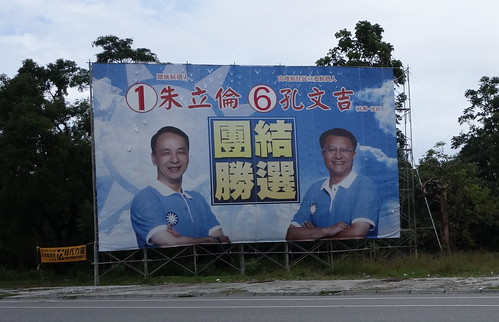
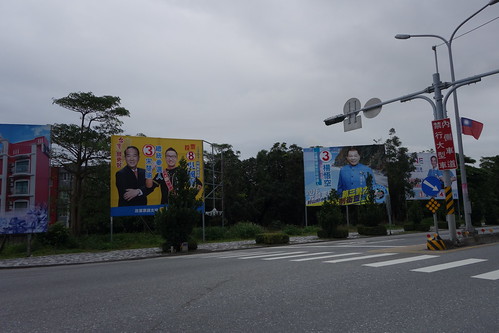
Candidate signs outside the Hualien Airport
FOR AMUSEMENT PURPOSES ONLY: Ted Galen Carpenter at CATO has learned nothing from years of "writing" and "thinking" about Taiwan. Still singing the same TAIWAN OMG WAR tune, still the same misunderstandings from a decade ago...
Just how futile Beijing’s strategy is of trying to neutralize pro-independence sentiment on Taiwan by increasing economic links between the island and the mainland can be gauged from recent polling data. Support for the DPP—and for a more assertive policy toward China—is strongest among young Taiwanese. We need to ask what happens when Chinese officials figure out that their entire Taiwan strategy is based on a faulty assumption and that there is almost no chance that they will ever get the island back peacefully.
It is more than a matter of academic interest to the United States. Under the 1979 Taiwan Relations Act, Washington is pledged to regard any coercive moves by Beijing against Taiwan as a grave breach of the peace of East Asia. We need to reexamine that commitment now, when there is not yet an acute crisis, and ask ourselves if, given the long-term geopolitical dynamics, it is a wise commitment in terms of America’s best interests. Mounting evidence suggests that being caught in the middle of a potentially bloody fight between Taiwan and the mainland is a growing danger. And it is a prospect that is definitely not in America’s best interests.
Carpenter, like others in the sellout crowd, writes as if Earth was planet where only China, Taiwan, and the US existed. But Japan has already signaled its quite happy with Tsai Ing-wen and Taiwan will likely move closer to Japan after Tsai becomes president, further enabling its incorporation into US strategic policy in Northeast Asia. Every Japanese thinker knows that after Beijing eats Taiwan, Okinawa is next. Hence, Taiwan is potentially important in Japan's defense -- and the US has a treaty with Japan (interesting how the CATO loon brigade never recommends selling out Japan). Fundamentally, when someone writes on Taiwan but does not mention Japan (or the Philippines or the South China Sea) they are writing nonsense and should be ignored.
Not that worried. I expect CATO will discover the joys of foreign involvement when its owners, the Kochs, ramp up their defense industry investments...
PS: Support for the DPP is not support for "a more assertive policy towards China". It's support for a more Taiwan-centered policy. Nice try there, Ted.
SERIOUS: Meanwhile, for those who crave understanding rather than amusement, David Gitter and Robert Sutter at NBR have long paper on Taiwan's National Power. There's a precis at The Diplomat. It's solid up to the end, where it veers into misunderstanding...
Notwithstanding all of the above, the greatest threat to Taiwan’s survival comes not from without, but instead lies in the deeply rooted political divide within. Despite the fact that both the KMT and DPP seek to avoid military conflict with China and to sustain the Taiwan government’s sovereignty, partisan wrangling has hobbled a consistent policy to address the island’s precarious position. During President Chen Shui-bian’s tenure, Chen’s ability to gain legislative approval for billions of dollars of offered U.S. arms met protracted opposition from KMT leaders controlling the legislature. Similarly, during Ma Ying-jeou’s presidency, Ma’s de-emphasis of military preparedness in favor of effective accommodation of China to ensure Taiwan’s security has encountered strong disapproval from the DPP, which instead favored greater defensive preparations to bolster the island against the growing Chinese threat. Such gridlock along party lines on sensitive issues of national defense are emblematic of a larger weakness in Taiwan’s infrastructure capacity — specifically the ability of the governing authority to set goals supported by elites and consolidate enough power to see those goals through. Because intense political competition has been viewed in zero-sum terms, neither the DPP government of Chen nor the KMT government of Ma has been effective in reaching consensus about what should be done to strengthen Taiwan, and each side continues to seek political advantage by focusing on the perceived shortcomings of the other’s policy proposals. Should a DPP government that is unwilling to accommodate and reassure Beijing come to power, it is not at all clear that a united ROC response would be mustered to deal with increased dangers from across the strait. Taiwan can ill afford to muddle through another four years, with bold policymaking addressing Taiwan’s demographic trends, international position, and national defense being sabotaged by fractious partisan debate.
There are two problems here. First, the greatest threat to Taiwan is not the "divided" politics, but China. The "divided" politics are part of the China threat: it's the pro-China party, a party of Chinese colonialism and Chinese colonists, that is preventing progress, blocking arms acquisition and meaningful defense moves, attempting to deliver the economy into Chinese hands, and disrupting Taiwan's relations with its neighbors. The KMT is merely the major manifestation of the China threat in Taiwan's domestic politics.
Note that while Gitter and Sutter assign the blame to the "partisan divide" the two examples they give are both those of the KMT blocking meaningful defense moves. Since both writers are very far from stupid, this is likely deliberate, a message for insiders. Someone needs to start pointing out that if the US wants to position Taiwan in its defense network in Asia, it needs to back the DPP, not the pro-China KMT. There's no point in having a defense treaty with Japan if your policy is to hand Taiwan over to China as a forward base.
Second, there is no "partisan divide" in the sense that we've known it since 1990. That era is drawing to a close. Instead, the Taiwanese national identity is steadily taking form, and those locals who identify as Chinese nationality are disappearing. The fact that some people identify as "Chinese" is reflects not the identities of locals but the manifold meanings of the word "Chinese". A new politics is emerging as the old "partisan divide" is dying.
This means that the post-2016 period is going to be the first true post-colonial period in Taiwan's history. Taiwan's politics since 1945 have been the politics of 20th century nationalist modernity. Now what we'll have going forward is the politics of post-coloniality.
The last time Taiwan chose a DPP president, Chen Shui-bian, in 2000, cross-strait tensions escalated. Given China’s increasing assertiveness in the region under Mr Xi, things could be even more dangerous now. China has been piling pressure on Ms Tsai. Mr Xi says he wants a “final resolution” of differences over Taiwan, adding that this is not something to leave for the next generation. China is demanding that Ms Tsai approve the “1992 consensus”, a formula by which China and the KMT agreed there was only one China—but disagreed about what that meant in practice. Ms Tsai has long said no such consensus exists, though when asked about it in a presidential debate, she called it “one option”.
That's hilarious. "Cross-strait tensions escalated". You know, because tensions just escalate, without human agency. All the Economist had to say was "China ramped up tensions" -- sad, because some of the other reporting in the article is pretty good, especially on identity issues, but this paragraph is just one long cri de coeur of KMT propaganda, right down to asserting that the 1992 Consensus, which Beijing has never accepted, actually exists, instead of being a merely a rhetorical cage to imprison the DPP.
The Economist added:
Taiwanese politics is famously raucous, and the DPP’s radicals seeking formal independence might yet cause problems.
Yes, if you want to live peacefully in an independent state, you're a radical. Indeed, such individuals "cause problems". But if you're Mr Xi, a mass murderer and dictator who has threatened almost every country bordering China, including Taiwan, with territorial expansion and war, you're "assertive" and the problems are caused by those resisting you. Occupy two neighboring states, claim the territory of others, threaten war, seize fishing vessels, and play potentially lethal games across borders -- hey, you're just being assertive. Want to live in a democratic and independent state? Shut up, you radical! Nothing better illustrates the banality of failure in our mainstream media discourse.
The tragicomic part of the Economist's "analysis" is that it supports the territorial dreams of two Leninist Socialist/Communist parties that nationalized their economies and retained a large state sector even after permitting private capitalism, despise the West (except as a place to retire to once they get their rake-off), and would never let a magazine like The Economist be published freely in a state they controlled.
"But... I'm not good-looking!" she said. I thought she was.
Chang said: “The KMT has lost its party soul; [the people of] the KMT do not dare acknowledge that they are Chinese. The party’s soul is with Hung.”
“The KMT wants our support, that is fine, but it has to promise that after we send its candidates to the legislature, the party would grant Chinese spouses equal rights to the four-year requirement for obtaining national identity,” Chang added.
“With the KMT in office, the requirement for the Chinese spouses has been lowered from eight to six years,” Hung said, adding that the two additional years is “discriminatory” and “unequal.”
I remember years ago when many of us warned that the spouses would become Beijing's little operatives in Taiwan we were dismissed as paranoid or racist. Well, there it is: which party are they rooting for? What identity do they hold? Note the first paragraph I've bolded there: "The party's soul is with Hung". Like I said, she's the darling of the bitter-enders and those who consider themselves the True Chinese tm.
TWEETED:
13 pig farmer association chiefs endorse Tsai; KMT agriculture minister calls them to ask if they were forced to https://t.co/Ayjlr2Fg5O
_______________________ [Taiwan] Don't miss the comments below! And check out my blog and its sidebars for events, links to previous posts and picture posts, and scores of links to other Taiwan blogs and forums!
From "Puppets and Cultural Identity in Taiwan", Jean-Luc Penso, pp 169-178. In Objects, Heritage, and Cultural Identity, edited by Muyard, Frank, Chou Liang-kai, and Dreyer, Serge. Taiwan Historica, 2009:
The first use of puppets was for divinatory purposes but their use became more secular over the centuries. Puppets played an essential role in the creation of the most respected and secular Chinese opera, since the art of puppets actually initiated opera. Many facts corroborate this argument. For example, the actors' gestures and particularly, the way they walk are not natural, but copy a puppet's movements. Another example is to be found in the way actors call puppeteers "Master", while a puppeteer would not have to show this form of respect to an actor.
According to Jacques Pampaneau, a specialist in Chinese theater, the glove puppets called "po-te-hi" in Taiwanese or "budaixi" (布岱戲) in Mandarin are believed to have come from India by the maritime route (Pimpaneau 1977). The name for glove puppets in Sanskrit is "pu ta li", close to "po-te-hi" and "budaixi", but once again, nothing is certain regarding this possible influence.
_______________________ [Taiwan] Don't miss the comments below! And check out my blog and its sidebars for events, links to previous posts and picture posts, and scores of links to other Taiwan blogs and forums!
ADDLED: Kudos to my man Solidarity, who translated this sick KMT ad of a pathetic, resentful middle aged man contemplating the unfairness of it all. That's the Rational Party at work! Some of the comments from my Facebook....
Twisted.
A eulogy for the ROC colonial enterprise.
Well, they set the shit advertising bar pretty high with that Chinese sub one a couple of cycles ago.
The politics of despair. Let's see how that works out for them!
Bunch of whiners.
Good Lord! Who would want to identify with that character?
i thought this was an ad for the republican party in the US
Cry me a river. It's weird see the KMT having a go at playing the victim card.
Bummer. I was waiting for shots of carousing at the KTV and the appearance of the second family in Shanghai.
To me, it appears as an ad to promote the DPP rather than the KMT. All the right reasons are there NOT to vote for the KMT.
Nice to see they worked in a shot at Korea in there, too. Very deft of them.
I noticed that neither of the candidates appeared anywhere in the ad...telling
I thought you meant "slick" at first and were praising them.....
Hubris meter pegged at maximum after only 20s of exposure.
Is that 連勝文?[Lien Sheng-wen, the losing KMT candidate for Taipei mayor]
Well if that ad isn't shameless, then I don't know what is.
Well, can't be surprised they're going to try every trick in the political playbook
"...我什麼都不是"
ah, poor little thing, here you have a cookie
Full of melodramatic, self pity and anger...KMT is the one who tears the country apart
Should be "born in the 60s" (not 50s)
I noticed that neither of the candidates appeared anywhere in the ad...telling
Nor did they mention which country they're banging on about.
On Twitter: Yoof and pro-TW's are unpatriotic, green-terror ingrates!
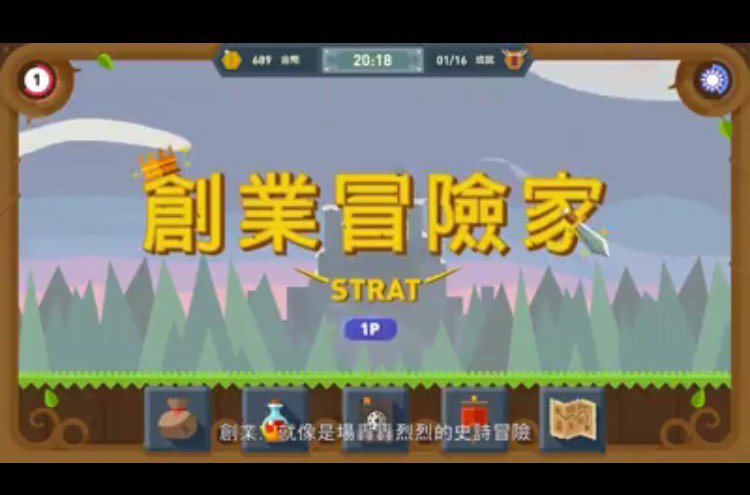
A party that makes ads like that has lost the people. As many pointed out, this ad is aimed at the KMT's base since it couldn't possibly be aimed at the general population -- and when you're attempting to shore up your base with negative ads two weeks before the election, you're toast. Lots of KMTers going to stay home to punish the KMT this election, so expect some surprises, especially in close legislative races in the north. One of my readers sent around a few parodies that came out immediately here and here. The KMT even managed to parody itself when they sent around an ad evoking a video game, which misspelled START as STRAT.
Compare that to this wonderful DPP ad which radiates confidence in the people and hope for the future.
ADDED: The Deep Blue New Party has actually made an ad to address the issue of Blue voters avoiding voting on Jan 16: "Why is everyone busy on 1/16?".
PROVOKING: Over at Thinking Taiwan, J Michael writes that Taiwan is not the provoker in the Taiwan Strait. That's an old and prominent theme on this blog, and it is good to see someone else taking up the cudgel.
But the NPP’s political rhetoric should be interpreted as pro-Taiwan rather than anti-China. Their political agenda is strongly focused on progressive social justice, human rights, and democratic values. Their economic policy focuses on higher corporate and luxury taxes in order to redress wealth inequality. The Sunflower Movement itself was not solely an anti-China manifestation – it was the culmination of years of a maturing social movement scene and social unrest.
The whole thing is excellent. The NPP might get as many as three wins in the election, including my own district. Two is probably more realistic. They've already said they will be holding the DPP's feet to the fire, but the DPP will probably reach, minimally, around 60 seats.
PIGGING OUT: Readers will recall that the beef issue was really a pork issue -- under WTO if Taiwan let in US beef with ractopamine, it would have to let in pork from the US with that same toxic drug. While beef is no big deal, pork farmers in Taiwan operate a large and lucrative industry. The KMT spent last week attacking Tsai Ing-wen because her policy, they said, was to let in US pork:
During the two Presidential debates, Tsai Ing-wen released signals for slowing changing her policy positions. She has clearly made two policy changes. One. She now proposes to allow in US pork containing ractopamine residue, provided that they meet Japanese and Korean standards. Two. She now wants the Cross-Strait Agreement Oversight Bill be given top priority during the coming session of the legislature. That means that soon after the election, Tsai Ing-wen may permit US pork imports containing ractopamine residue, and Huang Kuo-chang may back passage of the STA.
For politicians to change their policy whenever they change roles is commonplace. As long as this sort of pragmatism serves the greater good, it is tolerable. But Tsai Ing-wen's ability to brazenly flip-flop in her policy position before changing roles, without batting an eyelash, is without peer. She has demonstrated the DPP's total lack of consistent principles. She has confirmed the truth of the adage, "Politics is the art of deceit." She has no qualms whatsoever about playing the public on Taiwan for fools.
Lest we forget, in mid-June 2012, the DPP demanded a zero tolerance policy for ractopamine laced US beef imports. It forcibly occupied the legislature podium for five days and four nights, to prevent ruling party legislators from approving their importation. Earlier that year, pig farmers traveled north to Taipei to fling pig manure at the Ma government in protest. DPP legislators joined their ranks and castigated the KMT for "selling out the health of the nation," and for "destroying Taiwan's hog industry." They demagogued the US beef and US pork imports issue for all they were worth. Now, however, Tsai Ing-wen, riding on the bandwagon, is slowly whirling herself. Have the DPP's past lamentations about the "health of the nation" and the "hog farmers' livelihood" been forgotten?
The two parties appear to have flip-flopped on the issue, with the KMT posing as the champion of the farmers.
Another important issue for the KMT is Korea -- which many Taiwanese view as a rival state that has surpassed Taiwan, and which the KMT is hitting hard on in this election since "Tsai has no plan for Korea". Note that the resent-filled ad at the top of this post mentions Korea. Of course, Korea has passed Taiwan while the presidency and legislature were controlled by the KMT, and KMT policies have failed to prevent that.
Finally the US-China Economic and Security Review Commission report on the Taiwan Economy and the Election is online here. It also outlines the DPP economic team in Appendix 1.
Xinhua news agency on Tuesday carried an announcement from China’s Taiwan Affairs Office that residents of three Chinese cities — Chongqing, Kunming and Nanchang — would be allowed to transit through Taiwan Taoyuan International Airport for flights to a third nation, although a starting date was not given.
The council hailed the announcement as the result of President Ma Ying-jeou’s (馬英九) meeting with Chinese President Xi Jinping (習近平) in Singapore on Nov. 7 last year, and said it hoped the plan would be expanded to cover all Chinese travelers in the near future.
Asked whether the timing of China’s announcement was suspicious, coming so close to the presidential and legislative elections, Tsai said: “I will treat the matter with an ordinary mind.”
This is an opportunity local airlines have waited a long while for. DPP Presidential Candidate Tsai Ing-wen demand clarifications, since apparently it was done without negotiations, a grant from the beneficent Emperor BJ to the provincials.
“Issues regarding cross-strait exchanges should be subjected to full-scale negotiations. I would take them in my stride if they have been through a democratic procedure and handled with equality and dignity,” Tsai said...
Of course, as many have observed, this means that should Beijing become annoyed with President Tsai, it can withdraw this bounty of warm bodies, a symbolic punishment. Beijing's economy is intertwined with Taiwan's, and the slowdown there which wiped another 7% off the stock market's value today has hit Taiwan hard, with the NT losing ground against the dollar. Hence Beijing is probably reluctant to take more painful moves, since they hurt China as well. But withdrawing a flood of Chinese for which there is no negotiated agreement costs Beijing little.
This mess will strike voters as still more evidence that the KMT's China policy is wrong. Nevertheless, the Ma Administration has scheduled an international press conference for the 15th, the day before the election, to tell the press about how awesome its China policy has been. That should be high comedy...
Another China issue reverberating here in Taiwan is the kidnapping of the Hong Kong booksellers and publishers from Hong Kong and Thailand. Everyone in Taiwan can see what that means for our island. It wouldn't surprise me if it cost the KMT votes, and both Tsai and the KMT's Eric Chu criticized it. Tsai called for the Hong Kong government to give a clear explanation and protect democracy in Hong Kong. If both parties are talking about it, it's having an effect.
REMARKABLE: A friend from Hong Kong remarked that activists in Hong Kong became dispirited after the Umbrella Movement's failure, while activists in Taiwan have become inspired to do more.
A friend told me that Hung Tz-yung, the NPP candidate who is running in my district here in Taichung, and who is an attractive young woman in her early thirties, had said that she is the oldest person in her campaign headquarters. A bunch of NTU sociology department activists have come down to help run her campaign, and everyone is young.
POLLS:
The last poll of the pro-KMT Cross-Strait Policy Association said that Tsai was blowing out Chu, with Chu at 16.3 and Soong at 16.1. This has started many of us fantasizing about Soong actually finishing ahead of Chu, but I don't think it is possible. Few people are going to get out of bed on Saturday to file a protest vote when they could just as soon stay home. IMHO Soong will be lucky to break 10%, though there's a lot of people ignorant of history who think he is reasonable and might vote for him. The debates helped him immensely.
Undecideds are high, and they will either break for Tsai or stay home. They won't break KMT for the most part.
SUMMARIES: Longtime Taiwan scholar Bruce Jacobs summarizes things for the East Asia Forum, which was wildly and stupidly pro-ECFA. Jacobs observes:
There will naturally be competition for leading positions, but Tsai has demonstrated her ability to think carefully and strategically about appointments. Her choice of running mate, Chen Chien-jen — a public health specialist and former vice president of Taiwan’s premier research institution, Academia Sinica — has been widely praised.
The question of relations with mainland China featured heavily in the two televised presidential debates. The vast majority of Taiwanese citizens are more than happy to have good relations with China. But most Taiwanese oppose China’s claims that Taiwan belongs to it. And China continues to threaten Taiwan militarily, with approximately 1500 missiles currently targeting the country.
Whether relations between China and Taiwan can continue as they are, or even improve, depends on China’s attitude. If China is not hostile, relations could be excellent. But if China continues to threaten Taiwan, relations will not improve.
Several good observations here, but note how forthrightly Jacobs describes the relations with China: if China is hostile, things will go ill. When was the last time you read that so clearly in any media piece?
LABOR: Another of the excellent batch of new writers appearing since the Sunflowers -- whose activism also inspired and transformed the English commentary scene -- Brian Hoie at New Bloom writes on why there are labor protests:
Namely, the hotbed issue as of late an amendment to the Labor Standards Act announced by the Legislative Yuan, which would limit the amount of maximum allowable work hours to per week to forty hours per week, with two days off per week as mandatory holiday. Previous legal regulations stipulated maximum allowable work hours of 84 hours per two weeks. Yet though some would see this as progress for worker’s rights, the Ministry of Labor also announced after the amendment that seven days of vacation would be removed from current national holidays, reducing the amount of days off from 19 days to 12 days. It is also claimed by workers that the amendment still does not guarantee that workers will have two days off per week.
The KMT has long opposed real labor unions, but the DPP also has a history of soliciting the aid of labor and then ignoring it when it gets power. Hopefully there will be real change under Tsai Ing-wen.
MIAOLI: Perhaps this weeks most shocking post was that of Frozen Garlic on the rapid transformation of Miaoli, long a KMT stronghold. Miaoli is about 60% Hakka and the Hakkas have long been a solid KMT bloc. But the DPP under Chen Shui-bian began to make inroads into Hakka fears that Taiwanese nationalism meant that Taiwan would be a majority Hoklo-state, and the Taiwanese nationalism of the 1990s has largely disappeared from the discourse. Chen spent millions developing Hakka culture institutions such as the Hakka museums and cultural centers found all over Taiwan, and in Hakka language promotion and use in political ads, and even in Hakka studies.
Now Tsai, herself a half-Hakka from Fangliao in Pingtung, is reaping the benefits of KMT incompetence in Miaoli and the DPP's patient cultivation of the Hakka vote. It's difficult for the KMT to claim that the DPP is anti-Hakka when its nominee is a Hakka, while the fact that the DPP nominee is a Hakka helps mute Hoklo-Hakka tensions in the DPP camp. Morever, the under 35 generation is less invested in the archaic ethnic conflicts that date back two hundred years in Taiwan. The rising Taiwanese identity is subsuming ethnic identities like "Hakka" and "Mainlander" among the Han (though not the aborigines), and I expect people in a generation or two will refer to themselves as Hakka-Taiwanese in the way that I might refer to myself as Italian-American.
In any case, read the whole thing because his discussion of the interethnic problem is excellent, but Froze writes:
Then they introduced the next speaker, Chunan Township mayor Kang Shi-ming 康世明, and my brain exploded. First, Since Yuanli mayor Tu Wen-ching 杜文卿 is the DPP’s legislative candidate in Miaoli 1, that meant the mayors of the four biggest townships in Miaoli were all supporting Tsai Ing-wen and the DPP.Those four townships account for about 55% of Miaoli’s total population. What?? Second, Kang’s older brother Kang Shi-ju 康世儒, who is the real power behind the mayor, is running for legislator in Miaoli 1 on the MKT label and against the DPP candidate. How does this work? Is the Kang family not supporting their own party’s vice presidential candidate? Third, Kang was also elected as an independent, but unlike the Miaoli and Toufen mayors who were wearing the purple vests of Tsai’s support organization, Kang was wearing a green DPP vest. Did he join the DPP?? So many questions! In his remarks, Kang asked people to vote for Tsai and the DPP’s candidate in Miaoli 2, but he didn’t say much substantive. He did, however, ask people to vote for his brother, which made for an awkward moment.
If it is correct to assume that most Taiwanese have become either oppositional or indifferent to the ‘China’ narrative, the KMT has a real problem. It would probably not be able to convince the majority of Taiwanese again that it is the only party that can deal with China and that adherence to the ‘1992 consensus’ and the ‘One China’ principle in indispensable for Taiwan to be safe and prosperous. Nobody can be persuaded to believe that any more.
Certainly, this is only an assumption, and it could be wrong. Maybe the Taiwanese will be driven back into the KMT’s fold if China plays hard against a DPP government by insisting on the ‘1992 consensus’ uncompromisingly and becoming actively unfriendly. However, this is far from certain. Pressure on a people that has a stance based on a consolidated identity, be that stance politicized or just taken for granted, can only further consolidate that stance. The KMT would therefore do good to think of some new ‘cross-strait speak’ if and when it is defeated in the upcoming ballot.
Between Beijing and the KMT, the KMT's China rhetoric has been comprehensively discredited. Its claims that moving closer to China will be good for Taiwan have been shown to be false, Beijing has not punished Taiwan seriously for its desire to be democratic and independent, there's been no war.
What new discourse can the KMT find? It is a colonial state that has come to the end of its rhetorical tether, its ethnocentric colonial ideology now an anachronism held in contempt by the locals. Its alliances with local factions are marriages of convenience to be dropped when no longer useful, its alliance with the CCP is a marriage of convenience to be dropped when no longer useful, it has no foreign allies except a faction of commentators and officials in the US. Its "pragmatism", mere short-term profit chasing, is no promising wellspring of rhetoric. Buh-bye.
This sturdy study of Tsai Ing-wen and stability from the Lowy Interpreter is an exception to the DPP OMG STABILITY crap that one often sees. It's almost like a follow on to the Schubert piece above: while the KMT is coming apart, Tsai is steadily moving toward tomorrow.
______________ Daily Links:
_______________________ [Taiwan] Don't miss the comments below! And check out my blog and its sidebars for events, links to previous posts and picture posts, and scores of links to other Taiwan blogs and forums!
1. Stop calling politicians, protesters, and individuals in Taiwan "anti-China". They are pro-Taiwan.
2. Stop Using the Mainland Affairs Council (MAC) and similar polls to deprecate support for independence in Taiwan. For example and of course BBC:
Officially, the Democratic Progressive Party (DPP) still favours eventual independence for Taiwan, while the KMT favours eventual re-unification. Opinion polls show only a small minority of Taiwanese support one or the other, with most preferring to stick with the current middle ground.
Instead use a robust collection of polls to clearly explain how Taiwanese feel, and point out that when given the simple choice, support for independence runs 60-70%, and that support for the status quo de facto independence is high because it is a weak form of independence, not because people haven't made up their minds. Polls that have a "status quo" option are constructed to blur the population's real feelings.
3. Stop refusing to assign agency to cross-strait tensions by referring to them in the passive voice. Tensions do not arise for mysterious reasons: cross-strait tensions are caused by China, not Taiwan, and are a deliberate policy choice of Beijing used to manipulate observers in the US and transfer tension from the Washington-Beijing relationship to the Washington-Taipei relationship. Say that, for pete's sake.
4. Stop saying Beijing passed a law allowing it to attack Taiwan. For example:
The Communist Party, which still considers Taiwan a province, passed a law in 2005 allowing an attack if the island formalizes the split.
It didn't "pass" a law because China is not a democracy where such laws are openly debated and discussed. Further, it was always "allowed" to attack Taiwan; it can attack Taiwan whenever it wants, for any reason it desires. No "law" necessary. The stupidity of this trope should be clear -- imagine this potential conversation from a world without that law:
PLA to CCP: Taiwan has declared independence! Attack! CCP: Sorry PLA, we don't have any law allowing an attack. We'll just have to let it go. PLA: %@^#%$!!!
Never mind that if you are going to cite "the law" you should also be pointing out that China is signatory to the UN Declarations and the UN treaty itself that forbids it from using force to settle territorial disputes. Nor would any western media outlet write: "China has passed a law allowing it to imprison, torture, and kill dissidents." This "law" signals China's intentions, nothing more.
I sometimes wonder if the reason so many in the media erroneously write that the Taiwan Relations Act obligates the US to sell arms to Taiwan (it nowhere does that and is designed not to) is because they want a "law" to balance the Anti-Secession "Law".
5. Stop using the "wary" trope to say Taiwanese are "wary" or "skeptical" of China. Say it clearly: Taiwanese reject annexation to China and reject Chinese offers such as the "One Country, Two Systems". They are not wary of China -- millions of them have been there, and zillions of Chinese have visited here.
6. Stop saying Taiwan "provokes" China. China uses "being provoked" as a policy tool to create tensions and impact the Washington-Taipei relationship, as well as the international media. "Being provoked" is a policy choice, not a visceral response.
7. Stop saying "Split in 1949". Taiwan and China did not split in 1949. The last time any government based in China had some kind of sovereignty over some part of Taiwan was in 1895 (The Economist does a laudable job here of conveying this) when Taiwan was given to Japan. In the 1945-49 interregnum the ROC administrated Taiwan under the aegis of the wartime Allies as an occupying power, while Japan retained sovereignty until 1952. Thus in 1949 Taiwan was part of Japan, not China. What split in 1949 was the KMT and the CCP. The idea that Taiwan was "returned to China" in 1945 or "taken from China in 1895" is strictly pro-China propaganda.
8. Stop saying the 1992 Consensus forms the basis of the current detente between the KMT and the CCP. It doesn't. Nothing was agreed on in 1992 (see Wiki). It was invented after 2000 and then developed under Ma Ying-jeou as a cage to imprison DPP policy. China has never accepted it. The KMT and CCP have been talking to each other for decades and do not need a fake consensus in order to do so. The basis for their dialogue is China's desire to annex Taiwan, not the 1992 Consensus.
9. Stop saying China and Taiwan are "divided." The ideas of "division" and "unity" are pro-China tropes. There is no "division" between Taiwan and China, because there was never any "unity". Taiwan was a colony of the Qing, the Manchu Empire that conquered China, Mongolia, and parts of many other countries, just as Kenya was conquered and colonized by the United Kingdom. Today no one writes: "Kenya is divided from the United Kingdom"... and no one should write "Taiwan was taken from China in 1895". Go here for more. Oh, and China is not Taiwan's "mainland". You're thinking of Hainan Island.
10. Stop using Chinese propaganda to explain China's actions. Any sentence that begins "China sees Taiwan..." should end "as an important goal in its most recent round of expansion" or something similar. "China" does not view Taiwan as "the one that got away" or "the last piece of the puzzle" or "national humiliation" or "if Taiwan goes, the whole periphery will go" or suchlike. That is Chinese propaganda used to focus nationalism for China's masses outward rather than inward towards the Communist Party and its inhumanity and brutality. _______________________ [Taiwan] Don't miss the comments below! And check out my blog and its sidebars for events, links to previous posts and picture posts, and scores of links to other Taiwan blogs and forums!
So much out there this week, and me bogged down with work...
CHINA EXPERTS DON'T GET TAIWAN, CASE #39056: Lyle Goldstein, the China expert whose work on China's military is unexcelled, had a piece this week in the always-good National Interest titled How China Sees the Risky Path Ahead with Taiwan. Michal Thim has already taken a good look at it on his blog. But the paragraph below shows that, like so many China experts, Goldstein's understanding of Taiwan is through China lenses...
Taiwan has been an extraordinary issue in US-China relations since 1949 when Chiang Kaishek’s Nationalists fled to the island after defeat in China’s civil war. The only reason that Taiwan has been, by and large, out of the headlines since 2008 is that the island’s leader Ma Yingjeou quite radically shifted course from his two predecessors and bravely pursued a rapprochement with the mainland. That far-sighted policy has made for eight quiet years. Only readers unfamiliar with the very dicey situation across the Taiwan Strait from 1997-2007 could fail to appreciate the welcome and prosperous calm that has characterized the Taiwan issue over the last several years.
If you live in an intellectual world where a pro-China ideologue who wants to put the island in China's orbit like Ma is "brave" and the policy of selling out Taiwan to China is "far-sighted" and the situation in 1999 was "dicey" and where the media is quiet because of Ma's policies, you are living in a fantasy world. Prosperous! Our trade surplus has fallen every year since the inception of ECFA, and the stagnating local economy is a major election issue. This habitual internalization and re-presentation of Beijing's propaganda and thinking patterns by China scholars and China-based international media is one of Beijing's most important forms of soft power.
Apparently it never occurred to Goldstein that one reason Taiwan wasn't "in the news" is because the news is not in Taiwan: several major media orgs, including AP and WSJ, have axed their Taipei branches in recent years. Moreover, the news only reports sexy stuff from Taiwan like cross-strait tensions, which it hypes in a permanent OMG WAR IMMINENT mode, probably accounting for his strange idea that the situation in 1997 was "dicey". Many of the key trends in Taiwan politics don't appear in the international media -- for example, the relentless refusal of the Ma Administration to expand the defense budget and purchase weapons from the US, which stretches back to the KMT's refusal to let the special weapons budget leave committee and be debated on the floor of the legislature during the Chen Administration. Most of my readers will recall the "soft blackout" of the Sunflower occupation of the legislature, which was frustratingly underreported in the US media. And we all know how difficult it has been to get the international media to report that most Taiwanese want independence, while the rising Taiwanese consciousness remains unrisen for a large swath of the international media. Goldstein even reproduces several media tropes, such as the mysterious tensions which arise without an agent causing them. *sigh*
Japan is missing from Goldstein's thinking in this piece as is any idea of Taiwan's possible place in a defense of Japan. Whereas the Ma Ying-jeou government attempted to move Taiwan into China's orbit, Tsai is already busy aligning Taiwan with Japan and the US, facts actually noted in one of the pieces Goldstein cites. Does it serve US interests to align Taiwan with China instead of Japan? As an American strategist, would you rather have a leader who sees himself as Chinese, wants to annex Taiwan to China, despises the US, and irritates Japan, or one that Japan heartily approves of and can work with? The question answers itself.
Meanwhile, Tsai continues to lead massively in every poll.
OMG SOMEONE MADE ME THE HAPPIEST MAN IN THE WORLD: The media finally grew up this year. From CS Monitor:
Taiwan will hold elections on Jan. 16 that – if polls are correct – are likely to usher in a government that is far more pro-Taiwan than Beijing is used to, and could for the first time in 70 years oust the Nationalist Party from power.
*wipes tears of joy from eyes*. Someone in the media actually used the term "pro-Taiwan". Let's hope it's the start of a trend...
TWITTER WIT:
This was nicely put by TaiwanTalk on Twitter:
Taiwan Talk @1taiwantalk: For nearly a century, KMT's cause is revive China under KMT. Last 20 years, KMT's cause is to be leverage broker. KMT treats Taiwan as chips
Most of Chu’s criticisms of Tsai—that the DPP is obstructionist, that so many members of her team served in the Chen Shui-bian (陳水扁) administration, that she opposes the 18-percent civil servant interest rate though she benefited from it, that her cross-strait policy doctrine is unclear, that she equivocates on policies, that she wants to close off the country and send cross-strait relations back 20 years—were taken verbatim from Ma’s 2012 debate statements. The attack on her past property transactions replaced Ma’s references to Su Jia-chyuan’s (蘇嘉全) farmhouse and the Yu Chang case. The sneering smile Chu gave whenever Tsai rebutted him, meanwhile, called to mind the less exaggerated faces Ma Ying-jeou made at Frank Hsieh (謝長廷) in 2008.
Most importantly, Chu based his own candidacy on Ma’s cross-strait policies of bilateral economic liberalization and the 1992 Consensus, as has his campaign. His biggest innovation has actually been to dumb the Ma platform down, as demonstrated by his main-theme ad One Taiwan (https://www.youtube.com/watch?v=gjvMHNX2GJs). Chu’s arguments are bereft of the numeracy and attention to detail that made Ma compelling, perhaps by conscious choice, perhaps due to a difference in ability. Though Ma’s statistics and details sometimes belied correlation-causation errors, on the surface they gave the impression he really knew what he was talking about. He managed to make all the same criticisms of Tsai much more concisely than Chu, giving him time to present a positive and comprehensive policy platform of his own.
Bad Economy = Bad Polls. At about the same point that the economy started to sour over the last six months, Taiwan's presidential election turned from a competitive race into a rout. As the Taiwan Indicators Survey Research survey reproduced above shows, at the beginning of June, one could at least imagine a combined pan-blue effort that would give Tsai Ing-wen a real race: support for Hung Hsiu-chu and James Soong together was at 44.8%, above Tsai's 37.1%. But then what happened? Support for both cratered.
Part of that was Hung's own shortcomings as a candidate, but once she was replaced by Eric Chu, the KMT should have seen a real bounce. It hasn't. Chu is now down around 20% in the polls. That's likely to go up somewhat as pan-blue voters come back to the fold, and there are other polls showing him getting up to 30%. But even if pan-blue voters coordinated on a single candidate, the combined Chu-Soong support is nowhere near enough to make this a race anymore. It's all but over now.
The piece was thick with numbers and links, and it's a very good explanation as far as it goes. Solidarity linked to a recent Thinking Taiwan poll which showed that voters cared far more about the economy than cross-strait relations. However, the economy in the last six months is only part of the explanation, since Tsai was the anointed winner beginning with the November 2014 elections. Indeed, in Feb the pro-KMT TVBS already had the bad news -- 36% of those polled wanted the DPP to win the presidency in 2016, while just 19% supported the KMT. In this Feb poll Tsai was already 47-33 over Chu. Those ratios have basically held over time. The economy perhaps tells you why Chu's support refuses to rise -- though I expect part of that is the betrayal of Hung Hsiu-chu -- but explains why the KMT brand has suffered for the last several years.
On Twitter Templeman correctly pointed out that if the economy was at 6% then the KMT would be fine. Except that in 2008 the economy was at 6% and Hsieh was destroyed in the election.
Like the image above, @FormosaNation sent this around. DPP leads in all major regions: north, Hsinchu/Taoyuan/Miaoli, center, south, and Kaohsiung and Pingtung.
Those polls and movements not only reflect the rising Taiwan identity, but also the muddled central cleavage line. After the Sunflower Movement and independent Ko Wen-je’s victory of winning Taipei City, the capital which was only under the DPP’s rule for four years in the 90s, we have seen the spontaneous rise of collaborative actions by young Taiwanese. The sea of information and the power of the Internet are corroding the government’s ability to “correct” the view of Taiwanese on the island’s history and their identity.
You only find this new dimension of Taiwanese society if you look hard for it. For instance, four young Taiwanese born in the 90s used crowd funding to produce a documentary of Su Beng (史明), a Taiwanese historian and independence revolutionary. They raised 40 per cent more than their original target and received NT$7 million in the end. At this year’s Expo Milan 2015, a group of Taiwanese with an average age of 27, with ten month’s preparation, opened the Taiwan Pavilion in downtown Milan. When Taiwan’s Ministry of Foreign Affairs chose to walk away from the international event, it was those youthful Taiwanese people who chose to persevere and bring Taiwan back on the stage.
Indeed, sometimes you can't find this even if you look hard for it. For most foreigners in Taiwan the major arena of political talk among the young, college PTT systems, are terra incognita. On Facebook many young Taiwanese don't express their politics since they don't know who they will offend. But the bulletin boards are anonymous and simple to use.
Note also that this Taiwanese identity is a post-independence identity -- support for independence is assumed, not shouted. The young have more urgent things on their minds, like jobs and housing.
OF NOTE: Gwen Wang @GwenythWR 30 Dec 2015
Apply Daily interview with White Wolf: democracy is for cheaters and liars. #taiwan http://youtu.be/qsA_uU6CSns
Given Ms. Tsai’s repeated vows to maintain the “status quo” in the Taiwan Strait, as well as her commitment to engaging China constructively and “with sincerity,” Beijing would be shooting itself in the foot if, come May 20, it suddenly “collapsed” dialogue with Taipei, a decision that could only succeed in propelling Taiwan away from China and undo eight years of normalization that, by almost every yardstick, were politically beneficial to Beijing. Notwithstanding the TAO’s rhetoric and the more extremist elements in the CCP who would choose to act on its threats, we can therefore expect that Beijing will act pragmatically in the initial phase of a Tsai administration, during which it would assess her commitment to dialogue and continuity (keen on improving Taiwan’s moribund economy, Ms. Tsai knows all too well that unduly alienating the world’s second-largest economy and Taiwan’s No. trading partner is not a viable policy).
Another problem that could undermine Beijing’s ability to coerce Taiwan using the “1992 consensus” is the fact that the definition of “one China” appears to have been shifting. Over the years, the KMT was able to get away with its adherence to “one China” by insisting that both sides had a different interpretation of what “China” means, fuzziness that allowed both sides to claim victory. For Beijing, “one China” meant the People’s Republic of China (PRC), whereas in Taipei it stood for the Republic of China (ROC). Increasingly, however, it has become clear that “one China” is one thing and one thing alone: the PRC. It didn’t help, either, when President Ma, meeting President Xi in Singapore last month, “forgot” to mention the crucial “different interpretations” in his address. If, as seems to be the case, “one China” loses its ambiguity and comes to mean the PRC, it’s not just the DPP that Beijing will have to worry about, but a large number of supporters of the KMT as well, who certainly do not agree with becoming part of the PRC.
One of the cruelest attacks on Taiwan is when commenters assign agency for tensions to Taiwan, but not to Beijing. Yet, it is Beijing that determines the level of tensions in the Taiwan Strait. Kudos to J Michael for laying this out.
A visualization of the likely legislative election outcome. Sent around by the always awesome @FormosaNation
OOOHHHH THE PAIN: Douglas Paal, the longtime ardent KMT supporter who has had various US government posts and was also in the usual revolving door fashion a JP Morgan V-P for Asia, whjo comes over to support the KMT in elections (here) struggles to cope with the reality that the KMT is gonna get creamed in the Diplomat. Note how Paal argues against the strategic opportunity of having a pro-Japan, pro-US government in Taipei...
Some in U.S. and other circles, including in Japan and Taiwan, argue that Washington should seize the change in Taipei to raise the level of official dealings in U.S.-Taiwan relations, embed Taiwan in the “rebalance” to Asia, and promote closer security cooperation among Japan, the U.S., and Taiwan. That is an option, but in light of the increasingly interdependent agendas of the U.S. and Chinese leaderships, and the extreme sensitivity of issues involving sovereignty for the Chinese, pursuing such an option would be fraught with costs difficult to predict or control. For the Obama administration, on its way out and in search of a positive legacy, this seems an unlikely choice.
The Obama Administration needs to be laying the groundwork for closer cooperation between Taipei, Washington, and Tokyo during that last six months of 2016, so that the momentum carries over into the next Administration. COMING UP.... OKINAWA: Gordon Chang points out in The Daily Beast that China is now signaling more strongly that it wants Okinawa.
Chinese authorities in the spring of 2013 brazenly challenged Japan’s sovereignty of the islands with a concerted campaign that included an article in a magazine associated with the Ministry of Foreign Affairs; a widely publicized commentary in People’s Daily, the Communist Party’s flagship newspaper and therefore China’s most authoritative publication; two pieces in the Global Times, the tabloid controlled by People’s Daily; an interview of Maj. Gen. Luo Yuan in the state-run China News Service; and a seminar held at prestigious Renmin University in Beijing.
At the same time, the Ministry of Foreign Affairs refused to affirm that China recognized Okinawa and the Ryukyus as Japanese.
The close timing of events indicated these efforts had been directed from the top of the Chinese political system.
In the evolving catechism of Chinese expansion, the Senkakus, Okinawa, and Taiwan are all stitched together.
Netizens have had a field day parodying KMT Presidential Candidate Eric Chu's bizarre claim that an old grandmother in Danshui convinced him to run for President. Here displaced presidential candidate Hung Hsiu-chu brandishes a knife and says 'Danshui grandmother! Come out!'
TWITTER WIT: Solidarity observed:
I thought Eric Chu was Ma 2.0, but he's turned out to be the shareware version of Ma: less features, slower, even a 90-day trial period (before returning to the mayor's office).
IT'S A GOOD THING THE KMT IS THE RATIONAL PARTY:
The ad above might be absurd, but this ad is much better, showing different ethnic groups and languages. Reflect back to the debates where the candidates greeted everyone in several languages, and you can see how politicians are responding to our constantly changing multicultural society. Note again the extensive use of white, and the way that Chu is hit with strong light to make him look really really white. One of the latent problems the Deep Deep Blues have with him is that he's half-Taiwanese and thus, ethnically impure...
But the perception that Tsai is dangerously pro-independence is widespread, not only among international media but among Washington policymakers. Close to two decades ago, during Lee Teng-Hui’s presidency, Tsai was leader of secret study group organized by Lee to search out means for Taiwan to establish a legal basis for Taiwanese independence. This was a study group that not even Lien Chan, Lee’s vice president, was aware of. It remains on the basis of such past precedents that Tsai is perceived as dangerously pro-independence. [1]
Despite retrenchment on the issue of independence under her leadership of the DPP, it is interesting to note that as a presidential candidate Tsai had won over the loyalty of the old Taiwanese independence faction within the DPP as its best hope against the KMT. Some take this as indicating Tsai’s real political position, in the manner of the critics who claim that Tsai’s claim that she will maintain the status quo hides a pro-independence position. But, really, who can say as to what Tsai’s true views are, outside of the needs of political posturing? Does it actually matter? Tsai will conduct her policy on the basis of what seem to be the needs of the moment.
_______________ Daily Links:
Also from The National Interest: The Ugly Truth about Avoiding War with China. This is more of the hilarious sellout stuff from the moronic corporate sell outs at CATO. I expect they will continue to churn this crap out until the Kochs increase their investments in the defense industry.
_______________________ [Taiwan] Don't miss the comments below! And check out my blog and its sidebars for events, links to previous posts and picture posts, and scores of links to other Taiwan blogs and forums!
Debate time in the marketplace of ideas. I've taken the tweets of Twitter of Gwen Wang, Ben Goren, and Solidarity on the Presidential debate today, which Wang and Solidarity live-tweeted, and Goren commented on, plus a few comments from others. Click on read more to read it from end to beginning....
@FormosaNation tweeted some TVBS polls showing Tsai with a strong lead over Chu and most importantly, with leads among independent voters (center image) and in the north (second from bottom), the traditional geographic stronghold of the KMT. Chu's poll numbers are not significantly better than former reactionary KMT candidate Hung Hsiu-chu. Things are so bad that shockingly even Kinmen, long a KMT fief, is in play this election. Solidarity has a great piece on the China Policy Institute blog that discusses the legislative election.
Speaking of Hung, I've been chatting with my students, asking them who their parents are going to vote for. Getting lots of this from students whose parents are longtime Blue voters: "My parents aren't going to vote, they say." While many those will in the end still vote, it looks like some significant number of blue voters are simply going to ride this one out to punish the KMT.
The KMT paid off Miaoli's county's debts (described here) with a $2 billion NT dump of taxpayer cash into the county coffers. The massive debts of Miaoli, created during years of KMT administration, were preventing the government from paying its employees and carrying out the all-important patronage construction projects. Had this been done back in the first few months of the year when this story first started making the national news, then the KMT could legitimately say it was saving the county and taking care of its large Hakka voting base in Miaoli. But at this point, with the election three weeks away, it looks like vote buying with taxpayer money, done only for the sake of the election, and not because the KMT is taking care of its own (Miaoli is traditionally a KMT stronghold). This cynical treatment of its own supporters, exemplified by Vice Presidential candidate Jennifer Wang's speculating on military housing, is one reason the KMT is in so much trouble this election cycle.
The KMT news organ reports that the government is mulling lifting the ban on 830 agricultural items from China...
According to media reports, Taiwan will consider lifting the ban on the importation of 830 types of agricultural products from the Mainland if the following conditions are met. First, Taiwan does not grow the products and there is great demand for said products. Second, importing such products will not impact the livelihood of Taiwan farmers. Third, importing such products brings concrete benefits.
It is believed that products imported from foreign countries, such as chocolate, apples, cherries, avocadoes, grapefruit, rambutan, pear scion, and wheat, may be allowed to be imported from the Mainland. However, Taiwan will not lift the ban on the importation of politically sensitive products, such as rice and peanuts, from the Mainland.
This is a food safety issue which the DPP can capitalize on. _______________________ [Taiwan] Don't miss the comments below! And check out my blog and its sidebars for events, links to previous posts and picture posts, and scores of links to other Taiwan blogs and forums!
I assigned my students to present on a social/political issue in Taiwan. One group did Taiwan independence, which I thought was kind of cool. The ready way they selected this, with its suggestion that they did not feel anyone would be offended, shows how things have changed. After READ MORE are the PPTs they made, reproduced with their permission. On the "system of value" when I asked for an example of different values, they said Taiwanese treat each other with more respect than the way Chinese treat each other. The comment about women represents better women's rights in Taiwan. They laid it out in advantages vs disadvantages format, and concluded about what you'd expect for this generation...
DPP Candidate Tsai Ing-wen promises a No Provocations, No Surprises policy with China, but what will Beijing do? The annexation via economic integration proceeds apace, with the Ministry of Economic Affairs promising to fast trackcarefully scrutinize the deal under which a Chinese firm buys into key Taiwan semiconductor industry firms in the latest example of that...
But then, we may be lucky that China already treats Taiwan as a satrapy of Beijing, so it doesn't mess with the territory. Today news came out that China has told Korea it wants the marine border rolled back 100 kilometers towards Korea...
During their discussions, the Chinese side proposed that the problem of overlapping exclusive economic zones in the Yellow Sea should be solved by the demarcation line being moved to the east, closer to the Korean coast, on the grounds that China is larger, has a bigger population and a longer coastline than South Korea.
Under Beijing's proposal, the Ieo sea mount - first charted by the British merchant vessel Socotra in 1900 and initially named Socotra Rock - would fall under Chinese control. The feature is 93 miles from the Korean coast and 178 miles from China.
Seoul's position is that the demarcation line should lie half-way between the two nations' coastlines, as is considered the international norm.
I can't imagine what Beijing is thinking, pushing South Korea to make common cause with Taiwan and Japan, especially when it enjoys excellent relations with South Korea.
__________________ Daily Links:
Peter Enav on the US, Taiwan, and the Muslim hysteria in the US at Thinking Taiwan.
_______________________ [Taiwan] Don't miss the comments below! And check out my blog and its sidebars for events, links to previous posts and picture posts, and scores of links to other Taiwan blogs and forums!